Canada to Build New Multimodal Port in the Great Lakes
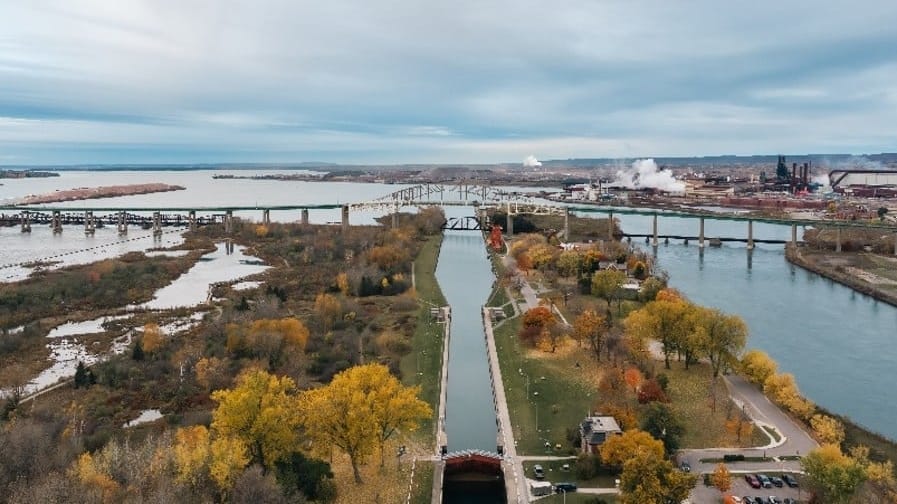
Canada’s federal government, along with the provincial government of Ontario, has approved funding for the construction of a new port, which they said will be located in the heart of the Great Lakes. It will be on the Canadian side, at Sault Ste. Marie, which is located at the juncture of Lake Superior and Lake Huron and just miles from the U.S. border and the U.S. city of the same name.
As Canada works to strengthen domestic supply chains, build industrial capacity and diversify export markets, the Port of Sault Ste. Marie will provide critical trade-enabling infrastructure linking Northern Ontario’s resource economy with Southern Ontario’s manufacturing base and customers around the world.
The governments approved a total of C$250 million (US$174 million) to build the new port. The federal government will provide half the money through a trade program, while the Province of Ontario reported its intention to provide a loan for the other half. The project will repurpose 243 acres of unused industrial and brownfield land into the trade hub with marine, rail, and road access.
The officials said it would provide vital access for Northern Ontario industries, including mining and critical minerals, steel, forest products, advanced manufacturing, and construction materials. The new port will include marine berths, rail transload facilities, cargo-handling areas, utilities, and tenant-ready industrial lands designed to attract investment in these sectors.
Once operational, the port is expected to handle more than 2.4 million metric tonnes of cargo annually. Officials said it will give businesses more transportation options and stronger connections among suppliers, processors, manufacturers, and export markets.
“For decades, economic diversification has been the most pressing challenge facing Sault Ste. Marie, and building the Port of Sault Ste. Marie represents a breakthrough in our community’s efforts to create a stronger local economy and brighter future,” said Matthew Shoemaker, Mayor of Sault Ste. Marie.
Work in 2027 will focus on land arrangements, Indigenous partnerships, environmental and technical investigations, regulatory review, and detailed design. Subject to approvals, site preparation could begin in 2028, followed by major marine, road, rail, and utility construction in 2029. Full buildout is targeted for 2031.
The project comes as Canada is working to reshape its trade and access to international markets. Large investments are also being made in the seaports at Montreal and Vancouver to expand their operations. Upgrades are also happening at Halifax in the east and Prince Rupert in the west, all designed to contribute to Canada’s international trade growth.
Vancouver’s Many Attributes Are Driving Strong Growth in Cruise Operations
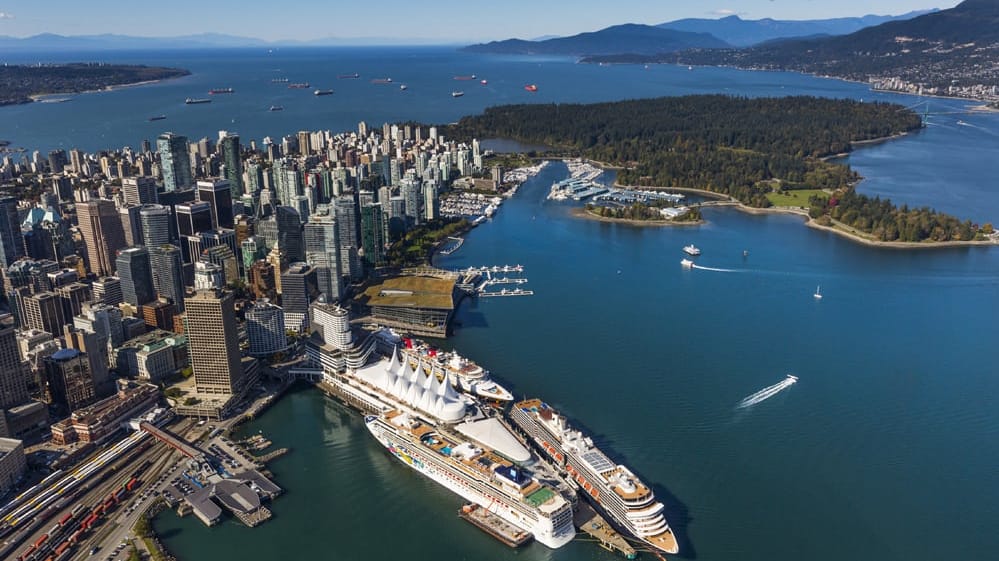
Vancouver, Canada, continues to experience strong growth as a cruise homeport. The often snow-capped peaks of the Pacific Coast mountain range form a spectacular backdrop to the City of Vancouver, Canada’s gateway to the Pacific, and provide cruise passengers a first taste of the scenery and cultures of the Pacific Northwest.
For first-time visitors arriving by cruise ship to the award-winning Canada Place cruise terminal or by airplane to embark on a cruise to Alaska or other destinations, it will likely be the first of many natural highlights on a journey to a region of West Coast North America. Vancouver provides the cruise lines with a strong homeport for an itinerary growing in popularity. In 2026, more ships took advantage of these unique benefits, including the arrival of Virgin Voyages’ Brilliant Lady, Ritz-Carlton Yacht Collection’s Luminara, and Disney Magic, which made her first call and homeported in Vancouver throughout the season. This year also saw Princess Cruises Star Princess (177,882 GT) become the largest cruise ship by tonnage to ever call the Canada Place cruise terminal.
In its 2026 cruise season, the Port of Vancouver achieved a record year for both passenger numbers and cruise ship calls. Both surged almost 20 percent, driving the port to nearly 1.4 million passenger visits and 358 cruise ship calls. The season saw an early cruise ship visit in February as Disney Wonder repositioned and a steady flow of cruise ships between April and October.
“We are thrilled to celebrate another successful cruise season with more than C$1 billion injected into the local economy as cruise lines and passengers increasingly make Vancouver a core part of their Alaska adventure,” said Jeff Scott, Vice President of Operations and Supply Chain at the Vancouver Fraser Port Authority.
Much of the growth has been attributed to the focus cruise lines have placed on the increasing popularity of the northern state. According to an Alaska travel industry study, in the summer of 2025 and winter of 2026, approximately 57 percent of Alaska visitors arrived on cruise ships.
“For many, it’s a bucket list travel destination (Alaska) with its natural beauty,” says Chance McKee, Port of Vancouver’s Cruise Account Representative. “With what they are able to offer as a tourism destination as well, they are able to draw a lot of people, and when it comes to cruising and traveling to Alaska, I think a lot of folks find it’s an easier way to travel to the state and also easier for multi-generational travel parties, which we are seeing more of,” he said.
For many of the cruisers seeking a West Coast adventure, their journey either begins or ends in Vancouver.
“Cruise lines and passengers look at where they want to start and end their Alaska cruise. They look at what Vancouver has to offer from a cruise and destination perspective, in and of itself, that is what draws a lot of folks to Vancouver,” McKee says.
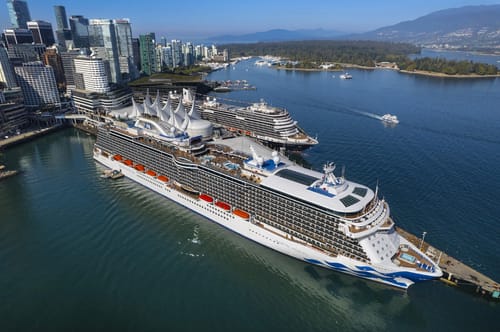
Star Princess became the largest cruise ship (by tonnage) to dock at Canada Place in September (Port of Vancouver)
The port spokesman proudly states, “Vancouver is a world-class destination. It has a very diverse population that has lent to the popularity of the destination itself. From cultural and food perspectives, our culinary scene continues to grow and expand. We see more Michelin Star and Michelin recommended restaurants popping up,” he said, adding that there are historical attractions and, from a cultural perspective, three local Indigenous communities, the Musqueam Indian Band, the Squamish Nation and the Tsleil-Waututh First Nations which McKee feels are appealing to a lot of passengers.
Access to and from the port for cruisers arriving or ending their journeys in Vancouver has become paramount, and the Canada Place cruise terminal is easily accessed from Vancouver International Airport.
McKee points out an interesting statistic in that the Alaska destination tends to draw a different demographic than cruising to the Caribbean or Bahamas. “Our passengers tend to be a bit on the older side, typically 45 and older, so just the actual location of the Canada Place terminal, situated in the heart of downtown Vancouver, makes it very easy from a travel perspective. You can fly into Vancouver, get on the Vancouver SkyTrain to your stop, and walk about a block and a half in downtown Vancouver to the terminal. It is so easy to access from the air, and also when you think of actually checking in, and once people have disembarked from an arriving cruise, everything is right there in downtown,” he said.
But with an older cruising population come increasing challenges. Vancouver highlights its ease of travel and accessibility as aiding the cruise industry.
“In a cruise passenger survey we did, about 13 percent of passengers coming through the Port of Vancouver in 2023 had some sort of physical disability,” plus the survey indicated how they traveled from a disability perspective. “We conducted the same survey in 2025, and we found the number grew from 13 percent to 17 percent, so actually what the cruise industry is seeing is a lot more accessibility challenges, so when it comes to travel and from an accessibility perspective, Vancouver has a lot to offer,” McKee said.
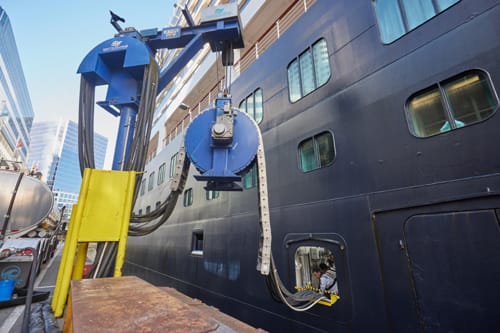
The Port of Vancouver and the federal government are working to expand shore power at Canada Place so that more cruise ships can plug in to B.C.’s low-emission, hydro-powered electrical grid while at berth (Port of Vancouver)
Going forward, McKee anticipates continued growth in cruise for Vancouver.
The port anticipates a seven percent increase in cruise calls, climbing to approximately 383 next year, up from 358 in 2026. It is also forecasting about a six percent increase in total passengers to approximately 1.47 million compared to just over 1.4 million in 2026.
In 2027, the port will welcome additional lines, one being the Japanese luxury line, Asuka. Some of the present lines will also add additional calls in 2027.
McKee says the increased calls add up to thousands of additional passengers visiting Vancouver, many for the first time. According to an industry survey, thousands will return for another visit.
On the infrastructure side, Vancouver has an eye on the environment and sustainability. It is working to create additional shore power capabilities for the cruise ships. Already, about 80 percent of cruise ship calls to Vancouver each year are shore power enabled.
“At Port of Vancouver and Canada Place, we were really a leader when it comes to implementing shore power,” says McKee. “We implemented shore power in 2009. We were the first in Canada and third in the world to offer this technology. But what is really interesting is that only about three percent of world cruise ports have the ability to offer shore power, and what makes Vancouver unique is that it offers electricity that is hydropower. It is low-emission and clean energy that cruise ships are able to access. It adds uniqueness to what Vancouver has to offer, and I think that makes it appealing to cruise lines,” he said.
McKee noted that cruise lines have a mandate from the International Maritime Organization (IMO) to reduce gas emissions to net zero by 2050. “So when they are looking at how they can do this and design itineraries, it helps them meet that goal. By being able to offer shore power, you increase your competitiveness when it comes to cruise line itinerary planning,” he stated.
In summary, McKee says Vancouver has a lot to offer the cruise industry. The natural beauty of Vancouver and onward to Alaska, a terminal in the heart of the city, that is bordered by the sparkling blue waters of the Pacific Northwest and snow-capped m
“I think a lot of cruise passengers maybe don’t know a lot about Vancouver. It is such a spectacular city,” says McKee, supported by cruise lines’ initiatives, port programs, and many other available services.
“Vancouver is attractive to cruise lines, and it is something we are proud of,” he said.

No comments:
Post a Comment