Governments across the globe have the choice at COP31 to unleash its power of agroecology and divert funds to a food system that nourishes people, supports fair livelihoods, and gives animals better lives while protecting the planet.
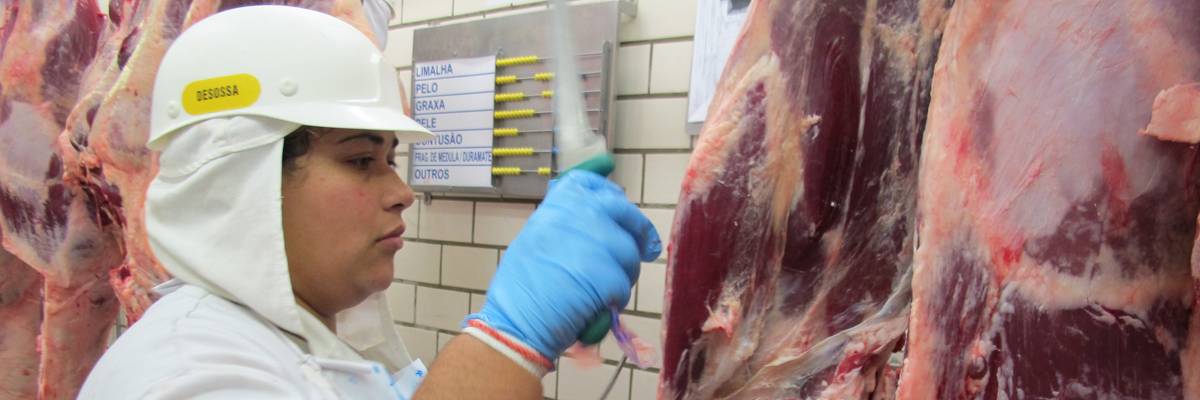
At the JBS meat plant in Lins, Brazil, workers with sharp knives carefully take apart what was once a 1,000-pound steer, making sure to cut along the correct anotomical divisions in the search for the best cuts of beef.
(Photo by Juan Forero/The Washington Post via Getty Images)
Tennyson Williams
Nov 14, 2026
Common Dreams
At COP 31, governments will be talking about tackling climate change and food system resilience, but unless they tackle their own contradictions, this is just hot air.
The contradictions are stark. This year, the African Development Bank warned that El Niño could cost the continent up to $20 billion. Despite a football field-sized field of tropical rainforest being destroyed every day by farms supplying industrial agriculture giant JBS, the Nigerian government has approved major expansion into Nigeria by JBS.
Nigerians needs answers about the real consequences of JBS’ expansion. Corporations like JBS concentrate power in the hands of a few, very rich people, such as Brazilian billionaire Joesely Batista whose shares control JBS and who met with US President Donald Trump just a day before Trump set out reduced tariffs on beef imports.
The opportunity to have a food system that is equitable, humane, and sustainable is truly exciting and a tangible prospect.
These giant industrial agriculture corporations also put pressure on precious nature resources; 1 kilogram of animal protein requires roughly 100 times more water than 1 kg of grain protein. They threaten livelihoods and how families support and feed themselves; when smallholder farmers already produce over 90% of the nation’s food—what will happen to them? Then the job creation narrative pushed by JBS needs questioning. Why not ask JBS workers in Colorado, who this year walked out in protest about labor rights abuses?
In Europe during unprecedented summer heat, the UK government set out increased support for chicken production in the name of food security, despite previously acknowledging that in the UK “animal farming at its current scale is unsustainable without a reliance on imports,” With South American soy providing 18% of produced animal feed.
Just two months earlier, the UK saw its biggest ever environmental lawsuit being brought to the High Court in London, by over 4,000 people, against Welsh Water and Avara Foods. Avara Foods are allegedly raising an estimated 24 million chickens in the catchment area. Litigants cited damage to three rivers, including the iconic River Wye, with impact on local ecosystems, communities, and tourism reliant businesses on these once thriving rivers.
Industrial agriculture is not the answer to hunger either. An estimated 766 million tonnes of grain is diverted annually to feed farmed animals rather than people. Nor is this a food system that provides food security. Quite the opposite, this is a teetering system that relies on synthetic fertilizers, imported animal feed, and fossil fuels. It’s hugely vulnerable to climate change, supply chain shocks, and geopolitical instability, including the conflicts involving Russia and Ukraine and Iran and the US.
Industrial agriculture even threatens the effectiveness of vital medicines. Antibiotic overuse in industrial agriculture has been linked to nearly 2,000 premature deaths in the UK alone. Antibiotics are given to animals to aid their survival and growth in the harsh conditions in which they are forced to live. Let’s be clear, we are risking antimicrobial resistance so that a few people can continue to put profit before animal welfare.
But central to this failing system is injustice. This is injustice not only for people and the planet, but for the over 90 billion animals trapped right now in the system. This cannot be overlooked in talk of climate change and food security. Every cow, sheep, pig, chicken, and goat is a sentient being capable of feeling pain and fear. Mother pigs are kept so confined that they cannot turn around. Chickens buckle under the weight of their selectively bred bodies. Baby animals are routinely mutilated without pain relief. Industrial agriculture is a horror system for animals.
The good news is, there is a better food system, called agroecology. Evidence increasingly demonstrates it has the power to provide long-term food and reduce animal suffering. Agroecology works with nature not against it. It adapts to climate change and offers resilience against market shocks. It connects how we grow food with how we treat animals, protect ecosystems, and support livelihoods. The opportunity to have a food system that is equitable, humane, and sustainable is truly exciting and a tangible prospect.
Governments across the globe have the choice at COP31 to unleash its power. They have the choice to stop using our money to prop up an unjust, cruel, and failing food system and divert to a food system that nourishes people, supports fair livelihoods, and gives animals better lives while protecting the planet. They must aid businesses to pursue the opportunities needed here alongside increased plant rich food production.
In Africa, how we produce our food must be shaped by the knowledge and insight of the people who grow it now and by the communities who depend on it. The government must also make finance and practical support accessible to them.
Factory farming grew following the Second World War, when maximizing food production was an urgent priority. Today we must judge success by more than volume. Our world has changed; we know more about animal sentience, ecological limits, and the fragility of supply chains,
That is what we do at World Animal Protection, we work to protect animals from cruelty and suffering. Governments must stop funding relentless cruelty to animals. At COP31, we don’t need more contradictions and hot air from governments. We need meaningful change.
Our work is licensed under Creative Commons (CC BY-NC-ND 3.0). Feel free to republish and share widely.
Tennyson Williams
Tennyson Williams is the priority director and country lead for Africa at World Animal Protection, where he also serves in the Global Senior Leadership Team. World Animal Protection is a global charity that works to end animal cruelty and suffering. With over 20 years’ experience in international development, he has held senior roles with ActionAid International. This includes regional director for West and Central Africa and country director in Kenya and Sierra Leone. He also served at the United Nations High Commission for Refugees (UNHCR) and the International Livestock Research Institute (ILRI) in Nairobi, Kenya. Tennyson is a Sierra Leonean national with a background in zoology and zoonotic diseases. He has led major programs across Africa, contributed to national development strategies, and engaged in research and consultancy for the Department for International Development (DFID), and for civil societies.
Full Bio >
‘Kick These Big Polluters Out!’ Worst-of-the-Worst Corporate Obstructionists Dominate UN Climate Summit
“You can’t put out a fire while handing the matches to the arsonists. And you certainly can’t expect the arsonists to write the evacuation plan.”
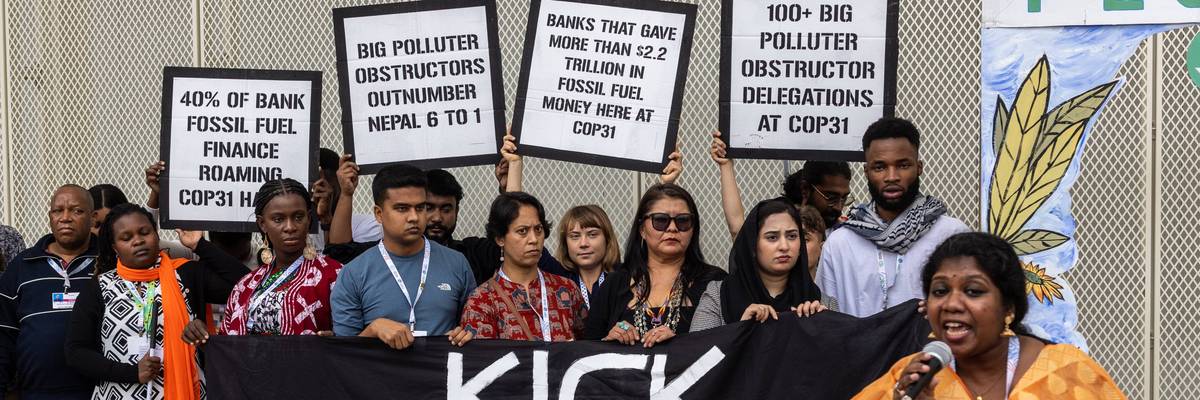
Activist Greta Thunberg attends “Kick Big Polluters Out” protest on day five at the COP31 UNFCCC Climate Conference on November 13, 2026 in Antalya, Turkey.
(Photo by Burak Kara/Getty Images)
Brad Reed
Nov 13, 2026
COMMON DREAMS
A coalition of environmental organizations is warning that the COP31 climate summit in Antalya, Türkiye is in danger of being co-opted by big polluters.
An analysis released on Friday by the Kick Big Polluters Out (KBPO) coalition finds that more than 100 polluting corporations and trade associations—including from fossil fuel, Big Tech, and industrial agriculture—have sent delegations to COP31.
Among the largest delegations, the report says, are International Emissions Trading Association (IETA), which sent 29 delegates; BNP Paribas, which sent 22; HSBC, which sent 19; and Amazon, which sent 12.
The analysis also shows that banks “collectively representing more than $2.2 trillion in fossil fuel financing from 2021-2025” have a presence at COP31.
The KBPO report notes that these industries and associations “have demonstrated track records of being notably misaligned with or obstructing climate policy... indicating they can be a threat to the strong climate action COP31 must urgently deliver.”
These polluters’ delegations are so big that they vastly outnumber delegations sent by many nations that are most endangered by the climate emergency, including Niger, the Philippines, and Nepal.
Maikel Peuki, director of the Papua chapter of the Indonesian Forum for Living Environment (WALHI) and a KBPO partner, said allowing big polluters to have a seat at the COP31 table would have dire consequences for his country’s environment.
“In Papua our forests and coastal areas are being targeted for fossil fuel and food estate projects and carbon-offsetting schemes by major corporate emitters,” said Maikel Peuki. “This is not a genuine solution to the climate crisis. Those who cause pollution should be the ones to pay for the damage they have created.”
Peuki’s remarks were echoed by Lien Vandamme, senior campaigner for the Center for International Environmental Law’s Climate and energy program.
“You can’t put out a fire while handing the matches to the arsonists,” said Vandamme. “And you certainly can’t expect the arsonists to write the evacuation plan. It’s therefore no surprise that the UN climate talks continue to fail in delivering the climate action that is needed. It’s time to show Big Polluters the door and fundamentally change the rules that keep rolling out the red carpet for them.”
Prakash Dalal, director of Friends of the Earth Nepal, accused big polluters of causing “loss of livelihood, emotional damage, trauma, and survival challenges” for people in his country, adding that “we cannot tolerate the disproportionate space given to them compared to civil society and our country delegations.”
“We need to kick these big polluters out!” Dalal emphasizes. “This should be a moral and legal obligation for the COP.”
The presence of polluters also drew the ire of climate activist Greta Thunberg, according to a Thursday report in Latin Times.
While protesting outside COP31, Thunberg decried the negotiations for being “filled with lobbyists” who are “paid by the very destructive industries” profiting from continued fossil fuel dependence.
Thunberg also accused governments attending COP31 of using the event to “whitewash themselves” without taking real action.
“You can’t put out a fire while handing the matches to the arsonists. And you certainly can’t expect the arsonists to write the evacuation plan.”
Activist Greta Thunberg attends “Kick Big Polluters Out” protest on day five at the COP31 UNFCCC Climate Conference on November 13, 2026 in Antalya, Turkey.
(Photo by Burak Kara/Getty Images)
Brad Reed
Nov 13, 2026
COMMON DREAMS
A coalition of environmental organizations is warning that the COP31 climate summit in Antalya, Türkiye is in danger of being co-opted by big polluters.
An analysis released on Friday by the Kick Big Polluters Out (KBPO) coalition finds that more than 100 polluting corporations and trade associations—including from fossil fuel, Big Tech, and industrial agriculture—have sent delegations to COP31.
Among the largest delegations, the report says, are International Emissions Trading Association (IETA), which sent 29 delegates; BNP Paribas, which sent 22; HSBC, which sent 19; and Amazon, which sent 12.
The analysis also shows that banks “collectively representing more than $2.2 trillion in fossil fuel financing from 2021-2025” have a presence at COP31.
The KBPO report notes that these industries and associations “have demonstrated track records of being notably misaligned with or obstructing climate policy... indicating they can be a threat to the strong climate action COP31 must urgently deliver.”
These polluters’ delegations are so big that they vastly outnumber delegations sent by many nations that are most endangered by the climate emergency, including Niger, the Philippines, and Nepal.
Maikel Peuki, director of the Papua chapter of the Indonesian Forum for Living Environment (WALHI) and a KBPO partner, said allowing big polluters to have a seat at the COP31 table would have dire consequences for his country’s environment.
“In Papua our forests and coastal areas are being targeted for fossil fuel and food estate projects and carbon-offsetting schemes by major corporate emitters,” said Maikel Peuki. “This is not a genuine solution to the climate crisis. Those who cause pollution should be the ones to pay for the damage they have created.”
Peuki’s remarks were echoed by Lien Vandamme, senior campaigner for the Center for International Environmental Law’s Climate and energy program.
“You can’t put out a fire while handing the matches to the arsonists,” said Vandamme. “And you certainly can’t expect the arsonists to write the evacuation plan. It’s therefore no surprise that the UN climate talks continue to fail in delivering the climate action that is needed. It’s time to show Big Polluters the door and fundamentally change the rules that keep rolling out the red carpet for them.”
Prakash Dalal, director of Friends of the Earth Nepal, accused big polluters of causing “loss of livelihood, emotional damage, trauma, and survival challenges” for people in his country, adding that “we cannot tolerate the disproportionate space given to them compared to civil society and our country delegations.”
“We need to kick these big polluters out!” Dalal emphasizes. “This should be a moral and legal obligation for the COP.”
The presence of polluters also drew the ire of climate activist Greta Thunberg, according to a Thursday report in Latin Times.
While protesting outside COP31, Thunberg decried the negotiations for being “filled with lobbyists” who are “paid by the very destructive industries” profiting from continued fossil fuel dependence.
Thunberg also accused governments attending COP31 of using the event to “whitewash themselves” without taking real action.

No comments:
Post a Comment