Kazakhstan blessed with wealth of “high-quality wind” that could put an end to dirty coal, say researchers

Kazakhstan is notoriously reliant on power generated from Soviet Era coal-fired power plants, but a new study by energy think tank Ember and software firm Converge Hybrid suggests that wind farms paired with solar panels and small batteries could meet the country’s national demand for power at a significantly lower cost than coal.
Ember tested simulated designs of such wind-hybrid power plants against what the study calls a “typical electricity demand profile” in Kazakhstan. In simpler terms, that is a scaled down version of national electricity demand patterns. Kazakhstan’s demand was essentially "shrunk" – for the purposes of the study – to a peak of 100 MW. Each simulated wind-hybrid power plant design was then tested against this 100-MW-peak demand model, representative of Kazakhstan’s yearly demand patterns (the model accounts for evening peaks in demand, overnight dips in demand and all other variabilities in demand that occur throughout a typical year).
Ember found that with a wind-hybrid approach Kazakhstan could meet 70-90% of a typical electricity demand profile, hour by hour, at a delivered cost below $60 per megawatt-hour (MWh) – well below the cost of electricity from a newly-built coal plant, which would stand at $70–170 per MWh.
New capacity needed fast
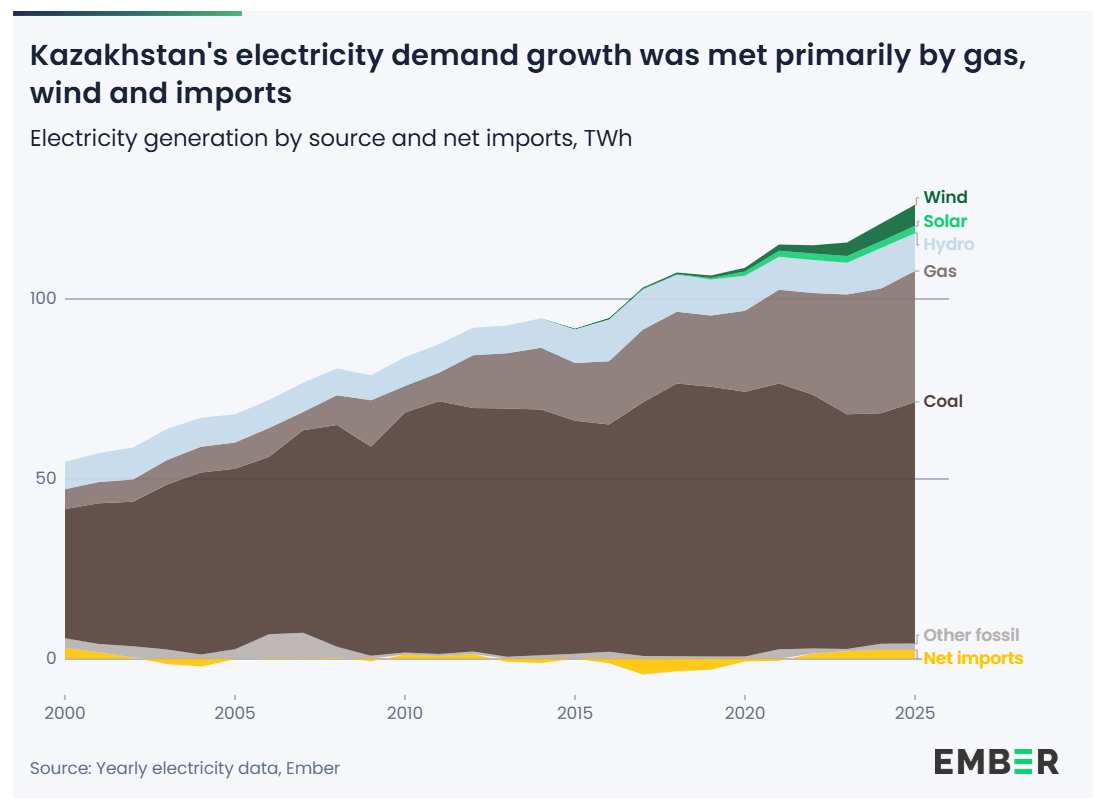
Kazakhstan’s electricity demand rose 16% in five years, from 107.3 terawatt-hours (TWh) in 2020 to 124.6 TWh in 2025. The country has imported more power than it exports since 2022, and the government wants self-sufficiency by 2027.
Coal still supplies 62% of electricity, but the ageing Soviet-built plants average over 50 years old – against a typical lifespan of 40 years – and are subject to frequent malfunctioning. As many as 891 “incidents of various severity” were recorded at the coal-based power plants between January and July this year alone, according to Ember’s assessment.
“The government is aiming to achieve [power] self-sufficiency by 2027 and potentially become a net exporter by 2029. To replace its ageing infrastructure and keep pace with fast-growing demand, Kazakhstan needs to build more capacity quickly and ensure its availability during peak periods, including winter demand spikes. The capacity also needs to be built close to where demand is to relieve pressure on the transmission network,” Ember’s report said.
“Kazakhstan already aims to build 6,659 kilometres [4,138 miles] of new high-voltage lines by 2035 to better interconnect its three largely isolated power zones – North, South and West,” the assessment continued. “This includes connecting the West zone to the rest of the national power system and increasing the limited transmission capacity between the coal-rich North and chronically undersupplied South zone. Building new capacity closer to demand would limit how much more grid needs to be built.”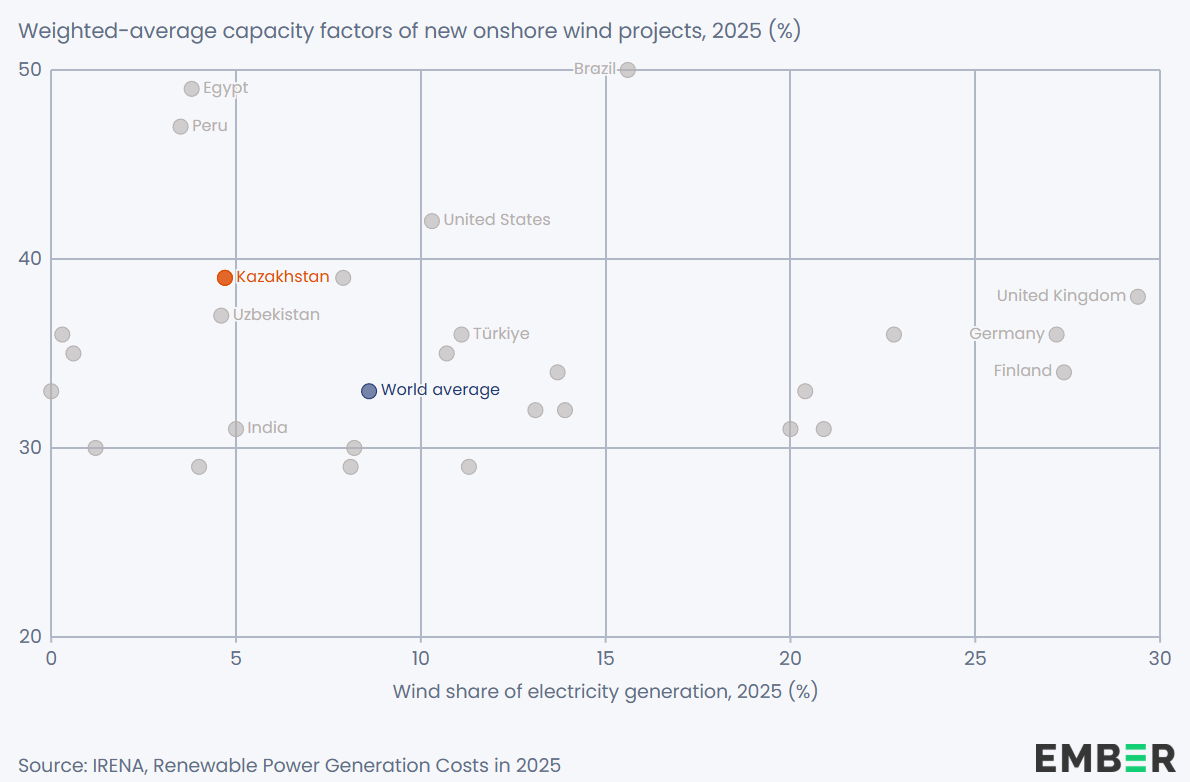
Credit: Report, Ember – Kazakhstan has the wind to power its demand growth. Authors: Kostantsa Rangelova, senior battery analyst at Ember & Philippe Chabarot, co-founder and CEO, Converge-Hybrid. (cc-by-4.0.)
Kazakhstan’s geographical advantage
Ember argues that “Kazakhstan’s geographical advantage lies not in having the world’s highest wind speeds, but in the breadth of its wind resource. High-quality wind is available in nearly every region rather than being concentrated on a handful of corridors. So unlike most countries in the world, Kazakhstan does not have to build wind in a few remote areas with high wind speeds and then build long transmission lines to bring it to where demand is.”
Two-thirds of Kazakhstan has average wind speeds above 7 metres per second (m/s) at 100 metres, which Ember calls “excellent for onshore winds”.
For comparison, “in Germany, where wind accounted for 27% of all power generation in 2025, less than a third (32%) of its territory has wind speeds above 7 m/s,” Ember wrote.
The study posits that “commercially viable wind can be built close to most demand centres, without adding to Kazakhstan’s already large need for new transmission.”
New wind farms in Kazakhstan produced 39% of their theoretical maximum output in 2025, beating the 33% global onshore average and nearly matching offshore wind (which stood at 41% in 2025). Yet wind supplied only 4.4% of Kazakhstan's electricity, against 8.6% worldwide.
This is where Ember’s simulated designs for wind-hybrid plants may come in handy. The designs are meant to address the fact that wind output varies both seasonally and geographically across the country.
How a hybrid plant works
The hybrid plants are essentially wind farms, solar panels and a battery sharing one grid connection. Ember chose 15 sites for its study and simulated 125 designs at each site “hour by hour over a 30-year project life”.
“The sites were selected for their proximity to a major demand centre and an existing power line, rather than because they had the country’s strongest winds,” according to the report.
As stated earlier, the think tank specified that “the [demand] profile represents national demand patterns and was scaled to a peak of 100 MW. Each site was tested against the same demand profile, so differences in results reflect weather conditions rather than differences in load.”
Ember modelled this “demand profile” based on three years (2022-2024) of weather data.
The best designs met 70% of demand at the weakest site, located near the southeastern town of Kordai, and 90% at the strongest site, located near the southwestern town of Zhanaozen, at an average delivered cost of $56 per MWh. That is, indeed, much cheaper than the previously stated cost of $70-170 per MWh that would come from a newly built coal-fired power plant.
Even in winter, when demand peaks and solar is weak, 13 of 15 sites cleared 70%, the study said.
To get that high a share, the plants are deliberately designed to be bigger than the demand they would serve. Wind and solar output rises and falls with the weather, so a plant sized to match demand would fall short on every calm, dark day. Oversizing means that even in poor conditions it still produces a useful amount of electricity. However, the catch is that on windy, sunny days it produces more electricity than the customer can use. That surplus is "curtailed" under Ember’s design: the turbines and panels are throttled back or the extra power is discarded. Across the 15 sites, 15-30% of potential output is lost this way, mostly in spring and summer when solar is strongest.
“The curtailment in these results is a [deliberate] design choice,” Ember said.
Credit: Report, Ember – Kazakhstan has the wind to power its demand growth. (cc-by-4.0.)
This lost output is included in the $56 per MWh figure. Building and running the plant works out at about $45 for every MWh it generates. But since customers only receive the electricity that is not thrown away, they would still have to pay for the remaining $11 per MWh, pushing the cost up to $56 for each MWh actually delivered to customers. In other words, $56 is the minimum a plant would need to be paid per delivered MWh to cover its costs.
As such, the extra $11 is the cost of building capacity that is sometimes switched off. The surplus could also be put to use, for example to charge electric vehicles (EVs) or to export power to neighbouring countries, Ember’s study suggested.
Under these designs, the battery plays a supporting role. It stores spare electricity for a few hours (four, in these designs) and releases it when wind and solar output drops, such as on summer evenings after the sun sets. The batteries in the study are modest in size. Their capacity varies between 12-25% of the plant’s combined wind and solar capacity, depending on the weather conditions of each given site, at 14 of the 15 sites.
At Zhanaozen, the best-performing site, the battery is larger, at 37%. Otherwise, bigger batteries would not pay for themselves (excluding the case of the Zhanaozen site), because in winter there is often no surplus electricity to charge them, so they would sit mostly empty.
“At the project level, adding more battery capacity is not economical, as they remain underutilised due to the large number of days without a large enough surplus to charge the battery in winter,” Ember wrote. “Batteries that only shift their own plant’s output could sit idle for much of the year, so realising their full system value is key.”
When revisiting the findings that these designs could meet 70-90% of Kazakhstan’s “typical demand profile”, one naturally occurring question could be, “Why not 100%?”
Why not aim for 100%?
It is technically possible, but the cost climbs steeply – meeting 91-97% of demand would need the largest plant Ember tested (180 MW of wind, 250 MW of solar and a 480 MWh battery), at $87-91 per MWh. That is roughly 50% more than the best designs, which meet 70-90% for under $60 per MWh. The additional percentage points would be expensive because they would need much more wind, solar and battery capacity, and the extra electricity produced would go unused. Each additional MWh gained this way would cost around $205-430.
Ember argues it is cheaper to cover the remaining gaps through the wider electricity system via “diverse generation sources, storage, transmission and demand-side flexibility”. Examples of this could include imports from neighbouring countries, other renewable or non-renewable power sources and customers who can shift their usage to other times.
It also helps to spread the plants across the country, as the wind conditions rarely stay poor across the whole country at the same time. The study points out that any single plant has stretches when it supplies less than a fifth of what customers need (mainly during winters), and this happens between 4.5% and 15.6% of the time, depending on the site. But if the 15 plants are linked together, those very-low-output moments almost disappear: the combined output falls that low for only about one hour a year, assuming the plants are well connected through the grid.
“Winter (December to February) is the most challenging season at most sites, as solar output is low and demand is at its highest. Even so, the modelled hybrid plants meet over 70% of demand at 13 of the 15 sites. A single plant has shortfalls, mostly on winter evenings and before dawn, when it delivers less than a fifth of demand. A flexible, interconnected system can fill these gaps far more cheaply than overbuilding each plant,” Ember wrote.
Even so, some backup capacity is needed. To cover all but the worst 1% of hours (about 90 hours a year), a single plant would need backup capacity equal to 81-91% of its peak demand, but all 15 plants taken together would need backup equal to only 48%.
It is worth noting that the $56 per MWh cost covers only the cost of electricity generated at a single plant. Ember did not appear to estimate the cost of the backup capacity the wider system would still need.
No dedicated target beyond 2030
Ember’s study noted that wind power in Kazakhstan is already competitively priced. Recent projects that pair wind farms with batteries have been priced at $39.9-44.9 per megawatt-hour (MWh), which is in line with the $41-49 per MWh that Ember estimates it costs the hybrid plants in its study to generate electricity.
The share of renewables in the country also appears to be growing quickly, in Ember's view. Renewables supplied 7% of the country’s electricity in 2025, up from 4.5% in 2022, and renewable generation rose 1.7 times over that period, “beating the interim national target” of a 1.5-fold increase, the study said. The longer-term target is 15% by 2030, counting wind, solar, bioenergy and small hydropower.
With that said, “Kazakhstan does not have a dedicated renewables target beyond 2030,” Ember’s report argues.
“Instead, the 2050 target is for 50% renewable and other alternative sources, which include nuclear. The lack of a specific renewables target risks undermining progress once the 2030 target is reached. There are already valid concerns that integrating more variable renewables beyond the 15% by 2030 target will be challenging due to insufficient system flexibility,” the study said.
“Kazakhstan’s coal plants have slow ramp rates and cannot run below about 70% of capacity, while other sources of flexibility like demand response and hydropower, remain untapped due to market rules that do not pay for flexibility. The grid operator, Kazakhstan Electricity Grid Operating Company (KEGOC), has argued for a pause on new renewable projects until flexible capacity catches up,” it added.
“Increasing system flexibility while keeping up the pace of renewable deployment is the central task of the next decade. A clear and ambitious post-2030 wind and solar target would be a clear signal to investors that the pipeline does not stop at 15%,” the report concluded.

No comments:
Post a Comment