Pope Leo puts Argentina’s poor at centre of visit as Milei’s austerity bites
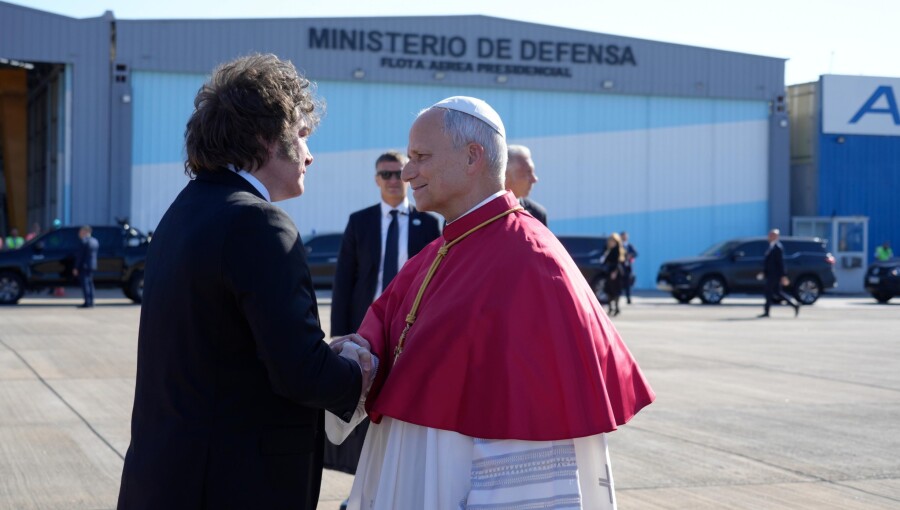
Pope Leo XIV mounted a forceful defence of workers’ dignity before Argentina’s union and business leaders, in a speech that opponents of President Javier Milei hailed as a repudiation of his libertarian agenda, at the end of a day in which the pontiff drew the biggest crowd of his papacy.
Addressing an audience at the Catholic University of Argentina (UCA) in Buenos Aires on November 9, the first US-born pope said joblessness inflicted damage far beyond lost earnings. “To deprive a person of work is not simply to deny that person an income,” he said. “It severely wounds their dignity, deprives them of the ability to contribute to society and plunges them into social exclusion.”
The speech followed an open-air Mass in the capital’s Palermo district which the Vatican estimated was attended by 2.5mn people. Earlier in the day Leo had visited a home for people with disabilities that has been caught up in disputes over government funding.
Leo took aim at several pillars of Milei’s free-market creed, telling the gathering that private property was “always subject to a social mortgage”. He warned that “wherever the domination of a few becomes the rule, work is turned into the exploitation of all components of the work community, and workers end up being valued solely for their efficiency.”
The pope described trade unions, which have spearheaded resistance to Milei’s reforms, as “indispensable institutions when they defend those who have no voice”. He also spoke up for grassroots movements of informal workers, which the government has excluded from handing out welfare payments on the grounds that they breed dependence on the state. Waste pickers, smallholders and artisans “do not passively wait for state assistance”, he said.
The audience broke into repeated applause, notably when Leo invoked his Argentine predecessor Pope Francis’s formula for social justice of “tierra, techo y trabajo”, or land, housing and work.
Leo also cautioned that “artificial intelligence and unregulated automation can put countless jobs at risk” and urged governments to protect workers. Milei opposes regulation of the technology and has been seeking billions of dollars in AI-related investment.
“Rapid technological development needs an ethical awareness to match its level," the Pope said.
Those in the hall included union leaders who have called general strikes against the government, manufacturers hurt by a surge in cheap imports since trade barriers were lifted, and “cartoneros”, the informal recyclers who enjoyed a prominent place during Francis’s papacy.
Opposition figures were quick to claim the pope’s message. “Let them listen to him, those who have closed their ears,” said Axel Kicillof, governor of Buenos Aires province and the most powerful elected Peronist, who met the Pope at the Cottolengo.
Milei has praised the pontiff’s words while avoiding their content. He described Leo’s address to Argentine officials on November 8 as “outstanding”, with “many elements of great value”, but declined to go further, saying he did not want to “fall into the mud of using the speech politically”, AP reported.
In that speech, delivered at the Palacio Libertad cultural centre with Milei seated beside him, Leo said “the economy must be at the service of people, not people at the service of the economy”. He urged support for education, pensioners and people with disabilities, groups that have borne much of the burden of the president’s spending cuts. “Those who exercise authority have a duty to act prudently, recognise the limits of the power entrusted to them and direct their decisions towards the common good of the entire community,” he said.
The pope also lamented emigration among the young. “A nation must seriously ask itself where it has gone wrong when its young people have to leave their homeland to fulfil their dreams,” he said, while calling for the protection of unborn life.
The libertarian leader, who welcomed the visit as a “profound honour”, told the pope: “I would ask you only to pray for Argentina, as we do.”
Milei, who was raised Catholic, has spent years studying Judaism and has said he intends to convert once he leaves office, arguing that religious observance would be incompatible with the duties of the presidency.
Leo began his tour on November 9 at the Cottolengo Don Orione in Claypole, south of the capital, which houses more than 400 people with disabilities. “A nation’s progress is also measured by how it welcomes all people with disabilities and special needs,” he said.
"Their lives are not a burden on society; they are a blessing."
The government has held back much of the funding for disability care despite a law that Congress passed over Milei’s veto last year to restore it, a stance that has drawn protests from Argentina’s bishops, AP reported. The Senate is due to debate legislation earmarking disability funding in next year’s budget.
At the Mass, attended by Milei, his sister and presidential chief of staff Karina Milei and the entire cabinet, Leo struck a more traditional tone, describing the family as the bedrock of society. “Do not give in to those who dismiss the Christian family as outdated,” he said. He acknowledged that Argentine households faced instability, precarious employment, domestic violence and addiction. The government declared a national holiday to allow people to attend.
Vice-president Victoria Villarruel, who is at odds with the government, did not attend and later said she had never received access details, La Nación reported.
The trip is the first papal visit to Argentina since John Paul II in 1987. Francis, who was archbishop of Buenos Aires before becoming pope, never returned during his 12-year papacy, a choice widely attributed to a reluctance to be drawn into the country’s polarised politics. He died in April 2025.
Leo, 71, underwent surgery for lung cancer in October. His 12-day South American tour, which began in Uruguay on November 6 and ends in Peru on November 17, covers about 31,000km and 10 cities. He travels to Córdoba on November 10 and to the shrine of Luján on November 11 before leaving for Peru.
The visit comes as Argentina’s economic recovery falters. Poverty fell from 52.9% in the first half of 2024 to 28.2% in the second half of 2025 as inflation collapsed, but rose to 32.3% in the first half of this year, according to Indec. Estimates based on the agency’s microdata put the rate at 34.4% in the second quarter, broadcaster C5N reported. Among children under 15, poverty stood at 44.5%.
Unemployment reached 7.9% in the second quarter, while gross domestic product shrank 0.6% from the previous three months. Monthly inflation edged up to 1.9% in September, taking the annual rate to 33.4%.
The IMF has praised the government’s fiscal discipline as it completes the third review of a $20bn programme. But 60% of Argentines disapproved of the government in an October poll by the University of San Andrés, as Milei prepares to seek re-election in October 2027.
The minimum pension is about $300 a month, roughly a quarter of what an older person needs to cover medicine, housing and food. “The weakest cannot be the ones carrying the burden of the adjustment, especially poor retirees,” said Isabel Martín, a 73-year-old parishioner at the Mass, according to AP. “If anyone can make him reconsider, it’s the pope.”

No comments:
Post a Comment