Paraguay prosecutors weigh blowing up vault in ousted president’s mansion
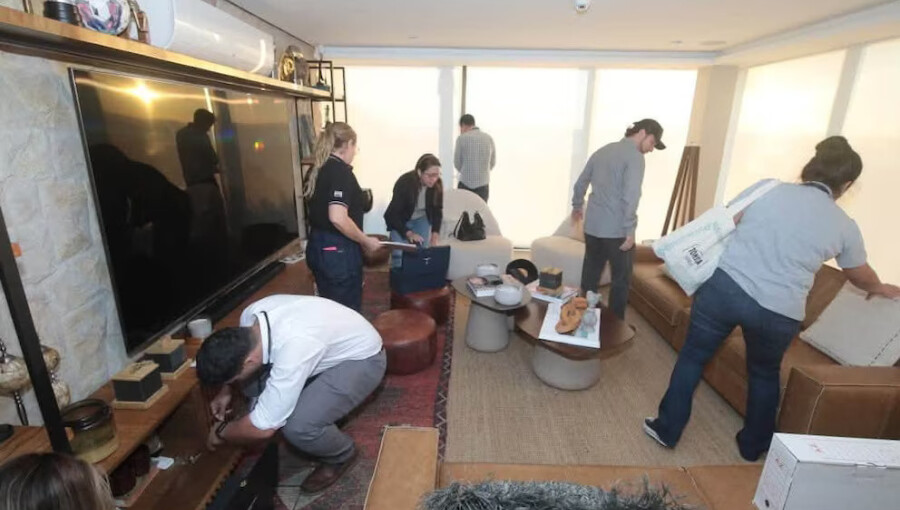
Paraguayan prosecutors are weighing whether to dynamite their way into a high-security vault hidden behind a false wall in the country mansion of Santiago Peña, after failing to get past its biometric locks. The former president was jailed at the weekend over the spectacular collapse of Ueno Bank, a popular digital lender with links to him.
Christian Benítez, one of the prosecutors on the case, said on November 9 that investigators had opened the first door to the vault at the property in San Bernardino, about 50km from Asunción, but could not breach a second security barrier, according to the local daily ABC Color. He said the prosecutor’s office would do “everything possible” to get in and would ask specialists for the best method.
Benítez set out three options. Prosecutors could bring Peña’s wife, Leticia Ocampos, to the property to see whether her iris is registered in the recognition system. They could approach other relatives. Or they could force it.
“We are even analysing the possibility of carrying out a controlled detonation, if there is no other way to open it,” Benítez said. He acknowledged that an explosion could damage both the contents and the structure, since a large swimming pool sits above the vault. He said this was “just an analysis” and that experts would “tell us the best way to open it”.
Bringing Ocampos to the house was “an option we’re considering”, he said, describing it as “a slightly simpler possibility than a possible transfer to the former president’s location”. Taking Peña himself to the house to unlock the system “is not yet one of the options under consideration”. Relatives are not legally obliged to cooperate. “The only problem we have is that they are not required to help us. However, we are in discussions to see if that is a feasible possibility,” Benítez said.
Investigators are working on the theory that the chamber is a safe room. “It’s being argued that it could be a panic room,” he said.
The raid began shortly before 7pm on November 8 and resumed at 7am on the next day. According to ABC Color, the vault is protected by a security system of Israeli origin that requires access codes and several layers of verification, including an iris scan of the owner. Other Paraguayan outlets reported fingerprint readers, keys and a hidden passageway leading to an armoured door. The prosecutor’s office has not said what it expects to find. Its statement confirming the raid did not mention the vault, and Peña’s lawyers have not commented.
The house is at the centre of the case against him. Prosecutors allege that Peña paid for its construction in 2024 and 2025 with two simultaneous loans from Ueno totalling about PYG3.5bn (roughly $600,000), taken out while he was in office. According to prosecutors, building the house cost about PYG7.7bn (around $1.2mn) and the property is valued at $2mn. The monthly repayments of PYG239mn were six times his presidential salary. When the mansion drew criticism in January 2025, Peña said he had worked since the age of 18 and considered himself an honest and hardworking man, according to the newspaper Última Hora.
The search caps a week-long unravelling of one of South America’s more stable governments. The central bank put Ueno into resolution in a decision dated November 2 and announced in the early hours of November 3. The bank’s solvency ratio had fallen below half the legal minimum after its accounts were restated. Its app, cards and transfers stopped working, cutting off about 3mn customers. Ueno said those customers made up some 60% of Paraguay’s adult population. At the end of 2025 it was the country’s fifth-largest private lender, holding 8.9% of system deposits.
Regulators said their concerns began in June with lending to companies tied to Ueno’s owner, Grupo Vázquez, a practice that is tightly restricted for banks. Peña was a business partner of Grupo Vázquez until March 2025, and had dismissed earlier warnings about the bank as a “media campaign." Carlos Carvallo, who chaired Ueno until Peña made him central bank governor in August 2023, has signed his resignation. He said he had recused himself from all decisions involving the lender.
Public money made up about a quarter of Ueno’s deposits. That included roughly $355mn from the Social Security Institute, which manages private sector workers’ pensions, as well as funds from the state power utility ANDE and the Itaipú dam. Prosecutors have ordered the arrest of eight people, including Ueno’s president, Juan Manuel Gustale, and its chief executive, Federico Miguel Vázquez Villasanti. Fitch cut the bank to default on November 4, leaving holders of the $350mn of five-year notes Ueno sold in March facing losses.
Regulators estimate that the deposit guarantee fund, which pays up to about $38,000 per depositor, fully covers some 97% of Ueno’s customers. Payouts are due by November 17, a deadline that can be extended once.
The political fallout was swift. The Senate removed Peña on November 6 by 44 votes out of 45, with many members of the president's right-wing Colorado Party voting against him, and Vice-President Pedro Alliana was sworn in to serve until August 2028. On November 7, Judge Humberto Otazú ordered Peña held in pretrial detention at a military base in Asunción to "guarantee his compliance" with the anti-corruption probe. Peña faces charges of instigating breach of trust and of embezzlement, with prosecutors putting the damage at about $809mn, the total of state deposits in the bank rather than a proven loss. Peña denies the charges.
Prosecutors also seized Peña’s iPhone at the regiment, after its commander said he had been allowed to use a mobile phone.
The scandal is a major blow to a country that has sold itself to foreign investors on low taxes, light regulation and macroeconomic stability, a pitch that recently earned Paraguay its first investment-grade credit ratings.

No comments:
Post a Comment