IntelliNews summary:
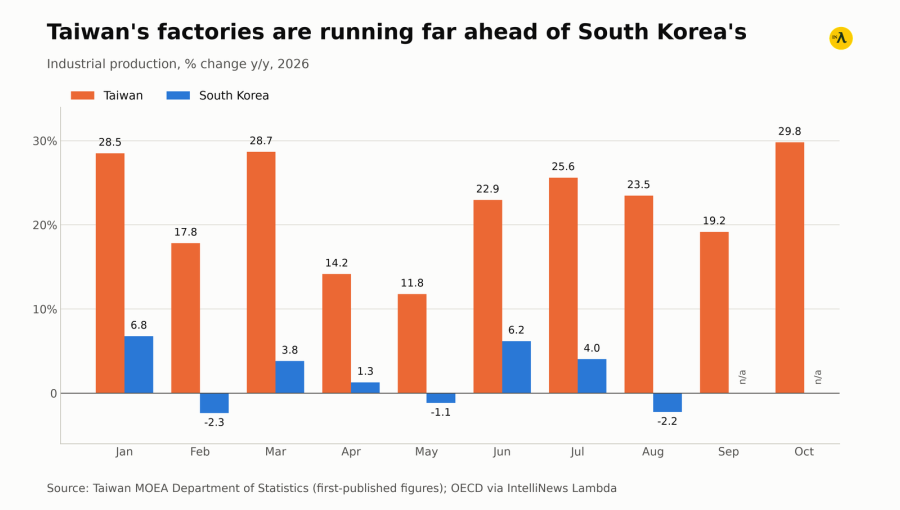
- Taiwan's October industrial output rose 29.8% y/y to a record, with computers, electronic and optical products up 130.57%.
- South Korea's output excluding construction moved between -2.3% and +6.8% y/y in January-August, while chip export values more than quadrupled.
- Goldman Sachs sees conventional DRAM and NAND prices falling about 20% in 2028.
- Taiwan's central bank sits at 2% with a TWD500bn ($15bn) fund in the market; the Bank of Korea is tightening at 3%.
____________________
Taiwan's and South Korea's stock markets soared and slumped almost in step over 48 hours, but only Taiwan's factories are turning out the boom both sets of share prices imply.
The Taiex jumped 8.99% to 40,122.35 on November 24, the day Nvidia's board reinstated Jensen Huang as chief executive, and the Kospi gained 6.32% to 5,006.03 as Samsung Electronics and SK hynix each added 6.7%. In Taipei, TSMC, Hon Hai and MediaTek all closed within a whisker of their 10% daily limits. By the next afternoon most of that was gone. The Kospi lost 6.16% to 4,697.51 on November 25, with Samsung down 9.87% and SK hynix 11.05%, the Korea Times reported. The Taiex closed 4.80% lower after shedding as much as 3,440 points during the session, according to Focus Taiwan.
Investors treat the two bourses as one AI trade, and both indices are top-heavy. TSMC alone accounts for more than 40% of Taiwan's market capitalisation, while Samsung and SK hynix make up roughly half of the Kospi, the Financial Times reported. Below the share prices the economies diverge. Taiwan's chip boom shows up in factory output across servers, foundries and machinery makers; South Korea's shows up mainly in export values and in two stocks.
The reversal on November 25 followed a 7.88% fall in the Philadelphia Semiconductor Index overnight. Traders in Taipei also pointed to reports of new US tariffs under a Section 301 investigation, and in Seoul to talk of a fresh round of US levies on trading partners over industrial subsidies and overcapacity. Goldman Sachs had already cut its SK hynix target price to KRW2mn ($1,494) from KRW3.5mn.
"Foreign investors turned net sellers, while Trump's remarks and uncertainty over tariffs also weighed on the market," Lee Kyung-min, an analyst at Daishin Securities, told the Korea Times.
Taiwan's factories at full stretch
Taiwan's industrial production index rose 29.8% y/y to a record 151.3 in October, its 32nd consecutive month of growth, the Department of Statistics at the Ministry of Economic Affairs (MOEA) said on November 24. The manufacturing subindex rose 31.63%. Output of computers, electronic and optical products, mostly servers, switches and chip inspection equipment, rose 130.57%, electronic components 25.39% and machinery 26.85% as chip suppliers installed new equipment.
Chemical materials output fell 2.8% and cars and parts 3.92%, and only four of the six main manufacturing industries grew. Production rose 21.52% in the first ten months, and the ministry expects manufacturing to grow by 22.2-26% y/y in November. In September the central bank raised its forecast for 2026 GDP growth to 11.48% in its third-quarter policy statement.
Industrial production, % change y/y, January-October 2026. Taiwan: first-published monthly figures; South Korea: industry excluding construction, to August. Source: Taiwan MOEA Department of Statistics; OECD via IntelliNews Lambda
Korea's boom runs through prices
South Korea's industrial output, excluding construction, moved between a 2.3% y/y fall and a 6.8% rise from January to August, OECD figures show. September brought a jump: mining and manufacturing output rose 9% m/m and chip production 19.2%, the Ministry of Data and Statistics said on October 30. Its October figures are due on November 30.
Exports grew far faster. Chip exports rose 331.2% y/y to $16.6bn in the first ten days of November, almost half of all shipments, and annual exports have passed $1 trillion for the first time. When export values race ahead of production volumes, prices are doing much of the lifting, and memory prices are exactly what Goldman Sachs expects to fall. Its latest note sees conventional DRAM and NAND prices each dropping by about 20% in 2028 as China's CXMT adds capacity.
That makes the Kospi a leveraged bet on the memory cycle. Samsung's market value closed at KRW998 trillion on November 25, its first close below KRW1 quadrillion since March 31, Korea JoongAng Daily reported.
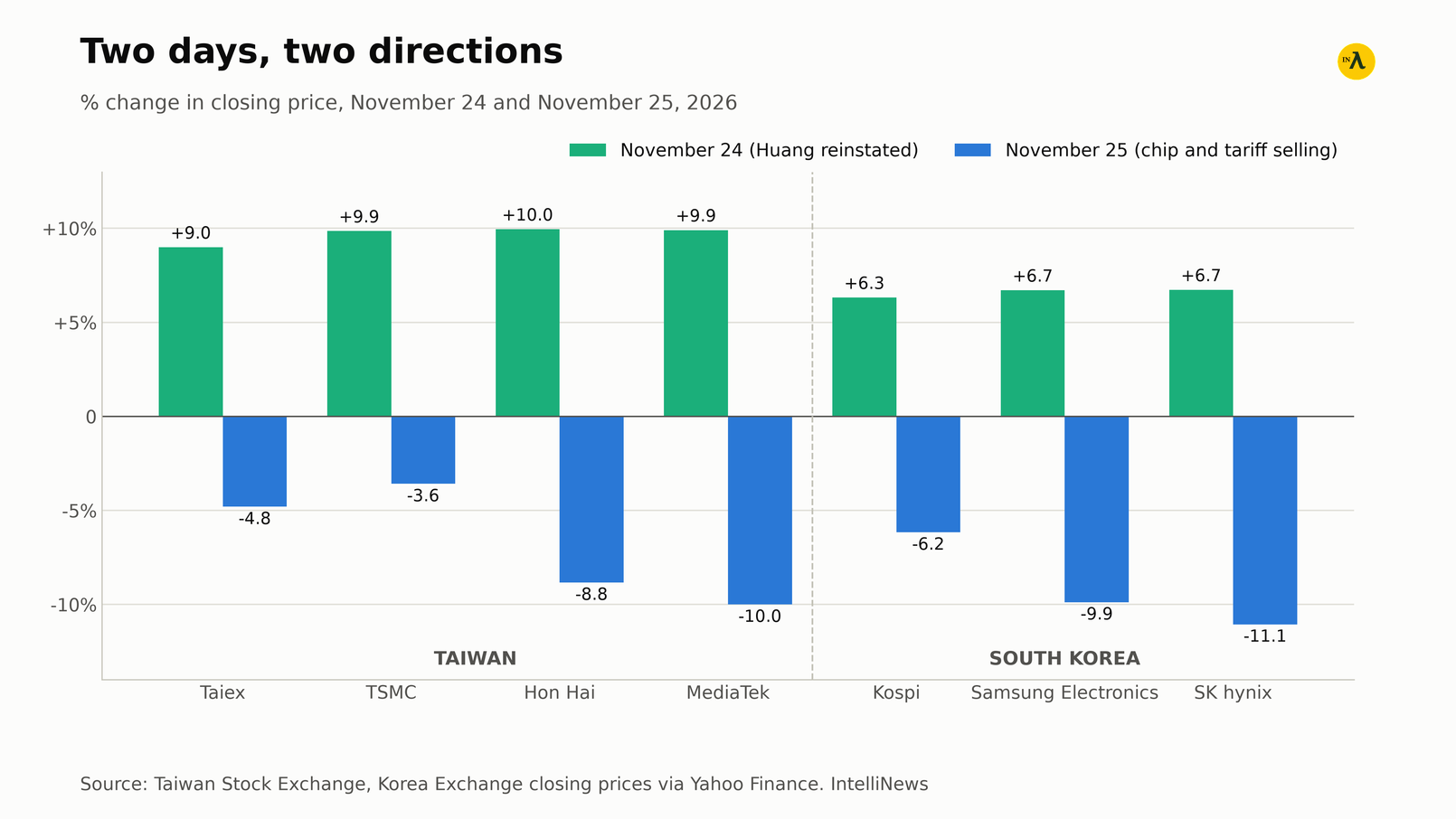
% change in closing price on November 24 and November 25, 2026. Source: Taiwan Stock Exchange, Korea Exchange closing prices via Yahoo Finance. IntelliNews
Who has room to respond
Taiwan has more slack. Its central bank kept the discount rate at 2% in September while forecasting 2026 inflation of 2.03%, and the TWD500bn National Financial Stabilisation Fund has been cleared to buy shares since November 6. The regulator has also banned short-selling of stocks that fell in the previous session. The weak point is the currency: foreign institutions pulled about $10bn in the first ten days of November, and reserves slipped to $596.44bn at the end of October as the central bank defended the Taiwan dollar.
The Bank of Korea is in the middle of a tightening cycle. It held its base rate at 3% on October 22 after raising it in July and August, with inflation at 2.9% in September, and its board meets again on November 26. An economy that grew 1% q/q in 3Q26 on chip exports leaves the central bank little reason to ease for the sake of the stock market.
Taiwan's exposure runs through an entire hardware supply chain that is still adding output; South Korea's runs through two memory makers whose earnings rest on prices. If the AI trade turns, both indices will fall together again, but only Seoul's has so little factory growth beneath it.
This article was produced with the help of the IntelliNews Lambda analytical tool

No comments:
Post a Comment