Monday, August 10, 2026


MSC Boxship Partially Sinks off Zhoushan

MSC Silvana
Via Chinese social media

Published Aug 9, 2026 9:26 PM by The Maritime Executive


The boxship MSC Silvana VIII has partially sunk off the coast of Zhoushan, and it took on a precarious position just ahead of the arrival of Typhoon Dolphin.  

The 8,400 TEU boxship MSC Silvana VIII arrived at the west side of the Guojiayou Island shipyard district for repairs in June. AIS data shows that during Typhoon Bavi she departed the dock and ended up at a position on the other side of the channel, just off Daishan. Her AIS transmission ceased thereafter.

Visible scaffolding around the foremast and the bridge suggests that shipyard work was under way when the vessel ran into difficulty. 

Chart data provided by Pole Star suggests that she may have touched bottom twice - once on a marked rock just off Daishan on July 11, and again at another marked outcropping on July 12, just off the west end of Dazhyu Island. The bottom in her current location drops off steeply into a deep channel of up to 40-50 meters of depth, enough water that she might eventually slip completely below the surface.

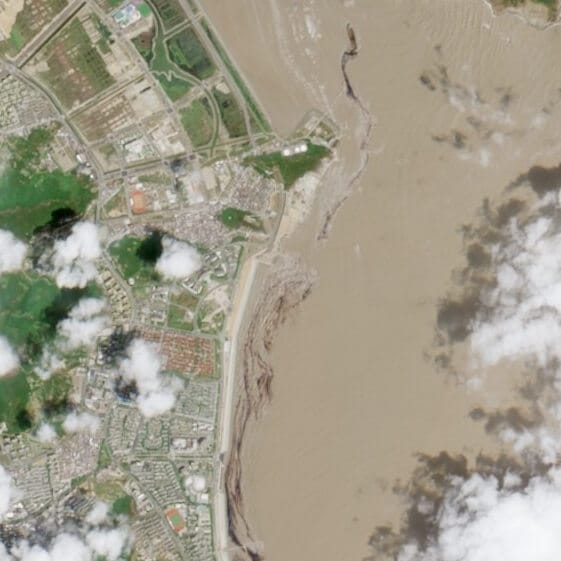
MSC Silvana VIII (top) and apparent oil slick (vertical) (Copernicus / Sentinel-2)

Satellite imagery shows that the ship was leaking fuel oil as recently as August 7, and a slick stretched off several miles to the south. Heavy wave action and high winds from the typhoon - which made landfall Sunday at a location to the south, in Zhejiang - will likely disperse the slick. 


After One Year, China Acknowledges Fatal South China Sea Collision

CCG
Chinese cutter CCG 3104 (right, with water cannon) was cut off by the Chinese warship Guilin (left), without harming the Philippine cutter Suluan (foreground) (PCG)

Published Aug 9, 2026 10:58 PM by The Maritime Executive


Chinese officials appear to have acknowledged that the collision between a PLA Navy warship and a China Coast Guard cutter near Scarborough Shoal last year resulted in two previously-unannounced fatalities. 

In a statement last week, the People's Armed Police Force - the parent institution of the China Coast Guard - said that it had recognized four servicemembers as "lieshi," or "martyrs." The honorary title is awarded to Chinese citizens who lose their lives in the furtherance of national interests, broadly conceived. 

In a brief statement, the department said that China Coast Guard servicemembers Yi Xinyu (21) and Cheng Long (25) had lost their lives on August 11, 2025, "while participating in a frontline rights defense operation in the South China Sea." "Rights defense" China's term for the pursuit of its ambitious maritime claims, including those located in the Philippine exclusive economic zone. 

The date in the notice corresponds with the date of the collision, and the casualty occurred during the process a CCG "safeguarding" activity. On that day, the cutter CCG 3104 was under way near Scarborough Shoal, pursuing and harassing the Philippine Coast Guard vessels Teresa Magbanua and Suluan as they escorted the supply ship Pamamalakaya. CCG 3104 had deployed its water cannon, and was approaching Suluan from astern. Meanwhile, the PLA Navy Type 052D destroyer Guilin (164) attempted to cut off Suluan by crossing at high speed from the Philippine cutter's starboard side. Suluan accelerated out of danger, but the move put Guilin's hull right in front of CCG 3104's bow. The Chinese cutter hit the Chinese destroyer, crumpling CCG 3104's bow in by about 30 feet and rendering it inoperable. The destroyer's hull was dented, but otherwise unharmed. 


At the time, China's government did not acknowledge the casualty. Observers of the South China Sea standoff quickly noticed the martyrdom announcement, however, and connected it to the only significant event on that date. 

"They ended up being the victims. The world knew what happened on that fateful day," commented Vice Adm. Alexander Lopez (Philippine Navy, ret'd), speaking to the Philippine Inquirer. 

Cathay Pacific’s profit soars 71% despite Iran war driving up fuel costs

AFP
August 5, 2026
Cathay Pacific reported net profit of HK$6.2 billion ($795 million) in the first six months of the year, while revenue increased 25.3 percent on-year to HK$68 billion
 – Copyright AFP/File Anthony WALLACE

Hong Kong carrier Cathay Pacific said Wednesday that net profit surged 71 percent in the first half of the year, as demand from passengers avoiding the Middle East offset a near doubling of fuel costs caused by the Iran war.

“Our result was positively impacted by ongoing underlying demand for Cathay Pacific and Cathay Cargo, improved performance from HK Express, and stronger contributions from associates,” the chair Guy Bradley said in its earnings report.

The airline reported net profit of HK$6.2 billion ($795 million) in the first six months of the year, while revenue increased 25.3 percent on-year to HK$68 billion.

Passenger revenue increased 26.3 percent to HK$43.2 billion, driven by strong travel demand and “amplified by increased transit traffic through Hong Kong as travellers looked to other hubs due to the Middle East situation in the second quarter”, the carrier said.

“Having got off to a strong start in the first quarter, we faced a more challenging second quarter due to the situation in the Middle East and the resulting significant increase in jet fuel prices,” Bradley said, adding that fuel costs nearly doubled from the first quarter to the second.

The airline has adjusted fuel surcharges multiple times since the war broke out in February.

Its fuel costs increased by 59.1 percent compared to the same period in 2025, the company said.

Cathay Pacific carried 17.5 percent more passengers, while its low-cost subsidiary HK Express carried 9.8 percent more passengers compared to the same period in 2025.

Its European performance was boosted by changes in traffic flows due to the Middle East situation, particularly for passengers travelling between Europe and Oceania through Hong Kong.

The airline had launched additional flights to Europe in March and April “to cater for an upsurge in market demand as passengers prioritised alternative routings”.

The company said it remains “cautiously optimistic” for the rest of the year, adding that it is on track to reach its passenger capacity growth target of around 10 percent for the group as a whole.

“We expect the impact of elevated fuel prices will continue for the rest of the year and we remain alert to the changing geopolitical and market situation.”

It said it aims to add 150 new aircraft to its fleet, currently numbering 235, in the next 10 years, if market conditions are favourable.
UK observatory nervously watches growing space junk threat

AFP
August 6, 2026

Experts at Chilbolton Observatory monitor UK-licenced satellites and ever-growing fragments of space debris swirling around them – Copyright AFP –

In the sweeping shadow of a satellite dish, staff at the Chilbolton Observatory in southern England track a growing number of objects in Earth’s orbit, providing data that underpins Britain’s space monitoring efforts.

As the hulking antenna swivels into action, screens inside the control room light up with the names of objects the radar system detects: stars, satellites and abandoned rocket bodies.

Experts at Chilbolton Observatory, operated by the UK’s national space laboratory RAL Space, monitor UK-licenced satellites and fast-multiplying fragments of space debris swirling around them.

The space junk includes defunct man-made objects like rocket bodies, dead satellites and fragments from launches, explosions and collisions that threaten to re-enter Earth’s atmosphere or crash into functioning satellites.

According to the European Space Agency, there are more than 46,000 pieces of debris weighing a total of 17,000 tonnes currently in orbit.

“Most of those don’t collide with anything, most of the time,” Matthew Archer, deputy director for launch and space domain awareness at the UK Space Agency told AFP on a visit to the observatory.

“But any of them can cause significant damage or even destroy potential satellites.”

On Wednesday, part of a SpaceX rocket about the size of a bus slammed into the Moon, unleashing a stream of debris. Researchers warn the growing density of space junk could trigger the so-called “Kessler syndrome” cascade of collisions.


– ‘Look at everything’ –


Chilbolton Observatory feeds data to the National Space Operations Centre (NSpOC) — led by the UK Space Agency and UK Space Command — that works around the clock to prevent orbital collisions and track debris re-entering Earth’s atmosphere.

“Our role is to look at everything that happens and is in space,” said Archer.

Space infrastructure underpins some 20 percent of the UK economy, said Archer. The growing “number of objects is making space far more congested, so the need for this capability is growing all the time.”

As he speaks, multiple Starlink devices — part of the constellation of thousands of internet satellites launched by US tycoon Elon Musk’s SpaceX — float by on the control room screens.

There are currently 14,000 satellites orbiting Earth, with some 1.7 million satellites planned in coming years. SpaceX alone has unveiled plans to begin launching more than one million satellites in 2028.

The UK has pledged to invest £85 million ($114 million) in the NSpOC, which issues around 3,000 monthly collision warnings to satellite operators.

The researchers also monitor to ensure satellite operators are complying with their licences and track foreign “adversaries”.

“We see examples of countries that have demonstrated the ability to get close or to fly by certain objects,” said Archer. “We do have to track … threats regularly from a military perspective.”

And when space debris re-enters the atmosphere, scientists are on stand-by to issue alerts for objects which may not burn up before landfall.

In January, Britain and European countries closely watched the re-entry of a Chinese rocket, amid fears fragments could land in Britain. The rocket eventually splashed down in the Pacific Ocean.


– Asteroids –


“The whole environment is changing,” said Chilbolton Observatory’s facility leader Sarah Nash. “It really is a multinational environment and there are so many objects that are not controllable.”

“The only way that all of this can continue to operate safely is by keeping track of where everything is,” Nash told AFP.

Another branch of their work is planetary defence, which involves identifying threats like comets and asteroids.

Last year, the UK Space Agency became a member of the International Asteroid Warning Network (IAWN), which monitors the movement of asteroids including those that could hit Earth.

“We work in partnership with NASA and others in the US to effectively give a percentage chance that (it) might hit the Earth and when that might happen,” said Archer.

While smaller space rocks frequently burn up in Earth’s atmosphere, large orbiting rocks like asteroids are rarer.

The UK to support the European Space Agency’s 2029 mission to study a 375-metre (1,230 feet) wide asteroid called Apophis as it flies by Earth.

“Asteroids are a really interesting challenge in many ways. It’s unusual for an asteroid to come out of nowhere,” explained Nash.

The giant space rocks are generally monitored by optical sensors, as they are too far away for Chilbolton’s radar dish to detect.

“If they’re close enough for the (radar) antenna to see them, then we have bigger problems,” laughed station manager Graham Marshall.
Cambridge to review hiring process amid plagiarism row

AFP
August 7, 2026

Cambridge university is investigating the circumstances around Arday’s appointment – Copyright AFP SHAUN CURRY

The University of Cambridge said Friday that it would be reviewing its hiring process for senior roles as it probes claims of plagiarism by a professor who resigned this week.

Jason Arday, who made headlines when appointed as Cambridge’s youngest black professor in 2023, resigned Wednesday after the university announced a probe into snowballing claims he plagiarised parts of his PhD thesis.

The university in an update Friday said that “regardless of “Arday’s resignation, it would “continue to investigate the circumstances around (his) appointment and tenure”.

“The findings will feed into a review of the process for the appointment of senior academic roles,” it added.

Arday had announced that he was resigning with immediate effect both from his university post as professor of sociology of education and as a fellow of Jesus College.

In a letter posted online, he said quitting was “the only way” to end a “difficult period”, but insisted the decision should not be “mistaken for an acceptance of the narratives that have surrounded me”.

The university had previously defended Arday but said Wednesday its probe was prompted by “new information”, without specifying.

Jesus College said separately that it was launching its own probe.

The college’s head, Sonita Alleyne, the first black head of an Oxbridge college, has removed her name from a petition defending Arday.

The scandal has been seized upon by right-wing newspapers and commentators, who have labelled Arday as a “poster boy” for diversity, equality and inclusion (DEI) policies.

The Times newspaper has recently published several investigative articles into Arday’s academic work and personal life.

In an interview with the newspaper, Arday admitted to “mistakes” in his academic work, but said he was being wrongly “portrayed to be a liar and a fantasist and an academic fraud”.

He also alleged the “campaign to unseat me from my position” was “racially motivated”.

Plagiarism claims against Arday were first made in July by Nathan Cofnas, a US academic and self-defined “race realist” whose research affiliation with a Cambridge college was terminated in 2024 amid racism accusations.
Nova Scotia’s ocean tracking network expands autonomous underwater systems to safeguard marine life

Dr. Tim Sandle
August 8, 2026
DIGITAL JOURNAL

Labrador, connected to mainland Canada, and Newfoundland, an island in the Atlantic Ocean. Image by Tango7174 – Own work, CC BY-SA 4.0,

The world’s oceans remain one of the least understood environments on Earth. Beneath the waves, countless species migrate, feed, reproduce, and respond to changing environmental conditions in ways that scientists are only beginning to understand. In Canada, a major effort to unlock these mysteries is being driven from Nova Scotia through the Ocean Tracking Network (OTN), a globally recognized marine research initiative headquartered at Dalhousie University in Halifax. As OTN expands its use of autonomous underwater and surface vehicles, researchers are gaining unprecedented insights into marine ecosystems while strengthening efforts to conserve valuable ocean resources.

The increasing deployment of advanced autonomous systems represents an important evolution in how marine science is conducted. These technologies are enabling continuous monitoring across vast ocean regions that would otherwise be inaccessible or prohibitively expensive to study using traditional research vessels.

Founded in 2008, the Ocean Tracking Network has developed into one of the world’s largest aquatic animal tracking and monitoring initiatives. The organization’s mission is to support the sustainable management of aquatic resources by improving understanding of animal movements, habitat use, and survival in rapidly changing marine environments. Today, OTN supports research involving hundreds of species and thousands of projects across the globe. The system relies on electronic telemetry technology. Scientists attach or implant acoustic tags into fish, sharks, seals, and other marine organisms. These tags emit unique acoustic signals that are detected by underwater receiver arrays positioned across strategic locations in oceans, coastal waters, and freshwater environments. The resulting data allows researchers to answer critical questions: Where do animals migrate? Which habitats are most important? How do environmental changes affect behaviour? And what measures are required to protect vulnerable species?

The rise of autonomous underwater vehicles


A major component of OTN’s expanding capabilities is its use of autonomous marine vehicles, particularly underwater gliders. Unlike conventional research vessels, autonomous vehicles can remain at sea for extended periods while collecting continuous environmental and biological data. OTN operates fleets of Slocum autonomous underwater gliders as well as Wave Gliders, which use wave and solar energy to travel long distances while collecting oceanographic information. These systems gather data on temperature, salinity, currents, biological conditions, and acoustic detections from tagged marine species. According to OTN, its glider fleet has already covered more than 138,000 kilometres, creating one of the most extensive autonomous ocean observation datasets available. Autonomous systems operate continuously, are more affordable than research vessels, and can function in challenging weather conditions. They also minimize the environmental footprint associated with traditional ship-based surveys. [navigator….ovation.ca], [oceantrack…etwork.org]

The information generated through OTN has significant implications for conservation and fisheries management. Many commercially important species travel across national boundaries and move through habitats affected by climate change, industrial development, fishing pressure, and pollution. Without detailed knowledge of migration routes and habitat use, management decisions often rely on incomplete information.

Tracking data has been used to support the design of marine protected areas, improve fisheries management strategies, and evaluate conservation policies. Researchers have also used the network to study endangered species and understand the impacts of environmental change on aquatic ecosystems. In Atlantic Canada, where fisheries remain a cornerstone of many coastal economies, the ability to understand species’ movements provides an important advantage. Better data can improve sustainability while helping protect the long-term viability of valuable marine resources.


The third UN Ocean Conference takes place in Nice, southern France, from June 9 to 13
 – © AFP


Climate change and ocean monitoring


Climate change has increased the urgency of ocean monitoring. Warming waters, changing currents, ocean acidification, and shifting food webs are altering marine ecosystems worldwide. Species distributions are changing as animals move in response to environmental pressures, creating new challenges for conservation agencies and fisheries managers. Autonomous vehicles provide an effective means of collecting long-term environmental data needed to understand these changes. Because the vehicles can repeatedly survey remote regions and gather measurements throughout the year, scientists are developing a clearer picture of how environmental variability influences marine life.

This combination of animal tracking data and environmental monitoring represents one of the network’s greatest strengths. Rather than simply knowing where an animal travels, researchers can increasingly understand why it moves and what environmental conditions influence its behaviour.

Although based in Halifax, OTN’s influence extends far beyond Atlantic Canada. The network supports a global community of researchers and maintains infrastructure deployed across oceans and freshwater systems worldwide. More than 2,500 researchers have participated in projects supported by OTN, with thousands of acoustic receivers deployed across key aquatic environments.

The organization collaborates extensively with government agencies, universities, industry partners, and conservation groups. These partnerships have enabled the creation of an international data-sharing framework that allows scientists to follow tagged animals across vast geographic ranges. bRecent collaborations, including participation in international ocean-monitoring initiatives, demonstrate how Canada’s expertise in aquatic telemetry and autonomous monitoring is contributing to global marine science efforts.

One of the most important developments is the integration of multiple monitoring technologies into a single observational ecosystem. Since 2020, OTN has expanded its technical capabilities through the addition of remotely operated vehicles (ROVs), side-scan sonar systems, autonomous gliders, and advanced oceanographic sensors. Together, these platforms provide a richer view of marine ecosystems than would be possible through animal tagging alone.

The result is a shift toward data-driven marine stewardship. Policymakers increasingly require robust scientific evidence to guide decisions regarding protected areas, fisheries quotas, offshore development, and biodiversity conservation. OTN’s growing autonomous vehicle capability helps provide that evidence.

Looking ahead

As pressures on marine ecosystems continue to increase, technologies capable of monitoring ocean health in real time will become increasingly important. Nova Scotia’s Ocean Tracking Network is demonstrating how autonomous systems, advanced telemetry, and international collaboration can be combined to improve understanding of aquatic environments while supporting the sustainable management of marine resources. The expansion of autonomous underwater vehicle systems is more than a technological achievement. It represents a new model for marine conservation, one in which continuous data collection and advanced analytics provide the knowledge required to protect species, manage fisheries, and better understand a changing ocean.

Op-Ed: Stanford X-ray laser ‘movie’ of chemical reactions opens new chapter in chemistry

Paul Wallis
August 5, 2026
DIGITAL JOURNAL

Creative view of the periodic table. — Image by © Tim Sandle

This could be the first true look at a new methodology for just about everything in physical science. At a speed of femtoseconds, the actual movement of electrons in chemical processes creating new chemical bonds.

Stanford’s Linac Coherent Light Source (LCLS) ”takes X-ray snapshots of atoms and molecules at work, providing atomic resolution detail on ultrafast timescales to reveal fundamental processes in materials, technology and living things.”

If that rather dry description seems a little vague, the translation is “a movie of how just about everything happens”.

Living things? Does that sound useful?

This process also instantly overturned computer simulations and has added levels of complexity to predictive models.

That’s just the start. A blow-by-blow version of chemical reactivity really is a new unexplored, and truly gigantic scientific ballpark.

According to the Stanford Report, this includes the making and breaking of chemical bonds.

We need to get a bit technical here.

In the abstract of the paper Stanford published in Nature, the description gets a bit more demanding:

“… its comprehensive description challenges our current theoretical and computational capabilities as it requires advanced treatment of electron correlation and nonadiabatic dynamics beyond the Born–Oppenheimer approximation.”

The Born–Oppenheimer approximation just happens to be “a fundamental mathematical model in quantum chemistry and molecular physics stating that the motion of atomic nuclei and electrons within a molecule can be separate” according to Gemini’s definition.

There’s the real breakthrough. Simulations are, to put it politely, the scientific equivalent of time-consuming ditch-digging. A simulation has to survive torturous checks to be viable.

The Stanford X-ray lasers have accurately visualized the reality of these relationships and actual electron movement. The new horizons are now visible.
What can this tech do? Pretty much everything.

It’s impossible to overstate the depth of value and the importance of this method in just about any application of real physical science. It couldn’t possibly be more useful for all levels of chemistry and materials science.

Imagine what the ability to check chemical reactions could do for anything from organic chemistry to biology to pharmacology to “designer” materials.

It’s historically very good timing, too, with the constant demands on materials science reaching new levels for accuracy and hard information regarding physical processes.

Consider the demands on microprocessors alone in their trillions, base materials, related materials, and the nano structures needed for so many new processes. This isn’t just the cutting edge. It’s the future cutting edge for materials doing things that have never been done before. The microprocessors alone require anything up to billions of models in simulations.

The Stanford LCLS method is likely the very beginning of a whole new science and it will deliver value from baseline chemistry to abstruse exotic new materials. The many decades of laborious theoretical models and brutally turgid patient research now have some backup.
“Productivity”, you say? Yes. By the omnibyte.

Moving on from Sales Pitch For The Obvious to the very hard science, the scale of information involved is exponential. Electrons aren’t famous for their cooperation with observation, and there are a lot of them.

The average electron has an infinite life expectancy longer than the universe. This is their first real appearance in a feature film, and it might be worth getting to know them a bit better.

They also generate so much information per femtosecond that “omnibyte” is perhaps too appropriate a metric. An “omnibyte” could be called a net all-inclusive unit of information related to a specific case. A distinct identity for a discrete mathematical set, if you like.

Per electron? Maybe. What if one electron does something unexpected? What if a whole new process hinges on pinning down electron behaviour in specific conditions. Cryogenic or plasma temperature? In the presence of what?

This won’t reduce the mental workload, in fact, it’s likely to increase it, but it will make it far more efficient in terms of managing information. You’ve now got a Yes/No response to work with in sims and models. That’s “productive” in anyone’s language.
Now the hard work begins

LCLS has a long track record in “snapshots” and is well-known for its adaptability in 3D molecular structuring. This level of information is where a lot of the data you see in research starts. It’s foundational.

The movie is a narrative. It’s the story of processes. It’s the continuum with qualifiers. It’s exactly what’s needed.

This is also a way of getting at the difficult stuff that reality keeps throwing at the sciences. Good science has been making discoveries that generate more questions than answers for millennia.

If you know the history of science bumping into those answers, you might agree that being able to at least explain them could be very helpful. It’d be downright nice to know why things happen.

Now, add AI processing values and the ability to test and verify on that scale. This is core business for all the sciences. Underselling the possibilities isn’t an option here.

__________________________________________________

Disclaimer

The opinions expressed in this Op-Ed are those of the author. They do not purport to reflect the opinions or views of the Digital Journal or its members.
Gaza beekeeper starts again on rooftop amid ruins of war

AFP
August 7, 2026
The war in Gaza obliterated the territory’s beekeeping sector
 – Copyright AFP Omar AL-QATTAA

Perched on the edge of a rooftop high above Gaza City’s bombed-out landscape, Ibrahim al-Dabba lovingly tends his community of bees, cultivating a rare source of hope among the ruins of the Israel-Hamas war.

Al-Dabba and his sons, donning protective netted hats and wielding metal bee smokers, gently inspect the neat rows of teeming hives.

As each frame of honeycomb is lifted out, hundreds of bees buzz lazily above the shattered urban neighbourhood — an incongruous setting for an apiary, but one the veteran beekeeper had little option but to choose.

Al-Dabba, who heads the Beekeepers Cooperative in the Gaza Strip, said the war which erupted in October 2023 obliterated the Palestinian territory’s beekeeping culture.

“We had more than 40,000 beehives and more than 450 beekeepers” before the war, he told AFP from the rooftop in Gaza City’s Tel al-Hawa neighbourhood.

“The situation was good, with more than 1,000 families making a living through the beekeeping sector,” he added.

“The war came and destroyed the beekeeping sector by more than 95 percent because most beekeepers were near the border areas,” he explained.

Al-Dabba himself lost some 400 hives, which he had kept in agricultural lands east of Gaza City.

He had no choice but to relocate his remaining 35 or so hives to the roof of a residential building, but admitted the situation was far from ideal.

“Bees are supposed to be in a safe, suitable agricultural area, but today the bees are suffering just as we are,” he said.

Al-Dabba explained that he could not move his bees back to their previous home because it had been destroyed and the land was now under the control of the Israeli military.

“We cannot approach or enter,” he said.

“Just as we are displaced in the streets, the bees are also displaced on the rooftops.”


– Hope despite suffering –


The devastating war in Gaza was triggered by Hamas’s October 7, 2023 attack on Israel, which resulted in the deaths of 1,221 people, according to an AFP tally based on official Israeli figures.

Israel’s retaliatory military campaign in Gaza has killed more than 73,300 people, according to the territory’s health ministry, which operates under Hamas authority and whose figures are considered reliable by the United Nations.

Despite the ceasefire in effect since October, bloodshed has continued in the tiny territory, with the Israeli military continuing to target Palestinians they say are militants.

Israel says it now controls more than 60 percent of the Gaza Strip, up from about half when the ceasefire took effect.

The humanitarian situation also remains dire, with hundreds of thousands of people living in tents and Israel tightly controlling the entry of all goods into the territory.

“We lack essential supplies because importing beekeeping equipment from the other side is not permitted,” Al-Dabba told AFP, saying he had approached external organisations and ministries in Gaza and the occupied West Bank for help.

Despite the suffering and challenges of relocating his hives to an unfamiliar landscape, Al-Dabba said he found “hope after seeing the bees coexist and adapt”.

“The bees now come and go and feel settled,” he said.

“So we hope that hope, goodness and living in peace and security will come, like in other countries.”

US unexpectedly loses jobs in blow to Trump’s economy claims

AFP
August 7, 2026

The US has had a ‘low-hire, low-fire’ labor market for months, with job seekers struggling to break into firms as turnover has remained relatively low in the world’s largest economy – Copyright AFP Patrick T. Fallon

The United States unexpectedly lost thousands of jobs in July, government data showed Friday, a blow to US President Donald Trump’s claims of leading an economic revival as his Republican Party gears up for crucial midterm elections.

The world’s largest economy lost 23,000 jobs in July, data published by the US Bureau of Labor Statistics showed, signalling potential labor market weakness after months of steady growth.

The unemployment rate ticked down to 4.1 percent, likely a result of falling labor supply as the US economy grapples with an ageing population and lower net migration.

Since taking office for his second term, Trump has unleashed a spate of policies aimed at reviving domestic manufacturing and curbing surging inflation.

Republicans face a stiff test in November’s midterm elections, with the state of the economy a key issue for Democrats who are seeking to wrest back control of both houses of Congress.

Friday’s data will also pose a question to the US Federal Reserve, which has been signalling it was preparing for a rate hike later this year.


– Implications for Fed –


In addition to the loss of jobs in July, the BLS revised down job growth in the previous two months by 103,000, showing the labor market to be less robust than previously reported.

Based on the new figures, job growth hit a peak in March before declining in the next three months and entering negative territory in July.

Analysts had expected further job growth, with economists polled by Dow Jones Newswires and the Wall Street Journal expecting 83,000 new jobs to be added in July.

The decline and revisions to the previous months will spark concern that the labor market may not be as strong as was previously reported.

The unemployment rate has remained relatively steady through choppiness in the labor market, due to the overall drop in labor supply.

Friday’s figures showed the labor force participation rate — a key metric — dropped slightly in July, after a sharp decline the month before.

Policymakers at the US Federal Reserve watch the labor market closely, as their dual mandate requires the Fed to deliver maximum employment while ensuring inflation remains at a long-term target of two percent.

The Fed has missed that target for five years, as inflation has battered US households since the pandemic.

Last month, the Fed held interest rates steady, but three regional Fed presidents dissented in favor of a rate hike.

“This morning’s report is a game changer in the sense that all of the recent focus has been on inflation and this report highlights the risks that are embedded in the labor market as well,” said Chris Zaccarelli of Northlight Asset Management.

“Before today, many were expecting that the Fed had no choice but to raise rates in order to fight stubbornly high inflation, because the job market was so strong, but this report shows that isn’t the case.”


– Retail trade losses –


Employment declined in the local government education and retail trade sectors, while it continued to grow in health care, the BLS statement said.

Retail trade also lost 19,000 jobs, with employment declining in warehouse retailers — firms like Costco, Sam’s Club and others that offer discounts for wholesale quantities of household goods — and general merchandise stores.

Employment in the financial activities sector continued its downward trend, losing 14,000 jobs. Employment in the sector is down 121,000 from its May 2025 peak.

The health care sector has buoyed the US labor market over the last year, with more Americans aging and requiring medical assistance.

In July, the sector added 22,000 jobs, but it was a slower pace than its average gain over the last year.

Average hourly earnings increased by 3.2 percent over last year, lagging inflation and therefore leaving workers with less income in real terms.
Q&A: How El Niño conditions and extreme weather is impacting on utilities

Dr. Tim Sandle
August 7, 2026
DIGITAL JOURNAL

El Nino warms surface temperatures in the central and eastern equatorial Pacific Ocean 
– Copyright AFP/File Sajjad HUSSAIN


AccuWeather meteorologists recently indicated that El Niño conditions are now established in the tropical Pacific, raising questions about how changing weather patterns could affect utilities and electricity consumers over the coming months.

To understand more about how weather is impacting utilities, Digital Journal spoke with Joe Matamoros, Chief Product Development Officer at S&C Electric Company. Matamoros considers extreme weather’s impact on utilities and grid resilience. Matamoros examines how managers of utilities are thinking about resilience investments, affordability and the role technologies like microgrids and battery storage are playing.

Digital Journal: How are utilities balancing investments in grid hardening and resilience with concerns about affordability?

Joe Matamoros: Utilities are increasingly focused on targeted investments that deliver measurable resilience improvements rather than relying solely on large-scale infrastructure replacement. Technologies that automate fault detection, isolate damaged sections of the system and restore service more quickly can often provide significant benefits without requiring a complete rebuild of the network. The conversation is shifting toward getting more value from existing assets while improving resilience. That approach helps utilities strengthen performance while remaining mindful of customer costs.

DJ: What evidence exists that grid modernization investments are improving reliability during extreme weather events?

Matamoros: Utilities that have deployed advanced automation and intelligent distribution technologies have shown an ability to limit the scope and duration of outages during major weather events. Florida offers a good example. In 2005, Hurricane Wilma, a Category 3 storm, left roughly 3 million customers without power for 18 days. Restoration efforts were prolonged due to the scale and spread of system damage. Recognizing this, the state’s largest utility made sustained investments in grid hardening, automation, and system intelligence across its distribution system.

In 2024, Florida experienced three landfalling hurricanes in a single season. By any objective measure, the 2024 hurricane season presented a more demanding test of the grid. Yet customer outcomes improved dramatically. Smart grid and automation technologies, along with physical infrastructure hardening, helped prevent nearly 900,000 customer outages across the three storms.

Restoration also progressed rapidly despite severe conditions. Power was essentially restored within one day after Hurricane Debby, within three days after Hurricane Helene, the strongest hurricane on record for the region, and within five days after Hurricane Milton, even as millions of customers across Florida experienced disruption.

These results demonstrate more than a faster response. They show that resilience translates into more reliable outcomes for customers.

DJ: Can distributed energy resources, microgrids, battery storage or other technologies help mitigate weather-related reliability risks?

Matamoros: These technologies can play an important role in improving resilience, particularly for critical facilities and communities that need access to power during prolonged outages. Microgrids and battery storage can provide localized support when parts of the broader grid are disrupted, while distributed energy resources add flexibility to the overall system. They become even more effective when combined with intelligent grid controls and automation. Resilience is often strongest when these resources complement, rather than replace, investments in the core grid.

DJ: Are there policy or regulatory tools available to help reduce customer cost impacts while maintaining reliability?

Matamoros: Regulators and policymakers can support investments that prioritize long-term resilience and reliability improvements and reduce the costs associated with repeated storm recovery efforts. Performance-based approaches, resilience-focused planning and funding mechanisms can help utilities make prudent investments while maintaining accountability. For example, the Infrastructure Investment and Jobs Act (IIJA) and DOE’s Grid Resilience and Innovation Partnerships (GRIP) program have provided sources of funding and aimed to accelerate efforts around reliability and grid resiliency.

It is also important that regulators help evaluate projects based on their ability to improve service continuity and reduce outage impacts over time. This will provide necessary accountability and incentivize utilities to strengthen the grid without losing sight of affordability.

DJ: What trends are utilities seeing in storm recovery and resilience spending, and what results are those investments producing?

Matamoros: Utilities are dedicating a growing share of capital spending toward resilience initiatives, particularly projects that improve operational awareness, automate restoration and strengthen vulnerable portions of the distribution network. Rather than focusing exclusively on rebuilding after storms, many organizations are investing in technologies that help prevent outages from becoming widespread in the first place. The result is often a grid that can respond more effectively under stress and recover more quickly when disruptions occur. As weather-related risks continue to evolve, utilities are increasingly measuring success by how well they can maintain service continuity during and after major events.