Monday, August 10, 2026

Why Trump’s Waiver of the Jones Act Is Unlikely To Lower Gas Prices

  • Trump is considering extending the Jones Act waiver as gasoline prices above $4 per gallon become a growing political risk ahead of the midterms.

  • The White House is also pressuring ExxonMobil and Chevron over soaring profits and investigating possible price gouging, while seeking additional ways to ease domestic fuel supply constraints.

  • Extending the waiver faces strong opposition from maritime groups and lawmakers, who argue it threatens U.S. shipping jobs and national security.

U.S. President Donald Trump is weighing another suspension of the Jones Act as gasoline prices above $4 a gallon threaten to become a liability for Republicans heading into the midterm elections. The move would again open domestic oil and fuel shipments to cheaper foreign-flagged vessels, extending an emergency waiver Trump imposed after the Iran war sent crude prices sharply higher in March. The problem is that the first waiver barely moved gasoline prices. Shipping costs account for only a small part of what Americans pay at the pump, leaving Trump with limited room to cut prices through maritime policy as he turns up the pressure on ExxonMobil and Chevron over their soaring profits.

At the same time, Trump has stepped up pressure on Big Oil over high gasoline prices, lambasting Exxon Mobil (NYSE:XOM) and Chevron (NYSE:CVX) for making too much money amid high energy prices and global supply shortages. Trump has directed the Department of Justice to investigate Big Oil for possible price gouging, accusing oil companies of keeping gasoline prices high even as global crude prices have fallen.

The backlash followed the companies' bumper second quarter results, with Chevron's quarterly earnings surging to $12 billion, up from $2.5 billion the previous year while ExxonMobil's profits more than doubled to $14.5 billion. 

With Big Oil showing no indication of heeding Trump’s threats, extending the Jones Act waiver is another lever to pull, from the perspective of the White House. The initial 60-day exemption, announced in March after oil prices spiked in the first weeks of the Middle East conflict, is set to expire on August 16. By temporarily lifting the law’s strict maritime restrictions, the White House has allowed foreign-flagged vessels to transport oil and refined petroleum products between domestic ports.

The Jones Act is a federal law that dictates that all cargo transported between U.S. ports must be carried on ships that are built in the U.S, owned by American citizens, and crewed predominantly by U.S. workers. It’s been waived a total of 40 times in its 105-year history, with former U.S. president Joe Biden also setting it aside in 2021 following the Colonial Pipeline ransomware attack.

The primary purpose of the Jones Act is to facilitate a steady pipeline of American-owned and operated commercial vessels available to assist national defense and logistics during wartime or national emergencies. It also guarantees employment for U.S. mariners and shipyard workers by eliminating cheap foreign competition on domestic shipping routes. Interestingly, there are some who are encouraging Trump to do away with the Jones Act altogether.

In his March Bloomberg Opinion piece, former New York City Mayor Michael Bloomberg argued that the temporary waiver of the Jones Act during the conflict with Iran demonstrated that the 1920 shipping law is an outdated, counterproductive protectionist measure. Bloomberg labeled the law "one of the most counterproductive protectionist measures of the last century," pointing out that its artificial inefficiencies unfairly penalize American consumers--costing typical families in isolated regions like Hawaii roughly $1,800 a year. He noted that the suspension helped restrain fuel prices and support domestic shipments without harming the broader industry, making a case for Congress to permanently repeal or relax the act.

However, whereas energy and agricultural sectors support the waiver for helping bypass supply bottlenecks, Trump is facing opposition to the idea of suspending the federal shipping law, including from members of his own party, with maritime industry critics warning it threatens American shipbuilding and domestic seafaring jobs.

Back in June, House Speaker Mike Johnson and over 50 Republican lawmakers sent a letter to the president urging him to let the Jones Act waiver expire as per the earlier schedule, arguing that it undermines American maritime jobs and national security. Data collected during the waiver showed that roughly 95% of the waiver voyages were handled by foreign operators, leading domestic maritime groups and congressional leaders to push for a return to standard protectionist rules. Meanwhile, Senator Maria Cantwell and other critics argue that the Jones Act waiver has failed to lower fuel prices while creating uncertainty and instability for the U.S. maritime and shipbuilding sectors. 

And, the Washington senator has a valid point. Previously, we reported that suspension of the Jones Act in March did little to lower oil prices “It is estimated that it’s going to be about 3 cents on the East Coast and it might go up on the Gulf Coast, but these changes are so small that they’re overshadowed by the spikes in oil prices, and the oil prices keep going up,” Usha Haley, a professor of management at the Wichita State University, told Al Jazeera about a month after Trump suspended the Jones Act.

The political pressure to bring gasoline prices down will only intensify as the midterm elections approach. A late-July Politico poll found that 46% of respondents said gas prices would influence how they vote this fall.

By Alex Kimani for Oilprice.com


Barrick, Newmont settle dispute with $1.95B deal

Barrick plans to spin off its Nevada assets (pictured here) into a new company. (Image courtesy of Barrick Mining.)

Barrick Mining (TSX: ABX)(NYSE: B) and Newmont (NYSE, ASX: NEM) have settled their outstanding Nevada Gold Mines disputes in a deal that brings key projects into the joint venture and requires Newmont to pay Barrick $1.95 billion.

Under the agreement, Barrick’s Fourmile project and Newmont’s Fiberline and Mike projects will be part of Nevada Gold Mines. Newmont will make the payment within 30 days, while the partners have also agreed to revised governance provisions.

Newmont also consented to Barrick’s planned initial public offering (IPO) of its North American gold assets, removing a potential complication as Barrick works towards completing the separation by year-end.

The settlement removes uncertainty surrounding the relationship between the world’s two largest Western gold miners at Nevada Gold Mines, while allowing Barrick to move ahead with an IPO that has become increasingly important as investors scrutinize its performance and leadership.

Costs weigh

The end of the dispute came as Barrick reported second-quarter adjusted earnings that missed analysts’ estimates as higher production costs and retrospective tax penalties in Mali offset stronger-than-expected gold output.

Adjusted profit was $0.82 per share for the three months ended June 30, below the $0.88 average analyst estimate compiled by LSEG.

Gold production increased 11% from the first quarter to 796,000 oz., beating guidance of 730,000 to 770,000 ounces. Barrick attributed the increase to the ahead-of-schedule ramp-up at Loulo-Gounkoto, a faster-than-expected recovery at Pueblo Viejo following planned first-quarter maintenance and record underground tonnes at Cortez as Goldrush continued to ramp up.

Gold cost of sales was $1,993 per oz., while all-in sustaining costs were $1,866 per oz. Barrick said mining and processing cost discipline kept expenses within guidance despite pressure from fuel prices.

Operating cash flow rose 28% year over year to $1.7 billion.

Barrick maintained its full-year production and cost guidance while reducing expected attributable capital expenditures to $3.8 billion-$4.2 billion.

IPO pressure

Barrick said its North American IPO remains on track for completion by year-end, with Mark Hill set to become CEO of the new company following the separation.

The company first floated the IPO in December but did not name a CEO for the business until Monday, adding to criticism and frustration among some investors over Barrick’s direction.

Benoit Gervais, portfolio manager at Mackenzie, a subsidiary of Power Corp. and Barrick’s 10th-largest shareholder, has publicly called for chairman John Thornton to step down.

“If you ask me, it would be nice to have a graceful exit of this current chairman and have someone else come in,” Gervais told Bloomberg News.

The IPO could represent Thornton’s last opportunity to reverse Barrick’s fortunes after more than a decade at the top of the company. He has led Barrick since 2014, first as executive chairman and, since last year, as chairman.

Under Thornton, Barrick shares have underperformed rivals Newmont and Agnico Eagle Mines (TSX, NYSE: AEM) while the company has struggled to fully capitalize on gold’s historic rally. Barrick slipped to third place among global gold producers last year after Agnico Eagle overtook it.

Thornton subsequently pushed out longtime CEO Mark Bristow and installed Hill at the helm. Hill’s selection to lead the proposed North American company puts him at the centre of Barrick’s effort to unlock value from its premier assets and regain investor confidence.


India Gains Momentum as Bangladesh Ship Recycling Market Comes Under Pressure

Wirana Shipping reports on the contrasting ship recycling markets in India and Bangladesh.

India Gains Momentum as Bangladesh Ship Recycling Market Comes Under Pressure

Published Aug 9, 2026 2:59 PM by The Maritime Executive


[By Wirana]

Wirana Shipping has identified improving steel demand in India as an encouraging sign for the country’s ship recycling market, while slower demand and financing pressures continue to weigh on Bangladesh.

The latest Market Outlook reports a second consecutive week of improving steel demand in India. Local steel plate prices increased by USD 4/MT, semis and finished steel products by USD 2–4/MT and imported scrap by USD 1/MT. Recycler offers remained unchanged, although Wirana Shipping expects prices to improve in the coming weeks if stronger steel demand continues.

Foreign-exchange inflows totalling USD 41 billion following central-bank measures introduced in June have also helped the local currency strengthen marginally despite higher oil prices.

In Bangladesh, recycler offers softened as domestic steel demand remained slow. Local steel plate and scrap prices increased by USD 4/MT and USD 2/MT respectively, while imported shredded scrap fell by USD 5/MT and imported scrap by USD 4/MT. Recyclers are generally looking to reduce offers for recycling candidates by around USD 10–15/LT LDT. Some importers are also experiencing difficulties opening Letters of Credit, adding further pressure to the market. Wirana Shipping expects recycler prices in Bangladesh to remain under pressure.

The circulation of new recycling candidates remains slow, with vessels mainly coming from the dry segment. Pakistan and Turkey remained broadly stable during the week, while overall recycling tonnage supply is expected to remain slow to moderate.

Hitesh Vyas, Vice President Middle East and Green Recycling Coordinator, Wirana Shipping, said: “The improvement in India is encouraging, but we need to see it continue for another couple of weeks before we can say the market is on firmer ground.

“Bangladesh is facing a tougher combination of slow steel demand, softer imported scrap prices and financing constraints. With relatively few recycling candidates available, local market conditions will continue to have a significant influence on pricing. There are, however, encouraging signs in India and, if steel demand continues to strengthen, we expect recycler prices there to improve in the coming weeks.”

The products and services herein described in this press release are not endorsed by The Maritime Executive.


Sino-Russian Flotilla Circumnavigates Japan and Outer Islands

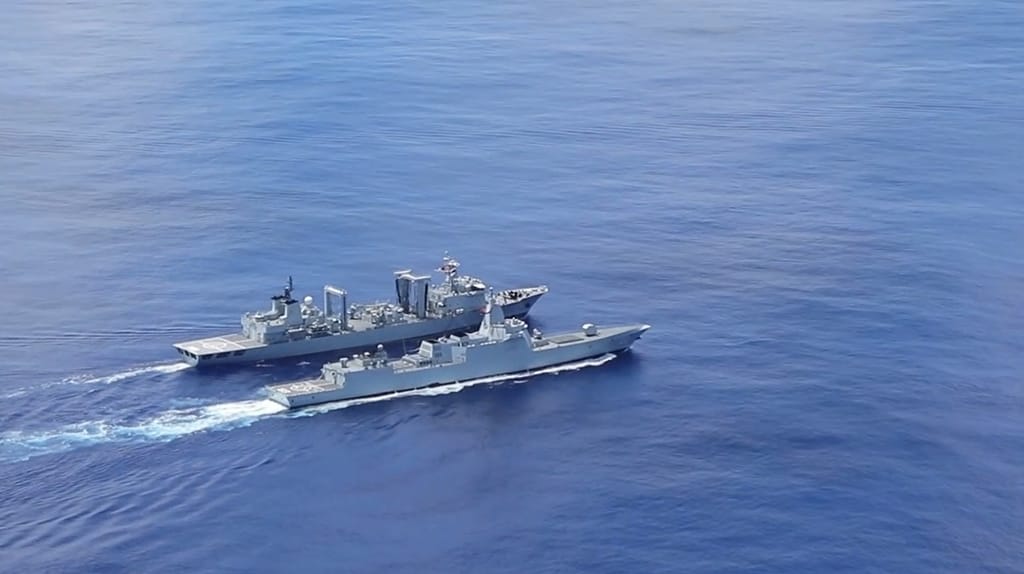
UNREP in progress during a joint Russian-Chinese exercise, Aug 2026 (PLAN)

Published Aug 9, 2026 1:01 PM by The Maritime Executive


Ships from the Chinese PLA Navy (PLAN) North Sea Fleet and Russia’s Pacific Fleet have completed their annual presence exercise in areas off Japan and Taiwan as an act of joint solidarity.

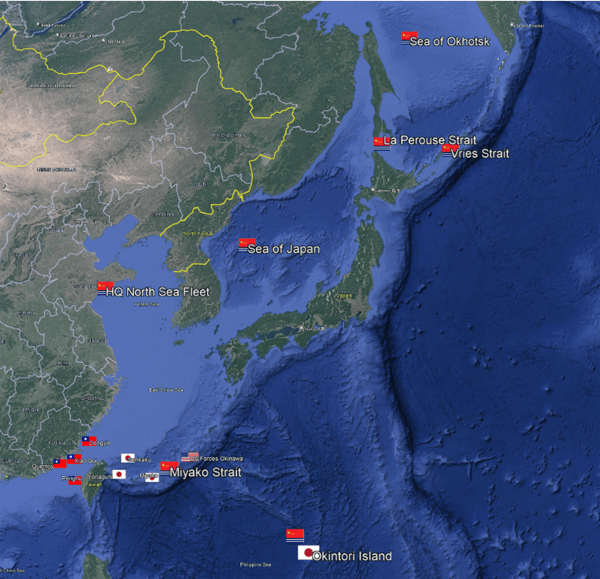
The 16-day patrol set off from the headquarters base of the PLAN North Sea Fleet at Qingdao, in Shandong province, on July 13. The flotilla appear to have circumnavigated Japan, cruising as far south as Okinotori Island in the Western Pacific, where the flotilla conducted a naval gunnery exercise, and as far north as the Sea of Okhotsk. The route took in the Miyako Strait, between Okinawa and the Japanese islands off the eastern coast of Taiwan, passed the heavily-disputed Senaku Islands belonging to Japan, but appears to have avoided the Strait of Taiwan. There does not appear to have been any attempt to monitor or interfere with the US Pacific Command’s Exercise RIMPAC 2026 mounted from Hawaii and which ended on July 31. RIMPAC 2026 involved 30 nations, more than 30 surface ships, five submarines and 15 national land contingents.

The PLAN vessels deployed were the Type 052DL destroyer PLANS Kaifeng (D124), the Type 055 destroyers PLANS Anshan (D103) and the Type 903A replenishment ship supply ship PLANS Kekexilihu (K903). The Russians participated with the Steregushchiy Class corvette RFS Rezky (F343). It is not clear if either the Kilo-II Class submarine RFS Ufa (B588) or the PLAN Yuan Class diesel-electric submarine which had participated with the other ships in the preceding Exercise Joint Sea 2026 accompanied the flotilla. But the Russian Slava Class missile cruiser RFS Varyag (D11) appears to have gone straight home to Vladivostok from Qingdao at the end of the exercise.

The PLAN symbols mark the sea areas patrolled by the joint Sino-Russian flotilla (Google Earth/CJRC)

This was a particularly important deployment for the Russian Navy, firstly demonstrating the solidity of their military alliance with China, at a time when the war in Ukraine is not going well and there is a need therefore for moral support. It is also now one of the only areas in the world where the Russian Navy can exercise with all its previous pride and hauteur, without being threatened by the Ukrainians – at least for now. 

For the PLAN, the exercise is important as well. Although modernizing and expanding at a very rapid rate, the PLAN’s naval expertise and skills inevitably lag some way behind, as new ships and new crews acquire sea-going experience. The opportunity therefore to conduct a medium-range patrol, though sensitive areas and presenting challenges requiring good command judgement, is a valuable learning experience. Nonetheless, the PLAN has some way to go before it can match the USS Abraham Lincoln (CVN-72)’s 210 consecutive days at sea, largely whilst also conducting combat operations.


COSCO Car Carrier Catches Fire off Costa Rica, 22 Seafarers Rescued

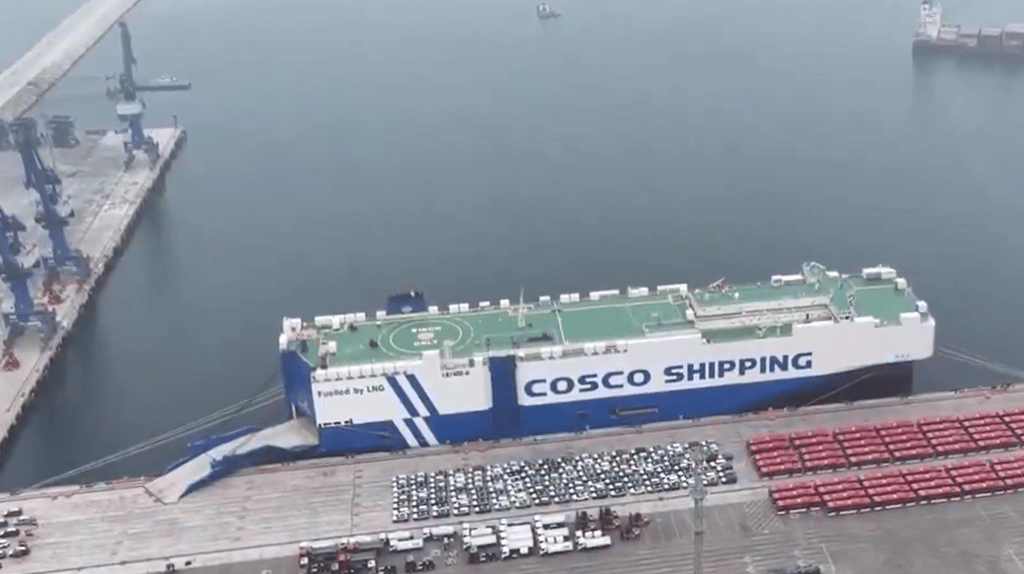
Min Jiang Kou (file image courtesy China COSCO)

Published Aug 9, 2026 1:40 PM by The Maritime Executive


Last week, two good Samaritan ships rescued the crew of a burning car carrier in the Eastern Pacific, far from shore. 

At about 1300 hours on Thursday, the U.S. Coast Guard received a distress signal over Inmarsat GMDSS from the Min Jiang Kou, a Chinese car carrier located about 600 nm southeast of Costa Rica's Pacific coast. The vessel was nearing the end of a  Pacific crossing from Tianjin, headed southeast towards Manta, Ecuador. The vessel's crew reported an engine room fire on board the vessel. 

The Coast Guard got in touch with the shipmanager, who reported that the crew had used the CO2 flooding system for the engine room in an attempt to extinguish the fire. This appeared to work at first, but as a precautionary measure the Coast Guard reached out to nearby merchant shipping using the AMVER system to request assistance. 

At about 2330 on Thursday night, Min Jiang Kou's crew reported that smoke aboard the vessel had increased. The master directed the crew to abandon ship into the lifeboats, but remained aboard himself to monitor the situation. 

Two good Samaritan vessels, the bulker Jin Hai Ping and tanker Degu, answered the Coast Guard's request for assistance and arrived shortly on scene. Jin Hai Ping recovered the 22 crewmembers from the lifeboats and brought them all safely aboard by 1220 hours Friday afternoon. The merchant ship will deliver all of them to shore upon her arrival at Akita, Japan.

The vessel is coordinating with American salvor Resolve Marine on next steps for a safe recovery.

"The willingness of fellow mariners to answer a distress call reminds us of the extraordinary commitment the maritime community shares to protecting life at sea," said Capt. Jessica Davila, Southwest District chief of incident management. "This rescue highlights the strength of international partnerships, and the vital role coordination plays in ensuring mariners in distress receive timely assistance."


Saudi Arabia’s RSGT Considers Bid for Port of Cape Town

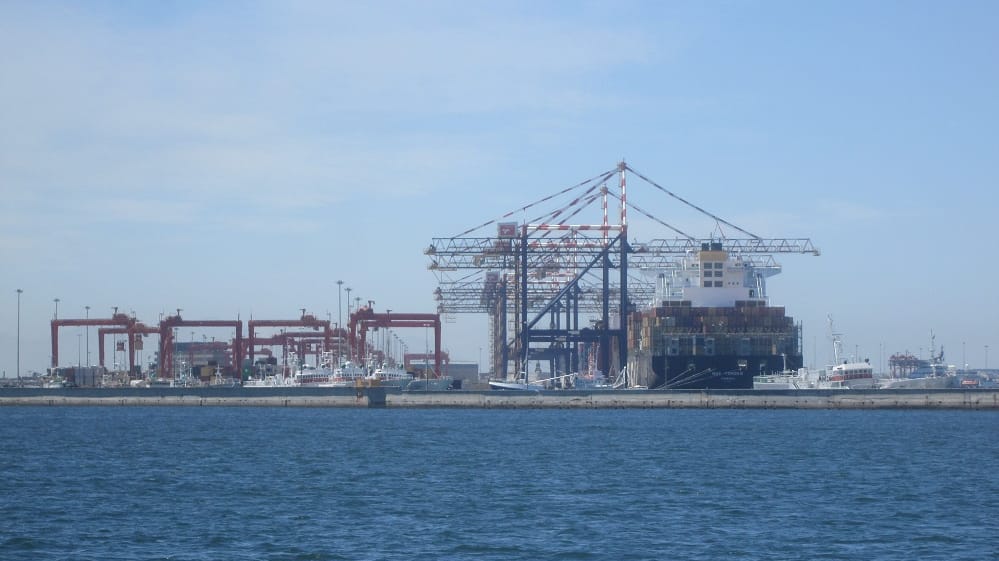
Port of Cape Town (file image courtesy Harry Valentine)

Published Aug 9, 2026 7:33 PM by The Maritime Executive


In its ongoing international expansion, Saudi Arabia’s Red Sea Gateway Terminal (RSGT) is planning to enter the South African port market. The operator is reportedly evaluating a bid for the Duncan Dock Precinct, one of the two multi-purpose terminals at the Port of Cape Town. This facility is one of the port’s 11 privately operated terminals but its concession is due to expire next year.

Last month, Transnet National Ports Authority (TNPA) issued a request for proposals (RFP) to appoint a new operator for the terminal. The terminal covers about 30 acres, and the concession would last for 25 years.  

TNPA held a briefing session last week, which attracted major global operators. RSGT is one of the firms that joined the meeting. The operator’s director of global investments Gagan Seksaria told Bloomberg that attendance in the meeting was to evaluate participation in the upcoming bid. In the past year, RSGT has been making inroads in the African port sector as countries in the continent lean towards private investors for maritime development.

In South Africa for instance, the government has accelerated port privatization to supercharge upgrades. Durban Pier 2, Transnet’s biggest container terminal, is now under the stewardship of International Container Terminal Services Inc. (ICTSI), which has pledged to invest over $680 million to boost capacity. There are already some notable improvements in Durban Pier 2, with recent Transnet data showing that quay crane moves per hour have climbed from 18 to 28.

These positive changes saw Transnet Port Terminals move a record 100,158 TEU in a single week early in the year, the highest ever weekly container throughput in South Africa. However, this single week record does not diminish structural pressures still facing major container terminals in South Africa. Recent data from Southern African Association of Freight Forwarders (SAAFF) shows that vessels calling at Durban Gateway Terminal (DGT) experienced an average of 80 hours at anchorage in July as congestion intensified at the Port of Durban. By July 31, there were about 28 vessels at anchor awaiting berthing at the port.

Meanwhile, South Africa has doubled down on efforts to become a global destination for ship repair services. Last week, TNPA issued a request for proposals (RFP) for a private partner to build and operate a floating dry dock at the Port of Cape Town under a 25-year concession. TNPA said that the RFP is in response to a growing demand for ship-repair services, with Cape of Good Hope now an important route for merchant shipping. The request also comes days after Port of Durban’s Prince Edward Graving Dock received one of the largest vessels to use the facility in a decade.


Houthis Escalate Attacks and Strike Lower Red Sea Ports

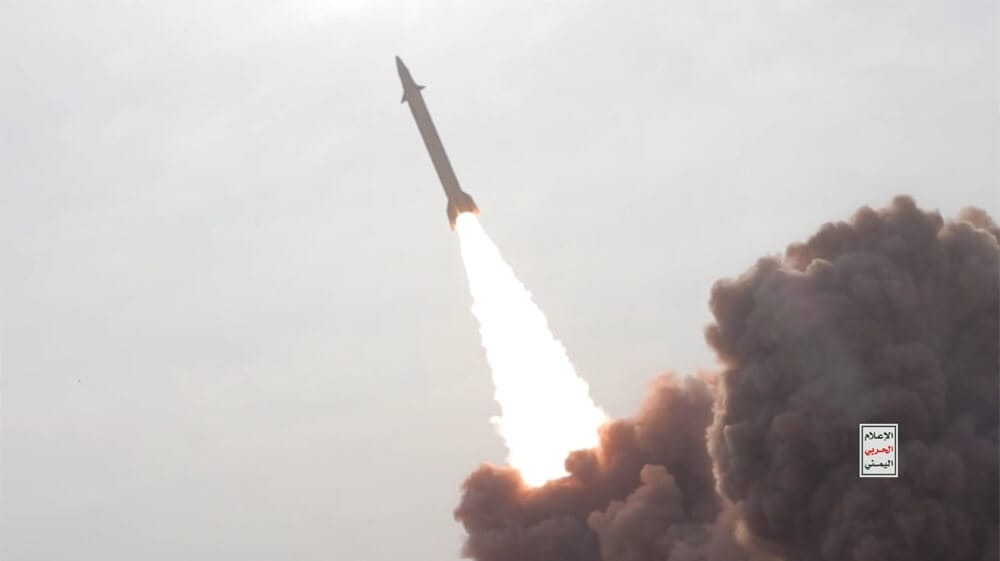
Houthi missile launch
File image courtesy Houthi Military Media

Published Aug 9, 2026 5:27 PM by The Maritime Executive


For several months, the Houthi have been preparing the population of the areas they control in north Yemen for renewed conflict with Saudi Arabia.

The Houthi leadership has unconvincingly attempted to pin the blame for this escalation on the Saudis, but the reality on the ground is that the Saudis have not initiated offensive action, and indeed have been remarkably restrained in the face of provocations from the Houthis. The increasingly bellicose rhetoric from Houthi leader AbdulMalik Al Houthi over the last two months has made reference to Iran’s struggles and to the plight of Gaza, but his verbal firepower has been reserved primarily for Saudi Arabia - from whom the Houthis are seeking greater concessions in negotiations which have been dragging on for some time to bring about a final settlement to the Yemeni civil war, which began in 2014.

Negotiations under Omani mediation have been going on since 2022, but have now reached an impasse. The Houthi escalation is designed to extract a $14 billion financial subsidy from the Saudis, an end to the UN-enforced blockade of Houthi areas of Yemen, and to force the Internationally Recognized Government (IRG) of Yemen to share oil revenues from oilfields in Yemen, which the IRG retains control of.

If the Houthis think they can force the Saudis and the IRG to offer concessions, then they are likely to be mistaken. The Saudis cannot afford to face a threat from Yemen now that the Strait of Hormuz is closed, and the IRG has grown in confidence now that the separatist threat from the Southern Transition Council has been neutralized. Both the Saudis and the IRG are confident they can handle the Houthis, and to make sure, the Saudis have initiated a maritime coalition to keep the Red Sea open, and formed a military alliance with Pakistan and Turkey to come to their aid.

Nonetheless, the Houthis are not yet deterred from their escalatory course of action.

Attacks which have resumed against shipping in the Red Sea have continued. In the last week, the Dominica-flagged products tanker Daisy (IMO 9516545) transiting the MSTC westwards in the Gulf of Aden on August 5 spotted an explosion close by, but continued on to Djibouti. The Houthis claimed to have fired ballistic missiles at the Saudi Arabia-flagged tanker NCC Wafa (IMO 9688348) off Yanbu on August 8, with unknown results. The oil refinery at Jizan was attacked again on August 9.

But the Houthi attacks have also spread to targets on land, where they have initiated offensives on four fronts: in Sadah and Al Jawf in the north along the border with Saudi Arabia, in the Marib oil field area, on the fragile front line around Taiz, and lastly – of most significance to mariners – along the coastline south of Hodeida which is controlled by the IRG and garrisoned by National Resistance Forces led by General Tariq Saleh.

As part of the attacks on the coastal strip south of Hodeida, the port city of Mocha was the subject of a sustained drone attack on August 8 which caused considerable damage to the civilian port structure. Further north, the fishing and trader boat port of Khawkhah was attacked. The Houthis have also attempted to advance from positions they hold in the mountains to the east of the coastal strip held by the IRG.

When breaches of the ceasefire have occurred since March 2022, they have tended to be short-lived and confined to one sector. But there now appears to fighting on all four major frontline areas, with the IRG counter-attacking vigorously. It appears that the Houthis want to bring the four-year-old ceasefire to an end, and having been prodded and provoked, the forces of the IRG are now responding in kind.

In such circumstances, the Houthis are likely to abandon the Saudi-only caveat that theoretically applied to their attacks on shipping in the Red Sea and Gulf of Aden, and the threat is now likely to become more general in character. However, traffic on the Bab el-Mandeb Maritime Security Transit Corridor on August 9 appeared if anything to be heavier than last week.

The opinions expressed herein are the author's and not necessarily those of The Maritime Executive.


Wrecked Tanker Continues Uncontrolled Oil Discharge off Oman

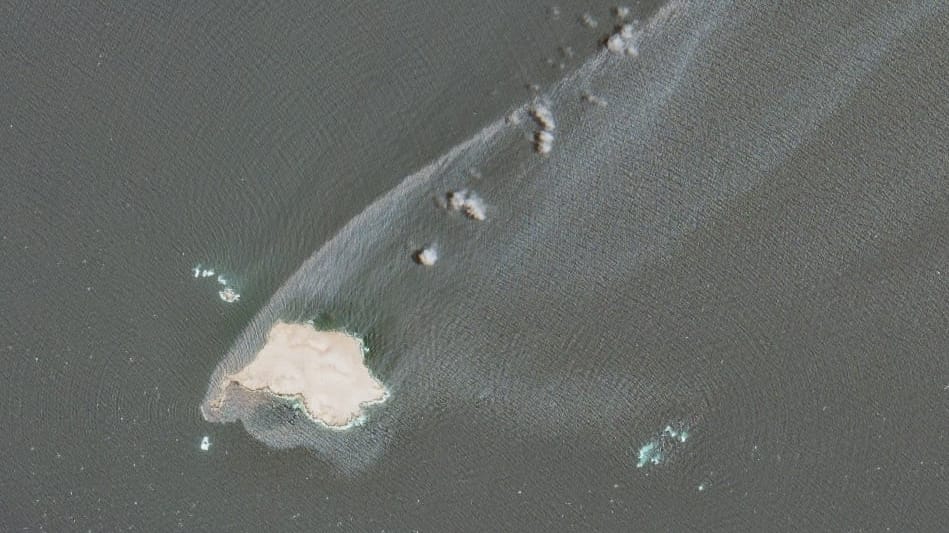
The spread of the oil plume from the Caroline Bezengi wrecked on Jazirat Al Qibliyyah, as seen on August 7 (Sentinel-2b/CJRC)

Published Aug 9, 2026 3:27 PM by The Maritime Executive


Oil is continuing to flow from the wreck of a Russian dark fleet Suezmax, the Cameroon-flagged Caroline Bezengi (IMO 9224439), beached on rocks off Jazirat Al Qibliyyah on the Dhofar coast of Oman.

The Caroline Bezengi was hit by an explosion on June 8 while off the coast of Oman. The tanker had completed a transit of the Suez Canal on May 30 and had left the Maritime Security Transit Corridor when the explosion occurred. The crew was taken off without injury some four days later, and the tanker subsequently was driven onto the rocks on the southwest tip of Jazirat Al Qibliyyah, one of the Hallaniyat Islands off the coast of Dhofar in the south-west of Oman. The tanker was laden with oil taken on board at Novorossiysk and was destined for Gujarat. The tanker has a past association with Russian state ship-owner Sovcomflot, and had been sanctioned by the EU, UK and US (OFAC).

The position of the ship does not appear to have shifted in recent days, despite having settled and developed a more pronounced list since it came aground. Nor from the imagery resolution available does it appear that the ship has broken up to any degree, although it is exposed to heavy seas in the Khareef monsoon which normally prevails at this time of year.

Although the Khareef brings rain to the Dhofar area, transforming the desert into a spectacularly lush and beautiful green landscape, at sea the winds and waves can be strong, and offshore islands are often isolated for the duration. While the ship appears still grounded on rocks forward, there are outcrops to port which could also catch the ship if it shifted. There are also exposed rocks 500 yards off the stern of the ship.

There is no indication as yet that the registered owners of the Caroline Bezengi have accepted their responsibility under UNCLOS for the clean-up. The Cameroon-flagged tanker is apparently owned by Rentoor Ship Management based in Huangpu Qu, Shanghai, and their reluctance to answer the telephone and step forward is likely to be a consequence of the tanker being under-insured. It is common for Russian dark fleet tankers to have no insurance whatsoever and to operate with fake insurance certificates.

Another issue for the Omani authorities may be that expert salvors who have the expertise to unload the cargo may be reluctant to become involved in a project to remediate a ship that is sanctioned by the US Treasury’s OFAC. This problem would dissipate if the Omani authorities took action to formally sequester the ship and its cargo, in a manner which the US Treasury has done for Russian dark fleet tankers which have been seized off Venezuela and elsewhere.

Experienced ship salvage experts examined the wreck on July 12, and identified a feasible plan for offloading the cargo via a 1,000 yard pipeline to a receiving tanker anchored in safer waters in the lee of the island. The tanker potentially could be refloated as it was lightened. But as there has been crude leakage into ballast and also into the double hull spacing, there is a risk of an on-board explosion from fumes during a salvage operation, as well as continuing risk that the wreck will break up in heavy weather.

From Sentinel-2 satellite imagery obtained Friday, taken at better than 10m resolution on a cloudless day, there appears to be no salvor or patrol vessel keeping watch over the wreck, nor conducting preliminary salvage activities.

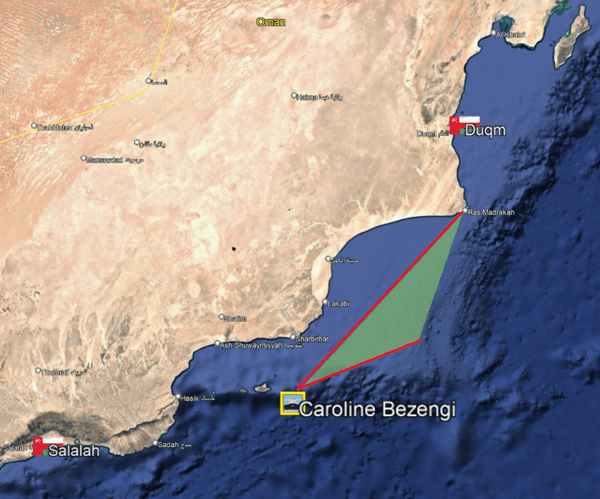
It also appears that the oil plume is moving in a more north-easterly direction, such that the bulk of the oil will miss the coast between Sharbithat and Ras Madrakah. Instead, the oil is skirting Ras Madrakah and flowing into the North Arabian Sea, an area from where the US Navy is maintaining its blockade of Iranian ships and ports. This is good news for nesting turtles coming ashore to lay eggs along this coastline, but bad news for petrel sea birds and rare Arabian Sea humpback whales, for whom this area of sea is a prime and protected habitat.

An approximate depiction of the spread of oil from the Caroline Bezengi, as seen on August 7.  The northern edge of the oil plume now is edging Ras Madrakah, with the bulk of the plume heading for the Northern Arabian Sea (Google Earth/CJRC)

The Caroline Bezengi appears to have been a victim of a limpet mine attack, possibly orchestrated by Ukraine. A limpet mine would most likely have been placed on the ship since it left Novorossiysk, and while at anchor. Ships customarily anchor while waiting to enter the Suez Canal, but also often do so to complete exit procedures at As Suways as well.

The Omani Ministry of Transport, Communications and IT in Muscat has been approached on a number of occasions to ask how the salvage operation is proceeding, but no response has been received as yet.

Op-Ed: Strait of Hormuz Tests the Limits of the Law of the Sea

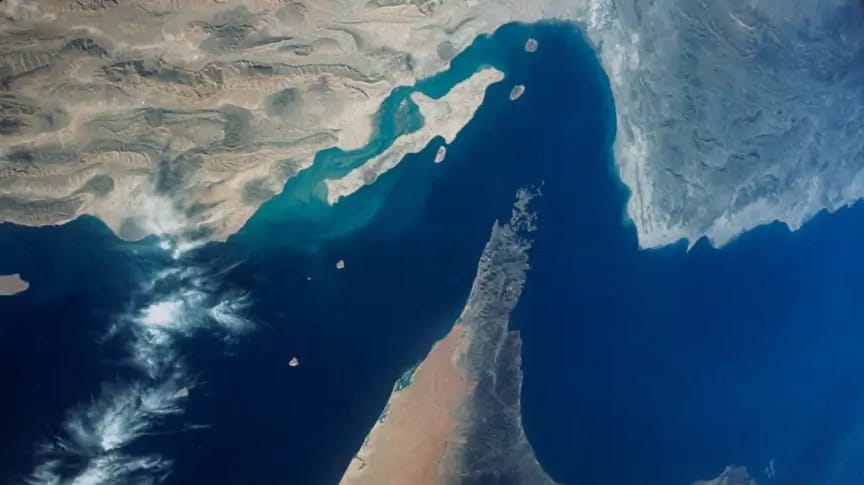
Strait of Hormuz
NASA file image

Published Aug 9, 2026 11:52 PM by Capt. Lefteris Avagianos


Every escalation in the Strait of Hormuz raises the same question: can international law keep one of the world's most important maritime chokepoints open? Renewed military tensions, attacks on commercial shipping, and competing interpretations of the legal regime governing passage have once again placed freedom of navigation under intense scrutiny. 

At the heart of the debate lies a fundamental disagreement. While Iran, a non-party to UNCLOS, maintains that navigation through the Strait is governed by the regime of innocent passage, the United States and most maritime nations regard it as an international strait where the right of transit passage under Article 38 of UNCLOS applies.

The implications extend far beyond the Strait of Hormuz. They raise a broader question about the effectiveness of the international legal order at sea. If one of the cornerstone navigational regimes established by UNCLOS can be openly challenged without an effective enforcement mechanism or automatic sanctions, what does that reveal about the Convention's practical authority?

UNCLOS establishes a comprehensive framework for the peaceful settlement of maritime disputes, but it does not create an international body capable of enforcing its rules or automatically sanctioning violations. Disputes over the interpretation or application of the Convention may be brought before an international court or tribunal where jurisdiction exists, and any resulting judgment is legally binding on the parties. In practice, however, compliance depends far more on the willingness of States to respect those decisions than on any system of coercive enforcement.

Broader enforcement measures may be authorized by the United Nations Security Council under Chapter VII of the UN Charter, but only where it determines that a situation constitutes a threat to international peace and security. Even then, action depends on political consensus among the Council's members, including the absence of a veto by any of the five permanent members.

The challenge, therefore, is not that international law lacks consequences. Rather, its most effective mechanisms are neither automatic nor purely legal. They ultimately depend on jurisdiction, State cooperation and, above all, political will.

Transit Passage vs. Innocent Passage

The legal dispute over the Strait of Hormuz ultimately turns on the distinction between two navigational regimes recognized by UNCLOS: innocent passage and transit passage. Although they may appear similar, they confer significantly different rights on foreign vessels and regulatory powers on coastal States.

Innocent passage, governed by Part II of UNCLOS, allows foreign ships to navigate through a coastal State's territorial sea, provided their passage is continuous, expeditious and not prejudicial to the peace, good order or security of that State. Under this regime, coastal States retain broad authority to regulate navigation in accordance with the Convention.

Transit passage, established under Part III, applies to international straits connecting one part of the high seas or an exclusive economic zone with another. Article 38 guarantees all ships and aircraft the right of transit passage, a right that cannot be suspended by the bordering States. The regime was specifically designed to ensure the uninterrupted movement of international maritime and air traffic while preserving coastal State sovereignty.

The distinction is critical. Whether the Strait of Hormuz is governed by innocent passage or transit passage determines both the rights of foreign vessels and the extent of coastal State control over one of the world's busiest maritime chokepoints.

Competing legal positions

The legal dispute over the Strait of Hormuz is not about geography, but about the interpretation of the legal regime governing navigation through it.

Iran signed UNCLOS but has never ratified it and is therefore not a State Party. It argues that transit passage is a treaty-based right available only to States Parties and that foreign vessels navigating the Strait are therefore subject to the regime of innocent passage. Under this interpretation, the coastal State retains broader authority to regulate navigation through its territorial sea.

Oman, which borders the southern side of the Strait, is a State Party to UNCLOS and generally accepts the Convention as the governing framework. Although it has adopted interpretative declarations concerning the passage of foreign warships through its territorial sea, its overall approach has been pragmatic, balancing navigational rights with regional stability.

The United States, despite not being a party to UNCLOS, maintains that the Convention's navigational provisions relating to international straits reflect customary international law. It therefore regards the Strait of Hormuz as an international strait where the right of transit passage under Article 38 applies—a position shared by most maritime nations.

The disagreement is therefore not merely political. It reflects fundamentally different views of the legal basis governing one of the world's most strategically important waterways. As the Strait of Hormuz demonstrates, international law does not eliminate disagreement between States; it provides the legal framework within which those disagreements are managed.

Does UNCLOS require stronger enforcement?

The Strait of Hormuz exposes a fundamental limitation of the current international legal order. UNCLOS provides a comprehensive framework governing maritime navigation, but it does not create an international authority capable of enforcing its rules or automatically sanctioning violations. Compliance ultimately depends on the willingness of States to respect the Convention and the legal order it establishes.

Whether this is a weakness remains open to debate. Unlike domestic legal systems, international law has traditionally developed through State consent rather than centralized enforcement. Compliance is encouraged through diplomacy, judicial decisions, reciprocal State practice, economic interests and the reputational costs of disregarding internationally accepted legal norms.

For the maritime industry, this is far more than a theoretical legal debate. Shipowners, operators, charterers, insurers and P&I Clubs make commercial decisions every day on the assumption that internationally recognized navigational rights will be respected. Freedom of navigation underpins voyage planning, contractual risk allocation, marine insurance and, ultimately, the stability of global supply chains. Periods of legal uncertainty in the Strait quickly translate into operational uncertainty, influencing voyage planning, war-risk assessments, insurance costs and commercial decision-making throughout the shipping industry.

The Strait of Hormuz therefore illustrates more than a regional dispute over navigational rights. It demonstrates that the effectiveness of UNCLOS depends not only on its legal provisions, but also on the continued willingness of States to recognize those provisions as the common rules governing international navigation. As geopolitical competition intensifies, that consensus may face increasing pressure.

Whether UNCLOS requires stronger enforcement mechanisms remains an open question. Equally important, however, is whether the international community can preserve the consensus that has sustained the Convention for more than four decades.

Conclusion

The legal debate surrounding the Strait of Hormuz extends well beyond a regional dispute over navigational rights. It highlights a broader challenge facing international maritime law: legal rules are effective not simply because they exist, but because States are willing to recognize and apply them consistently.

For more than four decades, UNCLOS has provided the framework on which international shipping has relied. Although disagreements over its interpretation are inevitable, the Convention continues to function because the overwhelming majority of maritime nations accept it as the foundation of the modern law of the sea.

The Strait of Hormuz serves as a reminder that the strength of UNCLOS has never rested on automatic sanctions or coercive enforcement. It has rested on a shared commitment to a common legal order at sea. If that consensus weakens, the consequences will extend far beyond the Gulf. They will be felt across global shipping, where legal certainty remains one of the industry's most valuable assets.

Capt. Lefteris Avagianos is a shipping professional and former Master Mariner. He is a graduate of the World Maritime University's Postgraduate Diploma in Marine Insurance Law and Practice and is currently pursuing an LLM in Maritime Law at The City Law School, City St George's, University of London. He also serves as a member of the United Nations Division for Ocean Affairs and the Law of the Sea (DOALOS) Pool of Experts for the Fourth Cycle of the World Ocean Assessment and is an Associate Fellow of The Nautical Institute. His professional interests include maritime safety, seafarer welfare, the social status of seafarers, and the practical application of international maritime law.

The opinions expressed herein are the author's and not necessarily those of The Maritime Executive.


Smugglers Attempt to Ship Meth From Germany to Australia Inside Car Parts

A transmission filled with 13 kilos of meth rather than gears (AFP)

Published Aug 9, 2026 9:25 PM by The Maritime Executive


Australian authorities have charged two men with trying to smuggle methamphetamine into the country in a shipping container of car parts last month. The unusual routing of the shipment - from Europe into Australia - is a sign of the exceptional demand for stimulants on the Australian market, and the profitability available for smugglers. 

On July 27, Australian Border Force officers were examining a shipping container of car parts and decided to give a closer look to a vehicle transmission in the consignment. X-ray examination revealed abnormalities, and when officers opened it up to look, they found five plastic bags filled with a white powder. The substance tested positive for methamphetamine - 13 kilos of it, worth about AUD$1 million per kilo.  

The ABF handed it over to the Australian Federal Police (AFP) for further investigation. AFP officers replaced the drugs with similar bags of an inert substance and sent the shipment on its way, under monitoring. The final destination was an industrial facility in a Sydney suburb. 

The AFP alleges that an 18-year-old man gave false information to collect the consignment, then pulled the "dirty" transmission out of the container and moved it to a location in the adjacent community of Greystanes. At that location, the 18-year-old provided the transmission to a 41-year-old man, the AFP claims. 

The 41-year-old individual was arrested at the scene. The teenager attempted to flee, AFP alleges, but was caught shortly in a foot chase. A third man escaped from the scene. 

The 41-year-old man faces charges of importing a commercial quantity of methamphetamine, and both face a charge of attempting to possess. These charges all carry a maximum sentence of life in prison. 

"Organized crime groups are constantly evolving their concealment techniques, but so too are our intelligence, targeting and detection capabilities to stay ahead of these methodologies," Superintendent Patwardhan said. "ABF officers use targeted, intelligence-based profiling to identify high risk imported consignments, and sophisticated technology to inspect them for any irregularities."

Australia has a higher demand for cocaine and methamphetamine (per capita) than anywhere else, and the drugs command a high price. The shipment intercepted on July 27 originated in Germany - itself a high-value drug market, ordinarily a destination rather than a point of origin - before making its way across the seas to Australia, where it would be worth even more.