Monday, August 10, 2026

‘It Is a Warning’: Super El Niño Pushed Ocean Temps to Hottest on Record for July

New data from Copernicus Climate Change Service, said one campaigner, shows that the “natural systems we depend on are being pushed closer to their limits.”
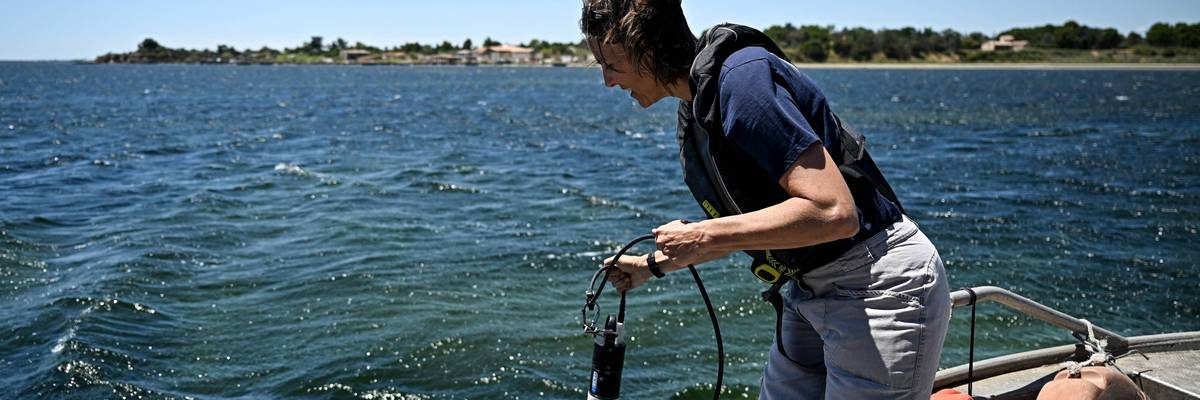


A researcher analyses temperatures and oxygen levels of the waters of the Etang de Thau, off Sète, France on July 2, 2026.
(Photo by Gabriel Bouys/AFP via Getty Images)

Jake Johnson
Aug 10, 2026
COMMON DREAMS

Last month’s average global ocean surface temperature was the hottest ever recorded in the month of July, fueled in part by uniquely intense, fossil fuel-driven El Niño conditions that have wreaked deadly havoc around the world this summer.

The European Union’s Copernicus Climate Change Service (C3S) said Monday that last month—which ranked as the second warmest July on record—“saw exceptionally high temperatures for the month across a large portion of the tropical Pacific, an area where El Niño conditions are present and forecast to further strengthen in the coming months.” Average global sea surface temperatures (SSTs) were 20.96°C last month, surpassing the July 2023 record of 20.89°C.

“Around Europe, SSTs reached record highs for July along the Atlantic coast and western Mediterranean, associated with widespread strong or severe marine heatwave conditions,” C3S said.

Brian O’Donnell, director of the Campaign for Nature, said the latest Copernicus data “is more than another climate milestone; it is a warning that the natural systems we depend on are being pushed closer to their limits.”

“Governments have become very good at documenting these records. Now they need to become much better at safeguarding the forests, wetlands, and oceans that help regulate the climate and protect communities from the impacts of warming world,” said O’Donnell. “With land and ocean temperatures across Europe breaching records, governments should be investing far more and delivering on their global commitment to protect at least 30% of land and ocean by 2030.”

The new analysis was released as western Europe and other regions faced deadly heat, wildfires, drought, and other extreme weather as the international community, including the US and other leading polluters, fails to rein in fossil fuel use—and as oil and gas giants reap record profits.

“Our leaders’ response has to be swifter and stronger than El Niño,” Anne Jellema, executive director of the environmental group 350.org, said Monday. “We already know that global heating is supercharging extreme weather damage, and the public wants polluters to pay for it. With Big Oil’s earnings skyrocketing while a global food crisis looms, now is the time to act. The only way to stave off a humanitarian disaster is to make those causing it pay upfront—before even more damage is done.”

Scientists have characterized this year’s El Niño, which officially began on June 11, as historically strong and dangerous, earning it the informal “Super El Niño” label.

The Washington Post reported Monday that the 2026 El Niño is “on track to become the strongest ever recorded, with cascading effects on global climate peaking late this year and into next.”

“El Niño’s effects have already been felt around the planet,” the Post observed. “The higher frequency of heat domes worldwide, the nonstop temperature records in Peru and deadly storms in Chile can all be linked to this pattern. As can the destructive typhoons in the western Pacific Ocean and the relative calm of the Atlantic hurricane season so far.”

United Nations Secretary-General António Guterres warned in remarks to reporters last month that El Niño is no longer just “on our doorstep.”

“It is inside the house—and turning up the heat,” said Guterres. “We have already endured a summer of extremes—record-shattering heat domes, apocalyptic wildfires raging in Spain, France, and far beyond. Thousands of lives lost in the scorching conditions.”

“But according to the latest science,” he added, “this is only a warm-up act.”
Scale of Trump’s Raid on National Parks Funds for White House ‘Vanity Projects’ Revealed

“The National Park Service is being used as a piggy bank,” said one critic.


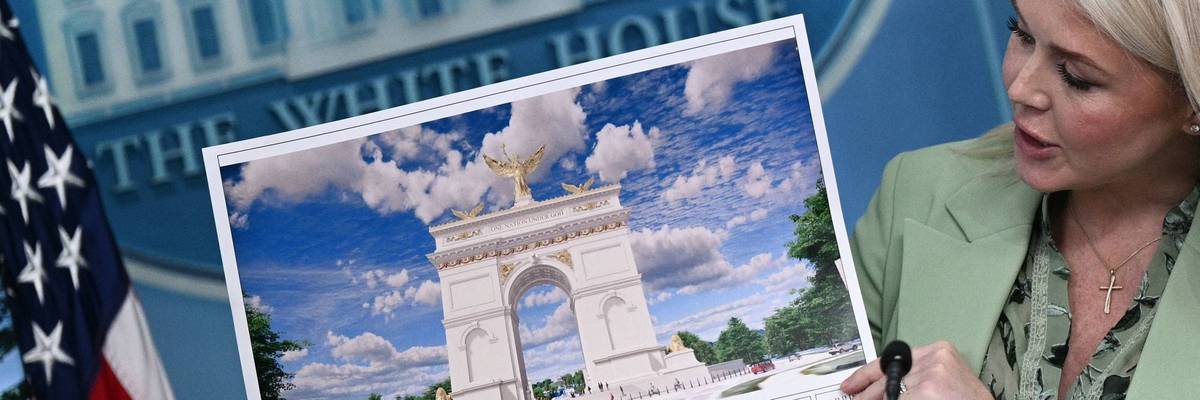
White House Press Secretary Karoline Leavitt shows an artist’s rendering of US President Donald Trump’s planned Triumphal Arch in Washington, DC, on April 15, 2026.
(Photo by Brendan Smialowski/AFP via Getty Images)


Brad Reed
Aug 10, 2026
COMMON DREAMS

Internal documents from the US National Park Service reportedly show that massive sums of money have been diverted to fund assorted projects commissioned by President Donald Trump.

According to a Sunday report from journalist Scott MacFarlane, NPS records show that $323 million has been rerouted to fund projects on the White House grounds this year alone, representing an increase of nearly 5,000% from the amount spend on such projects in 2024.

Additionally, the documents show NPS allotted nearly $100 million for projects on the Washington National Mall, a tenfold increase on the amount spent two years ago.

At the same time, the records show “multimillion-dollar reductions” in funding for several famous national parks, including Yellowstone, Yosemite, and Grand Canyon.

In fact, the total spending for projects at the White House and National Mall is larger than the combined spending at nine of the largest US national parks, MacFarlane found.

One anonymous federal employee who spoke with MacFarlane said that the spending shifts documented in internal records are “part of a pattern of the National Park Service being forced to prioritize Trump’s vanity projects over our own needs.”

Tim Whitehouse, executive director of Public Employees for Environmental Responsibility, similarly argued that “the National Park Service is being used as a piggy bank for Trump’s vanity projects,” which he said was “costing the American people.”

Some Democratic critics of Trump pounced on the report, which they said was the latest example of the president corruptly wasting taxpayer dollars.

“Let’s ask the American people,” wrote Democrats on the US House Ways and Means Committee in a social media post, “would you rather have your nearest national park preserved and protected or another monument to Trump?”

Sen. Ron Wyden (D-Ore.), whose state has been hit by devastating wildfires this summer, accused the president of “raiding wildfire prevention funding to pay for his vanity projects.”

Fred Wellman, a Democratic candidate for the US House of Representatives in Missouri, said that “Trump and his complicit Republican Congress have been robbing us to gild statues and build his private home without any oversight or approval.”

“This is theft on a grand scale,” Wellman added, “and all of us are paying for it.”
A Strait of Hormuz Fee Is the Price of Trump’s Dumb, Illegal War

The Trump administration may not like paying for the privilege of using the strait, but its decision to go to war in the first place created the situation the United States is now in. Bad policies have unintended consequences.


A photo illustration taken in Nicosia on May 4, 2026, shows a person in front of a large screen displaying vessel movements in the Strait of Hormuz on a ship-tracking website.
(Photo by AFP via Getty Images)

A Strait of Hormuz Fee Is the Price of Trump’s Dumb, Illegal War

The Trump administration may not like paying for the privilege of using the strait, but its decision to go to war in the first place created the situation the United States is now in. Bad policies have unintended consequences.

Daniel R. Depetris
Aug 10, 2026
Responsible Statecraft

In the weeks since the US-Iran Memorandum of Understanding collapsed, Washington and Tehran have used the time to strengthen their respective positions in the event negotiations resume.

For the United States, this has largely taken the form of overt threats by President Donald Trump himself and hints that an even more comprehensive US bombing campaign against Iranian strategic targets is on the table. For Iran, the strategy is familiar: ensure maritime traffic through the Strait of Hormuz is kept to an absolute minimum.

US and Iranian officials continue to give conflicting accounts of where negotiations stand. Despite Trump’s repeated declarations that Tehran is begging for a deal, the Iranians stress no talks are occurring with the United States. Still, both sides seem to agree that any pending agreement will center on the Strait of Hormuz, the strategic waterway that the Islamic Revolutionary Guard Corps has proved capable of shutting down at will.

Various schemes have been proposed between Iran and Oman, the two countries on either end of the strait. While a deal is not finalized, Iran will most certainly retain more power over the strait’s traffic than it did before the war began in February.

The question now is whether tolls or fees will accompany any arrangement worked out between Tehran and Muscat. The Trump administration is dead set against acceding to any fee structure because it would provide the Iranian government with additional revenue and represent visible proof that Trump’s preventive war was a strategic mistake. Referring to the Strait of Hormuz, Secretary of State Marco Rubio reiterated the US position in July: “If we create a precedent in the Middle East where a nation-state can decide that they are going to control an international waterway, charge a toll…we have created a very dangerous precedent which will repeat itself in other parts of the world.”

Of course, permitting an Iranian toll or fee structure isn’t ideal. Before the war, such a hypothetical would have been difficult to imagine. The strait at that time was free and open, and roughly 120 to 150 ships relied on the route each day to get their products to customers worldwide.

The United States wants Iran to return to this status quo. Yet Iran has no intention of doing so — and to expect otherwise is to be completely ignorant of how events have played out since.

Trump’s war handed Iran the perfect excuse to leverage its geography, and the Iranians didn’t hesitate to do so. Originally, Tehran’s shuttering of the strait aimed to increase the cost on Washington and eventually convince US partners in the region to pressure Trump into ending the war. But over time, the Strait of Hormuz, in addition to Iran’s more aggressive posture toward its neighbors writ-large, has become something far more valuable: a strategic card Iran can play whenever Trump threatens to accelerate military operations.

Re-opening the strait is now as important to the United States as containing Iran’s nuclear program, if not more so. The question is how to do it.

Trump originally tried to pursue this objective through military force, hoping US strikes could degrade Iran’s military capacity to such an extent that the IRGC would have to stop shooting at ships. The strategy overestimated the US military’s power to force a change in Tehran’s strategic calculus and underestimated Iran’s ability to manufacture and launch cheap drones and missiles at scale. Every US strike merely reaffirmed the Iranian government’s belief that the war was existential for them. Instead of capitulating, Iran fought back, targeting vessels that used the southerly route near Oman’s coast and making it clear that heavier US bombing would compel more Iranian attacks on Gulf energy infrastructure.

US military attempts to bring the strait back to its pre-February state have failed and will likely continue to fail. If the Trump administration seeks to extricate itself from a war without end, its best option is to accept a toll or fee structure in the regional chokepoint. Hawks on Capitol Hill would no doubt scream bloody murder, and some of Trump’s own political allies will have a difficult time explaining how such a scheme is appealing. But if the choice is between swallowing fees or endless conflict, then the former is the better option. The Trump administration may not like paying for the privilege of using the strait, but its decision to go to war in the first place created the situation the United States is now in. Bad policies have unintended consequences.

Fortunately, fees in the strait would not be the end of the world.

This wouldn’t be the first time a country located next to a critical trade chokepoint received some form of compensation. The most obvious case is the Strait of Malacca in Southeast Asia, where shipowners contribute to a voluntary fund, administered by Malaysia, Indonesia and Singapore, for navigational assistance, maritime safety, environmental protection and search and rescue. A similar arrangement in the Strait of Hormuz would thus not set a precedent. In fact, shipping companies and the insurance carriers that underwrite them might even view these voluntary payments as in their own interest if it helps prevent even costlier disasters or accidents.

There’s no use brushing the obvious under the rug: US acceptance of Iranian tolls or fees would be an embarrassing acknowledgment that Iran is now a principal arbiter of the strait. Moreover, depending on how high the fees are — Tehran is reportedly demanding 7% of the value of a ship’s cargo — the Iranians would be collecting revenue they wouldn’t have had prior to the war.

But even this scenario is not as dire as many assume. In practice, Iran’s leverage dissipates with every month that passes by. The Gulf Arab states are not sitting still and watching the new status quo helplessly. Rather, Tehran’s neighbors are increasingly adapting to Iran’s machinations by tapping into pipelines that bypass the strait altogether and exploring future projects that make their energy infrastructure more durable and less vulnerable to a single chokepoint.

Saudi Arabia is using its cross-country east-west pipeline to export more crude oil through the Red Sea. While this alternative route remains vulnerable to strikes by the Iran-aligned Houthis and doesn’t fully compensate for the loss of normal traffic in the Strait of Hormuz, it has still allowed the kingdom to avoid shutting down production entirely. Ditto the United Arab Emirates, which is sending more crude through its Fujairah export terminal, located outside the strait. Fujairah’s share of UAE exports increased to 66% in July from 51% a month earlier. Iran’s actions during the war will only reinforce Persian Gulf oil producers’ desire to diversify their routes, reducing Tehran’s ability to obstruct energy flows in the future.

Negotiations on reopening the Strait of Hormuz continue. If there comes a point where fees for passage are unavoidable, then US policymakers should keep a cool head. Ceding the point would be the most efficient way for the United States to remove itself from a foolish conflict at minimal cost.

© 2023 Responsible Statecraft

Daniel R. Depetris
Daniel R. DePetris is a columnist for the National Interest, the Washington Examiner and Newsweek. He is also a fellow at Defense Priorities, a think tank in Washington, D.C. dedicated to introducing more realism and restraint in U.S. foreign policy.
Full Bio >
‘Devastating to Watch’: Texas Democrats Condemn Destruction of Big Bend for Trump Border Wall

“State leadership should be stopping this purely political stunt destroying Big Bend,” said one lawmaker of Republican officials. “They don’t have the courage to stand up to Trump.”


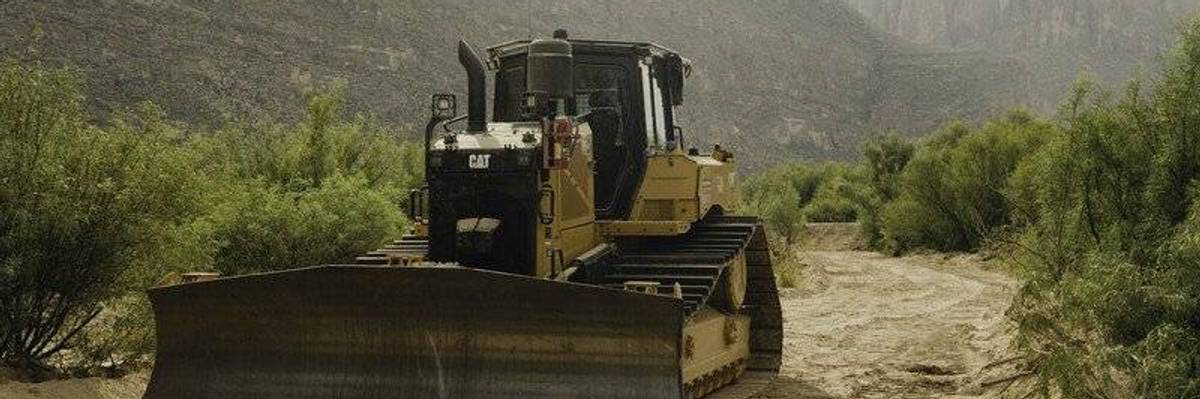
A bulldozer is seen in Big Bend National Park in Texas on August 6, 2026.
(Photo by Natalie Newman/Center for Biological Diversity)


Julia Conley
Aug 10, 2026
COMMON DREAMS

The arrival of bulldozers at Big Bend National Park along the US-Mexico border in Texas to clear native vegetation for an access road for President Donald Trump’s border wall was more than enough to send outrage through the state Democratic Party and advocacy groups last week—but on Monday one lawmaker directed her ire at Republican officials who have done nothing to stop the destruction of one of Texas’ most prized landmarks.

“This is devastating to watch. State leadership should be stopping this purely political stunt destroying Big Bend. They don’t have the courage to stand up to Trump,” said state Rep. Vikki Goodwin (D-47), who is running for lieutenant governor.

She demanded to know whether Republican Gov. Greg Abbott and his government are “fine” with the plan to build 175 miles of the border wall across Big Bend and the Black Gap Wildlife Management Area as well as over 200 miles of patrol roads in the region, following the US Department of Homeland Security’s (DHS) unprecedented waiving of dozens of environmental laws earlier this year.

“If not, stop it from continuing,” said Goodwin.

The state representative was joined by US Rep. Veronica Escobar (D-Texas) in calling out Republicans in the state who have taken no action to stop the bulldozing of a national park which supports thousands of jobs, generated $63.7 million in total economic output in 2024, and is not even a region where a border wall would fulfill Trump’s stated goal: stopping unauthorized crossings from Mexico.

“Ken Paxton, the Texas attorney general, could sue the federal government to stop this,” said Escobar on Sunday. “Greg Abbott, the Texas governor, could fight the federal government to stop this. But neither one is truly willing to fight for the people of Texas.”

The state AG is running for US Senate, while the governor is seeking another term. Escobar said that Paxton and Abbott’s Democratic opponents in the November elections—state Reps. James Talarico (D-50) and Gina Hinojosa (D-49)—would take action to stop the construction of the border wall.

“When I’m governor, I will defend our sovereignty, our land, and our inheritance,” said Hinojosa last week. “Gov. Abbott is either too weak to defend Texas and stop this, or he just doesn’t care.”

As the Center for Biological Diversity (CBD) noted last week, the Big Bend Sector covers more than a quarter of the US-Mexico border, but no unauthorized vehicle crossings have ever been documented in the mountainous region. In 2025, 1.3% of all border apprehensions took place in the area, and in the national park itself, apprehensions accounted for 0.045% of the national total.

“This absurd project is despised by everyone in West Texas,” said Laiken Jordahl, a southwest conservation advocate for CBD, on Saturday. “When will Texas leadership step in?”


All five sheriffs in the Big Bend border region oppose the building of the border well, while county judges in all 14 of the state’s border counties have spoken out against the project and seven former superintendents of the national park wrote to DHS in June, asking them reject waivers of laws including the National Park Service Organic Act, the Endangered Species Act, and the National Wild and Scenic Rivers Act.

As Common Dreams reported in June, the environmental laws were waived as planning documents showed miles of planned barriers to stop vehicles from crossing the border at Big Bend, as well as patrol roads cutting through the park. For some of the construction, such as in remote areas like Mariscal Mountain, extensive dynamite blasting will be required, according to CBD.

In May, DHS awarded a $1.7 billion contract to Southwest Valley Constructors, a subsidiary of Kiewit, as well as contracts to North Dakota-based Fisher Sand & Gravel and Montana-based Barnard Construction.

The chairman of the latter company, Tim Barnard, has contributed millions of dollars to Republican candidates, including $1 million to Trump, High Country News reported in June. Barnard’s largest contract was awarded without competitive bidding.

“We don’t need to give billions of our tax dollars to out-of-state vendors,” said Talarico on Sunday. “We don’t need to desecrate this sacred land. We don’t need this useless, disgraceful, corrupt Big Bend border wall.”
Trump’s Secret $24 Billion Tax on 401(k) Retirement Accounts

In a sane world, Trump would be impeached for such a blatantly illegal scheme. But that’s not the world we currently live in.


“If it’s not clear how Trump’s scheme amounts to a tax on your 401(k), think more carefully,” economist Dean Baker asks readers.
Photo by Towfiqu barbhuiya on Unsplash

Dean Baker
Aug 10, 2026
Beat the Press

You may not have heard about this latest tax from Trump. That could be because he’s not going through Congress to get it. Also, this scam could get buried in the middle of his many other grifting schemes. Trump is starting a new special subscription service to his social media platform, Truth Social, where big investors will pay $100,000 a month for advance access to Trump posts that can move markets.

This means that the next time Trump posts that he will blow Iran off the map and sends oil prices soaring, the people who paid Trump’s fee will have the opportunity to buy oil futures before the jump. The same story applies on the way down, as when he posts that a deal with Iran’s leaders is imminent.

And the inside information goes well beyond oil prices. He may announce a big military contract with Lockheed or one of his sons’ companies, sending stock prices soaring. Or he could announce a big DEI investigation of Disney or some other Hollywood entertainment company, causing their stock to plummet.

There are an infinite number of ways that Trump Truth Social announcements can move markets. This subscription service allows rich investors around the country to get in on the action.

If it’s not clear how Trump’s scheme amounts to a tax on your 401(k), think more carefully. If Trump’s clients get the jump on a big rise in oil prices, that means that they get the money, not you. This is true even if, like the vast majority of small investors, you are not actively managing your funds.

The person who is managing whatever fund(s) you hold will pay the higher price for oil or stock or anything else the funds might buy because Trump’s accomplices got their first. The same applies on the way down. The fund will get less money because the Trump gang already sold the stock before your fund manager had the chance to do so.

At this point, we can’t know how much money is involved because we don’t know how many big investors are prepared to sign up for what is blatantly an insider trading scheme. But we can do some speculation.

First, we need to calculate how much money an investor would expect to make from a service where they are paying $1.2 million a year. Since this scheme would likely lead to civil and possibly criminal charges if the Securities and Exchange Commission (SEC) or Justice Department ever gets taken over by honest people, it seems a very big payoff would be required.

Any person paying Trump for insider information would need to expect substantial legal bills, and also the possibility of being forced to leave the country or face prison time. (Ask Martha Stewart.) Let’s say the payoff has to be at least 20 to 1, which would mean they would need to earn $24 million a year for their Trump Truth Social subscription to make sense.

Then we need to speculate on how many people are prepared to sign up for Trump’s racket. We know Wall Street is a cesspool, but this level of open corruption is probably too sleazy even for most of the big traders. Still, there could be a 1,000 Trump-loving sewer dwellers who don’t mind being open about their thefts.

In that case, the Trump insiders would be siphoning off $24 billion a year from other investors in the market. That is not huge in the context of a $7.5 trillion budget, but it is larger than many things we have big fights over.

For example, the AIDS program for Africa, which saved tens of millions of lives, and Elon Musk eagerly fed into the wood chopper, cost $6 billion a year. That’s roughly a fourth of Trump’s 401(k) tax. The cost of extending the subsidies in the ACA exchanges, which Trump and the Republicans ended, would have been a bit higher at $27 billion a year.

So, 401(k) holders and other small investors are paying a considerable chunk of money through this “tax” to Trump and his enrolled insiders. As I said, this tax is not going to Congress for approval, but we can assume that all the Republicans in Congress approve of it. If not, Trump would be impeached for such a blatantly illegal scheme, but we know the Republican motto: “If Trump Does It, It’s Good.”
ZXMoto leads China’s charge to dominate the global motorbike market

AFP
August 9, 2026
A worker assembles a motorcycle at the ZXMoto factory in Chongqing, southwestern China – Copyright AFP/File WANG Zhao

Zhang Xue wept with joy and furiously waved a Chinese flag as he watched his company’s superbike scream across the finish line four seconds ahead of competitors in only its third world championship race.

That victory at the Supersport World Championship in March saw orders for ZXMoto’s two-wheelers skyrocket and provided a boost for the firm as it battles for an edge in the highly competitive Chinese motorbike market.

The company was founded just two years ago but already rivals leading manufacturers such as Europe’s Ducati and Japanese giants Yamaha and Honda with a bike retailing for a fraction of their prices.

“You have this dream you’ve been thinking about for many years, and when it finally comes true… I was so happy,” Zhang, 39, told AFP at his company’s headquarters in Chongqing.

ZXMoto has doubled its workforce since March and its factory runs 24-hours a day to meet demand, but customers still wait months for orders.

“Chinese brands are very clear about where our future lies,” said Zhang, a former mechanic who claims he can assemble an engine with his eyes closed.

“It has to be global.”

The firm’s flagship 133-horsepower 820RR motorbike — which accelerates from zero to 100 kilometres an hour in 2.8 seconds — sells for around 43,000 yuan ($6,370) in China, at least 30 percent cheaper than foreign rivals.

“Compared to imported ones like Kawasaki, it’s very good value,” said 28-year-old rider Yang, who owns an 820RR.

“First off, we support domestic production, and second, if the product is truly good, we’ll choose it.”

Sales have soared from 25,000 bikes in 2025 to a projected 100,000 this year, with plans to double that figure by 2027 -– a target on par with BMW’s scope.

However, it faces a shrinking domestic market, vicious competition and squeezed profits.


– Fan loyalty –


“Twenty years ago, as long as you produced a motorcycle, even if it didn’t start, people would line up to give you money,” Zhang said.

“Now… If you don’t get serious, you will be eliminated by the market.”

China’s motorbike sales fell 3.4 percent in 2025, and slid again this year as consumers increasingly favour cars or less regulated electric bikes.

In China, Zhang can rely on loyal fans who see him as a symbol of the country’s manufacturing prowess, drawn by his rags-to-riches background.

“Zhang Xue has brought glory to China, so I want to support him,” said Hu Zhaomeng, picking up his gleaming red 500 model from a Chongqing dealership.

But weakening domestic sales are pushing manufacturers like Zhang to seek fatter margins abroad, where consumers have more purchasing power.

Half of the 22 million motorcycles produced in China last year were exported, and nearly all brands are looking overseas.

Zhang hopes to export 40,000 bikes to Europe in 2027, while rival manufacturer Shineray sells 90 percent of its low-end models to South America, Southeast Asia, and Africa.

“The domestic market situation is very ‘juan’,” said Shineray’s overseas marketing head Nie Jianwei, using a Chinese buzzword for extreme competition.

“We are constantly reducing the price of our products to make them more competitive.”

In Chongqing, more than 50 manufacturers and hundreds of component suppliers are able to leverage the booming industry of China’s “motorbike capital”.

“Companies like ZXMoto are emerging from one of the world’s most competitive industrial ecosystems, where rapid iteration, integrated supply chains, and relentless competition yield world-class products rapidly,” said Bill Russo, an expert in China’s automotive industry.


– Prestige and heritage –


Zhang told AFP the city’s cheaper production costs offer Chinese brands “a greater advantage” over Japanese or European rivals.

“They have reached a (technological) ceiling, so they can only wait for me there… the speed of their progress is limited.”

For Russo, “the motorcycle industry today reminds me of where China’s passenger car industry stood roughly a decade ago”.

Chinese auto giants like BYD and Geely eventually out-competed established foreign rivals on price and are increasingly at the industry’s technological forefront.

However, two-wheelers may prove a more resilient market to break into.

“Motorcycles remain more emotionally driven purchases than cars. Heritage, racing history and brand prestige still matter much more, giving established Japanese and European manufacturers a stronger defensive position,” Russo said.

“The gap is closing, but it won’t close overnight.”

Still, momentum is building, and ZXMoto expects to sell most of its production overseas within five years.

Russo expects Chinese brands to establish a larger global footprint through local investments and partnerships rather than exports alone.

With an 800-million-yuan factory opening in late 2027, ZXMoto is on track to become one of the world’s top 10 motorcycle brands by 2034.

“When Japanese products first entered Europe, there was the same reaction, there were many questions,” Zhang said, over the roar of engines being tested.

“But as long as the products are good, one day people will accept and enjoy them.”
China’s Electric Mobility Strategy In South Asia: Opportunities, Dependence And Challenges For India – Analysis

An XPeng electric car showroom at the Taikoo Li Sanlitun shopping center in Beijing, China.
Photo Credit: Raysonho, Wikipedia Commons


August 10, 2026


Key Takeaways:

China has built global EV dominance through massive state investment and now exports an integrated ecosystem (vehicles, batteries, charging and software) that is rapidly penetrating South Asian markets where demand for affordable clean mobility is rising.

Competitive pricing, local assembly arrangements and favourable policy environments in Nepal, Bangladesh, Sri Lanka, Pakistan and others are creating long-term dependence on Chinese technology, standards and supply chains.

For India, this expansion poses both economic and strategic challenges by reducing regional market opportunities and increasing Chinese technological and political influence in its neighbourhood, requiring stronger domestic capabilities and alternative partnerships.

China has rapidly emerged as the global leader in the electric vehicle (EV) industry, and its growing presence in South Asia reflects a broader geopolitical and economic strategy. As of April 2026, Asia became the largest importer of Chinese EVs following a significant increase in Chinese vehicle exports. South Asian countries such as Nepal, Bangladesh, Sri Lanka, Pakistan, Bhutan, and the Maldives have become increasingly important destinations for these exports.

Rather than exporting only vehicles, China is introducing an integrated EV ecosystem that includes batteries, charging infrastructure, software platforms, and digital technologies. This strategy is creating long-term dependence on Chinese standards, technologies, and supply chains, raising concerns over economic vulnerability, technological dependence, and regional security. It also poses strategic challenges to India’s economic and geopolitical influence in its immediate neighbourhood.

China’s dominance in the EV sector is the result of decades of deliberate industrial planning and substantial state support. Between 2009 and 2023, the Chinese government invested more than US$230 billion in developing the EV industry. Public funding, tax incentives, purchase subsidies, scrappage schemes, and performance-linked incentives have accelerated both production and domestic adoption of electric vehicles. China has also invested heavily in charging infrastructure, accounting for approximately 80 percent of the world’s installed charging stations. These measures have enabled China to become the world’s largest EV market, selling around 13 million electric vehicles in 2025, representing nearly two-thirds of global EV sales. This figure is expected to continue rising. Chinese automobile manufacturers such as BYD, SAIC, Geely, Changan, NIO, and Xpeng have expanded their global footprint, while battery manufacturers like Contemporary Amperex Technology Co. Limited (CATL) dominate the international battery market through vertically integrated production systems.


South Asia has become an attractive destination for China’s EV expansion due to a combination of market demand, policy support, and geopolitical circumstances. Unlike Western markets, which have imposed tariffs and regulatory restrictions on Chinese electric vehicles, South Asian countries generally provide more favourable conditions for Chinese investment and exports. Governments across the region are promoting cleaner transportation to reduce fuel imports, lower carbon emissions, and meet climate commitments. Nepal has set ambitious carbon neutrality goals, Sri Lanka aims to achieve net-zero emissions by 2050, Bhutan continues to prioritise environmental sustainability, and Bangladesh has established targets for increasing electric vehicle adoption. These national strategies, combined with rising fuel costs and economic pressures following the COVID-19 pandemic, have accelerated the demand for affordable electric mobility solutions. China has successfully positioned itself as the leading supplier capable of meeting these requirements.

Competitive pricing has been one of China’s strongest advantages in expanding its presence across South Asia. Chinese electric vehicles are generally more affordable than competing models because of economies of scale, lower production costs, integrated supply chains, and cheaper battery manufacturing. In countries such as Nepal, Chinese brands dominate new EV sales largely because consumers find them more affordable and dealers receive higher profit margins. Low battery prices further enhance China’s competitiveness, making electric vehicles more accessible to price-sensitive markets.


Chinese firms are also establishing a local industrial presence in selected South Asian countries through assembly plants, distribution networks, and investment proposals. Pakistan hosts a BYD assembly facility, although local manufacturing remains limited and largely dependent on imported Chinese components. Bangladesh has similarly attracted Chinese interest through its National Electric Mobility Action Plan, with companies exploring battery assembly and distribution operations. However, most activities remain focused on assembly rather than developing indigenous manufacturing capabilities, research, or technological innovation. Existing economic ties and dependence on Chinese investment across various sectors provide Chinese firms with relatively easier market access than many international competitors. Local partnerships also facilitate the integration of software systems, connected charging infrastructure, and digital mobility platforms that reinforce China’s technological ecosystem.

Trade trends indicate that China’s influence in the South Asian EV market has expanded significantly over recent years. Since 2019, both the value and volume of Chinese EV exports to South Asia have grown substantially. Countries such as Nepal and Bhutan import a particularly high proportion of electric vehicles from China, while Sri Lanka has experienced especially rapid growth in Chinese EV imports. Pakistan, Bangladesh, and the Maldives have also recorded steady increases, although Bangladesh’s progress has historically been slower due to limited policy support and lower public demand. Nevertheless, recent policy reforms suggest that Bangladesh is likely to become a larger market for Chinese EVs in the future.

Chinese electric vehicles now account for a dominant share of the EV market in several South Asian countries. Nepal has emerged as one of the strongest examples of Chinese market penetration, while Bhutan has also embraced Chinese electric mobility as part of its environmental strategy. The Maldives remains relatively different because Japanese vehicles and two-wheelers continue to dominate its transport sector, although Chinese participation is gradually increasing. Bangladesh, despite initially lagging behind due to weaker policy incentives and consumer awareness, is beginning to experience stronger demand as government support for electric mobility expands.

For India, China’s expanding EV presence in neighbouring countries carries important strategic implications. Economically, it weakens India’s opportunities to develop regional manufacturing and export markets for electric vehicles and related technologies. Strategically, China’s growing technological footprint strengthens its influence across South Asia and deepens economic linkages that may translate into greater political leverage. The spread of Chinese digital platforms and connected mobility systems may also raise cybersecurity and data governance concerns, particularly as vehicles become increasingly software-driven and digitally connected. Consequently, China’s EV expansion represents not only an economic challenge but also a broader geopolitical development that could reshape regional technological standards, supply chains, and patterns of influence. India will therefore need to strengthen its own EV manufacturing capabilities, expand regional partnerships, and offer competitive technological alternatives if it aims to preserve its strategic position in South Asia.


About Dr. Sharanpreet Kaur
Dr. Sharanpreet Kaur is an Assistant Professor of International Relations at School of Social Sciences, Guru Nanak Dev University, Amritsar (Punjab) and her thrust area of research is India’s Foreign Policy with specialisation in Indo-US Nuclear and Defence Cooperation. She is the author of the book “India’s Soft Power Diplomacy: Prospects, Challenges and Way Forward”. She is also a columnist for The Daily Guardian and has written on issues related to India's Foreign Policy. She has also been the Subject Expert for 5 Social Impact Assessment projects for Land acquisition under Punjab Government and has contributed chapters for Reports regarding the same. She has been actively involved with the Observer Research Foundation (ORF) and Institute for Defence Studies and Analysis (IDSA) and think tanks like Centre for Civil Society and Students for Liberty. Dr. Kaur's research and writing modules include Diplomacy, India's Foreign Policy, Politics of South Asia, Central Asia and West Asia. She has been awarded the Young Researcher Award 2023 by Institute of Scholars (InSc), an ISO certified and registered body under Ministry of MSME and Corporate Affairs. She has also been awarded for her Contribution to Education Community by Women Leaders Forum. She has also been featured among 100 Inspiring Women 2023 by Fox Story India.
View all posts by Dr. Sharanpreet Kaur →
Delhi’s EV Policy Changes The Engine, Not The System – Analysis


August 10, 2026
 360info
By Soumyajit Bhar


Key Takeaways:

Delhi’s new EV policy combines purchase incentives with phased registration bans on conventional two- and three-wheelers and light goods vehicles, prioritising the most intensively used categories that contribute heavily to local air pollution.


Electrification alone is insufficient for a just mobility transition: it risks displacing pollution and resource harms elsewhere, leaving car dependence, congestion and social inequalities intact while placing conversion costs disproportionately on lower-income workers.

A more complete approach would pair cleaner vehicles with reduced private-car dependence, stronger public and shared transport, worker protections, reliable and equitable charging, and attention to the full energy and material supply chain.


At a traffic signal in New Delhi, an electric SUV can wait beside an e-rickshaw and a delivery worker on an electric scooter. All three may be counted as evidence of the same green transition, although they embody very different relationships to mobility.

The SUV offers private comfort and status; the e-rickshaw provides shared transport; the scooter is often inseparable from a worker’s livelihood. To see only three electric vehicles here is to miss the differences in power and vulnerability. This is what technological optimism does: treats a change in the machine as if it were automatically a transformation of the system.


Delhi’s new Electric Vehicles Policy, notified on June 30, and effective from July 1, 2026, is nevertheless a serious intervention. From January 2027, only electric three-wheelers and N1-category light goods vehicles can be newly registered; from April 2028, the mandate extends to new two-wheelers. First-year purchase incentives reach ₹30,000 for electric two-wheelers, and ₹50,000 for e-autos. Electric cars priced up to ₹3 million receive road-tax and registration-fee exemptions, while eligible owners who scrap older cars can receive ₹100,000. The policy also supports charging, battery recycling and government electric buses.

Unlike India’s national PM E-DRIVE scheme, though, the Delhi policy combines incentives with mandatory deadlines.

The policy identifies vehicles as contributing 23 percent of Delhi’s winter air pollution and notes that two-wheelers constitute about 67 percent of its vehicle stock. Prioritising intensively used two- and three-wheelers, goods vehicles and buses is sensible. EVs eliminate tailpipe exhaust, use energy more efficiently and generally produce lower lifecycle emissions than comparable petrol or diesel vehicles.

An India-specific review by the International Council on Clean Transportation and IIT Roorkee supports the immediate adoption of battery-electric vehicles, while showing how strongly the gains depend on the electricity mix and real-world energy use.


The policy is therefore a necessary beginning, but not a mobility transition. Unless Delhi also reduces car dependence, expands accessible public and shared transport, and distributes the costs of electrification more justly, it will remove pollution from the tailpipe while preserving the unequal and resource-intensive system around it.
Disappearing from the tailpipe, not from the system

An electric vehicle has no exhaust pipe, but it remains connected to an energy and material chain. According to the Central Electricity Authority, coal supplied roughly seven-tenths of India’s electricity during 2025–26 up to January. As the grid becomes cleaner, the climate advantage of EVs will grow. Until then, some of the pollution and environmental harm removed from Delhi’s streets is displaced towards coal-mining regions and settlements near power plants.

Similarly, batteries connect clean vehicles to landscapes marked by water depletion, land conflict and unsafe work. The International Energy Agency estimates that over half of current lithium and copper production is concentrated in areas facing high water stress, including lithium-producing regions in Australia and South America and much of Chile’s copper-mining belt. Delhi’s provisions for collection, reuse and recycling are welcome, but end-of-life management cannot guarantee justice at the beginning of the supply chain.

Electrification also leaves the structure of car-dependent mobility largely untouched. An electric SUV occupies the same road and parking space as a petrol SUV, creates the same congestion and can be equally threatening to pedestrians and cyclists. Tyres, brakes and road surfaces continue to generate particulate pollution.

For heavier, longer-range EVs, the OECD estimates that non-exhaust PM2.5 emissions can be 3–8 percent higher than those of comparable conventional vehicles, even though regenerative braking—which captures the energy lost during braking to recharge the EV battery—reduces brake wear. Vehicle weight and total travel therefore matter alongside the drivetrain.


EV registrations can rise even as the total number of vehicles and kilometres travelled rises with them. Delhi registered 709,024 new vehicles in 2024, up from 657,954 in 2023; two-wheelers alone accounted for 448,767 of the 2024 total.

But is dependence on private vehicles falling? Is affordable mobility becoming more widely available? These questions are inseparable from inequality. A tax exemption for a car costing up to ₹3 million benefits households that already possess the income, parking space and charging access required for car ownership. Delivery workers and auto drivers, by contrast, face debt, high interest rates, uncertain resale values, charging queues and earnings lost during charging or repairs.

The government has presented the policy as especially attentive to Delhi’s gig economy, emphasising the lower fuel and maintenance costs of EVs. Yet most of the immediate burden will be placed on individual workers and their families.

Delhi’s Gig Workers Association has asked for interest-free loans, adequate subsidies, affordable charging and battery swapping, social protection and financial responsibility from platform companies. It has also argued that no worker should suffer wage or income losses because of the policy.

Charging infrastructure illustrates the same divide between provision and access. More charging points will not help if they are unreliable, unaffordable or distant from workers and low-income residents. The Institute for Energy Economics and Financial Analysis found that nearly 84 percent of the public chargers examined in its representative Delhi sample were not functioning, primarily because of theft and inadequate maintenance. The policy does ask Delhi Transco Limited to develop service standards, but implementation must measure uptime, affordability and neighbourhood access, not merely installations.

There is also a cultural question that the policy leaves unaddressed. In India, the private vehicle has become a symbol of arrival, autonomy, safety, masculinity and class mobility. An electric SUV can carry the same aspirations and hierarchies as a petrol SUV, now accompanied by the reassurance of being green.

A policy that subsidises electric vehicles while leaving the prestige of private automobility intact, risks decarbonising aspiration without reducing the demand for energy, materials and urban space.
From electric vehicles to just mobility

A more adequate policy would locate EVs within the established “avoid, shift and improve” framework.

Delhi concentrates on improvement: replacing conventional vehicles with cleaner ones. A transition must also avoid unnecessary motorised travel through compact, mixed-use planning, and shift journeys towards buses, the Metro, walking, cycling and genuinely shared mobility.

The Intergovernmental Panel on Climate Change finds that shifting journeys from cars to buses or rail can reduce emissions and costs together. Delhi’s electric-bus commitment is valuable, but electrifying buses is not the same as ensuring that enough frequent, reliable and affordable services reach where working people live. Public expenditure must prioritise access to mobility over private vehicle ownership.


That means linking assistance to income and livelihood needs; providing concessional finance and social protection for workers; requiring platforms to share conversion costs; and ensuring reliable charging beyond gated housing. It also means favouring smaller vehicles, expanding walking and cycling infrastructure, applying parking and congestion measures to electric cars, and accelerating grid decarbonisation.

Delhi can draw on the ambitions of the European Union’s 2023 battery regulation, which moves beyond tailpipe emissions towards carbon disclosure, recycled content, mineral recovery and supply-chain due diligence. However, the EU has postponed the application of its battery due-diligence obligations until August 2027. Evaluation should track not only registrations, but vehicle kilometres travelled, mode share, vehicle weight, charging reliability, subsidy distribution and worker outcomes.

Delhi’s policy is a serious beginning, but its danger lies in allowing technological achievement to substitute for harder choices about public transport, urban space, labour and justice.

A just mobility system would be one in which fewer people are compelled to buy private vehicles, workers do not have to finance change with precarious incomes, and clean air in Delhi is not secured through hidden harm elsewhere.

Unless we also change the system organising mobility, aspiration and inequality, we will have replaced the engine without changing the direction of travel.


About the author and editor:

Soumyajit Bhar is Senior Assistant Professor and Director of the Community Transitions Research Centre at the School of Liberal Studies, BML Munjal University. His work examines consumption, inequality, developmental aspiration, and the social and psychological dimensions of environmental transitions.

Namita Kohli, Commissioning Editor, 360info


About 360info
360info provides an independent public information service that helps better explain the world, its challenges, and suggests practical solutions. Their content is sourced entirely from the international university and research community and then edited and curated by professional editors to ensure maximum readability. Editors are responsible for ensuring authors have a current affiliation with a university and are writing in their area of expertise.
View all posts by 360info →
Satellite Imagery Shows Work Underway On Laos’ Latest Large Mekong River Dam – Analysis


An artist’s rendering of the Pak Beng Dam (www.pakbengpower.com)


August 10, 2026
RFA
By Noh Jung Min


Key Takeaways:

Satellite imagery shows early construction of Laos’ Pak Beng hydropower dam, the country’s most upstream Mekong mainstream project, a Chinese-Thai joint venture expected to generate power mainly for export starting around 2033.

The dam forms part of Laos’ broader “Battery of Southeast Asia” strategy of building numerous large hydropower projects, often foreign-owned for decades under concession agreements that raise debt and sovereignty concerns.

Experts warn of accumulating downstream costs—disrupted fisheries, sediment trapping, altered flows, flooding and community relocation—while local residents near the dams typically bear the burdens and distant power buyers capture most of the benefits.


Construction is underway on Laos’ latest large-scale Mekong River dam, satellite imagery analyzed by Radio Free Asia shows. Experts told RFA that the Pak Beng hydropower project will be like the other mainstream Mekong River dams, with Vientiane hopeful that sacrificing riparian ecosystems and relocating nearby villages will be worth the expected benefits to the economy.

With dozens of hydropower dams either built or under construction on the Mekong River and its tributaries, Laos has gone all-in on its controversial economic strategy to become the “Battery of Southeast Asia” in hopes of selling electricity to neighboring countries.


Pak Beng, when complete, will be the most upstream dam on the Mekong in Laos. It is a joint venture between a Chinese investment company and a Thai energy firm, it will have a generating capacity of 912 megawatts and is expected to produce an average of 4,775 gigawatt-hours annually—enough to power a mid-sized U.S. city for a year.

“The construction has quietly begun,” Brian Eyler, director of the Southeast Asia program at the Washington-based Stimson Center, told RFA. “On paper, hydropower dams provide income for Laos by selling power to Thailand, Vietnam and Cambodia,” he said. “This brings foreign currency into the country, which is more resilient than the kip, Laos’ currency.”

Satellite imagery taken on July 29 shows a large earthen and rock embankment built across a bend in the river, creating a dry work area shielded from the river’s flow. Within the diverted section, workers appear to be excavating and laying the foundation for the dam’s main structure.

Numerous dump trucks and excavators are visible cutting into bedrock and sediment on the riverbed and leveling the surface to prepare a foundation base for the dam, Bruce Songhak Chung, a senior researcher at the Seoul-based Korea Institute for Security Strategy, told RFA.

“Satellite imagery shows what appear to be the early stages of a powerhouse building, a spillway, and foundational work for a ship lock and fish passage intended to allow vessel and aquatic movement past the dam once completed,” Chung said.

So far, only preparatory work has started and the main construction on the dam will begin in October 2026 after the wet season, Chandaly Mao, a communications officer with the Mekong River Commission, told RFA.

The commission is an intergovernmental organization that works with the governments of the four Mekong basin countries to jointly manage the shared water resources and the sustainable development of the Mekong.

“Work will start with the construction of the first-stage cofferdam,” Mao said, adding that the developer expects commercial operations to begin in 2033.
One of many

Meanwhile, further downstream, the Luang Prabang large-scale dam is more than 70% complete and will begin commercial operation in 2030 according to the commission. There are currently two operational dams and 9 others in various stages of completion according to the Stimson Center.

Eyler said there are more than 100 dams in Laos on Mekong tributaries, including the Xayaburi dam, the largest currently in operation. Additionally, Myanmar and Laos signed a joint agreement to develop a new 2,790-megawatt Mekong mainstream dam on July 5.

Little information has been released, but it is expected to sit in a canyon section of the Mekong along the Laos–Myanmar border and it would be one of the largest dams planned on the Mekong, he added.

“All these dams are built by foreign construction companies,” Eyler said. “Laos has the capability to build small dams but not large dams.”


Under this arrangement, the foreign construction company owns the dam for a set period — typically 20 to 30 years — collecting the income it generates, while the Lao government receives taxes and royalties, Eyler said. Once the contract ends, ownership transfers back to the Lao government.

Many of the foreign players involved are Chinese firms or have Chinese backing, and critics are concerned that the arrangement ensnares Laos in a debt trap, making Vientiane increasingly malleable to Chinese creditors.

“This is a sovereign decision of the Government of Lao PDR,” Mao told RFA. “A further consideration is that operating patterns are shaped by concession and power purchase agreements. It is therefore important that these agreements allow operating rules to be adapted for environmental purposes.”
Local economics

Experts also warn the dams affect the livelihoods of the local communities and carry significant environmental and social impact downstream with effects that accumulate as more dams are built along the river.

The dams generate electricity that is mostly sold to Thailand, which is beneficial to the country’s bottom line, but local communities near the dams see little benefit.

The Mekong River Commission has raised four concerns: sediment trapping, fish passage, changes to the flow regime, and socioeconomic impacts on communities that depend on fisheries. Fish passage is a particular concern, both for adults migrating upstream and for eggs and larvae drifting downstream through slow moving impoundments, Mao told RFA.

“Even though some of these dams have fish ladders built into them, the fish ladders don’t work very well,” Eyler said. “So the fisheries are in a dire situation, and people rely on those fisheries for their food and for income as well.”

According to the Stimson Center’s Mekong Dam Monitor project, fisheries are depleting and declining for local people along the entire run of the Mekong in Laos. In a section of the river where the borders of Laos, Myanmar and Thailand meet, entire villages have become ghost towns as fish stocks have collapsed.

Chung said dams also trap sediment and nutrients that would otherwise flow downstream, potentially accelerating erosion in Vietnam’s Mekong Delta and contributing to farmland loss and declining agricultural productivity.

“Dams can also release large amounts of water suddenly, causing flooding downstream,” Chung said, “Residents of villages affected by flooding and construction could be forced to relocate, losing their homes and livelihoods.”

“It’s very rare that people that live around dams benefit from those dams,” Eyler said. “Typically they bear the costs and then people far away get the benefits.”


About RFA
Radio Free Asia’s mission is to provide accurate and timely news and information to Asian countries whose governments prohibit access to a free press. Content used with the permission of Radio Free Asia, 2025 M St. NW, Suite 300, Washington DC 20036.
View all posts by RFA →


MP eggs Kosovo's PM in parliament as political crisis worsens


Live footage from the Kosovo Assembly shows MP Time Kadrijaj hurl eggs at acting PM Albin Kurti. / Kosovo Assembly via YouTube

By Valentina Dimitrievska in Skopje August 9, 2026


Kosovo's political crisis has entered another, increasingly bizarre chapter: MPs throwing eggs, parliament sessions being repeatedly postponed, political leaders meeting without reaching an agreement, and the August 7 constitutional deadline passing without the country's new legislature being constituted.

On August 8, the Kosovo Assembly once again failed to complete the constitution of its 11th legislature, following the June 7 snap general election, after Vetëvendosje leader and acting Prime Minister Albin Kurti asked for more time to negotiate with other political parties over the formation of institutions.

Assembly acting chairman Avni Dehari approved Kurti's request and called on the parties to continue negotiations. But the decision immediately triggered a confrontation in parliament.

MP from the Alliance for the Future of Kosovo, Time Kadrijaj, threw eggs at Kurti, prompting intervention by other MPs and security personnel. The session was interrupted as chaos erupted in the chamber.

The dramatic scene was only the latest manifestation of a political crisis that has dragged on for more than a year and a half.

MP from the Democratic Party of Kosovo (PDK), Arian Tahiri, accused Kurti of repeatedly abusing Kosovo's institutions and failing to take responsibility towards citizens.

"It is regrettable that Albin Kurti has been abusing Kosovo institutions for 18 months now," Tahiri said after the session was postponed again.

According to Tahiri, the political scenarios keep changing, but the underlying crisis remains the same.

PDK MP Enver Hoxhaj called Saturday a "session of shame", accusing Vetëvendosje of blocking democracy by failing to propose a candidate for Assembly speaker. He described the adjournment, after Kurti again requested more time for talks with other parties, as one of Kosovo's hardest days and urged citizens to condemn the situation.

Another election, another deadlock

Kosovo has been trapped in a cycle of elections and institutional deadlock since the February 2025 parliamentary elections, when Vetëvendosje, led by Albin Kurti, won 48 seats, short of the 61 needed for a majority. PDK and AAK ruled out joining an LVV-led government, while LDK proposed a transitional government that Vetëvendosje rejected.

The deadlock delayed the formation of institutions for months, with the Assembly failing to elect a speaker until August 2025. Two attempts to form a Vetëvendosje government subsequently failed, leading to the Assembly's dissolution and further elections at the end of December 2025.

A new constitutional crisis followed in early 2026 after MPs failed to elect a president. The Assembly was eventually dissolved and snap parliamentary elections were held on June 7. Vetëvendosje won the most seats again, but fell short of a parliamentary majority, leaving Kosovo facing another institutional stalemate and a fresh struggle to constitute parliament.

The election of the next president, who is chosen by parliament, has once again emerged as a stumbling block, with the parties unable to reach an agreement on the issue.

Kurti and Abdixhiku fail to find common ground

A meeting on August 7 between Kurti and Democratic League of Kosovo (LDK) leader Lumir Abdixhiku ended without an agreement, Koha.net reported.

Abdixhiku said afterwards that the two sides remained "very, very, very far" from reaching a deal.

The LDK's position is that it should propose the candidate for president, arguing that institutional balance is necessary for an agreement.

"For the LDK, institutional balance is necessary and until there is balance, there can be no agreement. If the same positions as in December remain, the outcome is the same as now," Abdixhiku said.

Kurti, meanwhile, rejected the LDK's demands, pointing to what he described as a major discrepancy between the party's demands and the results of the June 7 election.

The disagreement has become particularly important because Kosovo's president is elected by the Assembly, meaning that the failure to constitute parliament risks creating problems far beyond the current dispute over its speaker.

"A dangerous situation"

Former Alliance for the Future of Kosovo leader Ramush Haradinaj went further, accusing Vetëvendosje of deliberately allowing the constitutional deadline to pass.

He warned that Kosovo had entered a "dangerous situation" and said future political actions must focus on preserving the country's constitutional order.

"What is worse is that Kurti, Albulena and others have deliberately blown Kosovo's constitutional deadline to elect institutions," Haradinaj said before entering the Assembly.

He added that the Alliance would participate in the constitutive session despite the deadline having been exceeded.

"What has happened has constitutional consequences. Future actions must help preserve constitutionality," Haradinaj said.

The dispute now raises a bigger question than who will become speaker of parliament: how long can Kosovo continue functioning through temporary arrangements and political improvisation?