China’s Argentina mining footprint smaller than it looks

Chinese companies account for just 9.2% of investment approved for Argentina’s mining projects under its Large Investment Incentive Regime (RIGI), challenging estimates that link Beijing to 70% of the country’s planned lithium production, according to an analysis by Chilean consultancy Plusmining.

Argentina had approved 23 projects worth $49.8 billion under RIGI as of Oct. 1, including 12 mining developments valued at $21.2 billion, according to the Ministry of Economy. Weighting those mining investments by Chinese shareholders’ direct and indirect equity interests produces an attributable value of approximately $1.95 billion, said Antonia Godoy Arias, a policy and regulatory affairs analyst at Plusmining.
The discrepancy reflects two different measures of participation, Godoy Arias said. The 70% estimate concerns announced lithium production capacity at projects with Chinese shareholders, including developments awaiting approval, while the 9.2% figure measures ownership-weighted investment in projects already approved under RIGI.
The distinction matters as Argentina seeks foreign capital to expand its critical minerals industry while navigating competition between Washington and Beijing. Chinese companies have established a significant position in lithium, but their financial exposure, operational control and rights to future production differ substantially across projects.
Measuring ownership
Six of the 12 approved mining projects have identifiable Chinese equity exposure, although only three have direct Chinese shareholders.
Zijin Mining (SHA: 601899; HKG: 2899) controls Tres Quebradas in Catamarca through Neo Lithium, while Ganfeng Lithium (SHE: 002460; HKG: 1772) holds 46.7% of the Cauchari-Olaroz expansion in Jujuy through Minera Exar. Shandong Gold (SHA: 600547; HKG: 1787) owns 50% of phases eight and nine of the Veladero gold mine in San Juan.
The remaining three projects have indirect Chinese exposure through corporate ownership structures, without Chinese shareholders at the project level.
Chinalco’s approximately 11.23% holding in Rio Tinto (ASX, LON, NYSE: RIO) creates attributable exposure to the Rincón and Fénix lithium projects. At Los Azules, that interest falls to roughly 1.8% because Rio Tinto’s Nuton holds a stake in McEwen Copper, a subsidiary of McEwen Inc. (NYSE: MUX; TSX: MUX).
These indirect holdings do not establish Chinese operational control.
Plusmining calculated the ownership-weighted figures by multiplying each project’s approved investment by the Chinese equity interest attributable through its ownership structure. For indirect holdings, the consultancy multiplied successive ownership percentages through corporate entities to estimate China’s ultimate economic exposure.
The analysis also considered a broader, binary approach that attributes the entire investment value of a project to China whenever qualifying Chinese participation exists, regardless of the shareholder’s actual stake. Including indirect interests in Rincón, Fénix and Los Azules increases the measured footprint, but even this broadest calculation produces a share well below 70%.

The methodology distinguishes investment exposure from project association, but equity ownership does not capture every form of strategic influence. Chinese companies can also secure future mineral supply through offtake agreements, processing arrangements and integration into battery supply chains without controlling mining operations.
Lithium pipeline
Chinese participation could rise substantially as Argentina considers another $4.9 billion in RIGI applications involving Chinese shareholders.
Three pending lithium developments represent approximately 222,000 tonnes of proposed annual production capacity. The largest, Pozuelos-Pastos Grandes, involves $3 billion in planned investment and is 67% owned by Ganfeng. CNGR Advanced Material (SHE: 300919) backs Salar de Jama, while Tibet Summit Resources (SHA: 600338) is involved in Litio Ángeles.
Approval of Pozuelos-Pastos Grandes alone would raise China’s ownership-weighted share of RIGI mining investment to 16.3%, according to Plusmining. Approving all three applications would lift it to 22.3%.
Those scenarios apply the same equity-weighting method to the proposed investments and add them to the approved mining portfolio. They exclude spending outside RIGI, including the $1 billion Ganfeng paid to acquire Pozuelos-Pastos Grandes in 2022 and approximately $1.8 billion it had deployed alongside Lithium Argentina (TSX: LAR; NYSE: LAR) as of 2025.
China’s direct equity participation remains concentrated in lithium. Argentina’s emerging copper developments, backed by companies including BHP (ASX, LON, NYSE: BHP), Lundin Mining (TSX: LUN; STO: LUMI) and Glencore (LON: GLEN), have no direct Chinese shareholders among the projects examined.
Chinese-backed lithium developments represent approximately 307,000 tonnes of announced annual capacity, comprising 85,000 tonnes in approved projects and 222,000 tonnes awaiting approval.
For that volume to represent 70% of the total, the relevant project universe would need to contain approximately 439,000 tonnes of annual capacity. Available disclosures omit production figures for several approved developments, including Rincón and Fénix, preventing independent confirmation of the widely cited proportion from the sources reviewed.
The investment outlook also carries geopolitical implications.
US President Donald Trump characterized dependence on imported processed critical minerals as a national security threat in January and reiterated that position in July. Argentina and the US signed a critical materials agreement in February, although Argentine Foreign Minister Pablo Quirno said the arrangement does not exclude Chinese investment.
Economic ties complicate any rapid shift away from Beijing. The countries’ central banks extended their currency swap arrangement for five years, with its value equivalent to approximately 40% of Argentina’s international reserves.
Argentina’s mining exports reached $4.7 billion in the first half of 2026, rising 74.4% year over year. Shipments to China increased 205%, compared with 90% growth in exports to the US.
Jorge Mora of the International Lithium Association has observed that China’s position as a leading lithium producer and consumer limits the direct influence US trade policy can exert on Argentina’s industry.
Plusmining research shows the next RIGI approvals could materially change China’s measured participation. Their longer-term significance will depend on whether Chinese companies hold minority financial interests, control mining operations or secure future mineral supply through commercial agreements.
Argentina Seeks UNCLOS Ruling on UK-Backed Oil Project off the Falklands
[By Vicky Kapogianni]
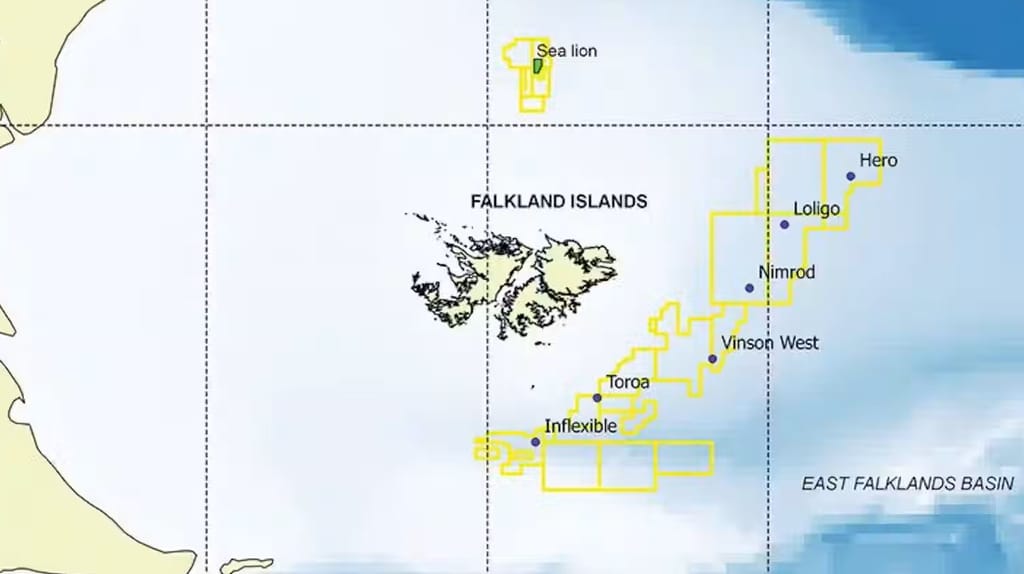
Argentina is trying to stop a planned oil project near the Falkland Islands. On October 13, the government asked the International Tribunal for the Law of the Seas (Itlos), a court in Hamburg that deals with disputes over the sea, to halt the project. Argentina says the UK approved the drilling without its agreement and in breach of Argentina’s rights to the seabed.
The project, called Sea Lion, is a joint venture between UK and Israeli companies, and has been licensed to produce oil by the Falkland Islands government. The Sea Lion field holds an estimated 1.7 billion barrels of oil, 500 million barrels of which is assessed as recoverable.
Argentina began arbitration proceedings against the UK on September 28 and gave London 14 days to stop the project. That deadline expired on October 12. The Argentinian government has now called on Itlos to issue “provisional measures” – emergency orders to protect each side’s rights, or prevent serious harm to the marine environment.
The UK’s foreign secretary, Ed Miliband, has rejected Argentina’s claims, insisting the UK will “vigorously” contest jurisdiction.
Itlos applies the UN Convention on the Law of the Sea, which governs the sea – not land. Yet rights at sea flow from owning the coast, which means that whoever holds the Falklands holds the seabed – and the oil – around the islands. Tribunals under the convention have no power to decide who owns land, and can’t settle sovereignty disputes.
Because rights at sea flow from land, every question about the oil in the dispute between Argentina and the UK has been dragged back into a near two-century argument over who owns the islands, as my colleague and I previously argued.
We proposed settling boundaries, resources and environmental protection on the basis of fairness, as Australia and Timor-Leste agreed in 2018 to share revenue from oil and gas in the Timor Sea.
What Argentina is asking for
Argentina’s request asks Itlos to order the UK to prevent Sea Lion from starting production while the arbitration is under way. The Argentinian government warns that commencing extraction would create “an irreversible fait accompli”.
To back its argument, Argentina is relying on a 2015 order in a sea-border dispute between Ghana and Ivory Coast. There, the tribunal allowed Ghana’s existing oil operations to continue but banned new drilling. So the question is whether – with Sea Lion’s development due to begin in early 2027 – the project could be halted in the same way.
The tribunal must also accept that the rights at stake are “plausible” – meaning there is a credible legal basis for them, even though the full case has yet to be heard. For Ivory Coast, this was simple. Nobody disputed that both countries had coastlines over which they had sovereignty. The only argument was over where the sea border between them should run.
For Argentina, it is an uphill battle. It insists it is not seeking a ruling on sovereignty, yet its request rests on “sovereign rights” over the continental shelf. It is hard to judge that this is a plausible claim without asking who owns the islands.
A bridge from Crimea?
In April, a tribunal hearing a dispute between Ukraine and Russian over coastal rights in the Black Sea close to the occupied Ukrainian province of Crimea found that Russia had breached the convention over the Kerch Strait bridge, which connects Russia with Crimea along with associated power cables and gas pipelines. Ukraine had brought the case in 2016, two years after Russia annexed Crimea, accusing it of usurping Ukraine’s rights in the surrounding waters – from drilling rigs to shipping lanes – and seeking compensation.
The tribunal found that Russia’s environmental assessments were inadequate and unpublished, and that it failed to cooperate in protecting the marine environment.
How could the tribunal say all this without deciding who owns Crimea? Because duties such as assessing environmental impact apply to activities under a state’s “jurisdiction or control”. What mattered was that Russia controlled the bridge, cables and gas pipelines. Who owns Crimea could be left for another day.
Could the same reasoning apply to Sea Lion? The UK answers for the islands internationally, and the convention requires states to ensure that activities under their jurisdiction or control do not cause pollution damage to other states. Argentina’s request cites a spill contingency plan by Premier Oil, Sea Lion’s former operator, which put the chance that oil from a blowout would cross into Argentine waters after 30 days at 30%. A tribunal could, without having to determine who owns the oil, consider whether the UK has assessed and shared such risks.
Should Argentina keep its hopes up?
The tribunal relating to Crimea held that the award was “appropriate declaratory relief”. This meant its formal, binding finding that Russia had broken the law was the sole remedy. Russia was not ordered to change its conduct or pay reparation for its environmental breaches.
So what are Argentina’s chances of success if it pursues an argument about the project’s environmental risk? Real, but the victory, if it comes, may not stop Sea Lion going ahead, and it won’t determine Argentina’s ownership of the Falkland Islands.
Even an interim order requiring the UK to assess and share the project’s environmental risks with Argentina would represent a win of sorts.
And with an election next year in which the incumbent president, Javier Milei, is struggling, and given how strongly most Argentinians feel about the issue, even a modest win could help the president.
Any order for Argentina and the UK to cooperate would bring London and Buenos Aires back to the same table over Sea Lion. A conversation about shared risks could be the first step towards sharing the resources.
Vicky Kapogianni is Associate Professor of International and Environmental Law, University of Reading.
This article appears courtesy of The Conversation and may be found in its original form here.

The opinions expressed herein are the author's and not necessarily those of The Maritime Executive.