Monday, November 16, 2026

North Korea’s Cryptocurrency Thefts Fund Illicit Weapons, Other Military Efforts


North Korean hackers linked to the TraderTraitor group are accused of stealing $6.3 billion from Binance in late October 2026 through AI-assisted fake job interviews, bringing total crypto thefts in recent years to $13.5 billion.

Analysts say the proceeds fund Pyongyang’s nuclear and missile programs and its military aid to Russia, while the regime also deploys overseas IT workers who use false identities to generate revenue and extort victims in violation of UN sanctions.

Australia and other partners have imposed new financial and travel sanctions on facilitators of the IT-worker scheme, reinforcing international efforts to disrupt North Korea’s illicit revenue networks.


North Korean hackers suspected of stealing $6.3 billion in cryptocurrency in late October 2026 are funding Pyongyang’s illicit nuclear weapons and ballistic missile programs and other military activities, including aiding Russia in its conflict with Ukraine, analysts say.

North Korean cybercrime is a global threat, the United States State Department said. Pyongyang has “increasingly turned to cybercrime to circumvent international sanctions and fund its unlawful weapons of mass destruction and ballistic missile programs. Cryptocurrency heists and laundering have become a significant part of this strategy.”

The North Korean hacking group TraderTraitor is accused of the theft from Binance, the world’s largest cryptocurrency exchange. North Korean hackers are believed to have stolen $13.5 billion in cryptocurrency in recent years.


Binance said the hackers used fake job interviews and a tool equipped with super intelligence, also known as artificial intelligence. They targeted a Binance engineer on the LinkedIn professional networking site and arranged a series of purported employment interviews to persuade the engineer to download a fake assignment that allowed TraderTraitor to access the company’s systems.

North Korea’s military technology, including uncrewed systems, and its aid to Moscow are tied to cyber theft and the regime’s overseas worker schemes, analysts say.

“North Korea has sent troops, munitions and weapons components to Russia, all funded through the same system, which is why a crypto hack is a national security issue and not only a problem for the exchange that got hit,” Michael Barnhart, a researcher with cybersecurity firm DTEX, told the Reuters news service.

Pyongyang recruits university students and sends them to hacker units overseen by North Korea’s intelligence agency, the British Broadcasting Corp. reported. The regime also deploys information technology (IT) workers to conduct malicious cyber activities to finance the regime’s illicit activities and circumvent United Nations Security Council resolutions.


The U.N. Security Council has adopted nine major resolutions sanctioning North Korea over its nuclear and missile activities since 2006. The U.N. called for Pyongyang to abandon its nuclear program in a “complete, verifiable and irreversible” manner, end its ballistic missile activities, and return to nuclear reduction talks. The resolution froze the financial assets of entities the Security Council determined were supporting the regime’s weapons programs.

Instead, the regime’s IT workers use false documents and stolen identities to obtain freelance employment from targets in East Asia, Europe and North America, according to the Japanese and Republic of Korea foreign ministries and the U.S. State Department. The IT workers extort victims using “threats of physical violence to demand payments,” the U.S. Federal Bureau of Investigation said in October 2026.

That same month, Australia imposed financial sanctions and travel bans against individuals and entities facilitating the IT worker scheme, which also violates U.N. resolutions prohibiting North Korea from exporting labor.

“Australian sanctions reinforce our ongoing efforts, alongside international partners, to disrupt North Korea’s illicit revenue-generating networks and increase pressure on the regime to comply with its international obligations and abandon its nuclear and ballistic missile programs,” the Australian Foreign Ministry stated.

This article was published by Indo-Pacific Defense FORUM


About Indo-Pacific Defense Forum
Indo-Pacific Defense Forum is sponsored by the United States Indo-Pacific Command (USINDOPACOM) and publishes daily online articles, daily social media updates and a quarterly magazine to provide timely updates on the Indo-Pacific security environment.


Chinese Criminal Networks Expand In Africa Despite Policing Agreements


Key Takeaways:

After Operation Eagle Flush, a Nigerian court sentenced Chinese nationals Huang Haoyu and An Hongxu to 46 years for cyberterrorism while 148 others were deported, illustrating the expansion of Chinese triad-linked scam compounds across Africa.

Beijing has responded with bilateral policing agreements covering at least 24 African countries and training for officers from 33, yet experts argue these arrangements primarily protect Chinese interests, citizens and technology while delivering little improvement in local public safety.

Critics warn that the exported model emphasizes surveillance and government control over community protection, risks importing authoritarian practices, and coexists with Beijing’s ambiguous ties to the same criminal networks it claims to combat.


In the wake of Operation Eagle Flush in 2025, one of the biggest, most complex anti-fraud crackdowns in Nigerian history, a federal court in February sentenced Chinese nationals Huang Haoyu and An Hongxu to 46 years in jail for cyberterrorism and internet fraud. They were the kingpins at the center of a massive criminal enterprise in Lagos, according to Nigeria’s Economic and Financial Crimes Commission. The operation resulted in the deportations of 148 Chinese nationals who were convicted of cyberterrorism, internet fraud, romance scams and fake cryptocurrency investment schemes. Huang and An, however, will serve their sentences before being repatriated.

As mass arrests provide further evidence that Chinese criminal syndicates are expanding across the continent, Beijing is selling something of a solution in the form of bilateral law enforcement agreements with many African governments. But experts say China’s policing arrangements protect its own interests, citizens and technology while failing to notably improve public safety.

“Where the crime goes, China’s offer of policing assistance follows, and it’s often accepted,” Oscar Warren, a program coordinator at the Australian Strategic Policy Institute, wrote in an October 16 report. He added: “Beijing is exporting a model of policing that protects governments rather than communities. It uses criminal networks abroad as proxies where a state actor cannot be seen to act. These partnerships give it access to partner forces, reach over diaspora communities, and influence.”


Decades of crackdowns in China have pushed highly organized, violent criminal groups, known as triads, outward to southeast Asia and more recently to Africa, where they now run industrial-scale scam operations, human and wildlife trafficking networks as well as poaching, smuggling and money-laundering efforts.

In 2025, a South African court sentenced seven Chinese nationals to 20 years in prison for human trafficking and forced labor. Ghana also has clamped down on Chinese criminals to tackle illegal gold mining known as galamsey, which has caused widespread environmental and economic damage.

Even when Chinese assistance leads to arrests in Africa, many deported criminals are not prosecuted. François Misser, a Brussels-based journalist who has covered Central Africa since 1981, blamed deep ties between the Chinese Communist Party (CCP) and triads such as the Hongmen Association, 14K-Hau and 14K-Ngai.

“Beijing’s role is ambiguous,” Misser wrote in an August article for the African Desk for Strategic Analysis, an independent research platform. “While it claims to clamp down on criminal networks and sometimes provides support to African governments to help them deal with the problem, it has also given political recognition to the Hongmen.”

According to public records, China has trained police from 33 African countries. Beijing has bilateral policing agreements with at least 24 countries and has embedded officers or runs joint operations in 10 countries, according to the Africa Center for Strategic Studies.


Matt Herbert, a human smuggling expert at the Global Initiative Against Transnational Organized Crime, said China’s policing arrangements on the continent have provided few benefits while raising several concerns.

“Complaints about the utility of Chinese training and the performance of equipment are common,” he said in a 2025 interview with the Institute of Peace. “In turn, the instillation of extensive surveillance networks in a number of African cities, promoted by China as a key policing tool, have not been correlated with a substantial decline in crime rates — with crime in Nairobi actually increasing.”

Authorities have uncovered industrial-scale scam compounds linked to China in at least nine African countries since 2020, and many more are at risk. But Misser warns that foreign policing arrangements are a dubious solution.

“China’s police answer solely to the CCP,” he wrote. “That is authoritarian policing: continuous surveillance, household-level data collection and pre-emptive intervention. Countries that learn from that model risk building forces aimed at their own populations rather than crime, leading to innocent people being surveilled, detained and silenced.”


About Africa Defense Forum
The Africa Defense Forum (ADF) magazine is a security affairs journal that focuses on all issues affecting peace, stability, and good governance in Africa. ADF is published by the U.S. Africa Command.
The Microsoft Global Outage: Should The Gulf Be Worried? – Analysis


A Microsoft 365 outage lasting more than 24 hours from 12–14 November disrupted Outlook, Teams and Copilot across the Gulf, forcing schools and businesses to fall back on WhatsApp while core critical infrastructure remained largely unaffected.

The incident underscored the risks of single-supplier cloud dependence, including shared login and recovery systems, and raised phishing threats that exploit the confusion of an outage.
Gulf organizations are urged to maintain offline contingencies, written recovery commitments and clear security rules for workarounds, treating business-continuity planning as a continuous process rather than a reaction to failure.

The global Microsoft outage poses a blunt question to users and customers across the Gulf region: What happens when the digital tools that keep everyday life ticking suddenly stop working?

Services are back, but Gulf businesses and public bodies still have to consider how they would cope with another prolonged failure. Their investment in digital services makes that a pressing concern, regardless of whether the cause is a cyberattack or a technical fault.

The outage began on Nov. 12, affecting Microsoft 365 services including Outlook, Teams and Copilot. Microsoft announced full restoration on Nov. 14 after disruption lasting more than 24 hours. The company said a fault introduced during an earlier network capacity upgrade had surfaced after a more recent network change.


Microsoft said the failure was unrelated to cyber activity or artificial intelligence agents. “We know our customers rely on our services to get important work done every day and regret the impact these outages had on those who depend on us. Our teams are reviewing what happened and how we can prevent similar issues going forward,” Microsoft executive Charles Lamanna said in a statement.

For Gulf businesses accustomed to warnings about cyberattacks, this was disruption of a different kind. In Saudi Arabia, some families were preparing for their children’s exams when the outage struck. Zainab Rahman, a parent, told Arab News that her daughter struggled to download assessment materials through Teams. The school resorted to WhatsApp to distribute them.

“We rely on Microsoft Outlook for emails and customer enquiries and use its services to coordinate orders and communicate with suppliers. With these services affected, it has become harder to respond to customers promptly, follow up on orders and manage routine business activities,” Mohammed Ahmed, a leather business owner, told Arab News.

Sameer Sayed, information technology manager at Giordano, said: “Our business operations rely heavily on Microsoft’s cloud services, including Exchange Online, Microsoft Teams, SharePoint Online and Copilot … Their unavailability has affected our ability to coordinate activities and carry out routine tasks efficiently.”


In the UAE, the Danube Group said it had to shift some transactions to WhatsApp after the outage complicated financial approvals and bulk sales. With several people needed to approve a transaction, the loss of email was enough to hold up business.

Other businesses were less affected. One company spokesperson said email was disrupted, but core sales and logistics operations, which run on SAP, continued as normal.

For Gulf governments and businesses, losing office software does not automatically mean payment networks, aircraft or electricity supplies stop functioning. Different systems depend on different services. Reports from this outage described disruption to workplace tools; they did not show widespread failure of the Gulf’s critical infrastructure.

However, the consequences can still be serious. England’s National Health Service activated contingency plans, including alternative systems and paper records. Pharmacies reported difficulties communicating with doctors’ offices, delaying prescriptions. A delayed email can matter a great deal when it holds up a patient’s medicine.

As more services across the Gulf move online, such interruptions become harder to contain. Teams working in different departments may rely on the same tools, leaving them vulnerable to the same fault, wherever it occurs.

Cloud services do far more than store files on distant servers; they handle email, shared documents, computing and the systems people use to log in. The ease of using these services together can encourage organizations to depend increasingly on one supplier.

Using one supplier can save money and make administration easier. But a company may only realize how much it depends on that supplier when email, shared documents and even recovery instructions become inaccessible together.

“If your emergency communications, identity management and recovery procedures all depend on the same unavailable cloud provider, your recovery plan has a fundamental weakness,” Morey Haber, chief security adviser at BeyondTrust, told Khaleej Times.


Keeping another copy of a document offers little protection if staff still need the failed login service to open it. And recovery instructions cannot help much if they are stored on a system nobody can reach.

Some Saudi companies had prepared alternatives. Meshari Hussain, digital head at Tamer Group, told Arab News that the company had alternative access through Google accounts alongside its integration with Microsoft services. He also said it had received no reports of a data breach linked to the incident.

The region is also investing in infrastructure closer to home. Microsoft announced in February that customers would be able to use its Saudi Arabia East data center region from the fourth quarter of 2026. The design includes three zones with independent power, cooling and networking infrastructure.

These facilities can improve service speed, support local data storage and protect against some physical failures. They can still depend on the provider’s wider systems, however. Microsoft’s own technical guidance notes that separate regions may rely on shared global services.

Knowing where data is stored is therefore only part of the job for Gulf decision-makers. They also need to know what is required to access it, who runs those services and how they would cope if several stopped working at once.

In July 2024, a faulty CrowdStrike security update affected an estimated 8.5 million Windows devices, according to Microsoft. The cause was different, and the software came from another company. But that incident also showed how widely used technology can spread disruption across organizations that otherwise have little in common.

Moving everything in-house would bring its own expense and maintenance burden. Spreading work among several suppliers may help, but it offers little protection if they all rely on the same infrastructure or login system.

For a hospital, a retailer or a school, the priorities will differ. Experts say managers need to work out what can wait during an outage and what staff must be able to do, and access, without delay.

Small businesses may not be able to afford duplicate systems. Even so, they can keep protected copies of essential contacts and records, agree on alternative ways to communicate and make sure staff know how to carry out some tasks manually.

Improvising during an outage carries risks of its own. Personal messaging accounts may keep people in touch, but staff need clear rules for sensitive information, financial approvals and recordkeeping. Without those rules, an urgent workaround may allow a fraudulent payment to slip through or make it hard to establish who approved a decision.

Leonid Bezvershenko, senior security researcher at Kaspersky GReAT, cautioned that the confusion surrounding the outage could be exploited by scammers.

“When normal communication channels go down, employees and customers are far more likely to trust messages that appear to offer updates, workarounds or a quick way to restore access,” he said in a statement

Bezvershenko described possible phishing emails and text messages impersonating Microsoft or internal IT teams, fake password resets and cloned login pages designed to steal credentials and multifactor authentication codes. Fraudsters could also pose as help desk staff seeking remote access.


“In the middle of a live outage, a simple request to ‘re-authenticate’ or ‘verify your account’ can seem credible because it matches what users expect to see,” he said.

These are ways criminals might exploit an outage once it has begun; they are not evidence that this incident was caused by an attack. Restoring normal work should not mean dropping routine security checks.

Bezvershenko urged organizations to provide a single verified source of updates and warn against unsolicited support. Staff should never disclose passwords or authentication codes to callers claiming to offer help. Any request for remote access should follow established verification and approval procedures.

Managers also need to put a price on the disruption. Delayed transactions, unanswered customers and a backlog of work all add to the bill. Spending on backups should reflect those costs, with the strongest safeguards reserved for services whose interruption could cause serious harm.

A cheap subscription may prove expensive if losing access holds up the business. When choosing or reviewing suppliers, companies should seek written commitments on recovery times and updates during outages. They also need to know how to retrieve their information if they decide to leave.

Microsoft, for its part, said it would publish a full report after reviewing the incident. Gulf customers should use it to examine how the company tests changes, restores services and keeps users informed when things go wrong. They can then judge where their own backup arrangements need work.

Mohammed Elias, IT head at the Muslim World League, is convinced that companies must assess their dependence on digital infrastructure and prepare for scenarios in which primary platforms become inaccessible.

“An outage of this scale highlights how dependent organizations have become on cloud-based services for their daily operations,” he told Arab News.

“Businesses need reliable backup systems and contingency plans to ensure they can continue working and accessing essential information when their primary platforms become unavailable … Business continuity planning should be an ongoing process rather than something addressed only when an outage occurs.”

Looking to the future, Gulf states have good reason to take the Microsoft global outage seriously. The family waiting for schoolwork and the business waiting to authorize a payment both need another way to get things done. They should be able to carry on while the provider works on a fix.


About Arab News
Arab News is Saudi Arabia's first English-language newspaper. It was founded in 1975 by Hisham and Mohammed Ali Hafiz. Today, it is one of 29 publications produced by Saudi Research & Publishing Company (SRPC), a subsidiary of Saudi Research & Marketing Group (SRMG).
View all posts by Arab News →


Italy fines Meta €805 million over Android app's photo access

14.11.2026

Photo: Wolf von Dewitz/dpa

Italy's data protection authority said on Saturday it had fined Facebook's parent company Meta €805 million ($887 million) for accessing Android users' photos and videos without their explicit consent. 

The fine concerns a feature on Facebook, available since 2023, which suggests photos and videos from a smartphone's gallery for users to post online.  

The feature relied on a single, general permission covering several app functions, and allowed the app to access a smartphone's entire photo archive, including metadata, in most cases permanently.

The regulator said Meta had failed to adequately inform users about the feature or to obtain effective consent. It said about 20 million Android users in Italy were affected.

The €805 million fine corresponds to around 0.47% of the group's global revenue in 2024, according to the authority.

The regulator said it had launched an investigation in July 2025 after a tip-off from the consumer protection centre in Bolzano.

Meta had questioned the Italian authority's jurisdiction in the case and pointed to the data protection authority in Ireland, where the group has its European headquarters. The Italian regulator rejected the objection.

Meta now has 60 days to obtain users' explicit consent to access their photo galleries. It must also switch off the feature as a default, including for users who have already granted general access.


Suspected Chinese spy left Megaspeed in 2025, company says

15.11.2026, 

Photo: Soeren Stache/dpa

Alice Huang, a former Chinese executive at Megaspeed International, who had an affair with recently resigned Nvidia chief Jensen Huang, has not worked for the company since late summer 2025, her former employer said on Sunday.

"Ms. Alice Huang officially left Megaspeed effective August 30, 2025 and currently has no role with the Company," the firm said in a statement.

An affair between Alice Huang and Jensen Huang, no relation, led to the Nvidia chief's resignation on Thursday. Alice Huang is suspected of having been a Chinese spy.

The case concerns possible shipments of Nvidia chips to China in circumvention of US bans. US authorities suspected Megaspeed of secretly shipping AI chips bought from Nvidia to China.

According to US media reports, Nvidia supplied Megaspeed with technology worth around $4 billion.

Megaspeed said on Sunday that it was aware of media reports about claims concerning the company's business, supply chain and global activities. 

It said these claims "are not supported by verifiable evidence" adding that the Singapore-based company "conducts legitimate and lawful business. 

The firm said it has retained external legal counsel to conduct a thorough internal investigation.

"Megaspeed does not comment on Ms. Huang’s personal and private matters," the company added.

Sunday, November 15, 2026


Volkswagen targets record 9% rate of return by 2030 despite crisis


15.11.2026, 

Photo: Julian Stratenschulte/dpa

Volkswagen chief executive Oliver Blume has set ambitious targets for his struggling carmaker, telling Germany's mass-circulation Bild newspaper that he wants to sell 9 million vehicles worldwide by 2030 with a 9% rate of return.

"We have never achieved that before in the history of the Volkswagen Group," Blume said, referring to the return on investment. Bild published the interview on Sunday.

The 9 million figure is just over the 8.98 million vehicles that the company delivered worldwide last year. For that year, the operating margin was 2.8%.

This year, the latest forecast suggests that at most 1% of sales will remain as operating profit.

In the interview, Blume also defended the carmaker's planned cuts of more than 100,000 jobs across the group. "That is not a radical blow of the kind that is sometimes written about," he said.

The company has initiated extensive cuts as it struggles with increasing Chinese competition, high costs, falling car prices and US tariffs.

Blume said the group was "spending billions, including on severance agreements." He added that personnel costs at German sites were "roughly twice as high as in other European countries."

The executive expressed optimism about the company's prospects in China, which he said is "not a lost market." Blume said VW was now producing there at Chinese costs. The car market in China has slumped by 20% this year, and prices have fallen 15% within two years, he said.


Germany's key skilled trades sector fears 80,000 job losses per year


15.11.2026

Photo: Michael Kappeler/dpa

The crisis in Germany's skilled trades sector is worsening despite more favourable growth forecasts, the president of the German Confederation of Skilled Trades said on Sunday.

"Our business climate index is at the level of the coronavirus pandemic, investment has fallen to the level of the financial crisis," Jörg Dittrich told newspapers of the Funke Media Group.

He warned that, if nothing was done to counter this, the trade sector would "lose between 70,000 and 80,000 jobs a year." He added that more than 150,000 jobs had already been lost in the sector over the past two years.

Skilled trades are a key part of the German economy and cover jobs ranging from construction and electrical positions to food production and health and personal care jobs.

Silent death of businesses

"Many business owners lack confidence, others simply lack the financial means. And then they shut up shop," Dittrich said.

The sector was experiencing a "silent death of businesses." The high cost of living was also putting skilled trades workers under pressure.

"Anyone who spends a lot at the petrol station is more inclined to think twice about having one fewer haircut or buying one fewer cake or piece of jewellery," he added.

To halt the trend, Dittrich called for a reduction in non-wage labour costs and for the coalition to push through its promised electricity tax cut for the trades. 

He warned that successful vocational training programmes were at risk of being cut. 

"It is undignified how the trades sector is being treated."

More than 1,500 migrants reach Canary Islands in single day

15.11.2026,

Photo: Antonio Sempere/EUROPA PRESS/dpa

By Emilio Rappold, dpa

More than 1,500 migrants arrived in the Canary Islands in a single day, the highest daily figure since records began, Spanish state broadcaster RTVE reported on Sunday, citing rescue services.

The vast majority arrived on the small island of El Hierro, where 13 boats carrying migrants reached the island on Saturday alone, it reported. One additional boat each arrived on Gran Canaria and Tenerife, the report said.

On Sunday, at least four more boats reached El Hierro, with the number of people on board initially unclear. 

At least 120 of the roughly 1,500 newcomers on Saturday were minors, RTVE reported, citing the authorities. They are mainly from Senegal, Gambia, Mauritania and Guinea. The Atlantic crossing can take up to a week - if all goes well.

A sad record

The RTVE report spoke of a "sad record." The previous daily high for the Canaries was 1,461 rescued people, recorded on November 7, 2020. At the time, arrivals were concentrated on Gran Canaria.

The situation is currently particularly tense on El Hierro, an island with just over 12,000 residents.

Since the start of the month, El Hierro has received more than 9,000 migrants on 91 boats. The Spanish government has therefore declared a migration emergency for the island.

Canary Islands President Fernando Clavijo on Sunday demanded the immediate implementation of aid pledges agreed with Madrid. These include additional accommodation, better medical care and faster transfers of migrants to other islands and the Spanish mainland.

Migration route to the Canaries - one of the most dangerous

The Canary route is one of the most dangerous migration routes to Europe. 

According to the Spanish aid organization Caminando Fronteras, which has strong networks in Africa, at least 635 people died in the first five months of this year while trying to reach the group of islands, located about 100 kilometres off the north-western coast of the African continent.

The Canary Islands record the most migrant arrivals of any other Spanish region. However, arrivals had fallen by just over 5% compared with the same period last year, to 13,327 between January and the end of October, figures from the Interior Ministry show.

Spanish media attribute the sharp increase in arrivals in recent weeks to a worsening social and economic crisis in Senegal.


Inverse Flows

The end of one lucrative trade from Europe to West Africa led to the creation of another. For product carriers, it was a bonanza.

Refinery

(Article originally published in Sept/Oct 2026 edition.)

I nearly titled this article "End of an ARA," meaning (A)msterdam, (R)otterdam and (A)ntwerp, the three cities that were for many decades responsible for the European trade in blended fuels destined for West Africa.

It was a big business, for as long as it lasted. In 2023, Europe exported 1.3 million barrels of gasoline per day (b/d) with a third of that going to West African buyers, according to Kpler. The trade was valued at $17 billion by Argus, a price intelligence provider.

The fuel was dismissively called "African quality" because it didn't live up to the aspirations of European environmentalists. It sometimes had 1,500 parts per million (ppm) of sulfur (compared with the 10 ppm permitted at European pumps), and it could be mixed with benzene, manganese octane-boosters and similarly hazardous additives.

While not permitted to be sold in Europe, such fuels could be exported.

That was true until 2023 when the Dutch passed a ban, eliminating Amsterdam and Rotterdam. That left Antwerp. Then Belgium joined the ban in 2024. With that, ARA ended. By September 2024, the three cities were still drip-feeding 150,000 b/d to West Africa. And the infrastructure? Well, it was fine – the refineries and ports, anyway. More on that shortly.

But what ended the "African quality" trade was not the Dutch and Belgian bans.

The Real Story

No, while Europe cleaned up its act, the real story was unfolding in Africa. In January 2024, billionaire Aliko Dangote, Africa's richest man and the CEO of Dangote Group, opened his new behemoth refinery in Lekki, near Lagos, Nigeria's largest city.

He started planning it in 2013 with help from China's National Chemical Engineering Company and Engineers India Limited, two state-owned firms that had been hired, respectively, to build and manage the project. The Lekki refinery would ultimately cost more than $19 billion. It required stabilizing a 2,600-hectare swampland and building a private port for equipment deliveries like 150,000 tons of prefabricated steel from Hangxiao Steel Structure and boilers and furnaces from India.

The Lekki refinery began with diesel and jet fuel. In fact, its first European cargo, shipped on 27 May 2024 to (ironically) Rotterdam, was 45,000 tons of jet fuel on the Greek MR product carrier Doric Breeze. Gasoline followed in September 2024, the same month Belgium's ban took effect. Two years later, in addition to exporting to Europe and the rest of West Africa, Lekki could satisfy 87 percent of Nigeria's domestic gasoline demand, according to Nigeria's own downstream regulator.

BIMCO reported that from "April to May [of 2026], Western Africa's clean petroleum product (CPP) imports fell 44 percent year on year," reflected in a 47 percent drop in vessel ton-miles.

But the new refinery was not the only factor rearranging origins and destinations.

In 2025, Europe imported "more than half of all its jet fuel from the Middle East," according to S&P. With war between the U.S. and Iran and the closure of the Strait of Hormuz in February 2026, those sources became unavailable. Purchases from India were interrupted because of E.U. sanctions targeting Russian-origin crude oil. India's refiners had made a business of buying it, refining it and selling it to Europe.

The Lekki refinery became the largest exporter of jet fuel to Europe in June and July of 2026. U.S. Gulf refineries (collectively) came in second.

Inverted Trade Flows

Europe's fuel mix became decidedly Atlantic. That meant shorter routes but fuller holds, i.e., fewer voyages on ballast. How are ships dealing with all of this?

Let's look at three of the affected vessel categories: LR1s, LR2s and MRs.

LR1s are "small" (Panamax) product tankers between 60,000 and 79,999 deadweight tons (dwt). LR2s are large (Aframax) product tankers between 80,000 dwt and 120,000 dwt. (Yes, there are even larger tankers, but they ordinarily carry crude, not refined products.) Then come MRs: smaller, versatile ships of between 40,000 and 55,000 dwt.

Before the Lekki refinery, "clean" tankers (the ones carrying refined products) would load at ARA and then unload in West Africa. They would sail back to Europe empty. Meanwhile, "dirty" tankers (the ones carrying unrefined crude) would haul their cargo from West Africa to Europe's refineries and sail back empty to Africa.

But tankers do not care whether they are bringing cargo from Europe to Nigeria or from Nigeria to Europe. A full hold is a full hold, whatever the direction.

MRs now travel in a square, not a triangle. They load product in the U.S. Gulf, then head to West Africa. There, they can load jet fuel or another product from the Lekki refinery. They haul that north to Europe. There, often at ARA, ships can sometimes pick up what little remains of the blended fuels African trade. The only side of the "square" that ships have to sail empty is from West Africa back to the U.S. Gulf.

This is working well. Kpler says that MRs' ton-miles have been consistently positive since July 2025.

LR1s were well-suited to the ARA-West Africa trade. Their West African ton-miles fell 88 percent, the worst of any class, but they've long been diversely employed "in trades between the U.S. Gulf and Asia, as well as on transatlantic routes," as Haiying Jia and Zhenming Wu stated this February in an article in the Journal of Transport Geography.

And the best for last: LR2s. In July 2026, an LR2 vessel that had earned $144,600 per day earlier in the year would be on a "downward curve with averages for June sitting at $72,700/day" for the same vessel, though these earnings are still "very healthy." For comparison, in 2025 LR2 earnings per day moved consistently in a narrow band between roughly $30-40,000.

We're holding back our tears.

Declining Output

And the European refineries, as I promised?

Shell, BP, ExxonMobil and Vitol operate at Rotterdam while Antwerp features TotalEnergies and ExxonMobil. "Very clearly," said President of Shell Nederland Frans Everts in April 2026, "every refinery in Europe is on what we call max jet mode," serving Europe's thirsty airlines.

Nonetheless, since 2009, Europe has lost about 30 of its refineries. Seventy-three still operate. This has less to do with West African competition or changes in buyer habits and more to do with plants reaching end of life.

Most of Europe's refineries were built in the 1960s and 1970s. They're ancient. The result? The U.K.'s Petroineos Grangemouth refinery, as one example, used to refine 150,000 bpd and was converted last year to a petroleum products import terminal.

Few European investors are willing to risk their capital on a new European oil refinery. Their focus is on clean energy like hydrogen and biofuels. "Europe is unlikely to build another conventional refinery on the scale of Pernis or Rotterdam. […] The continent's largest sites will require billions of dollars in cumulative spending to remain safe, reliable and commercially relevant. Some investments will extend the life of conventional units," EPCIntel says.

Europe is doubling down on its current refineries, if they're viable.

Africa Rising

Meanwhile, Aliko Dangote has announced a second refinery in Kenya at a cost of $15 billion. This one will process 700,000 bpd – another Lekki on the opposite African coast.

At least Kenya is far enough for the tankers to stretch their legs. And it's good to have two alternatives to the Strait of Hormuz, even when they both answer to one man.

Erik Kravets is a maritime lawyer whose law firm is based in Cuxhaven, Germany. He is a frequent contributor to the online Maritime Executive Newsletter and has lectured at the State Maritime College of Cuxhaven and at Bremerhaven University of Applied Sciences.

The opinions expressed herein are the author's and not necessarily those of The Maritime Executive.


A Wave of New Deep Seaport Projects Catches on in West Africa

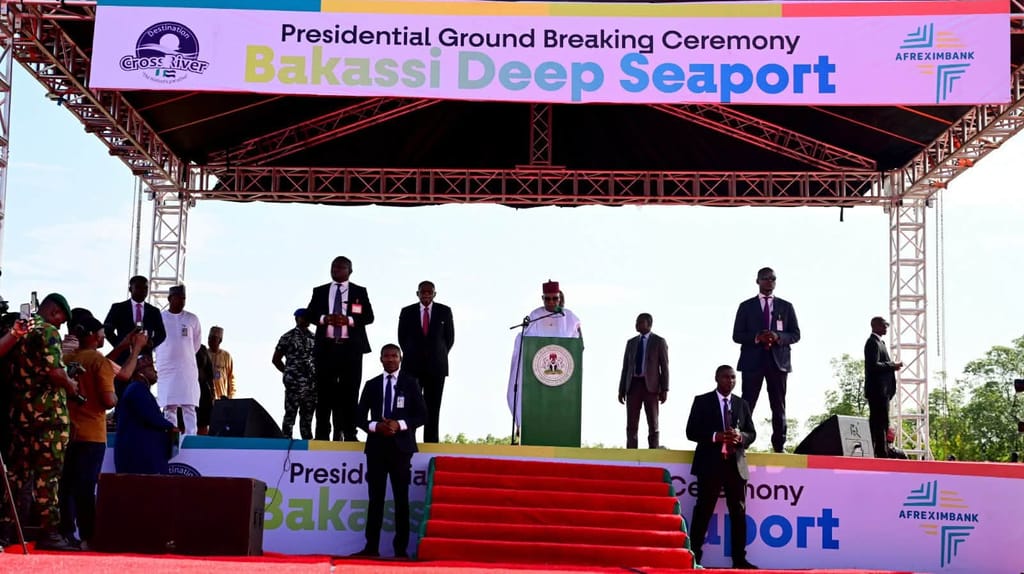
Groundbreaking ceremony for the Bakassi port complex in Cross River State, Nigeria (Gov. Bassey Otu)

The Asia-Africa trade lane has been one of the fastest-growing container shipping corridors globally in the past few years. The growth is supported by soaring import demand in Africa as countries in the region develop industrial capacity. Unfortunately, the surging imports have put a strain on old port infrastructure, especially in West Africa. To catch up, governments in the region are fast-tracking approval processes for deep-water port projects.

In the past week, Nigeria and Ghana have made significant progress in their port expansion efforts. After a decades-long wait, Nigeria is moving ahead with the construction of the Bakassi Deep Seaport in Cross River State. A groundbreaking ceremony was held on Friday, led by the country's Vice President, Kashim Shettima.

The port project was initially conceived in 2014 but was delayed by a slow regulatory process. With a proposed draft of 20 meters, the facility is set to become one of Nigeria's deepest ports. Currently, Nigeria is unable to accommodate ultra-large container vessels, as its major ports have shallow-water access. This has seen Nigerian-bound cargo transhipped through Lomé in Togo and Tema in Ghana.

Speaking at the groundbreaking ceremony, Nigerian Ports Authority (NPA) CEO Abubakar Dantsoho recognized Nigeria's need to match economic growth with port modernization. Nigeria's main trade gateway, Apapa Port, is approximately 100 years old. To keep up with the evolving demands of international shipping, Nigeria needs to urgently modernise its existing brownfield ports while simultaneously developing greenfield deep-sea ports, added Dantsoho.

The Bakassi port project is estimated to cost $3.5 billion, backed by a facility from the African Export-Import Bank (Afreximbank). An initial funding approval of $2.27 billion has already been made. The project will be delivered through a Public-Private Partnership arrangement.

Bakassi is one of the five deep seaports that Nigeria's government has approved. The other port projects include Badagry Deep Water Port in Lagos State, Olokola Port in Ondo State, Ibom Port in Akwa Ibom State and Bonny Port in Rivers State.

Meanwhile, Ghana has reportedly shortlisted seven companies to bid for the development of Keta port, the country's third commercial seaport. The selected firms will help finalize the project's design studies, as well as propose a financing model. The government did not reveal the names of the selected firms.

The proposed Keta port is expected to complement the existing Tema and Takoradi ports. Tema acts as Ghana's main import port, specifically for container shipping. Takoradi, on the other hand, handles bulk exports including cocoa, bauxite and manganese. Last week, the government launched construction of a new berth in Takoradi. The new facility, Berth 19, will enhance Takoradi's capacity at a time when cargo volume is rising. The berth project will cost $98 million, financed fully by the Ghana Ports and Harbours Authority (GPHA). The berth will be 300 meters long, with capacity to handle vessels of up to 75,000 dwt.