Showing posts sorted by relevance for query MINORITY REPORT. Sort by date Show all posts

Saturday, August 03, 2024

Argentina to use AI to stop crime before it happens


By Mark Moran


The government of Argentinian President Javier Milei is rolling out with new AI technology aimed at preventing crime. File Photo by Gala Abramovich/EPA-EFE

Aug. 2 (UPI) -- Argentina has announced plans to use artificial intelligence to predict crimes before they're committed, the country recently announced.

The plan was announced by the Ministry of Security as Argentina takes its next step toward using artificial intelligence in more and different ways.

The new AI unit will focus on the "prevention, detection, investigation and prosecution of crime," in addition to conducting drone surveillance, patrolling social media and using facial recognition to bolster security measures, a statement said.

The announcement comes after Buenos Aires court ruled in 2023 that facial recognition technology by the government was unconstitutional in the city. The judge in the case said the system was installed without complying with the legal requirements for the protection of the personal rights of the inhabitants of the City of Buenos Aires," a statement said.

Human rights groups have gone a step further, and are concerned that implementing the technology could infringe on freedom of expression as people are concerned over government monitoring of their social media posts, and having a chilling effect on what they choose to publish.

Still others are worried about how AI will affect the academic world, including what academics and students will share and whether it will be monitored by the emerging technology.

The Argentine Center for Studies on Freedom of Expression and Access to Information has said AI and similar technologies have been used to profile academics, journalists, politicians and activists.

They wanted to know how the technologies were developed, where they came from and how they will be used. The group called any lack of accountability The group said any lack of accountability would be "worrying."

President Javier Milei made a trip to Silicon Valley earlier this year that is now being seen differently in light of the move to bolster crime detection using AI. In May, he met with several tech leaders and encouraged them to consider investing in his country


Steven Spielberg's Minority Report,1 released in summer 2002, derives from a. Philip K. Dick short story first published in 1956.2 The futuristic premise of ...


Notes on Minority Report


July 2009

Authors:

I. Bennett Capers

Brooklyn Law School


Download full-text PDF


Abstract

Using Spielberg’s 2002 film Minority Report as a cultural text, this symposium essay explores the 'de-shadowing' work film does in relation to the criminal justice system, rendering visible the schism between the justice courts imagine they are administering and the justice that actually exists. This symposium essay also examines how Minority Report problematizes the role of the spectator, both as a watcher of filmic media and as a surrogate thirteenth juror assessing truth, guilt, and innocence.


Minority Report, 2002, Directed by Steven Spielberg, Screenplay by Jon Cohen and Scott Frank, based upon Philip K. Dick,. “Minority Report,” in The Minority .


In the opening scene of Steven Spielberg's 2002 film adaptation of Philip. K. Dick's short story The Minority Report,3 we see stylistically edited, disjointed ...


... criminologist, phrenologist, physician, and founder of the Italian school of criminology. ... He postulated that criminals represented a reversion to a primitive ...

... criminology from a legalistic preoccupation with crime to a scientific study of criminals ... primitive stage of human evolution. Lombroso contended that such ...

The Italian school of criminology was founded at the end of the 19th century by Cesare Lombroso (1835–1909) and two of his Italian disciples, Enrico Ferri ...


Feb 8, 2023 ... These atavistic characteristics, he argued, denoted the fact that the offenders were at a more primitive stage of evolution than non ...

Aug 8, 2019 ... ... primitive humanity and the inferior animals,” he wrote in his 1876 ... Italian criminologist and physician Cesare Lombroso. What ...

Cesare Lombroso was the founder of the Italian school of positivist criminology, which argued that a criminal mind was inherited and could be identified by ...

Saturday, June 08, 2024


What’s Next for Battlefield America?


Israel’s High-Tech Military Tactics Point the Way


I did not know Israel was capturing or recording my face. [But Israel has] been watching us for years from the sky with their drones. They have been watching us gardening and going to schools and kissing our wives. I feel like I have been watched for so long.
— Mosab Abu Toha, Palestinian poet

If you want a glimpse of the next stage of America’s transformation into a police state, look no further than how Israel—a long-time recipient of hundreds of billions of dollars in foreign aid from the U.S.—uses its high-tech military tactics, surveillance and weaponry to advance its authoritarian agenda.

Military checkpoints. Wall-to-wall mass surveillance. Predictive policing. Aerial surveillance that tracks your movements wherever you go and whatever you do. AI-powered facial recognition and biometric programs carried out with the knowledge or consent of those targeted by it. Cyber-intelligence. Detention centers. Brutal interrogation tactics. Weaponized drones. Combat robots.

We’ve already seen many of these military tactics and technologies deployed on American soil and used against the populace, especially along the border regions, a testament to the heavy influence Israel’s military-industrial complex has had on U.S. policing.

Indeed, Israel has become one of the largest developers and exporters of military weapons and technologies of oppression worldwide.

Journalist Antony Loewenstein has warned that Pegasus, one of Israel’s most invasive pieces of spyware, which allows any government or military intelligence or police department to spy on someone’s phone and get all the information from that phone, has become a favorite tool of oppressive regimes around the world. The FBI and NYPD have also been recipients of the surveillance technology which promises to turn any “target’s smartphone into an intelligence gold mine.”

Yet it’s not just military weapons that Israel is exporting. They’re also helping to transform local police agencies into extensions of the military.

According to The Intercept, thousands of American law enforcement officers frequently travel for training to Israel, “one of the few countries where policing and militarism are even more deeply intertwined than they are here,” as part of an ongoing exchange program that largely flies under the radar of public scrutiny.

A 2018 investigative report concluded that imported military techniques by way of these exchange programs that allow police to study in Israel have changed American policing for the worse. “Upon their return, U.S. law enforcement delegates implement practices learned from Israel’s use of invasive surveillance, blatant racial profiling, and repressive force against dissent,” the report states. “Rather than promoting security for all, these programs facilitate an exchange of methods in state violence and control that endanger us all.”

“At the very least,” notes journalist Matthew Petti, “visits to Israel have helped American police justify more snooping on citizens and stricter secrecy. Critics also assert that Israeli training encourages excessive force.”

Petti documents how the NYPD set up a permanent liaison office in Israel in the wake of 9/11, eventually implementing “one of the first post-9/11 counterterrorism programs that explicitly followed the Israeli model. In 2002, the NYPD tasked a secret ‘Demographics Unit’ with spying on Muslim-American communities. Dedicated ‘mosque crawlers’ infiltrated local Muslim congregations and attempted to bait worshippers with talk of violent revolution.”

That was merely the start of American police forces being trained in martial law by foreign nations under the guise of national security theater. It has all been downhill from there.

As Alex Vitale, a sociology professor who has studied the rise of global policing, explains, “The focus of this training is on riot suppression, counterinsurgency, and counterterrorism—all of which are essentially irrelevant or should be irrelevant to the vast majority of police departments. They shouldn’t be suppressing protest, they shouldn’t be engaging in counterinsurgency, and almost none of them face any real threat from terrorism.”

This ongoing transformation of the American homeland into a techno-battlefield tracks unnervingly with the dystopian cinematic visions of Steven Spielberg’s Minority Report and Neill Blomkamp’s Elysium, both of which are set 30 years from now, in the year 2054.

In Minority Reportpolice agencies harvest intelligence from widespread surveillance, behavior prediction technologies, data mining, precognitive technology, and neighborhood and family snitch programs in order to capture would-be criminals before they can do any damage.

While Blomkamp’s Elysium acts as a vehicle to raise concerns about immigration, access to healthcare, worker’s rights, and socioeconomic stratification, what was most striking was its eerie depiction of how the government will employ technologies such as drones, tasers and biometric scanners to track, target and control the populace, especially dissidents.

With Israel in the driver’s seat and Minority Report and Elysium on the horizon, it’s not so far-fetched to imagine how the American police state will use these emerging technologies to lock down the populace, root out dissidents, and ostensibly establish an “open-air prison” with disconcerting similarities to Israel’s technological occupation of present-day Palestine.

For those who insist that such things are celluloid fantasies with no connection to the present, we offer the following as a warning of the totalitarian future at our doorsteps.

Facial Recognition

Fiction: One of the most jarring scenes in Elysium occurs towards the beginning of the film, when the protagonist Max Da Costa waits to board a bus on his way to work. While standing in line, Max is approached by two large robotic police officers, who quickly scan Max’s biometrics, cross-check his data against government files, and identify him as a former convict in need of close inspection. They demand to search his bag, a request which Max resists, insisting that there is nothing for them to see. The robotic cops respond by manhandling Max, throwing him to the ground, and breaking his arm with a police baton. After determining that Max poses no threat, they leave him on the ground and continue their patrol. Likewise, in Minority Report, police use holographic data screens, city-wide surveillance cameras, dimensional maps and database feeds to monitor the movements of its citizens and preemptively target suspects for interrogation and containment.

Fact: We now find ourselves in the unenviable position of being monitored, managed, corralled and controlled by technologies that answer to government and corporate rulers. This is exactly how Palestinian poet and New Yorker contributor Mosab Abu Toha found himself, within minutes of passing through an Israeli military checkpoint in Gaza with his wife and children in tow, asked to step out line, only to be blindfolded, handcuffed, interrogated, then imprisoned in an Israeli detention center for two days, beaten and further interrogated. Toha was finally released in what Israeli soldiers chalked up to a “mistake,” yet there was no mistaking the AI-powered facial recognition technology that was used to pull him out of line, identify him, and label him (erroneously) as a person of interest.

Drones

Fiction: In another Elysium scene, Max is hunted by four drones while attempting to elude the authorities. The drones, equipped with x-ray cameras, biometric readers, scanners and weapons, are able to scan whole neighborhoods, identify individuals from a distance—even through buildings, report their findings back to police handlers, pursue a suspect, and target them with tasers and an array of lethal weapons.

Fact: Drones, some deceptively small and yet powerful enough to capture the facial expressions of people hundreds of feet below them, have ushered in a new age of surveillance. Not even those indoors, in the privacy of their homes, will be safe from these aerial spies, which can be equipped with technology capable of peering through walls. In addition to their surveillance capabilities, drones can also be equipped with automatic weapons, grenade launchers, tear gas, and tasers.

Biometric scanners and national IDs

Fiction: Throughout Elysium, citizens are identified, sorted and dealt with by way of various scanning devices that read their biometrics—irises, DNA, etc.—as well as their national ID numbers, imprinted by a laser into their skin. In this way, citizens are tracked, counted, and classified. Likewise, in Minority Report, tiny sensory-guided spider robots converge on a suspected would-be criminal, scan his biometric data and feed it into a central government database. The end result is that there is nowhere to run and nowhere to hide to escape the government’s all-seeing eyes.

Fact: Given the vast troves of data that various world governments, including Israel and the U.S., is collecting on its citizens and non-citizens alike, we are not far from a future where there is nowhere to run and nowhere to hide. In fact, between the facial recognition technology being handed out to law enforcement, license plate readers being installed on police cruisers, local police creating DNA databases by extracting DNA from non-criminals, including the victims of crimes, and police collecting more and more biometric data such as iris scans, we are approaching the end of anonymity. It won’t be long before police officers will be able to pull up a full biography on any given person instantaneously, including their family and medical history, bank accounts, and personal peccadilloes. It’s already moving in that direction in more authoritarian regimes.

Predictive Policing

Fiction: In Minority Report, John Anderton, Chief of the Department of Pre-Crime, finds himself identified as the next would-be criminal and targeted for preemptive measures by the very technology that he relies on for his predictive policing. Consequently, Anderton finds himself not only attempting to prove his innocence but forced to take drastic measures in order to avoid capture in a surveillance state that uses biometric data and sophisticated computer networks to track its citizens.

Fact: Precrime, which aims to prevent crimes before they happen, has justified the use of widespread surveillance, behavior prediction technologies, data mining, precognitive technology, and snitch programs. As political science professor Anwar Mhajne documents, Israel has used all of these tools in its military engagements with Palestine: deploying AI surveillance and predictive policing systems in Palestinian territories; utilizing facial recognition technology to monitor and regulate the movement of Palestinians; subjecting Palestinians to facial recognition scans at checkpoints, with a color-coded mechanism to dictate who should be allowed to proceed, subjected to further questioning, or detained.

Making the Leap from Fiction to Reality

When Aldous Huxley wrote Brave New World in 1931, he was convinced that there was “still plenty of time” before his dystopian vision became a nightmare reality. It wasn’t long, however, before he realized that his prophecies were coming true far sooner than he had imagined.

Israel’s military influence on the United States, its advances in technological weaponry, and its rigid demand for compliance are pushing us towards a world in chains.

Through its oppressive use of surveillance technology, Israel has erected the world’s first open-air prison, and in the process, has made itself a model for the United States.

What we cannot afford to overlook, however, is the extent to which the American Police State is taking its cues from Israel.

As I make clear in my book Battlefield America: The War on the American People and in its fictional counterpart The Erik Blair Diaries, we may not be an occupied territory, but that does not make the electronic concentration camp being erected around us any less of a prison.Facebook

John W. Whitehead, constitutional attorney and author, is founder and president of The Rutherford Institute. He wrote the book Battlefield America: The War on the American People (SelectBooks, 2015). He can be contacted at johnw@rutherford.orgNisha Whitehead is the Executive Director of The Rutherford Institute. Read other articles by John W. Whitehead and Nisha Whitehead.

Friday, June 14, 2024

US finds Phoenix Police Dept violates civil rights of city residents

A BUSHEL OF BAD APPLES

Thu, June 13, 2024

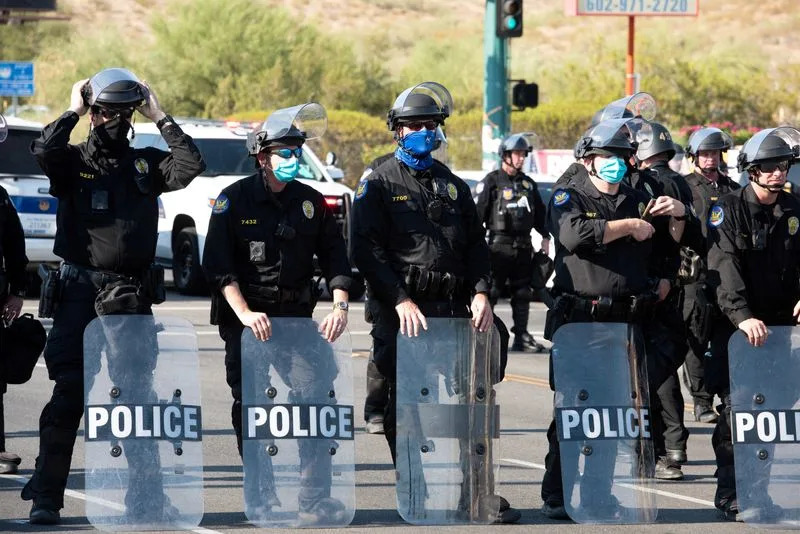
 Police block protesters during a visit by U.S, President Donald Trump to the Dream City Church in Phoenix

By Sarah N. Lynch

WASHINGTON (Reuters) -The U.S. Justice Department on Thursday took aim at the Phoenix Police Department, accusing its officers of systemically violating peoples' civil rights and using excessive and at times "unjustified deadly force" against city residents.

In a new investigative report, the Justice Department Civil Rights Division said it has reasonable cause to believe that police in Phoenix routinely discriminate against Black, Hispanic and Native Americans, and unlawfully detain homeless people and dispose of their belongings.

The report also found that the police frequently violate people's protected free speech, discriminate against people with behavioral disabilities and use aggressive tactics with children that could have a "lasting impact" on their wellbeing.

In a letter to Justice Department officials, Phoenix city attorney Julie Kriegh said that the city and its police department today are "materially different than the department" that was investigated.

"The Phoenix City Council has consistently, through meaningful dialogue with community members, invested in substantial public expenditures and proposed and approved significant projects," she wrote, citing the use of body-worn cameras and initiatives addressing homelessness and mental health.

The department's findings end a nearly three-year-long investigation, first announced in August 2021, that examined whether the Phoenix Police Department engaged in a "pattern or practice" of civil rights abuses.

"In the years leading up to our investigation, PhxPD officers shot and killed people at one of the highest rates in the country," the report found.

"PhxPD relies on dangerous tactics that lead to force that is unnecessary and unreasonable. PhxPD has taught officers a misguided notion of de-escalation. Rather than teaching that de-escalation strategies are designed to eliminate or reduce the need to use force, PhxPD has misappropriated the concept and teaches officers that all force—even deadly force—is de-escalation," the report said.

The report also found that police frequently retaliated against their own critics.

In one example, police created a so-called "challenge coin" that depicted the image of a protester whom an officer had shot in the groin.

The coin had a star over the image of the man's groin with the words: “Good night, left nut.”

On the back, the coin read, “Making America Great Again – One Nut at a Time.”

"Police officers abused their power to silence people asserting their constitutional rights to free speech and assembly," said Kristen Clarke, the head of the department's Civil Rights Division, during a virtual press conference.

The Justice Department's findings could possibly be met with some resistance by Phoenix city officials, who have declined prior requests by the department to enter into a court-monitored consent decree.

Some of the Justice Department's other high-profile civil rights investigations into police departments in Minneapolis and Louisville were spurred by police killings of unarmed Black citizens. The probe into Phoenix, by contrast, was not prompted by any single incident.

However, the report noted that in the years leading up to the investigation, Phoenix Police shot and killed people at one of the highest rates in the nation.

Thursday's report by the Justice Department's Civil Rights Division was delivered to Phoenix without any agreement between the parties on how to implement policing reforms.

In a January 2024 letter to Justice Department officials, the city's outside counsel Michael Bromwich accused the department of a "lack of transparency" and failing to share any of the tentative conclusions from the investigation.

He added that the city was already implementing policing reforms and asked the Justice Department to consider an alternative approach to a consent decree.

Clarke on Thursday called the department's findings "severe."

She said the department is prepared to sit down with the city to identify a "mutually beneficial path" toward reform.

"This is one instance where we can't count on the police to police themselves," she said.

Phoenix City Manager Jeff Barton, in a message to employees, said the city was taking the findings seriously and will review the report "with an open mind."

"Self-reflection is an important step in continuous improvement," he wrote.

(Reporting by Sarah N. Lynch; Editing by Josie Kao)


Phoenix police violated the rights of homeless residents and minority communities, scathing DOJ report finds

Hannah Rabinowitz and Devan Cole, CNN
Thu, June 13, 2024 


The Phoenix Police Department has for years violated the constitutional rights of residents experiencing homelessness and regularly discriminated against minority communities, according to a Justice Department report released Thursday.

Justice Department investigators found that Phoenix police targets “people experiencing homelessness, retaliates against people who criticize the police, and disproportionately uses force against people with behavioral health disabilities.”

The report also found that officers disproportionately enforce laws more severely against Black, Hispanic, and Native American people than against White people engaged in the same behaviors, even though “the city still claims it is ‘unaware of any credible evidence of discriminatory policing.’”

The blistering report marks the end of a nearly three-year investigation into the police department that began in the wake of several high-profile incidents, including the 2020 fatal police shooting of a man in a parked car.

This investigation was the first time that a department’s so-called pattern and practice investigation focused on officers’ conduct toward people experiencing homelessness – a clear warning for cities around the country where police sweeps of homeless communities have become a common response to the growth of tent cities in public spaces.

DOJ investigators found that “in the early mornings, officers cite or arrest homeless people for conduct that is plainly not a crime, such as sitting or lying down on public property or for ‘trespassing’ on private property when they are on a public sidewalk.”

Officers also repeatedly seized and destroyed the property of people experiencing homelessness under the guise of the city’s “clean-up operations,” according to the report.

“A person’s constitutional rights do not diminish when they lack shelter,” the report concludes.

Kristen Clarke, the head of DOJ’s Civil Rights Division, told reporters on Thursday that “homelessness is a challenge in Phoenix and in many cities across the country.”

“Over-policing of the homeless has become a central pillar of the (Phoenix) police department’s enforcement strategy,” she added. “The criminalization of homelessness has no place in our society today.”

How US cities have responded to a surge in unhoused residents has become a major flashpoint in recent years, prompting people experiencing homelessness and their advocates to push for greater accountability among local officials.

The Supreme Court is expected to rule in the coming days in a case challenging an Oregon city ticketing its unhoused residents. The justices have been asked to consider whether the practice violates the Constitution’s ban on “cruel and unusual” punishment.

The DOJ report acknowledges that the Phoenix Police Department has instituted several changes to address unconstitutional policing since the beginning of the federal investigation.

CNN is reaching out to the police department for comment.
DOJ report finds police used excessive force

The Phoenix Police Department frequently and inappropriately used deadly force, the report found, and has one of the highest rates of fatal shootings in the country per year.

Among the causes of Phoenix officers’ use of excessive force is that officers are taught a “misguided notion of de-escalation,” the report says.

“Rather than teaching that de-escalation strategies are designed to eliminate or reduce the need to use force, (the Phoenix Police Department) has misappropriated the concept and teaches officers that all force – even deadly force – is de-escalation,” the report reads.

Officers also delayed rendering aid to people whom they have shot, the report found, or continued to use force against those who were already incapacitated – sometimes even unconscious – because of gunfire.

In one example highlighted by the Justice Department, officers shot an individual in the chest who had pointed a handgun at police. A supervisor at the scene instructed officers to use a non-lethal weapon to give “a couple pops before we approach” the man, who had fallen to the ground, and then said that there was “no rush” in administering CPR. The man was later pronounced dead.

In other examples, officers were quick to physical violence or arrests when they felt that people were being disrespectful or criticizing the police.

Police officers have also used excessive force against protesters to deter First Amendment-protected speech, the report found, including by firing less-than-lethal weapons indiscriminately and without legal justification. Officers have used arrests to deter people from protesting, used criminal charges that were “far more serious than the evidence supported,” and have “sought to justify serious charges with false evidence.”

The police department’s “recent commitment to protecting free speech is important, but it would be premature to claim any new efforts are working,” the report adds.
Police target minority communities, report finds

The sprawling report also found that the Phoenix Police Department disproportionately polices the city’s minority communities, including through excessive tickets and arrests for less serious offenses.

The DOJ probe found that the department “cites and arrests Black, Hispanic, and Native American people for low-level traffic, drug, alcohol, and quality-of-life offenses at rates disproportionate to their shares of the population.”

The offenses cover a range of misconduct, according to the report, which said as an example that the department arrested “cyclists for biking on the wrong side of the road almost eight times more in predominantly non-white neighborhoods, compared with white neighborhoods.”

DOJ also said that the Phoenix Police Department lacked the ability to “adequately investigate” complaints from community members that an office acted with “overt bias.” Many complaints lodged against officers were classified by investigators at the department as “officer ‘rudeness,’” according to the report.

“In the vast majority of cases, (the police department) simply dismisses complaints of discriminatory policing absent evidence that an officer made an overtly racist statement or admitted to engaging in racist profiling,” the report found. “Since people are unlikely to admit to such things, (the department’s) practice of requiring this evidence means that these complaints will necessarily be given short shrift.”

For more CNN news and newsletters create an account at CNN.com

Wednesday, March 01, 2023


Indian movement spreads hate, victimizes religious minority groups, report says

Wed, March 1, 2023 

Volunteers of the Hindu nationalist organization Rashtriya Swayamsevak Sangh (RSS) take part in a celebration in Ahmedabad, India, on Oct. 7, 2018. According to a report by the National Council of Canadian Muslims and the World Sikh Organization of Canada, the RSS is at the core of a network of groups 'seeking to remake India into a country run by and for Hindus first at the expense of the country's dizzying slew of minority groups.' (Amit Dave/Reuters - image credit)More

Canada shouldn't allow a movement out of India that "disseminates hate" and victimizes religious minority groups to entrench itself in this country, according to a report released Wednesday by the National Council of Canadian Muslims and the World Sikh Organization of Canada.

The report, called Rashtriya Swayamsevak Sangh (RSS) Network in Canada, documents the roots of the RSS movement in India and its extensive global reach, promoting far right views in various ways.

"It's one of the most influential organizations in the world," said Steven Zhou, a spokesperson for the National Council of Canadian Muslims.

The council and the World Sikh Organization of Canada are trying to draw attention to what academics, including some in Canada, say they have witnessed for years — an increasing influence and threat from a movement closely linked to the government in New Delhi that they say promotes discrimination against minority religious groups at home and abroad.

"[The RSS] poses a major challenge to Canadian commitments to human rights, to tolerance and multiculturalism," said Zhou.

According to the report, the RSS is at the core of a network of groups "seeking to remake India into a country run by and for Hindus first at the expense of the country's dizzying slew of minority groups."

"It's ... vital to keep in mind that the ideal nationalism projected by the RSS network victimizes not just ethno-religious minorities like Muslims, Sikhs and Christians, but also members of India's lower caste Hindus."

Submitted by Sanjay Ruparelia

"It has domestic and international organs that seize political power, perpetuate its supremacist ideologies and actively participate in communal violence," the report said.

CBC News reached out to RSS's branch in Canada but did not receive a response.

On its website, the organization quotes its founder, Keshav Baliram Hedgewar, saying it is "the duty of every Hindu to do his best to consolidate the Hindu society" and that its mission is to strive for "national reconstruction."

On the Canadian website, it says it is a "voluntary, non-profit, social and cultural organization" and "aims to organize the Hindu community in order to preserve, practise and promote Hindu ideals and values."

Researchers say the ideology espoused by RSS is commonly known as Hindutva.

The Indian state has not always supported the RSS and Hindutva, banning it three times since its inception in 1925 as a paramilitary volunteer organization.

In an interview with CBC News in April 2022, Franco-Indian journalist Ingrid Therwath said the RSS network was founded on the principles of Italian facism, is ideologically similar to Nazism and was exported abroad by some in the Indian diaspora, said Therwath, who has been researching Hindu extremism for more than 20 years.

Therwath, who has been researching Hindu extremism for more than 20 years, said the first Canadian branch of the RSS's international organization was established in Toronto in the 1970s.

Zhou, a former researcher with the Canadian Anti-Hate Network who has chronicled far right movements within diaspora groups, told CBC in a previous interview Hindutva is a superficial politicization of Hinduism and has led to discrimination and sectarian violence against minority groups in India like Muslims and Christians.

Human Rights Watch has also attributed religious and ethnic violence to groups that espouse the Hindutva ideology.

In December 2021, in the northern Indian city of Haridwar, Hindu religious leaders openly called for a genocide against Muslims at an event organized by right-wing and Hindutva-following leaders.

Violence against other minority groups like Sikhs and Dalits has increased in India in recent years, say academics. Dalits are members of a caste who do not belong to the social order, according to the caste system.

"There's been an increase in different kinds of hate crimes," said Shivaji Mukherjee, an assistant professor specializing in South Asian political violence at the University of Toronto-Mississauga. He said those crimes are increasing at a time when the current government — with extensive links to the RSS — is enjoying an overwhelming majority.

"Now that the Bharatiya Janata Party (BJP) has come to power, it's easier for these groups to increase violence, to fulfil their political and social agendas."

'This is not a fringe ideology'

While the RSS has existed for decades, Mukherjee said it has been emboldened to take violent action based on its ideology in recent years by the election of Prime Minister Narendra Modi and the BJP with a majority in 2014.

According to multiple media outlets, the RSS has an estimated membership of more than five million worldwide, including Modi and the majority of ministers in his government.

"This is not a fringe ideology. This is the state ideology, " said Jaskaran Sandhu, a board member with the World Sikh Organization of Canada.

Academics have documented and noticed an increased attempt to challenge and silence criticism by supporters of the BJP and the RSS and Hindutva movement since the party came into power.

Submitted by Jaskaran Sandhu

In December 2021, Sanjay Ruparelia, an associate professor of politics and Jarislowsky Democracy Chair at Toronto Metropolitan University, organized a talk by prominent Indian politics researcher Christophe Jaffrelot hosted by the Toronto Public Library.

Ruparelia said he received hundreds of emails from individuals urging organizers to call it off and for the library to ban the event because it was "anti-Hindu." Academics say this kind of action can be attributed to those who support the views of the RSS.

"It's an attempt to silence them, to undermine their legitimacy," Ruparelia said, pointing out anyone engaging in debate about the Indian government or its views is automatically labelled by these supporters as "anti-Hindu" or "Hinduphobic."

Ruparelia said he knows of many academics who have been harassed and intimidated online by these people based on articles they're writing and events they're organizing.

"It's trying to shut down debate. It's trying to curtail freedom of expression."

RSS operations in Canada

The report on RSS highlights how the movement is operating in Canada, including through political lobbying and through seemingly benign cultural organizations that have charitable status.

In India, the report says, the RSS operates an India-based NGO called Seva Bharati, which operates health-care units, disaster relief efforts and education in the country's underserved areas.

Overseas, Sewa International provides these services and fundraises for these services around the world, according to the report.

It also says RSS operates overseas through an organization called Hindu Swayamsevak Sangh (HSS) that perpetuates Hindutva ideologies in the Indian diaspora, including in Canada, the U.S. and Europe. The report says HSS has held events on Hinduism in some Ontario public schools.

Ryan Remiorz/The Canadian Press

Through the report, the National Council of Canadian Muslims and the World Sikh Organization of Canada are urging the federal government to "carefully study and track the growth of a movement that disseminates hate here in Canada."

The report also calls for action from the Canadian government.

"Canadian leaders cannot allow individuals and [organizations] that push a Hindutva vision of India — a supremacist vision that discriminates against minorities and has led to mass bloodshed — [to] entrench themselves in this country, perpetuate their supremacist ideologies and radicalize relations between large faith-based communities," the report's authors wrote.

However, critics say Ottawa has stayed largely silent and complacent as it attempts to foster an economic relationship with India as part of its Indo-Pacific strategy, launched in November 2022 to enhance trade and engagement in that region.

"They're valuing trade deals and strategic relationships … rather than actually upholding values that are important to Canadians," said Sandhu, with the World Sikh Organization of Canada.

Several academics use Nepean MP Chandra Arya raising what appears to be the RSS flag on Parliament Hill during Hindu Heritage Month last November as an example of why they're concerned.

The event prompted professors from several Quebec universities to pen a letter to Prime Minister Justin Trudeau explaining why the flag was problematic. A separate letter was sent by community and cultural groups like Hindus for Human Rights and the Canadian Council of Muslim Women.

In an emailed statement to CBC News on Wednesday, Arya said the flag raised on Parliament Hill "represents the Hindu faith and does not represent, or indicate support for, any political organization or ideology."

"This auspicious symbol belongs to all Hindus, and no country or organization or individual can claim ownership or exclusivity to it," he said.

As India is projected by the United Nations to be the most populous country in the world this year, and the fastest growing economy in the next two decades, the world needs to pay attention to its human rights record, said Ruparelia.

"What happens in India has a great impact in the world," he said. "[That's why] the erosion of democracy that we've seen in India is deeply concerning."

In a statement, a spokesperson for Global Affairs Canada told CBC News "promoting human rights has always been at the core of our foreign policy" especially as India is set to host the G20 in September.

"Canada will continue to engage with India on issues related to security, democracy, pluralism and human rights."