Many Call Authoritarianism “Un-American.” 250 Years of History Show Otherwise.
A group of Indigenous scholars are countering erasures in US history in Rebecca Nagle’s new “First America” podcast.
By Petala Ironcloud ,
July 18, 2026
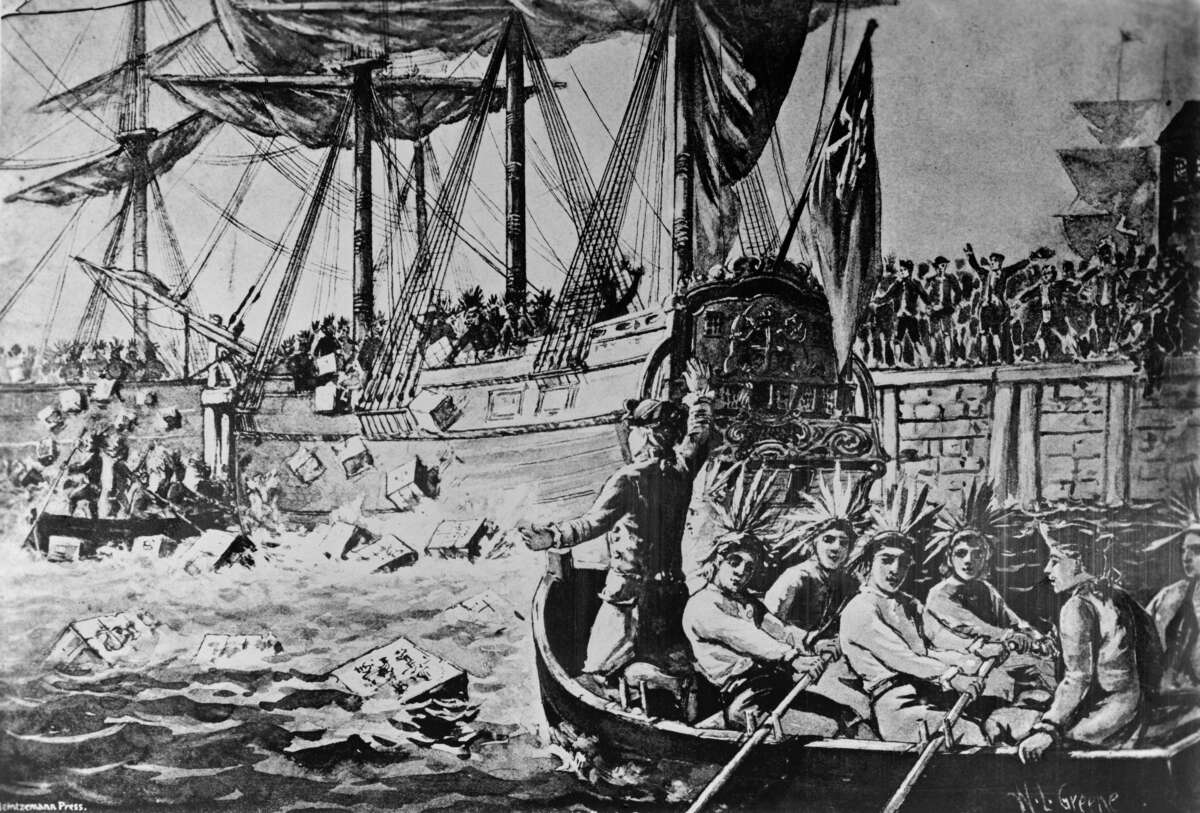
A wash drawing by W.L. Greene depicts the Boston Tea Party. “When colonists threw tea into Boston Harbor to protest an unjust tax, they dressed up as Native people,” says Rebecca Nagle.Bettmann / Contributor via Getty Images
The United States turned 250 this year, and the document officiating its birth, the Declaration of Independence, is famous for its opening lines proclaiming the nation’s freedom from England and the rights of men. But Rebecca Nagle, a journalist and citizen of the Cherokee Nation, frames the document differently, describing it as a list of grievances growing in ascending order, where Native people, smeared as “merciless Indian savages,” are the founders’ biggest “problem.”
This characterization rendered Native Americans as less than human and as part of the natural world, over which settlers believed they had God-given dominion, justifying genocide and land theft. The Declaration of Independence in 1776 reflected a general sense of antagonism toward Native peoples. Yet three years earlier, during the Boston Tea Party, Nagle notes, settlers dumped tea into the harbor while wearing Native clothing. This raises questions about whether early Americans wanted to get rid of Indigenous people — or become Indigenous themselves.
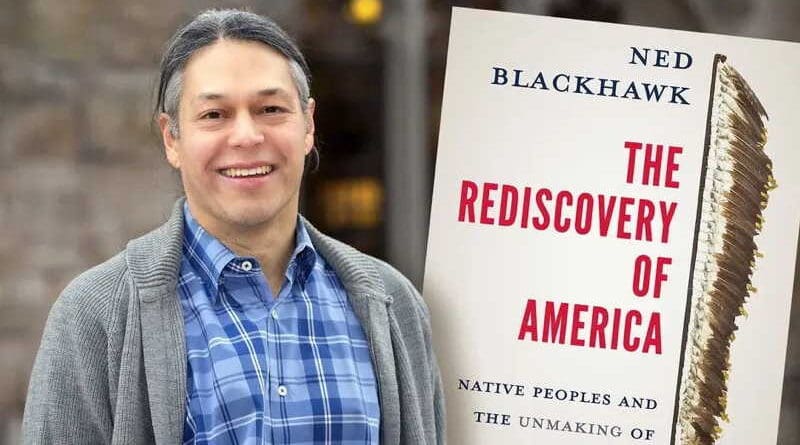
Nagle’s new podcast “First America” asks how the American public missed this tension. The project features a group of Native scholars, including Maggie Blackhawk (Fond du Lac Ojibwe), Ned Blackhawk (citizen of Te-Moak Tribe of Western Shoshone), Phil Deloria (Standing Rock and Yankton Sioux Tribes), and Nick Estes (Lower Brule Sioux Tribe).
In the interview that follows, Nagle discusses how colonists have appropriated Native identity, how Indigenous diplomacy exerted real influence over American founding documents, and how we can find authoritarianism in U.S. history.
This interview has been lightly edited for clarity.
Related Story
The United States turned 250 this year, and the document officiating its birth, the Declaration of Independence, is famous for its opening lines proclaiming the nation’s freedom from England and the rights of men. But Rebecca Nagle, a journalist and citizen of the Cherokee Nation, frames the document differently, describing it as a list of grievances growing in ascending order, where Native people, smeared as “merciless Indian savages,” are the founders’ biggest “problem.”
This characterization rendered Native Americans as less than human and as part of the natural world, over which settlers believed they had God-given dominion, justifying genocide and land theft. The Declaration of Independence in 1776 reflected a general sense of antagonism toward Native peoples. Yet three years earlier, during the Boston Tea Party, Nagle notes, settlers dumped tea into the harbor while wearing Native clothing. This raises questions about whether early Americans wanted to get rid of Indigenous people — or become Indigenous themselves.
Nagle’s new podcast “First America” asks how the American public missed this tension. The project features a group of Native scholars, including Maggie Blackhawk (Fond du Lac Ojibwe), Ned Blackhawk (citizen of Te-Moak Tribe of Western Shoshone), Phil Deloria (Standing Rock and Yankton Sioux Tribes), and Nick Estes (Lower Brule Sioux Tribe).
In the interview that follows, Nagle discusses how colonists have appropriated Native identity, how Indigenous diplomacy exerted real influence over American founding documents, and how we can find authoritarianism in U.S. history.
This interview has been lightly edited for clarity.
Related Story
Petala Ironcloud: You say the founders’ final grievance in the Declaration of Independence was “merciless Indian savages.” Why do you think that’s been erased from how we teach the Revolution, and what changes once you put it back in?
Rebecca Nagle: We like to tell the story of the Revolution as David standing up to Goliath — England is the more powerful bad guy, and our founders were brave, loved freedom and liberty and democracy, and threw off the king to establish a better form of government. Even people who are critical of the founders, who’d say obviously they weren’t including everyone in that vision of democracy, still want to hold on to the kernel of democratic hope the Revolution represents.
The founders were saying Indigenous people were something less than human. There’s deep racial animus in that line.
When you bring Native people into focus, it’s really different. The founders weren’t just fighting England; both leading up to the Revolution and during the war itself, the Revolution was also about land, about who would control the continent of North America. The part of the Declaration we like to teach is “all men are created equal,” and “life, liberty, and the pursuit of happiness.” But there’s also a line about “merciless Indian savages.” Savages is a word the founders used on purpose — in the late 1700s, it meant someone was less than human, that they didn’t have the same rights as “civilized” people, as the people of Europe. Alongside those Enlightenment ideas, the founders were saying Indigenous people were something less than human. There’s deep racial animus in that line, and it doesn’t fall out of the sky.
England, having financial problems, couldn’t afford to keep fighting wars with Indigenous nations. After an Indigenous uprising sacked a string of British forts in North America, the Crown decided to make peace — which meant telling colonists they couldn’t move further west. The king drew a line down the Appalachian Mountains. That really angered the colonists, who wanted to expand and saw that land as already theirs. The hunger for Indigenous land, and England’s refusal to let colonists take more of it, is one of the main reasons the Revolution happened in the first place.
You argue the founders built both a democracy and an empire, and that the two can’t coexist. What does that tension look like today?
The mythical version of the founding — the “No Kings” version — is that the founders threw off monarchy and tyranny and created a democracy instead. But almost immediately, they got busy building an empire with colonial forms of government not that different from England’s. They were conscious of it — they called it an “empire of liberty.” As they mapped how the U.S. would expand into what’s now the Great Lakes region, they called it “America’s first colony.” The same summer they were writing the Constitution, they were drafting a blueprint for American colonialism.
The hunger for Indigenous land, and England’s refusal to let colonists take more of it, is one of the main reasons the Revolution happened in the first place.
How is American colonialism different from American democracy? In the colonial system, there are no elections, no constitutional rights, no due process. Every iteration of American government since has governed the people it colonized through top-down structures. You can call it colonialism, call it empire — what it reminds me of most is authoritarianism: government that rules through force instead of consent, that isn’t accountable to the people it governs, that uses extreme violence to enforce what it wants. That’s how the U.S. governed Indigenous people and dispossessed us of our land.
So when people ask how the rise of authoritarianism could be happening in the United States — how this could be “un-American,” “unprecedented” — it’s not. Part of our government has always been authoritarian. The mistake Americans have made for a long time is believing those two things could coexist and stay separate. That’s just not how it works.
You’ve said you set out to make a history podcast and kept ending up in the present. Can you walk through a moment when researching the 1700s directly explained something happening in 2026?
I had a profound moment with historian Nick Estes, a citizen of the Lower Brule Sioux Tribe, who helped conceive this project. We were visiting Fort Snelling in Minneapolis — used in the 1860s as a concentration camp to detain Dakota people, part of a broader act of ethnic cleansing pushing Dakota people out of Minnesota. While we were there, Nick got a call: ICE had just killed [Renee Good]. The next day I was back on the Fort Snelling campus — not to visit the fort this time, but to report on a protest at ICE headquarters, which sits on that same campus because it’s still federal land, land that was once a military reservation. The past and present kept echoing.
Another moment: One of the later episodes covers the first war the U.S. fought after the Revolution, against what’s sometimes called the Northwest Confederacy — an alliance of Great Lakes tribes led by the Miami. That 10-year war shaped the U.S. military in lasting ways, but one striking thing about it is that it was never formally declared by Congress. In this moment — with Trump bombing Iran, invading Venezuela, bombing boats in the Caribbean, and all this debate over what war powers the president actually has — the U.S. has been fighting undeclared wars since the George Washington administration.
The Boston Tea Party episode reframes colonists dressing as Mohawk as identity, not disguise. What does that episode argue about “playing Indian” as an American tradition, and where do you still see it today?
Something I didn’t know until I encountered the work of historian Phil Deloria: when colonists threw tea into Boston Harbor to protest an unjust tax, they dressed up as Native people — put on a costume and “played Indian.” People often assume it was for disguise, so British officials would blame Native people instead of the colonists. But it wasn’t really a secret who’d thrown the tea. It wasn’t disguise — it was costume, because of what dressing as a Native person represented to early Americans.
When people ask how the rise of authoritarianism could be happening in the United States — how this could be “un-American,” “unprecedented” — it’s not.
Early Americans were in an awkward, unformed place. For a long time, they’d thought of themselves as English; suddenly they were fighting a war to no longer be English, but they weren’t yet American either. They needed a new national identity. Part of building it — saying we are no longer European, we are of this land, we are of this place — was appropriating Native identity, pretending to be Indian. It wasn’t just the Tea Party. The symbolic figure of “the Indian” showed up on pamphlets, guns, ships. In political cartoons from the era, England is represented by a white woman, and the colonists — not actual Indigenous people, but the white colonists — are represented by the image of a Native woman. Native people, or rather the idea of Native people in the colonial imagination, came to represent freedom and liberty in the early republic.
Americans have never really stopped doing this. You see it now at global scale — in the headdresses showing up at the last two World Cups, the way certain NFL teams banned headdresses at games years ago with no equivalent conversation yet at FIFA. I think the reason Americans still play Indian today is different from, but not unrelated to, what early Americans were doing. It’s still about identity, about a kind of alienation in modern life that makes people feel like their own culture is inauthentic — so they go looking for something that feels real, deep, connected, and think they find it in Native culture. You see that in what hippies wore, in New Age sweat lodge ceremonies, in mascots. That shift starts in the early 1900s — also from Phil’s work — and we’re still living in it: Americans searching for an imagined Native figure untouched by modernity, living purely in the woods.
What’s harmful is that the Native people of Americans’ imaginations get far more love and attention than actual, living, breathing Native people. When someone says a mascot or a land acknowledgment is “honoring” Native people, it’s often the opposite — it reinforces stereotypes to the detriment of real Native people. I look white, which comes with real privilege in this country, but I still encounter people questioning or outright challenging my Native identity because I don’t fit their stereotype. Native people who are Black and Brown experience that plus forms of racism I never have to. Non-Native people have invested so much of their own identity and self-actualization in this imagined stereotype that when they’re confronted with living Native people who don’t fit it, they don’t want it — and that leaves less space for us to just be seen and respected as we are.
What does the series argue was actually broken about the Articles of Confederation, and how does that connect to federal Indian policy?
Everyone agrees the Articles of Confederation weren’t working — they were dead on arrival. Most people don’t realize the Constitution we live under isn’t the country’s first form of government. Around the time of the Declaration, the founders created a different government to hold the colonies together, since they were separate British colonies needing some kind of unified structure. It looked very different from what we have now — no president, no Supreme Court, Congress ran everything, and Congress was so ineffective that sometimes not enough members even showed up for quorum.
One of the main reasons the framers built a new, more centralized government was expansion. There was constant infighting between states over land, and real tension over whether the federal government or individual states had the right to make treaties with tribes — Georgia and North Carolina, for instance, insisted they could simply take Native land even where federal treaties said otherwise. It was a mess, and the U.S. wanted to expand but needed to get that expansion under control.
People keep looking to Hungary, to Putin’s Russia, even to Nazi Germany to understand how authoritarianism takes hold. We don’t have to leave our own country to find those examples.
What’s especially interesting — and something the series gets into later — is that some of the core concepts in the Constitution itself come from our ancestors. One is the supremacy of treaties. At the time of the founding, the Treaties of Hopewell had been signed with the Cherokee, Choctaw, and Chickasaw at the end of the Revolutionary War. Southern states treated those treaties as invalid and kept violating them as tribes dealt with white encroachment. So tribal delegates actually traveled to the Constitutional Convention in Philadelphia and met with George Washington, Benjamin Franklin, and other framers, asking that states be bound to follow treaties — that treaties carry legal weight under the new federal government. What you get in the Constitution is the Supremacy Clause, placing treaties on essentially the same legal footing as the Constitution itself. At the founding, Indigenous treaties were taken that seriously. That’s a genuinely beautiful moment of Indigenous resistance, organizing, and diplomacy — at a time when our ancestors weren’t citizens, couldn’t vote, and were still exerting real influence over the shape of the new government.
How did you choose which scholars to center, and did any of them push back on your framing?
The project started as a conversation between me and Nick Estes — we were frustrated with how Indigenous people get left out of the story of America and wanted to build a corrective. We called up Phil Deloria, Ned Blackhawk, and Maggie Blackhawk and asked if they wanted to participate, and to my surprise, they all said yes. We got together at Yale in 2022 and hashed out the big ideas. At the time we thought it would be a magazine essay series — but between the state of print journalism and where the ideas kept taking us, it became a podcast instead. The series relies heavily on their scholarship throughout; you can see it clearly in episode two, which draws on Phil’s book Playing Indian to explain both the Tea Party and the present day.
This is timed to the 250th anniversary. What do you want it to counter-program against?
We’re in a moment of real debate over who we are as a country, where we come from, how we started — and I see both sides of that debate leaving Native people out of the story. Without Indigenous people, the founding story of the United States is simply wrong. We don’t actually know what happened if we leave us out.
I think that omission is at the root of the current political crisis. People keep asking how authoritarianism could be rising in the United States — how this could be happening here. I don’t think we know how America got here as a country, because we don’t know how it started. That failure to see is part of how we ended up in this moment. This isn’t about guilt, and it isn’t about diversity and inclusion — it’s about accuracy, about having a true and honest account of what the U.S. is and how it began. People keep looking to Hungary, to Putin’s Russia, even to Nazi Germany to understand how authoritarianism takes hold. We don’t have to leave our own country to find those examples. Presidential war powers, the bombing of Iran, the detention of migrant families, deploying the National Guard to U.S. cities, challenging birthright citizenship — the way this administration justifies all of it goes directly back to federal Indian law. The current administration is building on a foundation that’s already there. Most Americans just don’t know that foundation exists, and that makes it much harder to understand what’s happening right now.
For a listener who thinks this is just history — who feels like “those were somebody else’s ancestors, it’s sad, but I’m not responsible” — what’s the one contemporary policy fight you’d point them to as proof it isn’t?
What I want to shift isn’t whether people feel responsible for what our government did to Native people. I want them to see that it affects them. The government that rounded up families and put them in a concentration camp in Cherokee Nation, that put 15,000 people in open-air stockades in a single month, that drove a pregnant woman to her death in those camps — that government is still our government. It’s not just the government of Native people. It’s everybody’s government.
Maggie Blackhawk has a line in the podcast: We forged a knife out of metal, and that weapon can hurt anybody. There’s nothing specific to Native Americans that makes us uniquely susceptible to these tools of state violence — they can be, and have been, used on anyone. Maggie’s research found that some of the first Japanese incarceration camps during World War II were actually operated by the Bureau of Indian Affairs, on reservations — because the BIA already had the infrastructure and expertise to detain families and communities intergenerationally. They simply took what they’d built to do that to Native people and applied it to another group.
What we’re seeing now is that same set of tools being turned on an ever-broader portion of the population — increasingly, anyone not aligned with those in power. Have armed federal officers, members of the military, ever been deployed onto what’s now Minnesota to round up civilians? Yes. Has the military been used against civilians on U.S. soil? Yes. Our government has done all of this before, and we’ve never gone back and rewritten that government to say: genocide is a crime, and it can never happen again. We’ve never had that reckoning as a country. Compare that to Canada, which has at least paid some lip service to reckoning — ours has mostly been forced silence. At the U.S.’s 150th anniversary, people were literally celebrating what our government did to Indigenous people. Later generations just forgot. We’ve never reckoned with it.
This article is licensed under Creative Commons (CC BY-NC-ND 4.0), and you are free to share and republish under the terms of the license.

Petala Ironcloud
Petala Ironcloud is a Native writer and strategist whose work explores federal Indian law, environment, technology, and art. They have written for The New York Times, Time, The New Republic, MIT Technology Review, ARTnews, and other publications.