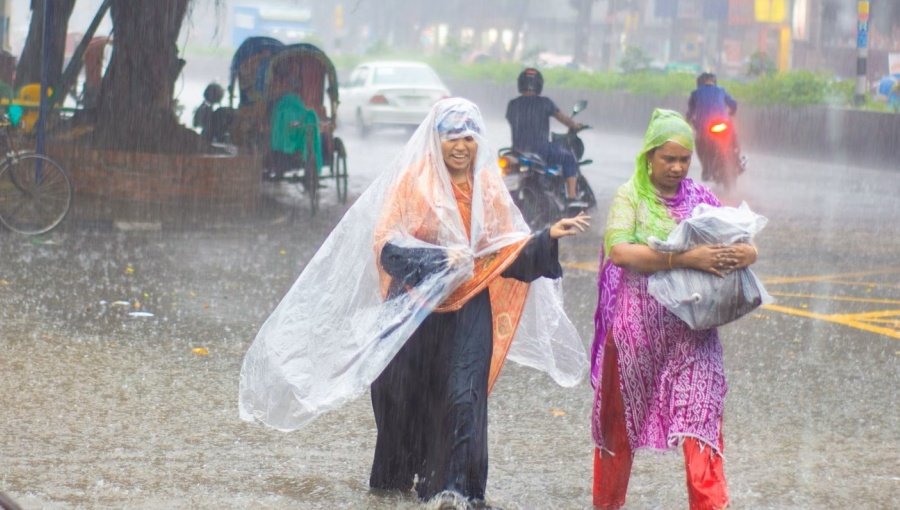
A very strong El Niño is unlikely to derail emerging-market growth but could lift inflation and widen trade gaps, with the Philippines most exposed, Capital Economics said on November 5.
The note, "Gauging the macro impact of El Niño", by William Jackson, chief emerging markets economist at the London-based consultancy, tests the current event against the 2015/16 and 2023/24 episodes across 15 economies. It puts the likely drag on GDP growth at just 0.05-0.30 percentage points, which is not enough to change its forecast that aggregate emerging-market growth will accelerate modestly in the coming quarters.
Manila has little room to absorb a food shock. Philippine consumer prices rose 7.8% year on year in October, the fastest pace since February 2023, the statistics authority reported on November 5. The Bangko Sentral ng Pilipinas (BSP) has already raised its policy rate by 125bp since April to 5.5%, and the peso fell to a record low past 64 to the dollar on October 28.
"The peso could come under pressure if the trade balance worsens given the already-large current account deficit. And with headline inflation already well above target, an El Niño food shock could trigger additional rate hikes," Jackson said.
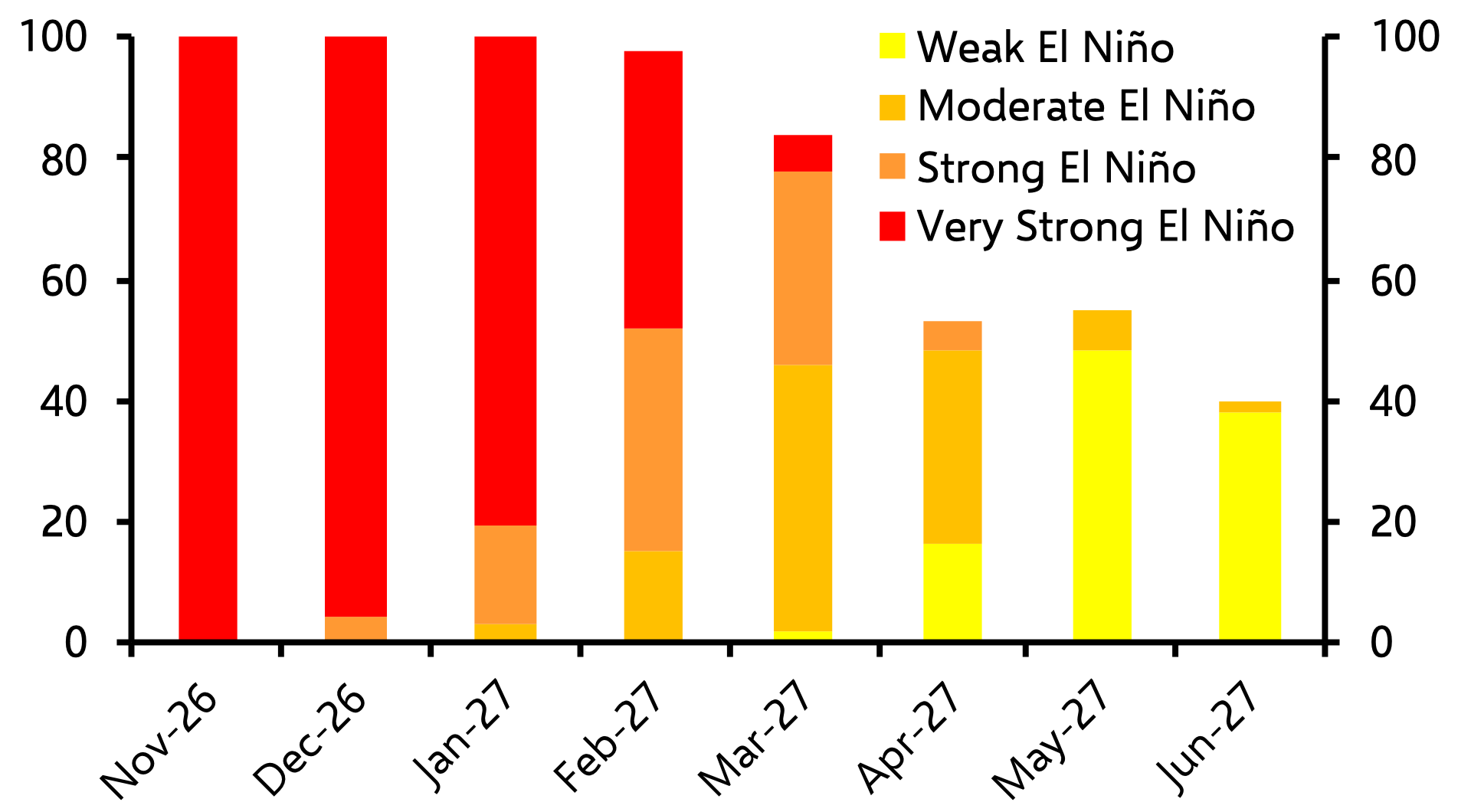
El Niño strength probabilities (%), November 2026 to June 2027. Source: NOAA
Probabilities from the US National Oceanic and Atmospheric Administration (NOAA), charted in the note, make a very strong event a near certainty in November and December, with the odds fading through the first half of 2027. The event is set to peak late this year and persist into 2Q27. It raises the odds of the extreme weather behind the annual disaster season, and the effects have started: India's monsoon ran around 15% below normal, while drought in Indonesia has fed wildfires whose smoke has spread across South East Asia.
A small hit to output
Comparing El Niño years with a pre-event baseline, agricultural gross value added growth slowed by between 0.3 and 2.5 percentage points in most of the economies studied. Agriculture is only 3-8% of GDP in most emerging markets, so the hit to the headline figure stays small, although the risk of a bigger fall is higher in parts of Africa and South Asia, where farming counts for more.
Agriculture lost ground in both episodes in Indonesia, the Philippines, Ghana, Mexico, South Africa and Thailand. It generally strengthened in Brazil, Chile and Colombia.
Coffee, palm oil and cocoa rose on average by 50% or more in dollar terms during the last two events, peaking 18-24 months after the start. Sugar and rice moved less, with prices up by around 20% at their peaks.
Logistics look a smaller worry than last time. Capacity on the Panama Canal was cut to 55% in 2023/24, yet that had no discernible impact on global inflation, and water levels in Gatun Lake are now in line with seasonal norms, according to Capital Economics. As of mid-October the canal was still running below its normal 36 transits a day, with the canal authority citing a continuing water deficit in the basin.
Trade balances take the strain
India and South East Asia carry the external risk. Agricultural trade balances in India, Malaysia, Indonesia, the Philippines and Vietnam worsened by an average of 0.5-1.0% of GDP in the last two events, through higher imports in Vietnam and the Philippines and lower exports in India, Indonesia and Malaysia. Thailand split: its balance worsened in 2015/16 but improved in 2023/24, when its rice exporters gained from higher prices and market share after India imposed an export ban. Latin American balances generally improved.
The study found no consistent link between those trade swings and exchange rates, probably because El Niño takes time to feed through and other forces such as the carry trade intervene. The Philippines stands out all the same, since it combines a large current account deficit with high exposure to a weaker trade balance, while India, Indonesia, Malaysia and Vietnam have much stronger external positions, according to Capital Economics. Ghana and Pakistan looked vulnerable to the last El Niño, but their risks have diminished significantly in recent years.
A more inflationary starting point
El Niño does not reliably push up emerging-market food inflation, which fell during both of the last two events. Both, however, coincided with falling energy prices. This time higher input costs from the Iran war, including the fertiliser shock and dearer diesel, and disruption to Black Sea shipping as Russia and Ukraine hit each other's ports will push global food prices higher, according to Capital Economics, adding to a food price shock that has already arrived.
Measured against the emerging-market median to strip out common effects, food inflation rose by 3.0-4.5 percentage points in India, Indonesia, Malaysia and Vietnam during the last two events, adding as much as 1.5-1.8 percentage points to headline rates. The Philippines saw a large relative rise in 2023/24 but not in 2015/16. Food inflation fell relative to the median in Peru, Chile and Colombia.
A food shock would be most worrying in Pakistan, the Philippines and Colombia, where inflation is already well above target. Capital Economics does not currently forecast more rate hikes in the Philippines or Colombia, but sees further tightening as possible if an El Niño shock materialises. ING said on November 5 that it expects a quarter-point BSP hike in December.
In India, El Niño feeds the view that the Reserve Bank of India's tightening cycle has further to run, according to Capital Economics. The RBI lifted its repo rate to 5.5% in October and policymakers have left the door open to more hikes as a weak monsoon adds to food prices. There is less cause for concern on inflation in Malaysia and Indonesia, given their lower starting points.
Colombia's hydropower risk
Power generation is the other channel, and Colombia looks especially vulnerable. Hydropower supplied 81% of its electricity in 2025, and that share fell to 55% in March 2024 during the previous strong El Niño, according to the US Energy Information Administration. The last two events coincided with increases of 10-20 percentage points in Colombian household electricity price inflation, directly adding 0.3-0.6 percentage points to the headline rate.
Power rationing in Brazil in the early 2000s may have knocked about one percentage point off GDP growth, and regular power cuts in South Africa in recent years may have reduced growth by a similar amount, according to Capital Economics. Brazil and Paraguay, also heavily reliant on hydropower, tend to see above-average rainfall during El Niño.
Who ends up paying
Policy will not stop the damage but will decide who bears the cost. Export bans, such as India's on rice in 2023, cut inflation at home and raise bills for importers. Tariff cuts, as in the Philippines in 2024, lower inflation but widen trade and budget deficits. Stock releases, subsidies and price caps in Indonesia and Malaysia shift the cost to governments or distributors, which is a fiscal concern in Indonesia.
Buffers are uneven: US Department of Agriculture data suggest global palm oil stocks are lower than at the start of the last El Niño, but rice inventories are high, especially in India, where the stockpile could cushion a harvest that industry officials expect to fall by around 10mn tonnes. State elections in India early next year could tempt the government towards export bans or stock releases, according to Capital Economics.
Energy may matter more than the weather: "were global energy flows to normalise, that would help to offset many of the effects of El Niño; were they to remain disrupted, El Niño may amplify the effects," the note said. Its comparison is deliberately simple and is meant to show where risks are concentrated and their rough scale, not to give precise predictions.

No comments:
Post a Comment