
November 8, 2026
By RFE RL
Key Takeaways:
The strikes injured more than a dozen people and killed one in Dnipropetrovsk, damaging a Kyiv kindergarten and the capital’s major Dnipro River bridge, while Ukraine retaliated with long-range attacks on Russian oil and military-industrial sites.
Ukrainian, Russian and U.S. negotiators are scheduled to hold talks in Abu Dhabi on 10–11 November, with Zelenskyy urging greater American support and sanctions as Russia continues to demand a comprehensive deal including territorial concessions.
Ukrainian President Volodymyr Zelenskyy says Russia is seeking to “plunge the entire country into a blackout” by pounding more than a dozen Ukrainian regions with drones and missiles ahead of US-mediated talks with Moscow next week.
“Ukraine must not be left alone” as the fifth wartime winter approaches, Zelenskyy said on November 7, days before Ukrainian, Russian, and US negotiators are set to hold talks in Abu Dhabi.
Since 2022, the Kremlin has repeatedly exploited cold weather to intensify its air strikes, attacking the country’s energy and civilian sites in a bid to pressure Kyiv into accepting its hard-line conditions for peace.
Heading into this winter, attacks have already left thousands of Ukrainians without heat or electricity. The latest strikes alone have created an “extremely difficult” situation in the capital, Mayor Vitali Klitschko said.
According to Ukrainian authorities, electricity transmission lines, residential buildings, and key transport infrastructure, including Kyiv’s major bridge over the Dnipro River, were targeted across the country overnight.
Zelenskyy said Russia had launched 172 drones and 36 ballistic missiles at Ukraine, among other things, seeking to disrupt its energy grid by targeting substations connecting the country’s nuclear power plants.
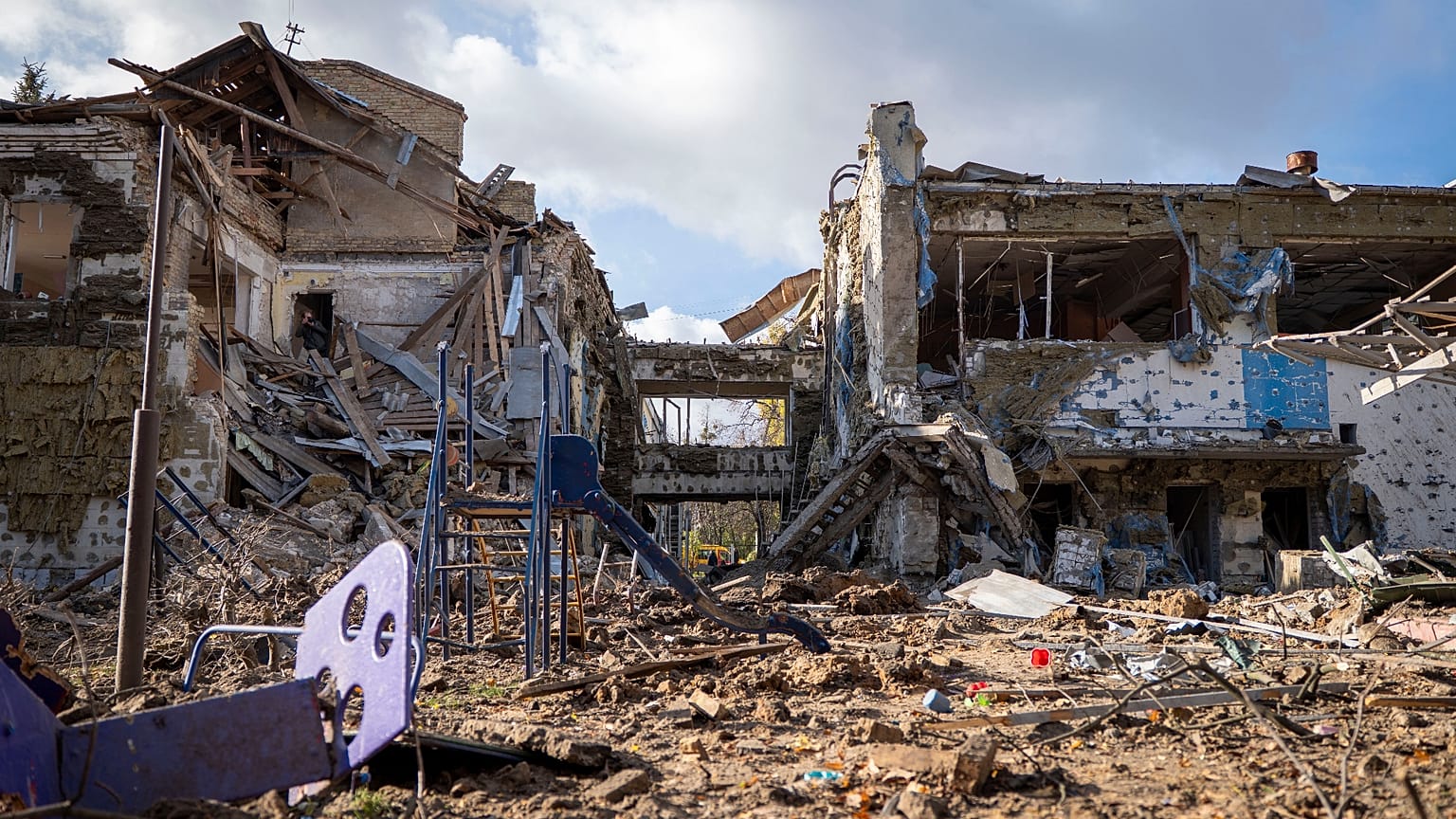
Separately, a kindergarten in the capital’s Solomyansky district was severely damaged in Russia’s attacks. Local residents told RFE/RL’s Ukrainian Service that the facility was in high demand among Kyiv families.
While helping clean up after the attack, a local, Tetyana, said the kindergarten had previously been near the site of several attacks, but that the November 7 strike had “directly” hit it.
“Only yesterday kids were playing here, dancing, and drawing,” she said, adding that “now, there is nothing left” inside the building. “We hope very much for help.”
More than a dozen people were reported injured across Ukraine on November 7, including at least two children. One person was killed in the Dnipropetrovsk region, the country’s key eastern hub that hosts thousands of refugees from occupied areas.
Russia’s Defense Ministry confirmed its strikes on Kyiv, claiming in particular that the targeted bridge was used to transport weapons and military equipment for the Ukrainian Armed Forces — a justification Moscow has often used for its attacks on civilian infrastructure.
Zelenskyy called on Washington to increase its support for Ukraine, urging greater Congressional unity on security issues, condemnation of Russian aggression, and stronger sanctions against Russian President Vladimir Putin.
“America’s determination and consistency in supporting Ukraine are of great importance in bringing peace closer,” he said.
Kyiv has repeatedly argued that increasing pressure on the Kremlin and its war machine could shift the balance of power in the war and force Russia into meaningful negotiations that could stop its long-running invasion.
Russia has previously resisted calls for a cease-fire, saying the fighting would stop only when the parties reach a “comprehensive peace deal” that would include Moscow’s demands, including control over Ukrainian territories that Russian forces have yet to seize on the battlefield.
In response, over the past year, Ukraine has increased its air strike campaign against Russian energy infrastructure and military-industrial facilities, targeting sites Kyiv says help sustain Moscow’s war effort.
On November 7, the Ukrainian military said its forces carried out long-range strikes against several Russian facilities linked to the oil industry and military production, claiming the attacks could disrupt the production of weapons used against Ukraine.
According to Ukraine’s General Staff, its missile forces targeted the JSC Proton-Electrotex military-industrial enterprise in Russia’s Oryol region, adding that the company produces components used in Russia’s Iskander-M ballistic missiles and cruise missile systems.
Oryol regional authorities reported damage to warehouses and production facilities belonging to commercial enterprises, as well as three private houses.
Separately, in Russia’s Saratov region, a fire broke out at the local oil refinery following a Ukrainian drone attack, Russian and Ukrainian media reported. Governor Roman Busargin said that civilian infrastructure was damaged in the strikes, with preliminary reports of casualties.
Russia’s Defense Ministry claimed its air defense systems shot down 411 Ukrainian drones overnight. The figure has not been independently verified.
While the dynamics on the battlefield show no signs of easing, trilateral negotiations between Ukraine, Russia, and the United States are planned for November 10–11.
US President Donald Trump, whose administration has been trying to settle the conflict since the start of his second term in January 2025, said he believed a “big, beautiful agreement” could be close and suggested it might involve not only Ukraine but “all of Europe.”
The Kremlin has previously raised concerns over its security in relation to European countries as another obstacle to a diplomatic resolution of its invasion of Ukraine. Trump’s envoy Jared Kushner, however, said the talks would respect the sovereignty and territorial integrity of every country.
Kushner added that no state would have a veto over another’s security choices or alliances, with NATO remaining central to European collective defense.
While more details of the future talks are yet to emerge, according to Interfax, Russia’s delegation to the talks will include presidential aide Vladimir Medinsky and other officials whom Kyiv had earlier said did not have sufficient decision-making authority.
Medinsky previously led Russian negotiating teams in talks with Ukraine in 2022 and 2025 without securing a breakthrough.
Ukraine’s delegation will be led by Rustem Umerov, head of Ukraine’s Foreign Intelligence Service and a former defense minister, according to Ukrainian media reports.
It will also include Presidential Office chief Kyrylo Budanov; David Arakhamia, head of the Servant of the People parliamentary faction; presidential communications adviser Dmytro Lytvyn; and Serhiy Kyslytsia, first deputy head of the Presidential Office.
Last month, the United States mediated a temporary cease-fire that enabled humanitarian aid deliveries and civilian evacuations from the Russian-occupied city of Oleshky, helping residents escape hunger and isolation in the war-torn area.
The development has increased hopes that the precedent could serve as a model for wider de-escalation efforts, but Moscow downplayed such ideas, suggesting it would not apply to the broader situation on the front line.
About RFE RL
RFE/RL journalists report the news in 21 countries where a free press is banned by the government or not fully established.
View all posts by RFE RL →
Russia fires North Korean missiles at 'key' Ukrainian energy facility, Zelenskyy says
"Moscow is deliberately seeking to leave millions of Ukrainians without electricity, heating, and water as winter approaches," Ukrainian Foreign Minister Andrii Sybiha said.
Russian forces fired North Korean missiles at a "key" energy facility overnight, Ukrainian President Volodymyr Zelenskyy said on Saturday, as he once again urged allies to accelerate deliveries of interceptor missiles.
"Technical assessments are ongoing at the sites hit by ballistic missiles. According to preliminary findings, at one of the key energy facilities that was damaged, the Russians used KN-23 missiles manufactured and supplied by North Korea," he wrote in a post on social media.
Zelenskyy said Russia had launched 36 ballistic missiles at the capital Kyiv and the surrounding region and that four were shot down.
The KN-23 missile
The KN-23 is a North Korean short-range ballistic missile with a top range of around 690 km, according to the Center for Strategic and International Studies' Missile Threat site.
It is thought to have been first tested in May 2019 and is similar in appearance to the Russian-made Iskander-M missile.
Ukraine's defence ministry said in April this year that the KN-23 has been used in previous attacks on Ukraine, adding that the weapon was "extremely difficult for air defence systems to deal with."
North Korea is believed to have sent more than 16,000 troops to support Russian forces since October 2024, as well as providing munitions. In June of that year, Russian President Vladimir Putin and North Korean leader Kim Jong-un signed a Comprehensive Strategic Partnership Treaty.
Winter attacks
Ukrainian Foreign Minister Andrii Sybiha said Russia's latest attacks had targeted "critical energy infrastructure" as Moscow once again ramps up strikes ahead of the winter months. Russia has repeatedly targeted Ukraine's power grid during wartime winter periods in a campaign to break the country's resolve.
"Moscow is deliberately seeking to leave millions of Ukrainians without electricity, heating, and water as winter approaches," Sybiha wrote on X.
Zelenskyy said the strikes were also likely part of a Kremlin ploy to put additional pressure on Ukraine's negotiating position ahead of planned trilateral talks between Kyiv, Moscow and Washington in Abu Dhabi.
Overnight strikes on the Kyiv region left at least six people, including a child, injured, and damaged a bridge and energy facilities, local authorities and Ukraine's State Emergency Service said.
Kyiv Mayor Vitali Klitschko said the Pivnichnyi Bridge had been hit, while energy infrastructure in the Kyiv and Zhytomyr regions had also been damaged.
"The situation regarding the capital’s energy supply is extremely difficult. Consequently, there are disruptions to the city’s heating and water supply systems," he wrote on Telegram.
The strikes targeted a substation connecting the Rivne and Khmelnytskyi nuclear plants to Kyiv, as well as substations in the Vinnytsia, Zhytomyr, Rivne, Kharkiv, and Dnipro regions, per Zelenskyy. A kindergarten was also partially destroyed, he added.


No comments:
Post a Comment