An Interview With Sonja Lokar
March 22, 2025
Source: Originally published by Z. Feel free to share widely.

Sonja Lokar speaking at the anniversary of the Antifascist Women's Front in February 2025
The Socialist Federal Republic of Yugoslavia has been well known for its socialist feminism – the politics that helped to create a state with a highly developed health-care system, with excellent childcare and all-day primary school, extended paid maternity and parental leave, public food canteens in the workplace, kindergartens, schools, companies and other state institutions, homes for the elderly in every municipality, an enshrined right to freedom of childbirth in the 1974 Constitution, and a whole system of support for the implementation of women’s reproductive and sexual rights and health. We spoke about this legacy and the current situation in reproductive work and reproductive rights in Slovenia (and other ex-Yugoslav countries) with a renowned Slovenian sociologist, international gender expert, feminist, activist, former politician and the president of The Women’s Lobby of Slovenia, Sonja Lokar.
What was the situation of women in the region of the former Socialist Federal Republic of Yugoslavia (SFRY) before SFRY was established, so before 1945?
The first Yugoslavia, the Kingdom of Serbs, Croats and Slovenes[1], was very diverse. Half of the country had a history of the Turkish Empire rule (today’s Serbia without Vojvodina, North Macedonia, Kosovo, Montenegro), the other half had a history of the Austro-Hungarian Empire rule (Vojvodina, Croatia, Slovenia). Bosnia and Herzegovina was under Turkish rule, then annexed to the Austro-Hungarian Empire in 1908. The formerly Turkish part of the country, with exemption for the large cities, was characterized by a very high illiteracy rate among men and especially among women (over 70% even by 1945), while in the formerly Austro-Hungarian parts there were no illiterate women. In Slovenia, already before World War II, women made 30% of the working class. The majority of the population in the Kingdom of Yugoslavia were peasants and day-labourers, the working class was small in number, but as industry developed, the working class became stronger and more and more unionized and, under the influence of the Soviet revolution, attempted to organize itself also along party lines. But in the Kingdom the Communist Party of Yugoslavia was soon banned and driven underground, where it remained until the beginning of World War II.
The first Yugoslavia was essentially an autocratic constitutional monarchy with an extremely progressive constitution modelled on the German Weimar constitution but, unfortunately, not implemented. Women were not equal before the law, as was then the case almost everywhere in the world except in the Soviet Union. The law made them subordinated to the male members of the family before marriage (father, brother) and after marriage to the husband. This constitution stated that they had the right to vote, but no law was ever passed to give them the right to vote. It was an underdeveloped, peripheral, capitalist, unitary state that sought to erase inherited specificities, above all denying national differences and imposing Greater Serbian nationalism. It recognized religious differences and regulated the private status of women (marriage, inheritance, child allocation, the status of illegitimate mothers and children, divorce – which was not possible because it was contracted under religious law). In Christian religions, only separation from the table and bed was possible, but not total divorce. In Islam, a man could divorce at will, but a woman could not. Schools provided religious education according to three denominations: Orthodox, Catholic and Muslim, which had the status of state religions.
The society of Slovenia was realistically described by writers, playwrights, and poets of that time: Oton Župančič in his poem Duma, Ivan Cankar in Idealist and Hlapci (Idealist, Serfs), Prežihov Voranc in Samorastniki (The Self-Sown), Ivan Potrč, Ciril Kosmač in Tantadruj and Srečko Kosovel. The women were mostly maids, hired daily farm workers and factory workers, as well as teachers, midwives and low-level clerks. Women teachers were not allowed to marry if they wanted to keep their jobs, and many professions were inaccessible to women. Married bourgeois women were housewives. Patriarchy, in the manner of a capitalist, underdeveloped society controlled by religious morals, was thus legitimised in economic, public, and private life.
During World War II, many women were among the Yugoslav partisans, not only as auxiliary personnel, but also as medics, doctors, intelligence gatherers and fighters. Did this emancipatory moment have an impact on the later position of women in the SFRY[2]?
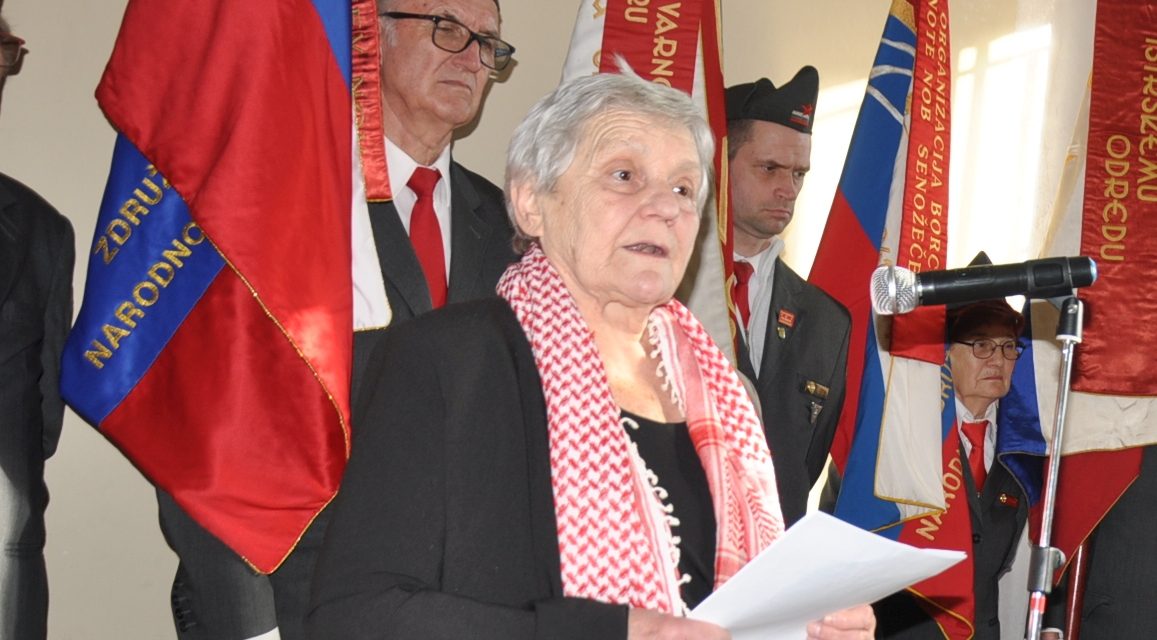
Sonja Lokar speaking at the anniversary of the Antifascist Women's Front in February 2025
The Socialist Federal Republic of Yugoslavia has been well known for its socialist feminism – the politics that helped to create a state with a highly developed health-care system, with excellent childcare and all-day primary school, extended paid maternity and parental leave, public food canteens in the workplace, kindergartens, schools, companies and other state institutions, homes for the elderly in every municipality, an enshrined right to freedom of childbirth in the 1974 Constitution, and a whole system of support for the implementation of women’s reproductive and sexual rights and health. We spoke about this legacy and the current situation in reproductive work and reproductive rights in Slovenia (and other ex-Yugoslav countries) with a renowned Slovenian sociologist, international gender expert, feminist, activist, former politician and the president of The Women’s Lobby of Slovenia, Sonja Lokar.
What was the situation of women in the region of the former Socialist Federal Republic of Yugoslavia (SFRY) before SFRY was established, so before 1945?
The first Yugoslavia, the Kingdom of Serbs, Croats and Slovenes[1], was very diverse. Half of the country had a history of the Turkish Empire rule (today’s Serbia without Vojvodina, North Macedonia, Kosovo, Montenegro), the other half had a history of the Austro-Hungarian Empire rule (Vojvodina, Croatia, Slovenia). Bosnia and Herzegovina was under Turkish rule, then annexed to the Austro-Hungarian Empire in 1908. The formerly Turkish part of the country, with exemption for the large cities, was characterized by a very high illiteracy rate among men and especially among women (over 70% even by 1945), while in the formerly Austro-Hungarian parts there were no illiterate women. In Slovenia, already before World War II, women made 30% of the working class. The majority of the population in the Kingdom of Yugoslavia were peasants and day-labourers, the working class was small in number, but as industry developed, the working class became stronger and more and more unionized and, under the influence of the Soviet revolution, attempted to organize itself also along party lines. But in the Kingdom the Communist Party of Yugoslavia was soon banned and driven underground, where it remained until the beginning of World War II.
The first Yugoslavia was essentially an autocratic constitutional monarchy with an extremely progressive constitution modelled on the German Weimar constitution but, unfortunately, not implemented. Women were not equal before the law, as was then the case almost everywhere in the world except in the Soviet Union. The law made them subordinated to the male members of the family before marriage (father, brother) and after marriage to the husband. This constitution stated that they had the right to vote, but no law was ever passed to give them the right to vote. It was an underdeveloped, peripheral, capitalist, unitary state that sought to erase inherited specificities, above all denying national differences and imposing Greater Serbian nationalism. It recognized religious differences and regulated the private status of women (marriage, inheritance, child allocation, the status of illegitimate mothers and children, divorce – which was not possible because it was contracted under religious law). In Christian religions, only separation from the table and bed was possible, but not total divorce. In Islam, a man could divorce at will, but a woman could not. Schools provided religious education according to three denominations: Orthodox, Catholic and Muslim, which had the status of state religions.
The society of Slovenia was realistically described by writers, playwrights, and poets of that time: Oton Župančič in his poem Duma, Ivan Cankar in Idealist and Hlapci (Idealist, Serfs), Prežihov Voranc in Samorastniki (The Self-Sown), Ivan Potrč, Ciril Kosmač in Tantadruj and Srečko Kosovel. The women were mostly maids, hired daily farm workers and factory workers, as well as teachers, midwives and low-level clerks. Women teachers were not allowed to marry if they wanted to keep their jobs, and many professions were inaccessible to women. Married bourgeois women were housewives. Patriarchy, in the manner of a capitalist, underdeveloped society controlled by religious morals, was thus legitimised in economic, public, and private life.
During World War II, many women were among the Yugoslav partisans, not only as auxiliary personnel, but also as medics, doctors, intelligence gatherers and fighters. Did this emancipatory moment have an impact on the later position of women in the SFRY[2]?
Partisan Woman by Nikolaj Pirnat, 1944
Not only did it have an impact, but it was also crucial. All our basic women’s rights are built on the blood and sacrifice of partisan women, nurses, doctors, couriers, informers, bourgeois women who collected food, shoes, clothes and sanitary supplies and sent them to partisans, peasant women who, in their homes, under the threat of the death of entire families and the burning of their homes, took the partisans under their roofs and fed them, bandaged their wounds and frostbite. What was particularly crucial was that among the partisans there were many dedicated communist women who really knew what had to be done to improve the situation of working women significantly. Vida Tomšič[3] presented a motion at the 5th National Conference of Yugoslav Communists in Dubrava near Zagreb in 1940 on the necessity of communists’ work among women, in which she developed to the last detail the program which the Communist Party had already started during the war, and which it had implemented step by step after the war. By 1990, women communists succeeded in implementing this programme almost fully.
Why was the Anti-Fascist Women’s Front founded and what was its importance in the struggle for women’s equality?
Not only did it have an impact, but it was also crucial. All our basic women’s rights are built on the blood and sacrifice of partisan women, nurses, doctors, couriers, informers, bourgeois women who collected food, shoes, clothes and sanitary supplies and sent them to partisans, peasant women who, in their homes, under the threat of the death of entire families and the burning of their homes, took the partisans under their roofs and fed them, bandaged their wounds and frostbite. What was particularly crucial was that among the partisans there were many dedicated communist women who really knew what had to be done to improve the situation of working women significantly. Vida Tomšič[3] presented a motion at the 5th National Conference of Yugoslav Communists in Dubrava near Zagreb in 1940 on the necessity of communists’ work among women, in which she developed to the last detail the program which the Communist Party had already started during the war, and which it had implemented step by step after the war. By 1990, women communists succeeded in implementing this programme almost fully.
Why was the Anti-Fascist Women’s Front founded and what was its importance in the struggle for women’s equality?

Vida Tomšič (1913-1998) was a Slovenian Partisan fighter during World War II, prominent communist politician, women’s activist, she was the president of the Antifascist front of Women of Yugoslavia between 1948 and 1953 (Photo: Danilo Škofič)
It was initiated by the leadership of the Communist Party of Yugoslavia. The basic idea was that women, under the ideological leadership of communist women, should organise themselves en masse as the most important support for the armed partisan struggle and, through their participation in the national liberation movement, train themselves in every possible way for a completely different social role, on an equal footing with men in the post-war period. The motto of the founding meeting of the Anti-Fascist Women’s Front (AFWF) in Dobrnič in October 1943 was “All for the partisans until the final victory.” After the end of the war, AFWF played a remarkable role, today we would say the role of a mass civil society organization, replacing the state social policy and its institutions, since a systemic and universal social policy was almost non-existent under capitalism, and could not be established overnight by the communist authorities. In the south of Yugoslavia, the AFWF eliminated female illiteracy within two years by holding seminars of its activists in every village. In Slovenia, for example, the AFWF eliminated the trachoma that caused mass blindness in Prekmurje region, took care of war orphans, of the disabled, who were very numerous after the war, of the health education of uneducated women who knew little or nothing about their bodies and not enough about the care of newborn babies, and made women aware of their equal rights at home, at work, in politics. In 1953, however, the AFWF was abolished by the communist authorities. Vida Tomšič was the President of the AFWF at the time, and she strongly defended this decision. Her argument was that confining women only to the AFWF was harmful because the really important development and political decisions are taken in the party and the organs of national and local governments, without women, who are too concerned only with specific social issues, but who, alone and marginalized, cannot actually solve them successfully. Today, we would say that she has opted for gender mainstreaming – bringing a gender perspective into all policies where they are actually decided. Subsequent insights by women researchers into this abolition of AFWF have also provided different explanations as to why this happened. Some concluded that because the AFWF was in daily contact with the needs of women workers and peasants, it remained revolutionary, while the leadership of the Yugoslav Communist Party slowed down and began to warm up to the idea that women should be more concerned with the home, children and family rather than with social problems, while others noted, that the AFWF was in fact becoming too strong a political force and that AFWF women were too determined and too demanding, fighting uncompromisingly for their priorities, putting them before the Party, which in those days had other priorities and “bigger concerns” than gender equality. In my view, the truth is actually a mixture of all these insights. What is important, however, is that our social development later confirmed that the socialist women’s movement, after the initial organizational shock, had successfully regained momentum and showed that communist women politicians were able to learn from their mistakes.
What were the characteristics of socialist feminism and how was it implemented in the SFRJ?
Typically, it was framed within the ideological scheme of the Marxist theory of the liberation of labor. The leading party feminists firmly rejected and publicly denounced any deviation from this theory as a delusion of petty-bourgeois feminism and a defense of the interests of the privileged women, those who are the better-off, better educated and better-connected to the centers of real economic and political power. By attacking the patriarchy as a timeless social machine for male discrimination against women, these better off women are turning the class struggle into a meaningless, and therefore, ineffective struggle of women against men. The basic idea of our communist feminism, based on the theory of the liberation of labour, was that gender inequality could only be eliminated simultaneously and concomitantly with the abolition of capitalist exploitation of workers and the abolition of private ownership of economic resources, the means of production. In the class struggle, and in the building of a socialist society, female and male workers have a common interest and there must be alliance, comradeship and solidarity between them, because only together can they achieve the fundamental goal: the abolition of the capitalist order in the society and its transformation into a society of equality and freedom for all, not only for those who appropriate political power on the basis of their economic superiority. That is why Vida Tomšič and her female comrades were resolutely opposed to any independent, autonomous self-organization of women in politics, in the Communist League, in the trade unions, in the Union of Socialist Youth. The only exception was the Socialist Union of the Working People, an organization where different social groups that shared a consensus regarding the legitimacy of the socialist constitutional order could meet, freely express their differences, and find out how to work together for the greater common good.
What were the key gains for women in SFRY? What role did women politicians and activists play in the realisation of economic, social and political rights of women?
I would like to stress a few key points first: full equality of men and women before the law, women’s suffrage (already in the election of national liberation authorities in the time of World War II), the right to education and work in almost all professions, the separation of church and state including in public education and kindergartens, civil marriage, civil divorce, the equalization of the rights of legitimate and illegitimate children, special assistance for single mothers, an individualized pension and tax system, the division of marital property in half in the event of divorce, the allocation of the care of the children of divorced parents in accordance with the children’s best interests.
The abolition of the AFWF therefore proved to be a wrong step because the communist women’s movement had been significantly weakened for several years, as there were far too few active women in political decision-making positions, especially in the executive bodies of the Communist League and the elected state organs at different levels: the assemblies and governments. The Federation of Women’s Associations, which was to replace the AFWF, was too dispersed for socially active women, who no longer had their own relatively independent united organization to be able to formulate common women’s social priorities and then successfully mainstream them into political decision-making bodies. The movement really took off only after 1966, when the leadership of the Communist League decided to take a new step in the decentralization of the state and for a more market-oriented economy, for an economic reform that opened up Yugoslavia to international finance and foreign investments, opened up the borders for the free movement of people, and took a new step in the decentralization of the federation. It blossomed anew in the 1970s, when Yugoslavia effectively created a complex welfare state, operating on the basis of social property, integral self-management and a further decentralised federation. The women active at that time established excellent cooperation in the Council for Women’s Social Activity of the Socialist Union of the Working People and achieved a real revolution by participating in delegate assemblies at the level of municipalities, republics and provinces and the federation, and above all in self-governing interest communities for childcare, education, health, housing and social policy. They have become so successful because a social agreement for all social, economic and political delegate decision-making bodies has set a minimum quota of 30% for women and it has been respected. In those days, we were on a par with the Swedes in terms of the proportion of women in the assemblies, and Sweden was then the first country in the world in terms of the proportion of women in parliaments.
Thanks to the Yugoslav socialist feminists of those days, we developed excellent childcare, all-day primary school, public food canteens in the workplace (kindergartens, schools, companies and other state institutions), extended paid maternity and parental leave, built health centers and homes for the elderly in every municipality, enshrined the right to freedom of childbirth in the 1974 Constitution, and set up a whole system of support for women’s reproductive and sexual rights and health. We have established a gynecologist and a pediatrician at the basic level of public health care. The social democrats in power in the most developed European countries at that time learned from us.
How important was political education in SFRY, also in the context of understanding the problematic nature of patriarchy and its connection to capitalism?
The public education system has undoubtedly given people a much better understanding of various societal processes than it does today. Perhaps that is why the process of Slovenia’s independence[4] was so brilliant and genuinely democratic. People, most of whom had at least a secondary school education, were able to grasp what was actually happening and to imagine and choose how society should be changed to make life freer and the economy more prosperous. Today, they come out of schools like idiots. This is not meant as an insult, idiot is a technical term for a person who is socially and politically illiterate. This is not the fault of the pupils and teachers, still less of the young people themselves, make no mistake, it is the fault of the concept of public education as we have developed it since independence.
As far as political literacy is concerned, especially for young people and for self-government activists, socialist Yugoslavia had a truly excellent system. The activists of the social-political organizations, that is, the members of the Union of Communists, the youth organization, the trade unions, the Socialist Union of the working People, the delegates, elected to the assemblies, had to be thoroughly educated about the values on which the economic and political system was based and how it worked. There were serious political schools. Sometimes some people speak derisively of the Kumrovec School[5], where the cadres of the Communist League were trained. This only shows how they do not understand anything. Where do you think the generation that led the process of Slovenia’s independence in government after 1990 was educated? Janša? Bavčar? Even Peterle! Whatever one thinks of them[6], they were certainly not politically illiterate. And look at the members of their parties in the National Assembly today![7]
We were also educated through practical action, the big political school being the youth work brigades[8]. The basic ideas of gender equality were always part of that training, although not exactly something that seemed to be the most important, it was more self-evident, because the basic value of the political system was equality between people living off their paid labor, so discrimination on the basis of gender was unacceptable, because the inequality of women would push half of society into inequality. But it has been much more difficult to integrate serious analyses of the realities of gender power relations into this education. Dr. Maca Jogan[9] has just published an excellent scholarly article on this, entitled “From Man to Men”. She analyses how slowly and with how much resistance sociology, which has been developing as a science in this country since the beginning of the 1960s at the Faculty of Social Sciences, has incorporated gender aspects into its research, taking for granted the concept of man as the first, equating it with the genderless human being and making him the measure of all things. And if there is no critical sociological research that takes gender seriously, there can be no serious awareness of what the real challenges of gender inequalities in the society are. There can be no accurate way of addressing them successfully in the general public and especially among social and political decision-makers without discrimination and violence against women
It was initiated by the leadership of the Communist Party of Yugoslavia. The basic idea was that women, under the ideological leadership of communist women, should organise themselves en masse as the most important support for the armed partisan struggle and, through their participation in the national liberation movement, train themselves in every possible way for a completely different social role, on an equal footing with men in the post-war period. The motto of the founding meeting of the Anti-Fascist Women’s Front (AFWF) in Dobrnič in October 1943 was “All for the partisans until the final victory.” After the end of the war, AFWF played a remarkable role, today we would say the role of a mass civil society organization, replacing the state social policy and its institutions, since a systemic and universal social policy was almost non-existent under capitalism, and could not be established overnight by the communist authorities. In the south of Yugoslavia, the AFWF eliminated female illiteracy within two years by holding seminars of its activists in every village. In Slovenia, for example, the AFWF eliminated the trachoma that caused mass blindness in Prekmurje region, took care of war orphans, of the disabled, who were very numerous after the war, of the health education of uneducated women who knew little or nothing about their bodies and not enough about the care of newborn babies, and made women aware of their equal rights at home, at work, in politics. In 1953, however, the AFWF was abolished by the communist authorities. Vida Tomšič was the President of the AFWF at the time, and she strongly defended this decision. Her argument was that confining women only to the AFWF was harmful because the really important development and political decisions are taken in the party and the organs of national and local governments, without women, who are too concerned only with specific social issues, but who, alone and marginalized, cannot actually solve them successfully. Today, we would say that she has opted for gender mainstreaming – bringing a gender perspective into all policies where they are actually decided. Subsequent insights by women researchers into this abolition of AFWF have also provided different explanations as to why this happened. Some concluded that because the AFWF was in daily contact with the needs of women workers and peasants, it remained revolutionary, while the leadership of the Yugoslav Communist Party slowed down and began to warm up to the idea that women should be more concerned with the home, children and family rather than with social problems, while others noted, that the AFWF was in fact becoming too strong a political force and that AFWF women were too determined and too demanding, fighting uncompromisingly for their priorities, putting them before the Party, which in those days had other priorities and “bigger concerns” than gender equality. In my view, the truth is actually a mixture of all these insights. What is important, however, is that our social development later confirmed that the socialist women’s movement, after the initial organizational shock, had successfully regained momentum and showed that communist women politicians were able to learn from their mistakes.
What were the characteristics of socialist feminism and how was it implemented in the SFRJ?
Typically, it was framed within the ideological scheme of the Marxist theory of the liberation of labor. The leading party feminists firmly rejected and publicly denounced any deviation from this theory as a delusion of petty-bourgeois feminism and a defense of the interests of the privileged women, those who are the better-off, better educated and better-connected to the centers of real economic and political power. By attacking the patriarchy as a timeless social machine for male discrimination against women, these better off women are turning the class struggle into a meaningless, and therefore, ineffective struggle of women against men. The basic idea of our communist feminism, based on the theory of the liberation of labour, was that gender inequality could only be eliminated simultaneously and concomitantly with the abolition of capitalist exploitation of workers and the abolition of private ownership of economic resources, the means of production. In the class struggle, and in the building of a socialist society, female and male workers have a common interest and there must be alliance, comradeship and solidarity between them, because only together can they achieve the fundamental goal: the abolition of the capitalist order in the society and its transformation into a society of equality and freedom for all, not only for those who appropriate political power on the basis of their economic superiority. That is why Vida Tomšič and her female comrades were resolutely opposed to any independent, autonomous self-organization of women in politics, in the Communist League, in the trade unions, in the Union of Socialist Youth. The only exception was the Socialist Union of the Working People, an organization where different social groups that shared a consensus regarding the legitimacy of the socialist constitutional order could meet, freely express their differences, and find out how to work together for the greater common good.
What were the key gains for women in SFRY? What role did women politicians and activists play in the realisation of economic, social and political rights of women?
I would like to stress a few key points first: full equality of men and women before the law, women’s suffrage (already in the election of national liberation authorities in the time of World War II), the right to education and work in almost all professions, the separation of church and state including in public education and kindergartens, civil marriage, civil divorce, the equalization of the rights of legitimate and illegitimate children, special assistance for single mothers, an individualized pension and tax system, the division of marital property in half in the event of divorce, the allocation of the care of the children of divorced parents in accordance with the children’s best interests.
The abolition of the AFWF therefore proved to be a wrong step because the communist women’s movement had been significantly weakened for several years, as there were far too few active women in political decision-making positions, especially in the executive bodies of the Communist League and the elected state organs at different levels: the assemblies and governments. The Federation of Women’s Associations, which was to replace the AFWF, was too dispersed for socially active women, who no longer had their own relatively independent united organization to be able to formulate common women’s social priorities and then successfully mainstream them into political decision-making bodies. The movement really took off only after 1966, when the leadership of the Communist League decided to take a new step in the decentralization of the state and for a more market-oriented economy, for an economic reform that opened up Yugoslavia to international finance and foreign investments, opened up the borders for the free movement of people, and took a new step in the decentralization of the federation. It blossomed anew in the 1970s, when Yugoslavia effectively created a complex welfare state, operating on the basis of social property, integral self-management and a further decentralised federation. The women active at that time established excellent cooperation in the Council for Women’s Social Activity of the Socialist Union of the Working People and achieved a real revolution by participating in delegate assemblies at the level of municipalities, republics and provinces and the federation, and above all in self-governing interest communities for childcare, education, health, housing and social policy. They have become so successful because a social agreement for all social, economic and political delegate decision-making bodies has set a minimum quota of 30% for women and it has been respected. In those days, we were on a par with the Swedes in terms of the proportion of women in the assemblies, and Sweden was then the first country in the world in terms of the proportion of women in parliaments.
Thanks to the Yugoslav socialist feminists of those days, we developed excellent childcare, all-day primary school, public food canteens in the workplace (kindergartens, schools, companies and other state institutions), extended paid maternity and parental leave, built health centers and homes for the elderly in every municipality, enshrined the right to freedom of childbirth in the 1974 Constitution, and set up a whole system of support for women’s reproductive and sexual rights and health. We have established a gynecologist and a pediatrician at the basic level of public health care. The social democrats in power in the most developed European countries at that time learned from us.
How important was political education in SFRY, also in the context of understanding the problematic nature of patriarchy and its connection to capitalism?
The public education system has undoubtedly given people a much better understanding of various societal processes than it does today. Perhaps that is why the process of Slovenia’s independence[4] was so brilliant and genuinely democratic. People, most of whom had at least a secondary school education, were able to grasp what was actually happening and to imagine and choose how society should be changed to make life freer and the economy more prosperous. Today, they come out of schools like idiots. This is not meant as an insult, idiot is a technical term for a person who is socially and politically illiterate. This is not the fault of the pupils and teachers, still less of the young people themselves, make no mistake, it is the fault of the concept of public education as we have developed it since independence.
As far as political literacy is concerned, especially for young people and for self-government activists, socialist Yugoslavia had a truly excellent system. The activists of the social-political organizations, that is, the members of the Union of Communists, the youth organization, the trade unions, the Socialist Union of the working People, the delegates, elected to the assemblies, had to be thoroughly educated about the values on which the economic and political system was based and how it worked. There were serious political schools. Sometimes some people speak derisively of the Kumrovec School[5], where the cadres of the Communist League were trained. This only shows how they do not understand anything. Where do you think the generation that led the process of Slovenia’s independence in government after 1990 was educated? Janša? Bavčar? Even Peterle! Whatever one thinks of them[6], they were certainly not politically illiterate. And look at the members of their parties in the National Assembly today![7]
We were also educated through practical action, the big political school being the youth work brigades[8]. The basic ideas of gender equality were always part of that training, although not exactly something that seemed to be the most important, it was more self-evident, because the basic value of the political system was equality between people living off their paid labor, so discrimination on the basis of gender was unacceptable, because the inequality of women would push half of society into inequality. But it has been much more difficult to integrate serious analyses of the realities of gender power relations into this education. Dr. Maca Jogan[9] has just published an excellent scholarly article on this, entitled “From Man to Men”. She analyses how slowly and with how much resistance sociology, which has been developing as a science in this country since the beginning of the 1960s at the Faculty of Social Sciences, has incorporated gender aspects into its research, taking for granted the concept of man as the first, equating it with the genderless human being and making him the measure of all things. And if there is no critical sociological research that takes gender seriously, there can be no serious awareness of what the real challenges of gender inequalities in the society are. There can be no accurate way of addressing them successfully in the general public and especially among social and political decision-makers without discrimination and violence against women
.
Youth Work Brigade, 1961, Builiding the Brotherhood and Unity Highway in Preševo SFRY
How did socialist feminism in SFRY deal with the problem of the burden of reproductive labor on women’s backs, and what is the state of reproductive labor today in Slovenia?
The partisans liberation movement’s feminists, not only Vida Tomšič, but also Mara Rupena and Majda Gaspari, for example, were very well aware of the burden and the consequences of this burden, which was still on women’s shoulders from the days of capitalism. They have tried very hard to turn as much of this unpaid work of women as possible into paid work and to set up a systemic solution of public services (kindergartens, canteens, elderly people’s homes…).
But younger generations of socialist feminists have subsequently, since the mid-1960s, succeeded in proving that patriarchy is much more long-lived and flexible than the partisan Marxist feminists thought. They made visible that specific kinds of patriarchy have lived in all social formations since humans as a species outgrew the hunter-gatherer phase, i.e. since slave-owning Rome, to feudalism and capitalism, and that it happily lives its adapted life even in socialism. Namely, every time it achieves that the so-called reproductive work, i.e. the work of keeping people fed, clean, healthy, nurtured, provided for when they are old, sick, disabled, helpless, the work that is necessary to raise infants into adulthood and then to become socially functional human beings, is transferred to women’s shoulders. They have shown that, even under our socialism, we have not yet succeeded in getting women’s unpaid caring work to be actually fairly divided between the sexes, that even when it is paid, it remains less valued than male-dominated work. The socialist system has only succeeded in reducing this reproductive work by making it partially paid, professional work. From the mid-sixties, gradually, some relief came also with the wide availability of the technology of washing machines, refrigerators, electric and gas cookers, central heating, vacuum cleaners, irons and other small household appliances. But even under self-managed socialism, parental leave was virtually always taken by women, women stayed on sick leave with sick children, women left the labor market prematurely to care for frail old parents, feminized professions were underpaid – textile workers, shop assistants, routine clerks, educators, nurses, even judges, and because of these, women suffered poverty in old age with shamefully low pensions, especially when their partners died.
The biggest problem of the current young generations in the context of reproductive work is that it does not become their problem at all because they cannot afford to have children. Most of them cannot afford to buy or even to rent a home, they do not have stable jobs or partnerships that are stable enough to dare to risk parenthood. Those who do have these conditions are increasingly divided into two groups: a group where men are increasingly, and consciously, taking a fair share of unpaid re-productive work, and a group, dominated by young men, but with young women increasingly present also, who are looking for a solution in the return of the women to the traditional feminine roles of wife, mother, housewife, even though this is a direct route to poverty and the restoration of the patriarchal domination of men over women.
The second major challenge relates to the aging society with a growing proportion of elderly in need of long-term care. There is a clear trend here of transforming long-term care into a for-profit activity. The concessioners are claiming the right to the profits that flow to them from public funds. This is pushing the prices of services skywards and will, in the long term, divide society between the rich, who can afford these prices and the cost of the above-standard service out of their own pockets, and the very poor and lonely, who will end up in the hellholes, with the miserable services into which public nursing homes will be turned, and those who will fall on the shoulders of their daughters. These daughters will have to leave the labor market early to care for their parents or partners. Many of those will see their pensions substantially reduced by the loss of an important part of their income, since the status of the carer of a very frail family member gets an allowance of 1.2 the minimum wage.
What was the understanding of reproductive rights in SFRY, especially compared to Western countries?
Communist and social democratic feminists were already campaigning for the legalisation and accessibility of abortion on social grounds before the World War II, as women workers were dying from unsafe back street abortions because they could not afford to have an abortion at a doctor’s office, which was forbidden but available for a large sum of money to wealthy women. Immediately after the war, the old Yugoslav law was in force, punishing both the woman who did it and the person who helped her to have an abortion. In SFRY the regime first abolished the punishment of the woman, then allowed abortion for medical and social indications recognized by a special commission, while at the same time taking great care of sex education and the availability of contraception as it was known at the time. Yugoslavia had already developed its own production of condoms and diaphragms in the 1950s, and the contraceptive pill, which American women got in 1960, was already being produced and dispensed on prescription by gynecologists to women in Yugoslavia as early as in 1964. As one of the prominent women leaders of non-aligned countries, Vida Tomšič was fighting in the United Nations for defining free choice in childbirth as a new human right in the 1960s. In doing so, she prevented the state demographic policy of forcing childbirth in developed countries with low birth rates and forcing the prevention of too many births at any cost in developing countries. Her solution was the concept of the desired child, which is a conscious choice made by the parents, because such a child has the best conditions for survival and healthy development. The state should only ensure that the parents are free to make an informed and free choice. In this case it is a woman’s right to decide whether to give birth or to abort after an unwanted conception. In the human right of freedom in giving birth, the duty of the state is to help women to make the decision to abort safely. So the right to abortion has been explicitly included in the human right of the freedom of birth.
The developed Western countries, with the exception of Scandinavia, have always been inclined towards a policy of state-led birth promotion and hypocritical restrictions on the ability of poor women in particular to have an abortion in their own country, and at the same time towards a policy of state-led population explosion control in the countries of the poor global South. The best example of such a policy is Germany, where there is no officially available information on contraceptives and the right to legal abortion, where abortion and contraception are paid for, where a woman has to go to counselling if she decides to have an abortion and then has to wait a week, if she does not change her mind, where the time in which a legal abortion can be performed is being cruelly reduced, where every major city has a baby box, a special box in which a mother who gives up her newborn baby can anonymously and safely deposit and abandon that newborn baby. At the same time, Germany, through its development aid policy, is fervently supporting the policy of state birth restriction, the so-called population policy, in developing countries.
In the 1974 Federal Assembly, Vida Tomšič convinced the delegates in the Constitutional Commission not to accept an amending proposal by Serbian feminists that the article in the new Federal Constitution on the human right to decide freely on the birth of children should be reduced to a woman’s right to decide on her own about the termination of her pregnancy. I have never asked Vida Tomšić whether she really wanted above all to assert the right of both women and men to decide together and consciously freely on the birth of a child, or whether she was just tactically trying to get men to agree that a woman can decide for herself whether or not to keep a foetus. Without men’s support, this article would not have made it into the Constitution. One thing I am sure of, however: the Communist feminists fought to ensure that desired children would be born, that all people would learn at an early age how they could prevent unwanted pregnancies, and that abortions would be kept to a minimum. For them, abortion was not a woman’s right to decide about her own body, but a rational last resort to prevent even greater harm: the health of the woman being endangered or even killed by a smear abortion.
What has changed in the former republics and autonomous regions of SFRY, and more specifically in Slovenia, since the transition to capitalism (from 1991 onwards)?
Slovenia has done best in the area of gender equality, although it has also lost a lot. In particular, it kept the article on freedom to procreate in its new constitution[10]. Croatia, the Federation of Bosnia and Herzegovina, Montenegro, and Kosovo no longer have it. Slovenia has maintained the separation of church and public education, the network of public kindergartens, and even introduced some important innovations: constitutionally protected legal gender quotas, 100% paid maternity, parental and special non-transferable paternity leave, excellent preventive health care for pregnant women, screening programmes for breast and cervical cancer, a lower tax rate for menstrual hygiene products, a redefined definition of rape in the Criminal Code based on the principle of the absence of freely given consent. Women’s access to education has not deteriorated, and women have penetrated the police and the army. The legal discrimination against same-sex couples has ended, and the Constitutional Court has just restored single women’s right to artificial insemination, which they lost in the 2001 referendum.
The only things that can be considered improvements everywhere in the former socialist Yugoslavia are two things:
Firstly, the proportion of women in parliaments at all levels after 2020 has finally surpassed everywhere the best results we had under socialism in the 1980s. The bad news is that there are fewer and fewer women elected to parliament to fight for women’s human rights. There are reasons for that: because many of them have no idea how much work we still have to do to achieve real equality, because they do not dare to fight, because they are afraid of losing support and the chance to be re-nominated and re-elected in their parties, where misogyny and machismo flourish, because of hate speech and threats against feminists, especially on social media, and even physical violence on the streets, that have made it dangerous to be a feminist, or simply because the powerful anti-feminist women politicians are in the front ranks and in the service of their radical right, nationalist, misogynist, homophobic and xenophobic political parties.
Secondly: Violence against women has lost its status as a private matter for the victims and has been given a prominent place in the policies of all the governments of the countries that emerged from SFRY, where truly progressive legislation has been adopted to prevent violence of all kinds against women and to protect the victims. As far as rape is concerned, the best legal solutions have been adopted, you will not believe it, in Kosovo. The bad news is that nowhere is this legislation really being implemented successfully.
Both improvements were won by large national coalitions of conscious civil society activists, experts, journalists, MPs and ministers of different political colors, in the sweat of their brow and with the overwhelming support of international organizations such as, in particular, the Council of Europe, UN Women, the OSCE, the ODIHR, the EU and progressive international political foundations.
But women’s economic and social rights have declined everywhere. The share of women in paid work has fallen sharply. The worst situation is in Kosovo and North Macedonia. The gap between average female and male wages is widening everywhere. Women’s work has become heavily precarious, and with it the rights to paid maternity leave, to an 8-hour working day, to a free weekend, to paid holidays, which remained in the legislation, have in practice all flown out of the window. Health security has deteriorated severely, as privatization has invaded public health care everywhere, bringing with it endless queues and a decline in the quality of public health services. Without money, you cannot get good medicines. There has also been a small decline in access to, and above all in the quality of, education, with higher education becoming increasingly fee-paying. The proportion of women in higher education is declining. In schools, children in Bosnia and Herzegovina are even physically separated, depending on which religion they choose: Catholic, Orthodox, or Muslim. In all three cases, they are taught that God created women to obey and serve men.
What is that – comprehensive sex education? It is nowhere to be seen or heard of anymore!
In Montenegro, kindergartens have been privatized, and quality kindergartens are no longer accessible to children from poor families.
The poverty of older women is spreading and deepening everywhere.
The situation of sexual and reproductive rights varies from one country to another. Abortion is still legal everywhere, but it has to be paid for and is much less accessible. Religious propaganda and public rallies against this right are spreading. Women need to pay for contraceptives everywhere, Slovenia is the only exception, but even here, gynecologists and pediatricians in primary health care are disappearing in practice.
Croatia is a good example: the right to freedom of procreation is no longer mentioned in the Constitution, but the legal framework regulating the right to an abortion has remained unchanged from the socialist times. In 70% of gynecological hospitals, where legal abortion can only be performed, there is not a single male or female doctor who does not claim conscientious objection. That is why women from Croatia are going to Slovenia and Bosnia and Herzegovina to have abortions. To conclude, I draw your attention to comparisons:
Despite the fact that Slovenia has long lacked any noteworthy state mechanisms to prepare and monitor the implementation of improvements in gender equality policies, and despite the fact that our legislation on equal opportunities for women and men is completely outdated, and the draft of a new one has been languishing in the government’s drawers for several years now, Slovenia, in 2024, takes, according to the European Union Institute for Gender Equality, a 12th place among EU Member States. It scores 70.1 out of a possible 100 points, below the EU average for gender equality by 0.9 points. This is a very solid, good result.
Serbia has one of the best legal frameworks for gender equality in the world; even a gender-sensitive budget has been enacted, and the state’s mechanisms for gender equality from municipalities upwards are well organized. But in June 2024, Serbia’s Constitutional Court annulled their law on equal opportunities until further notice. The reason? The law is said to be unconstitutional because it uses the word gender, which does not exist in the Serbian dictionary and it is written in gender-sensitive language, which is unacceptable, since linguistic experts think that male gender in Serbian language is a generic gender, and when used for men and women, it denotes persons of both sexes. This decision blocks the work of all state mechanisms for gender equality, as well as the work of NGOs that provide, with the support of the state budgets, essential services for the women that need them, e.g. SOS phones, safe houses, even psychological counselling for victims of violence against women.
[1] Established on December 1st 1918
[2] Socialist Federal Republic of Yugoslavia was established on November 29th in 1945 and then named Socialist People’s Republic of Yugoslavia (it was renamed in 1963). It was composed of six socialist republics (Slovenia, Serbia, Croatia, Bosnia and Herzegovina, Macedonia, Montenegro) and two autonomous regions ( Vojvodina, Kosovo).
[3] Vida Tomšič (1913-1998) was a Slovenian Partisan fighter during World War II, prominent communist politician, women’s activist, she was the president of the Antifascist front of Women of Yugoslavia between 1948 and 1953 and a professor of family law at the Faculty of Law at the University of Ljubljana. She was given the Order of the People’s Hero in postwar Yugoslavia. She was appointed minister for social policy in 1945 and later held important posts in the government of the Socialist Republic of Slovenia. She represented Yugoslavia in international relations, especially in the framework of the Non-Aligned Movement.
[4] Slovenia declared its independence from SFRY on June 25th 1991.
[5] Josip Broz-Tito (1892-1980), communist revolutionary, the president of SFRY, was born in a small Croatian town of Kumrovec close to the Slovenian border.
[6] Janez Janša, Igor Bavčar, Lojze Peterle, in 1991 at the forefront of Slovenian independence process, now right wing politicians and/ or businessmen. Janša and Bavčar both served jail time for corruption.
[7] Janez Janša is the leader of Slovenian Democratic Party (SDS), an extreme right wing party with members being known for their populist, vulgar statements.
[8] The Youth Work Brigades were working groups, active especially in the post-war period in the Socialist Federal Republic of Yugoslavia. They were organised on a voluntary basis and carried out work of public interest. Young people helped to rebuild the war torn country and helped to set up communal and traffic infrastructures. The activity was also important from a political point of view, the participants were also educated in the fields of culture, sport, transport, defence, medicine and first aid, various forms of youth and elderly care, different cultures, and the strengthening of interpersonal relations.
[9] Maca Jogan is Slovenian sociologist and feminist, professor emeritus of sociology at the Faculty of Social Sciences – University of Ljubljana.
[10] “It is a human right to decide freely on the procreation of children”, SFRY wrote the right to abortion in the Constutution in 1974.
ZNetwork is funded solely through the generosity of its readers. Donate
Sonja Lokar
Renowned Slovenian sociologist, international gender expert, feminist, activist, former politician and the president of The Women's Lobby of Slovenia, Sonja Lokar
How did socialist feminism in SFRY deal with the problem of the burden of reproductive labor on women’s backs, and what is the state of reproductive labor today in Slovenia?
The partisans liberation movement’s feminists, not only Vida Tomšič, but also Mara Rupena and Majda Gaspari, for example, were very well aware of the burden and the consequences of this burden, which was still on women’s shoulders from the days of capitalism. They have tried very hard to turn as much of this unpaid work of women as possible into paid work and to set up a systemic solution of public services (kindergartens, canteens, elderly people’s homes…).
But younger generations of socialist feminists have subsequently, since the mid-1960s, succeeded in proving that patriarchy is much more long-lived and flexible than the partisan Marxist feminists thought. They made visible that specific kinds of patriarchy have lived in all social formations since humans as a species outgrew the hunter-gatherer phase, i.e. since slave-owning Rome, to feudalism and capitalism, and that it happily lives its adapted life even in socialism. Namely, every time it achieves that the so-called reproductive work, i.e. the work of keeping people fed, clean, healthy, nurtured, provided for when they are old, sick, disabled, helpless, the work that is necessary to raise infants into adulthood and then to become socially functional human beings, is transferred to women’s shoulders. They have shown that, even under our socialism, we have not yet succeeded in getting women’s unpaid caring work to be actually fairly divided between the sexes, that even when it is paid, it remains less valued than male-dominated work. The socialist system has only succeeded in reducing this reproductive work by making it partially paid, professional work. From the mid-sixties, gradually, some relief came also with the wide availability of the technology of washing machines, refrigerators, electric and gas cookers, central heating, vacuum cleaners, irons and other small household appliances. But even under self-managed socialism, parental leave was virtually always taken by women, women stayed on sick leave with sick children, women left the labor market prematurely to care for frail old parents, feminized professions were underpaid – textile workers, shop assistants, routine clerks, educators, nurses, even judges, and because of these, women suffered poverty in old age with shamefully low pensions, especially when their partners died.
The biggest problem of the current young generations in the context of reproductive work is that it does not become their problem at all because they cannot afford to have children. Most of them cannot afford to buy or even to rent a home, they do not have stable jobs or partnerships that are stable enough to dare to risk parenthood. Those who do have these conditions are increasingly divided into two groups: a group where men are increasingly, and consciously, taking a fair share of unpaid re-productive work, and a group, dominated by young men, but with young women increasingly present also, who are looking for a solution in the return of the women to the traditional feminine roles of wife, mother, housewife, even though this is a direct route to poverty and the restoration of the patriarchal domination of men over women.
The second major challenge relates to the aging society with a growing proportion of elderly in need of long-term care. There is a clear trend here of transforming long-term care into a for-profit activity. The concessioners are claiming the right to the profits that flow to them from public funds. This is pushing the prices of services skywards and will, in the long term, divide society between the rich, who can afford these prices and the cost of the above-standard service out of their own pockets, and the very poor and lonely, who will end up in the hellholes, with the miserable services into which public nursing homes will be turned, and those who will fall on the shoulders of their daughters. These daughters will have to leave the labor market early to care for their parents or partners. Many of those will see their pensions substantially reduced by the loss of an important part of their income, since the status of the carer of a very frail family member gets an allowance of 1.2 the minimum wage.
What was the understanding of reproductive rights in SFRY, especially compared to Western countries?
Communist and social democratic feminists were already campaigning for the legalisation and accessibility of abortion on social grounds before the World War II, as women workers were dying from unsafe back street abortions because they could not afford to have an abortion at a doctor’s office, which was forbidden but available for a large sum of money to wealthy women. Immediately after the war, the old Yugoslav law was in force, punishing both the woman who did it and the person who helped her to have an abortion. In SFRY the regime first abolished the punishment of the woman, then allowed abortion for medical and social indications recognized by a special commission, while at the same time taking great care of sex education and the availability of contraception as it was known at the time. Yugoslavia had already developed its own production of condoms and diaphragms in the 1950s, and the contraceptive pill, which American women got in 1960, was already being produced and dispensed on prescription by gynecologists to women in Yugoslavia as early as in 1964. As one of the prominent women leaders of non-aligned countries, Vida Tomšič was fighting in the United Nations for defining free choice in childbirth as a new human right in the 1960s. In doing so, she prevented the state demographic policy of forcing childbirth in developed countries with low birth rates and forcing the prevention of too many births at any cost in developing countries. Her solution was the concept of the desired child, which is a conscious choice made by the parents, because such a child has the best conditions for survival and healthy development. The state should only ensure that the parents are free to make an informed and free choice. In this case it is a woman’s right to decide whether to give birth or to abort after an unwanted conception. In the human right of freedom in giving birth, the duty of the state is to help women to make the decision to abort safely. So the right to abortion has been explicitly included in the human right of the freedom of birth.
The developed Western countries, with the exception of Scandinavia, have always been inclined towards a policy of state-led birth promotion and hypocritical restrictions on the ability of poor women in particular to have an abortion in their own country, and at the same time towards a policy of state-led population explosion control in the countries of the poor global South. The best example of such a policy is Germany, where there is no officially available information on contraceptives and the right to legal abortion, where abortion and contraception are paid for, where a woman has to go to counselling if she decides to have an abortion and then has to wait a week, if she does not change her mind, where the time in which a legal abortion can be performed is being cruelly reduced, where every major city has a baby box, a special box in which a mother who gives up her newborn baby can anonymously and safely deposit and abandon that newborn baby. At the same time, Germany, through its development aid policy, is fervently supporting the policy of state birth restriction, the so-called population policy, in developing countries.
In the 1974 Federal Assembly, Vida Tomšič convinced the delegates in the Constitutional Commission not to accept an amending proposal by Serbian feminists that the article in the new Federal Constitution on the human right to decide freely on the birth of children should be reduced to a woman’s right to decide on her own about the termination of her pregnancy. I have never asked Vida Tomšić whether she really wanted above all to assert the right of both women and men to decide together and consciously freely on the birth of a child, or whether she was just tactically trying to get men to agree that a woman can decide for herself whether or not to keep a foetus. Without men’s support, this article would not have made it into the Constitution. One thing I am sure of, however: the Communist feminists fought to ensure that desired children would be born, that all people would learn at an early age how they could prevent unwanted pregnancies, and that abortions would be kept to a minimum. For them, abortion was not a woman’s right to decide about her own body, but a rational last resort to prevent even greater harm: the health of the woman being endangered or even killed by a smear abortion.
What has changed in the former republics and autonomous regions of SFRY, and more specifically in Slovenia, since the transition to capitalism (from 1991 onwards)?
Slovenia has done best in the area of gender equality, although it has also lost a lot. In particular, it kept the article on freedom to procreate in its new constitution[10]. Croatia, the Federation of Bosnia and Herzegovina, Montenegro, and Kosovo no longer have it. Slovenia has maintained the separation of church and public education, the network of public kindergartens, and even introduced some important innovations: constitutionally protected legal gender quotas, 100% paid maternity, parental and special non-transferable paternity leave, excellent preventive health care for pregnant women, screening programmes for breast and cervical cancer, a lower tax rate for menstrual hygiene products, a redefined definition of rape in the Criminal Code based on the principle of the absence of freely given consent. Women’s access to education has not deteriorated, and women have penetrated the police and the army. The legal discrimination against same-sex couples has ended, and the Constitutional Court has just restored single women’s right to artificial insemination, which they lost in the 2001 referendum.
The only things that can be considered improvements everywhere in the former socialist Yugoslavia are two things:
Firstly, the proportion of women in parliaments at all levels after 2020 has finally surpassed everywhere the best results we had under socialism in the 1980s. The bad news is that there are fewer and fewer women elected to parliament to fight for women’s human rights. There are reasons for that: because many of them have no idea how much work we still have to do to achieve real equality, because they do not dare to fight, because they are afraid of losing support and the chance to be re-nominated and re-elected in their parties, where misogyny and machismo flourish, because of hate speech and threats against feminists, especially on social media, and even physical violence on the streets, that have made it dangerous to be a feminist, or simply because the powerful anti-feminist women politicians are in the front ranks and in the service of their radical right, nationalist, misogynist, homophobic and xenophobic political parties.
Secondly: Violence against women has lost its status as a private matter for the victims and has been given a prominent place in the policies of all the governments of the countries that emerged from SFRY, where truly progressive legislation has been adopted to prevent violence of all kinds against women and to protect the victims. As far as rape is concerned, the best legal solutions have been adopted, you will not believe it, in Kosovo. The bad news is that nowhere is this legislation really being implemented successfully.
Both improvements were won by large national coalitions of conscious civil society activists, experts, journalists, MPs and ministers of different political colors, in the sweat of their brow and with the overwhelming support of international organizations such as, in particular, the Council of Europe, UN Women, the OSCE, the ODIHR, the EU and progressive international political foundations.
But women’s economic and social rights have declined everywhere. The share of women in paid work has fallen sharply. The worst situation is in Kosovo and North Macedonia. The gap between average female and male wages is widening everywhere. Women’s work has become heavily precarious, and with it the rights to paid maternity leave, to an 8-hour working day, to a free weekend, to paid holidays, which remained in the legislation, have in practice all flown out of the window. Health security has deteriorated severely, as privatization has invaded public health care everywhere, bringing with it endless queues and a decline in the quality of public health services. Without money, you cannot get good medicines. There has also been a small decline in access to, and above all in the quality of, education, with higher education becoming increasingly fee-paying. The proportion of women in higher education is declining. In schools, children in Bosnia and Herzegovina are even physically separated, depending on which religion they choose: Catholic, Orthodox, or Muslim. In all three cases, they are taught that God created women to obey and serve men.
What is that – comprehensive sex education? It is nowhere to be seen or heard of anymore!
In Montenegro, kindergartens have been privatized, and quality kindergartens are no longer accessible to children from poor families.
The poverty of older women is spreading and deepening everywhere.
The situation of sexual and reproductive rights varies from one country to another. Abortion is still legal everywhere, but it has to be paid for and is much less accessible. Religious propaganda and public rallies against this right are spreading. Women need to pay for contraceptives everywhere, Slovenia is the only exception, but even here, gynecologists and pediatricians in primary health care are disappearing in practice.
Croatia is a good example: the right to freedom of procreation is no longer mentioned in the Constitution, but the legal framework regulating the right to an abortion has remained unchanged from the socialist times. In 70% of gynecological hospitals, where legal abortion can only be performed, there is not a single male or female doctor who does not claim conscientious objection. That is why women from Croatia are going to Slovenia and Bosnia and Herzegovina to have abortions. To conclude, I draw your attention to comparisons:
Despite the fact that Slovenia has long lacked any noteworthy state mechanisms to prepare and monitor the implementation of improvements in gender equality policies, and despite the fact that our legislation on equal opportunities for women and men is completely outdated, and the draft of a new one has been languishing in the government’s drawers for several years now, Slovenia, in 2024, takes, according to the European Union Institute for Gender Equality, a 12th place among EU Member States. It scores 70.1 out of a possible 100 points, below the EU average for gender equality by 0.9 points. This is a very solid, good result.
Serbia has one of the best legal frameworks for gender equality in the world; even a gender-sensitive budget has been enacted, and the state’s mechanisms for gender equality from municipalities upwards are well organized. But in June 2024, Serbia’s Constitutional Court annulled their law on equal opportunities until further notice. The reason? The law is said to be unconstitutional because it uses the word gender, which does not exist in the Serbian dictionary and it is written in gender-sensitive language, which is unacceptable, since linguistic experts think that male gender in Serbian language is a generic gender, and when used for men and women, it denotes persons of both sexes. This decision blocks the work of all state mechanisms for gender equality, as well as the work of NGOs that provide, with the support of the state budgets, essential services for the women that need them, e.g. SOS phones, safe houses, even psychological counselling for victims of violence against women.
[1] Established on December 1st 1918
[2] Socialist Federal Republic of Yugoslavia was established on November 29th in 1945 and then named Socialist People’s Republic of Yugoslavia (it was renamed in 1963). It was composed of six socialist republics (Slovenia, Serbia, Croatia, Bosnia and Herzegovina, Macedonia, Montenegro) and two autonomous regions ( Vojvodina, Kosovo).
[3] Vida Tomšič (1913-1998) was a Slovenian Partisan fighter during World War II, prominent communist politician, women’s activist, she was the president of the Antifascist front of Women of Yugoslavia between 1948 and 1953 and a professor of family law at the Faculty of Law at the University of Ljubljana. She was given the Order of the People’s Hero in postwar Yugoslavia. She was appointed minister for social policy in 1945 and later held important posts in the government of the Socialist Republic of Slovenia. She represented Yugoslavia in international relations, especially in the framework of the Non-Aligned Movement.
[4] Slovenia declared its independence from SFRY on June 25th 1991.
[5] Josip Broz-Tito (1892-1980), communist revolutionary, the president of SFRY, was born in a small Croatian town of Kumrovec close to the Slovenian border.
[6] Janez Janša, Igor Bavčar, Lojze Peterle, in 1991 at the forefront of Slovenian independence process, now right wing politicians and/ or businessmen. Janša and Bavčar both served jail time for corruption.
[7] Janez Janša is the leader of Slovenian Democratic Party (SDS), an extreme right wing party with members being known for their populist, vulgar statements.
[8] The Youth Work Brigades were working groups, active especially in the post-war period in the Socialist Federal Republic of Yugoslavia. They were organised on a voluntary basis and carried out work of public interest. Young people helped to rebuild the war torn country and helped to set up communal and traffic infrastructures. The activity was also important from a political point of view, the participants were also educated in the fields of culture, sport, transport, defence, medicine and first aid, various forms of youth and elderly care, different cultures, and the strengthening of interpersonal relations.
[9] Maca Jogan is Slovenian sociologist and feminist, professor emeritus of sociology at the Faculty of Social Sciences – University of Ljubljana.
[10] “It is a human right to decide freely on the procreation of children”, SFRY wrote the right to abortion in the Constutution in 1974.
ZNetwork is funded solely through the generosity of its readers. Donate
Sonja Lokar
Renowned Slovenian sociologist, international gender expert, feminist, activist, former politician and the president of The Women's Lobby of Slovenia, Sonja Lokar

No comments:
Post a Comment