Where are US and China heading after Shangri-La Dialogue?
The cracks between the two superpowers, the US and China, seem to have widened during Asia's premier security forum. But while Washington is warning of the "threat" of China, Beijing is playing it close to the chest.

The Shangri-La Dialogue, Asia's largest defense and security forum, which is held annually in Singapore, wrapped up this weekend with a clear message from the United States: the Indo-Pacific is a top priority for the Trump administration amid what it sees as China's aggressive posturing.
US Defense Secretary Pete Hegseth urged Asian allies to step up their own defense in response to China's military build-up near Taiwan, a self-governing island Beijing claims as its own. Hegseth mentioned China more than 20 times in his first-ever speech at Shangri-La, and issued a more direct warning about any plans Beijing may have to take Taiwan.
"Any attempt by Communist China to conquer Taiwan by force would result in devastating consequences for the Indo-Pacific and the world. There's no reason to sugarcoat it," Hegseth said on Saturday.
"The threat China poses is real. And it could be imminent," he said. "We hope not, but it certainly could be."
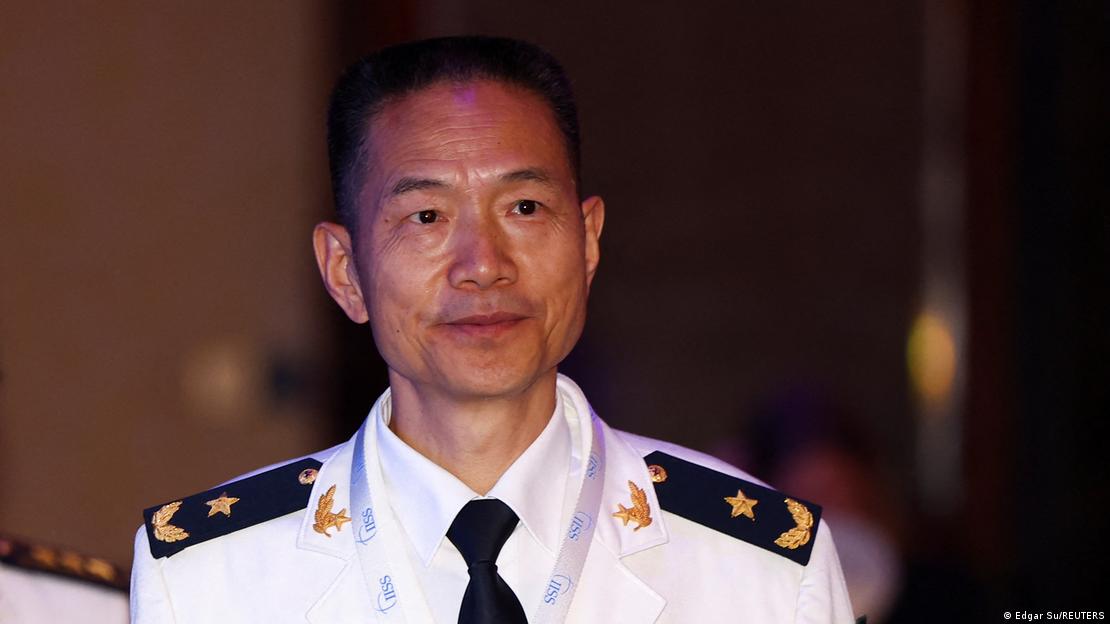
Chinese Rear Admiral Hu Gangfeng, who is leading a delegation from the National Defense University of the People's Liberation Army, called the remarks "groundless accusations."
The next day, China's Foreign Ministry also issued a statement to protest against Hegseth's remarks, claiming that the US military presence in Asia-Pacific is "turning the region into a powder keg."
China's defense minister stays away
The usual plenary session where Beijing used to outline its Indo-Pacific strategy was canceled this year, and speculation over why Beijing chose not to send Chinese Defense Minister Dong Jun to Singapore lingered throughout the three-day summit.
Zhou Bo, a senior fellow at the Tsinghua University's Center for International Security and Strategy, told DW on site that the minister was absent due to travel schedule arrangements and not for any strategic reason.
But other analysts suggested that China may be trying to avoid tough questions on security issues. Another possible factor is that Washington was presenting its Indo-Pacific policy at a global stage for the first time in US President Donald Trump's second term.
"It seems to me that China opted for a more cautious and defensive approach this time. It was waiting for the US to make a move," said Lin Ying-Yu, an assistant professor at the Graduate Institute of International Affairs and Strategic Studies at Taiwan's Tamkang University.
"Once the US has made its statements, then [China] will respond accordingly," he added.
As for clues about Beijing's possible countermeasures, Lin suggested waiting for the Beijing Xiangshan Forum, another international defense conference hosted annually by China in September or October.
Lin also warned that "China might use military actions toward Taiwan as a way to send a message to the US, and that's something we should be watching out for."
How might US-China relations change going forward?
China, which now has the world's largest navy by number of warships, has reportedly stepped up its deployment of naval and coast guard vessels across East Asian waters since early May.
Zhou, the Chinese military expert, told DW that the tone Hegseth used to address US-China competition shows an "almost 180 degree change" compared to the Biden administration and "runs contrary to what his predecessors said."
Standing at the same podium last year, former US Defense Secretary Lloyd Austin had emphasized that war with China was neither imminent nor unavoidable, stressing the importance of renewed dialogue between the two countries in avoiding miscalculations.
When asked at the venue about the future of China-US relations, Da Wei, director of the Center for International Security and Strategy (CISS) at Tsinghua University, said he expects day-to-day defense operations from both sides to "appear more confrontational," but without sudden escalation.
France's Macron warns of global divide
At the forum, French President Emmanuel Macron called out the apparent growing division between China and the US as the main risk currently facing the world.
"The instruction given to all the others: you have to choose your side," Macron said at the opening day. "If we do so, we will kill the global order, and we will destroy methodically all the institutions we created after the Second World War," he added.
In response to the concerns of the world splitting into two opposing camps, Zhou told DW: "Clearly we have not reached that level, which is a total hostile relationship between two enemies."
"We are still away from that and hope we will always be away from that," he said.
Tensions slowly rising around Taiwan
While China seemed more cautious in the diplomatic arena, its actions in the Taiwan Strait seem to be growing more aggressive.
Since Taiwan's current President William Lai took office over a year ago, the island's official data shows more frequent crossings by Chinese military aircraft over the Taiwan Strait's median line — the unofficial boundary between mainland China and Taiwan, despite Beijing officially considering all of Taiwan as Chinese territory. Taiwan also recorded an increased naval presence around its shores.
In Singapore, US Defense Secretary Hegseth warned that China could be ready to invade Taiwan as early as 2027 — a statement that echoes previous assessment by US authorities.
China has dismissed the 2027 timeline before but reiterated the goal of reaching reunification with Taiwan, whether by peaceful or non-peaceful means.
Despite being one of the most contentious flashpoints in the world, Taiwan had little official representation at Asia's premier defense forum, Taiwanese media reported.
The name "Taiwan" was also reportedly not shown on the guest list for the only two attendees from the island: I-Chung Lai, the CEO of a government-affiliated think tank, and former Defense Minister Andrew Nien-dzu Yang.
Edited by: Darko Janjevic
Yuchen Li East Asia correspondent covering China and Taiwan
Pushing The Insecurity And Militarisation Agenda In Asia Pacific – OpEd
Nothing new came out from the Shangri La security and defense summit held in Singapore recently. This is not surprising as the event which is touted as bringing together defence ministers, heads of ministries and military chiefs of Asia Pacific states has been a non achiever since its inception more than 20 years ago.
Began as a think-tank and wannabe influencer in the geopolitics of the region with Anglo Saxon lenses, its stated objective – “to cultivate a sense of community among the most important policymakers in the defence and security community in the region” – appears further away now with countries alleged by the West as drivers of belligerency or disrupters of the western defined international order either absent or deciding that it was not useful to give the ballyhooed but in reality, quite inconsequential, event in terms of security outcomes, much or any attention.
International Institute of Strategic Studies
To give one example, the exclusion of North Korea shows the inability of the organisers to break free from the ideological partiality that has characterized its agenda and activities right from the beginning. Although South Korea has been a participant since the forum’s inception, North Korea, regarded as an existential threat by the U.S. and West since its earliest days has been treated as if it counts for nothing in the security and geopolitics of the region.
Today the staunchly independent nation, initially nicknamed “ the hermit kingdom“, is a formidable power with its nuclear capability. Despite the attempts by the U.S. to deny the country its legitimate position in the world community, the fact is that North Korea is recognised by the rest of the world with membership in the United Nations, Non Aligned Movement, G77 and the ASEAN Regional Forum, the last an international governmental forum focusing on security and stability in the Asia Pacific region.
The exclusionary policy applied to North Korea in what is supposed to be an open and impartial forum bringing together countries of the region – it also includes countries from outside the region with really little or no legitimate credentials in deliberating on the region’s security issues e.g., Germany, France, Canada, and the U.K. – exposes the partisan operations of the private company, the International Institute for Strategic Studies (IISS), registered in the United Kingdom as a charity but in reality a profit making enterprise which organizes the dialogue.
Western Media Coverage
As expected too, Western media covering the dialogue have given attention to the presentations of the representatives of the U.S. and its allies. They have also provided little or no coverage to representatives and private sector voices from countries less or not aligned with American and Anglo Saxon foreign policy.
In his widely reported speech, U.S. Defense Secretary Pete Hegseth, the former Fox talk show host hoping to retain his job longer after bungling on the Signal leaked chat scandal involving a military operation against the Houthis in Yemen, initially paid effusive praise to President Trump for “restoring the warrior ethos” so that “we (the U.S.) remain the strongest and most lethal fighting force in the world”.
He then claimed that “we are not here to pressure other countries to embrace and adopt our politics or ideology; we are not here to preach to you about climate change or cultural issues; [and] we are not here to impose our will on you”.
His unsurprising main submission highlighted by western media was the singling out of China as the common enemy in Asia Pacific and call on countries to open their treasuries to invest more in the defence and security of the region. This crass salesmanship pitch duplicates the demand that the Trump administration has made to the European Union although there is no war being fought in the region to justify the alarmist call.
The identification of China as the regional, and increasingly global, threat to peace by the U.S. is nothing new. It continues a trend in global geo-politics following the shift in American policy responding to China’s rapid socio-economic development and increasing prominence on the regional and global stage.
Beginning in 2017 when the US officially designated China as a “long-term strategic competitor” in its national defense strategy, US policy has moved from the previous friendly and engagement-focused approach to an antagonistic one framing the relationship as one of “great power competition”.
To take China down in this great power rivalry, the US has employed a multi front strategy involving demonization of China on human rights, democracy and a host of other issues; restrictions on Chinese business; technology transfer sanctions and other forms of economic warfare; and including a trade war most recently.
Building Up Military Assets For War Or Peace
Exaggerating the threat from China to manipulate the foreign policy insecurities of countries in the region and indirectly soliciting procurement for the armament manufacturers of the U.S. and its allies that dominate military markets, Hegseth claimed that Beijing is “preparing to potentially use military force to alter the balance of power in the Indo-Pacific including its building its capabilities to invade Taiwan” and is “rehearsing for the real deal”.
This latest crying wolf on China’s security actions and intentions whilst reiterating the US commitment to the peace, stability and prosperity of the region has little support or resonance with non aligned governments who see the U.S. through unblinkered eyes, and are working for strategic autonomy. Most countries in the region are more likely to pinpoint the U.S. rather than China as the source of regional tension and instability.
It is very unlikely that the pressure exerted by the U.S. for countries in the region to share the military burden of alliance with the U.S. will improve the prospects for peace. On the contrary it could prove to be a double edged knife if it generates an even more dangerous arms race. Also important for American policy makers to bear in mind is that countries now have the choice to buy into Chinese military systems that are cheaper and equally if not more lethal than the ones that Hegseth boasted at length about in his presentation.
Finally Western and other analysts should realize that increases in the defence budgets of the region will not bring easy victories or peace for any side.
Perhaps this belated recognition can be a major focus for the 2026 dialogue event.
Lim Teck Ghee
Lim Teck Ghee PhD is a Malaysian economic historian, policy analyst and public intellectual whose career has straddled academia, civil society organisations and international development agencies. He has a regular column, Another Take, in The Sun, a Malaysian daily; and is author of Challenging the Status Quo in Malaysia.

No comments:
Post a Comment