Despite widespread belief in climate policy, disinformation still seeds doubt ahead of COP30
A new report looks at the climate disinformation online ecosystem
A majority of the world's population believes in climate change policies. And yet, climate disinformation is still rife, especially online.
A new report from the watchdog Climate Action Against Disinformation (CAAD) has looked at climate disinformation in the lead-up to COP30, and the major players fueling it. It found a massive increase in disinformation related to the UN climate conference.
What does it look like?
87 per cent of the globe supports climate change policies, according to a 2024 survey. According to YouGov, 62 to 76 per cent of Europeans are worried about climate change.
But disinformation can still bring about skepticism.
There is a significant difference between misinformation and disinformation. Misinformation is false or out-of-context information that someone is presenting as fact. Disinformation, on the other hand, is intentionally false and meant to deceive its audience
Earlier this year, CAAD and the Observatory for Information Integrity (OII) found a 267 per cent increase in COP-related disinformation from July to September.
They discovered about 14,000 examples online. One pertinent example was a post, created by generative artificial intelligence, of a reporter standing in a flooded city that resembles Belem, whereCOP30is taking place. The video has on the screen title of “THE TRUTH ABOUT COP30 IN BELÉM IN 2025” to hook viewers. However, the reporter, flood, and even the city were completely fictional.
A recent analysisfrom OII also found that COP30 was a recurring topic in Brazilian Telegram groups devoted to conspiracy theories. OII has identified over 285 mentions of COP30: attacking the conference itself, Belem, and climate solutions in general.
On the global stage, climate disinformation has also been promoted by the United States President Donald Trump. In September, hecalledclimate change the “biggest con job.”
Who is behind climate disinformation?
The new CAAD report looks into major players that contribute to the disinformationecosystem, derailing climate action by seeding doubt in audiences.
Companies that burn fossil fuels for energy and transportation, and large-scale agriculture (deemed Big Carbon) are some of the main perpetrators of climate disinformation.
“Big Carbon’s disinformation is designed to cause ordinary people to underestimate the strength of the scientific consensus on climate change,” the report says. “It is also causing people to underestimate the strength of solidarity in demanding action.”
However, tech companies are also at fault for allowing their messages to propagate without checks. These problems are not new and have plagued climate conferences previously.
A previousreportfrom CAAD found that in anticipation of COP28, fossil fuel companies paid up to $5 million (€4.3 million) for climate disinformation ads that appeared on Facebook. Shell, ExxonMobil, BP and TotalEnergies were the main funders, accounting for 98 per cent of ads.
“Spread rapidly and cheaply via online social media platforms and search engines (Big Tech), this disinformation is undermining policy and sabotaging action,” the new report says.
Climate disinformation discussion at COP
For the first time, this year’s climate conference will feature the Global Initiative for Information Integrity on Climate Change. This is a joint effort from the Brazilian Government, United Nations and UNESCO which is devoted to strengthening research and measures to address disinformation campaigns.
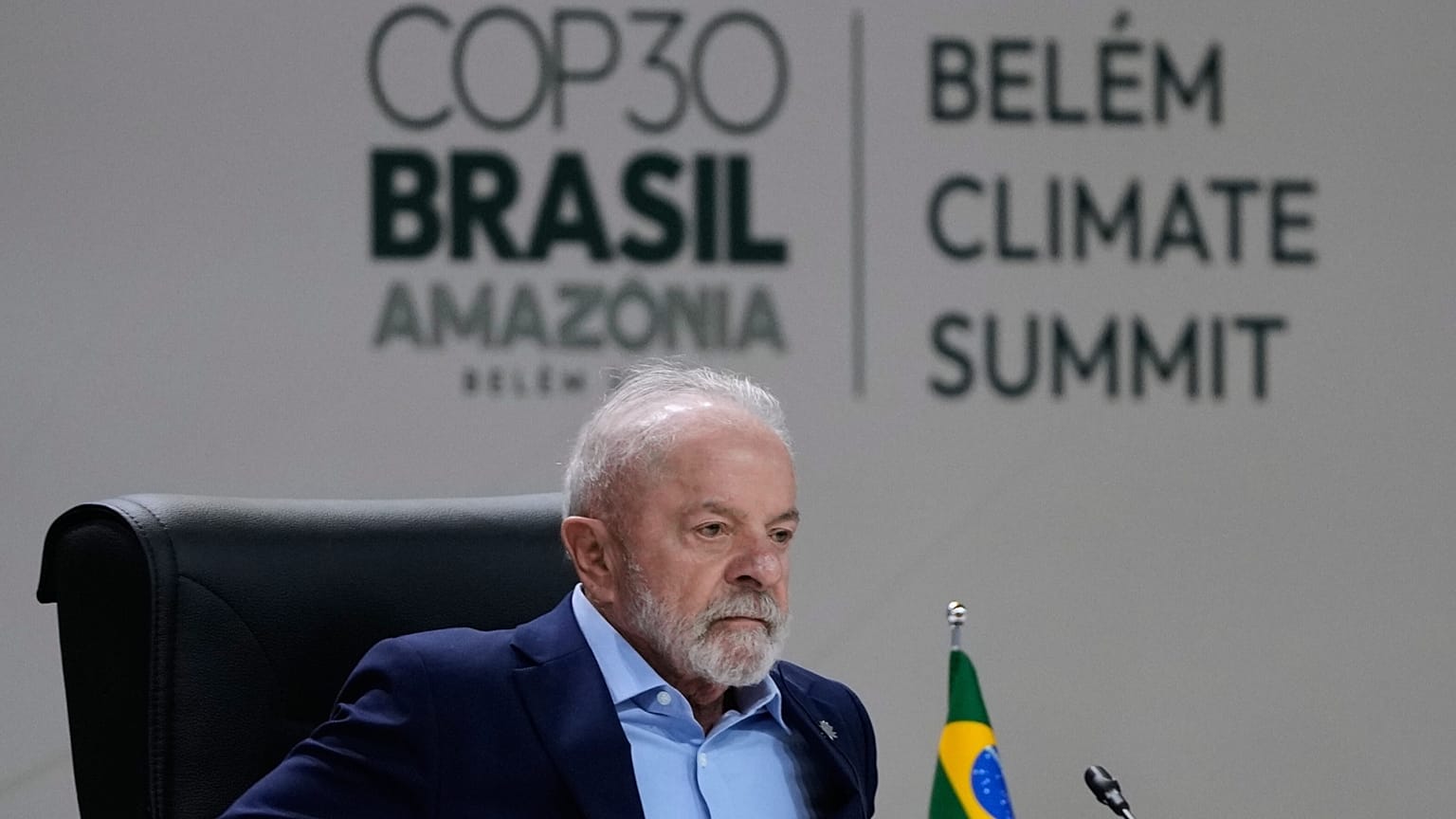
At the Leaders Summit on Nov 6, Brazilian President Luiz Inacio Lula da Silva and French President Emmanuel Macron both warned of the dangers of climate disinformation.
“Extremist forces fabricate fake news to obtain electoral gains and imprison future generations in an outdated model that perpetuates social and economic inequalities and environmental degradation,” said Lula.
This was echoed by Macron.
“Climate disinformation today threatens our democracies, the Paris agenda, and therefore our collective security,” he said. Earlier this year, a report found that French media was spreading climate disinformation, amplifying narratives that discredit climate science and climate solutions.
UN Secretary-General António Guterres also condemned the companies that are profiting from such disinformation.
“Too many corporations are making record profits from climate devastation – with billions spent on lobbying, deceiving the public and obstructing progress,” he said. “Too many leaders remain captive to these entrenched interests.”

Family photo of Climate Summit that brings together leaders from different countries ahead of the 30th United Nations Climate Change Conference (COP30) Photo Credit: Ricardo Stuckert, ABr
November 8, 2025
ABr
By Pedro Rafael Vilela
Brazilian President Luiz Inácio Lula da Silva said on Friday (Nov. 7) that armed conflicts – such as the war in Ukraine, invaded by Russia almost four years ago – have interrupted a period of reduction in polluting gas emissions into the atmosphere and could lead the planet to environmental collapse.


“The conflict in Ukraine has reversed years of efforts to reduce greenhouse gas emissions and led to the reopening of coal mines. Spending twice as much on weapons as we do on climate action is paving the way for climate apocalypse. There will be no energy security in a world at war,” he said at the opening of the second session of the Climate Summit in the Amazon city of Belém, Pará state.
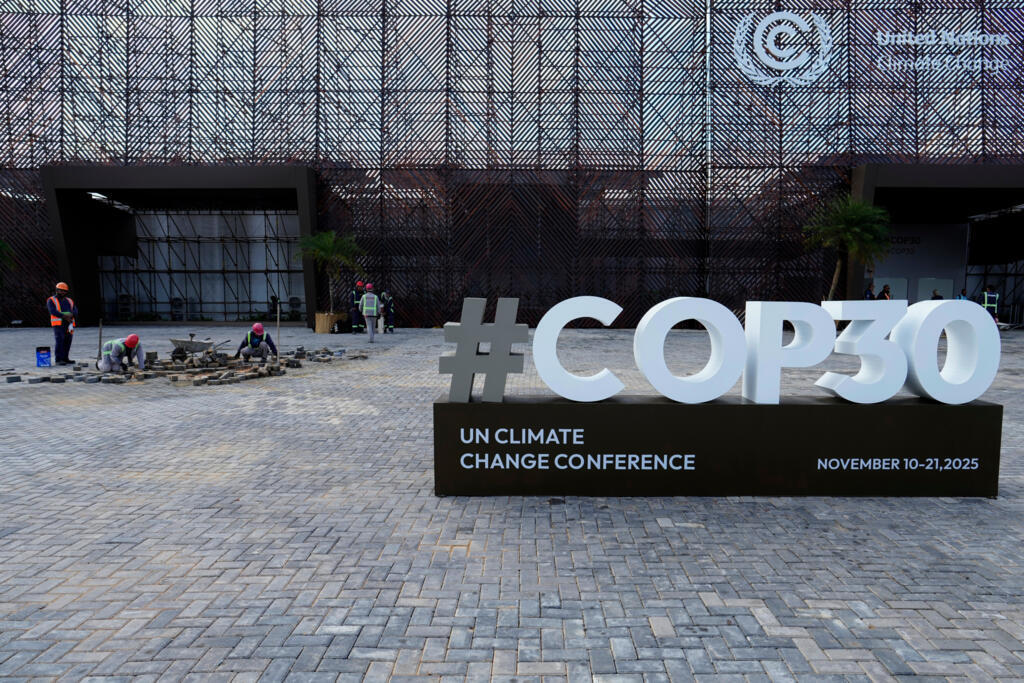
The Climate Summit, which ends this Friday, is an event that brings together leaders from different countries ahead of the 30th United Nations Climate Change Conference (COP30), which will be held from November 10 to 21, also in the capital of Pará. The goal is to update and reinforce multilateral commitments to address the urgency of the climate crisis.
The event will be attended by Secretary-General of the United Nations (UN) António Guterres and European leaders such as Spanish Prime Minister Pedro Sánchez and European Commission President Ursula von der Leyen.
Fair energy transition
President Lula noted that, despite advances made in the energy matrix, populations living in poor and developing countries are still far from a fair transition.
“It is essential to combat all forms of energy poverty – 2 billion people do not have access to adequate fuels for cooking, 660 million people depend on oil lamps and diesel generators in the outskirts of large cities and in rural communities in Latin America and Africa. And 200 million children attend schools without access to electricity. With no energy, there is also no digital connection, functioning hospitals, or modern agriculture,” he declared.
In the presence of leaders from different nations, the Brazilian president criticized the financial system that fuels the oil sector.
“Last year, the world’s 65 largest banks committed to lending USD 869 billion to the oil and gas sector. Since the adoption of the Paris Agreement, the share of fossil fuels in the global energy mix has only decreased from 83 to 80 percent,” he said.
Fund on oil profits
The president called for action to address the “injustice of unpayable foreign debts” and requirements that discriminate against developing countries. He also announced that he will create a fund to channel profits from the oil and gas sector into investment in renewable energy.
“A fair, orderly, and equitable process of moving away from fossil fuels requires access to technology and financing for countries in the Global South. There is room to explore innovative mechanisms for exchanging debt for financing climate mitigation and energy transition initiatives,” he stated.
“Directing part of the profits from oil exploration toward energy transition remains a valid path for developing countries. Brazil will establish such a fund to finance climate change mitigation and establish climate justice,” he said.
The president ended his speech by calling for the implementation of the COP28 agreement, held in Dubai, to triple renewable energy and double energy efficiency by 2030, in addition to including the elimination of energy poverty in national climate plans and prioritizing the issue of eliminating energy poverty in countries’ national climate goals.
“Scientists have done their part. At this COP, negotiators must seek understanding. And we, the leaders, must decide whether the 21st century will be remembered as the century of climate catastrophe or as the moment of intelligent reconstruction,” he declared.
ABr
Agência Brasil (ABr) is the national public news agency, run by the Brazilian government. It is a part of the public media corporation Empresa Brasil de Comunicação (EBC), created in 2007 to unite two government media enterprises Radiobrás and TVE (Televisão Educativa).
.jpeg)
South Africa's Minister of Forestry, Fisheries and the Environment, Dr Dion George, at Climate Summit in Brazil. Photo Credit: SA News
November 8, 2025
By SA News
The Minister of Forestry, Fisheries and the Environment, Dr Dion George, has called for urgent reforms to the international financial system so that multilateral banks can provide long-term and affordable capital for sustainable development and climate action.
According to the Global Stocktake, the collective global progress toward the Paris Agreement goals is insufficient.
“The Global Stocktake is clear. Progress is too slow. We must accelerate action on mitigation, adaptation, loss and damage, and the means of implementation.
“The Global Goal on Adaptation must deliver measurable indicators and the finance to achieve them. The Sharm el Sheikh Work Programme must unlock real investment through blended models. The Loss and Damage Fund must be capitalised,” the Minister said on Friday.
He said the Baku to Belém Roadmap must advance 1.3 trillion dollars in grants, concessional finance and fiscal space measures.
The roadmap aims at scaling up climate finance to developing country to support low greenhouse gas emissions and climate-resilient development pathways.
The Minister made these remarks at the United Nations Framework Convention on Climate Change (UNFCCC) COP30 Leader’s Summit, taking place in Belém, Brazil, as part of the 30th meeting of the Conference of the Parties (COP).
“Climate change is the defining crisis of our time. No nation can face it alone. This is a time that demands courage, solidarity and multilateralism in action. World leaders have a moral duty to close the gap between ambition and finance in the fight against climate change.
“South Africa further, reiterates that climate change response measures by developed countries should not impact developing countries’ industrial, trade and socio-economic development goals, in line with international law,” the Minister said.
He emphasised that the unilateral climate response measures should not have spill-over and negative cross-border impacts on developing countries.
“Our firm view is that the unilateral trade measures which aim to achieve unbalanced climate objectives outside of the framework of the multilateral process, or unfairly restrict global trade in green technology, will only serve to hinder our ability to achieve a just transition, and slow the global effort to address climate change,” the Minister said.
In fulfilment of South Africa commitments, under the Paris Agreement to reduce greenhouse gas emissions and adapt to climate change impacts, government has submitted its second Nationally Determined Contributions (NDCs).
They include a new mitigation target for 2035 of between 320 and 380 megatons of carbon dioxide equivalent, showing clear progression from our 2030 range.
“Our updated adaptation communication identifies our support needs for finance, technology and capacity building. South Africa’s expectations for COP30 are clear,” the Minister said.
SA News
Government Communication and Information System (GCIS) established the SA Government News Agency to enable all media locally and abroad to have easy and fast access to fresh government information, news and current affairs at no cost.
World leaders arri ve in the Brazilian Amazon on Thursday for a high-stakes test of global climate promises, with vulnerable nations demanding far greater financial support and scientists warning the world is still veering off track.
Issued on: 06/11/2025 - RFI
 Mist rises over the Carajas National Forest in Para, Brazil, where the mining industry and rainforest coexist uneasily ahead of Cop30 in the Amazon. REUTERS - Jorge Silva
By:Amanda Morrow
The two-day Belem Climate Summit takes place in the humid port city at the mouth of the Amazon River – a symbolic prelude to the UN’s Cop30 conference that begins there next week. Together they mark 10 years since the Paris Agreement and bring global attention back to the planet’s most vital carbon sink.
For Brazil, it is a moment to show that protecting forests and reducing poverty can go hand in hand. For much of the world, it is a chance to prove that promises made in Paris can still deliver results.
“We have to somehow manage to convey that there is progress on this agenda, because we are facing a phase in which most of the public think that this agenda is losing ground,” Cop30 president Andre Correa do Lago said.
But the talks open amid sobering news. Around two-thirds of the 195 countries that signed the Paris accord missed the February deadline to submit updated climate plans for 2035.
By early November, only about 65 countries had submitted new national climate plans for 2035, and most failed to impress. China’s target fell well below expectations, while India has yet to finalise its pledge.
The European Union agreed on Wednesday to a weakened 2040 climate goal after all-night talks in Brussels, keeping its 90 percent emissions cut headline but allowing countries to offset up to 10 percent of that target through foreign carbon credits and delay key measures.
Environmental groups warned the compromise undermines Europe’s credibility as a climate leader, while several member states argued it was needed to protect industries struggling with high energy costs and competition from cheaper imports.
Europe’s climate progress overshadowed by worsening loss of nature
The billion-dollar gap
The battle over money will dominate both the Belem summit and Cop30, which runs from 10 to 21 November. Wealthy nations are under pressure to explain how they will help poorer ones cope with rising seas, extreme heat and mounting climate losses.
Last year’s Cop29 in Baku ended with developed countries agreeing to provide $300 billion a year in climate finance by 2035 – far below what developing nations say is needed. Governments also set a vaguer goal of mobilising $1.3 trillion a year from public and private sources but offered little detail on how to achieve it.
A UN Adaptation Gap Report last week found the world will need to spend about $310 billion a year by 2035 to prepare for worsening floods, droughts and heatwaves – roughly 12 times current spending levels.
“More than ever, the general public, governments in general, cities in general, want resources for adaptation,” Correa do Lago said.
CARE International, which campaigns for climate justice and humanitarian relief, warned that the shortfall is already leaving millions exposed, especially women and girls.
“The need for adaptation finance is immense, up to $300 billion per year, yet current funding barely scratches the surface,” said Marlene Achoki, CARE’s global climate justice policy lead. “Cop30 will be successful, and truly a people’s Cop, when sufficient adaptation finance is provided to drive real action and implementation on the ground.”
Senior adviser John Nordbo described climate finance as “the fault line of global climate action”, saying many rich countries inflate figures and repackage loans as aid.
“Much of this so-called support comes as loans, not grants, and repayments often flow quietly back to donors,” he said.
Brazil's forest gamble
Holding the leaders’ summit in Belem brings the focus back to the rainforest’s central role in stabilising the planet’s climate.
The Brazilian government will use the event to launch the Tropical Forests Forever Facility – a new global fund that will reward countries with high tropical forest cover for keeping trees standing instead of cutting them down.
The facility aims to raise $25 billion from donor governments and another $100 billion from private investors, with Brazil already pledging $1 billion.
The fund “could be a step forward in protecting tropical forests” if paired with firm commitments to end deforestation by 2030, said Clement Helary, a forests campaigner with Greenpeace.
Tropical primary forest loss hit a record high in 2024 – the equivalent of 18 football fields a minute, driven largely by fires.
Hosting the conference in the Amazon makes it “the perfect opportunity to ramp up action to end deforestation”, the WWF has said, noting that global pledges from Cop26 to halt forest loss by 2030 have stalled.
From talk to action
Cop30 will test whether the world can finally move from ambition to action.
Under the Paris Agreement, countries must strengthen their emissions targets every five years, but the latest round of 2035 plans still falls well short of what is needed to limit warming to 1.5C.
What is needed now is “a step change” – moving from setting targets to delivering them, said the World Resources Institute.
The first global stocktake at Cop28 showed the world is “significantly off track”, while the UN Secretary-General has said overshooting the 1.5C goal is “inevitable” unless countries “change course”.
When the Paris Agreement was signed, the planet was on track for roughly 4C of warming by 2100. Later pledges have cut that to around 3C, and if all net-zero promises were fully met, the rise could fall closer to 1.9C.
Deeper emissions cuts and large-scale ecosystem restoration, scientists say, could still bring temperatures back below 1.5C later this century.
Last year was the first time the 1.5C threshold was breached for an entire year, with extreme weather causing more than $300 billion in damage. Renewable energy and electric vehicles, while already saving lives and creating jobs, is not happening fast enough, experts warn.
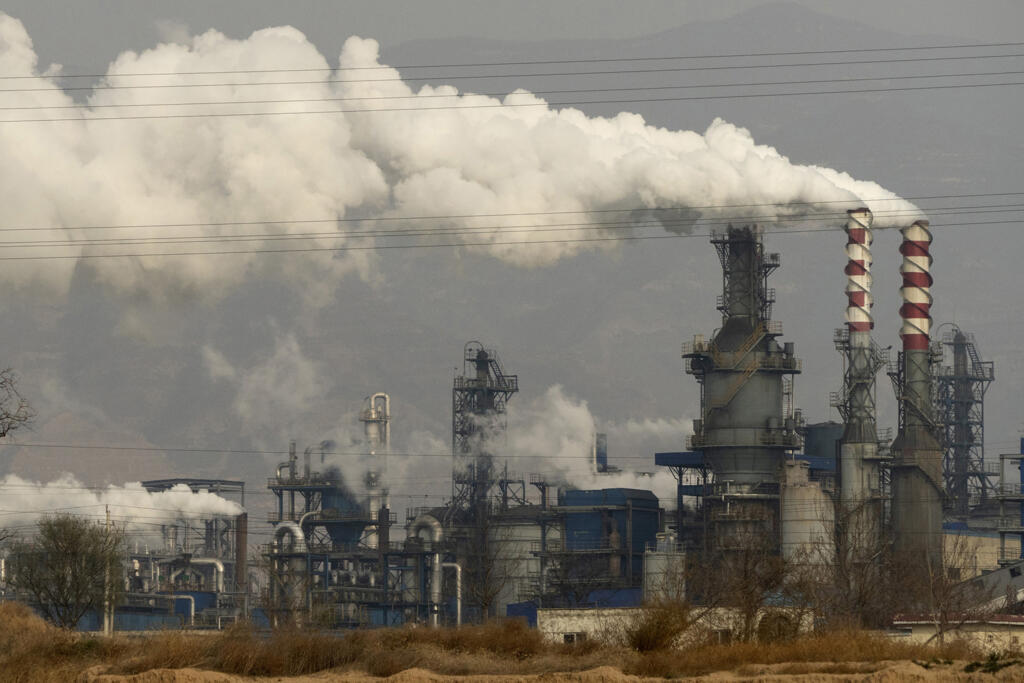
Record surge in CO2 puts world on track for more long-term warming
Can trust survive?
Unlike earlier climate summits, Cop30 has no single grand deal in sight.
Organisers are calling it the “Cop of Implementation”, focused on turning words into measurable progress.
“The Brazilian Presidency’s central challenge is to turn promises into real-world action – bridging divides between developed and developing countries, ambition and equity, mitigation and adaptation,” said Karen Silverwood-Cope from WRI Brazil.
The political mood adds to the challenge. US President Donald Trump has dismissed climate change as a “con job” and is sending no senior officials to Belem, deepening fears that global climate diplomacy is losing momentum.
Still, Brazil hopes the Amazon setting can help restore it. President Luiz Inacio Lula da Silva has been in Belem since the weekend, meeting local communities and overseeing preparations ahead of the summit.
He is expected to stay through the opening of Cop30 on Monday, as world leaders gather in the heart of the Amazon – a symbolic setting for a conference that will test whether a decade of promises can finally turn into action.

No comments:
Post a Comment