Mamdani’s Win Proves That Hope Is Power
Perhaps the most important takeaway from Mr. Mamdani’s campaign is this: Hope grounded in possibility is the fuel for democracy.
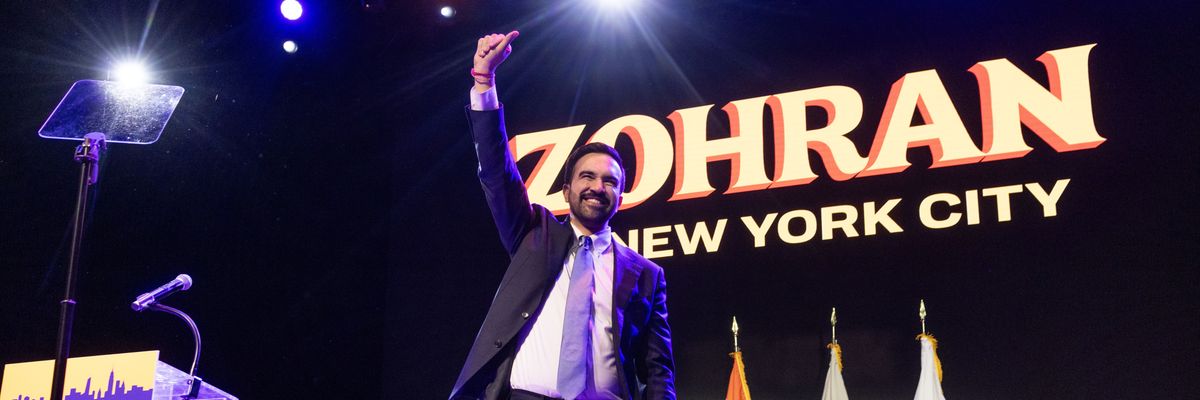
Democratic New York City mayoral candidate Zohran Mamdani delivers remarks at his election night watch party at the Brooklyn Paramount Theater on November 4, 2025 in the Brooklyn borough in New York City.
(Photo by Andrew Lichtenstein/Corbis via Getty Images)
LappéCorinna Rhum
Nov 08, 2025
Nov 08, 2025
Common Dreams
Zohran Mamdani’s stunning victory on Tuesday is a bright light in this otherwise terrifying political time, and the messages propelling his political ascendance offer many lessons. One particularly is music to our ears—indeed, it’s a song we’ve long been singing. We’ll let the words from his acceptance speech speak for themselves:
Tonight we have spoken in a clear voice. Hope is alive. Hope is a decision that tens of thousands of New Yorkers made day after day, volunteer shift after volunteer shift, despite attack ad after attack ad. And, while we cast our ballots alone, we choose hope together: hope over tyranny. Hope over big money and small ideas. Hope over despair. We won because New Yorkers allowed themselves to hope that the impossible could be made possible.
Right on!
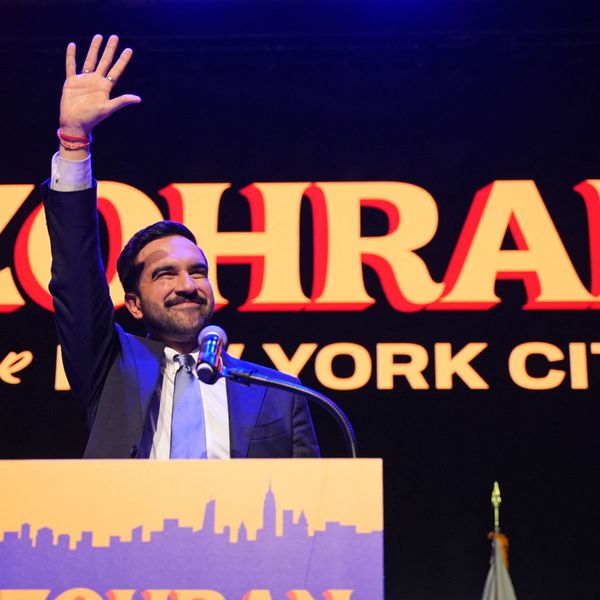
‘Hope Is Alive!’ Mamdani Victory in NYC Seen as Historic Turning Point

42-Point Blowout With Young Men Helped Fuel Mamdani’s Victory
Mr. Mamdani’s message is both powerful and incisive. To launch his campaign to become mayor of our largest city required hope—and great courage. A long-shot candidate—a 34-year-old South Asian Muslim and democratic socialist assemblyman—he is a departure from mayoral convention.
Nevertheless, he, and a dedicated team of volunteers, took the plunge, pouring heart and soul into one of the most impressive grassroots campaigns. Mr. Mamdani’s candidacy was an act of hope—rooted not only in a belief in the necessity of his ideas and capacity to govern but also of hope that the political landscape would embrace a leader like him.
We must challenge ourselves to hope! Why not run for office with a bold, hope-infused platform? Volunteer for a candidate we believe in? And cast our votes for a different and better future?
And that hope turned into victory—justifying itself. Adamantly and consistently, he worked to convince voters that a better New York is achievable—that hope need not be an abstract and ephemeral feeling but rooted in actual political possibility.
Doing so, Mr. Mamdani championed the concerns New Yorkers—but, really, most Americans—feel acutely: our affordability crisis in housing, food, and healthcare; the burden of wages failing to keep up with cost of living; the immense struggle required just to survive. At every step of his campaign, he addressed these deep structural problems with real, innovative policy solutions. He didn’t ask voters to find hope from his politicking. Rather, he offered real grounds for belief.
We have long said that hope is power. Mr. Mamdani’s political success is evidence of this truth.
So perhaps the most important takeaway from Mr. Mamdani’s campaign is this: Hope grounded in possibility is the fuel for democracy. We find this a particularly powerful line from Mr. Mamdani’s acceptance speech: “We won because we insisted that no longer would politics be something that is done to us. Now, it is something that we do.” This sentiment is, indeed, the crux of hope’s power. When we believe, the door to action opens. We become agents capable of making real the changes we so desperately. As Mr. Mamdani says, politics is not done to us, but what we do.
This spirit is contagious and key to fighting back successfully against the Trump administration’s fascist policies and reversing widespread democratic backsliding. We must challenge ourselves to hope! Why not run for office with a bold, hope-infused platform? Volunteer for a candidate we believe in? And cast our votes for a different and better future?
Organizations including Run for Something empower us to step up and consider ourselves as changemakers, and several other national groups such as Common Cause and Indivisible provide clear paths for citizen action. Who knows what may come from taking the next hopeful step in your community, whether its electoral or any other form of advocacy.
Remember hope is not for “wimps.” It requires courage to do what we thought we could not do. The root of the word courage is the French word for heart, “coeur.” So, when you step up and feel yours pounding, don’t doubt. It’s just your heart cheering you on!
Leading with hope, we can build the engaged and just “living democracy” we want and know is essential. We can become proud of our country again.
Our work is licensed under Creative Commons (CC BY-NC-ND 3.0). Feel free to republish and share widely.
Frances Moore Lappé
Frances Moore Lappé is the author of 20 books, beginning with the acclaimed "Diet for a Small Planet." Most recently she is the co-author, with Adam Eichen, of the new book, "Daring Democracy: Igniting Power, Meaning, and Connection for the America We Want." Among her numerous previous books are "EcoMind: Changing the Way We Think to Create the World We Want" (Nation Books) and "Democracy's Edge: Choosing to Save Our Country by Bringing Democracy to Life." She is co-founder of the Cambridge, Mass.-based Small Planet Institute.
Full Bio >
Zohran Mamdani’s stunning victory on Tuesday is a bright light in this otherwise terrifying political time, and the messages propelling his political ascendance offer many lessons. One particularly is music to our ears—indeed, it’s a song we’ve long been singing. We’ll let the words from his acceptance speech speak for themselves:
Tonight we have spoken in a clear voice. Hope is alive. Hope is a decision that tens of thousands of New Yorkers made day after day, volunteer shift after volunteer shift, despite attack ad after attack ad. And, while we cast our ballots alone, we choose hope together: hope over tyranny. Hope over big money and small ideas. Hope over despair. We won because New Yorkers allowed themselves to hope that the impossible could be made possible.
Right on!
‘Hope Is Alive!’ Mamdani Victory in NYC Seen as Historic Turning Point
42-Point Blowout With Young Men Helped Fuel Mamdani’s Victory
Mr. Mamdani’s message is both powerful and incisive. To launch his campaign to become mayor of our largest city required hope—and great courage. A long-shot candidate—a 34-year-old South Asian Muslim and democratic socialist assemblyman—he is a departure from mayoral convention.
Nevertheless, he, and a dedicated team of volunteers, took the plunge, pouring heart and soul into one of the most impressive grassroots campaigns. Mr. Mamdani’s candidacy was an act of hope—rooted not only in a belief in the necessity of his ideas and capacity to govern but also of hope that the political landscape would embrace a leader like him.
We must challenge ourselves to hope! Why not run for office with a bold, hope-infused platform? Volunteer for a candidate we believe in? And cast our votes for a different and better future?
And that hope turned into victory—justifying itself. Adamantly and consistently, he worked to convince voters that a better New York is achievable—that hope need not be an abstract and ephemeral feeling but rooted in actual political possibility.
Doing so, Mr. Mamdani championed the concerns New Yorkers—but, really, most Americans—feel acutely: our affordability crisis in housing, food, and healthcare; the burden of wages failing to keep up with cost of living; the immense struggle required just to survive. At every step of his campaign, he addressed these deep structural problems with real, innovative policy solutions. He didn’t ask voters to find hope from his politicking. Rather, he offered real grounds for belief.
We have long said that hope is power. Mr. Mamdani’s political success is evidence of this truth.
So perhaps the most important takeaway from Mr. Mamdani’s campaign is this: Hope grounded in possibility is the fuel for democracy. We find this a particularly powerful line from Mr. Mamdani’s acceptance speech: “We won because we insisted that no longer would politics be something that is done to us. Now, it is something that we do.” This sentiment is, indeed, the crux of hope’s power. When we believe, the door to action opens. We become agents capable of making real the changes we so desperately. As Mr. Mamdani says, politics is not done to us, but what we do.
This spirit is contagious and key to fighting back successfully against the Trump administration’s fascist policies and reversing widespread democratic backsliding. We must challenge ourselves to hope! Why not run for office with a bold, hope-infused platform? Volunteer for a candidate we believe in? And cast our votes for a different and better future?
Organizations including Run for Something empower us to step up and consider ourselves as changemakers, and several other national groups such as Common Cause and Indivisible provide clear paths for citizen action. Who knows what may come from taking the next hopeful step in your community, whether its electoral or any other form of advocacy.
Remember hope is not for “wimps.” It requires courage to do what we thought we could not do. The root of the word courage is the French word for heart, “coeur.” So, when you step up and feel yours pounding, don’t doubt. It’s just your heart cheering you on!
Leading with hope, we can build the engaged and just “living democracy” we want and know is essential. We can become proud of our country again.
Our work is licensed under Creative Commons (CC BY-NC-ND 3.0). Feel free to republish and share widely.
Frances Moore Lappé
Frances Moore Lappé is the author of 20 books, beginning with the acclaimed "Diet for a Small Planet." Most recently she is the co-author, with Adam Eichen, of the new book, "Daring Democracy: Igniting Power, Meaning, and Connection for the America We Want." Among her numerous previous books are "EcoMind: Changing the Way We Think to Create the World We Want" (Nation Books) and "Democracy's Edge: Choosing to Save Our Country by Bringing Democracy to Life." She is co-founder of the Cambridge, Mass.-based Small Planet Institute.
Full Bio >
Corinna Rhum
Corrina Rhum is the Institute Manager at the Small Planet Institute.
Full Bio >
OPINION
Tuesday’s elections in Georgia show change is coming — and fast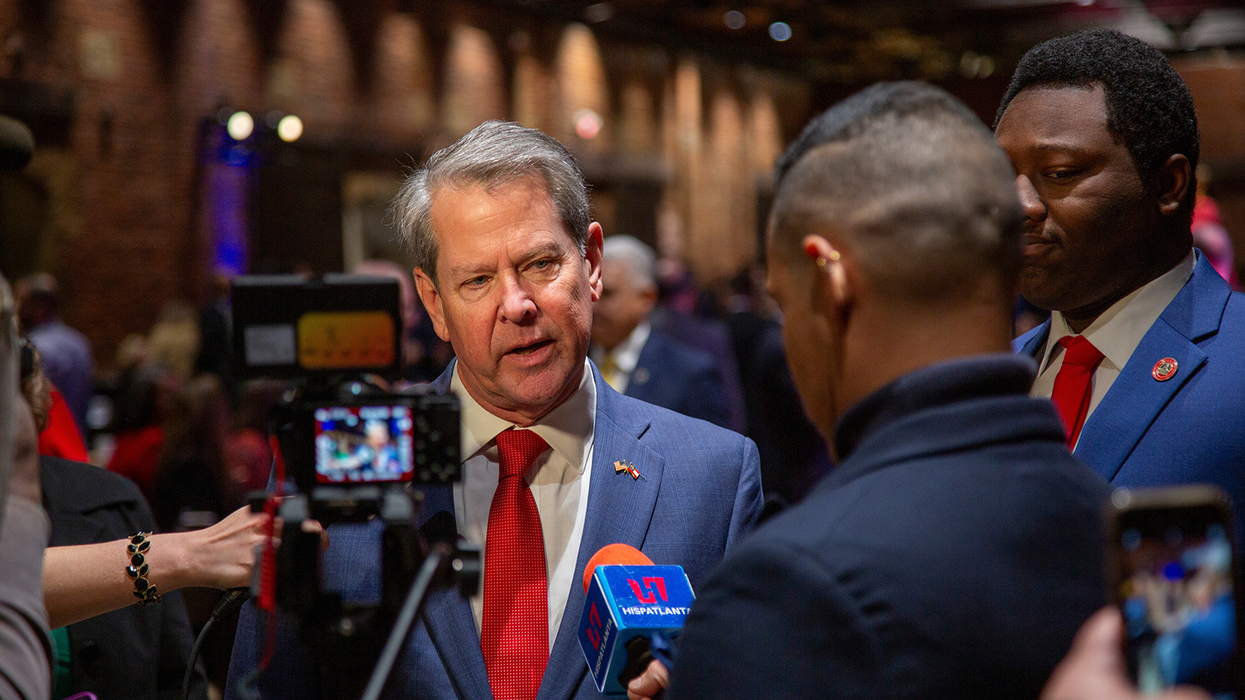
Atlanta, GA - February 6th 2024: Governor Brian Kemp participates in a interview, after a legislative breakfast held by the GHCC.
Jay Bookman,
November 06, 2025
Maybe what happened in Tuesday’s election was an anomaly. You could certainly make that case, as many Georgia Republicans have tried to do.
It was, after all, an odd-year election, with relatively low turnout, for two low-profile statewide races. So even if the resulting margins were spectacular – Democrats won two seats on the five-member Public Service Commission, both by 25 percentage points – maybe it was just an anomaly.
Joe Biden’s 2020 victory in the red state of Georgia was another such anomaly, so rare and unusual that to this day, Donald Trump refuses to accept that it happened.
Raphael Warnock’s victory in a special election runoff in 2021, making him the first Black Democrat elected to the U.S. Senate from the South, was also an anomaly, as was Sen. Jon Ossoff’s runoff win that year. Georgia hadn’t had a Democratic senator in almost 20 years, but suddenly we had two in the same year, so surely that too was just a fluke, the result of a rare confluence of political events at the national level that is unlikely to be repeated here in Georgia.
Of course, Warnock then won re-election in 2022. Was that too just an anomaly, a one-time event explained away by the GOP’s mistake in running Herschel Walker, a man who made his name on the football field, as its candidate? It’s not as if Georgia Republicans would ever repeat that unforced error, right? They would never again try to nominate someone else whose only qualification was football fame, someone like Derek Dooley?
No, they would never.
But anomalies are funny things. Considered in isolation, they might not mean much. But when you get a string of them, one anomaly after another, they cease to be anomalies at all.
Maybe what happened in Tuesday’s election was an anomaly. You could certainly make that case, as many Georgia Republicans have tried to do.
It was, after all, an odd-year election, with relatively low turnout, for two low-profile statewide races. So even if the resulting margins were spectacular – Democrats won two seats on the five-member Public Service Commission, both by 25 percentage points – maybe it was just an anomaly.
Joe Biden’s 2020 victory in the red state of Georgia was another such anomaly, so rare and unusual that to this day, Donald Trump refuses to accept that it happened.
Raphael Warnock’s victory in a special election runoff in 2021, making him the first Black Democrat elected to the U.S. Senate from the South, was also an anomaly, as was Sen. Jon Ossoff’s runoff win that year. Georgia hadn’t had a Democratic senator in almost 20 years, but suddenly we had two in the same year, so surely that too was just a fluke, the result of a rare confluence of political events at the national level that is unlikely to be repeated here in Georgia.
Of course, Warnock then won re-election in 2022. Was that too just an anomaly, a one-time event explained away by the GOP’s mistake in running Herschel Walker, a man who made his name on the football field, as its candidate? It’s not as if Georgia Republicans would ever repeat that unforced error, right? They would never again try to nominate someone else whose only qualification was football fame, someone like Derek Dooley?
No, they would never.
But anomalies are funny things. Considered in isolation, they might not mean much. But when you get a string of them, one anomaly after another, they cease to be anomalies at all.
They become a trend.
We also have other anomalies to consider. For example, today we have a former Republican lieutenant governor who has switched parties and is now running for governor as a Democrat. That’s pretty rare, right? When was the last time a party-switcher actually ran for governor and won?
Well, Sonny Perdue did it in 2002. That was an anomaly, until Nathan Deal did it again in 2010. The anomalies became a trend.
We also have MAGA queen Marjorie Taylor Greene, representing Georgia’s 14th Congressional District, who is suddenly and loudly condemning her own party’s leadership. She is slamming it for its failure to reopen the government and for its failure to address a looming crisis in health insurance affordability. In a startling appearance this week on The View, where Greene was greeted warmly by the liberal hosts, she called the GOP’s performance “embarrassing.”
My mother, who lives out of state, is a big fan of The View.
“What the heck happened to that woman?” Mom asked me this week. “Did she get struck by lightning or something?”
“No, Mom. I think it was space lasers. Or maybe chemtrails.”
The easy, short-term conclusion from all this is that Democrats have momentum going into the 2026 midterms, both here in Georgia and nationwide. While I think that’s true, something deeper and more profound is also going on.
A generation is finally ceding power that it has clung to for too long, necessary because we face new problems that our elders do not comprehend. The political establishments of both parties are crumbling, and frustration with government has become so profound that Americans of all ideologies find themselves open to solutions that previous generations had rejected. In a recent YouGov poll, for example, just 13% of Americans said they approved of how Congress is performing, and that’s just not sustainable. Change is coming, and fast.
What we see happening in Georgia, then, is just a small part of what’s happening nationally, globally. Coalitions are breaking apart, and new ones will be forming. Old ways of understanding are being tossed aside. As structures and systems are torn down, new ones must rise to replace them.
Trump and MAGA offer one such alternative, one they apparently intend to impose by force if necessary. Tuesday’s results offer us hope that other alternatives will emerge and prove more viable, but in a world where everything seems an anomaly, who the hell knows.
We also have other anomalies to consider. For example, today we have a former Republican lieutenant governor who has switched parties and is now running for governor as a Democrat. That’s pretty rare, right? When was the last time a party-switcher actually ran for governor and won?
Well, Sonny Perdue did it in 2002. That was an anomaly, until Nathan Deal did it again in 2010. The anomalies became a trend.
We also have MAGA queen Marjorie Taylor Greene, representing Georgia’s 14th Congressional District, who is suddenly and loudly condemning her own party’s leadership. She is slamming it for its failure to reopen the government and for its failure to address a looming crisis in health insurance affordability. In a startling appearance this week on The View, where Greene was greeted warmly by the liberal hosts, she called the GOP’s performance “embarrassing.”
My mother, who lives out of state, is a big fan of The View.
“What the heck happened to that woman?” Mom asked me this week. “Did she get struck by lightning or something?”
“No, Mom. I think it was space lasers. Or maybe chemtrails.”
The easy, short-term conclusion from all this is that Democrats have momentum going into the 2026 midterms, both here in Georgia and nationwide. While I think that’s true, something deeper and more profound is also going on.
A generation is finally ceding power that it has clung to for too long, necessary because we face new problems that our elders do not comprehend. The political establishments of both parties are crumbling, and frustration with government has become so profound that Americans of all ideologies find themselves open to solutions that previous generations had rejected. In a recent YouGov poll, for example, just 13% of Americans said they approved of how Congress is performing, and that’s just not sustainable. Change is coming, and fast.
What we see happening in Georgia, then, is just a small part of what’s happening nationally, globally. Coalitions are breaking apart, and new ones will be forming. Old ways of understanding are being tossed aside. As structures and systems are torn down, new ones must rise to replace them.
Trump and MAGA offer one such alternative, one they apparently intend to impose by force if necessary. Tuesday’s results offer us hope that other alternatives will emerge and prove more viable, but in a world where everything seems an anomaly, who the hell knows.
Georgia Recorder is part of States Newsroom, a nonprofit news network supported by grants and a coalition of donors as a 501c(3) public charity. Georgia Recorder maintains editorial independence. Contact Editor Jill Nolin for questions: info@georgiarecorder.com.

No comments:
Post a Comment