Month-long blackout leaves Mali's Mopti in the dark amid jihadist fuel blockade
The Malian city of Mopti has been plunged into darkness for weeks as a fuel blockade by jihadists tied to al-Qaeda cripples power supplies.
Issued on: 07/11/2025 - RFI
‘Catastrophic’ crisis
“Since 7 October, we haven’t had a second of electricity,” says Mohamed Sanous Nientao, a Mopti native now living in exile. “It’s a total blackout. For residents, it’s catastrophic.”
Nientao is a businessman and former local politician who once led the Mopti branch of the UDD, an opposition party now dissolved along with all political organisations under Mali’s military-led transition. Though he is abroad, he remains in close contact with his hometown and describes a city at breaking point.
“Economically, there’s no work, so no income,” he told RFI. “We get a few hours of water distribution, but even that is uncertain. With the security situation, we’re practically cut off from Bamako. The road is controlled by jihadist groups, and with the fuel shortage, the price of a bus ticket to the capital has exploded.
“We’ve never experienced anything like this in Mopti. It’s unbearable.”
Nientao appealed to Mali’s junta for help. “We know the authorities can’t fix everything overnight,” he says. “But we’re asking for at least one hour of electricity each day. The country is under attack from an extremist force. We have to stand together, but to do that, people need food, fuel and the means to live.
“We’re now in a position where we’re begging for a single hour of power.”
Earlier this week, Mali’s interim president, Assimi Goïta, said the government was working to find solutions. “Some of the answers must also come from families,” he added, urging Malians to limit travel, show solidarity and avoid panic.
This article was adapted from an original story in French by David Baché.
The Malian city of Mopti has been plunged into darkness for weeks as a fuel blockade by jihadists tied to al-Qaeda cripples power supplies.
Issued on: 07/11/2025 - RFI
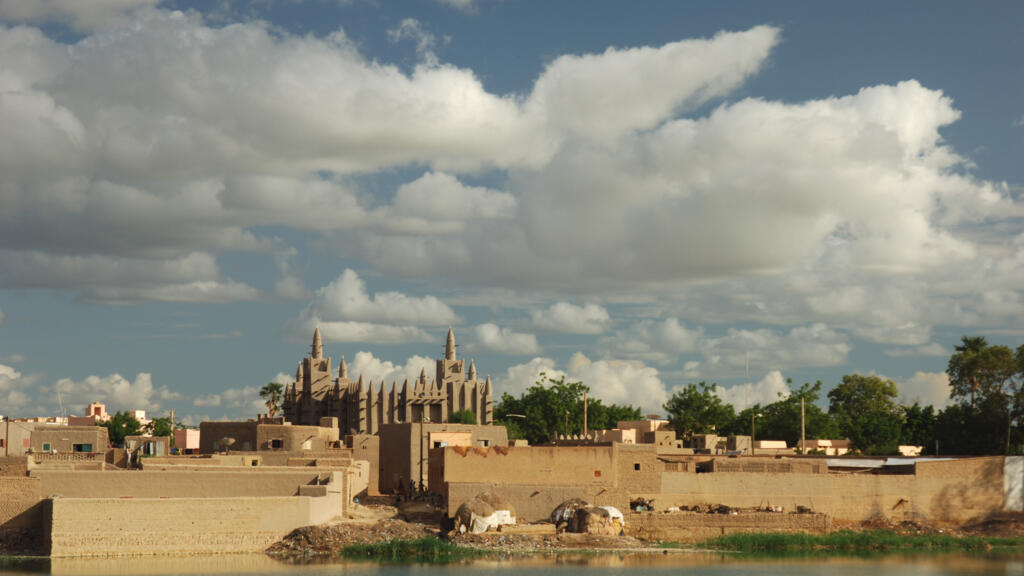
View of the city of Mopti, in central Mali, where a fuel blockade has left residents largely without power for the past month. © Getty Images/Friedrich Schmidt
For a month now, the people of Mopti – one of Mali’s largest and most vibrant cities – have been living in darkness. The lights went out in early October, and they have not come back on since.
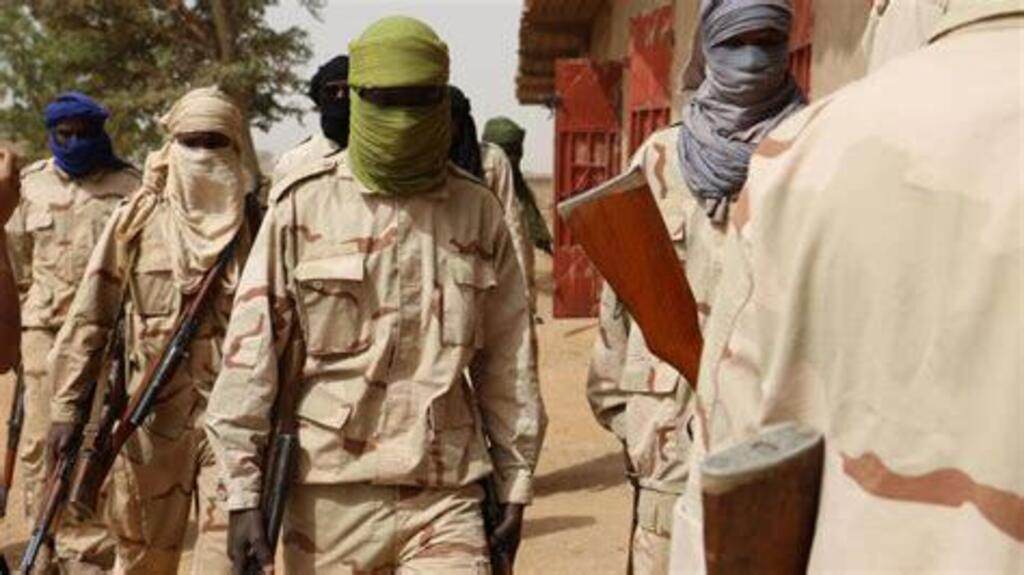
The blackout is the result of a blockade imposed by jihadists linked to al-Qaeda. The Group for the Support of Islam and Muslims – known as JNIM – announced in early September that it was cutting off fuel supplies to much of central Mali.
Since then, armed fighters have been attacking convoys of fuel tankers, leaving towns across the country struggling to power homes, hospitals and businesses.
Mopti, a riverside trading hub of more than 560,000 people, has been among the worst affected. Power cuts were already part of daily life, but with the blockade in place, fuel has all but disappeared.
Generators have fallen silent, and solar panels are now the city’s only lifeline – powering parts of the main hospital and letting residents charge their phones for a few minutes at a time.
For a month now, the people of Mopti – one of Mali’s largest and most vibrant cities – have been living in darkness. The lights went out in early October, and they have not come back on since.
The blackout is the result of a blockade imposed by jihadists linked to al-Qaeda. The Group for the Support of Islam and Muslims – known as JNIM – announced in early September that it was cutting off fuel supplies to much of central Mali.
Since then, armed fighters have been attacking convoys of fuel tankers, leaving towns across the country struggling to power homes, hospitals and businesses.
Mopti, a riverside trading hub of more than 560,000 people, has been among the worst affected. Power cuts were already part of daily life, but with the blockade in place, fuel has all but disappeared.
Generators have fallen silent, and solar panels are now the city’s only lifeline – powering parts of the main hospital and letting residents charge their phones for a few minutes at a time.
Jihadist fighters have surrounded Mopti, in central Mali, and terrorist groups are active in the area. © RFI/Coralie Pierret
Mali’s economy near standstill amid JNIM fuel attacks
‘Catastrophic’ crisis
“Since 7 October, we haven’t had a second of electricity,” says Mohamed Sanous Nientao, a Mopti native now living in exile. “It’s a total blackout. For residents, it’s catastrophic.”
Nientao is a businessman and former local politician who once led the Mopti branch of the UDD, an opposition party now dissolved along with all political organisations under Mali’s military-led transition. Though he is abroad, he remains in close contact with his hometown and describes a city at breaking point.
“Economically, there’s no work, so no income,” he told RFI. “We get a few hours of water distribution, but even that is uncertain. With the security situation, we’re practically cut off from Bamako. The road is controlled by jihadist groups, and with the fuel shortage, the price of a bus ticket to the capital has exploded.
“We’ve never experienced anything like this in Mopti. It’s unbearable.”
Nientao appealed to Mali’s junta for help. “We know the authorities can’t fix everything overnight,” he says. “But we’re asking for at least one hour of electricity each day. The country is under attack from an extremist force. We have to stand together, but to do that, people need food, fuel and the means to live.
“We’re now in a position where we’re begging for a single hour of power.”
Earlier this week, Mali’s interim president, Assimi Goïta, said the government was working to find solutions. “Some of the answers must also come from families,” he added, urging Malians to limit travel, show solidarity and avoid panic.
This article was adapted from an original story in French by David Baché.
France urges nationals to leave Mali temporarily amid jihadist fuel blockade
France’s foreign ministry on Friday recommended that French nationals in Mali leave the country temporarily and "as soon as possible", citing the "worsening security situation" in the West African nation battling jihadist insurgents.
Issued on: 07/11/2025
By: FRANCE 24
France’s foreign ministry on Friday recommended that French nationals in Mali leave the country temporarily and "as soon as possible", citing the "worsening security situation" in the West African nation battling jihadist insurgents.
Issued on: 07/11/2025
By: FRANCE 24
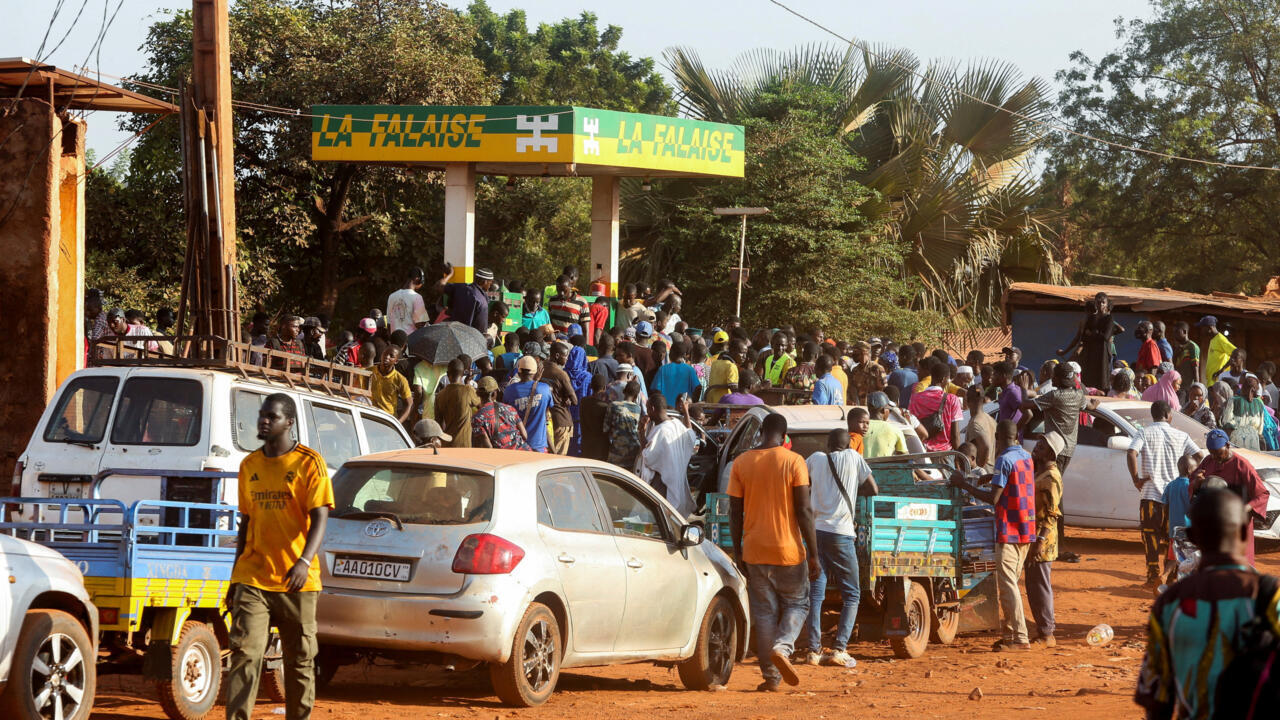
People gather at a petrol station in Bamako, Mali, on November 1, 2025, amid ongoing fuel shortages caused by a blockade imposed by al Qaeda-linked insurgents. © Reuters file photo
The French foreign ministry has urged all French nationals in Mali to temporarily leave the country, where a two-month-old fuel blockade by al Qaeda-linked militants has all but paralysed the capital Bamako.
In a travel advisory on Friday, the ministry recommended that French nationals leave Mali "as soon as possible" through commercial flights and not by land, warning that main roads have been targeted by "terrorist groups".
The ministry also reiterated its formal advice against travelling to the African country "regardless of the reason".
The al Qaeda-linked Group for the Support of Islam and Muslims (JNIM) has since September been targeting fuel tankers, particularly those coming from Senegal and Ivory Coast, through which the majority of Mali's imported goods transit.
WATCH MORE Jihadists' fuel blockade squeezes Mali's military rulers
France's announcement comes a day after the foreign ministry in Paris told a press briefing that insecurity in Mali showed the country’s decision to turn to Russia and Moscow-linked armed groups for security assistance had proven to be a failure.
"We are following the security situation in Mali with a great deal of attention and genuine concern," foreign ministry spokesperson Pascal Confavreux told reporters on Thursday.
"What I could add is that we can see that the contested presence of Russia, or forces associated with it in Mali, does not in any way ensure the security of Malian women and men."
Since back-to-back coups in 2020 and 2021 that led to the end of France's military presence, Mali has been ruled by a military junta that is struggling to counter various armed groups including the JNIM.
Last week, the United States and Britain announced the evacuation of their "non-essential" personnel and their families because of the deteriorating situation.
The Geneva-based shipping group MSC on Friday said it was halting its operations in Mali, citing the fuel blockade and deteriorating security.
(FRANCE 24 with AFP, Reuters)
The French foreign ministry has urged all French nationals in Mali to temporarily leave the country, where a two-month-old fuel blockade by al Qaeda-linked militants has all but paralysed the capital Bamako.
In a travel advisory on Friday, the ministry recommended that French nationals leave Mali "as soon as possible" through commercial flights and not by land, warning that main roads have been targeted by "terrorist groups".
The ministry also reiterated its formal advice against travelling to the African country "regardless of the reason".
The al Qaeda-linked Group for the Support of Islam and Muslims (JNIM) has since September been targeting fuel tankers, particularly those coming from Senegal and Ivory Coast, through which the majority of Mali's imported goods transit.
WATCH MORE Jihadists' fuel blockade squeezes Mali's military rulers
France's announcement comes a day after the foreign ministry in Paris told a press briefing that insecurity in Mali showed the country’s decision to turn to Russia and Moscow-linked armed groups for security assistance had proven to be a failure.
"We are following the security situation in Mali with a great deal of attention and genuine concern," foreign ministry spokesperson Pascal Confavreux told reporters on Thursday.
"What I could add is that we can see that the contested presence of Russia, or forces associated with it in Mali, does not in any way ensure the security of Malian women and men."
Since back-to-back coups in 2020 and 2021 that led to the end of France's military presence, Mali has been ruled by a military junta that is struggling to counter various armed groups including the JNIM.
Last week, the United States and Britain announced the evacuation of their "non-essential" personnel and their families because of the deteriorating situation.
The Geneva-based shipping group MSC on Friday said it was halting its operations in Mali, citing the fuel blockade and deteriorating security.
(FRANCE 24 with AFP, Reuters)
November 8, 2025
Foreign Policy Research Institute
By Raphael Parens and Delina Goxho
(FPRI) — Bamako is living on the precipice. Nervous hotel owners complain about a lack of electricity, but this time it’s worse than usual. In the landlocked capital of the Sahelian country of Mali, business owners have grown accustomed to frustratingly common rolling blackouts across the region. But the blackouts are more nefarious these days, as a jihadist blockade of Mali’s highways has squeezed Bamako’s access to fuel that powers its generators and fuels its cars. The city of Bamako is hanging on, yet Mali’s statehood may have already slipped into the night.
Mali’s government has been fighting multiple wars for over a decade, but until recently, it has managed to contain violence to the country’s rural areas. The same can be said for Mali’s Sahelian neighbors, Burkina Faso and Niger. Yet today, their capitals and major cities are threatened by jihadist forces linked to al-Qaeda and the Islamic State.
The Sahel has been defined by trading for much of its history. Over time, the region’s trade routes expanded from gold to enslaved people, and back to human trafficking, gold, and drug smuggling today. While these trends are concerning by themselves, they accompany developments in the region’s political fate that are particularly concerning today.
The first warning signs came, as they did across the Arab world, after the Arab Spring. A crackdown on opposition movements included the Muslim Brotherhood and its jihadist offshoots. Jihadists fleeing stringent counterterror programs in Algeria put down roots in the Sahel, upending sensitive local dynamics. They threatened a tense ceasefire between northern rebel groups and local governments, as all three groups fought to control the Sahel’s lucrative trade routes and its precious minerals.
The Malian government requested French military assistance in 2013, which proved initially successful through Operation Serval in driving jihadist forces out of central Mali and their strongholds in the north of the country. However, as occurred in Afghanistan with U.S. counterterrorism campaigns, the initial French mission was susceptible to “mission creep” —the military term for strategies that balloon beyond the capabilities of the forces involved. Operation Barkhane aimed to eradicate terrorism in the Sahel region (including Burkina Faso and Niger) and provide the Sahelian states with an opportunity to manage their own defense. Meanwhile, a UN mission (MINUSMA), featuring a broad contingent of European and American partners, aimed to uphold the fragile peace deal between rebel groups and the government. These goalsproved both lofty and difficult to achieve.
Nearly 10 years later, the Malian military decided that enough was enough, orchestrating consecutive coups d’état in 2020 and 2021 that fundamentally altered the country’s balance of power. European partners appeared to be lining their pockets with natural resources while failing to push jihadist and separatist groups out of Mali. With Russian media support, a Malian junta took power and pushed its European partners out, riding a wave of anti-colonial resentment towards France and nascent pro-Russian sentiment. Similar coups followed in Niger and Burkina Faso, albeit with limited initial Russian involvement.
Russian support has not saved Mali, nor has it saved its neighbors. The Russian state-backed mercenary company, Wagner Group, took the counterterror lead in Mali in early 2022, just as Russia began its invasion of Ukraine. Wagner Group immediately started killing civilians, attempting to send a message to Mali’s rural population that cooperation with jihadists was unacceptable. However, this strategy backfired, as Malian soldiers and civilians balked at atrocities like the internationally condemned Moura Massacre.
The invasion of Ukraine further complicated Wagner’s operations in Africa, as the Russian military lacked the capacity to support the organization logistically. Further, the Wagner Group had been spread thin by deployments across Africa—Sudan, the Central African Republic, and Libya. Yet, the organization’s reorientation toward Russia proved to be its true undoing. At Moscow’s behest, Wagner Group redeployed to Ukraine, where it clashed with the military over resources. This tension spilled over into a mutiny, its infamous march on Moscow, and the subsequent killing of its leaders, Yevgeny Prigozhin and Dmitry Utkin.
From the ashes of Wagner Group, the Kremlin resurrected its own public-private expeditionary force, known as the Africa Corps. In June, this organization took over Wagner Group’s operations in Mali. It expanded into Niger and Burkina Faso, but it was continually kneecapped by the Kremlin’s prioritization of the Ukraine conflict.
The Africa Corps has failed to recover from this loss, and this limited capacity contrasts with empowered jihadist and separatist movements across the Sahel. Jama’at Nusrat al-Islam wal-Muslimin (JNIM), the local al-Qaeda branch, has been very active in Mali over the summer. First, JNIM launched a series of coordinated attacks on several military bases across the country. Then, it resorted to blocking the country’s major roads, laying siege to some important cities, and setting fire to fuel trucks coming from western and southern Mali. This strategy reflects JNIM’s new aim on the battlefield: to choke Bamako and overthrow the military junta, while simultaneously demonstrating the extent of the Malian state’s collapse. Meanwhile, not only have fuel prices spiked across Mali, but the shortage is now so severe that Bamako and other major towns have been completely paralyzed. Rumors swirling around the army suggest that military officials in Kati and elsewhere are losing their patience.
Western governments are sounding the alarm. On Oct. 24, the U.S. State Department upgraded Mali to a level 4 “Do Not Travel” warning, and other countries like the Netherlands and Canada followed suit. The potential outcomes are varied—from another military coup to an extended siege evoking images of Mogadishu in the 1990s to a complete jihadist takeover. Regardless, change is coming for Bamako, and the region may never be the same again.
While Bamako is in dire straits, its neighbors could be the next dominoes to fall. Burkina Faso now ranks at the top of the infamous Global Terrorism Index. The country’s junta government made the fateful decision to arm civilian militias, exacerbating violence. Jihadist groups have responded with drone attacks, which are also proliferating in Mali and Niger.
Niger isn’t faring any better. Nigeriens are four times more likely to die due to jihadist violence since the withdrawal of Western military support. One local cleric noted that jihadist forces “are beginning to feel legitimate, bold and entitled to the taxes, not just by force, but as if they were a recognized government.” Self-defense militias such as the zankai and the garde nomade have become the only state-supported or condoned forces in the country’s most violence-affected areas, as the military struggles to reach them.
All three countries are experiencing a collapse of the state. Jihadist and separatist insurgencies have fundamentally altered their capacity to conduct international affairs and manage sovereignty. No Sahelian government can claim full sovereignty or control over the means of violence within its borders. The Sahel is experiencing feudalization, the progressive fragmentation of the state. In this context, armed groups, rebel organizations, and self-defense militias engage in violence across different parts of the territory, and countries exist only in name.
Looking forward, prospects appear particularly bleak for the Sahel. Jihadist partial or total rule will spur mass migration, most likely into Mauritania, Algeria, and Libya. While European and American leaders are focused on Russia and China, a volatile jihadist source of insecurity is looming in West Africa. The consequences of jihadist statelets near the Atlantic and the Mediterranean can and should stir fear in Washington, Paris, Brussels, and beyond.
Yet, cooler heads are needed. African migration bans and militarily focused policies are short-term approaches that will flounder in the face of a more profound crisis plaguing the Sahel. Responsible policies must center around the failures of governance in the Sahel—enormous gaps in public infrastructure, poor access to education, and a hollowed job market—which build grievances in peripheral communities and push individuals into armed violence. From the governance side, foreign partners will need to try harder against the corrupt networks that continue to manage the Sahel’s gold and human trafficking trade, which perpetuates instability and robs these countries of resources. Part of this push will fall on states that encourage these criminal behaviors, particularly the United Arab Emirates.
For now, most analysts prefer investment in the Sahel’s littoral neighbors. A full-capacity military and political campaign in the Sahel would be an expensive endeavor at a time when foreign policy budgets are being slashed around the world.
On the other hand, a new and evolving Syrian government suggests that there is potential for normalized relations between the Global North and former jihadists. Indeed, JNIM leadership in 2021 claimed that the war in Mali would not touch French soil. Any approaches along these diplomatic lines, though, would require a re-evaluation of Western relations with former client regimes in the Sahel and a degree of communication with jihadist organizations that does not exist today.
About the authors:
Raphael Parens is a Fellow in the Foreign Policy Research Institute’s Eurasia Program. He is an international security researcher focused on Europe, the Middle East, and Africa and specializes in small armed groups and NATO modernization processes.
Delina Goxho is an independent security analyst who works for several European foundations and civil society organizations.
Source: This article was published by FPRI
Published by the Foreign Policy Research Institute
Founded in 1955, FPRI (http://www.fpri.org/) is a 501(c)(3) non-profit organization devoted to bringing the insights of scholarship to bear on the development of policies that advance U.S. national interests and seeks to add perspective to events by fitting them into the larger historical and cultural context of international politics.

No comments:
Post a Comment