Not a Trump Anomaly: The Board of Peace and America’s Crisis-Driven Power Plays
.png)
The history of American power is, in many ways, the history of reinventing rules – or designing new ones – to fit US strategic interests.
This may sound harsh, but it is a necessary realization, particularly in light of US President Donald Trump’s latest political invention: the so-called Board of Peace.
Some have hastily concluded that Trump’s newest political gambit – recently unveiled at the World Economic Forum in Davos – is a uniquely Trumpian endeavor, detached from earlier US foreign policy doctrines. They are mistaken, misled largely by Trump’s self-centered political style and his constant, though unfounded, claims that he has ended wars, resolved global conflicts, and made the world a safer place.
At the Davos launch, Trump reinforced this carefully crafted illusion, boasting of America’s supposed historic leadership in bringing peace, praising alleged unprecedented diplomatic breakthroughs, and presenting the Board of Peace as a neutral, benevolent mechanism capable of stabilizing the world’s most volatile regions.
Yet a less prejudiced reading of history allows us to see Trump’s political design – whether in Gaza or beyond – not as an aberration, but as part of a familiar pattern. US foreign policymakers repeatedly seek to reclaim ownership over global affairs, sideline international consensus, and impose political frameworks that they alone define, manage, and ultimately control.
The Board of Peace – a by-invitation-only political club controlled entirely by Trump himself – is increasingly taking shape as a new geopolitical reality in which the United States imposes itself as the self-appointed caretaker of global affairs, beginning with genocide-devastated Gaza, and explicitly positioning itself as an alternative to the United Nations. While Trump has not stated this outright, his open contempt for international law and his relentless drive to redesign the post-World War II world order are clear indicators of his true intentions.
The irony is staggering. A body ostensibly meant to guide Gaza through reconstruction after Israel’s devastating genocide does not include Palestinians – let alone Gazans themselves. Even more damning is the fact that the genocide it claims to address was politically backed, militarily financed, and diplomatically shielded by successive US administrations, first under Joe Biden and later under Trump.
It requires no particular insight to conclude that Trump’s Board of Peace is not concerned with peace, nor genuinely with Gaza. So what, then, is this initiative really about?
This initiative is not about reconstruction or justice, but about exploiting Gaza’s suffering to impose a new US-led world order, first in the Middle East and eventually beyond.
Gaza – a besieged territory of just 365 square kilometers – does not require a new political structure populated by dozens of world leaders, each reportedly paying a billion-dollar membership fee. Gaza needs reconstruction, its people must be granted their basic rights, and Israel’s crimes must be met with accountability. The mechanisms to achieve this already exist: the United Nations, international law, longstanding humanitarian institutions, and above all the Palestinians themselves, whose agency, resilience, and determination to survive Israel’s onslaught have become legendary.
The Board of Peace discards all of this in favor of a hollow, improvised structure tailored to satisfy Trump’s volatile ego and advance US-Israeli political and geopolitical interests. In effect, it drags Palestine back a century, to an era when Western powers unilaterally determined its fate – guided by racist assumptions about Palestinians and the Middle East, assumptions that laid the groundwork for the region’s enduring catastrophes.
Yet the central question remains: is this truly a uniquely Trumpian initiative?
No, it is not. While it is ingeniously tailored to feed Trump’s inflated sense of grandeur, it remains a familiar American tactic, particularly during moments of profound crisis. This strategy is persuasively outlined in Naomi Klein’s The Shock Doctrine, which argues that political and economic elites exploit collective trauma – wars, natural disasters, and social breakdown – to impose radical policies that would otherwise face public resistance.
Trump’s Board of Peace fits squarely within this framework, using the devastation of Gaza not as a call for justice or accountability, but as an opportunity to reshape political realities in ways that entrench US dominance and sideline international norms.
This is hardly unprecedented. The pattern can be traced back to the US-envisioned United Nations, established in 1945 as a replacement for the League of Nations. Its principal architect, President Franklin D. Roosevelt, was determined that the new institution would secure the structural dominance of the United States, most notably through the Security Council and the veto system, ensuring Washington’s decisive influence over global affairs.
When the UN later failed to fully acquiesce to US interests – most notably when it refused to grant the George W. Bush administration legal authorization to invade Iraq – the organization was labeled “irrelevant”. Bush, then, led his own so-called “coalition of the willing,” a war of aggression that devastated Iraq and destabilized the entire region, consequences that persist to this day.
A similar maneuver unfolded in Palestine with the invention of the so-called Quartet on the Middle East in 2002, a US-dominated framework. From its inception, the Quartet systematically sidelined Palestinian agency, insulated Israel from accountability, and relegated international law to a secondary – and often expendable – consideration.
The method remains consistent: when existing international mechanisms fail to serve US political objectives, new structures are invented, old ones are bypassed, and power is reasserted under the guise of peace, reform, or stability.
Judging by this historical record, it is reasonable to conclude that the Board of Peace will eventually become yet another defunct body. Before reaching that predictable end, however, it risks further derailing the already fragile prospects for a just peace in Palestine and obstructing any meaningful effort to hold Israeli war criminals accountable.
What is truly extraordinary is that even in its phase of decline, the United States continues to be permitted to experiment with the futures of entire peoples and regions. Yet it is never too late for those committed to restoring the centrality of international law – not only in Palestine, but globally – to challenge such reckless and self-serving political engineering.
Palestine, the Middle East, and the world deserve better.
While the sheer pomposity, Trumpian megalomania, and painfully paradoxical context surrounding the so-called “Board of Peace” (BoP) might tempt some to dismiss it as mere spectacle or farce, its criminal, inhumane, and hegemonic nature make it far too dangerous to ignore.
Last week, Trump and his new, thuggish boys’ club of heads of state, publicly celebrated the launch of the Board at the World Economic Forum in Davos. Its hypocrisy was inadvertently underscored by Elon Musk—Trump’s on-again, off-again ally—when he quipped onstage that one might call it the Board of “p-i-e-c-e,” a venture devoted to claiming “a little piece of Greenland, a little piece of Venezuela,” to which his interviewer, Larry Fink, billionaire CEO of BlackRock, responded with cheer: “We got one.” Only a room filled with the world’s tech and business elite could find this funny.
In the week since, people of conscience around the world have been left to reckon with what may come of this brazen proclamation of a Trumpified world order. In particular, the BoP’s presentation of plans for “New Gaza” offered stark clarity about the greed-driven intentions Trump, his inner circle, and their Israeli billionaire partners seek to pursue, while raising a fundamental question as to how such a project of colonization and land theft could claim any legal basis at all, let alone a moral one.
As it stands, the BoP charter elevates Trump to a position akin to a global dictator for life, unchecked—on paper— by any external mechanisms of accountability or transparency. Acting as permanent chairman, chief executive, and controlling shareholder of the organization, Trump has declared that he holds absolute veto power, while retaining complete discretion over the potential multibillion-dollar slush fund generated through permanent member fees. In keeping with his long record of felonies and fraud, all budgets, financial accounts, or disbursements the BoP deems “necessary” to carry out its sweeping mission are subject only to the so-called “institutions of controls or oversight mechanisms” designed by the very same Executive Board.
A few invited world leaders, mostly from the EU, have done little more than politely decline their invitations. While they have not yet bent the knee to Trump in this mobster’s reality-show version of U.S. imperial power in action, this has not stopped those same governments from endorsing the other “peaceful actions” Trump is poised to pursue under the guise of BoP authority. These include the kidnapping of Venezuelan President Nicolás Maduro and the seizure of Venezuelan oil; the execution of dozens of extrajudicial boat strikes that have killed more than one hundred people in the Caribbean; threats of war and the promotion of dangerous regime-change fantasies in Iran and Cuba; and support for his complete takeover of occupied Palestine through U.N. Security Council Resolution 2803. That resolution effectively granted Trump authority in Gaza by endorsing his 20-point Gaza peace plan and welcoming the BoP as a transitional governing body. Thus far, Greenland remains the only red line EU states have managed to articulate.
Despite some rejections, other governments have gone ahead and accepted their invitations for a free three-year membership. The participation of Israel’s wanted genocidaire-in-chief, Prime Minister Benjamin Netanyahu, should serve as the clearest red flag that this organization has no interest in even pretending to care about the lives of the Palestinian people or any standard of international law. Netanyahu could not even fly to Davos to attend the BoP’s self-appointed pomp and circumstance for fear of being arrested as wanted war criminal.
Other beacons of democracy and world peace, eager to lend legitimacy to the BoP, include Trump’s own “favorite dictator,” Egyptian President Abdel Fattah al-Sisi; Argentina’s scandal-prone, right-wing President Javier Milei; “Europe’s last dictator,” Belarusian President Alexander Lukashenko; Netanyahu’s idea of a “moral conscience,” Albanian President Edi Rama; and Hungary’s model in authoritarianism, Viktor Orbán. Leaders from Arab states—including Saudi Arabia, the UAE, Jordan, and Qatar—have also joined, and will presumably stand alongside Trump and the Executive Board to help oversee, and quietly endorse, “New Gaza.”
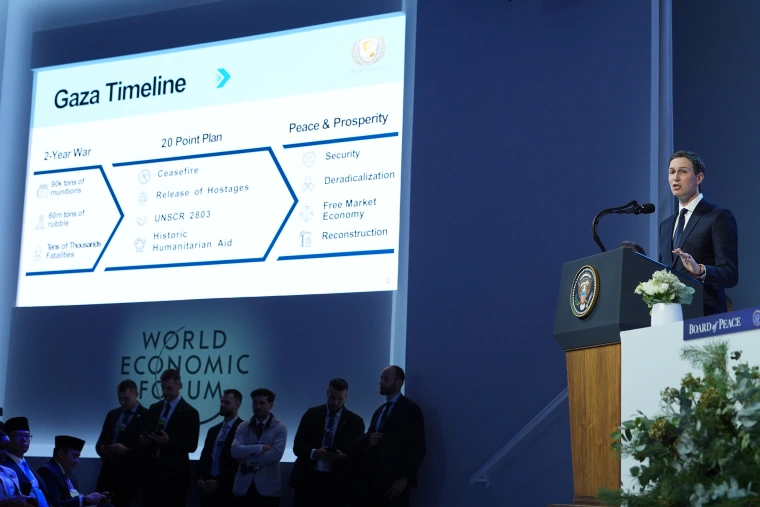
Their participation set the stage for Davos, where none other than Jared Kushner delivered the first public presentation of an investment plan contingent upon the ethnic cleansing and erasure of a national Palestinian identity. Kushner, Trump’s son-in-law and a member of the BoP “Executive Board,” has long served as the self-styled “master planner” of transforming Gaza into a prime real estate opportunity. He has a track record of articulating his absolute disregard for Palestinian life, describing the besieged Gaza strip in February 2024 as “very valuable…waterfront property.”
Kushner began his chilling slideshow by urging skeptical investors to “just calm down for 30 days,” declaring, “the war is over. Let’s work together.” Eager to move on to their real business of “peace,” Kushner appeared wholly willing to ignore the ongoing forced starvation, imprisonment, systemic torture, murder, and displacement of Palestinians across the occupied territories. Since the supposed “ceasefire” in October 2025, the Israeli military has killed at least 477 Palestinians in Gaza.
Trump has also failed to address Israel’s continued ban on dozens of international humanitarian and non-governmental organizations, a policy that has deliberately denied life-saving aid and medical care to the region while newborn babies continue to die of hypothermia. Instead, Kushner outright lied about the current scale of Israel’s designed humanitarian catastrophe, claiming that “100% of the food needs are met” and that “the cost of needs has gone down,” before unironically describing the administration’s role as “the largest humanitarian effort into a war zone that anyone’s been able to tell us about.” Meanwhile, as the conference unfolded, Israeli forces bulldozed the UN Refugee headquarters in East Jerusalem, and the Israeli Knesset voted by an overwhelming majority to annex the entirety of the West Bank.
Amid the distortions and denials of reality, Kushner did allow the logic of the project to surface when he identified the architect behind the purported $25 billion master plan for Gaza: Yakir Gabay, whom he described as “one of the most successful real estate developers and brilliant people I know.” Gabay is an Israeli billionaire and international real estate tycoon with close familial ties to the Israeli government. Reports also indicate that he has participated in efforts to pressure Columbia University administrators to suppress student protests.
Much like Kushner, a recent article by the editor-in-chief of The Jerusalem Post, described Gabay as having been eager to craft a plan for “New Gaza” from the very first weeks of Israel’s prolonged assault on the densely populated region:
“October 7, [Gabay] tends to say, woke him to action. [Gabay] thought: This time, my capabilities can change the face of reality…Other businesspeople heard about his work a year and a half ago. The White House had asked him to develop something even during Joe Biden’s term. He has good relationships with Tony Blair and Kushner, and when Trump won the elections, it became easier to push the issue.”
On the whole, Kushner’s “New Gaza” presentation made no attempt to acknowledge a Palestinian state, recognize Palestinian self-determination, nor address Israeli occupation or the implications of Gaza’s ‘reconstruction’ for the other occupied Palestinian territories. Instead, the eerily bizarre AI-generated slideshow of skyscrapers, oil rigs, and industrial complexes offered only a glimpse into the twisted billionaire fantasy that Kushner’s inner circle—including figures like Gabay—has sought to merge with Zionist imaginaries.
The only part of Kushner’s presentation that even acknowledged Palestinians was a single slide on “Palestinian-led demilitarization.” Beyond this ominous token reference, the narrative repeatedly circled back to framing Gaza as “an amazing investment opportunity” to the room full of multi-millionaires and billionaires.
Recent reporting from Drop Site News has confirmed and expanded upon this language, revealing “Resolution No. 2026/1,” an unsigned State Department document from December 2025 that declares the Board of Peace aims to transform Gaza into a “deradicalized and demilitarized terror-free zone.”
Here, “deradicalization” functions as a catch-all term to delegitimize resistance and criminalize opposition to Israeli occupation—a legal right under international law. Palestinians who maintain their political consciousness, national identity, or will for self-determination, and who refuse to normalize occupation, are almost certain to be labeled “terrorists” or deemed insufficiently “deradicalized.” Those who take up arms to defend their people against some of the world’s most heavily armed and nuclear powers risk being denied existence in their own lands—murdered or turned away by the very architects of genocide who now claim to bring “peace.” Access to basic rights is made contingent on surrendering political and economic agency, including abandoning a historically rooted cultural identity of resistance under occupation, forsaking traditional livelihoods, and subordinating the desire to shape the future of the land to whatever ‘economic opportunities’ BoP members deem investible.
The document further states that only those who “support and act consistently” to establish a “deradicalized, terror-free Gaza that poses no threat to its neighbors” may participate in governance, reconstruction, economic development, or humanitarian assistance. It also bars any individuals or organizations the Board deems to have “supported or demonstrated a history of collaboration, infiltration, or influence with or by Hamas or other terror groups”—a sweeping allegation Israel has long weaponized without evidence.
In practice, such standards mean that anyone who stands in firm solidarity with Palestinians, including international NGOs that seek to hold Israel to even minimal standards of accountability, will likely be barred from operating in Gaza. This has already become an entrenched and worsening reality since October 2023. What the BoP presents as a security framework is, in essence, a blueprint for controlling Palestinian movement, erasing any viable possibility of a Palestinian state, and ultimately, advancing ethnic cleansing, while preventing humanitarian organizations from participating in any meaningful process of reconstruction or the delivery of aid. A framework that insists “no one will be forced to leave Gaza”—as if forced removal were ever legitimate—while simultaneously conditioning access to aid, resources, and even limited political participation on compliance with what Trump and his confidants dictate, is not a framework in which any meaningful shred of freedom or dignity can exist.
In essence, Trump, convicted felon and yet-to-be-explicitly-named pedophile from Queens, New York, now supposedly wields full legislative, executive, and judicial control over the future of Gaza. He alone, along with his board of resort profiteers—who would hastily clear away the rubble burying the bodies of erased bloodlines and the remnants of mosques, churches, hospitals, and schools—will have complete authority over how surviving Palestinians live, how they are governed, and who may participate in decision-making. Only at the very bottom of the BoP’s tyrannical hierarchy sits a so-called “technocratic committee,” nominally including members of the Palestinian Authority. Its role appears purely advisory, permitted to exist only insofar as it appeases Trump and aligns with his agenda. There is little indication that it will serve, or even slightly represent, the people it claims to speak for.
The development is ultimately so jarring, so rooted in supremacist ideologies, and so flagrantly opposed to basic principles of sovereignty and human rights that it has few historical parallels. The closest comparison seems to be the gruesome reign of Belgian King Leopold II.
Those who participate in this process, including figures such as World Bank President Ajay Banga, lend legitimacy to a project that advances a perverse vision and a chapter of history that is not inevitable. Collaboration in the name of “reconstruction and development of Gaza” for a project so morally and legally corrupt is not pragmatic compromise—it is active participation in a plan that has no place in the world. The human cost of this complicity is impossible to ignore.
The BoP plan also offers no conceptions of justice, reparations, or accountability for Israeli terror. Its version of “peace” is imposed through state violence to silence, control, and force Palestinians into submission. It is a project that raises skyscrapers for Western elites atop mass graves, without including, or even acknowledging, the Palestinians its architects have killed and displaced. It relies too, on the pathetic inaction of the overwhelming majority of UN member states.
Much remains unknown about what is immediately required to take a single step toward “peace” in the region: if and when Palestinians may finally find reprieve from Israeli bombardment, whether the Rafah crossing will actually open, what will become of finding and returning the bodies of loved ones buried under the rubble, whether human rights organizations or journalists will even be permitted to document the reality–and work safely–on the ground, if displaced Palestinians will ever be allowed to return to Gaza, and crucially, whether other states will intervene. What is clear, however, is the sheer evil of this project.
Following Kushner’s presentation, many have rightfully said that if this BoP monstrosity were fictional, it would be so dark it would border on being unbelievable. And yet it is profoundly real: a greed-soaked plan dependent on mass murder and land theft, driven by men so wealthy and entitled that they believe they can escape accountability while reaping billions in profit in the process.World leaders have long entrenched impunity and rewarded the most atrocious US-Israeli war crimes and crimes against humanity, especially over the past two and a half years. Yet the Board’s ambitions—laid out in a charter that mirrors the UN and spans what Trump calls “the whole region of the world”—reveal a danger that stretches far beyond Palestine. The very consideration of such an inhumane, corrupt, and cruel project is a threat to humanity. And still—precisely because of the chaos, confusion, and sheer audacity of their plans—this dystopian vision for “New Gaza” is not inevitable. Those with political and economic power must firmly reject and actively work to reign in this Orwellian BoP. If any entity requires immediate disarmament and deradicalization, it is Trump and his so-called Executive Board.

No comments:
Post a Comment