
The Iranian Protests Explained
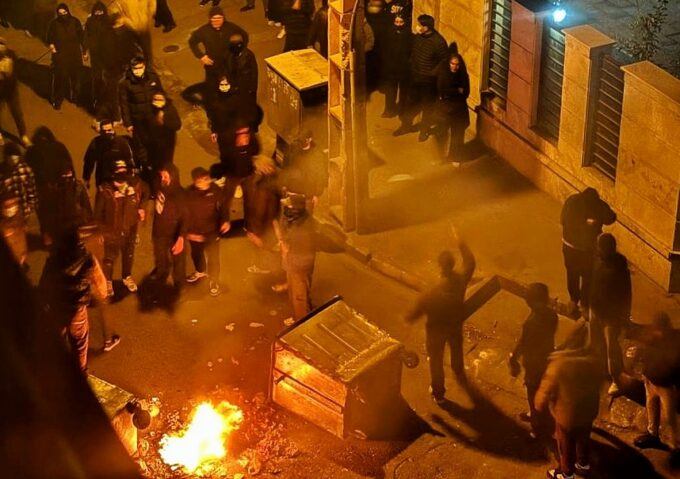
Protests in Tehran on 8 January. Photograph Source: Standardwhale – CC BY 0
In this interview, international relations scholar Stephen Zunes and Middle East historian Lawrence Davidson help to unpack the Iranian protests and explain their relevance within the context of U.S. and Israeli national interests.
Daniel Falcone: Jeffrey St. Clair of CounterPunch, recently cited filmmaker Jafar Panahi’s insistence that change in Iran must come from the will of the people, not from outside intervention. As U.S. and Israeli involvement tends to strengthen hardliners, how do you explain the balance between international solidarity and the risk of external actors undermining Iran’s sovereignty and social movement?
Lawrence Davidson: One has to ask what these terms, international solidarity, and risk from external actors, mean in today’s international environment. If international solidarity means, for instance, the solidarity of reactionary countries that have somehow made an alliance to change the internal behavior of a third nation, that is obviously problematic. In this case, international solidarity is the manifestation of just these external actors. If the United States intervenes in Iran at this time, it would not be to the benefit of the Iranian people, it would be for the suppression of anti-Zionist sentiment in the country through the introduction of the Shah’s adult son. This would probably lead to something like a civil war in Iran. If, however, international solidarity means the sentiment of people rather than governments, this has not proved very effective, as we can see in the case of Gaza.
The Arab and Muslim peoples have either chosen not to or could not in any practical way act to support the Palestinians. I’m afraid that the conclusion here is that in the present circumstances, there is no balance between international solidarity and external actors. The power of institutionalized external actors overwhelms practical terms, the power of popular solidarity.
Stephen Zunes: While the United States and Israel have tried to take advantage of the unrest, the protests this round, as well as previously, have been homegrown and not the result of imperialist machinations. Iran has had a long history of widespread civil resistance going back to the late nineteenth century with the tobacco strike against imperialist economic domination, through the Constitutional Revolution the following decade, through the revolution in the late 1970s that brought down the U.S.-backed Shah. The outspoken support for the protests by the U.S. and Israeli governments have probably been counter-productive, feeding the regime’s false narrative that they are a result of foreign backing. Israel and the United States have a lot of power in terms of blowing things up and killing people.
They do not have the power to get hundreds of thousands of angry Iranians into the streets or even to steer the direction of their protests. The people who have given their lives on the streets were fighting for their freedom, not for foreign powers. Threats of military action by the United States and Israel have also likely strengthened the regime, since people tend to rally around the flag in case of outside threats and most Iranians across the political spectrum do not trust either country.
Given the U.S. support for even more repressive regimes in the Middle East, don’t think the Trump administration cares about the Iranian people. Bombing Iran to ostensibly support the uprising would be a tragedy. People would certainly be reluctant to go out onto the streets while they are being bombed. Most of those calling for U.S. military intervention appear to have been from the Iranian diaspora, not those on the streets. Although some Iranians within the country may have been desperate enough to want to risk it as well, let’s remember that it was not the eleven weeks of NATO bombing that brought down Milosevic in Serbia. It was the massive nonviolent resistance of the Serbian people that took place more than a year later.
It is possible that the United States and Israel might prefer the current reactionary, autocratic Iranian regime to a democratic one, which would still be anti-hegemonic and anti-Zionist but have a lot more credibility. A democratic Iran would still be nationalistic and sympathetic to the Palestinian cause, but less likely to engage in the kinds of repression and provocative foreign policies that would give the United States and Israel an excuse for some of their militarism. Solidarity from global civil society, by contrast, is important and appropriate. Despite claims by some to the contrary, many prominent pro-Palestinian voices from Bernie Sanders to Peter Beinart to Greta Thunberg have been outspoken in their support for the Iranian popular struggle as well. People will certainly tend to protest more when their own governments are actively supporting repression and mass killing, as with Israeli violence in Gaza and the West Bank, than when their governments are opposing the repression and mass killing.
Same as during the Cold War—it is quite natural for Americans to be less involved in protesting Communist repression we could do little about than repressive rightwing governments backed by Washington, where we might have more impact. As a result, this line about “where are all the protests on U.S. campuses?” has been unfair (particularly since most were still on winter break). And although some sectarian leftists really have become apologists for the reactionary Iranian regime or have exaggerated the Israeli role in the uprising, they are fortunately a small minority.
Ultimately, international solidarity is important, but it must be from sources that genuinely support the principles for which a popular movement is struggling. The movement in Iran, as with similar movements against autocratic regimes elsewhere, is fighting for freedom, democracy, and social and economic justice. Since neither the U.S. nor the Israeli government supports those principles, the Iranian regime—quite accurately in this case—can observe that U.S. and Israeli backing of the resistance is about advancing U.S. and Israeli strategic objectives, since these right-wing governments support regimes with even worse human rights records and they themselves are undermining democratic principles in their own countries. Indeed, some statements of support have played right into the regime’s hands.
Daniel Falcone: It seems that the participation of bazaaris and the poor and working class makes these protests distinct from earlier movements dominated by students and the middle class. How does this class composition alter legitimacy and the political stakes for the regime?
Lawrence Davidson: Their participation reflects the economic circumstances now. Those circumstances are, in turn, the product of externally imposed economic sanctions and incompetent internal management. Certainly, the participation of the bazaar keepers and the poor and working class in the protests is significant. No matter who comes out on top here, you’re going to see some sort of reform take place. The probability that it is the government that comes out on top is a function of the remaining loyalty of various contingents of the military. And a lot of this has to do with the economic stake of the Revolutionary Guard Corps in the status quo. As long as the military components of the regime stay loyal, the addition of bazaar keepers and the lower classes in the demonstrations cannot change the government.
Stephen Zunes: I find it rather significant that the bazaaris, traditionally a backbone of support for the regime, have been in the leadership of the resistance, as is the fact that there has been significant poor and working-class participation in the protests, unlike some previous movements, which have been disproportionately students and those from the educated middle class. The Iranian military, like the military in Egypt and some other autocratic systems, has their fingers in all sorts of economic enterprises at the expense of the common people. As a result, their brutal response to the protests was not just ideological, but from a desire to protect their vested interests.
It is also striking how quickly the protests went beyond economic issues. Most Iranians want at minimum much greater democratization/accountability within the current system and an increasing number clearly want regime change, not just because of economic hardship, but because they are simply tired of the repression.
Daniel Falcone: Although U.S. led sanctions have crippled Iran, there are also problems of systemic corruption and mismanagement by the Iranian state. Protesters increasingly reject both. Do you see this moment as one in which economic grievances lead to demands for democratization?
Lawrence Davidson: The economic problems come from both factors you mention. The Iranian theologians did not understand the intricacies of modern economic institutions or the importance of international trade. Thus, they could not manage a national economy, particularly one under outside stress. At the same time, American sanctions were designed to destroy that economy and impoverish the Iranian people. The two factors, working simultaneously, opened the way for corruption. And then there is the Revolutionary Guard capturing control of important parts of the economy. It is a mess. Democracy? I think we are a long way from that. We are probably closer to a military coup with the mullahs kept as front men.
Stephen Zunes: U.S.-led sanctions are unjustifiable (since Iran was honoring the nuclear agreement when Trump reimposed them) and they are hurting the economy. But my sense is that both the regime and Washington, for different reasons, are exaggerating the importance of the sanctions in sparking the rebellion. It is the regime’s corruption, mismanagement, and lack of accountability that are the bigger problems. The sanctions have provided the government with an excuse to deflect attention from their lousy economic policies, but that justification is now wearing thin. The economic problems are systemic, so changes at the Central Bank and minor adjustments in fiscal policies will not satisfy most protesters. The regime’s crony capitalism is being seen increasingly as beyond repair under the current system.
Daniel Falcone: UBC Professor Jaleh Mansoor eloquently defended the circulation of protest images as a form of democratic solidarity, while also warning about reactionary diaspora fantasies that reduce Iran’s future to either the Islamic Republic or a restored monarchy. How do you see media circulation distorting an understanding of the protests?
Lawrence Davidson: I do believe that the images should be shown as widely as possible, just as should the ones from Gaza. However, the problem is that they are often shown with either few or misleading explanations. Western commentators do not understand much of the context of happenings in Iran, much less the history. This is the price of a corporate press. The ignorance and biases of editors, if not reporters, are shown over and over. In our lifetime the best example is during Vietnam.
Unless one is motivated to go to an alternate, more accurate source one will get a distorted picture. It is a curse that has always been with us. The wealthy Iranians in California can be as delusional as they wish but there will be no restored monarchy short of an American invasion and occupation of Iran. That is not going to happen. Thus, the Shah’s son will stay in LA.
Stephen Zunes: The greater the circulation of imagery of the people’s resistance and the regime’s repression the better. Care should be given as to how they are presented, however. Like protest coverage elsewhere, the media tends to disproportionately show dramatic photos of vandalism and arson even though overall the protests have been overwhelmingly nonviolent. Indeed, violence is used by the regime to increase its already horrific repression even more.
Similarly, the monarchists are certainly a small minority of the protesters, though both the regime and the Western media (for different reasons) like to highlight them. Although there is something of a nostalgia among better-off Iranians from the pre-revolutionary days—like there is by some Russians for the Soviet era—it is more of a sign of how bad things are now than how good things were then. The Shah was one of the most repressive dictators in the world, and the inequality and corruption under his rule was terrible. Despite some protesters with signs or chants calling for a return of the Shah, the reality is that most Iranians on the streets in recent weeks have been fighting for democracy. In addition to the small number of monarchists, there have also been communists, moderate Islamists, secular liberals, and lots of other folks. People are fed up. Based on my time in Iran a few years ago and my following the situation in that country for decades, I can say with confidence that most of the Iranian people are both anti-regime and anti-monarchist.
Daniel Falcone: Masoud Pezeshkian has taken a conciliatory tone. Are hardliners likely to prevail if the protests intensify? And do you see any viable path for change within the current system?
Lawrence Davidson: There is a story going around that some government people went to the University of Tehran. They asked the protesting students what they wanted. The answer was “we want you to leave.” This was a mistake on the part of the protesters. They gave those with more power than themselves, no way to retreat. I see no path to meaningful change. I do think that once the government retakes the streets, there will be minor positive alterations in their behavior.
Stephen Zunes: Pezeshkian is a relative moderate, but he is not nearly as powerful as the mullahs or the military. Iran’s authoritarian system is a series of complex overlapping loci of power which represent varying interests, unlike some authoritarian regimes centered around a single autocrat, whose social base is thinner. As a result, I am not surprised, though quite disappointed, that the regime appears to have successfully and violently suppressed another round of protests.
Another problem is that the Iranian regime is the first government to face a massive civil insurrection that initially came to power themselves through a massive civil insurrection. Just as regimes that have come to power through guerrilla warfare are better at engaging in counterinsurgency, the Islamic Republic has unfortunately developed better mechanisms than did the Shah (or Mubarak, Ben Ali, Milosevic, Marcos, Suharto, etc.) to suppress civil resistance. I do believe the regime’s days are numbered, however. I just can’t say when or predict what will replace it.
This first appeared in FPIF.
Daniel Falcone is a historian, teacher and journalist. In addition to CounterPunch, he has written for The Journal of Contemporary Iraq & the Arab World, The Nation, Jacobin, Truthout, Foreign Policy in Focus and Scalawag. He resides in New York City and is a member of The Democratic Socialists of America.
Ron Paul:

By Ron Paul
For the past month, Americans have been wondering whether President Trump will attack Iran, or whether the massive military build-up in the Middle East is just another bluff. President Trump claims that the decision is his alone to make.
Thus far, President Trump has made little effort to explain to the American people – or to Congress – why launching a war against Iran is in our national interest. Instead, he wanders from one reason to another, hoping something will stick. First it was a “nuclear threat” even though he swore that he had “obliterated” Iran’s nuclear program last summer. Then, after the CIA, Mossad, and UK’s MI6 launched a regime-change operation in the form of violent protests in late December, the excuse for war became the Iranian government’s crackdown on the insurrection. But before that could be used as the excuse, the Iranian government was able to quash the uprising. So President Trump returned to the issue of Iran’s nuclear program, while adding in the presence of Iran’s ballistic missile program.
Even by the low threshold for recent US military actions overseas, these arguments are unconvincing. That is why Americans are so skeptical. In a major poll last month, seven in ten Americans said they oppose any US military action against Iran.
When it comes to matters of war, where billions of dollars and countless lives are at stake, “will he, or won’t he” is a terrible question to have to ask. More than 250 years ago we rose up against a system where the king claimed the power to take us to war on his royal decision alone. Our Founding Fathers well understood the folly of concentrating so much power in the hands of one person and placed the power to take the country to war in the hands of the people’s direct representatives, Congress.
This Constitutional obligation has not only been usurped by the Executive Branch. Much blame must be reserved for Congress, which has allowed itself to become a doormat for whoever occupies the White House when it comes to war powers. Members of the president’s own party – regardless of which party it is – are terrified of going against “their” president and members of the opposing party are silent because they don’t want to be accused of not “supporting the troops.”
The media is reporting that Israeli prime minister Benjamin Netanyahu will make yet another trip to Washington – his sixth in one year – where he is expected to again pressure President Trump to launch a war on Iran. Last time he was in the US – in December – the regime-change protests in Iran were launched. What does he have up his sleeve this time?
How can it be that a foreign leader has more say on whether we go to war than the US Congress?
Here’s what we do know. Whether Trump launches a war or not, the massive military build-up in the Middle East has already cost us billions of dollars. Those are billions that instead of helping to actually make America great again will only make the military-industrial complex “greater.” All the American people will see is the continuing destruction of the dollar and with it more inflation and a lower standard of living at home. And, of course, we will see a “war supplemental” spending bill on top of the trillion-dollar military budget for the year.
Ron Paul
Ronald Ernest "Ron" Paul (born August 20, 1935) is an American physician, author, and politician who served for many years as a U.S. Representative for Texas. He was a three-time candidate for President of the United States, as a Libertarian in 1988 and as a Republican in 2008 and 2012.
Op-Ed
Trump’s Back-and-Forth Threats on Iran Are
Psychological Warfare
As Trump threatens Iran yet again, Congress continues to abdicate its responsibility to rein in war.
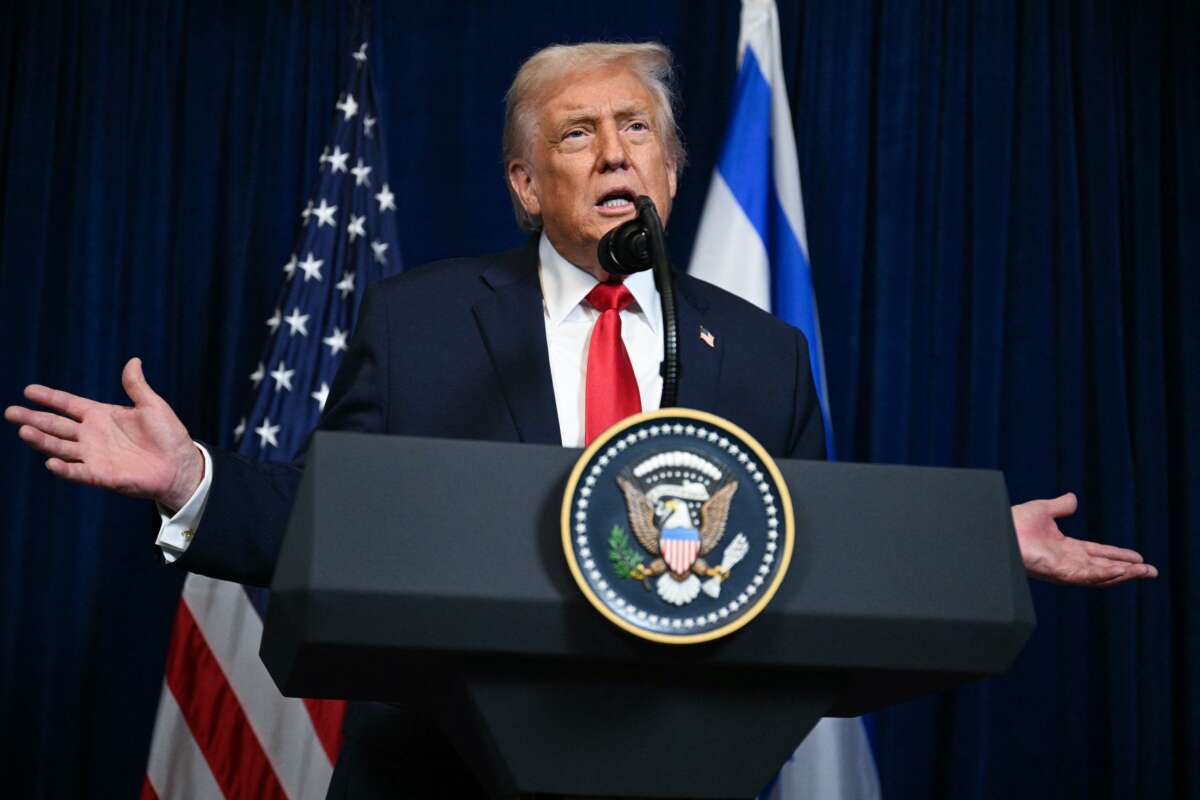
As Iranians rise in protest, Donald Trump’s rhetoric has become a study in contradictions. One day, he threatens “very strong action” against the Islamic Republic to defend Iranian protesters; the next, he praises the very regime he condemned and suggests the possibility of negotiations. His language and behavior are driven by self-interest, not genuine concern for the Iranian people. This theatrical show of menace and bravado is a calculated move, shaped by political ambition, military considerations, and the shifting tides of his support base. While Trump performs on the world stage, ordinary Iranians are left to face the consequences. Parents search mortuaries and hospitals for their loved ones, their grief and struggle reduced to the backdrop of a geopolitical drama.

The protests, which began on December 28, erupted in Tehran’s Grand Bazaar and rapidly spread across the country. While these protests have been organic, they are not spontaneous. They have been fueled by economic collapse: Iran’s currency has lost close to 90 percent of its value against the dollar in a year, and inflation is skyrocketing. People from all income groups and generations joined in, making a variety of demands that increasingly included the downfall of Iran’s current regime.
Iran’s uprising was met with brutality by the government, which shut down communications and cut Iranians off from the outside world. The strategy was not only to stop the protests, but to erase them from public view.
The human costs of these protests have been catastrophic. Across Iran, morgues and mortuaries have overflowed with the number of dead bodies, and hospitals have been collapsing under the weight of injuries. Trucks carrying body bags have been turned away and abandoned at gates, as facilities ran out of space to hold the deceased. The estimated number of casualties has varied substantially due to internet shutdowns. According to the Iranian government, more than 3,000 people have been killed, while the Human Rights Activists News Agency has verified over 6,000 deaths. Ongoing investigations into an additional 17,000 cases could raise the death toll substantially. Meanwhile, according to Amnesty International, tens of thousands of people, including children, have been detained by Iranian authorities.
Amid the crackdown, Washington has drifted into an all-too-familiar and dangerous posture, one that threatens war and bloodshed at the cost of Iranian lives. At the beginning of the protests, Donald Trump warned Iran’s government that if there were casualties, he would send “help” to Iranians in the form of “very strong action.” Yet just a few days later, he commended Iran’s government for ostensibly stopping a spate of executions while raising the possibility of diplomatic talks.
Iran’s Protesters Are Caught Between State Repression and Foreign Intervention
Both Trump and the Iranian government are treating Iranian protesters as political pawns.
By Alex Shams , Truthout January 15, 2026
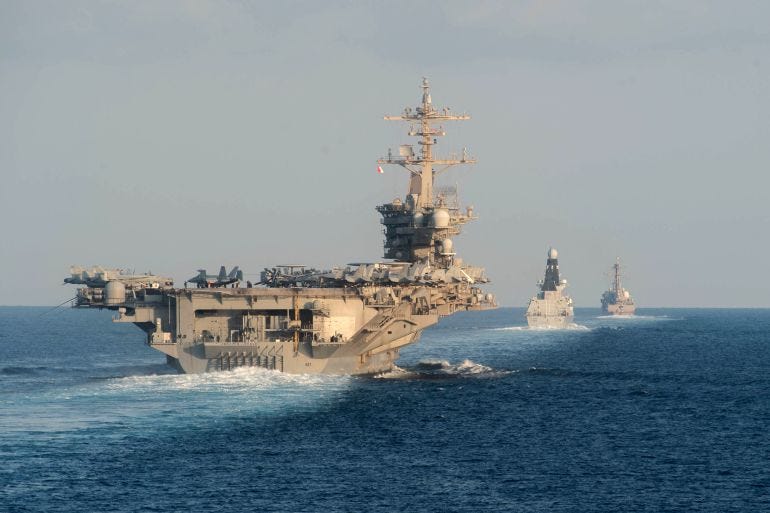
While Washington sends these mixed rhetorical signals, outlets including Al Jazeera and Reuters have continued to report on U.S. military assets being repositioned in the Middle East, allies placed on heightened alert, and American personnel being withdrawn from some locations. Additionally, the U.S. has begun moving a massive armada, led by carrier USS Abraham Lincoln, towards Iran. This naval operation adds roughly 5,000 additional troops to the region, where more than 30,000 American servicemembers are already stationed. This development comes as Trump has vowed that Iran’s resistance to come to the negotiating table over the nuclear program could provoke an attack “far worse” than the previous strike.
Furthermore, the U.S. has told the UN that “all options are on the table” for an attack. In response to this threat, Iran’s President Masoud Pezeshkian issued a warning on X that any attack on Supreme Leader Ali Khamenei would be “tantamount to a full-scale war on the Iranian nation,” adding that any unjust aggression would be met with a regrettable response.
When we peel back the layers of Iran’s current crisis, we must recognize that the frustration of the Iranian people is the outcome of 47 years of the regime’s oppression, corruption, and mismanagement, as well as decades of coercive U.S. policy. For the past eight years, unilateral sanctions have weakened Iran’s civil society, pushing the middle class into severe poverty. Against the backdrop of growing economic hardship and pain, internet blackouts have hampered employment and commerce by transforming an already collapsing economy into an instrument used for collective punishment.
While Trump and GOP leaders suggest the United States is preparing for an attack on Iran, the grounds for war are being prepared without congressional authorization, public debate, or clear disclosures from media about the implications of such a war, despite the common understanding from analysts that such a war would be disastrous.
During Iran’s 12-day war with Israel, the U.S. and its allied countries framed the war as limited and presented the ceasefire as a way to stop further escalation. But the death and destruction in Iran told a different story: More than a thousand Iranians were killed by Israel and the significant financial loss of the war will be felt for years after the fragile ceasefire.
U.S. military escalation is often minimized and downplayed publicly until it suddenly erupts into a catastrophic regional crisis. Before the Trump administration assassinated Iran’s high-ranking Maj. Gen. Qassim Suleimani in 2020, the American public was reassured that the threat of war would be limited. But within hours, the region came close to catastrophic war as a result of a single executive decision.
We’re watching the same thing play out again today. Trump’s language yo-yos between demands for diplomacy and threats of intervention, all to be interpreted alongside incoherent military movements. Meanwhile, mainstream media coverage ranges from whether war will or will not happen, rather than asking why escalation is the first option. This all has real-world consequences. According to Reuters, oil prices are fluctuating as markets closely track U.S.–Iran tensions. After all, the global market understands how devastating a regional war would be for global supply chains. Now imagine how that devastation will impact people in Iran, as well as people in the United States.
Inside Iran, the situation is grim. Iranian leaders have accused the United States and Israel of provoking unrest, a claim Washington denies. Meanwhile, figures on the right boast of interference; former CIA Director and Secretary of State Mike Pompeo even stated that Mossad agents are “walking beside” the Iranian people at protests. This rhetoric weakens the organic movement organized by the people of Iran and gives the Iranian state an excuse to double down on repression.
Time and again, we have seen the brutality of U.S. militarism. The U.S. claims to stand with the people of Iran, but in reality, it imposes hardships on them, making daily life unbearable. Unilateral sanctions imposed by Trump after abandoning the 2015 nuclear deal devastated Iran’s civilian population, restricting medicine, food, and basic necessities for families already suffering from starvation as the regime used those very sanctions to tighten its grip and enrich its leaders.
The Trump administration has shown that it does not care about human rights. But if Washington were truly concerned, it would loosen its grip on Iran’s economy and allow civil society to strike and continue organizing for a political system that best fits the needs of people within the country. For years, unilateral sanctions have hollowed out civil society by restricting banking, driving inflation and criminalizing financial networks. The shortage of cash flow restricts Iran’s civil society and labor from organizing — forcing survival over political action. Furthermore, Iranians abroad no longer have the ability to help their families financially due to banking restrictions as a result of sanctions.
The U.S.’s desire to intervene has been a failed and disastrous strategy, and history shows this — from Afghanistan and Iraq, to Libya, Yemen, and Venezuela. And while Republicans and some of the more hawkish Democrats are ready to escalate at any given moment, there is little to no oversight. Since the War Powers Resolution was enacted in 1973, U.S. presidents, well before Trump, have ignored its parameters, raising the fundamental question about a system that wages war without accountability, law, debate, or consent. Congress has not meaningfully debated the prospect of a serious war with Iran, just as it failed to do before the 2003 invasion of Iraq or recent intervention of Venezuela.
The U.S. people have not been asked for consent. Polling has consistently shown that a majority of Americans oppose another war, yet decision makers in Washington have used vague claims of national security to continue a policy of secrecy and keep debate from happening out in the open.
According to multiple major news outlets, a strike by the Trump administration was seriously considered earlier this month and then pulled back at the behest of Israel and key Gulf allies. There have also been concerns that the United States does not have the sufficient regional assets to defend against an aggressive response from Iran.
Hearing these piecemeal news updates, especially alongside Trump’s bluster, is not reassuring for Iranian Americans with family ties back home. This is psychological warfare. Such inconsistency, coming from a nuclear power, should not reassure us — it should alarm us. The very notion that at any moment a catastrophic war could break out in the Middle East underscores how fragile and undemocratic U.S. foreign policy is.
It is important to note that if Trump chooses to de-escalate and show restraint, it will not be a reflection of his commitment to supporting the Iranian people. It would instead be a thoughtful calculation that the economic, political, and military costs of intervention would outweigh Washington’s interest. The case for de-escalation is helped by the polls that have shown that majority of U.S. voters do not support another endless war; it is in Trump’s own best interest to refrain from entering into another catastrophic war in the Middle East.
We know that what’s underway is purely calculation, not thoughtful restraint. As history once again repeats itself, the lesson of the past two decades is clear: Wars begin when we normalize the idea that violence is the better option.
This article is licensed under Creative Commons (CC BY-NC-ND 4.0), and you are free to share and republish under the terms of the license.
Hanieh Jodat
Hanieh Jodat is a political strategist and a key strategist with Defuse Nuclear War, an initiative of RootsAction. She also serves as the Chair of Progressive Democrats of America – Middle East Alliances, focusing on fostering dialogue and progressive policies on critical global issues.
International law is absolutely clear. If the US attacks Iran, it would be a war of aggression and the “supreme international crime”.
The job of even supposedly liberal media like the Guardian is to persuade you this is not what is at stake. To disbelieve your lying eyes.
Look at this astonishingly dishonest headline and subhead from today’s paper:

“Threat of US-Iran war escalates” intentionally obscures the truth: that it is the US doing the “escalating” – and that its escalating is entirely illegal.
“Trump warns time running out for deal” makes it sound as though Trump has some kind of authority to make this “warning”. Hey, Guardian, maybe he’s doing it on behalf of his Board of Peace.
The truth is he has no such authority. That resides with the United Nations. What Trump is doing is not a warning; it’s a threat – an utterly illegal threat of aggression.
In any case, Iran has been trying to drag the US back to the negotiating table ever since Trump unilaterally tore up their original deal eight years ago. Time is only “running out” because the US has decided it now needs a pretext to launch an illegal war of aggression. Why is the Guardian not making that clear in its headlines?
Instead, it has turned reality on its head. Trump, according to the Guardian, is the one supposedly trying to secure a deal – that’s the very same Trump who tore up the original deal, has refused to return to negotiations and instead bombed Iran last summer – in another illegal act of aggression.
“US president says armada heading towards Iran is ‘prepared to fulfil its missions with violence if necessary’”. That is just the Guardian’s way of obscuring the fact that Trump is preparing to break international law by waging a war of aggression, the “supreme crime”.
The Guardian’s headline and subhead both present an act by the US of supreme illegality as though it is some kind law enforcement measure. This isn’t journalism. It is cheerleading for an illegal war in which Iranian civilians will inevitably pay the heaviest price.
We have to stop thinking that any corporate media represents the interests of humanity. They promote the interests of the billionaire class and their hangers-on, who make huge profits from a war machine that needs constant excuses to kill.
Corporate media doesn’t hold these billionaires to account. Its sole function is to serve as their public relations arm.
The BBC Pushes The Case For An Illegal War On Iran With Even Bigger Lies Than Trump’s
Source: Jonathan Cook SubstackHere is another example of utterly irresponsible journalism from the BBC on tonight’s News at Ten.
Diplomatic correspondent Caroline Hawley starts by credulously amplifying a fantastical death toll of “tens of thousands of dead” from recent protests in Iran – figures provided by regime opponents. Contrast that with the BBC’s constant, two years of caution and downplaying of the numbers killed in Gaza by Israel.
The idea that in a few days Iranian security forces managed to kill as many Iranians as Israel has managed to kill Palestinians in Gaza from the prolonged carpet-bombing and levelling of the tiny enclave, as well as the starvation of its population, beggars belief. The figures sound patently ridiculous because they are patently ridiculous.
Either the Iran death toll is massively inflated, or the Gaza death toll is a massive underestimate. Or far more likely, both are intentionally being used to mislead.
The BBC has a political agenda that says it is fine to headline a made-up, inflated figure of the dead in Iran because our leaders have defined Iran as an Official Enemy. While the BBC has a converse political agenda that says it’s fine to employ endless caveats to minimise a death toll in Gaza that is already certain to be a huge undercount because Israel is an Official Ally.
This isn’t journalism. It’s stenography for western governments that choose enemies and allies not on the basis of whether they adhere to any ethical or legal standards of behaviour but purely on the basis of whether they assist the West in its battle to dominate oil resources in the Middle East.
Notice something else. This news segment – focusing the attention of western publics once again on the presumed wanton slaughter of protesters in Iran earlier this month – is being used by the BBC to advance the case for a war on Iran out of strictly humanitarian concerns that Trump himself doesn’t appear to share.
Trump has sent his armada of war ships to the Gulf not because he says he wants to protect protesters – in fact, missile strikes will undoubtedly kill many more Iranian civilians – but because he says he wishes to force Iran to the negotiating table over its nuclear programme.
There are already deep layers of deceit from western politicians regarding Iran – not least, the years-long premise that Iran is seeking a nuclear bomb, for which there is still no evidence, and that Tehran is responsible for the breakdown of a deal to monitor its civilian nuclear power programme. In fact, it was Trump in his first term as president who tore up that agreement.
Iran responded by enriching uranium above the levels needed for civilian use in a move that was endlessly flagged to Washington by Tehran and was clearly intended to encourage the previous Biden administration to renew the deal Trump had wrecked.
Instead, on his return to power, Trump used that enrichment not as grounds to return to diplomacy but as a pretext, first, to intensify US sanctions that have further crippled Iran’s economy, deepening poverty among ordinary Iranians, and then to launch a strike on Iran last summer that appears to have made little difference to its nuclear programme but served to weaken its air defences, to assassinate some of its leaders and to spread terror among the wider population.
Notice too – though the BBC won’t point it out – that the US sanctions are a form of collective punishment on the Iranian population that is in breach of international law and that last year’s strikes on Iran were a clear war of aggression, which is defined as “the supreme international crime”.
The US President is now posturing as though he is the one who wants to bring Iran to the negotiating table, by sending an armada of war ships, when it was he who overturned that very negotiating table in May 2018 and ripped up what was known as the Joint Comprehensive Plan of Action.
The BBC, of course, makes no mention whatsoever of this critically important context for judging the credibility of Trump’s claims about his intentions towards Iran. Instead its North America editor, Sarah Smith, vacuously regurgitates as fact the White House’s evidence-free claim that Iran has a “nuclear weapons programme” that Trump wants it to “get rid of”.
But on top of all that, media like the BBC are adding their own layers of deceit to sell the case for a US war on Iran.
First, they are doing so by trying to find new angles on old news about the violent repression of protests inside Iran. They are doing so by citing extraordinary, utterly unevidenced death toll figures and then tying them to the reasons for Trump going on the war path. The BBC’s reporting is centring once again – after the catastrophes of Afghanistan, Iraq, Libya and elsewhere – bogus humanitarian justifications for war when Trump himself is making no such connection.
And second, the BBC’s reporting by Sarah Smith coolly lays out the US mechanics of attacking Iran – the build-up to war – without ever mentioning that such an attack would be in complete violation of international law. It would again be “the supreme international crime”.
Instead she observes: “Donald Trump senses an opportunity to strike at a weakened leadership in Tehran. But how is actually going to do that? I mean he talked in his message about the successful military actions that have definitely emboldened him after the actions he took in Venezuela and earlier last year in Iran.”
Imagine if you can – and you can’t – the BBC dispassionately outlining Russian President Vladimir Putin’s plans to move on from his invasion of Ukraine into launching military strikes on Poland. Its correspondents note calmly the number of missiles Putin has massed closer to Poland’s borders, the demands made by the Russian leader of Poland if it wishes to avoid attack, and the practical obstacles standing in the way of the attack. One correspondent ends by citing Putin’s earlier, self-proclaimed “successes”, such as the invasion of Ukraine, as a precedent for his new military actions.
It is unthinkable. And yet not a day passes without the BBC broadcasting this kind of blatant warmongering slop dressed up as journalism. The British public have to pay for this endless stream of disinformation pouring into their living rooms – lies that not only leave them clueless about important international events but drive us ever closer to the brink of global conflagration.
Here is another example of utterly irresponsible journalism from the BBC on tonight’s News at Ten.
Diplomatic correspondent Caroline Hawley starts by credulously amplifying a fantastical death toll of “tens of thousands of dead” from recent protests in Iran – figures provided by regime opponents. Contrast that with the BBC’s constant, two years of caution and downplaying of the numbers killed in Gaza by Israel.
The idea that in a few days Iranian security forces managed to kill as many Iranians as Israel has managed to kill Palestinians in Gaza from the prolonged carpet-bombing and levelling of the tiny enclave, as well as the starvation of its population, beggars belief. The figures sound patently ridiculous because they are patently ridiculous.
Either the Iran death toll is massively inflated, or the Gaza death toll is a massive underestimate. Or far more likely, both are intentionally being used to mislead.
The BBC has a political agenda that says it is fine to headline a made-up, inflated figure of the dead in Iran because our leaders have defined Iran as an Official Enemy. While the BBC has a converse political agenda that says it’s fine to employ endless caveats to minimise a death toll in Gaza that is already certain to be a huge undercount because Israel is an Official Ally.
This isn’t journalism. It’s stenography for western governments that choose enemies and allies not on the basis of whether they adhere to any ethical or legal standards of behaviour but purely on the basis of whether they assist the West in its battle to dominate oil resources in the Middle East.
Notice something else. This news segment – focusing the attention of western publics once again on the presumed wanton slaughter of protesters in Iran earlier this month – is being used by the BBC to advance the case for a war on Iran out of strictly humanitarian concerns that Trump himself doesn’t appear to share.
Trump has sent his armada of war ships to the Gulf not because he says he wants to protect protesters – in fact, missile strikes will undoubtedly kill many more Iranian civilians – but because he says he wishes to force Iran to the negotiating table over its nuclear programme.
There are already deep layers of deceit from western politicians regarding Iran – not least, the years-long premise that Iran is seeking a nuclear bomb, for which there is still no evidence, and that Tehran is responsible for the breakdown of a deal to monitor its civilian nuclear power programme. In fact, it was Trump in his first term as president who tore up that agreement.
Iran responded by enriching uranium above the levels needed for civilian use in a move that was endlessly flagged to Washington by Tehran and was clearly intended to encourage the previous Biden administration to renew the deal Trump had wrecked.
Instead, on his return to power, Trump used that enrichment not as grounds to return to diplomacy but as a pretext, first, to intensify US sanctions that have further crippled Iran’s economy, deepening poverty among ordinary Iranians, and then to launch a strike on Iran last summer that appears to have made little difference to its nuclear programme but served to weaken its air defences, to assassinate some of its leaders and to spread terror among the wider population.
Notice too – though the BBC won’t point it out – that the US sanctions are a form of collective punishment on the Iranian population that is in breach of international law and that last year’s strikes on Iran were a clear war of aggression, which is defined as “the supreme international crime”.
The US President is now posturing as though he is the one who wants to bring Iran to the negotiating table, by sending an armada of war ships, when it was he who overturned that very negotiating table in May 2018 and ripped up what was known as the Joint Comprehensive Plan of Action.
The BBC, of course, makes no mention whatsoever of this critically important context for judging the credibility of Trump’s claims about his intentions towards Iran. Instead its North America editor, Sarah Smith, vacuously regurgitates as fact the White House’s evidence-free claim that Iran has a “nuclear weapons programme” that Trump wants it to “get rid of”.
But on top of all that, media like the BBC are adding their own layers of deceit to sell the case for a US war on Iran.
First, they are doing so by trying to find new angles on old news about the violent repression of protests inside Iran. They are doing so by citing extraordinary, utterly unevidenced death toll figures and then tying them to the reasons for Trump going on the war path. The BBC’s reporting is centring once again – after the catastrophes of Afghanistan, Iraq, Libya and elsewhere – bogus humanitarian justifications for war when Trump himself is making no such connection.
And second, the BBC’s reporting by Sarah Smith coolly lays out the US mechanics of attacking Iran – the build-up to war – without ever mentioning that such an attack would be in complete violation of international law. It would again be “the supreme international crime”.
Instead she observes: “Donald Trump senses an opportunity to strike at a weakened leadership in Tehran. But how is actually going to do that? I mean he talked in his message about the successful military actions that have definitely emboldened him after the actions he took in Venezuela and earlier last year in Iran.”
Imagine if you can – and you can’t – the BBC dispassionately outlining Russian President Vladimir Putin’s plans to move on from his invasion of Ukraine into launching military strikes on Poland. Its correspondents note calmly the number of missiles Putin has massed closer to Poland’s borders, the demands made by the Russian leader of Poland if it wishes to avoid attack, and the practical obstacles standing in the way of the attack. One correspondent ends by citing Putin’s earlier, self-proclaimed “successes”, such as the invasion of Ukraine, as a precedent for his new military actions.
It is unthinkable. And yet not a day passes without the BBC broadcasting this kind of blatant warmongering slop dressed up as journalism. The British public have to pay for this endless stream of disinformation pouring into their living rooms – lies that not only leave them clueless about important international events but drive us ever closer to the brink of global conflagration.

The Iran Escalation Machine: Narratives, Sanctions, and the Normalization of Force
U.S. policy toward Iran is frequently sold as a reaction to urgent threats. In practice, it behaves more like a system: narrative escalation, economic coercion, covert pressure, and then the steady normalization of “military options.” The pattern repeats because it is institutionally convenient. It compresses debate, rewards maximal claims, and makes restraint look like failure.
Start with the information environment. On Iran, the line between verified reporting and advocacy often collapses. Casualty figures circulate fast, harden into “fact” faster, and then become emotional fuel for punitive policy. In the current cycle, official Iranian sources have cited a death toll around 6,000 during unrest, while Iran International has promoted numbers in the tens of thousands, including claims around 36,500. A gap that large isn’t normal uncertainty. It should trigger basic questions about method, sourcing, and incentives.
A serious media culture should demand transparent sourcing and methodological clarity from any outlet circulating extraordinary claims about Iran – because inflated or opaque reporting narrows debate and makes coercive policy feel inevitable.
Once the narrative is locked in, the next step is usually sanctions, marketed to Americans as a humane alternative to war. That framing is false. Sanctions are a form of economic warfare, and their most reliable impact is not “behavior change” among elites but predictable harm to civilians: disrupted medicine supply chains, overcompliance by banks and vendors, inflation shocks, and the slow deterioration of public health. Human Rights Watch has documented how “maximum pressure” sanctions and financial restrictions undermined access to essential medicines and threatened Iranians’ right to health, despite nominal humanitarian exemptions.
The United Nations has also been unusually explicit that sanctions’ human impact is often amplified by overcompliance – companies and financial institutions refusing lawful transactions out of fear. The Office of the U.N. High Commissioner for Human Rights warned that unilateral sanctions and overcompliance pose a serious threat to human rights in Iran, and U.N. experts later highlighted cases where overcompliance affected access to life-saving medicine.
The most damning evidence is quantitative. A peer-reviewed study in The Lancet Global Health estimated that unilateral sanctions were associated with an annual toll of 564,258 deaths (with wide confidence intervals) over its study period. Even if readers debate model assumptions, the core implication holds: economic strangulation can be war-like in its human cost. If Washington wants to claim human rights as a guiding principle, it cannot treat sanctions as morally clean simply because suffering arrives through shortages and delayed care rather than explosions.
This is also why the sudden humanitarian vocabulary that often accompanies pressure campaigns should be treated skeptically. U.S. officials can speak the language of women’s rights and freedom while advancing tools that predictably intensify hardship, increase polarization, and reduce the space for negotiated outcomes. But the incentives driving U.S. pressure campaigns are often material as well as ideological: leverage over energy, trade, and strategic geography. Venezuela is a useful reminder of how quickly “moral” narratives can sit alongside resource-centered outcomes – Washington simultaneously charged Venezuela’s leadership with “narco-terrorism” and related crimes, while U.S. policy in practice increasingly moved toward controlling Venezuelan oil flows and distribution. That is not a critique of women’s rights. It is a critique of instrumentalizing rights language as branding for coercion.
Covert pressure belongs in the analysis as well, not because it explains everything, but because it changes the incentive structure around instability. Israel’s history of clandestine activity targeting Iran’s strategic capabilities is widely reported, including sabotage and covert operations designed to weaken defenses and increase vulnerability. The Associated Press has described multi-year preparations, including smuggled systems and data-driven target selection, and ProPublica has reported on efforts to recruit Iranian dissidents for inside-Iran missions.
None of this proves that every protest or every violent incident is “foreign-made,” and it would be analytically sloppy to claim that. But it does establish a sober baseline: when unrest erupts, sophisticated actors have both capability and incentive to exploit volatility, intensify chaos, and steer events toward outcomes that make diplomacy harder and punitive policy easier to sell.
Terrorist violence is part of this landscape too. Iran has suffered mass-casualty attacks claimed by the Islamic State; Reuters has reported on ISIS’s claim after the Kerman bombing, and has also covered ISIS-linked cases and prosecutions. Recognizing violent opportunism does not negate real grievances or economic pressures. It simply prevents Washington from laundering coercion as “solidarity” while ignoring the covert and violent tools that cluster around flashpoints.
The strategic logic behind Washington’s “hardball” is not mysterious. Realist analysts like John Mearsheimer have argued that U.S. leaders understand the risks of direct confrontation with peer competitors such as China and Russia, and therefore often seek demonstrations of resolve against states they assume are more pressure-sensitive. Whether one agrees with Mearsheimer or not, the warning is relevant: when Washington needs an arena to perform strength, the Middle East is repeatedly treated as available – and Iran is framed as a permanent emergency rather than a state with which negotiation is possible.
This is where war talk becomes reckless. A conflict with Iran would not be “surgical.” It would be systemic. One reason is energy and shipping risk. Roughly 20% of the world’s oil flows through the Strait of Hormuz, and the U.S. Energy Information Administration has documented comparable figures for recent years. Even limited escalation can spike risk premiums, shipping costs, and inflation. A wider conflict would create incentives for retaliation and miscalculation that pull in multiple countries and damage infrastructure.
Americans should ask who pays – not in slogans, in invoices. War and war-footing politics expand executive power, widen surveillance, and turn “emergency” into governance. Randolph Bourne’s old warning remains intact: war is the health of the state. A foreign policy that normalizes coercion abroad reliably produces coercion at home.
The alternative is not naïve idealism. It is restraint. It means treating inflated claims with skepticism and refusing to let unverifiable extremes collapse debate into inevitability. It means acknowledging that sanctions are not a humanitarian tool but a coercive one with measurable civilian harm. And it means prioritizing de-escalation and durable diplomacy over the ritualized march from narrative panic to economic warfare to military options.
Iran is not an “emergency” that requires Americans to suspend judgment. It is a country Washington can choose to negotiate with, or choose to pressure until conflict becomes self-fulfilling. That is a political choice. The costs, if we choose wrong, will be paid by civilians first and by liberty eventually.
Sophia Gonzalez is an American activist and political analyst focusing on U.S. strategy, Middle East affairs, and global security. A peace and human rights advocate, she writes to challenge interventionism and promote diplomacy. Find her on X (@SophiaGnzlz) or contact her at Gonzalez.initial@gmail.com.

No comments:
Post a Comment