It’s possible that I shall make an ass of myself. But in that case one can always get out of it with a little dialectic. I have, of course, so worded my proposition as to be right either way (K.Marx, Letter to F.Engels on the Indian Mutiny)
Monday, February 02, 2026
In post-Maduro Venezuela, pro- and anti-government workers march for better pay Caracas (AFP) – Supporters and opponents of Venezuela's government protested on Monday for better salaries and pensions, marching separately although united in their demand for a decent income.
Issued on: 02/02/2026 - RFI
A banner reads 'decent wages now' at a protest by teachers and students in Caracas
The monthly minimum wage in Venezuela is 35 US cents -- the same as the state pension, in a country whose gross domestic product is reeling.
The government hands out discretionary bonuses as a supplement, but it's not nearly enough to make ends meet in Venezuela, where GDP dropped 80 percent in a decade and millions emigrated in search of a better life.
The Latin American country's leaders have promised an oil-led economic boom following the ouster of long-term leader Nicolas Maduro.
"We fight for wages, democracy, and freedom!" professors chanted at a rally outside the Supreme Court, which is weighing a case filed by Central University of Venezuela (UCV) staff against the state for insufficient wages.
"If oil income is going to increase, it must be invested in all workers," Gregorio Alfonzo, president of the UCV professors' association, said at the march.
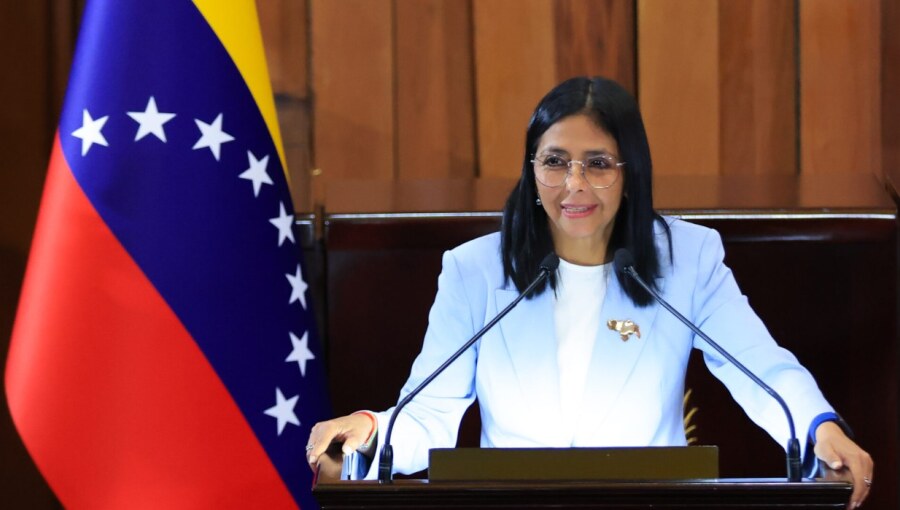
Venezuela's interim president Delcy Rodriguez, who stepped into Maduro's shoes after his toppling in a deadly American military operation a month ago, has made deals on oil and other topics with US President Donald Trump's administration.
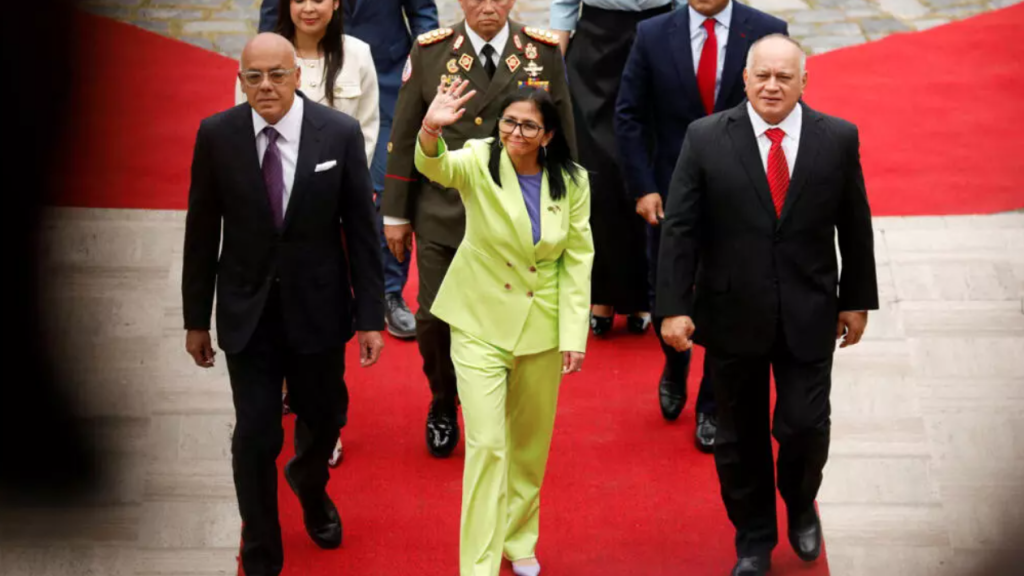
Pro-government workers also demonstrated, while calling for Maduro's release
Last week, lawmakers passed reforms to reopen Venezuela's nationalized hydrocarbons industry to private players, a move immediately reciprocated with a loosening of US sanctions.
Promising better days ahead for her long-suffering compatriots, Rodriguez has ploughed $300 million from a first US sale of Venezuelan crude into shoring up the country's ailing currency, the bolivar.
At a separate demonstration, which also gathered outside the Supreme Court, pro-regime workers called for Maduro's release from a New York jail cell, where he is awaiting trial on drug-trafficking charges.
But they also submitted a 10-point plan for the urgent improvement of workers' financial plight.
"We have the opportunity, through negotiations with oil companies, the reform of the Hydrocarbons Law, and a renewed national dialogue, to achieve economic recovery and wage growth," said their representative, Oliver Rivas.
Police separated the two groups to prevent any confrontation, which was limited to an exchange of slogans.
Oil exports from Venezuela have surged upwards since the end of the U.S. embargo and the capture of former dictator Nicolas Maduro. Under American management, oil cargoes rose to 800,000 bpd in January, up from about 500,000 bpd under U.S. Navy blockade in December.
Vitol and Trafigura reportedly reached an arrangement to buy the initial surge of bottled-up oil at Venezuela's loading terminals and anchorages, and the work of shipping it is proceeding. Two additional trading houses, Mercuria and AD Commodities, have filed papers to get U.S. Treasury licenses for the trade, reports Bloomberg.
According to Secretary of State Marco Rubio, the arrangement with commodity traders is temporary, and the U.S. wants to normalize Venezuela's oil export industry in the long run. The Office of Foreign Asset Control last week opened up a general license for oil trade with Venezuela for existing U.S. entities, so long as the payments are moved into designated U.S. Treasury accounts. Transactions involving counterparties in Russia, Iran, North Korea, Cuba or China are still prohibited.
There are unanswered questions about China's access to the market: U.S. officials have said that Maduro's ouster was motivated in part by a desire to deny China a foothold in South America, and that excluding China would be a priority going forward. So far, per Bloomberg, Chinese-linked entities have not been given a Treasury license to buy from Venezuelan state oil company PDVSA, and U.S. companies are still prohibited from buying from Chinese-Venezuelan oil E&P venture PetroSinovensa.
Part of the process of unwinding the bottled-up crude is in offloading sanctioned tankers and sending the oil out to normal buyers, not just commodity trading houses with a higher appetite for risk. On Monday, tanker Folegandros got underway from Venezuela, bound for an unknown European destination, and an LPG tanker departed Venezuela for the U.S. East Coast - both signals of a normalized international trade.
Proceeds of the initial sales were routed to a bank account in Qatar, an unusual arrangement that Secretary of State Marco Rubio has described as a short-term workaround to avoid legal exposure. Venezuela's government owes about $150 billion to U.S. and foreign creditors, and funds landing in an American bank account would be vulnerable to court seizure for unpaid debts. But Venezuela needs that money immediately to pay public servants' salaries, Rubio said. The executive order that outlines the Venezuelan oil sales plan, EO 14373, specifically points to “the possibility of attachment or the imposition of judicial process” in the U.S. court system as a foreign policy problem, and sets up a mechanism for Treasury-managed accounts within the U.S. for Venezuelan oil funds (as referenced by OFAC last week). But until that mechanism is finalized, Rubio said, the Qatari bank account is a fast way to conduct transactions and get Venezuela's oil industry working again.
Lawfare notes that there is an additional consideration: it is very hard for the administration to protect the funds against attachment for court judgments related to terrorism cases. Venezuela had ties to several designated terrorist organizations, including FARC, Tren de Aragua and others. Some of these groups are vulnerable to court judgments in the hundreds of millions of dollars - and Venezuela's oil funds could potentially be seized by the plaintiffs in these cases if the money were within U.S. jurisdiction.
Venezuela's new government proposes amnesty for political prisoners
“This law will serve to heal the wounds left by political confrontation, fuelled by violence and extremism. It will allow us to put justice back on track in our country,” Delcy Rodríguez said.
Venezuela's acting president Delcy Rodríguez has announced plans to introduce legislation granting amnesty to political prisoners detained since 1999, in yet another major policy shift following the recent ousting of Nicolás Maduro by US forces.
Rodríguez unveiled the proposal during the opening ceremony of the judicial year at Venezuela's Supreme Court of Justice on January 30, stating the measure would cover individuals imprisoned throughout the period spanning both the Hugo Chávez and Maduro administrations.
The interim president said she had instructed the Judicial Revolution Commission and the Programme for Coexistence and Peace to submit the legislation to the National Assembly within hours, calling for swift legislative approval.
"This law will serve to heal the wounds left by political confrontation, fuelled by violence and extremism. It will allow us to put justice back on track in our country," Rodríguez said during the ceremony, which was broadcast on state television.
The proposed amnesty would exclude individuals prosecuted or convicted for murder, narcotics trafficking, and human rights violations, according to Rodríguez.
According to the non-governmental organisation Foro Penal, Venezuela currently holds 711 political prisoners, though successive governments have denied detaining individuals for political reasons.
Foro Penal responded to the announcement with measured optimism whilst urging the law encompass all political prisoners and persecuted individuals in Venezuela.
"We hope that this step will contribute to justice, freedom, peace and national reconciliation," the organisation stated, according to Efecto Cocuyo.
The group, led by Alfredo Romero and Gonzalo Himiob, outlined six essential requirements for the legislation, including active participation of civil society and victims in drafting and implementation, clear constitutional compliance excluding human rights violators, and guarantees against recurrence of violations.
Foro Penal called for international human rights bodies to assist in formulating and monitoring the law's application, whilst emphasising that prisoner releases should continue during the legislative process.
The announcement follows years of advocacy by civil society groups for comprehensive amnesty legislation. Most recently, the Surgentes organisation and the Mothers for Truth Committee submitted a 12-article draft law addressing post-electoral political persecution.
Venezuela's last amnesty law was enacted in December 2007, when then-president Hugo Chávez pardoned individuals involved in a 2002 coup attempt. A 2016 amnesty law passed by the opposition-controlled parliament was ruled unconstitutional by the Supreme Court and never implemented.
Rodríguez, who became acting president following Maduro's capture in a US military operation on January 3, has moved rapidly to implement reforms under US pressure. In recent weeks, her administration has opened Venezuela's oil sector to private investment and agreed to release prisoners designated as political detainees by human rights organisations.
Venezuelan opposition leader María Corina Machado, a Nobel Peace Prize laureate, played down the amnesty proposal as responding to American pressure rather than representing a genuine policy change.
"This is not a voluntary gesture by the regime, but a response to pressure from the United States government," Machado wrote on social media.
Opposition lawmaker Tomás Guanipa, whose two brothers remain imprisoned, expressed cautious optimism that the measure could end "an era of repression".
US Secretary of State Marco Rubio has described relations with Rodríguez's administration as "productive" despite warning she could face Maduro's fate if she fails to meet American demands. Rubio told the Senate foreign relations committee last week that the US was seeing its first opportunity in over a decade to change conditions in Venezuela, though he cautioned against expecting rapid democratic transformation.
Following a call last month, President Donald Trump himself has lauded Rodriguez as a “terrific person” with whom “we are making tremendous progress as we help Venezuela stabilise and recover.” Meanwhile, the post-Chavista government is walking a political tightrope at home, balancing US pressure with the need to avoid appearing to have capitulated to what Venezuelan socialists have long slammed as imperialism.
The amnesty announcement coincided with Rodríguez's revelation of plans to close the notorious El Helicoide prison in Caracas, which human rights organisations have documented as a site where intelligence services tortured political prisoners under Maduro. The facility, originally constructed as a shopping centre, will be converted into a sports, cultural and commercial centre, she said.
The United States has responded to recent Venezuelan policy changes by lifting sanctions on the country's oil industry and removing restrictions on commercial flights. Washington is also preparing to restore its diplomatic presence in Caracas, with charge d'affaires Laura Dogu expected to arrive this week.
New head of US mission in Venezuela arrives as ties warm
The new head of the US diplomatic mission for Venezuela, Laura Dogu, arrives at Venezuela's Maiquetia International Airport on January 31, 2025 - Copyright US Embassy / Venezuela Affairs Unit/AFP Handout
The new head of the US diplomatic mission to Venezuela arrived in the country on Saturday and was welcomed by the South American country’s foreign minister, as relations gradually warm after the ouster of Nicolas Maduro in a US military raid.
“I just arrived in Venezuela. My team and I are ready to work,” Laura Dogu said in a post in Spanish on the US Embassy of Venezuela’s X account, accompanied by photos of her disembarking a plane.
Dogu, a former ambassador to Nicaragua and Honduras, was named last week as US charge d’affaires in Venezuela. A charge d’affaires is the head of a diplomatic mission in the absence of a full ambassador.
Venezuelan Foreign Minister Yvan Gil received Dogu after her arrival.
Their meeting was part of an effort by Caracas to “define a roadmap on questions of bilateral interest” and address existing differences via diplomacy, the foreign ministry said in a statement.
The United States has already sent a mission to assess the embassy in Caracas, which has been largely unoccupied for the past six years.
It was shuttered in 2019 shortly after Washington and other major powers declared Maduro to be illegitimate following a flawed election. Maduro then severed diplomatic relations with Washington.
US forces attacked Venezuela on January 3, capturing Maduro and his wife Cilia Flores and taking them to New York for trial on US-issued drug trafficking charges.
President Donald Trump says he is now running Venezuela and has allowed Maduro’s vice president Delcy Rodriguez to be interim leader so long as she toes Washington’s line — in particular granting US access to Venezuela’s vast oil reserves.
Since 2019, the US embassy has been largely deserted other than a few local employees.
Since last year, a charge d’affaires for Venezuela, John McNamara, has been based in neighboring Colombia.
McNamara travelled with other US diplomats to Caracas days after Maduro’s ouster to assess “a potential phased resumption of operations” at the embassy.
Trump has said he was working “really well” with Rodriguez, and a US official has said Rodriguez would visit the United States soon.
Reforms in her first month at the helm of the country have included a proposal for mass amnesty, plans to close the country’s notorious El Helicoide prison in Caracas, and passing a new law opening up the country’s oil sector to private investments.
US authorities on Friday announced that all Americans known to be held prisoner in Venezuela had been released.
For years, Venezuela has routinely arrested foreigners and domestic opposition actors on a range of charges from spying to plotting attacks — charges critics dismiss as fabricated.
The Foro Penal rights group counts more than 700 political prisoners in Venezuela. Many of them are held at El Helicoide, which has been denounced as a torture center by the opposition and activists.
Rodriguez has ordered it converted into a “social, sports, cultural and commercial center.”
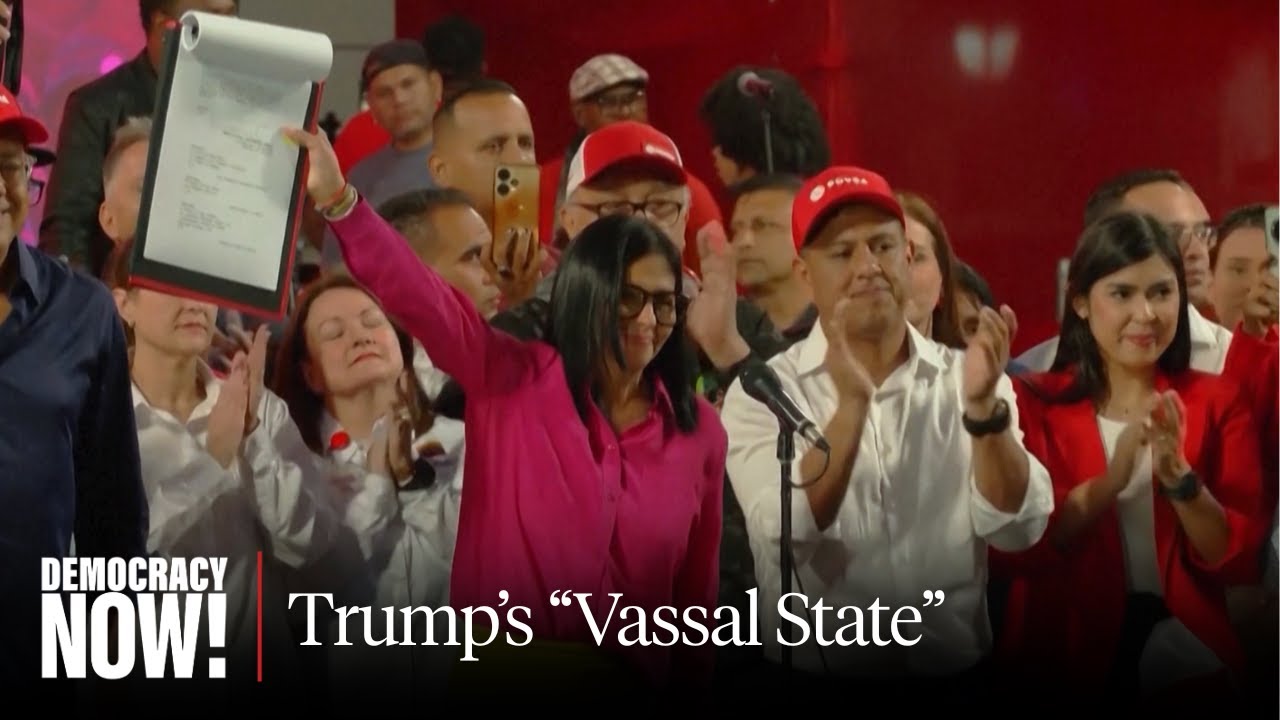
“Hostile Takeovers”: As U.S. Claims Venezuela's Oil, Trump Seeks “Vassal States” Across the World
In the aftermath of the abduction of Venezuelan President Nicolás Maduro and his wife Cilia Flores, Venezuela has agreed to submit a monthly budget to the Trump administration, which will release money from an account funded by oil sales. It’s a deal for the interim government led by Delcy Rodriguéz that historian Greg Grandin calls “governing under the blade.” In a further shift away from the nation-building foreign policy of the past several decades of U.S. power, “what the United States is planning for Venezuela is basically to run the country as a vassal state,” he says. “This is an arrangement with transactional details that we’ve never seen before.”
Transcript
This is a rush transcript. Copy may not be in its final form.
AMY GOODMAN: We begin today’s show looking at the Trump administration’s tightening grip on Latin America and the aftermath of the abduction of the Venezuelan President Nicolás Maduro and his wife Cilia Flores. On Thursday, Venezuela’s interim leader, Delcy Rodríguez, signed a law that will open Venezuela’s oil industry to privatization, reversing a key principle of the Chavista movement that’s persevered in Venezuela for more than two decades. This is Delcy Rodríguez speaking from Caracas.
INTERIM PRESIDENT DELCY RODRÍGUEZ: [translated] In this law is President Nicolás Maduro’s vision for the future, because there are those who think we pulled this law out of nowhere. No, we had already studied this law, its reform, together with President Maduro. I feel moved to be able to tell him from Caracas, his birthplace: President Maduro, we are delivering for you. We are delivering for the first combatant Cilia Flores. And we are delivering for the people of Venezuela.
AMY GOODMAN: Soon after the legislation was signed, the Trump administration lifted some sanctions on Venezuela to facilitate access to the country’s crude oil reserves for U.S. companies to buy, sell and store. President Trump also said Thursday the United States plans on opening up Venezuela’s airspace. Trump spoke following a Cabinet meeting yesterday.
PRESIDENT DONALD TRUMP: And I just spoke to the president of Venezuela, informed her that we’re going to be opening up all commercial airspace over Venezuela. American citizens will be very shortly able to go to Venezuela, and they’ll be safe there. … We have the major oil companies going to Venezuela now, scouting it out and picking their locations.
AMY GOODMAN: This all comes as President Trump Thursday signed an executive order that would impose tariffs on goods from countries that sell or provide oil to Cuba, as Trump intensifies efforts to topple the Cuban government. The move appears to be intended to put pressure on Mexico, which has been an oil lifeline for Cuba as the Island has been devastated by decades of U.S. economic sanctions. Trump said Thursday, quote, “Cuba will not be able to survive,” unquote. Meanwhile, the Financial Timesreports Cuba only has about 15 to 20 days left of oil.
For more on this and other issues, we’re joined by Greg Grandin, Yale University history professor, Pulitzer Prize-winning author, whose latest book is America, América: A New History of the New World, his recent op-ed in The New York Times headlined “Trump Picked the Right Stage to Act Out His Imperial Ambitions.”
So, we last spoke to you, Professor Grandin, when Maduro and his wife were abducted. They’re sitting not far from here in a Brooklyn detention center, expected to be in court, I believe, in March.
GREG GRANDIN: March, yeah.
AMY GOODMAN: But talk about what’s happening now. It surprised many when the Mexican President Claudia Sheinbaum announced that Mexico would be cutting off oil supplies, but then she had to clarify her comments. I want to see if we can go to a clip of President Sheinbaum talking about exactly what Mexico would be doing.
PRESIDENT CLAUDIA SHEINBAUM: [translated] It is Mexico’s sovereign decision to send humanitarian aid, and Pemex fulfills its obligations under the contract once it ships. I never said it had been suspended. It had not been suspended. That was a later interpretation based on a newspaper article. Therefore, humanitarian aid to Cuba, as to other countries, continues.
AMY GOODMAN: So, it’s not exactly clear what she’s saying there, that oil for humanitarian reasons would continue. But if you can explain what’s happening and the connection between — it’s something you’ve long said — Venezuela and Cuba, especially U.S. Secretary of State Marco Rubio, the Cuban American’s complete focus?
GREG GRANDIN: Yeah, well, just to put it into larger context, I mean, Trump came into power saying, with a kind of buffoonish change of the name of the Gulf of Mexico to the Gulf of America, and within a year, he had launched this campaign of chaos and murder, in terms of the speedboat operators and pilots, over a hundred dead, and then — you know, and then this fast strike into Venezuela. And he built up a military naval presence in the Caribbean that is still there. It hasn’t wound down since the kidnapping of Maduro. So the pressure is still on Venezuela, because Delcy Rodríguez, as Marco Rubio said the other day, is basically governing under the blade. You know, she could be in fear of — you know, he’s basically threatened to take her out if they didn’t — if they’re not happy or satisfied with the level of cooperation that they’re showing.
AMY GOODMAN: She’s the interim president.
GREG GRANDIN: Yeah, she’s the interim —
AMY GOODMAN: Yet President Trump already tweeted that he was the interim president.
GREG GRANDIN: Yeah, right.
AMY GOODMAN: President Trump himself.
GREG GRANDIN: Right. So, basically, what we’re seeing is a kind of new form of imperialism, where Trump is treating these countries like hostile takeovers, where — you know, whether it be Venezuela, whether it be Gaza, whether it be Haiti, whether it be Libya. These are all kinds of — in which these countries go into receivership. And Venezuela really is the most striking example, because it was — it’s a big country. In the past, in the 19th century and early 20th century, the United States would take over the customs house of the Dominican Republic or something like that. But what the United States is planning for Venezuela is basically to run the country as a vassal state, basically giving it an allowance, taking its revenues, approving its budget. The money is going to be deposited in some fund in Qatar. This is an arrangement with kind of transactional details that we’ve never seen before.
And yes, oil is key to it in terms of isolating Cuba — or, oil as a weapon, not oil as profit, oil as a way of isolating Cuba, because Venezuela, in the mind of Marco Rubio and the greater Florida constituency within the Republican coalition, wants the end of the Cuban Revolution. They want regime change in Cuba. And it seems like Trump has openly stated that that’s the next goal. And they’re putting pressure on Mexico to cut off oil to Cuba, and it seems like Mexico is caving to that pressure. Whatever Claudia Sheinbaum has said, the fact of the matter is that oil, the Mexican oil, has been dropping, has been decreasing, that it’s been exporting and transporting to Cuba over the last couple of months. So she’s under enormous pressure. And Cuba does have, apparently, a few weeks without oil, and it has very few friends. Brazil is not helping. Carney in Canada, for all of the strong words in his speech at Davos, they’re not saying anything about this action in the Western Hemisphere. It’s really a — it’s really criminal. It’s just straight-out criminal activity.
AMY GOODMAN: Why criminal?
GREG GRANDIN: Because it’s based on no international law. When the United States says that Venezuela has sanctioned oil, that’s just the United States asserting it. It’s not — it’s not ratified by any international body.
AMY GOODMAN: I wanted to go to new information, the Trump administration reportedly planning to establish a permanent CIA presence on the ground in Venezuela following the abduction of President Maduro. That’s according to CNN, which spoke to several anonymous sources that outlined talks between the State Department and the CIA have weighed short- and long-term schemes to foster U.S. influence in Venezuela. One source told CNN, quote, “State plants the flag, but CIA is really the influence.” CIA officers were in Venezuela in the months leading up to the U.S. military strike targeting Maduro and his wife. The agency covertly installed a small team inside Venezuela in August to surveil Maduro, providing key intelligence for the attack on Caracas earlier this month. One CIA source reportedly operated within the Maduro government.
GREG GRANDIN: Yeah, well, we could assume that in the Rodríguez government, the CIA is interpenetrated on all levels. I mean, the CIA has a presence in Latin America. That’s not new. Every embassy has CIA staff operating out of the basement office. But this is envisioning an upscaling of the objective, of the mission of the CIA. It’s basically turning the CIA into a colonial office, you know, how to run an informal empire.
AMY GOODMAN: Let’s go to Secretary of State Marco Rubio Wednesday refusing to rule out further U.S. attacks on Venezuela. His threat came during his testimony before the Senate Foreign Relations Committee, where he told lawmakers that Venezuela’s interim government has agreed to submit a monthly budget to the Trump administration, which will release money from an account funded by oil sales and initially managed by Qatar.
SECRETARY OF STATE MARCO RUBIO: On the third point of use of force, look, the president never rules out his options as commander-in-chief to protect the national interests of the United States. I can tell you right now with full certainty, we are not postured to, nor do we intend or expect to have to, take any military action in Venezuela at any time. The only military presence you will see in Venezuela is our Marine guards at an embassy.
AMY GOODMAN: Greg Grandin?
GREG GRANDIN: Well, and they haven’t drawn down the naval presence. About a 10th of the naval fleet is in the Caribbean, you know, doing — you know, both threatening Mexico, threatening Venezuela and isolating Cuba. So, they have many more ships in the Caribbean than they have in the Persian Gulf going into Iran. Again, this is a new form of — this is some kind of weird hybrid of imperial — informal imperial rule. It’s kind of like — it’s kind of like the hostile takeovers of nations and turning them — and putting them in receivership, in which the United States takes the power to administer the funds, to run them transactionally, but not take any responsibility.
But the idea of nation building, of course, it’s not something that Trump ran on and his base is against. But this really kind of obliterates the idea of national sovereignty and the idea of citizenship. This is turning millions of people, Venezuela’s population — but again, it’s not just Venezuela — Venezuela, potentially Cuba, Gaza, Libya and so on, into interdependencies, you know, and kind of a new vassal — kind of technovassal imperialism.
AMY GOODMAN: I wanted to also ask you — a really, really unusual report. Atlantic magazine recently published an article headlined ”MAGA Thinks Maduro Will Prove Trump Won in 2020.” The article quotes MyPillow founder Mike Lindell saying, quote, “I’m hoping now that Maduro will actually come clean and tell us everything about the machines and how they steal the elections,” unquote. Some have speculated Trump could pardon Maduro in exchange for him stating that Venezuela interfered in the 2020 election, even though no evidence of that exists. And it might also explain why, when the FBI raided the election office this week in Georgia’s Fulton County, seeking computers and ballots related to the 2020 election, inexplicably, the head of national intelligence, Tulsi Gabbard, who would be dealing with international issues, was there.
GREG GRANDIN: Yeah, apparently Tulsi Gabbard is going to be in charge of making the case that the 2020 election was rigged, drawing on all sorts of evidence. And there’s long been a conspiracy that the voting machines had — I’m not exactly sure, but there were some Venezuelans that were invested in the company that ran the machines. I don’t know the details.
But, I mean, anything could happen. Look, Trump pardoned Juan Orlando Hernández, who was convicted of drug running — he was former president of Honduras — basically as part of a deal to bring the conservative party in Honduras to power, to overthrow the left, and in alliance — if you read — there’s a great op-ed in The New York Times yesterday by Jean Guerrero about, basically, the MS-13 — Trump — were acting as election monitors, basically threatening people to vote for the conservative party or be killed.
AMY GOODMAN: Who Trump endorsed.
GREG GRANDIN: Right.
AMY GOODMAN: And again, just to make that point, as Trump says that Maduro is sitting in this Brooklyn jail because he is a narcotrafficker —
GREG GRANDIN: Yeah.
AMY GOODMAN: — that President Trump pardoned Juan Orlando Hernández, the former president of Honduras, who was sentenced to something like 45, 46 years in prison for bringing in 400 tons of drugs into the United States.
GREG GRANDIN: Yeah. So, you could imagine — I mean, who knows? But you could imagine some deal being worked out with Maduro where he makes some statement. I mean, the point is just to flood the zone — right? — to create confusion, to raise the idea that the election was stolen. And this is a way of setting up to discredit whatever comes in the midterms and whatever comes next presidential elections.
AMY GOODMAN: Well, we will continue to talk —
GREG GRANDIN: I mean, but there is one thing: The oil wasn’t privatized. I do just want to make this point very quickly. The privatization in Venezuela happened in the 1970s, and the law that was passed yesterday doesn’t reverse that. What it does is it moves any kind of arbitration to international courts. It’s what oil companies want. It gives oil companies better control over their operations. And it reduces the amount of royalties and taxes that Venezuela would charge on oil. But it doesn’t quite privatize. Oil remains considered part of Venezuela’s national patrimony, so that will still be a point of contention in future Venezuelan politics.
AMY GOODMAN: I want to thank you for being with us, Greg Grandin, Yale University history professor, Pulitzer Prize-winning author, his latest book, America, América: A New History of the New World. We’ll link to your piece in The New York Times, “Trump Picked the Right Stage to Act Out His Imperial Ambitions.”
Coming up, the families of two Trinidadian men are suing the Trump administration for wrongful death. The men were killed by the U.S. in a military strike that the U.S. engaged in, in a boat in the Caribbean. But first up, a premiere of a song by Billy Bragg.
[break]
AMY GOODMAN: That’s “City of Heroes,” a tribute to anti-ICE protesters in Minneapolis by the British folk singer Billy Bragg, the song written and released in response to the murder of Alex Pretti. In a note accompanying the release, Billy Bragg said, quote, “That these crimes can be committed in broad daylight, on camera and yet no one is held accountable only adds to the injustice.” We’ll play more of his song later in the broadcast.
On January 3, the United States bombed Venezuela and kidnapped president Nicolas Maduro and his wife, Cilia Flores. More than 100 people were killed in the attack.
In the preceding months the US had increased its attacks and threats against Venezuela and other Latin American countries, particularly Colombia.
Warships, planes and troops were moved into the Caribbean. The Venezuelan government was accused of “narco-terrorism”. Numerous small boats were sunk in the Caribbean near Venezuela and in the Pacific near Colombia. Their crews, accused without evidence of being drug traffickers, were murdered.
The US warned passenger planes not to enter Venezuelan airspace. US warships imposed a naval blockade.
The US has long been hostile to the Venezuelan government, both under Hugo Chavez who was president from 1999 until his death in 2013 and under his successor, Maduro. US policy has included attempted coups, economic sanctions and military threats.
The sanctions aimed to restrict Venezuela's trade with other countries. The US tried to prevent companies from having any dealings with the Venezuelan government, unless granted an exemption by the US government. If a non-US company defied this edict, it was threatened with retaliation by the US. The sanctions amounted to an economic blockade.
But since this was not totally effective, the US began using its military forces to impose a naval blockade.
The purpose of the economic blockade had been to create an economic crisis and extreme hardship in Venezuela, in the hope that this would weaken popular support for the government and enable its overthrow. While succeeding in causing hardship, it failed to overthrow the government.
Now the US is using military aggression and a naval blockade to coerce the Venezuelan government into making economic concessions to US capital.
The US has also made threats against Colombia, which has been led since 2022 by leftist president Gustavo Petro.
Why is the US hostile to Venezuela?
There were several reasons for US hostility to the Maduro government.
The US wants to control Venezuela's oil and other natural resources. In 2007 Chavez nationalised the assets of those foreign oil companies that refused to restructure in such a way as to give PDVSA (the state oil company) majority control. While Chevron agreed to comply, and was able to remain in Venezuela, some other companies such as Exxon did not. Chevron remained in Venezuela, but its joint venture with PDVSA controlled only a minority of Venezuela's oil production. Before the imposition of the naval blockade, most of Venezuela's oil exports went to China.
The US wants to install a government that will support US foreign policy. Maduro has condemned US foreign policy, particularly its support for Israel's genocide in Gaza. Venezuela developed strong links with Russia, China and Iran. Economically, the US economic blockade made it necessary for Venezuela to find alternative trading partners. Militarily, the fear of US aggression led Venezuela to acquire Russian weapons, including anti-aircraft systems (which proved ineffective on January 3).
Under Chavez, the Venezuelan government carried out some progressive social policies. It used oil revenue to fund programs in health care, education, housing etc. Chavez also encouraged the formation of communes. He said they should become the starting point for a new kind of state. These policies represented an alternative to the neoliberal model promoted by the US. The blockade undermined many of these gains. For example, the blockade makes it more difficult for Venezuela to get medicines, vaccines and medical equipment from the US and its allies, or companies intimidated by US threats.
Concessions to capitalism
The Maduro government, while claiming to be socialist, made many concessions to the capitalist class. These were defended as necessary in the context of the blockade.
For example, the US bans foreign companies from trading with Venezuelan state institutions, unless granted an exemption. If a Venezuelan state body, such as PDVSA, wished to import equipment or export oil, it often had to use a private company as an intermediary. Of course, the private company wants to make a profit, so the cost of imports is increased and the revenue received by the Venezuelan government from exports is reduced. In addition, the secrecy associated with such arrangements facilitates corruption.
The government also had political reasons for making concessions to the capitalist class. Maduro called for national unity against the threat of a US invasion. This implied some degree of cooperation with that section of the right-wing political opposition that is not totally subservient to US Imperialism.
As a result of these economic pressures and political considerations, there was a tendency towards privatisation of some government functions. However, some key industries remained under state ownership (PDVSA).
One aspect of the Maduro government's policy, which is often criticised, is the near-zero minimum wage. The value of the Venezuelan currency was cut to near zero by hyperinflation, but the minimum wage was not adjusted to compensate. On the other hand, many government services are subsided and low wages are supplemented by bonuses.
Some Venezuelan leftists describe the Maduro government as neoliberal. Others, while unhappy with what they saw as excessive concessions to capitalism, saw the government as progressive, often referring to its support for the communes as evidence.
Andreina Chavez, a former writer for Venezuelanalysis.com, wrote in 2024:
A lot of people like me are not entirely happy with the government’s liberal overtures in the name of circumventing the US blockade that moves away from the socialist alternative. We have felt ignored when making criticisms or requesting information regarding salaries, socioeconomic data, and the real state of healthcare, education and the electrical system and what investment is going (if any) into them. We don’t want to surrender our country to the US, but we also need guarantees about the next six years if Maduro wins. Will the government continue trapped in its echo chamber? Will they weed out the opportunists and corrupt? Will the socialist project be revitalized?
But while criticising the Maduro government, Chavez Alava supported Maduro's re-election. She said the right-wing opposition supported extreme neoliberal policies and would make Venezuela a “US client state”, whereas the Maduro government stood for “sovereignty” and the “construction of socialism” (however imperfectly it was pursuing this latter goal). She placed great importance on the building of communes, with government support.
Other progressive policies included the government's housing program, subsidised services such as electricity and public transport, and subsidised food distribution.
William Serafino, another Venezuelan leftist, criticises the claim Maduro was a neoliberal. He writes:
If Maduro were a full-fledged neoliberal, the Petróleos de Venezuela SA (PDVSA), the basic enterprises, the Caracas Metro, the electricity, telecommunications, and water supply companies — just to mention a few cases — would already be in the hands of the private sector.
Public banks, for example, would represent a small fraction of the national banking sector, which would be dominated almost entirely by private bankers. At the regulatory level, there would be no restrictions such as reserve requirements or public orientation of credit portfolios.
Likewise, tax collection policies would be reduced to a minimum. This pattern would be reproduced in every sector of the economy.
Clearly, none of this has happened or is close to happening in Venezuela, so the narrative that Maduro is neoliberal is flawed in its general premise....
It is an absurd contradiction to qualify a government as neoliberal if it has a wide range of taxes to strengthen its revenue collection, sustain subsidies to public services, and a massive food program: the CLAP, whose acquisition cost for the population is far below market prices. It is simply nonsense to call this neoliberalism. In fact, it is the opposite of neoliberalism.
Undemocratic?
Maduro was criticised as undemocratic. For example, left-wing parties, such as the Communist Party of Venezuela, that are critical of the Maduro government were excluded from participating in the 2024 presidential election.
The government was also accused of falsifying the results of the 2024 presidential election. I do not think this is true (and have addressed this issue elsewhere).
There are restrictions on the right to strike. This is common in wartime. The blockade is like an economic war.
Conclusion
Venezuela under Maduro presented a mixed picture. There were progressive policies, but also concessions to capitalism, and restrictions on democratic rights.
Was it socialist? Leon Trotsky argued there can be no socialism in a single country, isolated in a capitalist world. A revolutionary government can take steps in a socialist direction, but the pressures of a capitalist environment produce tendencies towards state bureaucratisation. Only the international spread of the revolution can prevent this.
The imperialist blockade is a major reason given by the Venezuelan government for its concessions to capitalism. Some leftists argue this is merely a pretext, not the real reason. In either case, ending the blockade is essential. If it is a pretext, then depriving the government of that pretext would make it easier for Venezuelan leftists to argue for socialist policies.
Today, Acting President Delcy Rodriguez is in a difficult position. Venezuela is under a naval blockade that prevents it from exporting oil without US permission. It is also threatened with renewed bombing if Rodriguez defies Trump's demands.
Under these circumstances, any agreement reached between Venezuela and the US will be extremely unfair. If Venezuela refuses to sign a bad agreement, the US will continue the blockade and Venezuela's oil industry will be shut down.
Should we condemn Rodriguez if she signs a bad agreement? For those outside Venezuela, such a condemnation would be pointless. Our task is to build a movement opposing the US blockade.
The 1918 Brest-Litovsk treaty between Germany and Russia's new Soviet government was unfair, but Lenin advised the Bolsheviks to sign it. The treaty became irrelevant later that year when the German government was overthrown by a popular uprising.
The blockade on Venezuela can only end through political change in the US. Movements opposing the Trump regime can contribute to such a change. We need a strong movement opposing US attacks on Latin America, including the blockade of Venezuela.
US imperialism, Madurismo without Maduro and Venezuelan sovereignty after January 3
The US government’s January 3 military assault on Venezuela and kidnapping of then President Nicolás Maduro and National Assembly deputy Cilia Flores, sent shockwaves through the region. It has also sparked intense discussions about why and how it was able to occur, what the new Delcy Rodríguez government represents and what it all means for Venezuelan sovereignty.
How do you interpret the US military actions that, after deploying warships throughout the Caribbean for several months, culminated in a military assault on Caracas and Maduro and Flores’ kidnapping? Is this simply about gaining control of Venezuela’s oil?
Obviously, the military intervention relates to oil, because everything concerning Venezuela relates to oil. But it is a bit more complex, because two things converged: the Venezuelan crisis and Trump’s foreign policy. Venezuela’s long depression, the political crisis, and the externalisation of national politics by the political class — both the Madurista (Maduro-aligned) ruling elite and the opposition elite — ultimately led to an externalisation of their conflict. The weakening, over so many years, of the sources of national power — economic, political, institutional, military, and cultural — resulted in the most humiliating political and military episode ever in the country’s history as a republic.
This weakening of the Venezuelan nation made it appealing for Trump to intervene. First, because he was acting against a government with no social support base, and lacking any rational or legal legitimacy. The US knew the Venezuelan people would not defend Maduro, and this weighed heavily in their decision. They intervened against an unpopular head of state with no democratic legitimacy.
Second, because the country’s political institutions were utterly illegitimate in legal terms and severely weakened in their capacity to wield real power — as shown by the reaction to the military operation. And third, because the Maduro government, being weak and having undermined national power over many years to cling to power for its own sake, was an easy target for the US to begin leveraging its entire foreign policy toward Latin America.
We can add that the Venezuelan political class doubled down on externalising the conflict, believing Trump would arbitrate in good faith in favour of one of the parties without later demanding a tribute. There we see the moral, ethical and, above all, strategic character of the various factions of the Venezuelan political class. If responsibility must be assigned to the catastrophic outcome of this systemic crisis, it is precisely the Venezuelan political class, both the Maduristas and the opposition, who must be blamed.
This weakening of the nation was exploited by the “foreign sentinel," which now seeks to leverage economic and political advantage. They will find a way to make Venezuela pay tribute — because that is the word that best describes the situation, Venezuela is tributing [paying as an acknowledgment of submission]. Venezuela will pay dearly for this weakening of the nation and the errors of its political class.
Here, oil is crucial to US plans to profit from its intervention through the payment of imperial tribute. The Venezuelan people will unfortunately pay dearly, in the face of territorialism and Trumpian neo-mercantilism, for our inability to resolve the overall state crisis on our own. We will pay with oil, but also with dependency and a loss of popular and national sovereignty over our immediate future.
But Trump was negotiating with the Maduro government, as we saw with Trump’s special envoy Richard Grenell's visit to Caracas. Why not simply accept Maduro's offer to hand over Venezuela's resources in exchange for remaining president?
It is clear that at a certain point Trump changed his mind and no longer believed Maduro was a credible negotiating partner. That point came when Grenell was removed from the negotiations. Trump realised Maduro could not be trusted; Maduro was no longer the “strongman” in Caracas for the US if he was willing to give up everything to stay in power. By offering everything to the US, Maduro also lost his credibility with Russia and China. Secretary of State Marco Rubio even said in an interview that Maduro’s “broken every deal he’s ever made.” Maduro ceased to be the person the US thought it could leverage its policy of “outward regime change” or geopolitical realignment, as it is known in international relations terms.
When Trump withdrew Grenell, we all assumed — or at least I did — that the US was going to take military action in Venezuela. In military terms, it was very similar to what happened with Russia and Ukraine: this military buildup was not intended, as some analysts suggested, to force an internal rupture within the regime, etc. If that had happened, it would have been the icing on the cake for Trump. The US was going to take military action. The debate was over the form this would take and what the aftermath would look like.
Simply put, Maduro lacked the national and international credibility to carry out this geopolitical realignment. Credibility is highly valued in international politics, and Maduro’s was practically nonexistent, much like his rational-legal legitimacy.
You said Venezuela was seen as an easy target for the US to begin leveraging its entire policy toward Latin America. What role is Venezuela playing in Trump’s foreign policy?
When Trump changed his mind, he began to leverage Venezuela as the basis for his now maximalist policy toward Latin America. The target was no longer just Venezuela. He enacted some completely irrational policies, for example, including Gustavo Petro, Colombia’s popular and legitimately elected president, on the Clinton List [of individuals sanctioned for alleged involvement in drug trafficking and money laundering]. Constant threats of “terrestrial” military interventions in Mexico have also begun, along with open electoral interference to support candidates aligned with what we might call the MAGA International, particularly in Honduras and Argentina.
Venezuela became the lever for a much more maximalist policy toward Latin America. That policy is reflected in the White House’s National Security Strategy and reactivation of the Monroe Doctrine, with its “Trump corollary” that represents a pivotal moment in terms of US grand strategy. Behind this Monroe Doctrine reactivation lies an entire school of geostrategists, from Nicholas Spykman to Robert J Art, who view territorialism in Latin America as essential in a moment of global or hegemonic conflict.
According to this territorialism, North and South America possess the resources that the US needs to survive a major global confrontation, which would inevitably disrupt the world market. The “Trump corollary” represents precisely a return to territorialism, where the US, by controlling the Western Hemisphere, can afford a major global conflict without becoming isolated or falling into a general depression due to supply chain disruptions.
That is why we have gone from the Barack Obama administration’s “Pivot to Asia” to Trump’s “Pivot to Latin America.” Latin America is going to pay the price for the empire’s decline and its withdrawal from Europe and, above all, Asia. Venezuela offered the Trump administration a weakened opponent, with little military capacity and internationally discredited, on which to leverage a policy of reorganising Latin America according to the MAGA worldview. Venezuela’s weakening under Maduro offered the US a wide range of low-cost victories.
Ideologically, it offers the defeat of socialism, notwithstanding Maduro’s regime being socialist in name only. Militarily, it offers a demonstration of firepower and persuasion. Geopolitically, it is a power move at the table of great powers, something Washington was eager for. Economically, it offers a substantial oil windfall for the US state and the corporations that financed Trump’s campaigns.
There was a lot of talk about regime change. But in the end, power remains in the hands of those who were in power with Maduro. How can we understand this situation?
I wrote an article about the concept of regime change recently. In The Long Venezuelan Depression, I said that the sanctions imposed by the Trump 1.0 administration failed to achieve regime change from above, but absolutely succeeded in achieving regime change from below; that is, they achieved regime change in the country’s political economy, steering it towards what I called neoliberalism with patrimonial characteristics and a very sui generis Venezuelan model of crony capitalism.
This regime change from below has converged with what we could call “outward regime change” or geopolitical realignment. A prime example of realignment, which I mentioned in our previous interview, is Anwar Sadat’s Egypt. The US achieved a complete realignment of post-Nasser Egypt, turning it against the Soviet Union. That is what the US is doing now in Venezuela.
It would have been extremely difficult to achieve this with Maduro, given his nonexistent legitimacy, credibility, and ability to shift the country’s political climate. Maduro tried: in his interview with Ignacio Ramonet on December 30, he clearly stated everything he was willing to give up, namely, all of the country’s natural resources, which, as a true patrimonialist, he believed belonged to him. That proposal failed for Maduro personally, but not for Madurismo without Maduro. Realignment or outward regime change will continue, but now under Madurismo without Maduro.
Do you think Trump will succeed in this realignment?
A few days ago, when asked why he was doing things this way, Trump said: “If you ever remember a place called Iraq, where everybody was fired — every single person, the police, the generals, everybody was fired — and they ended up being ISIS.” Trump may be right about that. He is trying a different approach “to the day after” the start of a regime change. But that does not mean it will be successful.
Venezuela is facing, to use another concept from international relations, what is known as a “Shimonoseki moment”, in reference to the 1895 Sino-Japanese War. That war, and especially the tributes and humiliation following Japan’s imposition of the Treaty of Shimonoseki, inaugurated an era of China’s humiliation. Something similar occurred with the Treaty of Versailles at the end of World War I — and we know how that ended. Well, that is precisely what the US is doing today: taking advantage of the Venezuelan state’s collapse, it seeks to impose colony status in the form of a protectorate and an oil-based colonial model that is irreversible in the medium term.
This model involves the US — as requested by the CEOs of major US oil companies — guaranteeing that things remain unchanged for a considerable period (20 or 30 years) and that a constant tribute is paid. The US is transitioning Venezuela toward a protectorate and ensuring the counterrevolution against Venezuelan oil nationalism, which was the backbone of the Venezuelan state’s construction throughout the 20th century, is irreversible. I would go further and add that they are doing this with the approval of both major factions of the Venezuelan political class.
So, what precisely is happening? A transition where the “foreign sentinel” establishes a protectorate and, with the acquiescence of the national political class, attempts to make it as irreversible as possible. What has made this possible? The extreme weakening of the foundations of the Venezuelan nation, to the point that Venezuelans preferred a military attack, a military intervention, when it proved impossible to resolve things on our own and halt the Maduro regime’s transition to patrimonialism. This weakening of the nation was due not only to the opposition political class, but also the Madurista political class, which for many years ignored the consequences for national sovereignty of its strategies for remaining in power for its own sake, as its sole leitmotif.
What happens now? Venezuela’s political class now has no substantive agency whatsoever, neither the opposition nor the ruling Madurismo elite. All they can do is obey Washington’s dictates and compete to be the best custodian to install the protectorate.
Where does this leave the right-wing opposition, which remains out of power?
Regarding the opposition political class, there is much to say. First, it is important to highlight the idiosyncratic worldview of a sector of Venezuelan society that is ignorant of Venezuela and utterly subservient [to Washington]. This meant that the only strategy available was to externalise the conflict, to put all their eggs in the basket of a foreign sentinel.
If we look at [right-wing opposition leader] María Corina Machado’s speeches, especially after the July 28, 2024 presidential elections, we can see that she was not speaking to Venezuelans in Venezuela. Her only political weapon was emotionally exploiting the Venezuelan diaspora. This reflected a complete weakening of her domestic political strength, an inability to manage and capitalise on the anti-government and referendum-like climate that led to July 28, 2024, even with government repression.
This weakening of the opposition elite’s capacity for domestic resistance was exploited by the US. Machado’s entire anti-Venezuelan narrative, whether active or passive, was utterly irresponsible and, dare I say, criminal. Machado and the opposition political class provided the Trump administration with elements, without any evidence whatsoever, to bolster its anti-Venezuelan policy, effectively decreeing that Venezuelans were hostis humani generis (enemies of humanity), to leverage not only its foreign policy but also domestic immigration policy, on the basis of criminalising a nationality. They committed this crime against the Venezuelan nation. This crime was consummated when they endorsed military intervention and stained their hands with the blood of those Venezuelans killed by a foreign military force on January 3.
We now have an opposition political class, mostly — or at least the most well-known and widely supported, both domestically and internationally — competing to see who can best install the US protectorate. That is the magnitude of our tragedy.
Were you surprised by how quickly relations between the Rodríguez and Trump governments became so friendly, just days after Maduro’s kidnapping?
No, because it was well known that the Maduro regime had been orchestrating a realignment, in which they were willing to give up everything — because they believed themselves to be the owners of the nation’s natural resources and the Venezuelan state, very much in line with their patrimonialism — just to remain in “political power,” as they like to say.
Nor was it surprising that the much-touted “thousand-year war,” “second Vietnam,” or “permanent resistance” lasted only two hours and was an extremely humiliating operation for the Venezuelan Armed Forces. All of this was very much in keeping with the Maduro regime: absolute incompetence in military terms and no one taking responsibility for the humiliation.
This did not surprise me because the only doctrine Madurismo — and now Madurismo without Maduro — believes in is precisely power for power's sake. They abandoned their programmatic, ideological, ethical and other principles long ago. They have long clung to power, with no intention of using it to transform society, or anything of the sort. What is surprising is seeing Delcy Rodríguez in the National Assembly calling Trump’s colonial-administered funds “sovereign funds” — yet another episode in the massacre of language and reality to which Venezuela, the kingdom of euphemisms, has become accustomed.
The situation now is as pathetic as it is concerning. Trump issues orders, such as his decision to administer the monopoly on the sale of Venezuelan oil and manage the revenue from those sales with complete discretion, transferring to the Venezuelan government whatever he deems appropriate, along with establishing a monopoly on imports. Trump dictates orders, and they obey.
He is dictating matters of such gravity, that it is very difficult to say that Venezuela is a sovereign country right now. [German jurist and political theorist] Carl Schmitt said “sovereign is who decides,” and those making decisions in Venezuela right now are in Washington.
What we are witnessing, in real time, with some rhetoric and attempts to cling to the traditions of the Bolivarian Revolution, is the establishment of a colonial protectorate in Venezuela. A protectorate where true power lies with the US, and the Venezuelan political class and the Venezuelan people are mere objects of policies dictated from Washington, without influence on our own destiny, at least for now.
It will be up to the Venezuelan people, the Venezuelan nation, the remaining moral, ethical and dignified reserves that still exist, to decide how long this continues. The solution will not come from the Maduro regime nor the opposition. If anyone can act against this national humiliation, it is the Venezuelan people, not the political class that caused the humiliation.
The Rodríguez government is taking steps to amend Chávez's hydrocarbons law. Why? What is happening in terms of state sovereignty over oil?
What is happening is the dismantling — to the delight of many in the country who always wanted this — of the foundations of Venezuelan oil nationalism. This was one of the great pillars of the construction of the Venezuelan state and nation throughout the 20th century. The Bolivarian Revolution, of which one pillar was precisely the defence of oil sovereignty, is, in this period of Maduroism without Maduro, overseeing the most anti-national episode in our oil history. It is worse than even the [Juan Vicente] Gómez era [of military dictatorship between 1908–35], with its oil concessions that enriched the power elite.
Today, what we have is a “lease” imposed by force, in the sense that oil production is being handed over to private US companies for a specific period of time. The proposed reform to the Hydrocarbons Law is Venezuela’s surrender as an oil-producing country, stepping backwards to the first half of the 20th century when it was a country that solely owned the resource.
Specifically, it is a radicalisation of what was already occurring, its formalisation. What was already occurring? The anti-blockade law and so-called “Chevron model,” greatly celebrated by Maduro, based on Production Participation Contracts (CPPs) in which PDVSA’s partners control everything, where there is absolute delegation on all operational matters. Essentially, capitulating on the idea of being an oil producing country. The Chevron model is now being radicalised; we will see this model on steroids, since it also grants private US companies a monopoly over marketing, discretionary management of income, a monopoly over imports, and so on.
Some argue: “But they pay taxes and royalties.” But this is not clear; it is absolutely opaque how it works. Can we take the idea of 15% royalties, as the reform proposes, seriously? Under the pretext of increasing production, are they reverting the state’s participation over its property back to what happened in the 1920s? The state’s participation in the oil business is not exercised through the legal categories of “taxes and royalties.” Oil rent is how the state collects, on behalf of the nation, the income it is entitled to from its ownership of the resource. Oil rent is the owner’s share of the profits from the resource. Until this is clarified, the true extent of the embezzlement of national property will not be known.
Obviously, all of this goes against the Constitution and the current Hydrocarbons Law. That is why they have to adapt the law to reflect current practices, which oil companies requested in their meeting with Trump. This will allow oil companies with much greater expertise and capacity to enter the market, while all those shell companies, unknown companies, and very strange companies — such as the one owned by Trump's friend, Harry Sargeant — will be driven out. These companies entered the oil industry without any oversight or transparency, in a completely opaque manner. The CPPs were a prerequisite for the entry of crony capitalism into the oil sector through these phantom oil companies that served the interests of the political clique and were created simply to plunder Venezuelan oil.
[Venezuelan lawyer and former Minister of Mines and Hydrocarbons between 1959–63] Juan Pablo Perez Alfonzo understood very well that the logical consequence of the state owning oil was the state producing it, as being a producer was the only way to maximise revenue. A state that does not produce oil has no way to claim income from its property. Therefore, this reactionary reform to the Hydrocarbons Law, under the pretext of raising oil production, eliminates the country’s role as a producer and an owner. In other words, ownership of oil is meaningless if you are unable to extract the resource.
Furthermore, this model envisions an oil-producing country dependent on importing light crude and diluents to market its heavy crude. Revenue will plummet, even if production rises slightly. Venezuela will become an oil-producing country dependent on imports of crude oil and refined products. This is a consequence of undermining the capacity of the state-owned company, PDVSA, to vertically integrate for 60 years.
Do you see any possible resistance against Trump’s recolonisation plans?
The future, in the short and medium term, is very difficult to predict, because I see all these agreements as highly unstable. It is true that the Madurista political class offers the least resistance — to put it mildly — to implementing Trump’s foreign policy in Venezuela. It is no coincidence that the CIA reports on which Trump based his policies chose Madurismo to lead the transition to a protectorate. And as we can see, it is achieving this without much fanfare, for now.
But there could be other sources of resistance and conflict: for example, internal conflicts within Madurismo could be a point of resistance that leads to this new normal collapsing at some point. Not for reasons of dignity, or over ethical or programmatic issues, but because of power struggles inherent to each faction, as well as attempts to settle scores between them. But I do not foresee any major problem or resistance to establishing this protectorate coming from within the political class.
Nor do I expect the social base of Madurismo — what remains of it — to accuse Madurismo without Maduro of betraying Chávez's legacy or the Bolivarian Revolution. That water passed under the bridge a long time ago. Madurismo is an utterly uncritical, de-ideologised movement, devoid of doctrine and solely advocates for the economic survival of its cadre. Its only homeland is so-called “political power” — namely, its privileges that come with state management.
But I do believe — and that is why I mentioned the Shimonoseki moment — that nations possess moral and ethical reserves that allow them to persevere in their very being, a certain spirit of the homeland. The Boxer Rebellion followed the Shimonoseki moment in China. The Venezuelan nation, in some way, will have to demonstrate a reservoir of dignity to reaffirm how it perseveres and asserts its right to self-governance.
We are perhaps entering the most important crossroads in our republican history, where we will see how the nation rebuilds itself and begins to demand its rights, primarily its right to decide its own destiny. There will be no shortage of reactionaries who advocate for the Venezuelan nation to lose sovereignty over itself as penance for the catastrophic outcome of the political conflict. But there will also be no shortage of republicans and Bolivarian supporters advocating for freedom, sovereignty, equality, virtue, and the general and national-popular interest as a supreme value that we can give ourselves and that we deserve.
Do you think a return to democratic governance is possible in the short or medium term?
The transition to democracy, elections, and so on, is not expected anytime soon by the US. Why? Because Trump made a sound decision — in terms of his own interests — when he realised that Madurismo without Maduro could guarantee much better stability for the protectorate than a government led by Machado or [opposition presidential candidate] Edmundo González could have. They would have had to confront democratic, economic and popular demands that Madurismo has suppressed.
This is largely the reason for Trump’s decision to have Madurismo lead the initial stages of the protectorate, as it represents the point of least resistance to establish US interests in Venezuela. The transition to patrimonialism seems to have been halted, but crony capitalism — with one of its most important representatives now at the head of the government — is very well positioned for the future. I think we need to pay close attention to this, to see what happens next. For Trump, tribute comes first, while democracy can wait.
I do not see a transition to democracy as the most important thing for the US in the short or medium term. The main thing is to make the protectorate irreversible or at least to make a lot of money, in Trump’s own words. And in this, he seems to agree with the government, which believes that the Venezuelan people must be kept politically captive so they do not vote for the far right. I think other international actors will begin to exert pressure as the months go by for a government with electoral legitimacy, and I think this will be no small matter.
I believe that the Venezuelan nation’s perseverance at this moment hinges on reclaiming our right to self-governance, on establishing a government that defends our national interests. But we must also focus on strengthening the sources of national power, without which, realistically speaking, no nation is viable within the international system. A nation that collapses militarily, as Venezuela did on January 3, is not viable within the international system. Nor is a nation viable when it has collapsed healthcare and education systems, political institutions lacking in any representation or legitimacy, and so on.
For Trump, Venezuelans will only be able to vote when they are no longer capable of choosing against the US’ interests — that is, when the protectorate is irreversible. But for the Venezuelan people, political participation and electoral expression based on their interests is a vital imperative.
What can the left do internationally to support the struggle of the Venezuelan people?
The first thing the left should understand is that its solidarity must be with the people of Venezuela, not with the Maduro government as it was before, or with the Madurismo without Maduro now. What we in Venezuela are asking for is a political ethic that stands with the Venezuelan people, with those who have truly endured this crisis and will continue to endure it for a long time.
This government ceased representing the deepest and most profound interests of the Venezuelan people a long time ago. Not only does it fail to represent their interests, but, as we see, it has no qualms siding with those who seek to undermine the interests of the peoples of the world. Nicolás Maduro's son had no qualms stating that Venezuela should establish relations with Israel, while Maduro’s actions toward the global left closely resembled those of Machado with the Venezuelan diaspora: emotional exploitation and nothing more.
The Maduro government was a moral and strategic debacle for the left, not only in Latin America but globally. When I say strategic, I mean that Maduro was a champion of defeats who weakened the nation and annihilated the ethical and political strength of the movement he inherited. He reduced it to dust. And when he had to put that movement in historic danger to defend his own power, he did so.
This attack by US imperialism does not prove that Maduro was right, that imperialism was plotting against him, and that imperialism was the cause of all this. Rather, it proves that Maduro was utterly incompetent — I repeat, incompetent — when it came to defending the Venezuelan nation against imperialism.
What Maduro did was precisely help imperialism do what it wanted to the nation: weaken it militarily, economically, culturally, and institutionally, and above all, weaken its popular forces, the popular sovereignty upon which the nation and its social transformation rests. What we must ask ourselves is: why did an attack like this, obviously against international law, obviously against international rights, give hope to the majority of the Venezuelan people, both inside and outside the country?
Furthermore, Trump found the perfect scapegoat to leverage his interventionist policy toward Latin America. A policy that, as we see, goes against President Petro in Colombia, against President Sheinbaum in Mexico, but above all, against the national sovereignty of those sister Latin American nations. What made this possible? It was the patrimonialist government of Maduro, which a certain section of the international left, which does not consider Venezuelans to be subjects of anything, so loves to defend.
For much of the left, Venezuelans are incapable of even “domestic tyranny,” to use a phrase coined by [Venezuelan liberator] Simón Bolívar. This left absolves the Maduro government of any agency, even that of despotism; the only actor for them in this whole story is imperialism. The problem with much of the global left, especially in the Global North, is that they do not consider Venezuelans — neither the elite nor the people — to be subjects in this story, actors in their own story.
They do not consider the Maduro government to be a subject, one capable of carrying out its own domestic tyranny, which is precisely what it ended up doing. Because for them, we are merely objects of a history determined by imperialism. The history of imperialism against Venezuela is a convenient narrative for leveraging an “anti-imperialist” domestic policy in their respective countries. The complexities of reality matter little to them.
Even though it seems that we lack the capacity to decide our own destiny right now, I assure you that the Venezuelan nation will be reborn in some way, sooner rather than later, and we will take the reins of our future and our destiny. To rephrase the [Colombian writer and] poet [Gabriel García Márquez]: The peoples condemned to one hundred years of solitude will have a second chance on this earth.

 A banner reads 'decent wages now' at a protest by teachers and students in Caracas © Pedro MATTEY / AFP
 Pro-government workers also demonstrated, while calling for Maduro's release © Pedro MATTEY / AFP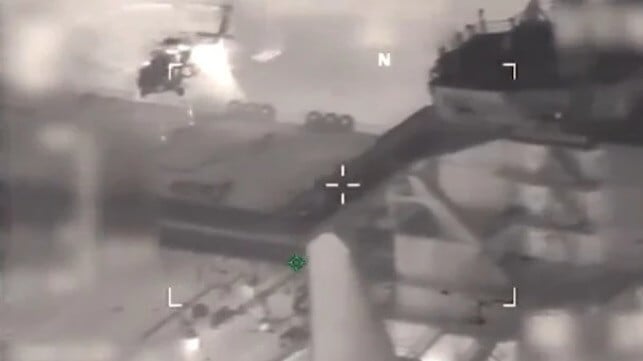


No comments:
Post a Comment