Op-Ed
ICE Is Not the Only Problem. Border Patrol Has Acted With Impunity for Decades.
Ending immigration agents’ abuses requires reckoning with a long history of cruelty at the border.
By Monika Langarica ,
US Is Legally Obligated to Provide Asylum. SCOTUS May Help Trump End It Anyway.
The federal government is appealing a case from Trump’s first term to reinstate an asylum ban at the southern border. By Victoria Valenzuela , Truthout December 19, 2025
Now, Border Patrol has taken its show on the road, delivering harrowing abuses to communities far from external U.S. boundaries, and in operations that have nothing to do with its purported mandate of securing the border.
It’s not just Border Patrol’s violent tactics that are encroaching on interior communities; it’s the harmful legal rules as well. Take, for example, summary deportations without due process of established community members. “Expedited removal” is a process by which immigration agents unilaterally and rapidly deport people without the involvement of any courts. For decades, this authority was reserved in practice for recently-arrived migrants encountered at or near the border, and courts rationalized its legality based on the lack of ties that those subjected to that removal authority have to the United States. But the Trump administration has expanded expedited removal to apply to anyone in any part of the country who cannot prove they have lived in the United States for at least two years. In recent months, DHS attempted to apply expedited removal to a mother of three U.S. citizen children who has resided in the United States for thirty years.
There is also a new bond policy that subjects longtime community members to indefinite detention by denying all undocumented immigrants who entered the country without permission the right to seek release before an immigration judge. This marks a massive expansion of a detention system previously reserved for newcomers and now being applied regardless of how long someone has lived in the country. Strikingly, a federal court has declared this policy unlawful, but the administration has refused to restore the rights of people unlawfully denied bond.
Together, these practices subject, for the first time, longstanding community members — noncitizens and citizens alike — to a system of unjustified and sometimes deadly stops and arrests; rapid deportation without due process; and indefinite detention. We can only expect further escalation at the hands of new ICE leadership drawn directly from Border Patrol, a reorganization announced late last year.
Many are rightfully horrified by these abuses (and by what is yet to come). But we should not be surprised. These practices are well known to those of us who for years have been defending newly arrived migrants against cruel enforcement tactics at the border.
To be clear: The Department of Homeland Security’s current attack against longtime noncitizen and citizen community members is unacceptable and we must demand an end to it. But this will require that we also reckon with the history of border enforcement that helped bring us to this moment — in which the administration is expanding abusive border practices to the interior of the country — and continue the fight against the unfair treatment of new migrants at the border.
After all, if rapid deportation, indefinite detention, and abusive conduct is intolerable for longtime immigrants and other community members, why should we accept that treatment for newcomers? Many have journeyed to the United States for reasons that resonate with those of us whose parents and grandparents arrived decades ago, including the search for refuge from persecution, extreme humanitarian need driven by economic sanctions and other instability, and displacement caused by war and military intervention. Importantly, the law does not require such disparate treatment, and reserving the most basic protections only for those with the longest ties to the United States betrays the promise of the Constitution. It is also a slippery slope for the rest of us; as we are witnessing today in Minnesota and in Maine, conceding the rights of newcomers at the border eventually endangers communities on the interior.
To protect all of us — and to uphold our legal and moral obligations — we must name and resist the continued erosion of rights at the border, including the right to seek safety in the United States. Efforts to defund and abolish ICE must also account for the need to dismantle Border Patrol’s cruelty campaign in interior and border communities. If not as a full-throated rejection of the idea that newcomers at the border are inherently less worthy, then as a preemptive defense against what will inevitably come down the pike for our loved ones across the country.
This article is licensed under Creative Commons (CC BY-NC-ND 4.0), and you are free to share and republish under the terms of the license.

Monika Langarica
Monika Langarica is a senior staff attorney at the Center for Immigration Law and Policy at UCLA Law (CILP), where she focuses on strategic litigation and policy advocacy to defend and advance the rights of immigrants in the United States. The daughter of Mexican immigrants who settled in San Diego, Monika was born and raised in the borderlands, where she is currently based.
ICE Is Not the Only Problem. Border Patrol Has Acted With Impunity for Decades.
Ending immigration agents’ abuses requires reckoning with a long history of cruelty at the border.
By Monika Langarica ,
January 31, 2026
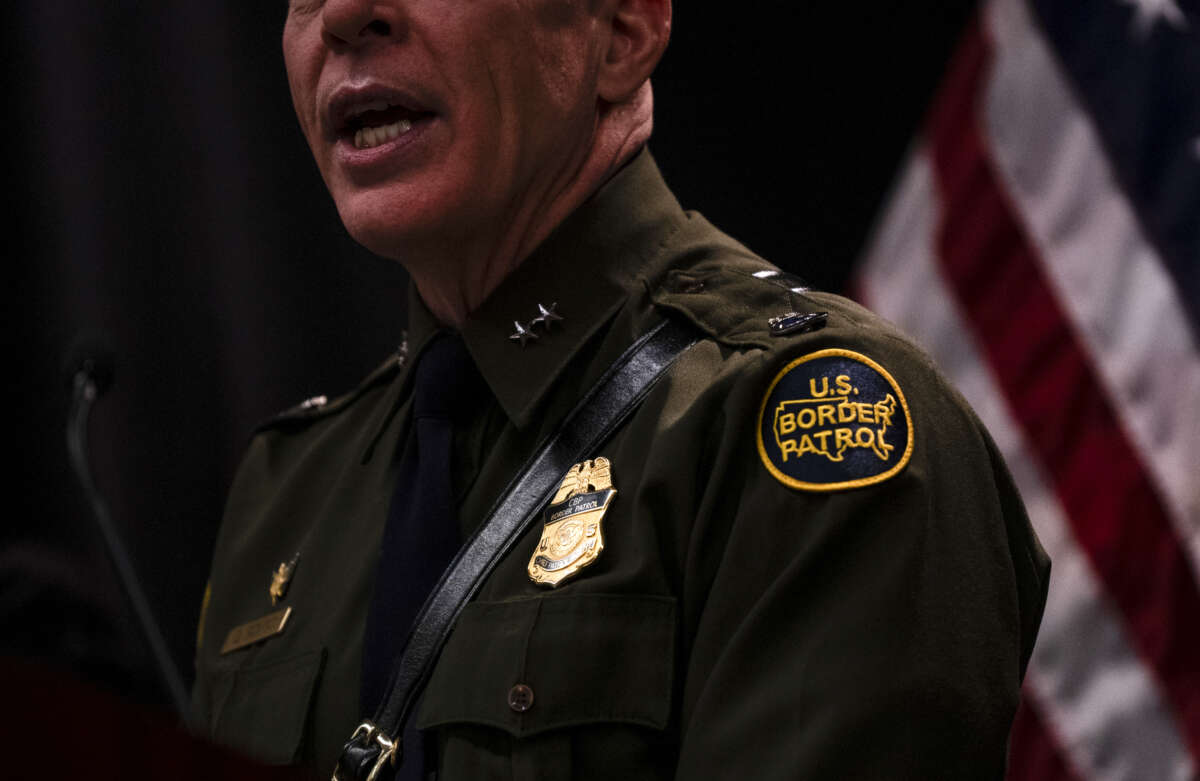
Border Patrol Commander Gregory Bovino speaks during a press conference at the Bishop Henry Whipple Federal on January 22, 2026, in Minneapolis, Minnesota.Stephen Maturen / Getty Images
The idea of a “border crisis” has long been used by both Republicans and Democrats to justify harsh immigration policies. From Biden’s sweeping asylum processing restrictions intended to gain “control of our border,” to Trump’s near-total suspension of asylum processing predicated on a proclaimed “invasion” at the southern border, the playbook is nothing new.
Whether you have believed that “crisis” to be illusory or real, by all measures, it is now over. The number of people encountered at the southern border began falling even before the start of the second Trump administration (and before the “invasion” proclamation), and it is still dropping. Yet the current administration has continued to use the canard of a so-called “border invasion” to unleash extreme anti-immigrant strategies far beyond the border. And it’s not just the “invasion” narrative that is being exported from the border to the interior of the country — it’s the cruel enforcement scheme, too. There is a direct through line between the violence and evisceration of rights at the border and the increasingly violent incursions from the Department of Homeland Security (DHS) in the interior of the country.
Take, for example, the deployment to the interior of Border Patrol — a DHS agency tasked with enforcing immigration and customs laws in areas, as its name suggests, near the border. For months, Border Patrol’s former commander-at-large, Gregory Bovino, led immigration raids in cities across the country — most recently resulting in massive community resistance in Minnesota (where Bovino was recently seen personally launching smoke canisters at protesters). Bovino may be on his way back to his post in El Centro, California, but nothing suggests a withdrawal of Border Patrol from the interior — indeed, DHS has confirmed that Trump’s so-called “border czar,” Tom Homan, is taking over in Minnesota.
As part of these raids and other interior enforcement, Border Patrol has been carrying out violent arrests, separating parents from their babies, and even arresting and detaining children as young as five years old. At least three tragic flashpoints have involved Border Patrol-trained agents: Jonathan Ross, who shot and killed U.S. citizen mother Renee Good in Minneapolis, started his post-military immigration enforcement career at Border Patrol’s El Paso sector in 2007, where he remained for eight years before becoming an Immigration and Customs Enforcement (ICE) agent. The shooter of 37-year-old ICU nurse Alex Pretti, who died on January 24, is a Border Patrol agent. And the men in Portland who shot Luis David Nino-Moncada and Yorlenys Betzabeth Zambrano-Contreras, who are both Venezuelan, are current Border Patrol agents conducting enforcement in Oregon. The administration has repeatedly offered disproven justifications for these actions.
While truly horrific, this kind of violence is not isolated or new; border communities have experienced abuse and impunity at the hands of Border Patrol for decades, including incidents like the 2023 shooting and killing of Raymond Mattia, a U.S. citizen and citizen of the Tohono O’odham Nation, and the 2010 torture and killing of Anastasio Hernández Rojas, a Mexican father of U.S. citizen children. Border Patrol also operationalized the cruel separation of families seeking asylum at the border. The agency routinely detains vulnerable children, including when it took into custody a ten-year-old girl with cerebral palsy who was on her way to an emergency surgery in 2017. And Border Patrol has long engaged in these practices with little to no accountability.
Related Story
The idea of a “border crisis” has long been used by both Republicans and Democrats to justify harsh immigration policies. From Biden’s sweeping asylum processing restrictions intended to gain “control of our border,” to Trump’s near-total suspension of asylum processing predicated on a proclaimed “invasion” at the southern border, the playbook is nothing new.
Whether you have believed that “crisis” to be illusory or real, by all measures, it is now over. The number of people encountered at the southern border began falling even before the start of the second Trump administration (and before the “invasion” proclamation), and it is still dropping. Yet the current administration has continued to use the canard of a so-called “border invasion” to unleash extreme anti-immigrant strategies far beyond the border. And it’s not just the “invasion” narrative that is being exported from the border to the interior of the country — it’s the cruel enforcement scheme, too. There is a direct through line between the violence and evisceration of rights at the border and the increasingly violent incursions from the Department of Homeland Security (DHS) in the interior of the country.
Take, for example, the deployment to the interior of Border Patrol — a DHS agency tasked with enforcing immigration and customs laws in areas, as its name suggests, near the border. For months, Border Patrol’s former commander-at-large, Gregory Bovino, led immigration raids in cities across the country — most recently resulting in massive community resistance in Minnesota (where Bovino was recently seen personally launching smoke canisters at protesters). Bovino may be on his way back to his post in El Centro, California, but nothing suggests a withdrawal of Border Patrol from the interior — indeed, DHS has confirmed that Trump’s so-called “border czar,” Tom Homan, is taking over in Minnesota.
As part of these raids and other interior enforcement, Border Patrol has been carrying out violent arrests, separating parents from their babies, and even arresting and detaining children as young as five years old. At least three tragic flashpoints have involved Border Patrol-trained agents: Jonathan Ross, who shot and killed U.S. citizen mother Renee Good in Minneapolis, started his post-military immigration enforcement career at Border Patrol’s El Paso sector in 2007, where he remained for eight years before becoming an Immigration and Customs Enforcement (ICE) agent. The shooter of 37-year-old ICU nurse Alex Pretti, who died on January 24, is a Border Patrol agent. And the men in Portland who shot Luis David Nino-Moncada and Yorlenys Betzabeth Zambrano-Contreras, who are both Venezuelan, are current Border Patrol agents conducting enforcement in Oregon. The administration has repeatedly offered disproven justifications for these actions.
While truly horrific, this kind of violence is not isolated or new; border communities have experienced abuse and impunity at the hands of Border Patrol for decades, including incidents like the 2023 shooting and killing of Raymond Mattia, a U.S. citizen and citizen of the Tohono O’odham Nation, and the 2010 torture and killing of Anastasio Hernández Rojas, a Mexican father of U.S. citizen children. Border Patrol also operationalized the cruel separation of families seeking asylum at the border. The agency routinely detains vulnerable children, including when it took into custody a ten-year-old girl with cerebral palsy who was on her way to an emergency surgery in 2017. And Border Patrol has long engaged in these practices with little to no accountability.
Related Story
US Is Legally Obligated to Provide Asylum. SCOTUS May Help Trump End It Anyway.
The federal government is appealing a case from Trump’s first term to reinstate an asylum ban at the southern border. By Victoria Valenzuela , Truthout December 19, 2025
Now, Border Patrol has taken its show on the road, delivering harrowing abuses to communities far from external U.S. boundaries, and in operations that have nothing to do with its purported mandate of securing the border.
It’s not just Border Patrol’s violent tactics that are encroaching on interior communities; it’s the harmful legal rules as well. Take, for example, summary deportations without due process of established community members. “Expedited removal” is a process by which immigration agents unilaterally and rapidly deport people without the involvement of any courts. For decades, this authority was reserved in practice for recently-arrived migrants encountered at or near the border, and courts rationalized its legality based on the lack of ties that those subjected to that removal authority have to the United States. But the Trump administration has expanded expedited removal to apply to anyone in any part of the country who cannot prove they have lived in the United States for at least two years. In recent months, DHS attempted to apply expedited removal to a mother of three U.S. citizen children who has resided in the United States for thirty years.
There is also a new bond policy that subjects longtime community members to indefinite detention by denying all undocumented immigrants who entered the country without permission the right to seek release before an immigration judge. This marks a massive expansion of a detention system previously reserved for newcomers and now being applied regardless of how long someone has lived in the country. Strikingly, a federal court has declared this policy unlawful, but the administration has refused to restore the rights of people unlawfully denied bond.
Together, these practices subject, for the first time, longstanding community members — noncitizens and citizens alike — to a system of unjustified and sometimes deadly stops and arrests; rapid deportation without due process; and indefinite detention. We can only expect further escalation at the hands of new ICE leadership drawn directly from Border Patrol, a reorganization announced late last year.
Many are rightfully horrified by these abuses (and by what is yet to come). But we should not be surprised. These practices are well known to those of us who for years have been defending newly arrived migrants against cruel enforcement tactics at the border.
To be clear: The Department of Homeland Security’s current attack against longtime noncitizen and citizen community members is unacceptable and we must demand an end to it. But this will require that we also reckon with the history of border enforcement that helped bring us to this moment — in which the administration is expanding abusive border practices to the interior of the country — and continue the fight against the unfair treatment of new migrants at the border.
After all, if rapid deportation, indefinite detention, and abusive conduct is intolerable for longtime immigrants and other community members, why should we accept that treatment for newcomers? Many have journeyed to the United States for reasons that resonate with those of us whose parents and grandparents arrived decades ago, including the search for refuge from persecution, extreme humanitarian need driven by economic sanctions and other instability, and displacement caused by war and military intervention. Importantly, the law does not require such disparate treatment, and reserving the most basic protections only for those with the longest ties to the United States betrays the promise of the Constitution. It is also a slippery slope for the rest of us; as we are witnessing today in Minnesota and in Maine, conceding the rights of newcomers at the border eventually endangers communities on the interior.
To protect all of us — and to uphold our legal and moral obligations — we must name and resist the continued erosion of rights at the border, including the right to seek safety in the United States. Efforts to defund and abolish ICE must also account for the need to dismantle Border Patrol’s cruelty campaign in interior and border communities. If not as a full-throated rejection of the idea that newcomers at the border are inherently less worthy, then as a preemptive defense against what will inevitably come down the pike for our loved ones across the country.
This article is licensed under Creative Commons (CC BY-NC-ND 4.0), and you are free to share and republish under the terms of the license.
Monika Langarica
Monika Langarica is a senior staff attorney at the Center for Immigration Law and Policy at UCLA Law (CILP), where she focuses on strategic litigation and policy advocacy to defend and advance the rights of immigrants in the United States. The daughter of Mexican immigrants who settled in San Diego, Monika was born and raised in the borderlands, where she is currently based.
Travis Gettys
February 2, 2026
ALTERNET

Ammon Bundy/Gage Skidmore
Ammon Bundy was the was the most famous right-wing militant in America not long ago, after he led two armed standoffs against federal agents at his family's Nevada ranch and an Oregon bird sanctuary, but his outspoken criticism of President Donald Trump has made him an outcast in his own community.
The 50-year-old published a lengthy essay in November on "God's law and the unalienable right to migrate" and decried the Trump administration’s treatment of undocumented immigrants as a "moral failure." In a recent livestream he condemned the fatal shooting of Renee Good by an ICE agent in Minnesota, and he spoke with The Atlantic a few hours after federal immigration agents gunned down Alex Pretti.
“It’s sickening to me, just to see the parallels of history repeating itself,” Bundy told the magazine's Jacob Stern. “When it comes to the more humanitarian side of it, I think the left has it much more correct than the nationalist right.”
Bundy remains deeply conservative, saying that Democrats are “communist-anarchists” who are “spurred by wickedness,” but his ideological allies have shifted toward what he sees as a “nationalist” movement with authoritarian tendencies, as Stern found when he interviewed some of those former anti-government militants.
"After Good was shot and killed, I reached out to a number of those who stood with Bundy at Bunkerville, at Malheur, or afterward," Stern wrote. "None of them would condemn ICE, and some expressed enthusiastic support."
Nick Ramlow, a Montana militant and member of Bundy’s People’s Rights Network who once warned a sheriff that he "had a bigger army than he does," argued that a jury would "make a determination of liability when a civil suit is brought" in Good's death, while Eric Parker, who pointed a semiautomatic rifle on federal agents at Bundy Ranch in 2014, had nothing but praise for the agent who killed the 37-year-old mother.
“I mostly think it’s important to note how impressive it was to get those first two shots off in under a second,” said Parker, who now leads the Real Three Percenters of Idaho. He added that Good's wife should face unspecified criminal charges.
Lee Rice, a longtime People’s Rights member and longtime Bundy supporter who participated in the Oregon standoff, has apparently drifted away from his 2023 statement that he didn’t “believe in the government running roughshod over you," Stern wrote.
“I’m supportive of what’s going on, because we need to get these clowns out of here," Rice said, adding that Good deserved her fate because she sided with undocumented immigrants.
Some of Bundy's associates did change their mind a bit about ICE after two Border Patrol agents shot and killed Pretti, who was legally carrying a firearm that Trump administration officials claimed justified his death.
“I feel completely different about this one,” Parker told Stern in a text message. “No detainment just fighting. Disarmed him then shot him.”
However, Bundy said most of his former allies, much to his astonishment, broadly supported the masked federal agents shooting and roughing up Americans and immigrants alike.
“We agreed that there’s certain rights that a person has that they’re born with," he told Stern. "Everybody has them equally, not just in the United States. But on this topic they are willing to completely abandon that principle.”
“"It doesn’t make sense to me,” Bundy added. “It’s scary, actually.”

No comments:
Post a Comment