Spain cuts the link between gas and power and has Europe’s cheapest power
A year ago this week, Spain’s grid ran entirely on renewable power for a full day for the first time ever. Wind, solar, and hydro met all the peninsula’s electricity demand on April 16. Five days later, solar set a new record, generating 20,120 MW of instantaneous power – covering 78.6% of demand and 61.5% of the grid mix.
Spain is the second highest producer of solar power in the EU, but a fifth of its electricity still comes from gas. Spain’s largest source of clean electricity in 2025 was solar (22%) and its share of wind and solar in the energy mix (42%) exceeds the EU average (30%), according to Ember.
Spain has emerged as Europe’s green energy champion after the government invested heavily into renewables as it sought to break its dependence on expensive and increasingly unreliable fossil fuel imports. That has already paid huge dividends as the cost of power plummeted and is now one of the lowest in Europe.
But the transformation is not over yet: Spain relied on fossil fuels for 25% of its electricity in 2025.
Its per capita emissions of 0.9 tonnes of CO₂ were below the EU average of 1.3 tonnes of CO2e. It ranked 21st globally for electricity demand in 2024.
In 2025, wind generated 256 GWh. Solar followed with 151 GWh. Hydroelectric sources added 129 GWh. Solar thermal contributed 11 GWh. Other renewables added another 11 GWh. And Renewable waste generated 1 GWh, according to Spain’s grid operator Red Eléctrica.
Its per capita emissions of 0.9 tonnes of CO2e were below the EU average of 1.3 tonnes of CO₂ . “Spain’s power sector emissions have fallen by more than two thirds over the last two decades, as wind and solar expansion displaced fossil fuels,” Ember said in a report in February.
Breaking the fossil fuel chains
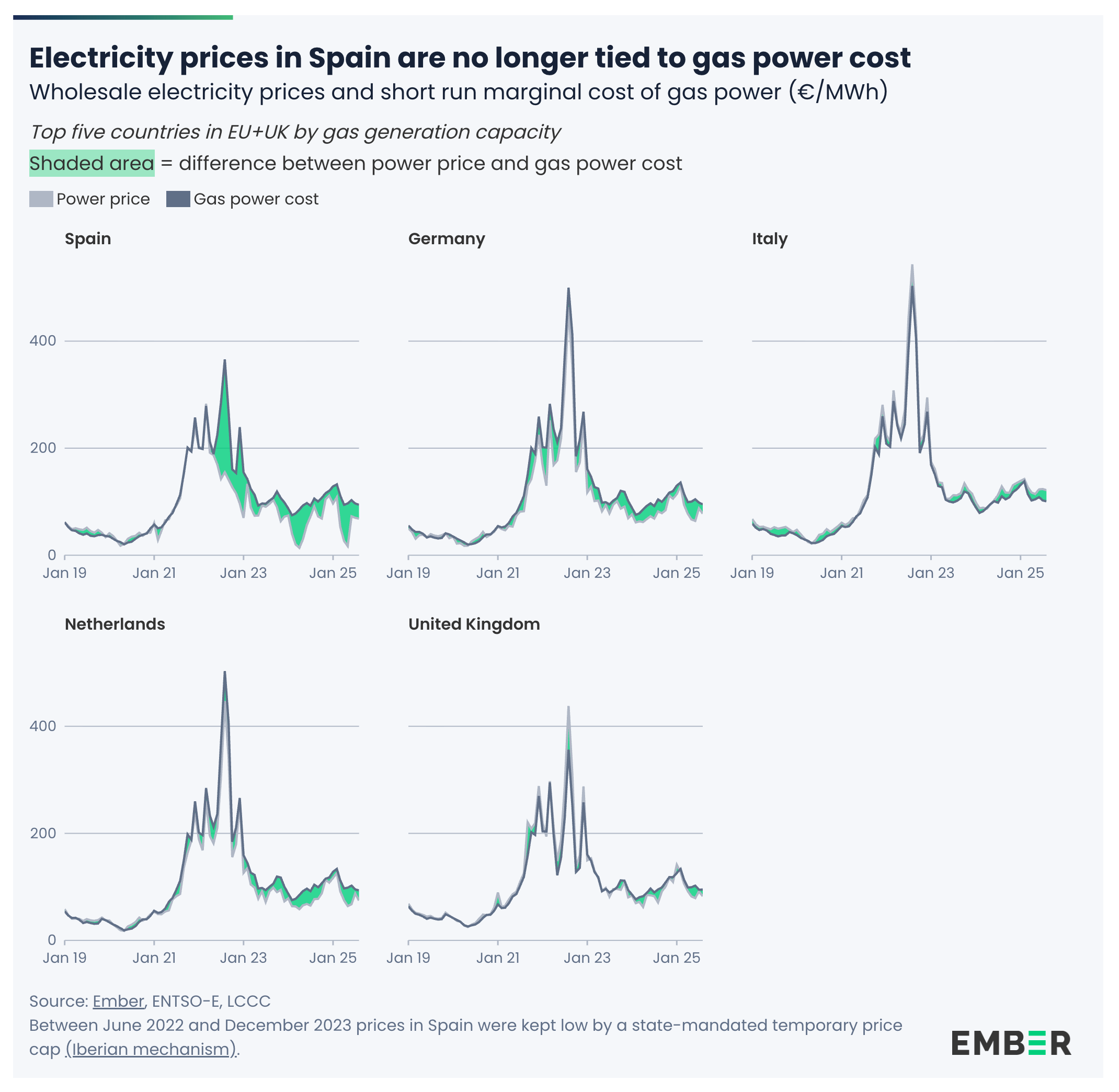
Spain’s electricity market is being reshaped by the effort to break the link between fossil fuels and power prices. It is a policy that has already delivered some of the cheapest wholesale electricity in Europe but has also exposed new vulnerabilities in the country’s grid.
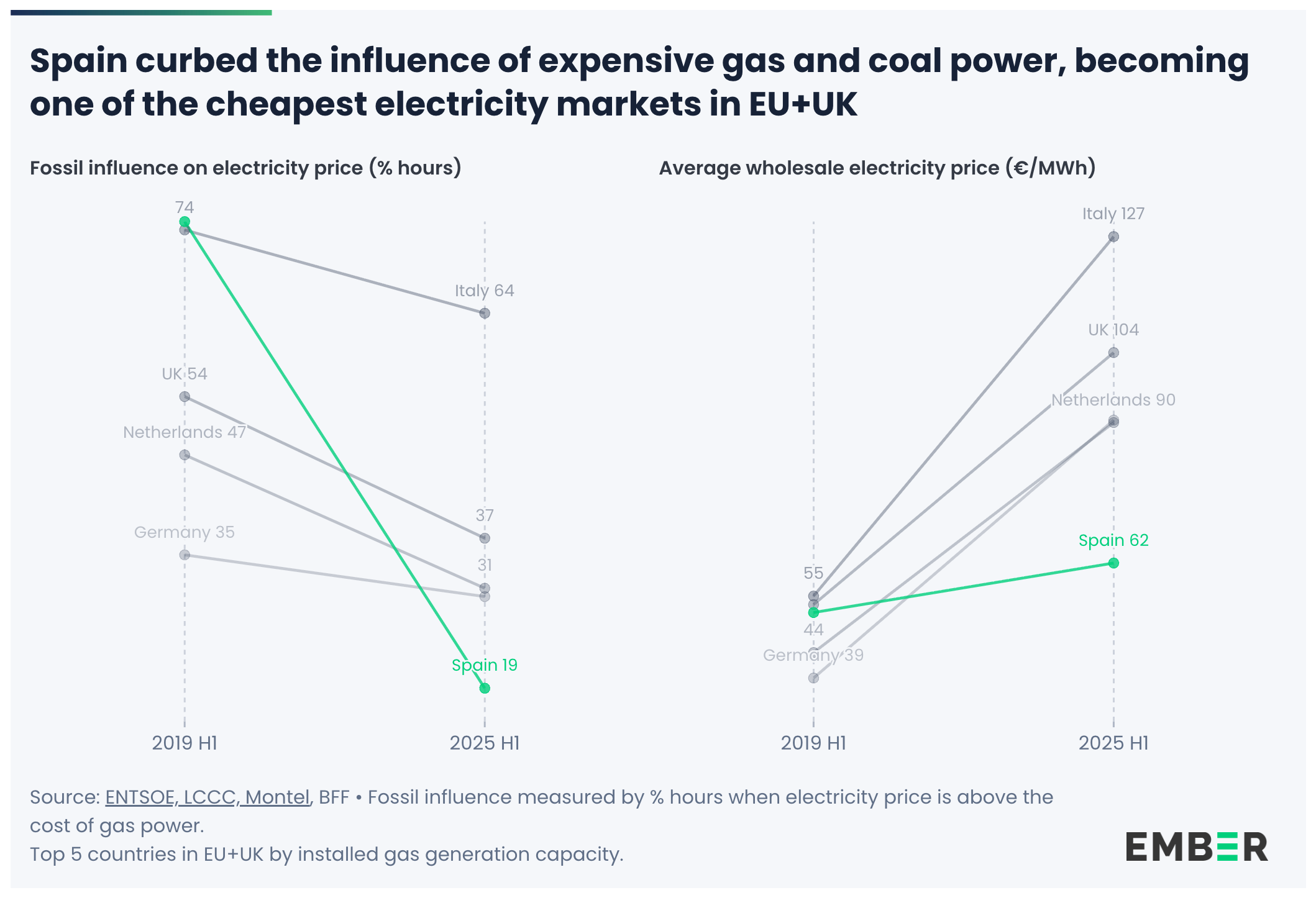
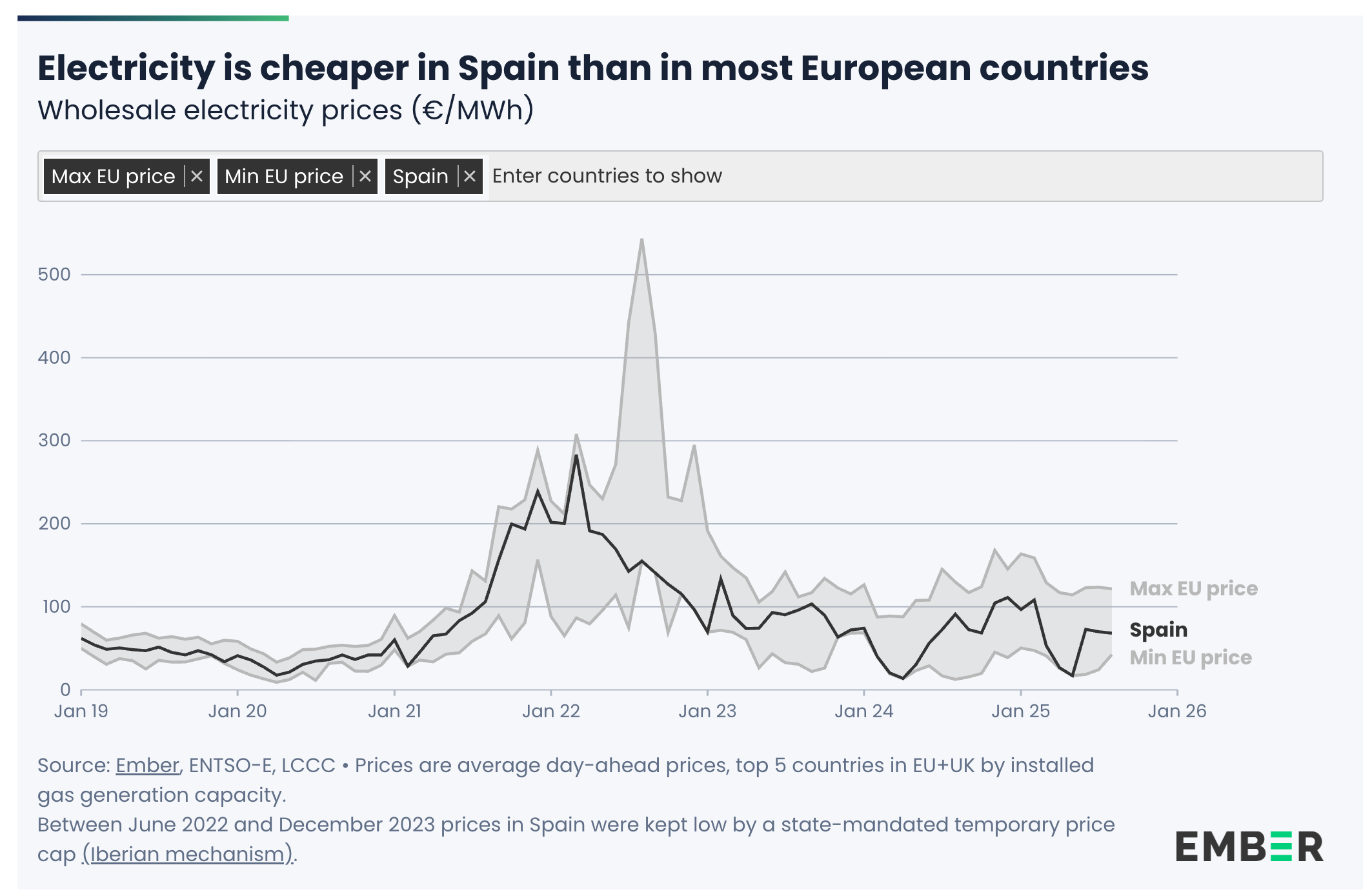
Wholesale electricity prices in Spain were a third (32%) less the EU average in the first half of 2025, reflecting what Dr Chris Rosslowe, senior energy analyst at Ember, described in a report as “the reduced influence of expensive fossil gas and coal power on the electricity market… driven by surging wind and solar”.
The country has moved from being among Europe’s most expensive power markets in 2019 to one of its cheapest, as renewable capacity has taken over fossil fuels.
At the core of that transformation is a sharp decline in the role of gas in price-setting. In 2019, fossil fuels determined Spain’s electricity price in 75% of hours; by 2025, that figure had fallen to 19%.
Rosslowe said that “Spain has broken the ruinous link between power prices and volatile fossil fuels”, with average wholesale prices of €62/MWh ($67/MWh) sitting well below the cost of gas-fired generation, which averaged €111/MWh over the same period.
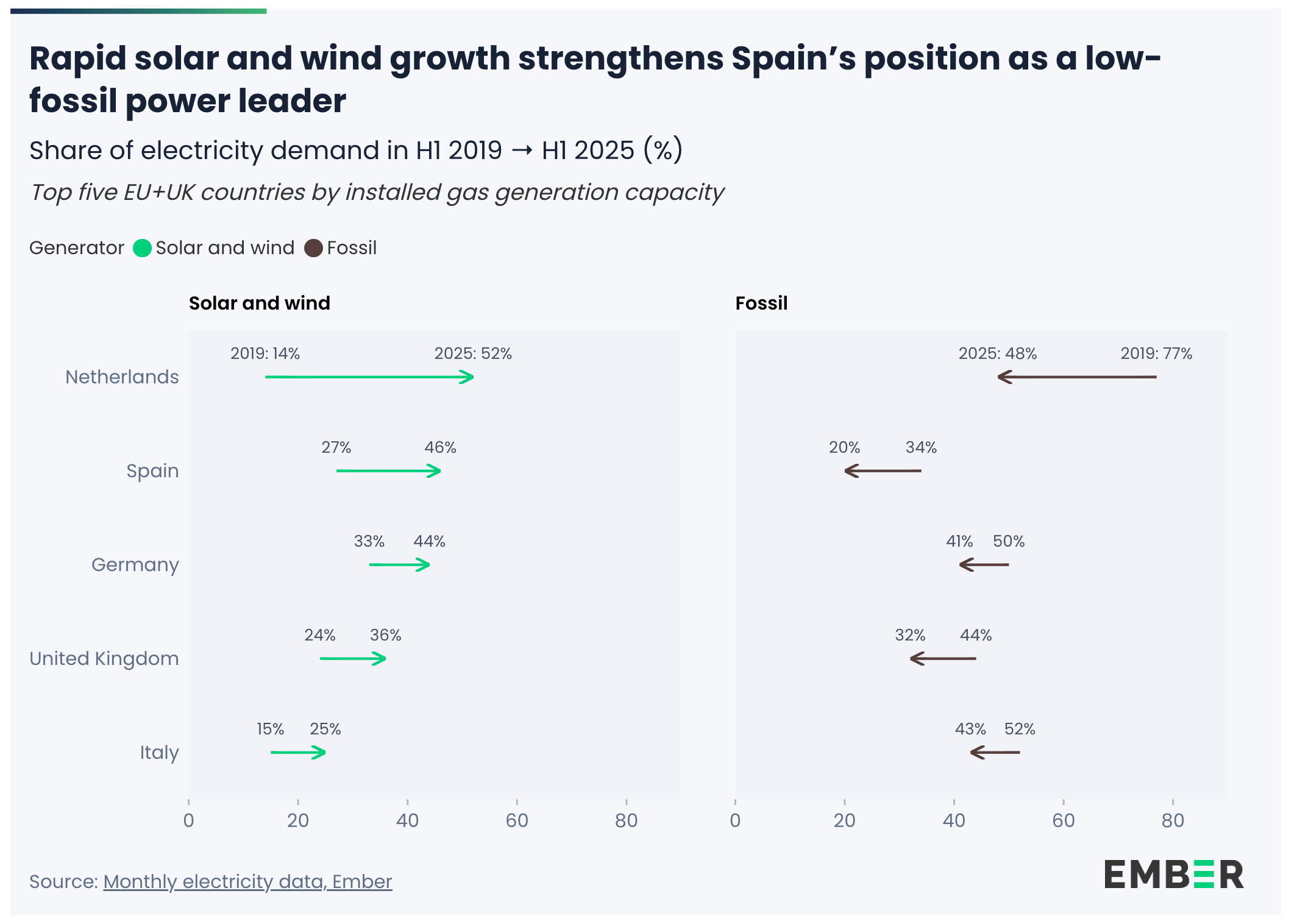
The scale of the build-out has been decisive. Spain added more than 40GW of wind and solar capacity between 2019 and 2025, doubling its installed base. Renewables accounted for 46% of electricity demand in the first half of 2025, up from 27% six years earlier, while fossil generation fell to 20% of the mix—far below levels in Germany or Italy. April 2025 marked the first month ever without coal-fired generation, a milestone that would have been improbable a decade earlier, says Ember.
This expansion has also reduced import dependence and has provided a buffer to the current energy price shock. New renewable capacity installed since 2020 avoided 26bn cubic metres of gas imports, saving €13.5bn ($14.6bn), according to Ember. The Bank of Spain has estimated that wholesale prices would have been 40% higher in 2024 had wind and solar remained at 2019 levels.
Yet the gains have come with some problems. There are two parts to the green energy transition: investment in renewable generating capacity and investment into the grid. Spain has made a lot of progress in the first task, but the second is a work in progress.
The problem is renewable power supply can be erratic, unlike the steady state of generating power using something like gas. Last summer the entire Iberian peninsula was blacked out on April 28 2025, due to large fluctuations in power that the grid could not cope with. Spain still relies on gas-fired plants to stabilise the grid but now needs to invest into a grid that can cope with these unpredictable swings.
Rosslowe warned that “increased reliance on gas power post-blackout for grid stabilisation has been costly”, with ancillary service costs surging. In May 2025, such services accounted for 57% of the electricity price, up from 14% previously, while the cost of balancing actions doubled year on year.
The reliance on gas for system stability has also driven a sharp rise in renewable curtailment. Between May and July 2025, 7.2% of potential renewable generation was curtailed, compared with 1.8% in the preceding years, as grid constraints forced operators to prioritise gas plants for voltage control and system balance.
A lag in infrastructure investment has left Spain with one of Europe’s largest gas fleets but only the thirteenth-largest battery storage capacity, with just 120MW installed. The battery revolution could smooth out the renewables power supply, but until grid-level eight-hour batteries appear the green transition will not be over.
Spanish grid spending has also trailed peers, with €0.30 invested in networks for every €1 spent on renewables, compared with a European average of €0.70, according to Bloomberg.
Still, policy is now shifting again. The government has approved reforms to expand clean flexibility, including plans for eight synchronous compensators at a cost of €750mn ($810mn), expected to deliver annual savings of €200mn. Battery projects totalling 2.6GW are in development, while new interconnection capacity with France is advancing with support from the European Investment Bank.
Rosslowe said that “boosting grids and batteries will help Spain break free from fossil dependency for good”, adding that the country’s experience shows both “the success in growing renewables” and the risks of failing to match that growth with system flexibility.

No comments:
Post a Comment