“That the US Congress is not debating or introducing bills to address the issues presented here represents a breakdown of democracy,” said an economic justice think tank.
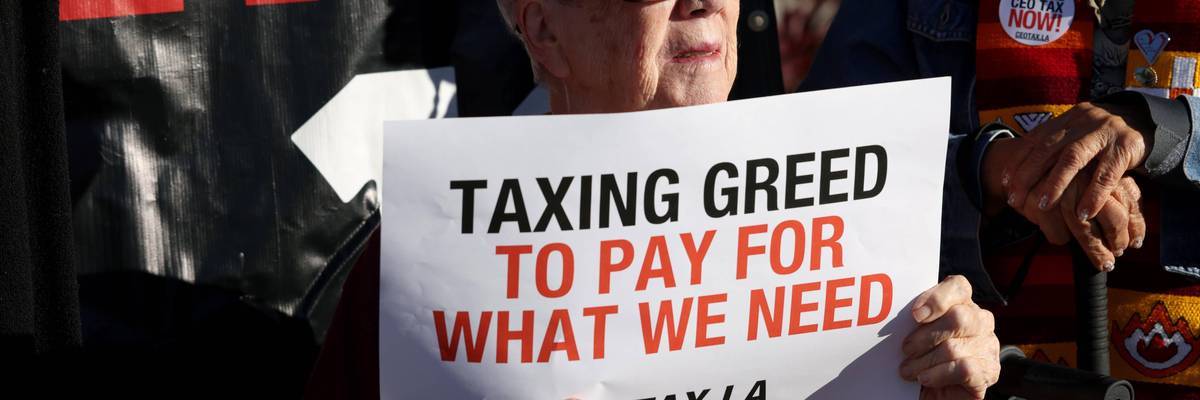
Sister Diane Smith, with CLUE (Clergy and Laity United for Economic Justice), joins The Fair Games Coalition to announce the launch of the Overpaid CEO Tax Initiative in front of the Tesla Diner in Los Angeles on January 14, 2026.
(Photo by Genaro Molina/Los Angeles Times via Getty Images)
Julia Conley
Apr 13, 2026
COMMON DREAMS
A new report by an economic think tank takes aim at the broadly accepted idea that Americans are divided on the major issues affecting millions of people every day—the question of how to ensure everyone can get the healthcare they need without going bankrupt, how the government can ensure working people make enough money to live, and whether the US should take more aggressive climate action.
As it turns out, the Center for Economic and Policy Research (CEPR) suggested Monday, there’s far more agreement on those and more issues across the political spectrum than the corporate media and establishment politicians from both sides of the aisle would have the public believe.
Lawmakers who push for good, fair-paying jobs for all workers; raising the chronically stagnant federal minimum wage; guaranteeing healthcare for all Americans; clean energy investments; and ending the influence of corporations and billionaires on US elections would not be advocating for policies that are just popular on the left, the report says, but would actually be promoting a “Majority Agenda.”
“It may feel like Americans agree on nothing right now, but recent polling tells a different story,” said CEPR on social media. “From raising the minimum wage and strengthening Social Security to affordable housing and healthcare reform, these progressive policies are broadly popular despite the political establishment continuing to ignore them.”
The group pointed to one 2024 poll by the American Communities Project that showed more than 60% of Americans agreed that the economy “is rigged to advantage the rich and the powerful,” while 62% disagreed with the idea of cutting social programs to lower taxes.
Another 2024 poll by The Associated Press found that 91% of Americans supported equal protection under the law and 88% supported the right to privacy, while a 2020 poll by the Carr Center for Human Rights at Harvard Kennedy School revealed that 89% of Americans expressed strong support for affordable healthcare, 85% felt people have the right to a job, and 93% thought the right to clean air and water is essential.
Analyzing those surveys and other data, CEPR advised policymakers to consider the Majority Agenda as a “roadmap” to passing policies that large majorities of Americans view as major priorities to improve their quality of life.
The report is divided into three sections: Good Jobs, Strong Infrastructure, and Fair Play.
To push for fair, well-paying employment, said CEPR, lawmakers should support policies including:Increasing unionization‚ supported by 68% of Americans in one recent poll, through the Protecting the Right to Organize (PRO) Act, cracking down on retaliation against union members, and repealing or reforming the Taft-Hartley Act;
Raising the $7.25 federal minimum wage, supported by 86% of Americans; and
Setting a floor for paid time off from work by strengthening the Family and Medical Leave Act.
The section on strengthening US “infrastructure” looks beyond the traditional definition of the term regarding physical infrastructure projects, pushing for stronger policies that can help working people thrive by ensuring their healthcare, housing, and other basic needs are met.
A stronger infrastructure, said CEPR, would include:Guaranteed healthcare for everyone in the US through the passage of the Medicare for All Act, which has been introduced in the US House and Senate numerous times, and a corporate practice of medicine law to stop the corporatization of healthcare;
A reversal of the trend of federal housing policy directing “too much funding to the wealthy and too little for everyone else,” by ending federal restrictions on the creation of new federal public housing instead of investing in mortgage interest deductions for wealthy homeowners and the Low-Income Housing Tax Credit, whose benefits are greater for wealthy investors than for low-income renters; and
An investment in clean energy by reinstating Biden-era regulations and strengthening the Clean Air Act and other environmental protection laws in order to meet the demands of 59% of Americans who view the climate crisis as “very or extremely dangerous,” according to a 2021 poll by the University of Chicago.
CEPR pointed to three areas in which lawmakers could increase “fair play” for Americans:Strengthening and supporting Social Security, which Republicans frequently attack as rife with fraud and on the verge of going broke, by diverting some among of general revenue to the program and increasing monthly benefits modestly;
Passing a constitutional amendment to allow the government to regulate campaign fundraising and spending both by campaigns and outside individuals and artificial entities; and
Raising taxes on large businesses and the wealthy, as large majorities of Americans believe government should, and restoring funding to the Internal Revenue Service to ensure proper collection of taxes.
“That the US Congress is not debating or introducing bills to address the issues presented here represents a breakdown of democracy, one that comes at a considerable cost to the betterment of life for large swaths of Americans. At the same time, the access to and influence over our democratic processes by the monied class has upended our system of government, and all too often the tyranny of the wealthy minority has reigned,” reads the CEPR report.
“We hope this report stands as a reminder that even in a fraught political moment,” said CEPR, “there is a range of straightforward, broadly popular policy choices that could improve the lives of millions of people.”
New study reveals what the White House doesn't want you to know about prices
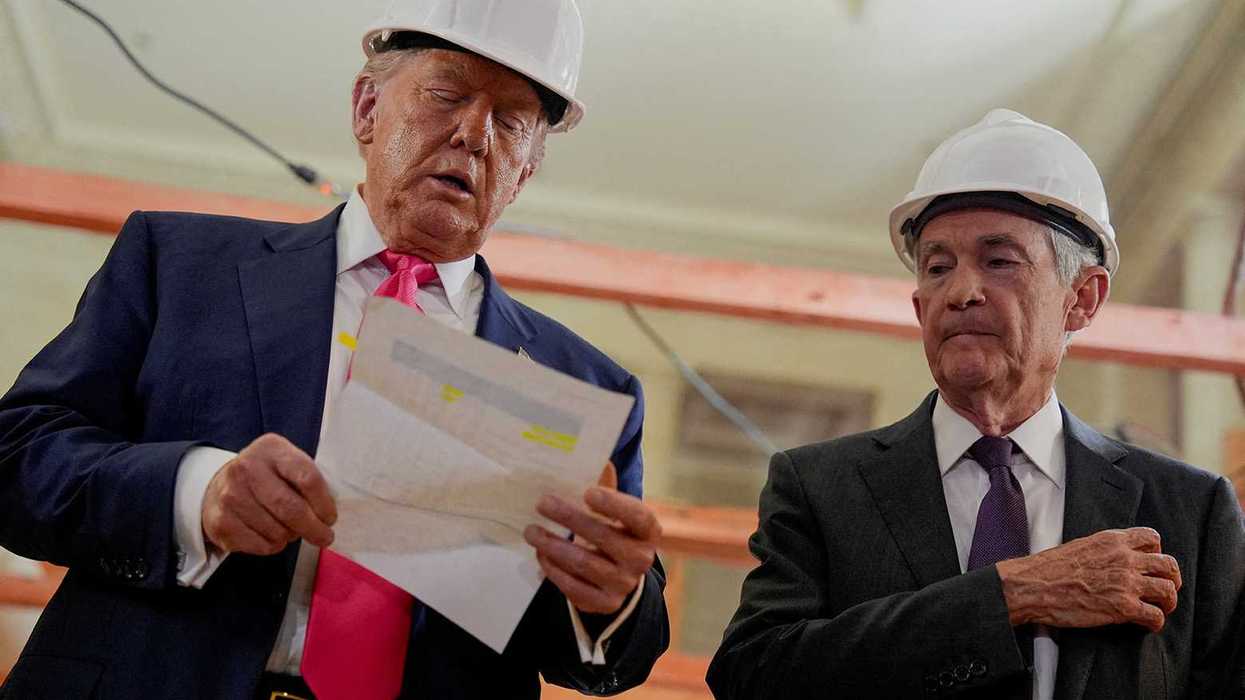
FILE PHOTO: Federal Reserve Chair Jerome Powell looks at U.S. President Donald Trump holding a document during a tour of the Federal Reserve Board building, which is currently undergoing renovations, in Washington, D.C., U.S., July 24, 2025. REUTERS/Kent Nishimura/File Photo
FILE PHOTO: Federal Reserve Chair Jerome Powell looks at U.S. President Donald Trump holding a document during a tour of the Federal Reserve Board building, which is currently undergoing renovations, in Washington, D.C., U.S., July 24, 2025. REUTERS/Kent Nishimura/File Photo
April 13, 2026
ALTERNET
President Donald Trump insists the US economy has never done better than under his second term, but a right-leaning magazine just published an article claiming the opposite is true — indisputably so.
“Tariffs implemented last year by President Donald Trump's administration are entirely to blame for the recent surge in prices for consumer and household goods,” wrote Reason's economic policy reporter Eric Boehm on Monday. ”Those tariffs have raised core goods prices by 3.1 percent, according to a new study by a trio of economists at the Federal Reserve. Those higher consumer prices were the result of retailers passing the cost of tariffs along the supply chain.”
As of two months ago, Trump’s tariffs entirely account for the excess inflation of core goods that Americans have felt since the start of his second term.
"Our estimates indicate that tariff effects on prices gradually build over time, with cumulative effects seven months after implementation consistent with our theoretical measures of full dollar-for-dollar pass-through,” the economists wrote. Boehm added that “the study used the personal consumption expenditures price index (PCE), which is published quarterly by the federal Bureau of Economic Analysis and differs in some small ways from the monthly consumer price index published by the Department of Labor.”
“High prices causes real wages to fall, reversing the gains made since last summer in 2025,” former Special Assistant to President Joe Biden on the National Economic Council Mike Konczal wrote earlier this month regarding prices and tariffs under Trump. A former adviser to President Barack Obama, Betsey Stevenson, similarly wrote that "wars mean declining living standards for everyone,” referencing Trump's unprovoked conflicts against Venezuela and Iran.
Trump’s “tariff shock” has especially hit America’s auto industry, with car magazine WardsAuto reporting last month that “General Motors projects a tariff hit of $3.5 to $4.5 billion in 2025. Ford absorbed an $800 million second-quarter blow. Volkswagen is bracing for a €5 billion impact. Cox Automotive estimates the industry has collectively accumulated more than $25 billion in tariff obligations through just the first seven months of the year — roughly $5,200 per imported vehicle. For vehicles built in Mexico, a critical manufacturing hub, the added cost runs to approximately $4,800 per unit, effectively turning the build-in-Mexico business model upside down.”
As Americans continue to struggle economically because of Trump’s tariffs conservatives like Mona Charen of The Bulwark worry that Republicans will lose in future elections because of the economy.
“Voters are rarely able to connect policy to outcomes, but they have done so in the case of tariffs,” Charen wrote in February. “Back in 2024, Americans were about equally divided on the question of trade, with some favoring higher tariffs and roughly similar numbers opting for lower tariffs. Experience has changed their views.”
She concluded Democrats could win if they embrace as their campaign message, "Tariffs bad—full stop.”
“Tariffs implemented last year by President Donald Trump's administration are entirely to blame for the recent surge in prices for consumer and household goods,” wrote Reason's economic policy reporter Eric Boehm on Monday. ”Those tariffs have raised core goods prices by 3.1 percent, according to a new study by a trio of economists at the Federal Reserve. Those higher consumer prices were the result of retailers passing the cost of tariffs along the supply chain.”
As of two months ago, Trump’s tariffs entirely account for the excess inflation of core goods that Americans have felt since the start of his second term.
"Our estimates indicate that tariff effects on prices gradually build over time, with cumulative effects seven months after implementation consistent with our theoretical measures of full dollar-for-dollar pass-through,” the economists wrote. Boehm added that “the study used the personal consumption expenditures price index (PCE), which is published quarterly by the federal Bureau of Economic Analysis and differs in some small ways from the monthly consumer price index published by the Department of Labor.”
“High prices causes real wages to fall, reversing the gains made since last summer in 2025,” former Special Assistant to President Joe Biden on the National Economic Council Mike Konczal wrote earlier this month regarding prices and tariffs under Trump. A former adviser to President Barack Obama, Betsey Stevenson, similarly wrote that "wars mean declining living standards for everyone,” referencing Trump's unprovoked conflicts against Venezuela and Iran.
Trump’s “tariff shock” has especially hit America’s auto industry, with car magazine WardsAuto reporting last month that “General Motors projects a tariff hit of $3.5 to $4.5 billion in 2025. Ford absorbed an $800 million second-quarter blow. Volkswagen is bracing for a €5 billion impact. Cox Automotive estimates the industry has collectively accumulated more than $25 billion in tariff obligations through just the first seven months of the year — roughly $5,200 per imported vehicle. For vehicles built in Mexico, a critical manufacturing hub, the added cost runs to approximately $4,800 per unit, effectively turning the build-in-Mexico business model upside down.”
As Americans continue to struggle economically because of Trump’s tariffs conservatives like Mona Charen of The Bulwark worry that Republicans will lose in future elections because of the economy.
“Voters are rarely able to connect policy to outcomes, but they have done so in the case of tariffs,” Charen wrote in February. “Back in 2024, Americans were about equally divided on the question of trade, with some favoring higher tariffs and roughly similar numbers opting for lower tariffs. Experience has changed their views.”
She concluded Democrats could win if they embrace as their campaign message, "Tariffs bad—full stop.”

No comments:
Post a Comment