Isaac Schorr
Wed, April 8, 2026

White House press secretary Karoline Leavitt dropped some bombshell news at Wednesday afternoon’s briefing when she revealed that President Donald Trump would be discussing the United States’ potential exit from NATO with Secretary General Mark Rutte later that day.
After being asked, “On NATO, can you tell me, is the United States still considering withdrawing from NATO? Is that still a possibility?” Leavitt replied, “It’s something the president has discussed, and I think it’s something the president will be discussing in a couple of hours with Secretary General Rutte.”
“And perhaps you’ll hear directly from the president following that meeting later this afternoon,” she added.
Earlier in the same press conference, a reporter noted that some European allies have issued a joint statement saying, “our governments will contribute to ensuring freedom of navigation in the Strait of Hormuz,” before asking Leavitt, “What’s the administration’s reaction to that joint statement? Does that smooth things over when the president meets with NATO Secretary General a little bit later this afternoon?”
She replied:
Trump has expressed his displeasure over NATO’s lack of support for the United States during its conflict with Iran in no uncertain terms.
“One thing — we’re very disappointed, I’ll say it publicly — we are very disappointed with NATO, because NATO has done absolutely nothing. And I’ve always said, 25 years ago, and I was somebody that wasn’t a politician, but I was always involved in politics, and I understood politics, I said 25 years ago that NATO’s a paper tiger, but more importantly, that we’ll come to their rescue, but they will never come to ours,” said Trump last month. “And I want you to remember that we said this. They didn’t come to our rescue. Now they all want to help. When they’re annihilated — the other side is annihilated — they said, “We’d love to send ships.” They actually made a statement, a couple of them, that we want to get involved when the war is over. No, it’s supposed to get involved at the war’s beginning, or even before it begins.”
Rutte’s ‘Daddy’ Diplomacy Is Wearing Thin, Even After Trump’s Iran Climb Down
By EurActiv
By Magnus Lund Nielsen
(EurActiv) — Mark Rutte heads to Washington as his much-mocked “daddy diplomacy” wears thin with jittery European allies who have felt the sting of Donald Trump’s criticism and the impact of the war with Iran.
NATO’s Secretary General arrives at the White House hours after the US President agreed to a two week ceasefire with Teheran. Trump has been furious with European NATO countries for failing to help with his military operations in Iran, who they argue they have had little to do with.
Rutte – a former Dutch Prime Minister – is on a mission to better transatlantic relations. Rutte has cast himself as of the continent’s most ardent defenders of Trump. He gave the US President his ‘daddy’ nickname at a NATO summit in Hague last year, repeating it at different occasions since.
While Trump has recently threatened to pull the US out of the alliance, Trump is clearly pleased with Rutte. On Monday, Trump referred to Rutte as a “wonderful guy
In Brussels, diplomats are wary that Rutte is overstepping his mandate when meeting with Trump today.
“Rutte has the difficult job to explain that NATO’s mandate and mission,” a NATO diplomatic source admitted to Euractiv’s defence newsletter, Firepower. “While providing clear defence and military added-value for the US, [the mandate] does not extend to delivering Europeans on any given issue on which they were not consulted.”
The NATO chief has earlier raised eyebrows in Brussels. When meeting the European Parliament’s Defence Committee, Rutte warned against the bloc moving away from the US on the defence cooperation. “Now is not the time to do it alone,” Rutte said.
Yet, his approach to has also worked in the bloc’s favour. When Trump vowed to not use military force to seize Greenland, a semi-autonomous country under Denmark, Rutte was largely creditedwith having defused tensions at a bilateral meeting with Trump on the sidelines of the World Economic Forum in Davos.
Rutte’s Washington visit has been planned for a long time, a NATO official told Euractiv.
“The secretary general will seek to build on the success of the NATO Summit in The Hague, unlock further cooperation among defence industry on both sides of the Atlantic, and discuss current security dynamics including in the context of Iran as well as Russia’s ongoing war against Ukraine,” said the official.
Alice Tidey contributed to this report.
Wed, April 8, 2026

NATO Secrertary-General Mark Rutte met with US Secretary of State Marco Rubio ahead of his meeting with Trump (Kent Nishimura)(Kent Nishimura/AFP/AFP)More
US President Donald Trump will discuss the possibility of leaving NATO when he meets with the alliance's chief Mark Rutte on Wednesday, the White House said, accusing Washington's partners of "turning their back" on the American people.
The meeting comes one day after the United States and Iran agreed to a two-week ceasefire. Trump has expressed anger at Western partners' refusal to back his war on Iran, rocking the 77-year-old transatlantic alliance.
"It's quite sad that NATO turned their backs on the American people over the course of the last six weeks when it's the American people who have been funding their defense," White House Press Secretary Karoline Leavitt told reporters.
When asked if Trump would discuss a possible withdrawal from NATO, Leavitt said: "It's something the president has discussed, and I think it's something the president will be discussing in a couple of hours with Secretary-General Rutte."
"Perhaps you'll hear directly from the president following that meeting," she added.
Trump has branded NATO partners "cowards" for limiting US forces' access to bases on their territories and for refusing to lead efforts to open the strategic Strait of Hormuz.
But NATO's secretary-general touts a record of pulling Trump back onside -- and will be looking to do so again when he meets the president, as well as US Secretary of State Marco Rubio and Pentagon chief Pete Hegseth.
Ahead of the White House visit, Rutte met with Rubio to talk about Iran, Russia's war against Ukraine and NATO responsibilities.
"The two leaders discussed Operation Epic Fury, ongoing US-led efforts to bring a negotiated end to the Russia-Ukraine war, and increasing coordination and burden shifting with NATO Allies," said State Department Principal Deputy Spokesperson Tommy Pigott.
- 'Obsolete' -
NATO has been thrust repeatedly into crisis since Trump returned to power last year -- most acutely by his threat to seize the vast Arctic island of Greenland from alliance member Denmark.
That followed him pulling the rug out from under Ukraine in its war against Russia, his threats not to protect allies unless they don't spend more on defense, and warnings that Washington could pull troops from Europe.
Dubbed a "Trump whisperer," Rutte, a former Dutch prime minister, has been central to allied efforts to mollify the US leader, often by means of flattery.
On Iran, he has sought to thread the needle by calling US efforts to degrade Tehran's military capability something to "applaud."
Trump has warmed to Rutte's praise, describing the secretary-general as "a wonderful guy" -- even while claiming that fellow NATO countries had "gone out of their way not to help" in the Middle East.
Speaking as Rutte headed to Washington, a NATO official said he planned to "discuss current security dynamics including in the context of Iran as well as Russia's ongoing war against Ukraine" in his talks with Trump.
And he would "seek to build on the success" of last year's NATO summit in The Hague at which allies agreed to Trump's demand to ramp up their defense spending target, the official said.
Trump has long railed against NATO, calling it "obsolete" in 2017 and mulling withdrawing.
Compounding the worries this time, however, Trump has been joined by traditional NATO supporters including Rubio, who warned last week the United States was "going to have to reexamine" the relationship in light of the rift over Iran.
The United States and Iran agreed to a two-week ceasefire Tuesday barely an hour ahead of Trump's deadline to obliterate the rival country was set to expire, with Tehran to temporarily reopen the vital Strait of Hormuz.
ec/ub/md-sst/des

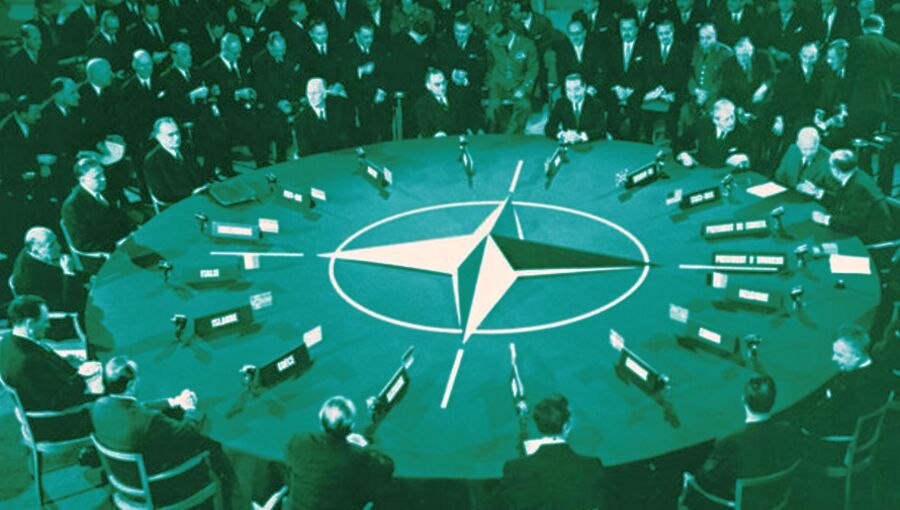
The West is discussing a new defence alliance format to replace Nato that would include Ukraine. Nato's current form is ineffective, so it is worth creating a new defence structure that would include Ukraine, said Keith Kellogg, former US President Donald Trump's special envoy for Ukraine.
According to the retired general, the Alliance's current configuration has exhausted itself, as it has proven ineffective in large-scale crises. Kellogg proposes "redrawing defence lines" and combining US efforts with Japan, Australia, Poland, and Ukraine.
He emphasised that Ukraine has demonstrated its military strength and commitment to common security interests during the current war, and that the country has become a "good ally" for the West.
This view is supported by former Deputy National Security Advisor Victoria Coats. She notes that Nato has proved "insignificant" because it has been unable to resolve the largest military conflict on its own continent since World War II – the war in Ukraine.
Clearly angered by the lack of support from Nato’s European members for the US attack on Iran, Trump has said he is seriously considering withdrawing from the Alliance on two occasions recently.
Transatlantic relations are “deteriorating rapidly” as Trump cools on all international commitments. He has already withdrawn from 66 international institutions, half of which were key UN institutions.
The US-Europe alliance is approaching a “breaking point”, and the Iranian war fallout has shown that the current formation is not fit for US consumption and their wider plans. It has become evident to all who have experienced the past six weeks that several key Nato nations, including Germany, Spain and France, have found attacks by the US and Israel on Iran and Lebanon.
Trump expressed “disgust” at European allies for not participating in the campaign after he called on Nato allies to join his armada to reopen the Strait of Hormuz by force.
There is a growing frustration within the White House over burden-sharing and the perceived imbalance in military commitments between Washington and its allies.
Secretary of State Marco Rubio described this as a "betrayal at a crucial moment." He explained that Nato membership allows the US to deploy troops, aircraft, and weapons in regions without US bases, including much of Europe. However, during tough times, countries like Spain, which is a Nato member that the US has pledged to defend, have denied access to their airspace and even boasted about it, refusing to allow US use of their bases. Others have followed suit," he said.
As a result, Rubio questioned whether the US would continue to defend Europe as a member of Nato. "All of this is subject to review," he stated.
When asked about past US plans to withdraw troops from Europe – causing distrust among allies – Rubio responded that "without the US, there is no Nato." He warned that "if we withdrew our troops tomorrow, Nato's existence would be in jeopardy, and they are aware of this. Hopefully, we can correct this," Rubio added, noting that he would address the issue later as the US is currently focused on Iran.
Europe has been pressuring the US to continue weapons deliveries to Ukraine, paid for by Europe as part of the Prioritised Ukraine Requirements List (PURL) programme, but which were appropriated by the US and sent to the conflict in the Middle East.
Trump is questioning the strategic value of Nato itself, asking whether defending Europe serves US interests if European governments do not support American military interventions in the Middle East or elsewhere. The remarks suggest a potential re-evaluation of collective defence principles that have underpinned the alliance since its founding in 1949.
According to WSJ, the administration’s position is being described internally as a “break” with US global strategy dating back to the end of the Second World War, when Washington committed to maintaining security guarantees across Europe as a deterrent to adversaries.
European officials have not publicly responded in detail to the latest comments, but previous disagreements over defence spending and strategic priorities have already strained relations within NATO. The alliance has faced repeated pressure from Washington in recent years to increase military expenditure and take on a larger share of collective defence responsibilities.

No comments:
Post a Comment