Thursday, February 20, 2020

Colorado River flow shrinks from climate crisis, risking ‘severe water shortages’

Millions of people rely on the 1,450-mile waterway as increasing periods of drought and rising temperatures reduce flow of river


Oliver Milman Thu 20 Feb 2020

 

Colorado River in Grand Canyon at Toroweap.
 Photograph: tonda/Getty Images/iStockphoto

The flow of the Colorado River is dwindling due to the impacts of global heating, risking “severe water shortages” for the millions of people who rely upon one of America’s most storied waterways, researchers have found.

Increasing periods of drought and rising temperatures have been shrinking the flow of the Colorado in recent years and scientists have now developed a model to better understand how the climate crisis is fundamentally changing the 1,450-mile waterway.

The loss of snow in the Colorado River basin due to human-induced global heating has resulted in the river absorbing more of sun’s energy, thereby increasing the amount of water lost in evaporation, the US Geological Survey scientists found.

This is because snow and ice reflect sunlight back away from the Earth’s surface, a phenomenon known as the albedo effect. The loss of albedo as snow and ice melt away is reducing the flow of the Colorado by 9.5% for each 1C of warming, according to the research published in Science.

The world has heated up by about 1C since the pre-industrial era and is on course for an increase of more than 3C by the end of the century unless planet-warming emissions are drastically cut. For the Colorado this scenario means an “increasing risk of severe water shortages”, the study states, with any increase in rainfall not likely to offset the loss in reflective snow.

The magnitude of the Colorado’s decline as outlined in the Science paper is “eye popping”, according to Brad Udall, a senior scientist at Colorado State University and an expert on water supplies in the west who was not involved in the research.
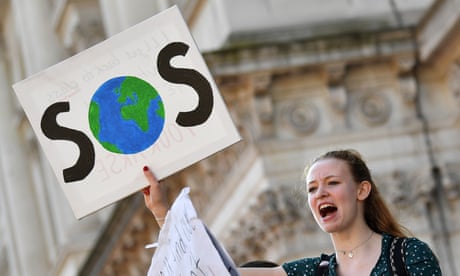


“This has important implications for water users and managers alike,” Udall said. “More broadly, these results tell us that we need to reduce greenhouse gas emissions as soon as we possible can.

“We’ve wasted nearly 30 years bickering over the science. The science is crystal clear – we must reduce greenhouse gas emissions immediately.”

The Colorado rises in the Rocky Mountains and slices through ranch lands and canyons, including the Grand Canyon, as it winds through the American west. It previously emptied into the Gulf of California in Mexico but now ends several miles shy of this due to the amount of water extraction for US agriculture and cities ranging from Denver to Tijuana.

The river’s upper basin supplies water to about 40 million people and supports 16m jobs. It feeds the two largest water reserves in the US, Lake Powell and Lake Mead, with the latter supplying Las Vegas with almost all of its water.

Snowpacks that last into late spring have historically fed streams that have nourished the Colorado River, as well as reducing the likelihood of major fires. As the climate heats up, the river is evaporating away and the risk of damaging wildfires is increasing.

The climate crisis is compounding existing threats to the river, which include intensive water pumping for agriculture, water use by urban areas and the threat of pollution from uranium mining. Lake Mead, the vast reservoir formed by the Hoover dam, has dropped to levels not seen since the 1960s.

A 19-year drought that racked stretches of the river almost provoked the US government to impose mandatory cuts in water use from the river last year, only for seven western states to agree to voluntary reductions. The problems are set to become more severe, however, as the climate becomes hotter and drier at a time when demand for water from expanding cities in the American west increases.

THE GUARDIAN
African killifish may hold key to stopping ageing in humans

Turquoise killifish is able to suspend its development for longer than its average lifespan


Thu 20 Feb 2020
It was previously thought that the process, diapause, 
was linked to droughts across millions of years. 
Photograph: MDI Biological Laboratory


The curious ability of the African turquoise killifish to press pause on its development could have intriguing implications for human ageing, say researchers.

Certain creatures, including the killifish, can put themselves into suspended animation as an embryo – a trait known as diapause. The phenomenon is thought to have evolved in response to pressures such as seasonal changes in the environment – for example ponds drying up – or sudden challenges that pose a risk to the creatures. In other words, diapause allows the animal to put its development or birth on ice until conditions improve.

In the case of the African turquoise killifish, this means that embryos can pause their development for months or even years – longer than their adult lifetime of about four to six months. Scientists say the trait is likely to be linked to annual droughts.

“We actually don’t think the mechanism of diapause is directly caused by drought ,” said Prof Anne Brunet, co-author of the research from Stanford University. “But the mechanism is indirectly linked to drought in the sense that drought provided a selective pressure for this African turquoise killifish species: over millions of years of evolution, the African killifish evolved to survive drought by having its embryos enter a state of diapause.”

While the process is thought to be genetically programmed, quite how it works has been something of a puzzle.

Now scientists say they have unpicked the mechanism behind the phenomenon, and have revealed that pausing development as an embryo has no impact on the fish’s future lifespan, fertility or how large they grow as an adult – suggesting the impact of time on cells and tissues themselves was suspended.

“Diapause is a fascinating state of ‘suspended life’ that can preserve a complex organism long-term, with no apparent tradeoff for subsequent life,” said Brunet.

Writing in the journal Science, Brunet and colleagues report how they probed the processes involved in diapause in killifish embryos, revealing the phenomenon involves genes involved in cell proliferation and organ development being dialled down, while the activity of genes linked to muscle maintenance and metabolism is also affected.

Part of this seems to be down to increase in the production of a protein called CBX7. In the nucleus, DNA is packaged up by being wrapped around proteins called histones – CBX7 binds to particular histones. The team say this binding appears to influence the activity of a number of genes, including some involved in muscle function and metabolism, resulting in muscle being maintained throughout diapause.

The team say it may be possible to apply these mechanisms to adults. As an accompanying editorial notes, this has previously been tried in a simpler organism – the roundworm C elegans, whose larvae can undergo diapause – and been found to extend longevity.

“One can hypothesise that turning on a “diapause-like” state – or tapping into the molecular machinery of diapause – in some adult tissues or cells could help preserve them long-term,” said Brunet.


Could this lead to a way to stop ageing in humans? “We think it’s interesting from a fundamental point of view to understand how the accumulation of the damage due to the passage of time can be stopped or suspended. Diapause offers us a way to understand this,” said Brunet. Such an understanding may provide clues as to how to slow the “ageing clock”, she said, but added that at present it is still speculative.

Prof Paul Shiels, an expert in biological ageing from the University of Glasgow, said that while the authors point to similarities between diapause and other types of suspended animation, such as hibernation, they probably involve at least some different processes – not least since hibernation involves the preservation of organs in their adult form, rather than arresting their development.

Shiels said it was not clear how the new study could offer ways to slow or prevent human ageing, since this would involve keeping adult tissues in a suspended state. “[The study] has implications for organ regeneration,” he said. “Whereas organ preservation, you’d [learn] more from hibernating mammals.”
Care workers like me aren't low skilled – these immigration rules will risk livesKarolina Gerlich

The proposed salary requirements for non-English workers will cripple the care industry. The consequences could be terrifying


Thu 20 Feb 2020 

Care workers are skilled professionals. 
Photograph: Realimage/Alamy Stock Photo


I’ve been a full-time care worker in this country for eight years. People’s wellbeing is at the heart of what I do. I have the privilege of supporting some amazing people and their families, using a wide range of clinical, emotional and academic skills.

But under the new immigration rules proposed by the government, I would not have been able to enter the country 12 years ago. I came to the UK when I was 18 and began working part-time in care, while also working in hospitality and manufacturing. With no job offer or degree, and little certainty my English qualifications would count, I would not have had the necessary 70 points.


Social care leaders criticise plans for immigration salary threshold

The government says we are “unskilled”, but one thing I know for sure is that care work is highly skilled. It is unacceptable that the government does not understand what social care is and what we, as care workers, do every day.

We are responsible for peoples’ lives, mobility, medication, and diet; we manage catheters, PEG feeds, stoma bags, and hoists, and collaborate closely with many other professionals. Our jobs and responsibilities are complex and they require diligence, insight, and attention to detail.

The new regulations confuse, wrongly, low pay with low skill. Many low-paid jobs require a high level of skill. In fact, the distinction between skilled and unskilled seems archaic, and more related to academic and non-academic training. Most care workers are required to undertake training before they can start a job, and continue training throughout their working lives. Many also have degrees. We choose to work in care because we want to make a difference in peoples’ lives, not because we are stupid or incapable of doing anything else.

Decades of neglect and underfunding from the central government have driven average care worker salaries to between £16,200 and £19,500, for local authorities and the independent sector respectively. With a minimum threshold of £23,040 for points due to salary, most jobs in the sector will count for nothing. The government’s call for employees to simply pay workers more is unfeasible; many providers, already wanting and willing to increase the pay they offer, will just not be able to as the government is not putting the funding into social care in the first place.

For social care, the blow from the immigration policy will pile on to an industry crippled by a turnover of 30.8%, and 122,000 vacancies in England alone. The potential consequences are terrifying; the unmet need, already at 1.4 million people, will only increase, and peoples’ wellbeing and lives will be at risk.

I urge the government to put care workers on the skills shortage list. I strongly recommend that by better funding the sector and ensuring that there are enough care workers to support everybody in need, they do what is right for the country, and secure their own care and support in the years to come.
Why are French soldiers in the Sahel? Protesters have an answerAlexandra Reza
Macron’s autocratic attitude towards dissent in countries such as Niger and Mali is only stoking anti-French sentiment


Thu 20 Feb 2020 

Emmanuel Macron, centre, with Niger’s president Mahamadou Issoufou, right, and Chad’s president Idriss Déby, left, at a summit on the Sahel, in Pau, France, in January 2020. Photograph: Reuters


Large protests have been taking place in Bamako, the capital of Mali, demanding that French troops leave the country. “We marched for them to leave, and now they send 600 more,” one blogger in Mali wrote in response to the news that more French soldiers were to be deployed to the Sahel. In total, roughly 5,100 French troops are deployed in Mali, as well as across Chad, Niger, Mauritania and Burkina Faso. Public opposition to French military intervention in the Sahel, seen as undermining national sovereignty, has been growing over the last year across francophone Africa. The popular Cameroonian musician Géneral Valsero recently declared, “The presence of the French army is an insult.”French troops have been in the region on and off since they occupied it in the 19th century, seeking to secure French access to labour and resources. They have remained, and returned, since independence. The French launched Operation Serval in 2013 in response to gains made by insurgent groups in the north of Mali. Since then, instability has spread and different states in the region are now dealing with repeated attacks and insurgencies from a range of groups, some linked to al-Qaeda and Islamic State.

Threatening foreign presidents to quell public debate and dissent at home is an autocratic gesture

Deep-rooted and complex tensions are driving the insurgencies: livelihoods under attack, trafficking networks manipulated by political and business elites, the failure of nation states to provide economic and social security for its citizens. The climate crisis and associated land degradation are major factors.

In this context, President Macron says the French Operation Barkhane, which replaced Serval in 2014, exists in the name of the “collective security” of the Sahel and the wider world.

But France still has significant commercial and political interests in the region. The state-owned energy company, Areva, gets a large proportion of its uranium from Niger. Total has oil fields in Mali. The French have a military base in Chad (when Macron visited in 2018, he brought enough champagne for 1,300 troops). Despite years of fighting, the insecurity and attacks on civilians continue. Four thousand deaths were reported last year alone.

Sahelian public resistance to the French military presence is a problem for Macron’s government. He is under rising pressure at home because of recent French casualties in the region. As a result, the presidents of Sahel countries came under orders from Macron to sort out anti-French sentiment. Speaking after the Nato summit in London last December, Macron put on a stern, somewhat exasperated tone. “Do they want us to be there? Do they need us?” he asked. To get an answer, Macron called a summit in early January in Pau, a town in the south-west of France. On Burkinabè television, the president of Burkina Faso, Roch Marc Kaboré, criticised the tone of this “summons”. Nevertheless, he later joined the presidents of Niger, Mali, Mauritania and Chad in releasing a joint statement confirming that, yes, they wanted France to stay.


In making French military presence apparently conditional on a public show of allegiance, Macron wants to be seen as committed to democratic process in Africa. Famously, at a landmark speech at the University of Ouagadougou in 2017, he described himself as a president from the generation for whom “the crimes of colonisation are indisputable”. He wasn’t one to tell African countries what to do. And sure enough, here he is in 2020 asking African presidents what they want. But threatening foreign presidents to quell public debate and dissent at home is an autocratic gesture.

Members of the public have responded: “We are acting legally and democratically to express our disagreement against France’s policy,” said one organiser in Mali, denying that protesters were to be treated as rebels or disturbers of the peace. “We need to free ourselves from this,” said Valsero.

It is no surprise that some pushback – albeit fleeting, and only directed at a domestic audience – came from Burkina Faso. Kaboré is facing elections later this year, in a country where in 2014, after 27 years in power, popular struggle dislodged Blaise Compaoré, a staunch ally of the US and France. Kaboré is not in a position to completely ignore his electorate, even if the French president tells him to.

In Niger, President Mahamadou Issoufou played down the significance of those protesting against the French military in his country. “Those demonstrating in the street are a tiny minority,” he said in an interview in December last year. This insouciance was at odds with his authorities’ prohibition of a protest in the Niger capital, Niamey, the week before. The French have supported Issoufou and in turn he gives the French army free rein. French drones take off from Niamey to monitor Islamist movements in the Sahel.

Last February, French forces attacked soldiers opposed to the Chad president, Idriss Déby. As the political scientist Marielle Debos has pointed out, these soldiers were no cuddly democrats, but bombing the regime’s opponents falls squarely outside the stated objectives of Operation Barkhane. It seemed to serve only to shore up the position of Déby, who himself took power by force in 1990 with French support. Seen this way, the presence of French soldiers in the Sahel has more to do with securing French interests than about achieving security for the general public.

There is also a relationship between foreign policy and what’s going on in mainland France. In Bamako in January, demonstrators calling for French troops to leave burned a French flag, and a man on a loudspeaker called for the abolition of the camps in Calais. In France, members of the Chad diaspora campaigning against French interference have been involved in organising with the “gilets noirs”, a movement mobilising against the exploitation of the undocumented migrants on which the French economy depends. At the Pau summit, a collective associated with the gilets noirs, La Chapelle Debout, called a protest against the theatrics of Macron’s summit: “We demand the departure of French troops,” one member wrote. “Colonisation is over.”

The gilets noirs have been explicit about the connections between exploitation at home and French presence abroad. Seen through this optic, the instability in the Sahel is not a hermetic issue confined to the region. It is a part of a story of inequality across the international divisions of labour that western states and companies help produce.

• Alexandra Reza is a junior research fellow in French at Trinity College, Oxford


THE GUARDIAN
Debate shows Bernie Sanders could win most votes but be denied nomination

The Vermont senator was alone in saying he would back whoever won a plurality of delegates – with others open to superdelegates tipping the balance for another candidate at the convention


Thu 20 Feb 2020
  

Bernie Sanders greets Mike Bloomberg and Elizabeth Warren at the Democratic debate in Las Vegas on Wednesday. Photograph: Mike Blake/Reuters


Amid the Mike Bloomberg pile-on and the Pete Buttigieg-Amy Klobuchar squabbling, there was a key point that slipped by almost unnoticed during Wednesday’s tumultuous Democratic debate – one that could potentially prevent Bernie Sanders from becoming the nominee.

Towards the end, each of the six candidates was asked if – at the Democratic national convention this summer in Milwaukee – they would support the person who has won the most delegates – even if that person hasn’t achieved a majority.

Five of the candidates said they would not. The Democratic socialist and Vermont senator said he would.


It might seem a wonky, opaque detail, but it raises the prospect that Sanders, who has a commanding lead in the polls and has emerged as the frontrunner, could win the most pledged delegates – those allocated on the basis of votes during the marathon Democratic primaries – but be swindled, at the last, by the Democratic party elite.

That’s because of superdelegates.

Superdelegates, who are chosen by the central Democratic party, are different from pledged delegates, who are effectively voted for during the primaries. As of 20 February, Buttigieg is in the lead in terms of pledged delegates, with 22 to Sanders’ 21.


But Sanders is better-placed than Buttigieg to pick up more pledged delegates in Nevada on Saturday and South Carolina the following week. He is also likely to add to his total again on Super Tuesday, when 14 states vote, yielding a total of 1,357 delegates.

If Sanders’ popularity endures, he could amass more delegates than his rivals by the time of the July convention, when the pledged delegates effectively vote for the nominee in a first round of voting that is meant to pick the nominee.

However, if Sanders does not have an absolute majority – more than 50% – during the first ballot when the pledged delegates line up behind their chosen nominee, then it is the superdelegates who will join the vote in a second round of voting.

Superdelegates, who in the past have aligned with the center, “establishment” wing of the Democratic party, will be free to wade in and vote for whomever they choose in this second ballot.

With Sanders a resolute outsider in Democratic terms – he sits as an independent in the Senate, and had to sign a pledge last year committing to the party – he is unlikely to be a favorite of these party grandees.

Who won the Nevada Democratic debate? Our panelists' verdict
Jessa Crispin, Benjamin Dixon, Art Cullen, Arwa Mahdawi and Lloyd Green

Read more

If the superdelegates vote for a more centrist figure, that could mean Sanders – even if he has secured a majority of votes in the primaries – would be pipped at the post, and not be the nominee.

That’s why that moment in the Nevada debate was so important. Five of the candidates were effectively saying that even if they were losing at the Democratic national convention, they were open to the unelected superdelegates weighing in in their favor, potentially gifting them the nomination even though they did not win the support of the most actual voters in the whole race.

It’s a prospect that would leave Sanders’ supporters irate – and even upset some non-supporters. Marianne Williamson, Sanders’ erstwhile rival for the nomination, was among those to criticize the process on Wednesday night.

“The Democratic Party should be on notice: if you even think about using superdelegates to take the nomination from someone who has the plurality of delegates going into Milwaukee, we the people will not take it lying down,” Williamson wrote on Twitter.

The superdelegate rules were changed in 2018 after criticism from Sanders and others. Until then, superdelegates could vote for whomever they chose in the first round of the convention, and an overwhelming majority supported Hillary Clinton in 2016, although she was also ahead of Sanders in pledged delegates and rank-and-file votes.

At the time, Sanders called the 2018 change “an important step forward in making the Democratic party more open, democratic and responsive to the input of ordinary Americans”.

With the prospect of superdelegate interference once again looming over his presidential chances, however, it is likely Sanders feels more reforms are needed.


THE GUARDIAN
Scampia residents mourn homes as razing of 'Gomorrah' begins

Sail-shaped towers in Naples were for years a drugs hotspot and scene of mafia wars


Lorenzo Tondo in Naples @lorenzo_tondo Thu 20 Feb 2020
 

Young residents watch the demolition of the so-called Green Vela, one of the four sail-shaped tower blocks in the Scampia housing estate. Photograph: Alessio Mamo/The Guardian

Bulldozers have begun tearing down one of the four sail-shaped tower blocks in the Scampia housing estate in Naples, one of the biggest drug-dealing centres in Europe and the setting for the Italian TV drama Gomorrah.

For decades these run-down apartment blocks have been the scene of bloody wars between Camorra clans. Local authorities have described the demolition as a historic moment for the city. A special claw crane, 50 metres tall and weighing 130 tonnes, is being employed to raze three of the buildings, which were a symbol not only of criminality but also of the failures of Italy’s postwar dream of social housing.

TV crews from every part of the world descended on Scampia to film the “fall of Gomorrah”. Meanwhile, former inhabitants observed the destruction of their homes in silence.
Television crews from every part of the world have descended upon Scampia to film what has been described as the ‘fall of Gomorrah’. Photograph: Alessio Mamo/The Guardian

For 30 years the residents were forced into silence by the criminal clans, looked upon with indifference by the press and hounded by the police. Despite acknowledging the need to raze an uninhabitable area of the city, some residents could not hide their sadness as they witnessed the buildings’ demise.

“It is as if they were demolishing a piece of my life,” said Anna De Martino, 53. “My daughter and my grandchild, who is only three years old, were born in this vela (sail). He is still too small to understand, but this morning he asked me to take the house we had here and bring it to the temporary house where we live today.” 

Graffiti at the Scampia housing estate.
 Photograph: Fabio Sasso/Zuma/Rex/Shutterstock

Some inhabitants of the so-called green vela that was bulldozed on Thursday have been transferred to new apartments and others have been temporarily transferred to the only one of the four buildings that will remain standing. That building will be renovated.

“I was born and I got married on this vela,” said Rosa Amato, 25. “Despite the TV series and the films, people lived here – real people, with real stories. Here today, a piece of my history dies.”

Built between 1965 and 1980 by the architect Francesco di Salvo, le Vele (the Sails) were designed to replace the slums and squalor of the medieval city centre of Naples. Seven apartment blocks were built; three were demolished between 1998 and 2003).

The idea was to recreate housing complexes in the outskirts of Naples that would evoke the narrow alleyways of the “old city” to encourage community relations, and create infrastructure and green spaces for the poor.

Di Salvo’s dreams were quickly dashed as funds were siphoned into private pockets. Many of the blocks were left unfinished and the alleyways that di Salvo hoped to create were soon transformed into a warren for dealing heroin and evading the police. Scampia became Gomorrah and the Vele its fortress.

Hundreds of people watch the demolition. 
Photograph: Alessio Mamo/The Guardian

In 2006, Roberto Saviano wrote a book that would change the history of the Camorra and that of Scampia. His revelations of the brutality and business deals of the Neapolitan clans shone an international light on the local mafia. The book was titled Gomorrah, a pun on the Camorra and the sinful Biblical city.

The degradation of the Vele continued to make news around the world when in 2008 Saviano’s book became the subject of a film directed by Matteo Garrone, and then in 2014 a crime drama TV series. The Vele would become the backdrop for the power struggles of Genny Savastano, Ciro Di Marzio and Don Patrizia, fictional characters inspired by real criminals.

In time, the residents of Scampia began to grow tired of the degradation that was synonymous with poverty and organised crime and started campaigning for new apartments to be built.

“I lived in one of these buildings in Scampia for 20 years and, believe me, we had enough of all the people who slandered us, saying we were the inhabitants of Gomorrah,” said Lorenzo Liparulo, one of the leaders of the residents’ association. “There are people here who lived with dignity, despite everything.”

Last year the authorities announced the demolition plans. The work was held up when workers found tonnes of asbestos.  

A huge crowd gathered on the ground and 
the roof of facing buildings. 
Photograph: Alessio Mamo/The Guardian

“It is a beautiful day for all of our city and Italy,” said the mayor of Naples, Luigi de Magistris, at a press conference before the demolition began.

Time will soon be up for the Vele but in order to destroy the real Gomorrah much more time will be needed. For years a banner hanging from one of the buildings read: “When the winds of oppression cease, the sails will be unfurled toward happiness.”

A new banner hanging from the vela that began to be demolished on Thursday read: “This is only the beginning.”


The mystery sickness bringing death and dismay to eastern Ethiopia


As villagers in Somali region fall ill in unexplained circumstances, some locals fear gas exploration has tainted the local water supply
Global development is supported byAbout this content


Juweria Ali and Tom Gardner

Thu 20 Feb 2020 09.00 GMTLast modified on Thu 20 Feb 2020 18.15 GMT


Shares
1719
A natural gas well at one of the Hilal gas fields in Ethiopia’s Somali region. Photograph: Courtesy of Poly-GCL


At first, 23-year-old Khadar Abdi Abdullahi’s eyes began turning yellow. Then the palms of his hands did the same. Soon he was bleeding from his nose, and from his mouth, and his body was swelling all over. Eventually he collapsed with fever. He later died.

A deadly sickness is spreading through villages near a Chinese natural gas project in Ethiopia’s Somali region, according to locals and officials who spoke to the Guardian. Many of Khadar’s neighbours have suffered the same symptoms. Like him, some died.

It is not clear what is causing the sickness, and officials in the federal government in Addis Ababa firmly denied allegations both of a health and environmental crisis in the Somali region, or of any problems relating to large-scale energy projects there.

Poly-GCL, a partly state-owned Chinese company, has been prospecting for oil and gas in the Ogaden Basin, as the vicinity is known, since 2014. Calub, roughly 500km south-east of Jigjiga and near neighbouring Somalia, is due to start commercial gas production soon.


Khadar, like many from the area, is suspicious that the sickness is caused by hazardous chemical waste that has poisoned the water supply.

“It is the toxins that flow in the rainfall from Calub [gas field] that are responsible for this epidemic,” said Khadar, as he sat outdoors in the eastern Ethiopian city of Jigjiga.

He had recently been discharged from hospital; doctors there said there was nothing more they could do for him. He was weak and thin and his eyes were sinking into their sockets.

“There are new diseases that have never been seen before in this area,” said an adviser to the Somali regional government, speaking on condition of anonymity.


Sign up to the Green Light email to get the planet's most important stories

Read more

“Without any public health protection, it is very clear that Poly-GCL uses chemicals that are detrimental to human health.”

It is an allegation the Guardian heard repeatedly during a recent visit to the thinly populated scrubland that surrounds Calub gas field, though it was not able to independently verify its veracity.

Poly-GCL did not respond to requests to comment.

Ketsela Tadesse, director of licensing at the federal ministry of mines and petroleum, said the government was not aware of any reports of spillages, adding that in any case there were “there are no permanent settlers” in the vicinity of the gas field.

“We can emphatically state that all the gas wells at Calub and elsewhere in the Ogaden Basin, are sealed, safe and secured … according to international standards,” Tadesse said.


What is clear, however, is that the mysterious sickness has caused deaths.

Ceeble Tuuba, a resident and prominent activist in the town of Haarcad, said her neighbour Cambaro Tawal was the first local to die from it, in 2014.

“The widespread symptoms from which locals living around Calub die are different from all others,” she said.

Tuuba cited the example of her two year-old nephew, who was taken to the hospital in Jigjiga earlier this year. He stayed there for a month, receiving multiple blood transfusions to no effect. He died after being discharged from hospital.

His symptoms were those common to all who have contracted this unidentified sickness, she said: swelling, fever, sleeplessness, yellowing eyes and palms, and lack of appetite.

A doctor from the referral hospital in Jijiga, who surveyed the area but wished to remain anonymous, said most of the symptoms locals exhibited in the clinics he visited were life-threatening.

Ceeble said “countless” of her neighbours had died in this way in recent years.

Hassan Ali, a doctor at a health clinic in Haarcad, claimed there is a direct correlation between the number of reported cases in each village and its proximity to the Calub wells.

Xuseen Sheekh Siraad, the chairman of Dhoobaweyn district, estimated that there have been at least 2,000 deaths since 2014.

But there is no official death toll and those who live around Calub are predominantly nomadic pastoralists, whose contact with the Ethiopian government is limited. Many bury their dead without informing local officials. 


A ceremony marking crude oil extraction is attended by Abdi Mohamoud Omar, right, the former president of Ethiopia’s Somali region, foreign envoy Meles Alem, centre, and former comms minister Ahmed Shide

Furthermore, Hassan explained, most do not come to the clinic, and even if they do it does not have the facilities to treat or even diagnose serious cases such as liver failure.

Last year, Poly-GCL conducted the first ever crude oil extraction tests in the Ogaden Basin. It also signed a memorandum of understanding with neighboring Djibouti to invest $4bn (£3.1bn) in building a 760km pipeline from Ogaden to the Djiboutian coast, which will enable Ethiopia to export as much as 6.3tn cubic feet of natural gas.

At a groundbreaking ceremony in June 2018, Abiy Ahmed, Ethiopia’s Nobel prize-winning prime minister, said oil and gas would help alleviate the country’s unemployment problem.

“Oil production should never be a bane to us,” he declared, adding that earnings at full capacity could be as much as $7bn a year. Exports, he said, would begin in 2021.

But oil and gas exploration has a long and troubled history in the Ogaden.

When the former Ethiopian emperor Haile Selassie first embarked on oil exploration in the Ogaden in 1945, mass demonstrations forced him to suspend the project.

Between 1955 and 1991, 46 wells were drilled at sites in Calub and Hilala. None were successful.

In 2007, rebels from the secessionist Ogaden National Liberation Front stormed another Chinese-run oilfield, killing 74 workers and destroying the facility.

The Ethiopian government responded by launching a counter-insurgency campaign involving tactics so brutal that Human Rights Watch said they amounted to crimes against humanity. Whole villages around Calub were razed to the ground.

The area remains heavily militarised, with police and soldiers patrolling the highway and the gas field’s 40km restricted zone.

Ismail Qamaan, 63, has lived his whole life in the Calub area and remembers the arrival of a German firm in the 1960s. He said a large truck recently drove across his neighbourhood, spilling a white substance.

Deaths increased following this spillage according to Ismail. “They have destroyed everything that we had,” he said. “They must account for what they did.”

But the most serious allegations came from two former employees of Poly-GCL.

Speaking on condition of anonymity, an engineer who worked for the company in Calub for three years said that there were regular spillages of deadly drilling fluids including sulphuric acid.

Exposure to such chemicals can lead to liver failure and stomach cancer.

Ali Hassan Farah, another former employee, said that “those indigenous to the land die from raw toxins spilled out of sheer carelessness. Operational companies in Calub have forfeited their duty to protect local people.”

However, chemical spillages could have been caused by local Ethiopian transport firms, for instance, not Poly-GCL, and it is also possible that environmental damage predates the company’s arrival in the area.

At least two environmental impact assessments related to oil and gas development in the Ogaden have been carried out. The results have not been made public.

Ketsela said all impact assessments had been “checked and certified by relevant governmental bodies, and the ministry of mines and petroleum has been monitoring the situation since then”.

Since August last year there has been a new government in Somali region, led by acting state president Mustafa Omer, who has been praised for his reforms.

An official told the Guardian that the region was trying to repair the damage done under its authoritarian predecessor, including in the management of natural resources.

The Nobel peace prize can inspire Abiy Ahmed to new heights in Ethiopia
Jed Stevenson and Felix Girke

“We recognise the serious consequences of resource exploration, particularly for those living closest to exploration sites,” said Abdikarim Abdirahman, the regional head of energy, mines and petroleum.

“We have established an office for energy, mines and petroleum as well as an office dedicated to the environment … We are seriously dedicated to addressing the decades of marginalisation and abuse that have resulted from oil and gas exploration.”

Meanwhile, the federal government in Addis Ababa, the capital, recently announced a revenue-sharing formula that will grant the host region 50% of any income from oil or gas exploration, 10% of which will go directly to the production area. The rest will be split between the federal government and Ethiopia’s other regions.

Locals are sceptical. Many are particularly worried about the construction of the pipeline, for which feasibility studies are currently underway.

They said that once again they have not been consulted, and feared it could further disrupt their grazing lands and natural environment.

“Not a single person has ever asked us about our plight,” said Ismail.
The long read
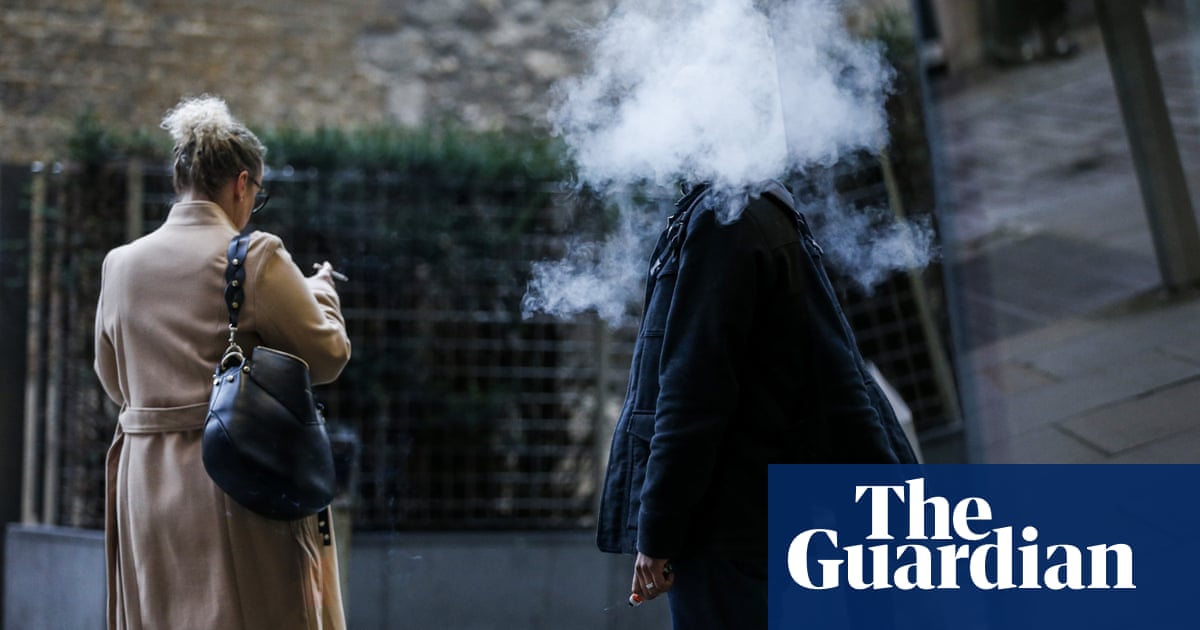
The great vape debate: are e-cigarettes saving smokers or creating new addicts? 


Photograph: Bloomberg via Getty Images


The US is cracking down on vaping while the UK is promoting e-cigarettes as an aid to giving up smoking. Where does the truth lie? By Sarah Boseley


Tue 18 Feb 2020

Gone With the Smoke is already no more than a distant whiff of bubblegum-flavoured vapour. The vape shop and lounge, one of many in San Francisco, has been forced to close. So have Vapor Den (“eclectic lounge & hipster go-to”) and Happy Vape. From late January, it became illegal to sell e-cigarettes and e-liquids in San Francisco. Even online sales to addresses within the city limits have been stopped. Stores outside the city that dispatch e-cigarettes to an SF postcode will face prosecution.

While vaping is banned, sales of legal marijuana and tobacco will continue as usual. San Francisco has often been considered more progressive than the rest of the US in its approach to drugs and unorthodox lifestyles: marijuana was legalised in California for medical use in 1996, after a campaign by Aids activists from the city, and for recreational use in 2016. Vaping, on the other hand, has crossed a line.

Behind the outright ban on sales of e-cigarettes in San Francisco is a panic about teenagers vaping. More than one in four American teens have tried vaping, according to the US Centers for Disease Control and Prevention. A study published in the New England Journal of Medicine reported that 12% of 16- and 17-year-olds were addicted to nicotine, and raised the alarm about the effect of nicotine on the adolescent brain. The Food and Drug Administration (FDA) recently described the use of e-cigarettes as a “crisis among America’s youth”.

“San Francisco has never been afraid to lead. That will always be the case when the health of our children is on the line,” announced the San Francisco city attorney Dennis Herrera in a statement after the ban was passed by the the city legislature last June. He was scathing about the FDA’s failure to control e-cigarette sales. “Now, youth vaping is an epidemic. If the federal government is not going to act to protect our kids, San Francisco will,” he said.


In the UK, meanwhile, the medical establishment is endorsing vaping as an aid to giving up smoking. My local vape shop in London is colourful, thriving, offers a panoply of flavours and displays a banner the length of its storefront proclaiming: “Vaping is 97% safer than smoking, according to NHS and Cancer Research UK.” (The correct figure is 95%, according to a report in August 2015 by Public Health England, PHE, the government executive agency and watchdog that offers guidelines on health protection issues.)

A transatlantic schism has opened up over vaping and health. In the US, the war on vaping is being pursued by activists, politicians and scientists who believe that tobacco companies are cynically promoting e-cigarettes as a means to get people addicted to nicotine, which will – sooner or later – lead them to cigarettes. In the UK, anti-smoking campaigners and health experts counter that for many adult smokers, vaping offers the best hope of avoiding a premature death.

The two sides periodically break into open hostilities. The claim by PHE that vaping is 95% safer than smoking tobacco, frequently quoted by e-cigarette manufacturers and sellers, has been criticised as misleading by anti-smoking campaigners in the US. Matt Myers, who heads the Campaign for Tobacco-Free Kids in Washington DC, the biggest anti-smoking organisation in the world, has called the 95%-safer figure “mere fiction”.

Prof Ann McNeill of King’s College London, a tobacco and addiction expert who advises PHE, defends its position. “We are battling against misinformation on a massive scale,” she says. McNeill acknowledges there has been a rise in vaping among kids in the US and Canada, but does not see it as a reason for panic. “I don’t think it merits discussion of an ‘epidemic’. That word is overblown,” she said.


The soaring popularity of vaping among the young in the US is largely down to Juul – a tiny black or chrome device that looks like a USB stick and fits into the palm of the hand. In 2004, two design graduate students came up with the idea for an electronic alternative to smoking. They launched Juul in 2015, which quickly defined the market; by July 2019, Juul accounted for 75% of US e-cigarette sales. Since then, its fortunes have taken a dive. The company is accused, in dozens of lawsuits from San Diego to New York City, of targeting young users via social media campaigns featuring youthful models. Opponents claim Juul pods are easier for novice vapers to inhale, since they contain nicotine salts instead of straight nicotine, further softened with teen-friendly flavourings such as mango, cool cucumber and creme brulee. Juul has repeatedly denied it has marketed to teens.

There was fresh alarm in the US last year when 2,500 cases of lung disease and 55 deaths were associated with vaping. E-cigarettes work by heating liquid containing nicotine to produce vapour, which is then inhaled. There is no smoke or tar involved, but there are small amounts of chemical flavourings, including diacetyl, which has been linked to lung disease, and propylene glycol or vegetable glycerin. If the e-liquid overheats, formaldehyde can be formed. In fact, none of these chemicals were to blame in these cases – it turned out that the people who fell ill were using bootleg devices containing cannabis – but the reputational damage was done.

In the wake of this alarming spate of hospitalisations and deaths, the New York state governor, Andrew Cuomo, took emergency action in September, attempting to ban flavoured e-cigarette products. President Trump entered the fray, telling the FDA to act and imposing a temporary ban on any flavours that might appeal to young people. In December, New York City mayor, Bill de Blasio, signed a law banning flavours. “Manufacturers of fruit and candy-flavoured e-cigarettes are intentionally and recklessly targeting young people,” said Cuomo, citing flavours including bubblegum, cotton candy and Captain Crunch. The state ban was overturned in January 2020 by Justice Catherine Cholakis, who said it was an overreach.

In the UK, the NHS continues to edge as close as it can to approving the use of e-cigarettes to quit smoking. NHS hospitals in the West Midlands have sanctioned vape stores on the premises, while PHE launched, via YouTube, a video showing two white-coated experts with bell jars demonstrating how e-cigarettes are free of all the disgusting and damaging tar in a conventional cigarette.

The science is furiously disputed. Academics on both sides are accused of cherry-picking data to suit their own prejudices. PHE is a global authority on health issues such as vaccination and obesity, but on vaping, it is looking increasingly isolated. Deborah Arnott, head of Action on Smoking and Health (Ash) in the UK, says that Britain is losing ground in the e-cigarette debate because of the virulent campaign in the US against vaping. “The noise is causing problems in how we are perceived,” Arnott said. “We’re being written off.”


What should be settled by science has become a clash of faiths. In the US, the debate is dominated by those who believe people should “just say no” to drugs. In the UK, there is more support for the idea of “harm reduction”, in which addicts take controlled amounts of their drug, be it alcohol, heroin or in this case, nicotine, to keep them stable.

PHE’s support for e-cigarettes as a tool to help people quit smoking is shared by other respected health bodies, such as the Royal College of Physicians and Cancer Research UK. They point out that the UK regulates smoking and vaping far more rigorously than the US. The UK has rules on age, and health warnings, and caps on the nicotine content. Marketing to young people is forbidden – e-cigarettes cannot be advertised on TV. There is less nicotine in Juul pods or e-cigarette cartridges sold in the UK: Juul in the US contains up to 59mg per ml, while nicotine levels in e-cigarettes across Europe are capped at 20mg per ml by an EU directive enshrined in British law. In the US, at this point, there is no middle ground between unrestricted sales and an outright ban. 

A still from PHE’s video demonstrating how vapes are free from the tar and damaging substances found in cigarettes. Photograph: PHE

All sides agree that vaping nicotine is safer than getting it from cigarettes. Nicotine by itself is “relatively harmless”, according to the NHS, while the harm from cigarettes is in the smoke produced by burning tobacco and the residue of tar it leaves, which damages the airways, causing lung disease and cancer.

“People smoke for nicotine but they die from the tar,” wrote Michael Russell, a professor in addiction at the Institute of Psychiatry in London and a pioneer of harm reduction, in 1976. His work laid the foundations for the introduction of nicotine replacement therapy – the nicotine patches and gum the NHS hands out today.


Russell, who died in 2009, wanted to develop a low-tar cigarette that would be high in nicotine, to give smokers the hit they wanted without inhaling more deeply. His research on the low tar product was funded by the tobacco company RJ Reynolds, now owned by British American Tobacco (BAT). This relationship with a tobacco company, which Russell later claimed was normal practice at the time, is now seen as fatally compromising. It has since been used to undermine his research and attack his reputation.

Ann McNeill, who worked with Russell as a young researcher, believes he was ahead of his time. “His pioneering research improved the quality of life of smokers and saved the lives of many more,” she said in a paper celebrating Russell, co-written with Debbie Robson of the UK Centre for Tobacco & Alcohol Studies. “It is a sad indictment of our community that his work is still not recognised adequately by all those working in tobacco control, some of whom still fail to recognise the centrality of nicotine in tobacco use and the implications of this.”

Anti-tobacco activists – whether they are for or against e-cigarettes – believe they are defending the gains they have made in the battle against smoking. Vaping’s defenders say the tobacco firms are diversifying into a product that won’t kill their customer base. Hardline opponents are convinced e-cigarette sales will keep the hated tobacco companies in business.

The major tobacco companies – Philip Morris, Imperial, British American Tobacco and Japan Tobacco – did not take long to realise the potential of e-cigarettes, and all are now players in the vaping business. Blu, launched in the US in 2009 by an Australian entrepreneur, was bought by Lorillard Tobacco, and later acquired by the British company Imperial. In 2013, BAT launched Vype. In 2015, RJ Reynolds, makers of Camel and Lucky Strike, produced Vuse, which was the most popular brand in the US before Juul came along. Altria, the parent company of Philip Morris USA, acquired a 35% stake in Juul.

Most scientists and health campaigners in the US will have no dealings with the tobacco industry, because of its history of devious marketing practices and underhand tactics. Under the terms of a World Health Organization (WHO) treaty in the early 00s, governments agree not to have any discussions with tobacco industry representatives (over trade terms, for example, taxation, regulation or investment). But anti-smoking campaigners now fear that, by promoting the benefit of their e-cigarettes as an alternative to smoking, tobacco companies are acquiring respectability. WHO shares that anxiety and has advised measures to control e-cigarettes. Many countries, including Brazil, Thailand, Singapore, the Seychelles and Uruguay, have banned e-cigarettes as a result, while others have imposed regulations limiting their use.


Anumber of health professionals and academics have dedicated their careers to exposing lies about the safety of tobacco products and stopping the promotion of cigarettes around the world. Recent hard-won victories include smoking bans in public spaces and plain packaging with severe health warnings. Despite their efforts, there are still over 1 billion smokers in the world. The global cigarette market was worth $888bn (£682bn) in 2018 and forecast to rise to $1,124bn by 2024.

Stanton Glantz, professor of medicine at the Center for Tobacco Control, Research and Education at the University of California San Francisco, is the loudest of the anti-tobacco lobbyists – in his choice of Hawaiian shirts as well as his pronouncements. Glantz claims he was agnostic when e-cigarettes first appeared. He isn’t now. In December, he tweeted: “Using e-cigs increases exposure to toxic chemicals for most users; they would be better off just smoking.”

This was a new extreme, even for Glantz. Alex Berezow, vice-president of scientific affairs at the American Council on Science and Health, described the tweet as “mind-boggling”. “Unfortunately, Dr Glantz has become something of an ideologue. His (justifiable) animosity toward the tobacco industry has been turned (unjustifiably) to other industries, such as vaping,” he wrote on his blog. The research paper that had prompted Glantz’s tweet, Berezow pointed out, actually shows that e-cigarette users get less exposure to toxic chemicals than tobacco smokers – not more.

Glantz, who you have to interrupt if you want to ask a question, told me that in the tweet, he was talking about dual-users – people who are both smoking and vaping. “Maybe it was worded inarticulately,” he conceded. But he won’t back down. He claims the evidence suggests that most people are dual users (in the UK, about a third of vapers are still smoking as well, according to a survey by YouGov).

A giant in the anti-tobacco lobby, Glantz does not understand how researchers he respects can support vaping. Glantz claims that confidence in e-cigarettes, at PHE and among the UK scientists who condone it, is starting to crack. He is convinced the “95% safer” figure is wrong. It came from a paper published in 2014 by a group of experts led by David Nutt – the former government drugs adviser famous in the UK for declaring that ecstasy and LSD were safer than alcohol, which led to his sacking.

“The Nutt paper had no evidence whatsoever. It was 12 guys who sat around and pulled that number out of the air,” said Glantz. “The most generous thing you can say about that paper is that it was much earlier in the process and there wasn’t a lot of evidence out there.” He believes the credibility of Nutt’s group has been undermined by revelations that they were part-funded by a consultancy called EuroSwiss Health, run by Delon Human, a South African doctor who has accepted funding from BAT for some of his ventures.


Nutt says that’s nonsense. The group comprised 12 world experts. “Has [Glantz] ever read the paper?” he said. “There are 14 variables in that paper [possible harms, such as death from cancer]. It looks at the effect of 12 different forms of nicotine on 14 variables. And I bet he wouldn’t actually disagree with any of them.” He gives an example. “Does he actually think that tobacco is not much more harmful than vaping on the likelihood of lung cancer?” The paper, he said, “comes up with an answer he doesn’t want. That’s why he thinks it’s bad science.”Get the Guardian’s award-winning long reads sent direct to you every Saturday morning

Nutt, a professor in neuropsychopharmacology at Imperial College London, says he is “saddened” by Glantz’s attacks. “He was a hero of mine. He was one of the pioneers in demolishing the myth that tobacco wasn’t addictive and opposing the fraud and misinformation and lies of the tobacco industry. But the problem is he is still basically playing the same tune and we’re now in a different era.” It’s proven impossible to stop people selling tobacco, Nutt said. “So the anti-tobacco people have got to attack something else, because that’s what they do – they attack and they ban. So basically they’ve fixed their wagons against vaping because it is one thing they can ban, and they’re very successful. It’s laughable that in India people go to prison for selling vaping when the government allows advertising of tobacco.”

Glantz became an icon of the anti-tobacco movement after he received 4,000 leaked documents from Brown and Williamson, then the US’s third-biggest tobacco company, in 1994. They proved the industry knew that smoking caused cancer and had hidden it. Since then, Glantz has always objected vigorously to any compromise with the industry. In 1997, a deal was broached with the tobacco industry by Matt Myers of the Campaign for Tobacco-Free Kids. It would have brought in tight federal regulatory control of cigarettes, prohibiting the sort of advertising and marketing that is still ubiquitous in the US, as well as sales to children. But Glantz was opposed to any deal that would allow cigarette manufacturers to continue in business. His goal was to close them down altogether. Myers was stymied by his own allies, and the US still does not have the anti-tobacco regulations that are common in Europe.

Myers is calm and quietly authoritative. He is not against harm reduction, he says. Nor are other public health bodies such as the American Cancer Society or the American Heart Association. “All of us have said that under appropriate circumstances, if e-cigarettes are shown to actually significantly help smokers quit or switch completely, and that there are rules in place to prevent them being marketed in a way that doesn’t unduly impact youth, we would be supportive,” he said.

Up until now, on a national level, the US has had no regulatory control of e-cigarette sales, marketing, minimum age, or limits on nicotine content. “It’s the wild west,” said Myers. Tobacco-Free Kids has brought legal action against the FDA over its failure to regulate e-cigarette use and last year won a ruling from a federal judge that there was no excuse for further delay. The e-cigarette companies are irresponsible too, Myers added.

Myers says both sides in the argument interpret scientific studies according to their prior beliefs. He describes PHE’s “95% safer” figure as worthless, because not enough research has been done. “I have very little doubt that e-cigarettes under appropriate circumstances are significantly less harmful to a smoker. Do we know exactly how much less harmful? The answer is no, because we have no clue how much nicotine it is delivering, how pure they are, what else they’re putting in them. Comparing it to the most lethal product ever created, for public relations purposes, is not helpful.”

In March 2018, Myers and Glantz, as well as representatives of PHE and almost every other influential anti-smoking scientist or campaigner, attended the World Conference on Tobacco or Health in Cape Town – just up the road from BAT’s South Africa HQ. At this meeting, held every two years, activists can discuss the perfidy of the industry, celebrate their successes and plan for the future.

Nobody connected with the tobacco industry is allowed in the building. The WHO’s Framework Convention for Tobacco Control, which came into force in 2005, lays down recommended anti-smoking measures for governments, from taxing cigarettes to marketing controls and smoking bans in enclosed public places. It has been signed by 168 countries (the US is a notable exception). The Framework document says governments “need to be alert to any efforts by the tobacco industry to undermine or subvert tobacco control efforts” and must limit their contact to the absolute minimum. Activists now take this to mean there must be an impenetrable wall between themselves and anyone in any way connected with tobacco.

The man who did as much as anyone to establish the Framework Convention while an executive director of WHO, Derek Yach – originally from Cape Town but now based in the US – finds himself on the wrong side of that wall. Yach was pointedly excluded from the conference in his home city – and yet much of the conversation was about him. Yach had done the unthinkable: accepting almost $1bn over 12 years from Philip Morris, makers of Marlboro and other leading brands, to set up his Foundation for a Smokefree World in New York in 2017 to fund research into alternatives to tobacco.

As part of its commitment to a “smokefree future”, Philip Morris International is heavily promoting its e-cigarettes and Iqos, a cigar-shaped electronic device designed to heat, rather than burn, tobacco. “These products will one day replace cigarettes,” it says on its website, claiming to be moving on from tobacco products because “society expects us to act responsibly”. Iqos has taken off in Japan, where 3 million people regularly use them. Smoking there was declining by 2% a year before Iqos arrived, and is now dropping by 10% per year, for which Philip Morris International claims the credit.

Yach believes it’s in the tobacco companies’ interests to develop products that will leave conventional cigarettes behind. His erstwhile colleagues believe he is working for the devil. Why, they ask, does Philip Morris still sell cigarettes if it cares about the world’s health?

As rumours circulated that Yach was in the building or lurking outside, Michael Bloomberg, the billionaire former mayor of New York and funder of vast amounts of anti-tobacco science and programmes, was launching his own campaign. Striding down the hallway, flanked by purple banners emblazoned with the words Bloomberg Philanthropies, the financial backer of the conference and his entourage made their way to the TV cameras to discuss his Stop initiative. Bloomberg announced he has set aside $20m to counter the lies of the tobacco industry. Top of the watch list was Yach’s Foundation. 
Attorney general Letitia James announces 
a lawsuit by the state of New York against 
e-cigarette maker Juul.
 Photograph: Lucas Jackson/Reuters

Bloomberg helps pay for WHO’s work on tobacco. I was offered a five-minute audience – just long enough to ask if he thinks there’s a role for e-cigarettes in combating smoking. “It is like marijuana: one of the stupid things we’re doing is legalising it,” he said. “I think there’s no place for e-cigarettes. I think it’s a terrible idea.”

Yach claims that “A-grade scientists and researchers around the world” are picking up grants from his foundation and doing useful work, but few believe he can succeed. He admits he was taken aback by the strength of feeling. “I wasn’t completely naive about it, but I didn’t actually appreciate how harsh it would be, particularly from a pretty small bunch of people who have incredible influence at WHO,” he says.

Clive Bates, the former head of the UK’s Ash, who blogs and campaigns for e-cigarettes from his home in Nigeria – he is married to the British High Commissioner – said he was amazed by the anti-vaping anger in Cape Town. “It was like a cult, almost,” he said. “Particularly the attacks on the foundation. It’s quite an achievement for Derek to create an institution that has a worse reputation than Philip Morris.”

However, Robert West, a professor of health psychology and director of tobacco studies at UCL, says: “It is playing out beautifully [for Philip Morris]. [The Foundation] has got the tobacco control community arguing among itself and divided. Result.”

In the UK, a small number of prominent public health academics vehemently oppose e-cigarettes. Martin McKee, professor of European public health at the London School of Hygiene and Tropical Medicine, and Simon Capewell, professor of clinical epidemiology at Liverpool, believe the tobacco companies are using e-cigarettes as a route back to respectability. Sally Davies, until recently the UK’s chief medical officer (the most senior government adviser on public health matters), backs a ban on flavours that might attract children. She’s worried that we don’t know the long-term health effects of vaping, which she described as a “ticking time bomb”.

Ann McNeill says there is not much growth in vaping among kids in the UK. Her key concern would be a rise in vaping among young people who have never smoked, but there’s no sign of that. She thinks the key to reducing youth uptake is “getting adult smoking down”, because young people tend to imitate their elders’ behaviour.

She feels she and her colleagues at PHE have been unfairly attacked for saying vaping is 95% safer than smoking tobacco. She points out that they never said it was harmless. A 5% risk of harm, she insisted, “is not an insubstantial number”. She feels that the statement has been twisted as if PHE had said vaping was completely safe.

There is evidence that smoking is going down as e-cigarette use goes up, both in the UK and in the US. In 1942, 82% of British men smoked. By 2006, when e-cigarettes first appeared, 22% of adults in England smoked. The number of smokers is now at an all-time low of 14.7%, while 7% of the UK population are vaping regularly. Bans on smoking in public places, no-logo cigarette packaging with gruesome pictures of tumours, and the removal of cigarettes from sight in shops have all had an impact, but, McNeill says: “All the evidence, I believe, points to e-cigarettes playing a role.”

The best evidence that vaping helps people stop smoking comes from a study showing that e-cigarettes double the quitting success rate compared to gum or other aids. Peter Hayek from Queen Mary University of London and colleagues carried out the trial among more than 880 people who went to the NHS for help to give up smoking. Half were given nicotine replacement therapy in whatever form they wanted, such as patches or gum. The other half were given a starter e-cigarette kit and encouraged to buy their own when it ran out. The results, published in the New England Journal of Medicine in January 2019, showed that, at a year, the quit rate in the e-cigarette group was twice that of the nicotine replacement group, 18% versus 9.9%.

Of course, it did not satisfy the critics. When the researchers went back to the subjects after a year, most of the e-cigarette group were still vaping, whereas few of the ex-smokers in the other group were still chewing gum. So, they insisted, the study showed just how addictive e-cigarettes are.

Juul, once the leading e-cigarette, is struggling against public outrage and bad press. Sales have dropped and hundreds of staff have been laid off. The company said to be worth $38bn in 2018 was written down to $24bn by Altria in October last year, and valued at just $19bn by one of its major investors, Tiger Global Management, in December.

In the storm over child users, and anticipating an FDA ban, Juul stopped selling its fruit medley and mango flavours in the US in October and even dropped mint the following month. In January, the FDA acted, banning all flavours except tobacco and menthol from e-cigarettes that use a cartridge – as the Juul devices do. These are the devices kids use, said the FDA: flavours will not be banned from the refillable e-cigarettes that are more popular with adults. The FDA is also finally getting going on regulation, and has instructed manufacturers of e-cigarettes to apply for a right to trade by May.

The WHO, taking its cue from the US and from Bloomberg, has advised countries to control vaping, warning about the unknown impact on health and stating that e-cigarettes are risky for teenage brains, as well as for the foetus. That may leave the UK isolated, a lone bastion where (highly regulated) vaping is actually encouraged in the hopes of cutting smoking rates. Many public health experts in the UK believe they are witnessing an unnecessary tragedy, and that failure to promote the most promising method of helping people quit smoking is endangering the lives of millions.

McNeill insists public health experts in the UK do care about young people. But those whose lives are at risk are adults living in disadvantaged communities, who cannot kick their smoking habit. “I have lived with smokers and watched smokers die. You want them to do anything they can to prevent them from smoking.”

• This article was amended on 19 February 2020: to clarify that Altria is the parent company of Philip Morris USA and that Iqos is a product of Philip Morris International and to correct an error in attributing a quote from the WHO’s Framework Convention for Tobacco Control.


---30---


The Guardian's Audio Long Reads False witness: why is the US still using hypnosis to convict criminals? – podcast
Podcast
Published:17 Feb 2020

False witness: why is the US still using hypnosis to convict criminals? – podcast
Justin Trudeau Is Under Pressure to Resolve Wet’suwet’en Tensions. Good Luck


CONSERVATIVE Political opponents say nationwide protests are damaging the economy. Indigenous leaders say they will continue to mobilize against the Coastal GasLink pipeline. An easy resolution seems unlikely.

By Anya Zoledziowski Feb 18 2020


PRIME MINISTER JUSTIN TRUDEAU MET WITH CABINET MINISTERS ON MONDAY AFTER FACING MOUNTING PRESSURE FROM POLITICAL OPPONENTS TO ADDRESS ONGOING TENSIONS BETWEEN COASTAL GASLINK PIPELINE PROJECT AND WET’SUWET’EN HEREDITARY CHIEFS. ADRIAN WYLD (CP)


Prime Minister Justin Trudeau cancelled a diplomatic trip to convene an emergency meeting with officials as rallies in support of Wet'suwet'en hereditary chiefs continue across Canada, blocking railways, border crossings, and city streets.

He said his hope is to resolve ongoing tensions as quickly as possible.

Trudeau met with cabinet ministers on Monday to discuss the standoff currently taking place in B.C. between the Coastal GasLink pipeline project and Wet’suwet’en land defenders who say their leadership never sanctioned the proposed $6.6 billion pipeline, which would travel through Wet’suwet’en territory, if built. Trudeau, Deputy Prime Minister Chrystia Freeland, and several additional cabinet ministers also discussed the subsequent rail blockades by Wet’suwet’en supporters that are currently hamstringing the majority of Canada’s train routes.

The meeting was planned after Trudeau faced mounting pressure from political opponents, including outgoing Conservative leader Andrew Scheer, Ontario Premier Doug Ford, and NDP House Leader Peter Julian, to cancel his trip to the Caribbean and address the pro-Wet’suwet’en protests currently blocking Canada’s rail system.

The railway blockades, which have halted more than 400 trains, are threatening part of the country’s economic framework, with rail responsible for about $200 billion towards Canada’s gross domestic product (GDP) a year. CN claims that the temporary shutdown might lead to layoffs in the future. Teamsters Canada, which represents rail workers, said 6,000 jobs are at risk.

Monday’s meeting emphasized the “urgency of the situation and the need for ministers to continue to be engaged at all levels to resolve this quickly to minimize these very real impacts on Canadians,” according to a statement released by the prime minister’s office.

“We’re going to continue to focus on resolving the situation quickly and peacefully,” Trudeau said, while reaffirming the political right to peaceful protest.

Now, federal and B.C. ministers tasked with Indigenous engagement are calling for a meeting with Wet’suwet’en hereditary chiefs at the “earliest opportunity,” so a resolution can be discussed.

But neither side says it’s willing to stand down, throwing the possibility of resolution into question. B.C. Minister of Indigenous Relations and Reconciliation Scott Fraser said the province will not falter on its support for the pipeline, while Wet’suwet’en hereditary chiefs say they will continue to oppose the project.

Some land defenders are hoping Canada’s top officials will take a more hands-on approach in response to ongoing demonstrations.

“Sitting in offices and going through all these meetings is one thing but actually coming out and seeing with your own eyes, that could be a little bit different,” a Wet’suwet’en supporter from Tyendinaga, Jarden Persaud, told CTV News. Tyendinaga Mohawk Territory sits near Belleville, Ontario, where one of the major railway blockades is taking place.

Trudeau isn’t the only leader pressing for quick action. The national chief of the Assembly of First Nations said he would speak with reporters first thing Tuesday morning to discuss the ongoing tensions in B.C.

Rallies ramped up over the holiday weekend as Wet’suwet’en supporters marched through popular streets in Montreal, Vancouver, Regina, and Toronto. Many also blocked the border entry point near Niagara Falls and the Thousand Islands Bridge, which sits just east of Kingston, Ontario, and connects Canada and the U.S.

Follow Anya Zoledziowsi on Twitter.