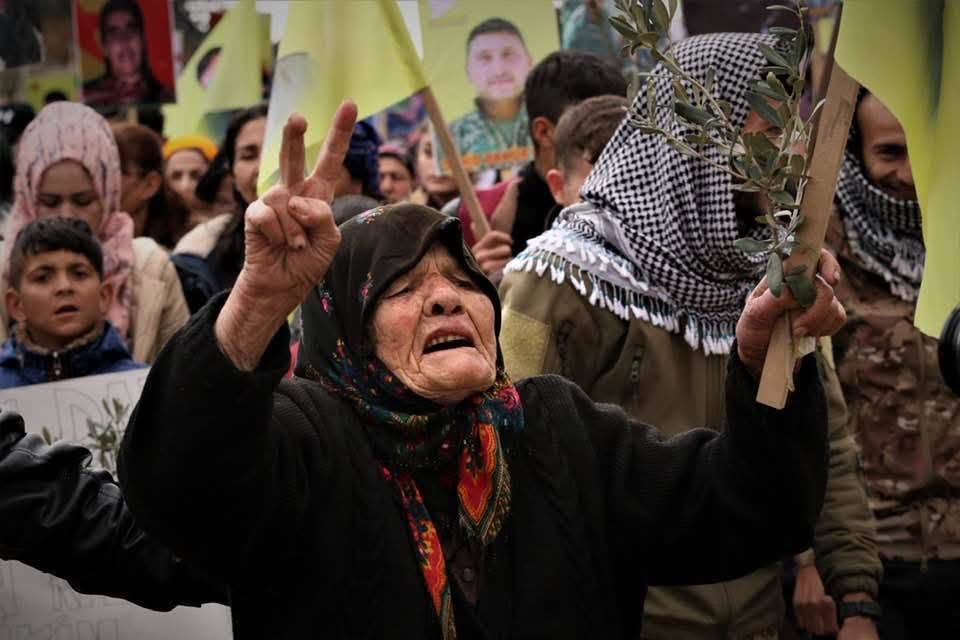
The attacks targeting the Kurdish neighborhoods of Sheikh Maqsoud and Ashrafiyah in Aleppo are not the products of instantaneous military developments or local clashes; they are inherently a part of a multi-layered and conscious political sabotage strategy of the invader, colonialist Turkish state.
The brutal massacre attacks directed at the Kurdish neighborhoods in Aleppo through the Turkish state and the jihadist paramilitaries it supports named Hayat Tahrir al-Sham (HTS) and the Syrian National Army (SNA) are an organized move aimed at neutralizing the political impact of Kurdish People’s Leader Abdullah Öcalan’s message for the year 2026 and his February 27 statement, which constitutes its essence.
These attacks are neither a tactical reflex nor a secondary extension of the struggles for control on the ground. They are a counter-revolutionary intervention, planned with the state mind, aiming to prevent even the possibility of a solution to the Kurdish question from becoming visible.
The February 27 statement is dangerous for Ankara as much for the calls it contains as for the historical moment it represents. This statement has once again revealed that the Kurdish question cannot be managed with policies of armed denial, suppression, and distraction; it has expanded the address of the solution to point not only within the borders of Turkey but to the entirety of the regional Kurdish reality.
The 2026 perspective has also temporarily squeezed the state policy based on making the Kurds’ lack of status permanent. This very squeeze has triggered the fundamental reflex of the AKP–Erdoğan regime: Not to advance the solution, but to annihilate even the fragments of the possibility of a solution.
At this point, the fundamental goal of the fascist Turkish state is clear: To break the military and political backbone of the de facto Kurdish status emerging in Rojava, Northern and Eastern Syria. The YPG, YPJ, and Syrian Democratic Forces are not only the military power of this status but also the concrete realization of Öcalan’s paradigm on the ground.
Therefore, the problem for Ankara is not only the armed structures but the political-ideological ground upon which these structures rest. Öcalan’s message was targeted precisely because it carries the potential to legitimize this ground and make it visible again on a regional scale.
In line with this goal, the Turkish state first tried the path of direct political pressure. For example, the impositions toward Öcalan carried the aim of expanding the content of the message and establishing the connection that it is not only an intra-Turkey call but also directed toward Rojava. All these attempts of the fascist Turkish state were neutralized by Öcalan. Subsequently, parliamentary delegations were put into play, and meetings were held, but again, the desired result could not be obtained.
Because Öcalan’s February 27, 2025 call and the Manifesto of Democratic Society are only related to the PKK. They were not made toward organizations in other parts of Kurdistan. The PKK, for its part, has taken the steps falling upon it based on Öcalan’s calls until today. Through the steps it has taken, the PKK has clearly diagnosed and exposed that the fascist Turkish state does not show a sincere and concrete will for a solution.
The critical point that must be underlined here is this: The fascist Turkish state has no solution plan regarding the Kurdish question. This is not a deficiency but a conscious choice. If there were such a plan, it would have had to be reflected in legal and constitutional regulations by October 2025 at the latest.
However, the state deliberately spread the process over time and tried to pacify the Kurdish Freedom Movement with tactics of distraction and postponement. It did not limit this only to Northern Kurdistan (the part in Turkey) but tried to spread it to the parts of Kurdistan in Iran, Iraq, and Syria as well. This is the classic fascist Turkish state mind that does not produce a solution but manages the lack of solution.
While this distraction continued inside, a harsher tool was put into play outside: Proxy war.
The driving of jihadist gangs HTS and SNA onto the stage in Aleppo, especially in Sheikh Maqsoud and Ashrafiyah, is a direct result of this strategy. These Kurdish neighborhoods were not chosen randomly. Sheikh Maqsoud and Ashrafiyah are the military, political, and social vanguards of the Rojava revolution in Aleppo.
These neighborhoods are living examples of how Öcalan’s paradigm can be vitalized even under urban conditions, siege, and war. Therefore, the attack toward these areas is directed not only at Kurds but at an idea, a model, and a future.
The role of HTS and SNA in this process is not limited to simple subcontracting. These structures are the most functional tools that the fascist Turkish state mind can use on the ground.
Because they both possess anti-Kurdishness ideologically and are actors who can be easily criminalized in the international arena and discarded when necessary. In this way, Ankara aims to achieve strategic benefits from the results without appearing as the direct perpetrator of the attacks. This is a classic dirty war method.
The timing of the attacks against Sheikh Maqsoud and Ashrafiyah also gains meaning in this context. These attacks intensified at a moment when Öcalan’s message began to be discussed much more by the public as of 2026, and the possibility arose for the Kurdish question to be talked about again on the axis of a political solution.
The aim is clear: To pull the agenda back to the axis of security and violence, to create distrust toward Öcalan among the Kurdish people, to create distrust and contradictions between the PKK and Öcalan to fracture and weaken the Kurdish Freedom Movement. And most importantly, to imprison Kurds in a defensive position and suffocate the solution discussion. War, here, is not only a result but inherently a tool.
The targeting of Sheikh Maqsoud and Ashrafiyah is also a threat. The message is clear: If there is no laying down of arms by the Syrian Democratic Forces in Rojava, Northern and Eastern Syria, there will be civilian massacres in Aleppo. And this will not be limited only to the two Kurdish neighborhoods in Aleppo.
This is a message given not only to Kurds but also to the international community. The Turkish state is putting the Kurdish issue on the table again as an element of instability and trying to show that it holds the key to this instability.
The political meaning of the attacks directed at Sheikh Maqsoud and Ashrafiyah in Aleppo cannot be explained only by Ankara’s tactical choices. These attacks are a current manifestation of the structural reflexes of the fascist Turkish state mind regarding the Kurdish issue, spanning over a century. This reflex, at every moment a possibility of a solution appears, turns toward destroying the possibility of a solution, not the problem.
Because for the Turkish state, the Kurdish question is not an issue to be solved, but an anomaly to be managed, spread over time, and suppressed with violence, blood, and massacres under suitable conditions.
Öcalan’s February 27 statement and the 2026 perspective could not be stomached and were targeted because they created a threshold that disrupted this management strategy. This threshold forced a rethinking not only of intra-Turkey balances but also of regional Kurdish geopolitics. The self-governance model that emerged in Rojava has de facto surpassed the paradigm that imprisons the Kurdish issue within nation-state borders.
YPG, YPJ, and the Syrian Democratic Forces, beyond being military forms of this surpassing, are the social-political expression of Öcalan’s paradigm. The moment these forces lay down their arms, the issue will not be solved; on the contrary, the military, political, and social gains of the Kurds will be left defenseless and put into a liquidation process. Ankara’s persistent imposition of disarmament stems not from a will for a solution but from an intention for liquidation.
For this reason, the Turkish state wanted to expand Öcalan’s message and not reduce it only to a “call for disarmament” inside Turkey. The regional dimension of the message, the political horizon covering Rojava, Northern and Eastern Syria, is unacceptable for Ankara. The fact that the impositions remained inconclusive directed the state mind to harsher and indirect tools.
The putting of parliamentary delegations into play was the soft face of this harshness. But these attempts also did not produce a solution because the state did not offer a concrete roadmap. Distraction, uncertainty, and spreading over time were operated as a conscious strategy.
The complementary pillar of this strategy in foreign policy is the use of proxy forces. HTS and SNA are as functional here as they are ideologically anti-Kurdish. But structures provide Ankara with two advantages: First, the capacity to produce violence without taking direct responsibility. Second, deniability thanks to their ability to be presented as “out-of-control actors” in the international arena. However, the logistics, timing, and target selection of the attacks in Aleppo show that this denial is not convincing.
The selection of Sheikh Maqsoud and Ashrafiyah is not a coincidence. Because these neighborhoods are the political reflection of Rojava in Aleppo. The life established here has shown that Öcalan’s paradigm can become socialized even under war conditions.
Communes, councils, women’s leadership, and self-defense have been able to produce order, not chaos, in the absence of the state. It is precisely this reality that Ankara fears most. Because as long as these neighborhoods stay on their feet, the discourse of “if you lay down arms, there will be a solution” loses its credibility.
HTS’s role in these attacks cannot be explained only by ideological fanaticism. HTS is a theocratic power project supported by the USA, EU, Saudi Arabia, Qatar, and the Turkish state, aiming to take society under absolute obedience. This project is in an existential conflict with a pluralistic, women-liberated, and communal life.
Sheikh Maqsoud and Ashrafiyah are not only a military target for HTS but an ideological bankruptcy. As long as these neighborhoods exist, HTS’s claim of an “Islamic order” collapses. For this reason, the attacks are fed by ideological hatred more than military necessity.
The SNA, on the other hand, performs a more naked function in this picture. Demographic transformation, looting, and forced displacement are the basic practices of the SNA. These practices overlap exactly with the long-term goals of the Turkish state regarding Rojava and its surroundings.
The fragmentation of the Kurdish population, the breaking of social continuity, and the dispersal of the political subject is a much more effective liquidation method than disarmament. The attacks in Aleppo are the testing ground for this method.
The fact that the PKK has taken the steps falling upon it inside has not strengthened the state’s hand; on the contrary, it has made the state’s distraction politics more visible. Because every step taken toward a solution requires concrete regulations in return.
However, as of October 2025, the legal regulations that should have been made were not made, constitutional discussions were not started, and instead of preparing the public for the idea of a solution, it was surrounded again by security discourse. This shows that the process was consciously suspended.
The attacks in Aleppo are precisely the external front complement of this suspension policy. An equation has been established in which Kurds are distracted by the discourse of “adherence to the process” on one hand, and forced to pay a price on the ground on the other.
This equation is built on either pushing the Kurdish side out of the process with a defensive reflex or forcing them into unconditional disarmament. In both cases, the winner will be the state mind that aims for liquidation, not a solution.
The form of the attacks directed at Sheikh Maqsoud and Ashrafiyah in Aleppo reveals in all its nakedness how the Ankara-centered strategy operates. The violence applied here is not the product of a war logic aiming for military gain; it is a calculated and time-spread social destruction technique aimed at producing political results.
Civilian massacres, siege, the targeting of infrastructure, and forced migration are the real language of the disarmament imposition on the ground. This language is the language of threat, not negotiation.
The systematic targeting of civilian areas cannot be explained as a control error or a lack of discipline. The houses, schools, markets, and health points hit in Sheikh Maqsoud and Ashrafiyah are the result of a conscious choice aiming to weaken the collective living capacity of Kurdish society.
Because Ankara’s strategy assumes this: The more price the society pays, the more effective the pressure for disarmament will be. This assumption is an expression of having never understood Kurdish history and the sociology of resistance.
Siege is the central tool of this strategy. Siege is not only a military technique; it is a political practice that paralyzes social time, fragments daily life, and aims to erode hope. Sheikh Maqsoud and Ashrafiyah have been wanted to be taken over many times with this method.
But every time, it has been seen that the siege did not produce the expected result. Because in these neighborhoods, society takes its strength not from the security provided by the state, but from its own organized existence. Hunger and deprivation have produced solidarity, not dissolution.
Forced migration and demographic pressure are the complementary elements of the disarmament policy. The aim is to break social continuity rather than to physically destroy Kurds. With every family forced to migrate, a memory line, an experience of organization, and a political bond are intended to be broken. However, the example of Sheikh Maqsoud and Ashrafiyah shows that this calculation also does not hold. Because these neighborhoods have produced a political culture that is not limited to space. The one who migrated carried this culture along with them.
At this point, it is necessary to read correctly the equivalent of the disarmament imposition on the ground. The expectation of the Turkish state is that the increasing violence will narrow the Kurdish movement with a defensive reflex and distance it from political initiative. However, what is experienced is exactly the opposite.
The attacks in Aleppo have made it clearer in Kurdish society not the need for a solution, but under which conditions a solution cannot be possible. Calls for laying down arms toward Rojava, Northern and Eastern Syrian defense forces are perceived under these conditions not as the name of peace, but as surrender.
For this reason, the goal of disarming the YPG, YPJ, and Syrian Democratic Forces finds no response on the ground. Because these forces are not only military structures but the institutionalized forms of social defense. In Sheikh Maqsoud and Ashrafiyah, the weapon is not a tool of power but a limited defense mechanism that protects the continuity of life. When this mechanism was removed, not peace but massacre arrived. The experience in Aleppo has revealed this truth with all its clarity.
The attitude of international actors is also an inseparable part of this process. Silence is not neutrality but a functional approval. As long as the Great Powers see the goal of disarming Kurds as compatible with their strategic interests, they have ignored what happened in Aleppo. Human rights discourse functioned as a showcase at this point and veiled the reality on the ground. This situation has once again confirmed the following for Kurds: A people who entrust their own security to someone else’s conscience is historically doomed to lose.
The language of the media also forms the ideological ground for this approval. Concepts like “clash,” “mutual fire,” and “security operation” erase the difference between the aggressor and the defender. However, what is experienced in Sheikh Maqsoud and Ashrafiyah is not a mutual clash but a unilateral attack aimed at suffocating the possibility of a solution. This language not only distorts the truth but also normalizes violence.
This whole picture clearly shows why the goal of disarmament is doomed to fail. As violence increased, Kurdish society turned not toward laying down arms but toward stronger organization. Because what has been experienced has proven many times that weaponlessness does not bring security; on the contrary, it creates vulnerability. The attacks in Aleppo are the most current and most painful example of this historical lesson.
The massacres directed at Sheikh Maqsoud and Ashrafiyah were designed not to accelerate the disarmament process, but to force consent to this process. However, this design worked in reverse on the ground. The stage reached by the attacks directed at Sheikh Maqsoud and Ashrafiyah in Aleppo makes visible the bankruptcy of a political mind, not just a military concentration. This bankruptcy declares the non-solution of the solution imposed by the gun, that the politics of distraction has been exhausted, and that proxy violence cannot cover the truth.
At the point reached today, the aggression carried out by Ankara through HTS and SNA has not eliminated the historical threshold pointed out by Öcalan in his February 27 statement; on the contrary, it has made the inevitability of that threshold even more distinct.
The reason why Öcalan’s paradigm is strengthened under these conditions is not a superiority of discourse, but a correctness of practice. Sheikh Maqsoud and Ashrafiyah have made possible a life where the weapon is not sanctified but defense is mandatory, and where power is not centralized but politics is socialized.
This life has surrendered to neither the statist security doctrine nor to jihadist theocratic tyranny. For this reason, the attacks aimed at denying the possibility of this life more than weakening these neighborhoods militarily. But denial does not eliminate the truth; it only makes it more visible.
The fundamental fallacy of the Turkish state is that while presenting disarmament as a prerequisite for peace, it has not been able to guarantee security and life. What happened in Aleppo clearly showed that weaponlessness produces not a solution but a fragility under these conditions.
For this reason, the idea of laying down arms in Kurdish society has become identified not with peace but with defenselessness. This identification is the product of concrete experiences, not an ideological stubbornness. The attacks in Sheikh Maqsoud and Ashrafiyah have engraved this experience into the collective memory.
At this point, the conditions for a solution have become clearer. A solution is possible through mutual and concrete assurance, not through imposition. A solution advances with open legal and constitutional steps, not with distraction calendars. A solution can be established with a political courage that recognizes the regional Kurdish reality, not with proxy wars. The regulations not made in October 2025 showed not the deficiency but the absence of this courage. This absence was tried to be compensated for with violence in Aleppo.
The resistance of Sheikh Maqsoud and Ashrafiyah is, therefore, not only a defense success but a political criterion. These neighborhoods have clarified under which conditions there cannot be a solution. There can be no solution on a ground where weapons are silent but justice does not speak, where negotiation is voiced but the law is not operated, and where peace is promised but security is not provided. The attacks in Aleppo have revealed this truth with all its clarity.
The presence of HTS and SNA on the ground has shown that these attacks do not produce legitimacy but only multiply the dirty face of violence. The language, method, and goals used by these structures supported by the fascist Turkish state have not distanced Kurdish society from a solution; on the contrary, they have confirmed that a solution can only be protected by self-defense and political organization. This confirmation is not a temporary mood but a historical lesson.
The silence of the international system is also a part of this lesson. The atrocity experienced in two Kurdish neighborhoods in Aleppo has once again exposed how conditional and interest-oriented the peace discourses of hegemonic powers are. This silence did not produce a new illusion in the political mind of the Kurds; it reinforced an old truth: Peoples who tie their own fate to someone else’s calendar have to postpone their own future.
The resistance in Sheikh Maqsoud and Ashrafiyah is the concrete expression of rejecting this postponement. It must be clearly stated here once again: The attacks directed at Kurdish neighborhoods in Aleppo are not a security problem. They are a political sabotage. This sabotage aimed to suffocate the historical opportunity opened by Öcalan’s 2026 perspective and the February 27 statement. However, this goal did not find its response on the ground. Because what is defended in these neighborhoods is not just a call, but a lived and living truth.
Sheikh Maqsoud and Ashrafiyah stand today not only as two resisting neighborhoods but as İwo political laboratories showing on which ground a solution is possible. The result of this laboratory is clear: Peace begins not with the silencing of weapons, but with the securing of life.
A solution is possible through mutual recognition and concrete transformation, not through surrender. This truth has become even more clear among the ruins of Aleppo.
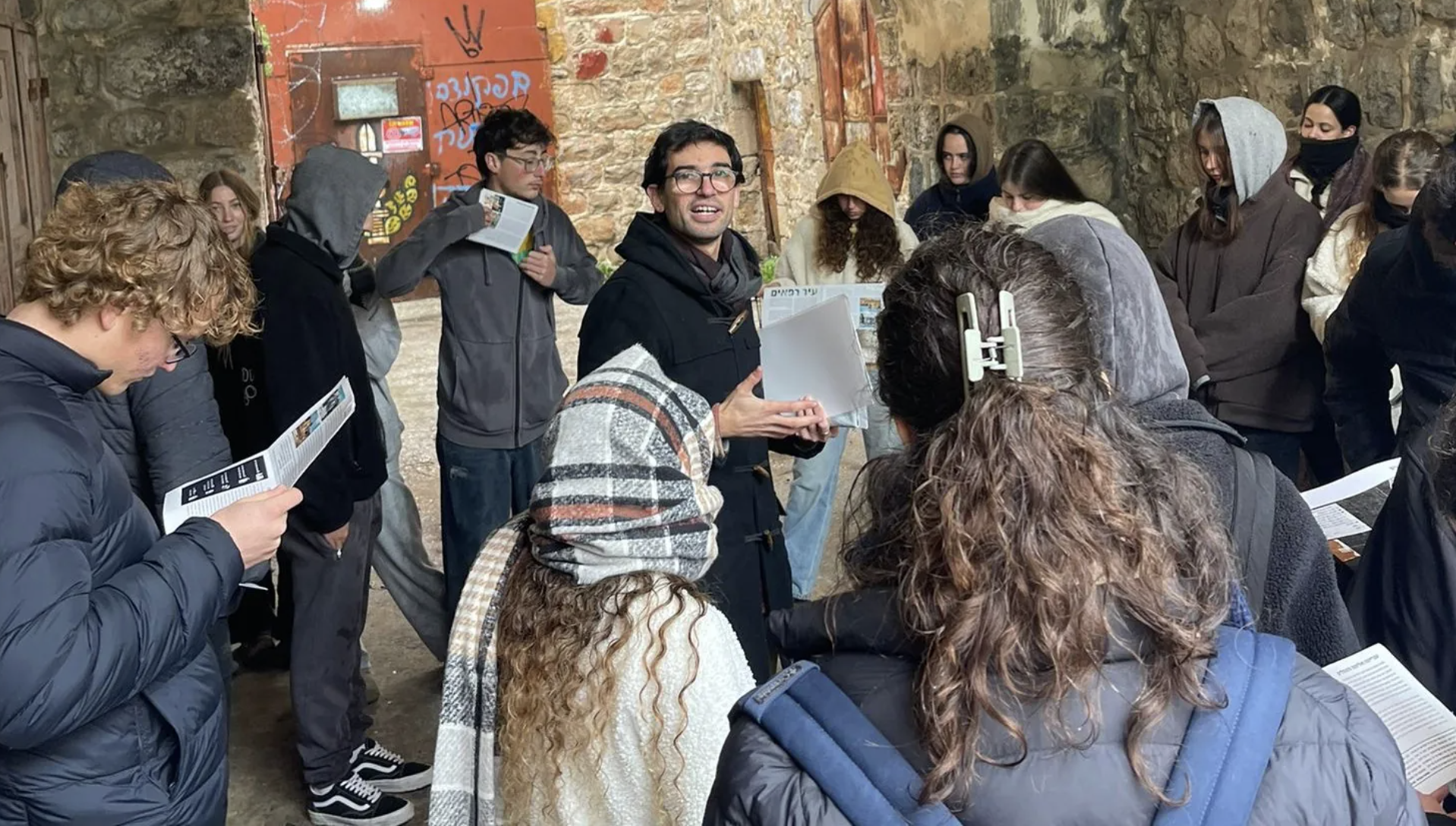
A tour group stood on Hebron’s Al-Shuhada Street, listening as a former Israel Defense Forces soldier pointed out, on a map, the nine roads in the West Bank city that Palestinians are restricted or prohibited from accessing.
Once a bustling market hub, Al-Shuhada Street was now quiet and devoid of pedestrians, aside from a nearby guard post from which three or four soldiers were coming and going, watching the group.
The visitors were taking part in a guided tour run by Breaking the Silence, or BTS, an organization founded by former IDF soldiers. BTS uses soldiers’ testimonies, political tours and advocacy to expose how Israel’s occupation of the Palestinian territories functions on the ground and to challenge Israelis to confront the moral cost of maintaining it.
As the group listened to their guide explain the separation policy in Hebron, a private tour passed by. “That’s Breaking the Silence. They spread lies about Israel, about us,” their guide said loudly.
Joel Carmel, the BTS advocacy director and guide that day, nodded in the man’s direction without pausing his explanation.
“Our right-wing detractors accuse us of not showing both sides [of the occupation],” Carmel said, speaking on the phone a few days after the tour. “It’s ironic, because what we’re showing is the Israeli side — whether our detractors like it or not.”
“We want to show what the occupation looks like, from the perspective of the perpetrators,” he continued. “What the commands were and what the interactions look like between soldiers and Palestinians.”
BTS publishes anonymous testimonies from soldiers who have served in the occupied Palestinian territories on its website in collections, such as “Occupying Hebron: Soldiers’ Testimonies from Hebron 2011-2017.”
“The point of the testimony collection is not to draw out specific incidents and say, ‘Look how terrible this soldier was,’” Carmel said, “it’s to show that what we’re being sent to do is a policy that comes from above.”
He explains that each testimony is like a puzzle piece. “Put them all together [and] you get a good sense of what it actually means to be an occupying force over millions of people, subjected to a military regime.”
On Breaking the Silence’s website, thousands of testimonies detail soldiers’ experiences in the military, from the routine to the extreme. They reveal explanations of code names, warfare tactics, operation objectives, recollections of conversations with officers, and often the moments that led soldiers to testify.
Testimonies are categorized under headings that range from “law enforcement,” “patrols” and “checkpoints” to “desecration of bodies,” humiliation” and “human shields.”
Founded in 2004, BTS initially set out to collect testimonies from soldiers who served during the Second Intifada of 2000-2005. Since then, more than 1,500 former soldiers have come forward.
An entire category is dedicated to the genocide in Gaza: Since it began, BTS has seen an influx of new testimonies, especially from reservists.
Carmel believes that the older age of reservists explains this increase in testimonies. “They are sent to do unbelievable things at a stage in their life when they have kids, a job, when they’ve made up their minds politically,” he said. “They stop and think ‘What am I doing here?’ in a way that maybe an 18 or 19-year-old doesn’t.”
Young Israelis have few spaces where conversations about the occupation are held — not even schools.
Carmel notes that, before joining the military, he had little opportunity to hear from Israelis who were critical of the occupation. “In our education system, the word occupation doesn’t feature at all.”
In addition to limited public discourse, many Israelis are too young to remember a time before the occupation. “So many people can’t even imagine a reality without constant war, constant fighting,” Carmel said. “For my generation and for my parents’ generation, we don’t know a time when we weren’t an occupying force.”
As a result, occupation has become a permanent part of Israeli identity. It also makes military actions taken in the name of “security” easy to justify to the Israeli public.
BTS sees tours and testimonies as tools to disrupt this normalization and raise the question: “To what extent should security justify the occupation and abuse of another population?”
“They’re meant to be wake-up calls, like — ‘do you realize how not normal this is?’” Carmel explained.
BTS runs two political tours: one in Hebron’s H2 area, the section of divided Hebron that is under Israeli military administration, and a second in the South Hebron Hills, focusing on the village of Masafer Yatta, where Palestinians face near-daily settler violence, home demolitions and displacement.

Tours trace how Israeli policies target Palestinians businesses, limit their movement and steadily push residents out of the area, while protecting Israeli settlers and the expansion of illegal settlements.
“If Hebron is the occupation at an urban level,” Carmel said, “Masafer Yatta provides the rural perspective.”
Participants also have the opportunity to meet with local Palestinians and hear their experiences of life under occupation. In Hebron, groups meet with Issa Amro, a Palestinian nonviolent activist and the founder of Youth Against Settlements, an organization based in H2 that seeks to end the expansion of illegal Israeli settlements and the end of occupation.
Amro explains that the Israeli military is everywhere in H2. “The city is full of surveillance and facial recognition cameras. It’s a violation of our privacy.”
On his Instagram account, Amro publishes videos and photographs of soldiers and settlers assaulting Palestinians. He says he sees BTS as an important voice in Israel, speaking out against the occupation. “I’ve been collaborating with Breaking the Silence for more than 20 years,” Amro said. “I feel we are partners in the same goal: to make peace and to make the occupation costly.”
For Amro, the collaboration offers a chance to speak with Israelis and international Jews directly. “I tell [Israeli visitors] to be changemakers, to be peacemakers,” he said. “I tell them to not stay silent about what’s going on around them or to be on the side of occupation. I remind them that ending the occupation is the only way for security for all.”
BTS’s tours attract tourists, diplomats and journalists, but recent protest movements within Israel have also brought new local participants, says Carmel. The mass protests that broke out in 2023 against Prime Minister Benjamin Netanyahu’s judicial reform proposals are leading more Israelis to open conversations about power and democracy. “People are beginning to think a little bit more critically,” Carmel said.
The consequences of ignoring the reality of occupation are already visible in Israeli society, Carmel says during the Hebron tour, from rising unemployment to increased alcoholism and domestic violence. “You can see how [being an occupying force] has been so toxic for Israeli society. There’s so much violence in our society, there’s so much aggression,” he said.
Beyond the social damage, BTS argues that the occupation is failing to fulfill its own stated claim of security, with considerable resources spent on protecting settlers and settlements over citizens.

Between 1,000 and 1,500 soldiers patrol the streets of H2, where 700 Israeli settlers live at the heart of the city. That’s one or two soldiers for every Hebron settler, according to Amro.
Hamas’s attack on Israel also exposes the imbalance of resources. On the morning of Oct. 7, 2023, BTS says there were more than 30 battalions of infantry and combat soldiers in the West Bank, and two and a half positioned across the entire Gaza border.
“Israel’s security policy for decades now, has been to ‘manage the conflict,’” BTS wrote in a report published days after the October attack.
“Apart from the unfathomable violation of human rights, we’ve created a massive security liability for our own citizens,” the report continued. “Our country decided — decades ago — that it’s willing to forfeit the security of its citizens in our towns and cities, in favor of maintaining control over an occupied civilian population of millions, all for the sake of a settler-messianic agenda.”
Despite these failings, organizations like BTS are sidelined as extreme, radical left, unpatriotic or traitors.
Carmel described representing BTS at mechinot, pre-military preparatory academies, where gap year students are offered programs on leadership and national identity, and presented with different viewpoints from Israeli society.
“[The students] have a tour or a lecture with us and then immediately after that they’ll meet with settlers, or hardcore right-wing groups,” he said. “It’s always so mind-blowing. They’ll have me, and then they’ll have [Itamar] Ben Gvir. It’s a testament to the way Israeli society perceives us.”
Anger towards BTS’s message has led right-wing groups to attempt to discredit the organization’s work, which have included attacks on the veracity of testimonies, attempted infiltration and even physical threats.
In 2020, right-wing Israeli activist organisation Ad Kan petitioned the attorney general of Israel to open an investigation into BTS’s testimony collection for endangering national security. The criticism has caused many “middle-of-the-road” Israelis to not want to interact with a group considered radical, Carmel said.
The Israeli government has also sought to constrain the organization through legislation. In December 2025, the Israeli Knesset held its first reading of a bill targeting Israeli organizations receiving donations from foreign state entities.
Over half of BTS’s funding comes from foreign governmental entities, the organization’s website reads. The bill, which is worded to affect left-wing groups while protecting right-wing organizations, would make it impossible for BTS to do its work if it passes, Carmel said.
In 2016, the Israeli State Attorney sought a warrant for the disclosure of documentation regarding the identity of BTS testifiers who served in Gaza in 2014.
At the same time, opposition has raised BTS’s international profile and encouraged more Israelis to speak out about their military service.
For BTS, the current Netanyahu government’s methods — from the judicial overhaul to the funding bill — indicate that occupation policies are being replicated in Israel, with little public resistance.
“Israelis have become used to the idea that it’s somehow legitimate to have groups of people who simply aren’t eligible for democratic rights,” Carmel said. “Once that’s become normalized with regards to Palestinians from the occupied territories, it’s not a big leap to imagine that logic being rolled out here in Israel too.”
There’s a lot more work for BTS to do, such as continuing to collect testimonies from those who served in Gaza and drawing attention to what BTS calls a ‘Gaza-fication’ of the West Bank.
“A lot of what we saw in Gaza has already been translated into action in the West Bank,” Carmel said, pointing to the standards that became normal during the war in Gaza, the rules of engagement, the weaponry used and the military mindset from Gaza.
In Gaza, the October 2025 ceasefire and U.S. President Donald Trump’s Gaza peace plan have been framed as the end of fighting and the wider conflict.
Instead, BTS sees that the situation in Gaza has defaulted to how it was before Oct. 7, with Israel continuing to control the enclave. However, humanitarian conditions in Gaza are far more dire. Despite the ceasefire, Israeli strikes have killed at least 477 Palestinians in the past three months, according to the Gaza Health Ministry. With much of the enclave flattened by airstrikes, around 1 million Gazans lack adequate shelter and 1.6 million face high levels of acute food insecurity, the UN has reported.
“It’s just another form of managing the conflict, and it’s the same recipe that led us to October 7, and there’s no guarantee that it won’t happen again,” said Carmel. “It’s not a solution at all. We have to be clear with the Israeli public and the international community [that] there won’t be peace or security for Palestinians or Israelis until the occupation ends. That’s really our goal.”

No comments:
Post a Comment