
Bitcoin Country
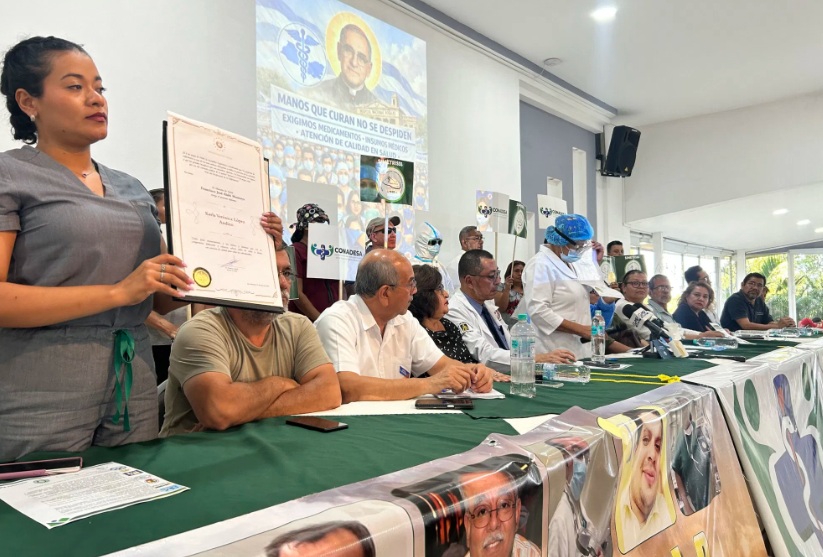
Juan Hernández arrived at the Jan. 7 press conference in a uniform that became commonplace in 2020 during the COVID-19 pandemic: full-body white medical protective gear, including a cap, mask and safety goggles. When it was his turn to speak, he read a statement calling for dialogue to negotiate fair severance packages or the reinstatement of more than 1,800 employees laid off from the Rosales Hospital in San Salvador on Dec. 23, 2025 — the last working day before the Christmas holiday break. This hospital was the country’s main primary health center.
“They used to call us heroes,” says Karla Verónica López, another health care employee laid off in December, referring to the pandemic. Hernández and López held up their diplomas and a medal they each received in recognition of their work during that time.
Estimates from several organizations place the number of public health care sector layoffs in 2025 alone between 7,000 and 8,000, in a country of 6.4 million people. The government has not explained these cuts, but they are likely due to the government’s efforts to meet the International Monetary Fund’s requirements for a US$1.4 billion loan. Another requirement of that loan, granted early last year after a staff-level agreement was signed in December 2024, was restricting the use of the cryptocurrency Bitcoin in public finances.
On Jan. 9, the laid-off workers from Rosales Hospital reported they weren’t able to file the paperwork to receive their severance pay, as the health ministry was refusing to provide them with necessary details like their start date. That same day, pro-government media outlet Diario El Salvador posted on X about the upcoming second edition of the Bitcoin Golf Invitational, a tournament organized by U.S. couple Max Keiser and Stacy Herbert, two prominent Bitcoin advocates very close to President Nayib Bukele.
El Salvador became the first country in the world to make Bitcoin legal tender when it passed its Bitcoin Law in 2021, and Bukele justified the move as a way to facilitate greater financial inclusion. But that rosy picture of financial prosperity and economic inclusion has materialized for only a small, elite few.
Today, even Bukele has acknowledged the economic hardships most Salvadorans are facing, but crypto believers’ activity in El Salvador has not slowed. In the five years since Bukele rebranded El Salvador as the home of Bitcoin, the divide between a tiny elite class and the majority of the country’s population has only grown wider.
“When analyzing income, using local data from the Household and Multipurpose Survey, I’ve found that the population with incomes of less than US$500 (monthly) makes up nearly 75% of the population,”’ economist and university professor José Luis Magaña explains to Truthdig. “In contrast, the population with incomes above US$2,500 — well, we’re talking about 0.49%.
“The government promotes an image of prosperity and wealth, but such prosperity is only for this (tiny) group,” Magaña says.
Crypto paradise for a select few
Herbert and Keiser are intimately involved with Bukele’s Bitcoin efforts in El Salvador. After migrating to the country with her husband in 2021 following the passage of the Bitcoin Law, Herbert is now the director of the National Bitcoin Office (ONBTC), an entity that reports directly to the Presidency of the Republic of El Salvador and that is behind the organization of several cryptocurrency-related events in the country. Historic Bitcoin, held in November 2025, took place partly in the National Palace — a historic building and museum that once housed government offices and is now used almost exclusively for special events, such as certain presidential addresses or diplomatic gatherings.
While Bukele has not granted any interviews to traditional or independent media outlets since he was first elected six years ago, he has no qualms about receiving crypto ambassadors. At the Historic Bitcoin event, the president took photos with several of the special guests.
Further, Bukele has regularly announced the purchase of more Bitcoin for state reserves. This is despite the fact that the Legislative Assembly reformed the Bitcoin Law in January 2025 to satisfy the IMF’s requirements, and established that the cryptocurrency could only be used for private transactions. Bukele has also failed to explain why the government continues to maintain a dedicated office for this cryptocurrency. Even last year’s reform still left loopholes ripe for exploitation, however, most notably by stipulating that all cryptocurrency transactions be exempt from capital gains tax.
In that tax-free environment, the businesses, companies and individuals orbiting what Herbert promotes as “Bitcoin Country” show no sign of retreating. On the official Bitcoin Country website, the ONBTC boasts about the growing number of businesses that accept the cryptocurrency in El Salvador (1,224 at the time of writing), and encourages crypto investors to migrate to the country.
An exclusive elite linked to crypto assets is growing in El Salvador, Magaña says, and it is driven more by financial speculation than by any interest in technology. “I believe we are in a moment of elite rivalry and elite alliances,” he says.
He argues that there is an emerging economic group that is forging alliances with traditional economic sectors, such as a landowning elite, to consolidate power. Despite the government’s public discourse focusing on improvements in technology and innovation, an analysis of macroeconomic data shows that “what is growing is not the information and communication sector. What is growing is the financial sector. This isn’t about the adoption of new technologies, innovation or blockchain, but rather the financial bubble behind all of it, and how to gain access to financial mechanisms without going through the financial mechanisms of the financial elite,” he explains.
El Faro reported in January 2025 that at least 15 individuals linked to cryptocurrencies — mostly foreigners — have acquired some 50 properties in El Zonte beach, in the department of La Libertad. There, the market value has tripled in just five years. According to the outlet, this appreciation occurred in parallel with the promotion of the area as a hub for Bitcoin use and with the acquisition of these properties by foreigners.
El Zonte forms part of what the Salvadoran government has renamed and rebranded Surf City. This zone is currently the flagship of Salvadoran tourism, hosting major surfing competitions.
In March last year, in that same area, the Canadian investment company Northfield announced a series of ventures through its subsidiary True North Airways (TNA). These include establishing a company in El Salvador and securing “50 acres of land in El Zonte.”
TNA announced the start of its operations in El Salvador in November 2025 through its subsidiary Cielo Norte Aviación (CNA), which owns a helicopter that was flown during the golf tournament. The aircraft has even been named Bitforce One. As of Jan. 11, both the CNA’s official website and its social media accounts indicated that its certification as an aviation company was still being processed with the Civil Aviation Authority of El Salvador.
They also indicate that the helicopter is at the helipad of the Salamanca Eventos venue, in Nuevo Cuscatlán district — the political birthplace of Bukele. The golf tournament was held just a few kilometres to the south, at the exclusive El Encanto residential estate, where the CEO of the crypto company Tether has purchased property. Truthdig attempted to contact CNA regarding its involvement in the golf event, but the company declined to comment, except to state it had permission for the flight, without providing evidence. That such companies are able to operate without proper certifications demonstrates the privilege they get from their government connections.
Another major Bitcoin-related event, the Plan B Forum, is planned for Jan. 30-31. The international gathering will bring together more than 100 crypto speakers in El Salvador and is being sponsored by two giants in that space: the companies Tether and Bitfinex. The ONBTC is also participating in the Bitcoin Capital Summit in San Salvador on Jan. 29 with Canadian blockchain technology company Blockstream and U.S. start-up investor company Fulgur Ventures.
Those living outside the crypto bubble
“They want to sell the idea, just like 25 years ago when the (Salvadoran) economy was dollarized, that foreign investment would arrive like a lifeline to the country. And with more foreign investment, jobs would be created, people would bring money back to their families, and … they would have purchasing power that would stimulate the economy,” Juan José Ortíz, spokesperson for the hundreds of people affected by a US$30 million embezzlement from the Santa Victoria Savings and Credit Cooperative (COSAVI), tells Truthdig.
“But, 25 years after dollarization, we remain the country that attracts the least foreign investment. Bukele sold Bitcoin in the same way, as the great public economic policy that would bring foreign investment back and that there would be job opportunities here,” he says.
COSAVI operated for many years as a successful cooperative where thousands of Salvadorans safeguarded their savings, but it was taken over by the state in May 2024 due to administrative irregularities by several managers. Subsequent investigations have shown that COSAVI granted millions of dollars in loans to municipalities governed by Bukele’s New Ideas party.
If anyone can speak to unequal treatment in El Salvador’s economic sphere, it is those affected by this scandal. It has been almost two years since the multimillion dollar fraud, and a significant portion of clients are still fighting to recover their life savings: at least seven people have died waiting to get their money back. The COSAVI Affected Persons Committee has requested hearings with legislators and the Financial System Superintendency, sent letters to U.S. congresspeople and even to other foreign governments, without being heard anywhere. It filed 104 lawsuits in civil courts; 103 were rejected. Only one was accepted by a small claims court and is still pending.
“The government has publicly announced that the economy grew 5.1% in its third quarter … But when you look at the data presented by the Central Bank itself, the 5.1% growth is based on three very volatile sectors. The first of these is construction,” Ortíz says. Apart from representing the embezzlement victims, Ortíz has studied and worked in finance. For him, improvements in macroeconomic indicators are almost an illusion.
The construction and foreign investment sectors have received multiple incentives over the last two years in El Salvador. The most recent is income tax deductions for investments over US$1 million. This adds to other previously approved incentives such as exemption from capital gains taxes, tax exemptions for up to 10 years and streamlined construction permits for buildings over 35 stories.
Bitcoiners and even the president’s family have taken advantage of these favorable deals to purchase property and establish exclusive businesses, particularly in the historic center of San Salvador. In fact, some of the properties are next to each other, forming part of the center’s tourism development hub. Their owners are the same people dominating business in El Zonte: Giancarlo Devasini (founder of Tether) and Keiser. Desvasini and two other crypto investors, all with ties to the government, bought four buildings in the historic center of San Salvador worth US$7.5 million.
The government has reportedly spent US$100 million on developing the historic center over the past four years, displacing thousands of informal vendors from the area in order to do so. In December, there were social media reports about the confiscation of street vending carts. Truthdig contacted an informal vendor to learn about her situation. Although she initially agreed, she later declined the interview. “They already found out I spoke with some journalists, and they came to threaten me,” she said before ending the call.
Ortíz revealed that the COSAVI Affected Persons Committee is currently preparing a fourth letter to the IMF, reiterating that it should consider the embezzlement case as part of the compliance and anti-corruption indicators required of the Salvadoran government for the US$1.4 billion loan. The previous three letters have not yet received a response.
Within El Salvador, Ortíz says the lack of response from the civil courts is due to “political interests” and a desire to “erase all evidence that the political class, and particularly the ruling party, was involved in the cooperative.”
The incursion of privileged groups, with a significant presence of foreigners, is already reaching other spheres of the country beyond the crypto ecosystem. In August 2025, the Salvadoran congress approved the creation of the National Hospital Network, a new entity that will depend directly on the presidential office and which, in practice, meant subtly opening up the health system to privatization and unequal care, as well as the legal dissolution of the Rosales Hospital.
Juan Hernández, the worker laid off from Rosales, says foreign health professionals were hired at salaries double or triple those of local employees. For him, and for the 75% of Salvadorans struggling to cover the basic cost of living, it can be hard to see why their government is prioritizing the crypto elites.

No comments:
Post a Comment