
Ewan Gleadow
February 4, 2026
RAW STORY
A vital peace pact which prevents escalations in creating nuclear arms is set to end tomorrow (February 5).
Donald Trump's administration has not reportedly worked on finding a solution to the treaty, with negotiations stalling last month and not picked up from there. According to those familiar with the peace treaty developments, the president and his advisers are yet to even hold a conversation about what to do about the impending deadline, let alone how to resolve it.
Writing in Slate, Fred Kaplan claimed those who knew of the New SMART expiry date were not in a position to bend to Trump's demand that China be included in the next treaty arrangement. Such a suggestion could take years, according to Kaplan.
He wrote, "If past is precedent, a new treaty would take at least a year to negotiate; if China takes part, something that has never happened before, it would take many years.
"In the meantime, we may well see the renewal of a nuclear arms race, reversing a trend of the past half-century. The stunning thing is that, by all accounts, Trump and his advisers haven’t so much as held a conversation about the possibility or its implications for U.S. policy or the safety of the world."
Trump was flippant when asked about the treaty last month, saying, "If it expires, it expires. We'll do a better agreement.
"It’s worth recalling that when Trump scuttled the Iran nuclear deal back during his first term as president, he said that he—master of the “art of the deal”—would goad Tehran into accepting a 'better' deal.
"This never happened. There is no reason to believe, especially given Washington’s tense relations with both Moscow and Beijing, that he’ll bring about a superior substitute for New START either."
An ex-Pentagon official had previously warned the expiration of the treaty may bolster Russia and its allies. Kingston Reiff warned the new START deal had offered valuable insight into what Russia had been doing with its military.
He wrote, "So, my net assessment is the treaty reduced uncertainty about Russian strategic nuclear forces and provided us with greater confidence in our own nuclear plans and capabilities.
"Since New START's entry into force, there has been no real progress on further arms control measures. Moscow and Beijing deserve most of the blame for this. Charting a course to the next chapter will not be easy, but remains a necessary pursuit."
Ewan Gleadow
February 3, 2026
RAW STORY

FILE PHOTO: U.S. President Donald Trump and Russian President Vladimir Putin shake hands as they meet in Helsinki, Finland, July 16, 2018. REUTERS/Kevin Lamarque/File Photo
A treaty between Russia and the U.S. could expire shortly because of a standstill over country membership.
An ex-Pentagon official said the potential expiry is a frustrating one, and it appears Donald Trump is caught up in a detail that, to the former official, makes little difference. Kingston Reiff warned the new START deal, which will expire on February 5, had offered valuable insight into what Russia had been doing with its military.
He wrote, "So, my net assessment is the treaty reduced uncertainty about Russian strategic nuclear forces and provided us with greater confidence in our own nuclear plans and capabilities."
But Reiff has since suggested the deal may lapse because Trump wants to include China in the agreement, something which has puzzled the former Pentagon worker. He wrote, "It was never clear to me why we should jettison all limits on Russian strategic forces because New START wasn’t a panacea that captured all nuclear weapons — which of course it was never intended to be.
"Same goes for the argument the treaty didn’t include China. During the treaty’s 15-year existence, the limits have been sufficient to meet U.S. deterrence objectives against both Russia and China. (Whether this remains the case is a topic of significant debate.)
"In the end, factors outside the scope of the treaty ultimately became too much for it to overcome. These included the onset of the COVID pandemic in early 2020, which put the treaty inspections on ice, and Russia’s unconscionable invasion of Ukraine.
"Since New START's entry into force, there has been no real progress on further arms control measures. Moscow and Beijing deserve most of the blame for this. Charting a course to the next chapter will not be easy, but remains a necessary pursuit."
Democratic Party representatives are equally concerned, with John Garamendi (CA) suggesting the deal must not collapse. He told Politico, "If we allow New START to lapse without a replacement or an extension, we will be entering a new terrifying world we haven’t seen in decades: a world without limits on the nuclear arsenals of the two largest nuclear powers."
Among the critical issues facing our country today, nuclear arms control is seldom top of mind for most people, understandably, given our myriad political, social and economic crises. Recent books and films such as Annie Jacobsen’s 2004 non-fiction tome Nuclear War: A Scenario and last fall’s A House of Dynamite, directed by Kathryn Bigelow, garnered needed attention for the still-existential threat of nuclear weapons, yet the problem remains mostly absent from our political discourse.
Part of the fault for that lies with President Donald Trump, who while constantly touting his ability to “make deals,” is missing in action on a simple agreement that would make the US and the world safer. New START, the arms control treaty negotiated by President Barack Obama and extended by President Joe Biden, will expire on February 5. However, Russia offered last September a one year, or longer, extension of the treaty’s key limits of 1550 deployed, strategic nuclear warheads and 700 launch systems each.
Trump simply needs to say “Da” (yes) to the Russian proposal, which would cost very little politically at this time. While both countries, along with the seven other nuclear weapons states, are in the midst of dangerous and exorbitant nuclear weapons “modernization” programs, neither are in a position to rapidly exceed the current New START limits, nor should they, for global security and financial reasons. While both countries tout their in-development bombs and missiles that could end most if not all life on Earth, at the cost of more life-affirming investments in human needs and protecting our planet, the reality is these systems, such as the new Sentinel Intercontinental Ballistic Missile (ICBM), are boondoggles that mostly benefit the financial interests of the large weapons contractors rather than the Common Good.
Then there is Trump’s fantasy of building a “Golden Dome” missile defense shield. Such a chimera is more properly seen as part of a potential offensive nuclear war fighting scheme rather than mere defense; that is if it works, which it is extremely unlikely to do. So it could be a lose-lose-lose scenario, whereby it spurs other countries to deploy more missiles and counter-measures to overcome such a missile “defense;” and it likely would not work to shoot down all incoming missiles (and would be useless against other forms of attack); and it could be used to argue arms control and disarmament treaties are unnecessary, because the shield will protect us, providing a dangerously false sense of security.
One does not need to engage in all the arguments against Golden Dome, or for investing in other, more economically productive pursuits, or think a nuclear weapons-free world is achievable any time soon, to agree that ditching the benefits of New START is a stunningly bad idea at this time.
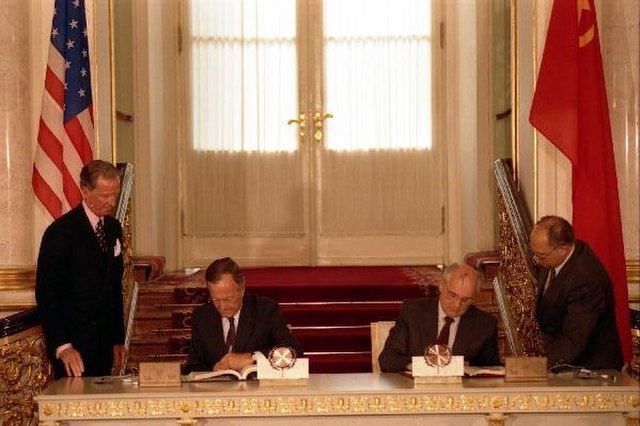
The US and Russia (formerly the Soviet Union) have had a series of treaties limiting and reducing nuclear weapons since 1972. If New START limits go away, we will enter a very dangerous brave new world.
Trump’s famously insatiable ego could be slaked by not only agreeing to the Russian proposal, but by challenging Moscow to initiate new talks to go lower. At the end of the Obama Administration and in its aftermath, there were conflicting claims by the US and Russia on which side whiffed at a chance to go lower, to 1,000 deployed strategic warheads each. So Trump could propose something his nemesis Obama failed to do. Such an agreement might take a sustained period of negotiation, or Trump could do as President George H. W. Bush did in 1991 in announcing a unilateral nuclear weapons cut, which was coordinated with and matched by Russia, with mutually agreed verification procedures.
Trust between Moscow and Washington is low for various reasons, but neither country can afford, politically or economically, to engage in a futile, costly new arms race, and global public reprobation would be deservedly harsh for both countries. And it would further erode any credibility for the US to insist China engage in arms reduction talks regarding its arsenal, which is still much smaller than those of Russia and the US. Even at the height of the Cold War, with the Soviet Union and United States competing for global dominance and engaging in deadly “proxy wars” and armed interventions around the globe, the two sides saw the wisdom of not blowing up the planet, and collaborated on a series of treaties that dramatically reduced their nuclear arsenals, which made the world safer.
Should Trump blow this chance, his global approval, already dismal, will doubtless decline further. Upcoming international review conferences of the Nuclear Non-Proliferation Treaty (NPT) this spring and the Treaty on the Prohibition of Nuclear Weapons (TPNW) this fall, both at the United Nations in New York, will likely lay the blame for a renewed arms race at his feet.
It is not (yet) too late. A coalition of US peace and disarmament organizations is mobilizing public action to press Congress and the White House to accept the Kremlin’s offer, if not by Thursday’s deadline, then as soon as possible. For more information on how to raise your voice on this critical issue, concerned individuals can consult Peace Action’s FaceBook page.


No comments:
Post a Comment