
A Bad Idea Whose Time Should Never Come: A U.S. War on Iran
February 4, 2026
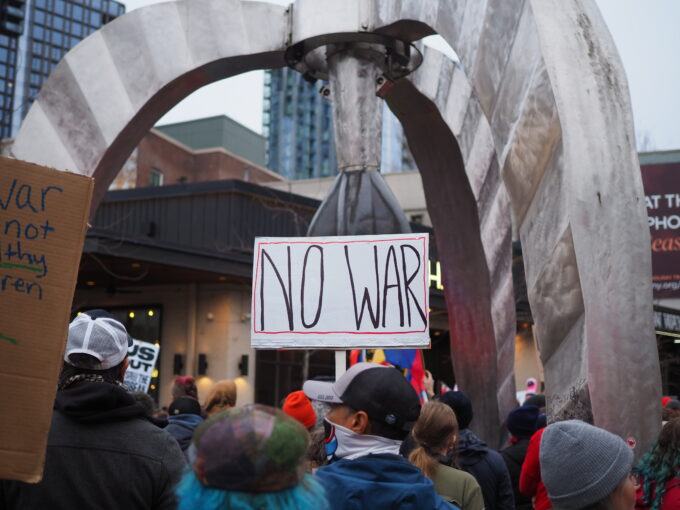
Photograph by Nathaniel St. Clair
The U.S. and Israeli regime-change op in Iran flopped in January, to the shock of Washington and Jerusalem. Tehran was reportedly on the brink of executing over 800 traitors – CIA and Mossad spooks presumably – when Donald Trump claims to have stepped in and menaced the Iranians into ditching these plans. But, per Lawrence Wilkerson on Judging Freedom, Iran’s back is up against the wall. The Iranians know full well what the Western Empire just tried to do to them, and they also know that, under Trump, that Empire will try to do it again and again and again.
So this time it’s different. It’s worse. And one casualty, as Israeli prime minister Bibi Netanyahu knows quite well, could be his country, because Iran has enough ballistic missile firepower to obliterate the postage-stamp-sized acreage of Israel. Perhaps with this in mind, Netanyahu recently indicated that maybe this assault on Iran wasn’t such a great idea. In short, he blinked. But bad things have a way of snowballing, and with an American armada pugnaciously steaming toward the Persian nation, this time the lousy momentum could be unstoppable.
What that means is lotsa U.S. navy ships get holes shot into them, multitudes of ordinary Iranians die, numerous U.S. soldiers in the Persian Gulf die, Israel gets wiped out and Iran closes the Strait of Hormuz, tanking the West’s economy – and don’t think for a minute that that closure will stop Persian oil from flowing to China. It won’t. The closure will be selective. The current Iranian regime may not survive, but in all likelihood the country will: it will not be balkanized per the fever dreams of its Israeli adversaries. And it’s also likely that any replacement regime will still champion the Palestinians, Syrians and Lebanese who resist Israeli domination.
‘“This isn’t about the nukes or the missile program. This is about regime change,’ said a former U.S. official,” Drop Site news reported January 30. “He told Drop Site that U.S. war planners envision attacks that target nuclear, ballistic and other military sites around Iran, but will also aim to decapitate the Iranian government and in particular…the Islamic Revolutionary Guard Corps.” Apparently the IRGC and the military now rule Iran, as Ayatollah Khamenei delegated all power to them before, quite sensibly, taking to his bunker.
Israel, though insufficiently alarmed at what is likely in store for it, nonetheless wants Iranian ballistic missiles destroyed. Tehran will never agree to that. Its ballistic missiles are existential, all the more so because of the religious fatwa against developing a nuclear weapon. However, if a new regime takes control and the ayatollah gets the boot – what’s to stop a NEW ruler in Tehran from saying, “Well yes, it’s obvious. Like North Korean, Russia and China, we need nukes”?
Attempts at backchannel talks, per Drop Site, include “a trilateral meeting involving Iranian, American and Turkish leaders, aimed at forestalling an expected attack.” On January 27, Saudi Arabia, in a stupendous display of backbone, “ruled out the use of its air space for a potential U.S. attack on Iran.” Presumably Saudi ruler Mohammed Bin Salman wants to avoid volcanic Iranian bombing and incineration of Saudi oil fields. The day before, the United Arab Emirates announced a similar prohibition, including its territorial waters. “The scope of the war will certainly extend across the entire region,” Drop Site quoted Brigadier General Mohammad Akraminia on January 29, speaking about an “American miscalculation,” to wit, any assault on Iran. “From the Zionist regime to countries that host American military bases, all will be within range of our missiles and drones.” The U.S. boasts between 30,000 and 40,000 troops with this big black bullseye painted on their backs.
Meanwhile, according to military expert Will Schryver on X January 30, the USS carrier Abraham Lincoln has “put considerably more distance between itself and Iranian anti-ship missiles.” No surprise there. U.S. Navy aircraft carriers are sitting ducks, especially when it comes to hypersonic missiles, which Iran has loads of. Bye the way, we don’t. We here in the U.S. have zero, zip, nada, zilch hypersonic missiles and, despite the Pentagon’ much-hyped efforts have failed to develop them. And while Tehran may lack the Kremlin’s super-duper Oreshniks, you may be sure, its defense allies Moscow and Beijing have supplied it with darn near the latest in every other sort of hypersonic missile technology; and of course, they’re no slouches in this realm either. The Persians have their own formidable hypersonic missiles.
According to Schryver: “Three Arleigh Burke-class destroyers accompany the carrier (96 Tomahawk total missiles). There are now 5 additional destroyers, 2 allegedly in the Persian Gulf (those guys are playing with fire) 2 in the eastern Mediterranean, 1 in the Red Sea. (160 total Tomahawk missiles). There is also assumed to be 1 Ohio-class missile submarine. (154 total Tomahawk missiles). There are also rumors that 1 Virginia-class attack submarine is in the region. (12 Tomahawk missiles)…I would still characterize this as a relatively modest array of naval power…On the other hand, U.S. air assets have been considerably augmented in recent days.” This bolsters Wilkerson’s and Col. Douglas Macgregor’s views aired on Judging Freedom that we are looking at a bombing campaign, as it’s virtually impossible for the Empire to muster enough troops for an invasion. Well, thank the Almighty for small favors, though the U.S.’s and its friends’ bombings are still infamously God-awful. Just look at the multiple Hiroshima-level detonations Israel inflicted on nearly defenseless Gaza, a territory it tried and is still trying to turn into a total graveyard.
Schryver also notes that the “U.S. has transferred pretty much all its available THAAD and Patriot systems to the region. They’re obviously trying to prepare as best they can for an Iranian counterstrike – although both THAAD and Patriot had abysmal success during the 12-Day War, and both the U.S. and Israel effectively exhausted their stockpiles of interceptors, which was the primary motivation for them begging Iran for a ceasefire.”
Iran was too nice. Many military experts think the Persian nation, which clearly had the upper hand at the end of the 12-Day War, should not have stopped bombing Israel. Indeed, this latest U.S./Israeli escalation proves their point. Israel begged Iran to stop bombing it, and Tehran’s compliance was taken as weakness, which in fact is standard operating procedure in the west. Any restraint, any forbearance or display of human decency is taken to be weakness and a green light for renewed aggression.
So the question of the hour, of course, is how will Russian president Vladimir Putin and Chinese president Xi Jinping react to a Trump war on Iran? Well, on January 29, it was announced that Iran, China and Russia will hold joint military exercises in the Sea of Oman and the Indian Ocean. Washington cannot feign shock. These three are allies, and Russia and China supplied loads of Air Defense to Iran, which – I repeat – will never give up its ballistic missiles. And again – when Iran closes the Strait of Hormuz, you may be sure oil to China will still get through, while the west’s economy tanks.
But it’s tough not to be fatalistic about Putin and Xi putting the brakes on this trainwreck. Look at their non-votes in the UN security council last fall: they abstained from vetoing Trump’s atrocious Board of Peace for Gaza. The sad truth is that so far, when it comes to saying Nyet to the U.S. Empire’s depredations, in the past, both Putin and Xi have tended to hold their fire. Still, you can hope. Maybe this time, Washington has gone too far for its peer adversaries. Because there have been murmurings in recent months of a changed attitude in the Kremlin and in Beijing. Hints and whispers. With any luck, they will step in, make their views known and at last take action to stop this stinking, looming catastrophe.
Photograph by Nathaniel St. Clair
The U.S. and Israeli regime-change op in Iran flopped in January, to the shock of Washington and Jerusalem. Tehran was reportedly on the brink of executing over 800 traitors – CIA and Mossad spooks presumably – when Donald Trump claims to have stepped in and menaced the Iranians into ditching these plans. But, per Lawrence Wilkerson on Judging Freedom, Iran’s back is up against the wall. The Iranians know full well what the Western Empire just tried to do to them, and they also know that, under Trump, that Empire will try to do it again and again and again.
So this time it’s different. It’s worse. And one casualty, as Israeli prime minister Bibi Netanyahu knows quite well, could be his country, because Iran has enough ballistic missile firepower to obliterate the postage-stamp-sized acreage of Israel. Perhaps with this in mind, Netanyahu recently indicated that maybe this assault on Iran wasn’t such a great idea. In short, he blinked. But bad things have a way of snowballing, and with an American armada pugnaciously steaming toward the Persian nation, this time the lousy momentum could be unstoppable.
What that means is lotsa U.S. navy ships get holes shot into them, multitudes of ordinary Iranians die, numerous U.S. soldiers in the Persian Gulf die, Israel gets wiped out and Iran closes the Strait of Hormuz, tanking the West’s economy – and don’t think for a minute that that closure will stop Persian oil from flowing to China. It won’t. The closure will be selective. The current Iranian regime may not survive, but in all likelihood the country will: it will not be balkanized per the fever dreams of its Israeli adversaries. And it’s also likely that any replacement regime will still champion the Palestinians, Syrians and Lebanese who resist Israeli domination.
‘“This isn’t about the nukes or the missile program. This is about regime change,’ said a former U.S. official,” Drop Site news reported January 30. “He told Drop Site that U.S. war planners envision attacks that target nuclear, ballistic and other military sites around Iran, but will also aim to decapitate the Iranian government and in particular…the Islamic Revolutionary Guard Corps.” Apparently the IRGC and the military now rule Iran, as Ayatollah Khamenei delegated all power to them before, quite sensibly, taking to his bunker.
Israel, though insufficiently alarmed at what is likely in store for it, nonetheless wants Iranian ballistic missiles destroyed. Tehran will never agree to that. Its ballistic missiles are existential, all the more so because of the religious fatwa against developing a nuclear weapon. However, if a new regime takes control and the ayatollah gets the boot – what’s to stop a NEW ruler in Tehran from saying, “Well yes, it’s obvious. Like North Korean, Russia and China, we need nukes”?
Attempts at backchannel talks, per Drop Site, include “a trilateral meeting involving Iranian, American and Turkish leaders, aimed at forestalling an expected attack.” On January 27, Saudi Arabia, in a stupendous display of backbone, “ruled out the use of its air space for a potential U.S. attack on Iran.” Presumably Saudi ruler Mohammed Bin Salman wants to avoid volcanic Iranian bombing and incineration of Saudi oil fields. The day before, the United Arab Emirates announced a similar prohibition, including its territorial waters. “The scope of the war will certainly extend across the entire region,” Drop Site quoted Brigadier General Mohammad Akraminia on January 29, speaking about an “American miscalculation,” to wit, any assault on Iran. “From the Zionist regime to countries that host American military bases, all will be within range of our missiles and drones.” The U.S. boasts between 30,000 and 40,000 troops with this big black bullseye painted on their backs.
Meanwhile, according to military expert Will Schryver on X January 30, the USS carrier Abraham Lincoln has “put considerably more distance between itself and Iranian anti-ship missiles.” No surprise there. U.S. Navy aircraft carriers are sitting ducks, especially when it comes to hypersonic missiles, which Iran has loads of. Bye the way, we don’t. We here in the U.S. have zero, zip, nada, zilch hypersonic missiles and, despite the Pentagon’ much-hyped efforts have failed to develop them. And while Tehran may lack the Kremlin’s super-duper Oreshniks, you may be sure, its defense allies Moscow and Beijing have supplied it with darn near the latest in every other sort of hypersonic missile technology; and of course, they’re no slouches in this realm either. The Persians have their own formidable hypersonic missiles.
According to Schryver: “Three Arleigh Burke-class destroyers accompany the carrier (96 Tomahawk total missiles). There are now 5 additional destroyers, 2 allegedly in the Persian Gulf (those guys are playing with fire) 2 in the eastern Mediterranean, 1 in the Red Sea. (160 total Tomahawk missiles). There is also assumed to be 1 Ohio-class missile submarine. (154 total Tomahawk missiles). There are also rumors that 1 Virginia-class attack submarine is in the region. (12 Tomahawk missiles)…I would still characterize this as a relatively modest array of naval power…On the other hand, U.S. air assets have been considerably augmented in recent days.” This bolsters Wilkerson’s and Col. Douglas Macgregor’s views aired on Judging Freedom that we are looking at a bombing campaign, as it’s virtually impossible for the Empire to muster enough troops for an invasion. Well, thank the Almighty for small favors, though the U.S.’s and its friends’ bombings are still infamously God-awful. Just look at the multiple Hiroshima-level detonations Israel inflicted on nearly defenseless Gaza, a territory it tried and is still trying to turn into a total graveyard.
Schryver also notes that the “U.S. has transferred pretty much all its available THAAD and Patriot systems to the region. They’re obviously trying to prepare as best they can for an Iranian counterstrike – although both THAAD and Patriot had abysmal success during the 12-Day War, and both the U.S. and Israel effectively exhausted their stockpiles of interceptors, which was the primary motivation for them begging Iran for a ceasefire.”
Iran was too nice. Many military experts think the Persian nation, which clearly had the upper hand at the end of the 12-Day War, should not have stopped bombing Israel. Indeed, this latest U.S./Israeli escalation proves their point. Israel begged Iran to stop bombing it, and Tehran’s compliance was taken as weakness, which in fact is standard operating procedure in the west. Any restraint, any forbearance or display of human decency is taken to be weakness and a green light for renewed aggression.
So the question of the hour, of course, is how will Russian president Vladimir Putin and Chinese president Xi Jinping react to a Trump war on Iran? Well, on January 29, it was announced that Iran, China and Russia will hold joint military exercises in the Sea of Oman and the Indian Ocean. Washington cannot feign shock. These three are allies, and Russia and China supplied loads of Air Defense to Iran, which – I repeat – will never give up its ballistic missiles. And again – when Iran closes the Strait of Hormuz, you may be sure oil to China will still get through, while the west’s economy tanks.
But it’s tough not to be fatalistic about Putin and Xi putting the brakes on this trainwreck. Look at their non-votes in the UN security council last fall: they abstained from vetoing Trump’s atrocious Board of Peace for Gaza. The sad truth is that so far, when it comes to saying Nyet to the U.S. Empire’s depredations, in the past, both Putin and Xi have tended to hold their fire. Still, you can hope. Maybe this time, Washington has gone too far for its peer adversaries. Because there have been murmurings in recent months of a changed attitude in the Kremlin and in Beijing. Hints and whispers. With any luck, they will step in, make their views known and at last take action to stop this stinking, looming catastrophe.
Iran Protesters Include Mossad and MEK
Donald Trump has promoted the idea – amplified by much of the international media – that protesters inside Iran are calling for U.S. military intervention and the overthrow of their government.
At the same time, Trump is threatening Iran with major military action, demanding not only changes in how protesters are treated, but that Iran abandon what he claims is a pursuit of nuclear weapons and relinquish its long-range missile capabilities and other defensive systems.
It’s true that many Iranians are protesting in response to severe economic hardship, which has reached unprecedented levels. But a major driver of Iran’s inflation and currency collapse has been the sanctions imposed by the Trump administration, which have sharply constrained Iran’s economy and access to global markets.
What is largely absent from Trump’s rhetoric – and from much of the dominant media narrative – is that these protests are not purely organic. External actors are also involved, including Israel’s intelligence agency, Mossad, and the Mojahedin-e-Khalq (MEK), an exiled Iranian group that has committed acts of terror for decades.
Mossad involvement has been openly acknowledged
On social media, Mossad posted a message directed at Iranians stating: “Go out together into the streets. The time has come. We are with you – not only from a distance and verbally. We are with you in the field.”
Israeli Heritage Minister Amichai Eliyahu reinforced this openly, stating: “When we attacked in Iran during ‘Rising Lion,’ we were on its soil and knew how to lay the groundwork for a strike. I can assure you that we have some of our people operating there right now.”
Former U.S. Secretary of State Mike Pompeo compounded this message of encouragement by tweeting: “Happy New Year to every Iranian in the streets. Also to every Mossad agent walking beside them.”
And last year, Mossad Director David Barnea confirmed Israel’s ongoing activities in Iran, declaring: “We will continue to be there, as we have been.”
The MEK’s involvement is also self-declared
We also know that the MEK, previously characterized by U.S. officials as exhibiting “cult-like behavior,” is actively participating in the protests and publicly organizing around them.
On its own website, the MEK claims responsibility for organizing protest activity today in Iran, and states that it has identified “1,449 martyrs” as of January 30:
“The nationwide uprising against the religious dictatorship in Iran continues to shake the regime’s foundations on Friday, January 30, 2026. While the regime’s Minister of Science has openly admitted to the continued detention of students accused of affiliation with the People’s Mojahedin Organization of Iran (PMOI/MEK), rebellious youth across the country are intensifying their campaign to dismantle the regime’s apparatus of suppression… Meanwhile, the human cost of freedom continues to rise. The PMOI has released the names of 450 additional martyrs [bringing the total to 1,449], revealing the brutal extent of the regime’s crackdown on women and children. Despite the repression, support for the resistance grows, with national athletes joining the call for a democratic republic.”
Founded in Iran in 1965, the MEK carried out armed attacks against the Shah’s government and U.S. targets in the 1970s, and initially supported the 1978-1979 Islamic Revolution.
But soon afterward the group took up arms against Iran’s new leadership, was banned, and driven into exile. Its later decision to fight alongside Iraq in the Iran – Iraq War is widely regarded in Iran as a betrayal.
The U.S. State Department designated the MEK a terrorist organization in 1997, yet the U.S. still supported the group during that time, and the designation was eventually lifted in 2012 as part of President Obama’s broader U.S. geopolitical strategy.
TAKE OVER YOUR INSTITUTIONS!!! … HELP IS ON ITS WAY
This external involvement in Iranian protests has also been openly encouraged at the highest levels of U.S. politics. On Jan. 13 Trump publicly urged Iranian protesters to escalate and seize state institutions, writing:
“Iranian Patriots, KEEP PROTESTING – TAKE OVER YOUR INSTITUTIONS!!! … HELP IS ON ITS WAY.”
Taken together, these statements and admissions shatter the simplified narrative now dominating public discussion. While real economic grievances may be driving protests inside Iran, they exist alongside overt encouragement and involvement by foreign intelligence services, exiled opposition groups, and senior U.S. political figures. Ignoring that context distorts public understanding of what is unfolding and risks normalizing escalation under the guise of supporting the people of Iran.
Some final questions
In the unlikely event of regime change in Iran, have Trump and Israel seriously considered what comes next?
Who would actually govern the country? Not the Shah’s polarizing son – a figure who has spent decades in Maryland, lacks broad support inside Iran, and whose viability even President Trump has publicly questioned.
Does Trump believe Iran can be managed the way the U.S. has attempted to manage Venezuela – or the way Israel and the U.S. are attempting to manage Gaza?
How many troops on the ground would be required to occupy and administer a country of roughly 90 million people, the vast majority of whom already view the United States with deep hostility?
Does Trump understand – or care – that Iran’s Supreme Leader, Ali Khamenei, is regarded by many Shiite Muslims as a religious authority with lineage tied to the Prophet Muhammad? Does he expect the roughly 200 million Shiite Muslims worldwide to remain passive in the face of a direct assault on their religion?
Groups such as Hezbollah in Lebanon, the Houthis in Yemen, and the Shiite-led government in Iraq understand that if Iran falls, they’re next – and that without Iranian support, they would be far easier to defeat. Do Trump and Israel seriously expect these actors to lay down their arms?
If the United States attacks Iran again and Iran inflicts substantial damage in return – to the point where Iran appears to be prevailing – how likely is it that the U.S. and/or Israel would escalate by using nuclear weapons to salvage “victory”?
In 1951, Iran’s democratically elected leader Mohammad Mosaddegh was named Time Magazine’s Man of the Year. Just two years later he was overthrown in a CIA-backed coup. Seventy-five years on, Iran is in a far worse position and now faces what many see as an existential threat.
So the final question is unavoidable: if you were an Iranian citizen, would you want your country to possess nuclear weapons if that were the only credible deterrent left? And if not, what realistic alternative exists for Iran to break the stranglehold imposed by the United States and Israel?
Chris Ernesto is the webmaster and co-founder of St. Pete for Peace, a non-partisan antiwar organization providing peace oriented education events and services to the Tampa Bay, FL community since 2003.
Donald Trump has promoted the idea – amplified by much of the international media – that protesters inside Iran are calling for U.S. military intervention and the overthrow of their government.
At the same time, Trump is threatening Iran with major military action, demanding not only changes in how protesters are treated, but that Iran abandon what he claims is a pursuit of nuclear weapons and relinquish its long-range missile capabilities and other defensive systems.
It’s true that many Iranians are protesting in response to severe economic hardship, which has reached unprecedented levels. But a major driver of Iran’s inflation and currency collapse has been the sanctions imposed by the Trump administration, which have sharply constrained Iran’s economy and access to global markets.
What is largely absent from Trump’s rhetoric – and from much of the dominant media narrative – is that these protests are not purely organic. External actors are also involved, including Israel’s intelligence agency, Mossad, and the Mojahedin-e-Khalq (MEK), an exiled Iranian group that has committed acts of terror for decades.
Mossad involvement has been openly acknowledged
On social media, Mossad posted a message directed at Iranians stating: “Go out together into the streets. The time has come. We are with you – not only from a distance and verbally. We are with you in the field.”
Israeli Heritage Minister Amichai Eliyahu reinforced this openly, stating: “When we attacked in Iran during ‘Rising Lion,’ we were on its soil and knew how to lay the groundwork for a strike. I can assure you that we have some of our people operating there right now.”
Former U.S. Secretary of State Mike Pompeo compounded this message of encouragement by tweeting: “Happy New Year to every Iranian in the streets. Also to every Mossad agent walking beside them.”
And last year, Mossad Director David Barnea confirmed Israel’s ongoing activities in Iran, declaring: “We will continue to be there, as we have been.”
The MEK’s involvement is also self-declared
We also know that the MEK, previously characterized by U.S. officials as exhibiting “cult-like behavior,” is actively participating in the protests and publicly organizing around them.
On its own website, the MEK claims responsibility for organizing protest activity today in Iran, and states that it has identified “1,449 martyrs” as of January 30:
“The nationwide uprising against the religious dictatorship in Iran continues to shake the regime’s foundations on Friday, January 30, 2026. While the regime’s Minister of Science has openly admitted to the continued detention of students accused of affiliation with the People’s Mojahedin Organization of Iran (PMOI/MEK), rebellious youth across the country are intensifying their campaign to dismantle the regime’s apparatus of suppression… Meanwhile, the human cost of freedom continues to rise. The PMOI has released the names of 450 additional martyrs [bringing the total to 1,449], revealing the brutal extent of the regime’s crackdown on women and children. Despite the repression, support for the resistance grows, with national athletes joining the call for a democratic republic.”
Founded in Iran in 1965, the MEK carried out armed attacks against the Shah’s government and U.S. targets in the 1970s, and initially supported the 1978-1979 Islamic Revolution.
But soon afterward the group took up arms against Iran’s new leadership, was banned, and driven into exile. Its later decision to fight alongside Iraq in the Iran – Iraq War is widely regarded in Iran as a betrayal.
The U.S. State Department designated the MEK a terrorist organization in 1997, yet the U.S. still supported the group during that time, and the designation was eventually lifted in 2012 as part of President Obama’s broader U.S. geopolitical strategy.
TAKE OVER YOUR INSTITUTIONS!!! … HELP IS ON ITS WAY
This external involvement in Iranian protests has also been openly encouraged at the highest levels of U.S. politics. On Jan. 13 Trump publicly urged Iranian protesters to escalate and seize state institutions, writing:
“Iranian Patriots, KEEP PROTESTING – TAKE OVER YOUR INSTITUTIONS!!! … HELP IS ON ITS WAY.”
Taken together, these statements and admissions shatter the simplified narrative now dominating public discussion. While real economic grievances may be driving protests inside Iran, they exist alongside overt encouragement and involvement by foreign intelligence services, exiled opposition groups, and senior U.S. political figures. Ignoring that context distorts public understanding of what is unfolding and risks normalizing escalation under the guise of supporting the people of Iran.
Some final questions
In the unlikely event of regime change in Iran, have Trump and Israel seriously considered what comes next?
Who would actually govern the country? Not the Shah’s polarizing son – a figure who has spent decades in Maryland, lacks broad support inside Iran, and whose viability even President Trump has publicly questioned.
Does Trump believe Iran can be managed the way the U.S. has attempted to manage Venezuela – or the way Israel and the U.S. are attempting to manage Gaza?
How many troops on the ground would be required to occupy and administer a country of roughly 90 million people, the vast majority of whom already view the United States with deep hostility?
Does Trump understand – or care – that Iran’s Supreme Leader, Ali Khamenei, is regarded by many Shiite Muslims as a religious authority with lineage tied to the Prophet Muhammad? Does he expect the roughly 200 million Shiite Muslims worldwide to remain passive in the face of a direct assault on their religion?
Groups such as Hezbollah in Lebanon, the Houthis in Yemen, and the Shiite-led government in Iraq understand that if Iran falls, they’re next – and that without Iranian support, they would be far easier to defeat. Do Trump and Israel seriously expect these actors to lay down their arms?
If the United States attacks Iran again and Iran inflicts substantial damage in return – to the point where Iran appears to be prevailing – how likely is it that the U.S. and/or Israel would escalate by using nuclear weapons to salvage “victory”?
In 1951, Iran’s democratically elected leader Mohammad Mosaddegh was named Time Magazine’s Man of the Year. Just two years later he was overthrown in a CIA-backed coup. Seventy-five years on, Iran is in a far worse position and now faces what many see as an existential threat.
So the final question is unavoidable: if you were an Iranian citizen, would you want your country to possess nuclear weapons if that were the only credible deterrent left? And if not, what realistic alternative exists for Iran to break the stranglehold imposed by the United States and Israel?
Chris Ernesto is the webmaster and co-founder of St. Pete for Peace, a non-partisan antiwar organization providing peace oriented education events and services to the Tampa Bay, FL community since 2003.
Important Texts before the Trump Regime
Starts Yet Another War on Iran and Its People

Here is just a very short guide for the concerned:
While you find little, or nothing, comprehensive, well-researched and meaningful in Western mainstream media, there are lots to be gained from every day visiting the online homes of, say, Al Jazeera, Al Mayadeen, the Middle East Eye — and others too, of course.
Visit also their social media outlets and video channels, mostly however on Google-censored YouTube, but still. And subscribe to their newsletters and updates.
By the way, Al Jazeera has condemned YouTube’s compliance with an Israeli law banning the network’s livestreams in the country, warning that the move signals how major tech companies can be “co-opted as instruments of regimes hostile to freedom”.
As usual, David Hearst, is spot-on with “Iran’s battle for survival is the Arab world’s fight too,” sub-titled “Everyone in the region, whatever their past history with the Islamic Republic, should do their utmost to defend Iran and guarantee its sovereignty.”
If you choose to read only one of these, I recommend Hearst’s.
The Middle East Eye also brings you Soumaya Ghannoushi’s “Why the West will never accept Iranian sovereignty” sub-titled “This truth has endured for decades, from the 1953 removal of Mosaddegh to today’s looming US-Israeli strike.”
The MEE staff also has this fine overview of Trump’s irreparable hatred of Iran with various emphasis and arguments, “How Trump’s demands on Iran have shifted over time.”
Seyed Hossein Mousavian, the world renown Iranian former diplomat, now at Princeton, thinks constructively in his “How the Middle East can escape the cycle of conflict in 2026.” For once, someone takes a larger perspective in time and space and thinks constructively… See also his homepage with lots more.
Visit the Middle East Eye and find more yourself.
Al Jazeera’s Shola Lawal analyses the US military presence and build-up in the region, all around Iran. The maps with all the US bases speal volumes about the a-symmetrical character of this conflict; you look in vain for any Iranian military presence close to Europe or the US. Her illuminating display of US military might is “How does US military build-up off Iran compare to the June 2025 strikes?” — “And could a sudden deployment of major US naval and air force assets indicate a strike on Iran is imminent?”
Maziar Motamedi gives you valuable insights into the devastating combination of US and allies’ ruthless sanctions and domestic economic mismanagement in “Iran delegates import powers as US war threats keep economy unstable” — “Iranian governors gain new powers as country prepares for possible war amid sanctions and looming geopolitical tensions.”
If you do not feel pain in your heart on behalf of the Iranian people when reading this, nothing will move you.
There is also a lot be learnt from Al Jazeera’s explainer, “Iran since 1979: A timeline of crises” — “From a hostage crisis, a years-long war, and a nuclear dispute, Iran’s struggles remain pivotal to its identity.”
Follow Al Jazeera every day in time to come.
Al Mayadeen brings you this very reasonable Iranian viewpoint – “Iran rejects coercive talks, open to principled diplomacy: Ghalibaf“: “Iran says it remains open to diplomacy but rejects negotiations under military pressure, as Parliament Speaker Mohammad Baqer Ghalibaf warns that coercion and threats undermine meaningful dialogue.”
And this interesting background story “US threatened attacks on Iranian facilities via 3rd party” — “An Iranian media official warns that any US strike on Iran, no matter how limited, would be treated as an all-out war, amid US political signaling through military buildup.”
It tells you very clearly that Iran this time sees any type of attack as a threat to its existence and will fight accordingly.
As a final example, read Samuel Geddes’ Latest US-backed regime change operation in Iran hits the wall: “Western attempts to weaponize protests and sanctions against Iran have once again collapsed, exposing that the West does not have a viable alternative to the Islamic Republic, and the limits of US power.”
Follow Al Maydeen every day in time to come.
And stop relying on Western US-dominated media. They don’t do true journalism and public education anymore in the field of international affairs.
Let me round this off with a completely different – and today almost non-existent — perspective, that of peace-making. You know, the world spends far too much energy on the past and the present and far too little on possible futures — and far too much on geopolitical diagnosis and doomsday-like prognosis without have a single thought on the quite relevant question: What can be done?
So militarised have minds become — in research, politics and the media. And the word peace has been disappeared in all three.
That said, world renown peace and future researcher Johan Galtung wrote a peace plan for the Middle East in 1971 — “A regional strategy for sustainable peace for Israel & Palestine: [1]-[2]-[6]-[20]” — in the Journal of Peace Research (JPR). However, today SAGE Publications seems not ashamed to charge you £ 29 to download single articles. So here is a 2015 short summary of Galtung’s – brilliant – insights and thoughts on the issue, 55 years ago published by TFF of which he was an inspirer, friend and Associate.
Ask yourself why that sort of thinking has disappeared – and whether a bit more constructive, healing thinking could help make the world, including the Middle East, just a little bit better. I mean, how can we create a better future if no one has the imagination to outline possible options and get them discussed?

No comments:
Post a Comment