US Forest Service Logging and Burning Will Cook Bull Trout to Extinction in the Jarbidge River
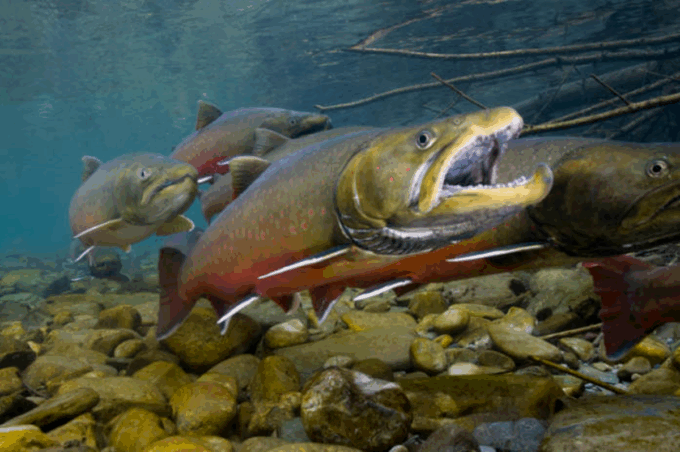
Bull Trout. Photo: USFWS.
Bull trout were listed as “threatened” under the Endangered Species Act in 1999 after the Alliance for the Wild Rockies and Friends of the Wild Swan successfully sued the Fish and Wildlife Service. Bull trout require cold water from 36 to 59 degrees F. They cannot tolerate warmer waters. Because bull trout need cold, clean, and connected water to survive and reproduce, they are an excellent indicator of overall water quality.
Since people also need very clean water and a climate that doesn’t bake us, what is good for bull trout is also good for humans. But instead of doing what’s good for bull trout and humans, the Forest Service is once again focusing on what is good for cattle. Given that the US is the world’s top producer of beef, rest assured the nation’s 94.2 million cattle are not at risk of extinction.
The same cannot be said for the imperiled population of Jarbidge River bull trout — the southernmost population in the nation which is at extreme risk of going extinct. In 2004, well before the severe and on-going drought in the Southwest, “the Jarbidge River Bull Trout Recovery Team estimated that fewer than 500 bull trout, with 50–125 reproductively mature fish, were present within the core area.”
You read that right – there were only 50-125 bull trout capable of reproducing — and that was 22 years ago. Yet the recently approved Humboldt-Toiyabe Forest-wide Prescribed Fire Restoration Project authorizes logging and burning of 30,000 acres every year throughout 5.1 million acres of the National Forest. The “restoration” plan includes logging trees up to 16″ in diameter in the watershed of the Jarbidge River, which is Federally Designated “critical habitat” for bull trout.
The Jarbidge River originates in the Jarbidge Mountains of northeastern Nevada, flows through the canyons of Idaho’s Owyhee Desert high plateau and eventually into the Snake River. Nearly 29 miles of the Jarbidge River are designated wild with challenging whitewater through the steep rhyolite/basalt canyons with steep walls and statuesque rock formations.
Subalpine fir, whitebark pine, limber pine, cottonwoods, aspens, mountain mahogany, and juniper shade the Jarbidge River, keeping it cool enough for bull trout to survive. But cows don’t eat trees. The Forest Service hopes grass will replace the trees, but most likely the trees will be replaced by an invasive and highly flammable weed that is native to Russia called cheatgrass as has happened throughout the West.
High water temperatures are already a problem since the Fish and Wildlife Service notes that the Jarbidge River and other streams in the Snake River watershed are the most susceptible to climate change. The logging and burning will only increase the water temperatures.
The Endangered Species Act requires that any action authorized, funded, or carried out by the federal government cannot jeopardize the continued existence of any threatened or endangered species, or result in the adverse modification of critical habitat for these species. In our comments and objections, we told the Forest Service and Fish and Wildlife Service that this project could result in the extinction of bull trout in the Jarbidge River — but they ignored us.
Since the Jarbidge bull trout’s only hope is to stop the massive logging and burning of their watershed, the Alliance for the Wild Rockies, Native Ecosystems Center and Wildlands Defense filed a 60-day Notice of Intent to Sue if the agencies don’t pull the project.
We have not yet raised the money to pay the cost of this lawsuit. It’s not easy nor cheap to sue the federal government and we could use, and very much appreciate, any help you can give us to save the Jarbidge bull trout from being cooked into extinction. Please also consider donating to Counterpunch for keeping the public informed about what our government is doing.

No comments:
Post a Comment