Thursday, February 20, 2020

Lawyers to seek asylum for Julian Assange in France

Assange’s European defence team say it is their duty to raise case with Emmanuel Macron


Associated Press in Paris Thu 20 Feb 2020 

 
 Lawyers at a press conference in Paris publicising Julian Assange’s asylum bid. Photograph: François Guillot/AFP via Getty Images


Julian Assange’s European defence team have said they will try to seek asylum for him in France. Hearings over Assange’s extradition from the UK to the US on spying charges are due to start next week in London.

Éric Dupond-Moretti said the “fate and the status of all journalists” was at stake in Assange’s case. “We consider the situation is sufficiently serious,” he said, “that our duty is to talk about it” with the French president, Emmanuel Macron.
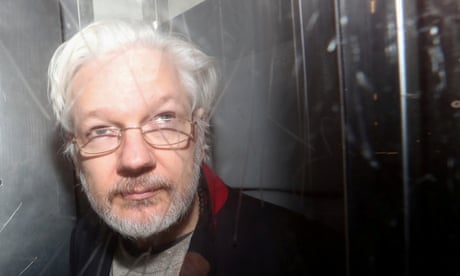

Donald Trump 'offered Julian Assange a pardon if he denied Russia link to hack'

Read more

He was one of a team of lawyers lined up at a Paris news conference to explain why they view the case against Assange as unfair, citing his poor health and alleged violations of his rights while in jail in London.

French members of the team said they had been working on a “concrete demand” for Macron to grant Assange asylum in France, where he has children and where WikiLeaks had a presence at its founding.

Baltasar Garzón, the Spanish coordinator of Assange’s team, reiterated his client’s plan to claim that the Trump administration offered him a pardon in return for saying Russia was not involved in leaking Democratic National Committee emails during the 2016 US election campaign.

Garzón said Assange was “pressured by the Trump administration” but resisted, and “the order was given to demand the extradition of Julian Assange”.

The White House has firmly denied the claim. However, Garzón said that testimony and “documentary proof” of the claim would be offered to the court at the full hearing which opens on Monday.

Assange, 48, spent seven years in Ecuador’s London embassy before being evicted and arrested in April 2019. Last November, Sweden dropped a sex crimes investigation against him because so much time had elapsed.

Assange, who is Australian, has received backing from numerous quarters. The Council of Europe’s commissioner for human rights, Dunja Mijatović, added a voice of opposition on Thursday, citing concerns over Assange’s eventual treatment in a US prison and the impact on press freedoms were he to be extradited.

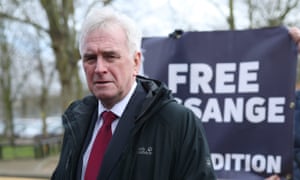
The shadow chancellor, John McDonnell, visited Assange in prison on Thursday and said: “I think this is one of the most important and significant political trials of this generation – in fact longer.”

THE GUARDIAN

House members reportedly told Russia interfering in 2020 election


John Brennan, the former director of the Central Intelligence Agency and a prominent public critic of Donald Trump, weighs in on the significance of the new report about Trump being furious about an intelligence briefing for members of Congress that included the conclusion that Russia is still attempting to interfere in the 2020 election with the goal of supporting him.
John O. Brennan(@JohnBrennan)

We are now in a full-blown national security crisis. By trying to prevent the flow of intelligence to Congress, Trump is abetting a Russian covert operation to keep him in office for Moscow’s interests, not America’s. https://t.co/Vj6lUV5ZNuFebruary 21, 2020


“Russia intends to interfere with the ongoing Democratic primaries as well as the general election.”

That’s key new information that House lawmakers heard during an intelligence briefing last week, according to the New York Times. The briefing, which reportedly angered the president, once again conveyed to lawmakers the conclusion from intelligence officials that Russia was interfering in the election with goal of electing Trump.
Kyle Griffin(@kylegriffin1)

Last week’s briefing did contain what appeared to be new information, according to NYT, including that Russia intends to interfere with the ongoing Democratic primaries as well as the general election. https://t.co/NEdqx6ee8bFebruary 21, 2020


House members reportedly told Russia interfering in 2020 election

House members were reportedly warned by intelligence officials last week that Russia is interfering in the 2020 campaign to try to get Trump re-elected, mirroring the country’s meddling in the 2016 race.

The New York Times reports:

The day after the Feb. 13 briefing to lawmakers, Mr. Trump berated Joseph Maguire, the outgoing acting director of national intelligence, for allowing it to take place, people familiar with the exchange said. Mr. Trump cited the presence in the briefing of Representative Adam B. Schiff, the California Democrat who led the impeachment proceedings against him, as a particular irritant.


During the briefing to the House Intelligence Committee, Mr. Trump’s allies challenged the conclusions, arguing that Mr. Trump has been tough on Russia and strengthened European security. Some intelligence officials viewed the briefing as a tactical error, saying that had the official who delivered the conclusion spoken less pointedly or left it out, they would have avoided angering the Republicans.

That intelligence official, Shelby Pierson, is an aide to Mr. Maguire who has a reputation of delivering intelligence in somewhat blunt terms. The president announced on Wednesday that he was replacing Mr. Maguire with Richard Grenell, the ambassador to Germany and long an aggressively vocal Trump supporter.

The Washington Post reported earlier today about the confrontation between Trump and Maguire, but the content of the intelligence briefing was not previously known.

Trump has repeatedly pushed back against the intelligence community’s conclusion that Russia interfered in the 2016 race to help him defeat Hillary Clinton.

During the impeachment inquiry and trial, some of the president’s allies tried to peddle the baseless conspiracy theory that it was actually Ukraine who meddled in the 2016 race.

That claim was dismissed by Fiona Hill, the White House’s former top Russia expert, as a “fictional narrative” pushed by Vladimir Putin’s government.


https://www.theguardian.com/us-news/live/2020/feb/20/roger-stone-sentenced-democrats-debate-bloomberg-trump

THE GUARDIAN

USA NEEDS IMMIGRANTS WAIT WHAT


THE GUARDIAN
https://www.theguardian.com/us-news/live/2020/feb/20/roger-stone-sentenced-democrats-debate-bloomberg-trump

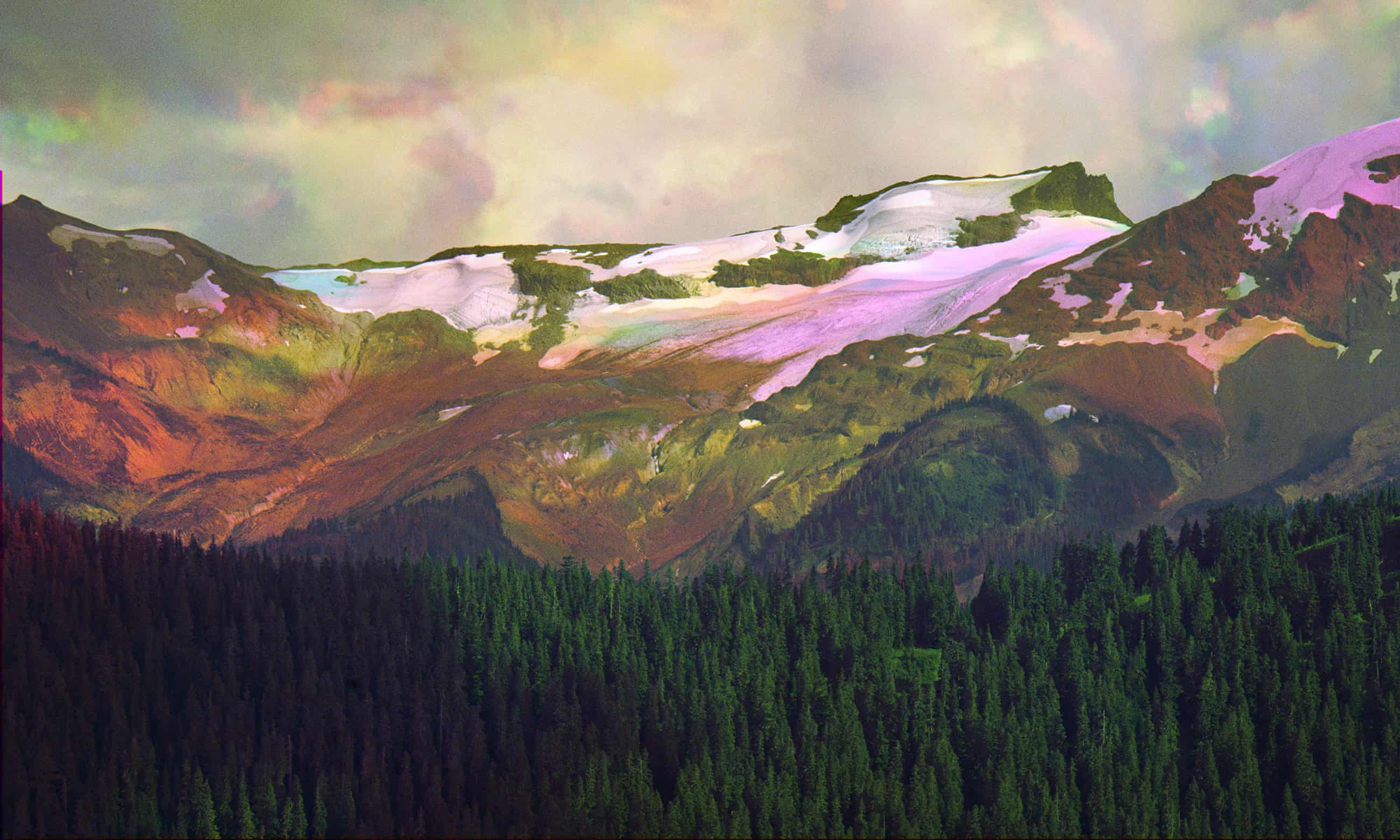
Ghost glaciers: the transcendent Anthropocene – in pictures

 Mount Baker Expedition. Photograph: Funch/Peter Funch

Peter Funch’s latest photo-book, The Imperfect Atlas, explores human impact on the environment by using a technique invented at the height of the industrial revolution – RGB tri-colour separation

The Imperfect Atlas is published by TBW Books
Thu 20 Feb 2020
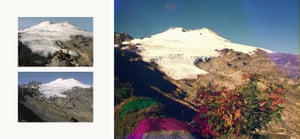
Funch used vintage postcards as a model for his images of Washington’s Mount Baker to capture the effects of glacial recession. ‘Photography is an interesting tool since it is so dependent on the reality in front of us, while at the same time it can be used to describe something so general that everyone can relate to it,’ he says.

Funch used vintage postcards as a model for his images of Washington’s Mount Baker to capture the effects of glacial recession. ‘Photography is an interesting tool since it is so dependent on the reality in front of us, while at the same time it can be used to describe something so general that everyone can relate to it,’ he says."

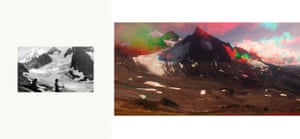
The book includes postcards, such as the ones seen here. Featuring images captured during Funch’s trips through the Northern Cascade mountain range in the US, it is an imperfect re-creation of landscapes and wilderness

The book includes postcards, such as the ones seen here. Featuring images captured during Funch’s trips through the Northern Cascade mountain range in the US, it is an imperfect re-creation of landscapes and wilderness
Funch used maps and satellite imagery to locate the position where the postcard images were created, then brought in the RGB process described above to create a magical, almost Technicolor effect. Here he depicted Thunder Glacier in Washington

SEE ALL THE PHOTOS HERE 


 A young man holds a red smoke bomb to send a signal to attendees during a rally at Independence Square in Kyiv, Ukraine. Photograph: Sergii Kharchenko/Guardian Community

https://www.theguardian.com/artanddesign/2018/jan/15/share-your-best-photographs-of-the-week-with-us#img-1

SMOKE BOMBS COURTESY THE USA 

THE GUARDIAN
Syria

The highway that determines the future for Syria and its citizens


900,000 have fled up the M5 in search of safety as Assad tries to regain last rebel stronghold


Bethan McKernan Middle East correspondent Thu 20 Feb 2020
 

The population of Idlib has grown from 1 million 
to 3 million as people have arrived trying to from
 Syrian troops. 
Photograph: Aaref Watad/AFP via Getty Images

It was dawn when the Hussein family packed up to leave their home in Saraqeb. The whine of Russian and Syrian government warplanes had got too close for comfort in the last few days, and the thuds of bombs and artillery fire were scaring Odai al-Hussein’s 7-month-old son, Yahya.

Odai and his wife Banan spent two weeks agonising over whether to leave home and take Syria’s M5 highway north, into the unknown. But in the end, the looming violence of Bashar al-Assad’s new campaign against Idlib, the last rebel stronghold in the country, led them to pack up the car. Hussein’s father cried as he bid farewell to his house.

The family joined 900,000 others who have made their way up the highway in the largest displacement of people to date in Syria’s long war. For civilians who now have nowhere else to flee, the northbound M5 was the route to relative safety. Now totally under the control of Assad’s forces, the highway is instead the regime’s road to victory.


The M5, or Syria’s “international road”, threads all of Syria’s major cities and six provinces together. The 450km (280 miles) artery joins the political capital Damascus to the economic centre of Aleppo. Stretching as far as Turkey in the north and the southern Jordanian border, which then linked Syria to the Gulf states, the M5 was essential for the movement of wheat and cotton, carrying an estimated $25m in goods and commodities every day before the war broke out in 2011.

Recapturing the M5 has always been a high priority for Assad. Sections of the vital highway have been in the hands of opposition and jihadist fighters for the last eight years, but with Russia’s help, the Syrian government has slowly clawed back control since 2014, emptying towns and cities along the route via a series of blistering air campaigns and sieges.


By the summer of 2018, Idlib, a rural farming province in the country’s northeast, was the only part of Syria out of Assad’s control. The population of the city of Idlib and the surrounding countryside has swollen from 1 million to approximately 3 million as people afraid to wait for regime troops to arrive in their neighbourhoods have fled north in wave after wave of displacement.

Even though the area was protected by a de-escalation deal brokered by Turkey – which backs some opposition groups – and Assad’s allies in Moscow, part of the M5 cuts through the Idlib countryside. And in December, Damascus launched a ferocious new campaign to recapture the last slivers of the road, finally taking the last rebel-controlled section around the village of Khan al-Assal last week.

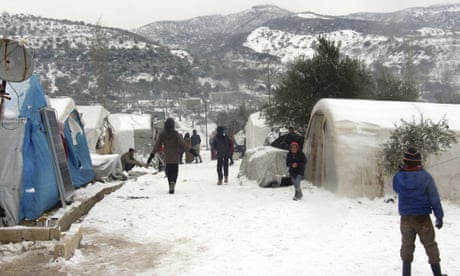
Families trapped by Assad’s assault on Idlib fight to survive in the snow

The regime victory has come at a high price for civilians. Bumper-to-bumper traffic has clogged the M5 and other roads leading north towards the closed Turkish border, those who can afford the fuel fleeing in cars, motorbikes and flatbed trucks, often taking no more than what they can carry.

Even these escape routes have become hazardous options: sniper and artillery fire targeting civilian convoys has killed at least 15 people. So far, the regime campaign has killed more than 300 in bombings that have hit medical facilities, bakeries and other civilian infrastructure in the last three months. Footage has emerged on social media of regime troops allegedly desecrating graves in newly-retaken rebel towns.

Regaining full control of the M5 is a major victory for Assad, according to Danny Makki, a Syrian analyst. “The highway’s recapture will inevitably galvanise the Assad government both economically and strategically, despite the losses they have suffered in men and equipment in their numerous attempts to secure it,” he said.

“It also alleviates the logistical nightmare of supplying Aleppo and Syria’s embattled north, which has relied on reinforcements and supplies through dangerous and poorly-maintained alternatives.”

Play Video
0:34 Footage shows displaced people ransacking an aid warehouse in north-west Syria – video

The Syrian president himself made a rare televised address on Tuesday following the capture of the road, congratulating his troops and vowing to press ahead with the campaign.

“This liberation does not mean the end of war and it does not mean… our enemies will surrender,” he said.

“But it means that we rubbed their noses in the dirt as a prelude for complete victory and ahead of their defeat sooner or later. We should not rest, but continue to prepare for coming battles.”

For the 3 million civilians cowering in Idlib, his words carry a terrifying weight. The situation is already desperate, with the UN and aid agencies warning the area could face “the worst humanitarian disaster of the century”. Turkish attempts to repel the regime advance with an influx of 12,000 troops have so far led to nothing.

Aid response efforts are at breaking point. On Wednesday footage emerged on social media of displaced people tired of waiting ransacking an aid warehouse and grabbing what they can. Hundreds of thousands more are camped out in tents and other substandard accommodation on the Turkish border in freezing winter conditions, begging Turkish soldiers to open the border.

Hussein counts himself and his family as lucky: they have managed to find an unfurnished apartment in Azaz, which is under Turkish control, although they are already longing to go home.

“I heard that regime soldiers set fire to the houses of those who oppose the regime in Saraqeb and I saw pictures of soldiers looting. Our future is unclear,” Hussein said.

“I don’t think I am afraid to die in the war, in bombing. But I know for certain I can never live alongside the men who fight for Assad – the animals who have done this to us.”
'Humiliating to the core': how India turned a Kashmir hotel into a jail

The Centaur hotel was transformed into a gilded prison for once-powerful politicians loyal to India

#KASHMIR IS #INDIA'S #GAZA
Hannah Ellis-Petersen and a reporter in Srinagar Thu 20 Feb 2020 
 

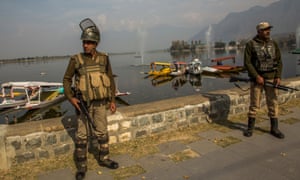
Indian forces stand guard on the bank of Dal lake, 
in Srinagar, the summer capital of Indian-administered 
Kashmir. Photograph: Yawar Nazir/Getty Images


It was a prison unlike any other. The picturesque venue, on the lake front in the city of Srinagar in Kashmir, just minutes from a golf course, usually functions as a palatial hotel, but for three months last year it became a gilded jailhouse for Salman Sagar and dozens of once-powerful Kashmiri ministers and legislators.

“It was a jail,” said Sagar. “The notion was given that it was five star but it was not …They put immense psychological pressure on us. They were as strict as possible.”

Sagar, an influential politician in Kashmir’s National Congress party and the former mayor of Srinagar, was among nearly 50 senior politicians who were arrested in August and held in the Centaur hotel, and later a hostel, for six months without being charged with any crime. The mass arrests followed the Indian government’s swift and brutal decision on 5 August last year to revoke Article 370, the law that had given this disputed Himalayan region a special semi-autonomous status for almost seven decades.

The Indian government argued that the mass detention of politicians was to maintain order in a region where security forces have been fighting a long-running insurgency against militants supported by Pakistan.

Detentions without trial are routine in Kashmir and have been vigorously invoked against anti-India politicians and militant sympathisers, but it was the first time the law was used against politicians who had sided with New Delhi and subsequently endured decades of insurgents’ threats and fatal attacks.

For Sagar and others loyal to India during Kashmir’s long-running conflict, the arrests and detention without cause were an exercise in humiliation. Kept under the watch of police and central paramilitary officers, some stayed in single rooms while others were forced to share and their freedoms were limited. Their main source of entertainment was pacing the hotel corridors together. 

Kashmir’s chief minister, Omar Abdullah, 
during a visit to the Martyrs’ Graves in 
Srinagar in 2014. 
Photograph: Danish Ismail/Reuters

“You expect there to be serenity,” Sagar said of the hotel-turned-prison that stands at the foot of Zabarwan mountain, and boasts a gym, health centre and shopping arcade they were never allowed to access. “But there was no calm there. There was only discomfort.”

He added: “We were never allowed to touch the hotel grass … we were only allowed to go down [to the common areas] for lunch and dinner. We requested to be allowed to go out to the lawns but they never allowed it.”

Sagar was among dozens of politicians finally released in February, due to the Indian government being legally allowed to detain them for only six months. However, the four most senior political leaders, two former chief ministers of Jammu and Kashmir, Omar Abdullah and Mehbooba Mufti , and two regional party leaders, Ali Mohmmad Sagar and Sartaj Madni, have been kept in detention and recharged under India’s Public Safety Act (PSA), which allows detention without trial for up to two years. Ali Mohmmad Sagar is Salman Sagar’s father, and they were kept in detention in the Centaur hotel together.

Sagar, who has lost 18kgs during the last six months, said he spent the first few days of detention “mourning the demise of 370”. “Then everybody was asking: ‘when will we be released?’ There was so much fear on our minds,” he said.

While Sagar was in detention, his grandfather fell ill one evening and quickly died. “I begged the police to let me see him but they did not allow and my grandfather died that evening,” said Sagar. “I felt helpless.”

He also described breaking down in tears when, on his birthday, his family came to visit and was kept waiting five hours. His four-year-old son had grown so hungry, without access to food, they had been forced to feed him Sagar’s birthday cake. “I cried so much when I heard that,” he said. 

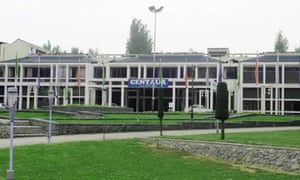
Image of Centaur Lake View hotel from the 
hotel’s website Photograph: centaurhotelsrinagar

The detention of pro-India politicians was an addition to about 5,000 anti-India politicians, activists, protesters and businessmen who were jailed without trial in the months before article 370 was revoked. Arrests have also continued in the subsequent months.

The continued imprisonment of party leaders and the continued ban on public meetings in Kashmir has ensured that politicians on all sides remain in a state of limbo, and democratic representation in Kashmir has disintegrated, which experts fear will have disastrous long-term impacts in the region.

“Political activity in Kashmir has been reduced to zero,” said Khalid Shah, an associate fellow specialising in Kashmir at the Observer Research Foundation. “There was a robust mainstream, pro-India politics in Kashmir which is completely over, it is finished, but the government has [been] doing nothing since to ensure people are represented or political activity is resumed from within.”

‘A storm has hit my life': the Kashmiri families torn apart by mass arrests

Shah added: “That is very scary because in a place like Kashmir, where a lot of people are already radicalised, you want politics and democracy to be a vehicle to bring people into the mainstream. So there is a fear that radicalisation will increase.”

The detentions have caused so much fear and uncertainty in Kashmir’s political circles that few are willing to speak about their imprisonment and even fewer are willing to be named. Like many others, Sagar was forced to sign a mandatory bond that he would not instigate people in dissent or speak against the abrogation of the Article 370.

An influential member of the People’s Democratic Party – a Kashmir political party which was seen as cooperative with the Indian government – who was recently released from his six-month long detention and spoke on the condition of anonymity, said: “Everybody feels betrayed, cheated.”

“We have always taken the risk of going with secular India … our loyalty to the idea of India was questioned because the definition of that idea has been changed,” he said.

He was also among those held at the Centaur for three months, before being moved to a hostel. To pass the time, he said the prisoners read and discussed religious and political books, played cards and prayed but had never been allowed outside. He, like many held in the Centaur, also came to believe the lakeside hotel was haunted and many could not sleep out of fear of the spirit.

“I also felt [a djinn] in my room once. I could see some dark shadow on the wall, of a man, a huge man, he said. Then I switched on the light and kept it on whole night. There was a lot of talk that there was a djinn, some said the djinn did not let them sleep.”

He said the lengthy detention was “humiliating to the core” and provided him a “moment of introspection”. “There was a sense of defeat,” he said. “I saw one [political leader] crying several times because it was very humiliating. Food was very bad, chocolate or a toffee would have been a treat.”

He said at times it felt like being dead. “No one remembers you,” he added. “I felt like a bird in a cage.”

THE GUARDIAN

'It's about German guilt': Why The Tin Drum still divides audiences

The stage version of Günter Grass’s 1959 novel is set to open in London – with its ‘unbearable’ protagonist and tales of Nazi collaboration, it’s as controversial as ever


Philip Oltermann in Berlin Thu 20 Feb 2020
A force of nature in short trousers … Nico Holonics in The Tin Drum, Coronet Theatre, Feb 2020. Photograph: Birgit Hupfeld


Every audience loves a hero, but Oskar Matzerath, one of the most unsettling literary characters of the 20th century, doesn’t make it easy for the spectator. By the end of Oliver Reese’s stage version of Günter Grass’s novel The Tin Drum, of which Oskar is the sole protagonist, the realisation spreads through the auditorium that Oskar has played a key part in the deaths of all three people who make up his family.

The man official records call his father, Alfred, has choked on the Nazi membership badge his son handed to him as the Russian Red Army descended on his house. Jan Bronski, his mother’s lover, has been shot dead by the Nazis after being denounced by the boy who might be his biological son. His mother, meanwhile, has stuffed herself with herring and eel until succumbing to fish poisoning, horrified by the realisation she could be about to have another child.

It’s not exactly a list of achievements that makes you warm to young Oskar, a precocious child with a vivid imagination who refuses to grow up when he turns three, and underlines his unyielding will by banging a red and white tin drum and shattering glass with his high-pitched screams. “He’s unbearable,” says director Reese. “He’d be a nightmare as a flatmate.”

In Volker Schlöndorff’s Academy Award-winning 1979 film adaption, Matzerath the younger was played by the 11-year-old Swiss child actor David Bennent, lending an innocent face to Grass’s not-coming-of-age story.

David Bennent as Oskar Matzerath in the 
1979 film adaptation of The Tin Drum. 
Photograph: Alamy Stock Photo

For the stage version, which has been packing out the main hall at the legendary Berliner Ensemble for the last three years and transfers to London’s Coronet theatre for five nights next week, director Reese has fitted this ultimate unreliable narrator with a more grownup face.

Thirty-six-year-old Nico Holonics is a gap-toothed force of nature in short trousers and a hoodie, blossoming on a bare stage decorated with only a pile of soil from juvenile pig-headedness into full-on megalomania, eventually picking fights with those in the audience who still dare to laugh at him.

For Reese, who made his name with one-man shows based on letters and diaries of other such crowd-pleasers as Joseph Goebbels and the notorious German child murderer Jürgen Bartsch, Oskar Matzerath is a man whose conscience is on trial.

“I see The Tin Drum as a novel about German guilt,” he says in his room on the River Spree at the Ensemble – he has been the theatre’s artistic director since 2017. “The second book ends with Oskar Matzerath having effectively killed his three parents. All that coincides not just with the end of the Nazi regime, but also the end of Oskar’s childhood, because he has just turned 21.


Not-coming-of-age story ... Günter Grass, 
David Bennent and Volker Schlöndorff during 
shooting of the 1979 film adaptation of 
The Tin Drum. Photograph: United Artists/EPA


“The crucial question of this character is: now that the issue of German guilt is dealt with, can I begin to grow up? Can there be, metaphorically speaking, a mature new Germany? Or am I going to keep banging my tin drum like a monstrous little terrorist? That’s the key question. It’s not just Oskar’s coming of age story, but that of an entire country.”

What makes Matzerath an even more ambiguous character is that he is also an artist figure, and part self-portrait of his original creator. When Grass published his debut novel in 1959, aged 31, The Tin Drum was perceived as an assault on the German bourgeoisie.

Its graphic content and critical depiction of the Wehrmacht enraged the country’s churches and soldiers. Senators in the Bremen vetoed Grass from being awarded its literature prize; years later, in 1997, the US state of Oklahoma tried to ban the film version for depicting Matzerath performing oral sex on a teenage girl.

In the novel’s first half, its protagonist uses his artistic talent to sabotage the National Socialist war machine, at one point literally forcing the marchers at a Nazi rally to dance to the beat of his tin drum. The anarchic energy and tuneless protest of Grass’s character found admirers across the globe, especially among other artists.

American novelist John Irving, whose most famous creation Owen Meany carries the same initials as Grass’s, wrote that the German novelist had taught him “that it was possible to be a living writer who wrote with Dickens’s full range of emotion and relentless outpouring of language”. Oskar Schell, the main character in Jonathan Safran Foer’s Extremely Loud and Incredibly Close is another homage to Matzerath’s trail-blazing influence. Even British band Bronski Beat nodded to Grass’s troubled small-town-boy drummer with their name, if Richard Coles’s autobiography is to be believed.

When Grass revealed in 2006 that at 17 he had been drafted into the Waffen-SS before the end of the war, it complicated his legacy, leading some to criticise his status as a conscience of the German nation and call on him to hand back the Nobel prize he was awarded in 1999. Yet in Reese’s view, the moral conflict Grass and his creation carry inside them is precisely what makes his work endure.

“Grass worked his own enmeshment with the Nazi regime, which he only started talking about much later, into the fabric of this work. That’s why this novel is such a work of genius – he answers with a work of art.”

Even in the original text, Reese points out, young Oskar is not just a saboteur but also a collaborator, who eventually agrees to perform singing tricks for Nazi troops in Paris. “Even then, the story is held in a fine balance, because even though Oskar Matzerath is now a collaborator, it’s also clear that he, ‘the dwarf’, would go straight to the gas chamber if the Nazis had their way. They don’t consider his life worth living.”

THE GUARDIAN

Julian Assange case is the Dreyfus of our age, says John McDonnell

Shadow chancellor compares US extradition case to 19th-century treason trial


Ben Quinn Thu 20 Feb 2020
John McDonnell outside Belmarsh prison
 in London where he visited Julian Assange. 
Photograph: Yui Mok/PA

The US attempt to extradite Julian Assange is the “the Dreyfus case of our age”, John McDonnell has said, as Europe’s human rights watchdog added her voice to opposition to the move.

The shadow chancellor paid a two-hour visit to see Assange in Belmarsh prison in London on Thursday and said Britain’s standing in the world would be severely damaged if the extradition went ahead

On Wednesday it was claimed in a London court that Donald Trump had offered Assange a pardon if he would say Russia was not involved in leaking Democratic party emails.

McDonnell likening the plight of Assange to Alfred Dreyfus, the 19th-century Jewish French army officer who was tried and convicted on charges of treason amid a climate of antisemitism.

“I think this is one of the most important and significant political trials of this generation,” the shadow chancellor said. “In fact, longer. I think it is the Dreyfus case of our age, the way in which a person is being persecuted for political reasons for simply exposing the truth of what went on in relation to recent wars.”

Separately, the Council of Europe commissioner for human rights. Dunja Mijatović, said Assange should not be extradited because of the potential impact on press freedom and concerns about “the real risk of torture or inhuman or degrading treatment”, in contravention of the European convention on human rights.

Allowing the extradition would have “a chilling effect on media freedom, and could ultimately hamper the press in performing its task as purveyor of information and public watchdog in democratic societies”, she said.

“The indictment raises important questions about the protection of those that publish classified information in the public interest, including those that expose human rights violations. The broad and vague nature of the allegations against Julian Assange, and of the offences listed in the indictment, are troubling, as many of them concern activities at the core of investigative journalism in Europe and beyond.”


The extraordinary claim about the supposed offer of a pardon from Trump was made at a hearing at Westminster magistrates court on Wednesday before the opening next week of Assange’s legal case to block attempts to extradite him. Assange faces charges in the US for publishing hacked documents.

Those voicing support for Assange were joined on Thursday by the Council of Europe commissioner for human rights. Dunja Mijatović said he should not be extradited because of the potential impact on press freedom and concerns about “the real risk of torture or inhuman or degrading treatment”, in contravention of the European convention on human rights.

A former Republican congressman named by the Assange legal team as a key witness denied the pardon claim.

Assange’s lawyers alleged that during a visit to London in August 2017, congressman Dana Rohrabacher told Assange that “on instructions from the president he was offering a pardon or some other way out if Mr Assange … said Russia had nothing to do with the DNC [Democratic National Committee] leaks.”

Rohrabacher denied the claim, saying he had made the proposal on his own initiative, and that the White House had not endorsed it.

McDonnell said he and Assange had discussed the issue of the reported pardon but had not gone into great detail.

“We are hoping that in court he is able to defeat the extradition bid. We don’t believe that extradition should be used for political purposes, and all the evidence – even the recent revelations with regard to Trump engagement – demonstrates that this is a political trial and we are hoping that the courts will see it that way,” he said.

“If this extradition takes place it will damage the democratic standing of our own country as well as America. We have a longstanding tradition in this country of standing up for whistleblowers, journalists … if this extradition takes place I think it will damage our reputation.”

The comparison between Assange and Dreyfus drew criticism, including from the Community Security Trust (CST), a charity working against antisemitism and racism in British society, which tweeted: “Disgraceful false equivalence to one of the key learning moments of modern Jewish history.”

A protest in support of Assange is due to take place on Saturday in Parliament Square and will be addressed by political figures and others such as the music producer Brian Eno. McDonnell said he and others were calling on people to demonstrate peacefully.

He alluded to attempts to build a cross-party alliance to fight any extradition, adding that there were Tory MPs who he believed could come onboard. He also believed there were “deep doubts” in government, based on comments by Boris Johnson to Jeremy Corbyn about the unbalanced nature of the extradition treaty between the US and the UK


“The problems we have now is that when the hearings start they will be subjudice and it will be difficult to raise it in the House of Commons, but we will be looking to see how we can raise it as often as we possibly can, of course within parliamentary rules, but also build cross-party support, and as you know people like [the Conservative MP] David Davis have raised their concerns, so this is across parties in the House of Commons,” McDonnell said.

“I am hoping that combination of cross-party support, what has happened in the media, the exposes that have taken place in recent weeks, will ensure that we have a climate of opinion in this country that prevents this extradition taking place.”


THE GUARDIAN


Meat company faces heat over ‘cattle laundering’ in Amazon supply chain

Brazil’s JBS says it can’t trace the origins of all stock, as concern grows over deforestation linked to beef industry


JBS OPERATES IN CANADA AS WELL

Animals farmed is supported by

About this content

Dom Phillips Thu 20 Feb 2020
 

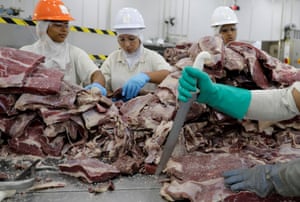
An undisclosed percentage of meat processed
 at JBS plants comes from ‘indirect suppliers’, 
which are difficult to monitor. 
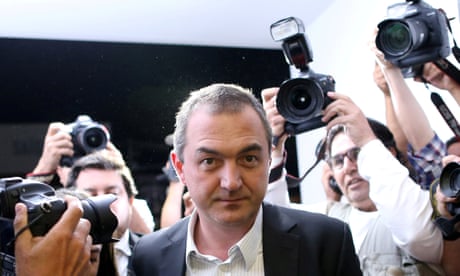
Photograph: Paulo Whitaker/Reuters


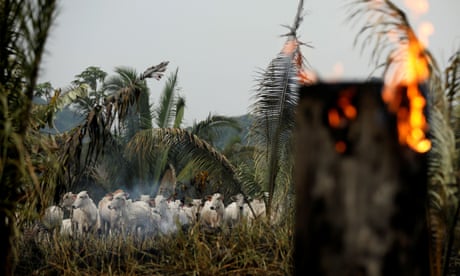
The world’s biggest meat company has frequently been accused of links to deforestation. Now JBS is facing growing pressure from Brazilian politicians and environmentalists to address the information gaps and transparency failings in its supply chain.

Critics say these deficiencies mean JBS is unable to ensure it does not buy cattle from farms involved in illegal deforestation over a decade after promising to do so.

Senator Fabiano Contarato, who presides over the environment commission, has called for Brazil’s environment and agriculture ministers to attend a Congress hearing. “These facts are serious and they should be investigated rigorously,” he said. “This is a form of cattle laundering.”

Amid mounting outrage over damage to the Amazon from deforestation and fires linked to cattle farming, the meat company’s lack of transparency is increasingly out of step with global finance. The world’s largest asset manager BlackRock has now made sustainability integral to investing. The climate crisis dominated the 2020 World Economic Forum at Davos.

But JBS remains unable to monitor a significant proportion of its suppliers despite operating deep in the Amazon. It is a problem for the entire meat industry in Brazil, but other companies, such as Marfrig, have come clean about the scale of the issue, and are taking action to resolve it. Meanwhile, JBS has refused to answer direct questions about exactly how much of its beef comes from so-called “indirect suppliers”.

Further criticism has been levelled at the audits done on the JBS supply chain, which state openly that there is “no verification system” in place for indirect suppliers.

The swashbuckling meat tycoons who nearly brought down a governmen

“This is totally against ethical principles in relation to its consumers,” said Marina Silva, a former environment minister who won international awards for reducing deforestation and called for a certification programme. “These audits end up as more of a smokescreen.”

Last year joint investigative work by the Guardian, Repórter Brasil and the Bureau of Investigative Journalism showed the way that global meat demand was driving Amazon deforestation and revealed that fires were three times more common in Amazon beef farming areas.

Cattle may be birthed on one farm, fattened
on another, and then sold on to other farms 
or slaughterhouses. 
Photograph: João Laet/The Guardian

JBS operates sophisticated checks for cattle reaching its slaughterhouses from Amazon “full cycle” farms – where cattle are reared from birth to slaughter. These farms are also called “direct suppliers”.

“The JBS monitoring system in the Amazon covers more than 280,000 sq miles, an area larger than Germany, and assesses more than 50,000 potential cattle-supplying farms every day,” the company said. “To date, we have blocked more than 8,000 cattle-supplying farms due to noncompliance.”

But this is only part of the picture. JBS does not monitor indirect suppliers in its supply chain. These are farms where cattle are birthed, or those who sell to farms where cattle are fattened, who then sell on to other farms or to slaughterhouses.

Marfrig, JBS’s biggest competitor admits that half its cattle in the Amazon come from such suppliers, but JBS so far has refused to give figures to the Guardian’s direct question. And that, say environmentalists, prosecutors and researchers, is a big problem.

“Cattle supply chains are really fluid and producers can move between the different roles and commonly sell as both direct suppliers and indirect suppliers,” said Holly Gibbs, a professor of geography at the University of Wisconsin who has monitored Amazon cattle supply chains for a decade. Her research showed that 80% of direct suppliers in the Amazon bought from other properties – on average up to 15 of them.

Revealed: rampant deforestation of Amazon driven by global greed for meat

“Direct suppliers often own multiple properties but only one is property is monitored,” she said. “The vast majority are either adjacent or within 1km.”

She compared the system to using air conditioning in a heatwave but leaving the windows open. “The cattle companies are monitoring direct suppliers but there are so many loopholes that the indirect suppliers can just come in and out,” she said.

Last year Marfrig told the Guardian that 53% of its cattle purchases came from indirect suppliers. But JBS refused to discuss how many of its cattle came from indirect suppliers and declined to make a spokesperson available for interview.

“JBS is committed to eradicating deforestation, ensuring sustainable livestock practices and improving the livelihoods of farmers in the Amazon region,” the company said by email. “We have worked for more than a decade on the frontlines, driving meaningful, responsible change in the region. We urge those who share the common goal of ending deforestation to seek solutions rather than criticism. We will only meet this collective challenge and preserve this important biome through collaboration and action.”

But the company has been making these promises for more than a decade. In 2009 a devastating report from Greenpeace led to JBS, Marfrig and Minerva (another Brazilian meat giant) signing a landmark cattle agreement with the environmental NGO. The meat companies promised not to buy from any direct suppliers involved in deforestation and to expand that commitment to include indirect suppliers within two years.

The same year federal prosecutors in Amazon states signed agreements with more than a dozen meat companies, including JBS, Marfrig and Minerva.

“It was a watermark,” said Greenpeace Brazil’s senior forest campaigner Adriana Charoux.

Deforestation fell afterwards, said Daniel Azeredo, a federal prosecutor who played a key role in the prosecutors’ deal.

But he noted: “It talked about the direct suppliers, those that sell to slaughterhouse, not those who sell to another farm.” A clause in the deal requiring companies to start monitoring indirect suppliers had no deadline, he said.

Fires were three times more common in
 beef-producing zones than in the rest of the 
Amazon in 2019. Photograph: Joao Laet/Getty

In 2017, JBS was fined R$24.7m (£4.2m) by Brazil’s government environment agency Ibama for buying 49,000 cattle in the Amazon state of Pará from illegally deforested areas – some via indirect suppliers. Following the fine, Greenpeace abandoned the cattle agreement. “Our credibility would have been completely at risk if we continued with them,” Charoux said.

The deal with prosecutors still stands, but Azeredo believes meat companies should be doing more. “All the companies working in the Amazon know that indirect suppliers is a serious problem,” he said.

When asked about these issues, JBS points journalists to the independent audits performed by Norwegian company DNV.GL, the latest of which reported that no irregularities relating to deforestation in 7,140 Amazon cattle transactions were found during 2018. The same company audits Marfrig.

But the 2019 audit added a caveat, as it also did in 2018. “Regarding indirect suppliers, JBS and the industry in general does not yet have in place a verification system in these cases,” it said.

Critics questioned an audit that failed to check out the entire supply chain. “Nobody is going to buy the animals if they don’t know where they are from, or if they are healthy,” said Prem Sikka, a professor of accounting and finance at the University of Sheffield. “If there is a trail, that makes the auditors’ omission even more damning.”

DNV.GL has been doing audits for Marfrig since 2011 and for JBS since 2018. “Our role is to assess adherence to the ‘minimum criteria for transactions with cattle and beef products on an industrial scale in the amazon biome’,” a spokesperson said in an email, referring to the terms of the deal with Greenpeace signed in 2009 – but crucially, not the promise to start monitoring indirect suppliers within two years, by 2011.

Revealed: fires three times more common in Amazon beef farming zones

“Indirect suppliers’ information was requested, however the companies do not have this information,” DNV.GL said. “In both cases a non-conformity was raised.”

“In the case of indirect suppliers, JBS has not yet been successful in implementing traceability processes,” the audit’s “non-conformity” entry read.

Since 2013, Marfrig has used a self-declaratory mechanism called a request form of information (RFI) in which the farm delivering the cattle is required to supply the name of its supplier, including tax number and the name of the farm. A spokesperson said last year that 30% of its cattle supply from the Amazon came with the form, which it is working with the World Wildlife Fund and other non-profit groups to improve.

“For me, RFI is a good tool even though it is voluntary,” said Mauro Armelin, executive director of Friends of the Earth Brazil. “It has a good chance of success.”

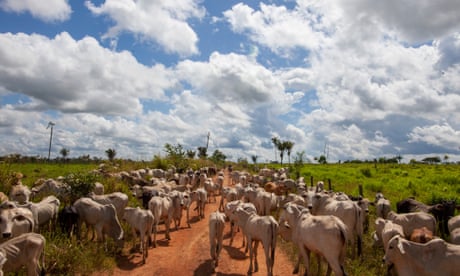
Lack of transparency makes it difficult to tell 
if cattle originate from illegally-deforested areas. 
Photograph: João Laet/The Guardian

Armelin said monitoring systems could also make use of state and federal government information on cattle movements, produced for sanitary controls. But last year, the Brazilian government restricted access to sanitary control documents that had previously been accessible.

“It’s critical that this data stays available,” Gibbs from the University of Wisconsin said. “It’s very challenging to monitor indirect suppliers.”

DNV.GL stated that the government documents “are not public” and that JBS and other companies have been trying to get access to them from the ministry without success.

But other researchers have succeeded in accessing them in the past.Using these documents and information from Brazilian government registers and databases, University of Wisconsin researchers and the US National Wildlife Federation developed their own monitoring system: Visipec; a free cloud-based tool that can be plugged into cattle companies’ current monitoring systems.

“Increasingly, they’re open and there’s a lot of discussions happening,” Gibbs said of the meat companies. But so far, she said, not one of them has taken it up.

It was announced on Thursday that JBS is buying American meat-packing company Empire Packing Company for $238m (£185m).

---30---

THE GUARDIAN