Friday, September 18, 2020


Implications of powerful DNA-altering technology are too important to be left to scientists and politicians: researchers

by Science in Public

Citizen assemblies are ideal for probing the complexities of genome editing. 
Credit: Alice Mollon

Designer babies, mutant mozzies and frankenfoods: These are the images that often spring to mind when people think of genome editing.


The practice, which alters an organism's DNA in ways that could be inherited by subsequent generations, is both more complex and less dramatic than the popular tropes suggest.

However, its implications are so profound that a growing group of experts believe it is too important a matter to be left only to scientists, doctors and politicians.

Writing in the journal Science, 25 leading researchers from across the globe call for the creation of national and global citizens' assemblies made up of lay-people to be tasked with considering the ethical and social impacts of this emerging science.

The authors come from a broad range of disciplines, including governance, law, bioethics, and genetics.

The immense potential, and threat, of gene editing was vividly demonstrated in 2018, when geneticist He Jiankui announced he had used the technology to create two genetically altered babies.

Dr. He was eventually jailed by Chinese authorities, but his rogue work threw crucial questions about gene-editing humans firmly into the spotlight. How should this technology be used—and who should make those decisions?

The questions go well beyond our own species. Gene editing potentially offers a way to change mosquitoes and wipe out malaria, to boost crop resilience and reduce starvation, or to produce pigs full of organs easily transplanted into humans.

It can also can potentially prevent conditions such as sickle cell disease, cystic fibrosis and even some forms of cancer.

But every good promise, at least in the popular imagination, is mirrored by a bad one: accidentally mutated disease-carrying insects, sterile crops, new treatment-resistant illnesses—and babies engineered for super-strength or musicality.

These implications are so important, believe researchers led by Professor John Dryzek, head of Australia's Center for Deliberative Democracy and Global Governance at the University of Canberra, they should be examined not just by those in the field, but by the general public: teachers, plumbers, butchers, bakers and candlestick-makers.

Dryzek and colleagues believe that citizens' assemblies—groups of lay-people tasked with diving deep into the ethical and moral issues thrown up by genome editing—will provide a valuable guide for scientists, doctors and politicians around the world.


"The promise, perils and pitfalls of this emerging technology are so profound that the implications of how and why it is practiced should not be left to experts," Dryzek said.

In the Science paper, the researchers say their proposed global assembly should comprise at least 100 people—none of whom would be scientists, policy-makers or activists working in the field.

The international meeting will take place after several national versions have been conducted. Events in the US, UK, Australia and China are already planned and fully funded by organizations including the Kettering Foundation, National Institutes of Health, the Australian Government Medical Research Future Fund Genomics Health Futures Mission, and the Wellcome Genome Campus.

Projects in Belgium, France, Germany, Brazil and South Africa are also well advanced.

"The fact that they are made up of citizens with no history of activism on an issue means they are good at reflecting upon the relative weight of different values and principles," Professor Dryzek said.

"Think of how we trust juries in court cases to reach good judgements. Deliberation is a particularly good way to harness the wisdom of crowds, as it enables participants to piece together the different bits of information that they hold in constructive and considered fashion."

Citizen-based deliberations are not unusual, as recent plebiscites in Ireland and Australia illustrate. However, the global assembly would be significantly different.

"The issues to be discussed in this assembly are different from the types of issues examined in other forums of this nature—for example, whether same sex marriage should be legalized," said co-author Dianne Nicol, professor of law at the University of Tasmania.

"I don't think the goal of the citizens' assembly should be to answer questions of whether heritable genome editing should be prohibited globally. Rather, it should be about better understanding community concerns and expectations."

It will also be about social justice, added Professor Baogang He, chair of international studies at Australia's Deakin University.

"A global citizens' assembly will help to develop moral and political regulation on genome editing experiments, and to ensure fair access to the technologies," he said.

"It will help global civil society guard against ill use of genome editing for the interest of a few."

Co-author Herve Chneiweiss, Director of UNESCO's International Bioethics Committee and member of the WHO Expert Advisory Committee on the Governance of Human Genome Editing, said the selection process for the global assembly must reflect differences rather than geopolitics.

"Too many people would make a real deliberation impossible, not enough should make it inefficient," he said.

"Our goal should be to be representative. Thus it is not a Senate where each state would get one vote, whatever the number of its population. The '100' should represent the diversity of cultures and origins."

Another co-author, genetic counselor Professor Anna Middleton from Society and Ethics Research, Wellcome Genome Campus in the UK, said new gene-altering practices will eventually impact the whole world.

"For technologies such as genome editing it is crucial to understand social impact," she said.

"The whole globe has the potential to be affected by this, so we must seek representation from as many public audiences as possible across the world."

Professor Dryzek said funding for the global assembly was already well advanced, with funders including the Australian Research Council already on board. He hoped the interest generated by the Science paper would provide a pathway to more.

The planning process and eventually the assembly itself is being recorded by Emmy Award-winning Australian documentary-makers Genepool Productions.

"This is not about providing a speakers platform, rather a thinkers pool," said Genepool creative director and co-author Sonya Pemberton.

"The researchers have come up with a powerful and people-focussed approach to examining a world-changing technology. Capturing this world-first event on film, I hope, will preserve the historic occasion, amplify the global conversation, and provide a template for citizen deliberation on other, equally important matters."

Explore further Report: Heritable genome editing technology is not yet ready for clinical use

More information: J.S. Dryzek el al., "Global citizen deliberation on genome editing," Science (2020). science.sciencemag.org/cgi/doi … 1126/science.abb5931

Journal information: Science

Provided by Science in Public


Emissions may add 40 cm sea level rise by 2100, experts warn

by Patrick Galey
The gigantic ice caps contain enough frozen water to lift oceans 65 metres

Sustained greenhouse gas emissions could see global sea levels rise nearly 40 centimetres this century as ice sheets in Antarctica and Greenland continue to melt, a major international study concluded Thursday.


The gigantic ice caps contain enough frozen water to lift oceans 65 metres, and researchers are increasingly concerned that their melt rates are tracking the UN's worst case scenarios for sea level rise.

Experts from more than three dozen research institutions used temperature and ocean salinity data to conduct multiple computer models simulating the potential ice loss in Greenland and Antarctic glaciers.

They tracked two climate scenarios—one where mankind continues to pollute at current levels and another where carbon emissions are drastically reduced by 2100.

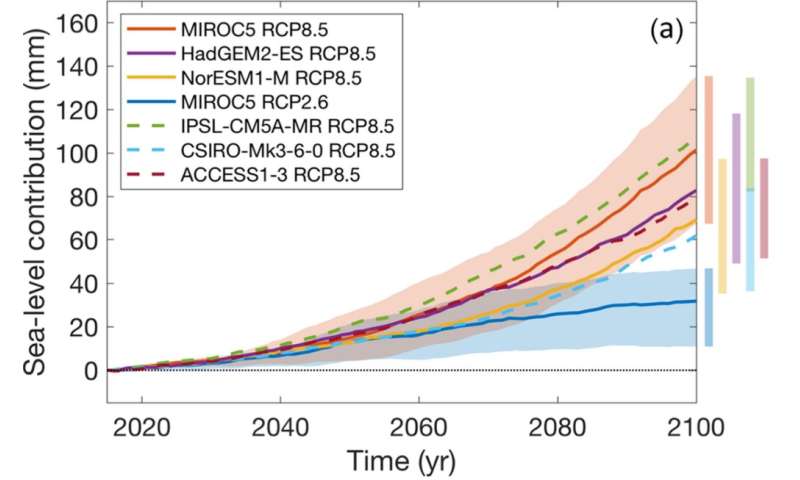
They found that under the high emissions scenario ice loss in Antarctica would see sea levels rise 30 cm by century's end, with Greenland contributing an additional 9 cm.

Such an increase would have a devastating impact worldwide, increasing the destructive power of storm surges and exposing coastal regions home to hundreds of millions of people to repeated and severe flooding.

Even in the lower emissions scenario, the Greenland sheet would raise oceans by around 3 cm by 2100—beyond what is already destined to melt due to the additional 1C of warming humans have caused in the industrial age.

"It's not so surprising that if we warm the planet more, more ice will be lost," said Anders Levermann, an expert on climate and ice sheets at the Potsdam Institute for Climate Impact Research.

"If we emit more carbon into the atmosphere we will have more ice loss in Greenland and Antarctic," he told AFP.

"We have in our hands how fast we let sea levels rise and how much we let sea levels rise eventually."
ISMIP6 mean projections for rise in sea levels through 2100 due to the melting of the Greenland Ice Sheet. The red-shaded area is the projection for the pessimistic scenario, while the blue-shaded is the projection for the optimistic scenario . Credit: Heiko Goelzer, et al., The Cryosphere, September 17, 2020.

Outpacing predictions

Until the turn of the 21st century, the West Antarctic and Greenland ice sheets generally accumulated as much mass as they shed. Runoff, in other words, was compensated by fresh snowfall.

But over the last two decades, the gathering pace of global warming has upended this balance.

Last year, Greenland lost a record 532 billion tonnes of ice—the equivalent of six Olympic pools of cold, fresh water flowing into the Atlantic every second. This run-off accounted for 40 percent of sea level rise in 2019.


The UN's Intergovernmental Panel on Climate Change (IPCC) in a special report on Earth's frozen spaces predicted last year that Greenland ice melt could contribute 8-27 cm to ocean levels by 2100.

It estimated Antarctica could add 3-28 cm on top of that.

A study published earlier this month in Nature Climate Change said the mass already lost by melt-water and crumbling ice between 2007-2017 aligned with the most extreme IPCC forecasts for the two sheets.

They also predicted a maximum of 40 cm sea level rise by 2100.

Authors of Thursday's research, published in a special edition of The Cryosphere Journal, said it highlighted the role emissions will play this century on the world's seas.

"One of the biggest uncertainties when it comes to how much sea level will rise is how much ice sheets will contribute," said project leader Sophie Nowicki from the University of Buffalo.

"And how much the ice sheets contribute is really dependent on what the climate will do."

Levermann said uncertainty in the projections "cannot be a reason to wait-and-see" in terms of emissions cuts.

"We already know that something will happen. We just don't know how bad it is going to get."


Explore furtherSea level rise from ice sheets track worst-case climate change scenario

More information: tc.copernicus.org/articles/special_issue1019.html

Heiko Goelzer, et al. The future sea-level contribution of the Greenland ice sheet: a multi-model ensemble study of ISMIP6. The Cryosphere. September 17, 2020. doi.org/10.5194/tc-14-3033-2020

Hélène Seroussi, et al. ISMIP6 Antarctica: a multi-model ensemble of the Antarctic ice sheet evolution over the 21st century. The Cryosphere. September 17, 2020. doi.org/10.5194/tc-14-3071-2020

Journal information: Nature Climate Change


© 2020 AFP


Consumers value difficult decisions over easy choices


by Jeanne Hedden Gallagher, Rensselaer Polytechnic Institute
Credit: CC0 Public Domain

Let's say you want to purchase a camera, and you're comparing two different advertisements. In one, the font, colors, and layout make the information easy to read. The other has an obscure style that takes more time for you to understand. If you decide to purchase the second camera with the more confusing advertisement, new research out of Rensselaer Polytechnic Institute shows that, over time, you'll likely be happier with your choice.


In a paper co-authored by Gaurav Jain, an assistant professor of marketing in the Lally School of Management at Rensselaer, researchers found that disfluency, or the difficulty for an individual to process a message, increases people's attitudes toward that message after a time delay.

"This research has real-life impact," Jain said. "Most of the time, marketing communicators try to make their message clear. What we learned, however, is that there are certain times, especially when people need to make choices, when we should actually use disfluent stimuli so that whatever people are choosing, they will like it once time has passed."

Using primary data collection designed by Jain of about 500 diverse individuals, researchers also found that consumers misattribute the time spent in the decision-making process. Rather than recognizing that the lengthy decision came from trying to understand the information, when looking back on the process, consumers instead believe they spent the time on making the decision. This leads the consumer to believe the decision they made was informed and worthy.

These findings have implications for marketing communications in many fields.

"When people are making decisions," Jain said, "be it choosing between insurance products, retirement funds, or even when choosing an elected official, marketers and designers need to remember that if we can make an individual spend some time in that choosing process, it's more likely people will stick with the option they chose over time."

Jain posits that when consumers' attitudes about a product increase, the impact on post-purchase decisions like returns and reviews of the product will be more favorable to the brand.


Explore further

More information: Gaurav Jain et al, (The lack of) fluency and perceptions of decision making, Journal of Marketing Communications (2020). DOI: 10.1080/13527266.2020.1815072

Thursday, September 17, 2020

Turtle scavenging critical to freshwater ecosystem health

by Nature Publishing Group
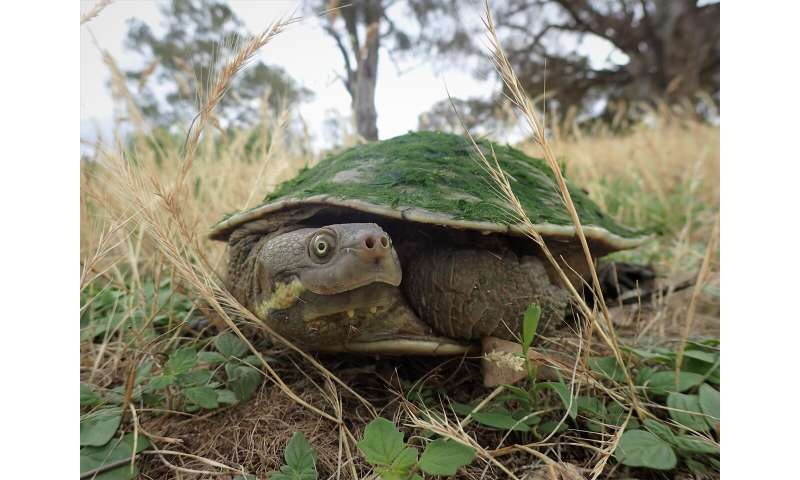
Adult Emydura macquarii. Credit: Claudia Santori.

Freshwater turtles may have a role in regulating water quality in river systems by scavenging fish carcasses, suggests a study of Emydura macquarii, a vulnerable freshwater turtle species found in Australia. The findings are published in Scientific Reports.

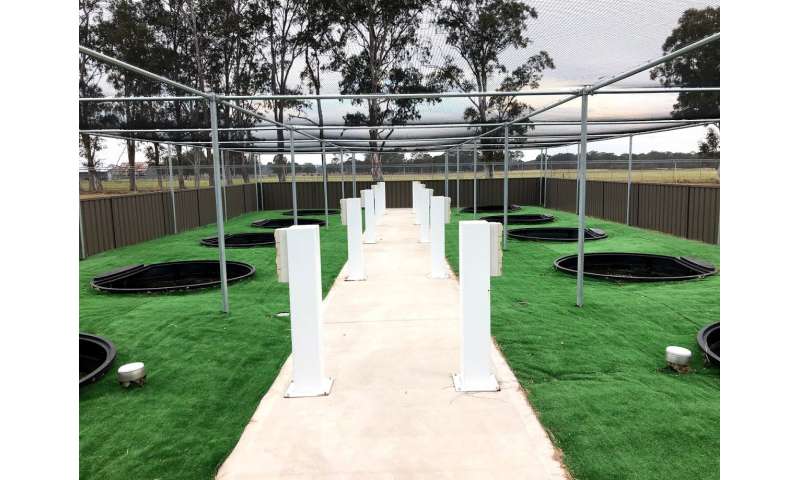
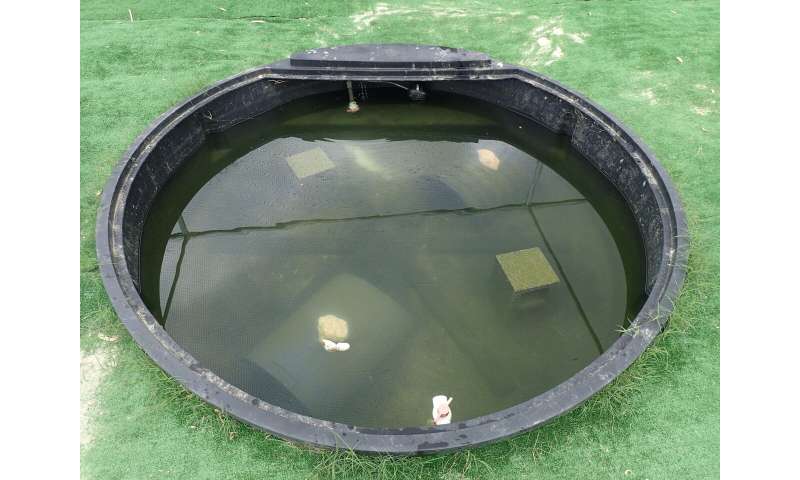
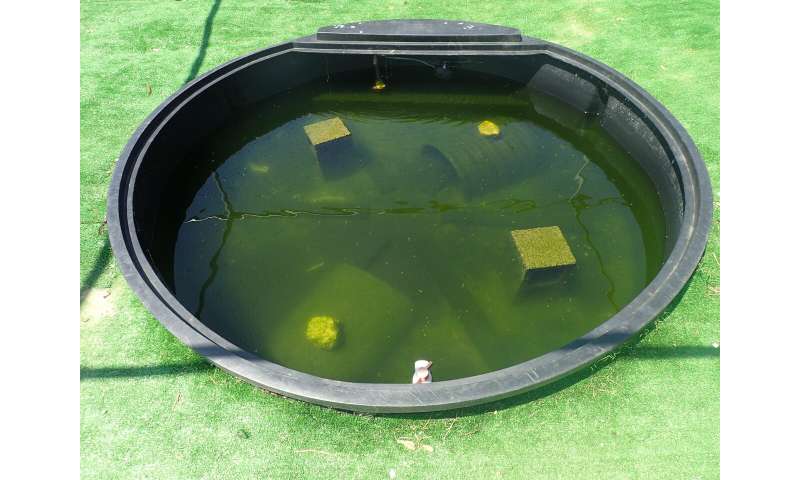
Carp are a major pest in many parts of Australia and ammonia, a by-product of carp carcass decomposition, is toxic to animals in high concentrations. Ricky-John Spencer and colleagues measured the impact of scavenging turtles on the water quality of artificial wetlands containing carp carcasses, using five groups of four male Emydura macquarii caught at Hawksview Lagoon in New South Wales. Each artificial wetland contained either four or no turtles and consisted of a tank filled with flowing water, cement blocks for turtles to bask on and plastic tunnels for shelter. Carp carcasses were left in each artificial wetland until they had either been fully eaten by turtles or had fully decomposed. When turtles were present, carp carcasses were removed three times faster and water quality returned to initial conditions more quickly, as indicated by a fall in ammonia levels and the recovery of dissolved oxygen levels. Aquatic animals need dissolved oxygen to breathe.

The Murray-Darling basin is a river system that supports 40% of Australia's agricultural production. It is the main water source for more than 2.8 million people. Freshwater turtles are scarce in the Murray-Darling basin due to death on roads and nest destruction by foxes. The water quality and ecosystems of the basin could be severely affected by plans by the Australian government to reduce the number of invasive carp through the introduction of a naturally occurring carp virus as there are fewer turtles present to scavenge on carcasses, the authors suggest.

The state-of-art experimental wetland facility at Western Sydney University’s Hawkesbury campus. Credit: Ricky Spencer and Claudia Santori.
Baby Emydura macquarii. Credit: Tom Burd.
Day one of the mesocosm experiments within the state-of-art experimental wetland facility at Western Sydney University’s Hawkesbury campus - a carp carcass is added to the water. Credit: Ricky Spencer and Claudia Santori.
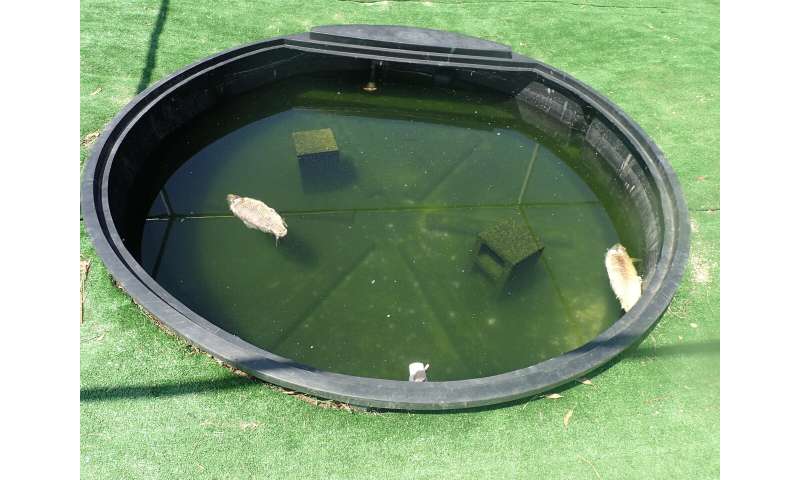
Day nine of the mesocosm experiments within the state-of-art experimental wetland facility at Western Sydney University’s Hawkesbury campus - with turtles present in the water, the carp carcass has been completely devoured. Credit: Ricky Spencer and Claudia Santori.

Day nine of the mesocosm experiments within the state-of-art experimental wetland facility at Western Sydney University’s Hawkesbury campus - without turtles present in the water, the carp carcass continues to decompose and water quality deteriorates. Credit: Ricky Spencer and Claudia Santori.

The state-of-art experimental wetland facility at Western Sydney University’s Hawkesbury campus. Credit: Ricky Spencer and Claudia Santori.

Baby Emydura macquarii. Credit: Tom Burd.


Explore further Millions of rotting fish—turtles and crays can save us from carpageddon

More information: Scavenging by threatened turtles regulates freshwater ecosystem health during fish kills, Scientific Reports (2020). DOI: 10.1038/s41598-020-71544-3 , www.nature.com/articles/s41598-020-71544-3

Journal information: Scientific Reports


Provided by Nature Publishing Group
Taxing online sports betting, fantasy sports may help states cover pandemic losses

by Avery Ruxer Franklin, Rice University
Credit: Pixabay/CC0 Public Domain

Taxing online fantasy sports and sports betting may help states recoup some of the sales tax revenue lost during the coronavirus pandemic, according to a finance expert at Rice University's Baker Institute for Public Policy.


Joyce Beebe, a fellow in public finance, writes that COVID-19 has saddled state governments with large revenue shortages, highlighted by a 21% plunge in average sales tax revenue in May 2020 compared with a year earlier. Some states have been exploring creative ways to raise money—like imposing excise taxes on sports betting and daily fantasy sports (DFS).

"When excise taxes are levied on potentially harmful goods and activities, such as cigarettes, gambling and alcoholic beverages, they are often called 'sin taxes,'" Beebe wrote. "Over time, what constitutes 'sinful' products varies as a result of evolving cultural, health and social perspectives. Although 'sin taxes' arguably focus on goods and activities that aren't overly controversial, the public debate is no less intense, because the tax is imposed, in part, to change people's behaviors."

The U.S. Supreme Court overturned a federal law prohibiting sports betting in 2018, allowing states to decide on the issue for themselves. As of 2020, sports betting is legal—and providing tax revenue—in 23 states and Washington, D.C. Yet, not all of these states allow DFS, and not all states that allow DFS permit sports betting.

"The distinction generally lies in whether the fantasy sports are considered a 'game of chance' or a 'game of skills' under state law, where the former falls in the definition of gambling and the latter is generally authorized," Beebe wrote. "As such, some DFS industry groups maintain the distinction between DFS and sports betting by emphasizing the skill element of DFS, hoping to increase the chance of legalizing DFS—although their goal is to ultimately legalize both."

COVID-19 has provided an unexpected environment for DFS to flourish due to social distancing measures, Beebe argues. She wrote that such measures may continue to "fuel the popularity of online sports betting, and the pandemic will motivate more states to accelerate its legalization."

"When debating whether to legalize sports betting, the real gain is that states can regulate the activities and provide a legitimate environment that protects consumers from disreputable operations and limits the risk of addiction," Beebe wrote.


Explore furtherPoll: Majority of Americans support legalization of sports betting

More information: 
Be a good sport (and pay your taxes): blog.bakerinstitute.org/2020/0 … -and-pay-your-taxes/

Provided by Rice University
Study shows quizzes improve academic performance
NOT TESTING!!!
by Iowa State University
Credit: CC0 Public Domain

About a year ago, a conversation during a faculty meeting piqued Marcus Crede's interest.

 A senior faculty member in Iowa State University's Department of Psychology said that he believed frequent quizzes help students better grasp classroom material.

 Crede, an associate professor of psychology, was skeptical that something as simple as a quiz could positively impact students' academic performance. He decided to dig deeper and conduct a meta-analytic study of existing research to see if there was any merit to the claim. What he discovered truly surprised him.


"I have a long history of trying to understand the variables that contribute to learning and performance in the classroom," Crede said. "For me, this study is part of a larger effort to understand what works and what doesn't work. It turned out to be a much more interesting paper than I thought it was going to be. I was surprised."

The study

Crede teamed up with psychology graduate student Lukas Sotola, who took the lead on much of the research. They analyzed data from previously published studies that examined 52 classes with almost 8,000 students, primarily college-level courses, to determine if frequent quizzes improved the students' academic performance. Laboratory settings were excluded from the study because Crede and Sotola wanted to observe whether similar studies from labs would apply to general classrooms. They defined quizzes as low-stakes assessments of learned material that occurred at least once a week.

Crede emphasizes that this study did not involve true experiments, where some students were randomly assigned quiz conditions and others were not.

"As soon as we don't have random assignments, we can't be 100% certain that the difference is really do to the quizzes. It could be something else."

Nevertheless, the results suggest there may be a strong link between frequent quizzing and student success.

The study's results are detailed in the paper, "Regarding Class Quizzes: A Meta-analytic Synthesis of Studies on the Relationship Between Frequent Low-stakes Testing and Class Performance," published last month in the journal Educational Psychology Review.

A few surprises

Crede and Sotola discovered that when students are quizzed over class material at least once a week, they tend to perform better on midterm and final exams compared to students who did not take quizzes. They also found that students who took frequent quizzes were less likely to fail the class, especially if they were struggling with the course content.


"I was surprised the effect of quizzes was relatively strong," Crede said. "I was skeptical. I didn't think this would have much of an effect. The other surprising thing was how much quizzes helped reduce failure rates in classes. The odds of passing a class went through the roof where instructors used this."


Even if quizzes only modestly impact students' ability to pass a class, Sotola said this tool should be part of an instructor's teaching curriculum.

"A modest effect can have a large impact over the course of many years," Sotola said. "If quizzes improve performance and lead to even a slightly lower percentage of students failing their classes, then that will presumably have positive effects on graduation and drop-out rates down the road, which will save students and institutions time and money."

Crede noted that students who struggle the most in a class seem to benefit the greatest from frequent quizzes. This is a profound finding, he said, especially since implementing short quizzes into course curriculum is a relatively simple task.

"In many universities, including Iowa State, there's often concern about drop-out rates and failure rates, and so the fact that we can apparently do so much with so little effort is really encouraging for us," Crede said.

In addition to quiz frequency, another factor that seemed to positively impact students' performance was immediate feedback from instructors. Also, Crede and Sotola said quizzes that required students to answer with written responses proved more beneficial to their understanding of class material compared to multiple-choice questions, though their pool of data for this particular aspect of the study was small.

"You have to be cautious about the amount of data we have, but multiple-choice questions seem to be a little less effective than what we call a constructive-response question, when you actually have to come up with the answer yourself," Crede said. "It's about recognizing the right answer and actually remembering what the right answer is."

Crede acknowledges that asking teachers to grade written quizzes daily or weekly may discourage some from implementing them in their classes. Instead, he recommends instructors utilize online quizzes that can be automatically graded by a course management system, such as Canvas.

Crede and Sotola said some quiz attributes proved insignificant in their study, including whether the tests were pop quizzes versus planned, or if they were online or on paper. No matter how they are delivered, Crede and Sotola agree that their study shows frequent quizzes with immediate instructor feedback help students, especially those who are having difficulties, succeed in the classroom.

"The impact on struggling students was really remarkable," Crede said. "Again, we only have data on about 1,000 students, but it's really quite dramatic. If it's even remotely in that neighborhood, this is something we should all be doing."


Explore further  No evidence that grit improves performance, analysis finds

More information: Lukas K. Sotola et al, Regarding Class Quizzes: a Meta-analytic Synthesis of Studies on the Relationship Between Frequent Low-Stakes Testing and Class Performance, Educational Psychology Review (2020). DOI: 10.1007/s10648-020-09563-9


Future teachers often think memorization is the best way to teach math and science – until they learn a different way

by Peter C. Cormas, The Conversation
Credit: Pixabay/CC0 Public Domain

I found that college students who are taking courses to become teachers can change their beliefs of how science and mathematics should be taught to and learned by K-12 students.

Most of these future teachers tell me when they start my course, they believe that K-12 students must memorize science and mathematics knowledge to learn it. They also believe that students cannot acquire knowledge through a process used by scientists and mathematicians called problem-solving. Problem-solving asks students to solve engaging and challenging problems that are provided without a strategy or solution. It also involves group work and a time to present and justify their strategies and solutions to the class.

To challenge my students' beliefs, I ask future teachers to teach science and mathematics to students with problem-solving. At first they often resist because they believe that their students can only memorize science and mathematics knowledge. However, after they have asked the students to use problem-solving and find it successful, they discover that students can learn like scientists and mathematicians The evidence and experiences start to change their beliefs.


The way I reached these conclusions was by studying future teachers over the course of four years. I studied 113 future teachers' beliefs in 10 sections of a course that I taught on how to teach science and mathematics. Throughout the course, I asked the future teachers to discover science and mathematics knowledge with problem-solving. I also had the future teachers teach students at a local school by asking them to learn with problem-solving.

To measure changes in future teachers' beliefs following completion of the class, I asked them to complete a survey at the start and end of the course. At the end, the findings showed that the future teachers were significantly more likely to teach in a way that reflected how scientists and mathematicians solve problems.

It also appeared that their teaching of science with problem-solving encouraged their use of the method when they taught mathematics. Conversely, their teaching of mathematics with problem-solving encouraged their use of the method when they taught science.

This study matters because a teacher's beliefs – their personal philosophy about teaching and learning—often determine how they will teach and what students will learn. And because problem-solving is necessary for scientific and mathematical literacy, students need teachers who will expose them to problem-solving.


This study also matters because college professors who work with future teachers can employ similar strategies. They can place future educators in situations in which they must confront their beliefs about teaching and learning with evidence and experiences that contradict their beliefs.

Those who do similar research are trying to figure out how to assure future teachers use problem-solving in their future classrooms. I have taught many education students who did quite well in my course, and successfully used science and mathematics problem-solving with their students. However, former students that I ran into years later often told me that they do not use problem-solving as teachers. Instead, they reverted to simply asking students to memorize science and mathematics information. They told me the reason for this is that teachers in their present schools do not use problem-solving. I find this troubling.

It may be that one way to solidify beliefs about teaching through problem-solving instead of memorization would be for science and mathematics faculty to use problem-solving in their college classrooms. Research shows that similarities and coherence between college courses may increase the likelihood that future teachers will believe in the value of problem-solving. If so, then my students may become less likely to abandon the methods learned in their courses. In turn, they may be more likely to help make their future students more adept at mathematics and science.


Explore furtherCreativity important to lift math education

Provided by The Conversation

This article is republished from The Conversation under a Creative Commons license. Read the original article.


Could breadfruit be the next superfood?


by University of British Columbia
UBC Okanagan researchers say breadfruit is nutritionally sound and has the potential to improve worldwide food security issues.
Credit: Jan Vozenilek, Copper Sky Productions, Kelowna.

A fruit used for centuries in countries around the world is getting the nutritional thumbs-up from a team of British Columbia researchers.

Breadfruit, which grows in abundance in tropical and South Pacific countries, has long been a staple in the diet of many people. The fruit can be eaten when ripe, or it can be dried and ground up into a flour and repurposed into many types of meals, explains UBC Okanagan researcher Susan Murch.

"Breadfruit is a traditional staple crop from the Pacific islands with the potential to improve worldwide food security and mitigate diabetes," says Murch, a chemistry professor in the newly-created Irving K. Barber Faculty of Science. "While people have survived on it for thousands of years there was a lack of basic scientific knowledge of the health impacts of a breadfruit-based diet in both humans and animals."

Breadfruit can be harvested, dried and ground into a gluten-free flour. For the project, researchers had four breadfruits from the same tree in Hawaii, shipped to the Murch Lab at UBC Okanagan. Doctoral student Ying Liu led the study examining the digestion and health impact of a breadfruit-based diet.

"Detailed and systematic studies of the health impacts of a breadfruit diet had not previously been conducted and we wanted to contribute to the development of breadfruit as a sustainable, environmentally-friendly and high-production crop," Liu says.

The few studies done on the product have been to examine the glycemic index of breadfruit—with a low glycemic index it is comparable to many common staples such as wheat, cassava, yam and potatoes.

"The objective of our current study was to determine whether a diet containing breadfruit flour poses any serious health concerns," explains Liu, who conducted her research with colleagues from British Columbia Institute of Technology's Natural Health and Food Products Research Group and the Breadfruit Institute of the National Tropical Botanic Garden in Hawaii.

The researchers designed a series of studies—using flour ground from dehydrated breadfruits—that could provide data on the impacts of a breadfruit-based diet fed to mice and also an enzyme digestion model.

The researchers determined that breadfruit protein was found to be easier to digest than wheat protein in the enzyme digestion model. And mice fed the breadfruit diet had a significantly higher growth rate and body weight than standard diet-fed mice.

Liu also noted mice on the breadfruit diet had a significantly higher daily water consumption compared to mice on the wheat diet. And at the end of the three-week-trial, the body composition was similar between the breadfruit and wheat diet-fed mice.

"As the first complete, fully-designed breadfruit diet study, our data showed that a breadfruit diet does not impose any toxic impact," says Liu. "Fundamental understanding of the health impact of breadfruit digestion and diets is necessary and imperative to the establishment of breadfruit as a staple or as a functional food in the future."

The use of breadfruit is nutritious and sustainable and could make inroads in food sustainability for many populations globally, she adds. For example, the average daily consumption of grain in the United States is 189 grams (6.67 ounces) per day. Liu suggests if a person ate the same amount of cooked breadfruit they can meet up to nearly 57 per cent of their daily fiber requirement, more than 34 per cent of their protein requirement and at the same time consume vitamin C, potassium, iron, calcium and phosphorus.

"Overall, these studies support the use of breadfruit as part of a healthy, nutritionally balanced diet," says Liu. "Flour produced from breadfruit is a gluten-free, low glycemic index, nutrient-dense and complete protein option for modern foods."

The study was recently published in PLOS ONE.


Explore furtherStudies confirm breadfruit's ability to repel insects

More information: Ying Liu et al, Breadfruit flour is a healthy option for modern foods and food security, PLOS ONE (2020). DOI: 10.1371/journal.pone.0236300

Journal information: PLoS ONE


Provided by University of British Columbia

Sugar promotes sperm longevity in pig reproductive tract

by Lauren Quinn, University of Illinois at Urbana-Champaign
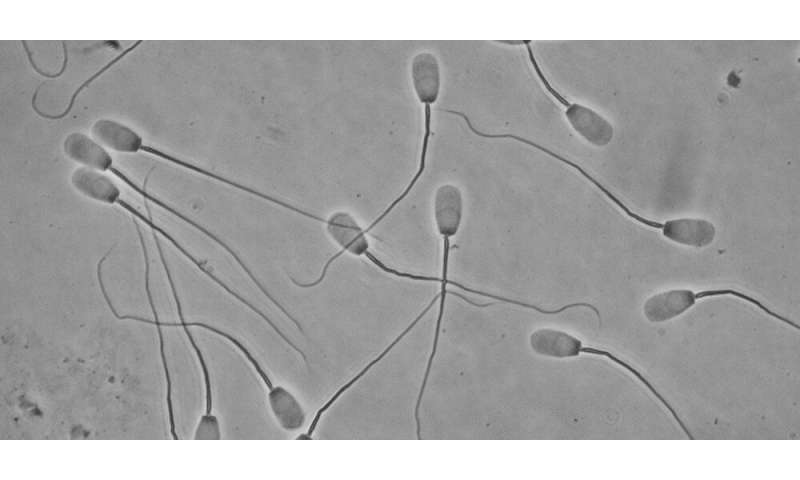
Pig sperm. Credit: University of Wisconsin Madison

For many livestock species, artificial insemination (AI) is standard. But it can be tricky to achieve success the first time, thanks to variability in ovulation timing across the herd.

Sperm remains viable for a day or two once they reach the oviduct, the tube connecting the uterus with the ovaries, in pigs and cattle. The amount of time sperm can be stored in the oviduct has a direct bearing on AI success; if ovulation happens just outside that window, the effort and expense of AI has to be repeated.

A new University of Illinois study identifies a naturally occurring sugar that slows the maturation of sperm in pigs, opening up the possibility of extending sperm storage time within the female reproductive tract and increasing the chances of successful fertilization through AI.

"We knew there was something about the oviduct that was increasing sperm lifespan, but we didn't know what it was, exactly," says David Miller, professor in the Department of Animal Sciences at Illinois and co-author on the PLOS One study. "In this study, we discovered the molecules of the oviduct that bind sperm and increase their lifespan are complex sugars called glycans."

After screening more than 400 sugars for their capacity to hold sperm, Miller's team had an inkling glycans were a candidate for pigs. To confirm, they isolated various sugars from the pig oviduct and applied them to beads in the laboratory, mimicking the oviduct lining. Compared with other sugars, the glycan-treated beads bound more sperm.

But it wasn't just the physical act of slowing sperm down that increased their lifespan.

"We found out glycans were delaying the normal influx of calcium into sperm," Miller says. "Normally, calcium slowly comes into sperm as they mature, and that triggers them on their differentiation pathway, which makes them capable of fertilization. But binding to these immobilized sugars actually stops that calcium movement inside the cells. So it in a sense, the glycans are blocking their differentiation pathway and making them live longer."

Miller sees several potential applications for this discovery. For example, it might be possible to conduct a fertility test for sperm using glycans in the lab. Sperm whose lifespan didn't increase when exposed to glycans would likely be less fertile and could be discarded. It might also be possible, someday, to introduce supplemental glycans in the oviduct during AI to create a larger reservoir of viable sperm.

The results also extend scientists' understanding of fertility across animal species. Miller has done research to show a similar sugar binds and extends longevity in bovine sperm, and he's currently looking for genetic similarities in sperm storage organs among a wide variety of animal groups. Nature may use the same mechanisms to lengthen sperm lifespan after mating in several species.

The article, "Adhesion to oviduct glycans regulates porcine sperm Ca2+ influx and viability," is published in PLOS One.


Explore further

More information: Sergio A. Machado et al, Adhesion to oviduct glycans regulates porcine sperm Ca2+ influx and viability, PLOS ONE (2020). DOI: 10.1371/journal.pone.0237666

Journal information: PLoS ONE

Provided by University of Illinois at Urbana-Champaign


Discovery of microbes with mixed membranes sheds new light on early evolution of life

by Royal Netherlands Institute for Sea Research
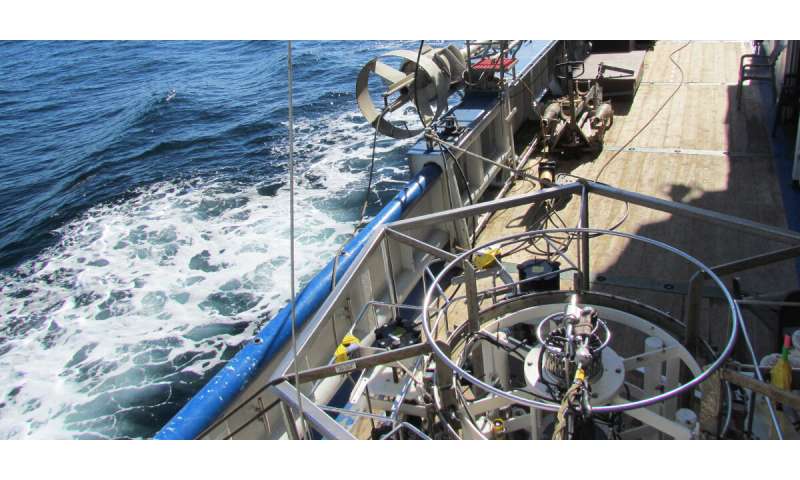
View from the RV Pelagia during the expedition on the Black Sea
Photo: Laura Villanueva

Current research suggests that more complex life-forms, including humans, evolved from a symbiosis event of Bacteria and another single-celled organism known as Archaea. However, evidence of a transition period in which the two organisms mixed where nowhere to be found. That is, until now. In the deep waters of the Black Sea, scientists found microbes that can make membrane lipids, a layer that surrounds a cell like a skin, of unexpected origin. Researchers from NIOZ and Utrecht University have published their findings in the prestigious ISME Journal.


Changing skins

Cells are surrounded by a layer of membrane lipids that protect them from changes in their environment such as temperature, much in the same way that our skin changes when we are cold or exposed to the sun. Lead author and NIOZ senior scientist Laura Villanueva explains why they make such interesting biomarkers. "When a cell dies, these lipids preserve like fossils and hold ancient-old information on Earths' early environmental conditions." Our tree of life includes small and simple cells (Bacteria and Archaea) and more complex cells (Eukaryotes), including animals and humans. Bacteria and Eukaryotes share a similar lipid membrane. Looking at Archaea, their 'skin' or membrane looks very different and is primarily designed to help these microorganisms to survive in extreme environments. Villanueva: "This 'lipid divide,' or difference in membranes between Bacteria and Eukaryotes on the one hand and Archaea on the other, is believed to have happened after the emergence of Bacteria and Archaea from the last universal cellular ancestor (LUCA)."

Missing piece hidden in the deep Black Sea

The leading theory is that Eukaryotes evolved from a symbiosis event between archaeal and bacterial cells in which the archaeal cell was the host. But how does this work when their 'skins' are so different and share no sign of common ancestry? Villanueva: "To explain the creation of more complex life-forms, the archaeal membrane must have made a switch to a bacterial type membrane. Such a switch likely needed a transition period in which the two membrane types were mixed." However, mixed lipid membranes had never been found in microbes until the team of Villanueva made an unexpected discovery in de deep waters of the Black Sea.

Villanueva notes, "We found a possible missing piece of this puzzle in the Black Sea. Here, an abundant group of bacteria thrive in the deep-sea, absent of oxygen and with high sulfide concentration. We discovered that the genetic material of this group did not only carry pathway genes for bacterial lipids but archaeal ones as well." The peculiarity was also found in the genetic material of other, closely related Bacteria and supports the idea that this ability to create 'mixed' membranes is more widespread than previously thought. This discovery sheds new light on the evolution of all cellular life forms and may have important consequences for the interpretation of archaeal lipid fossils in the geological record and paleoclimate reconstructions.


Explore furtherNew insight into the evolution of complex life on Earth

More information: Laura Villanueva et al, Bridging the membrane lipid divide: bacteria of the FCB group superphylum have the potential to synthesize archaeal ether lipids, The ISME Journal (2020). DOI: 10.1038/s41396-020-00772-2

Journal information: ISME Journal


Provided by Royal Netherlands Institute for Sea Research