Wednesday, February 17, 2021

Commercial Carbon Capture And Use Takes A Step Forward With Carbon Clean


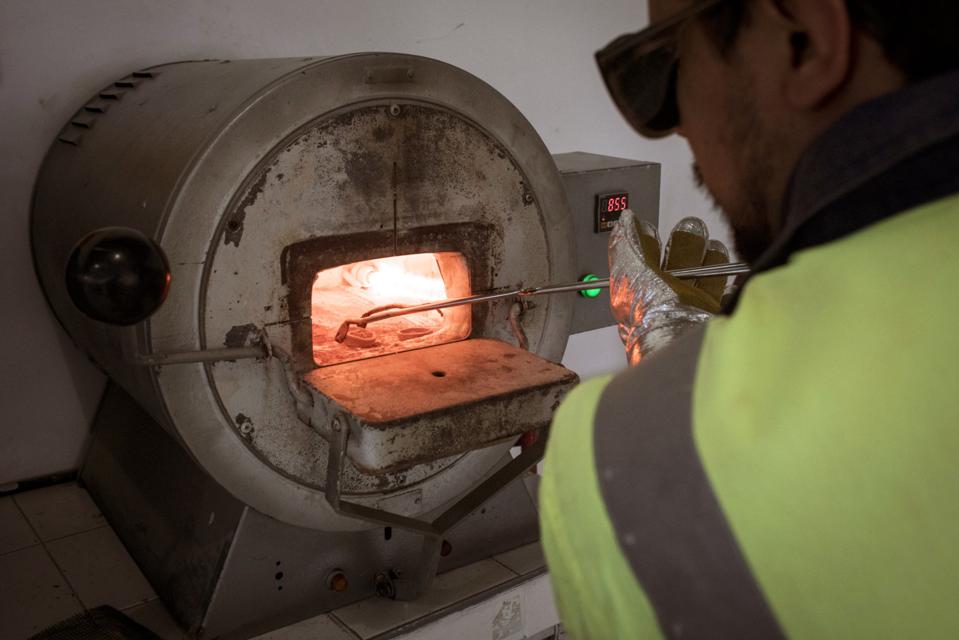
A worker removes a cement sample from an oven in the laboratory of the Cemex Latam Holdings SA . © 2018 BLOOMBERG FINANCE LP

The US Department of Energy has awarded a grant to RTI International, CEMEX (a leading supplier of cement, concrete and aggregates), Carbon Clean and Oak Ridge National Laboratory to jointly work on development of a CO2 capture system and commercially viable carbon utilization solution.

The project will be associated with CEMEX’s Victorville, California cement plant, and will exploring cost-competitive solutions to completely close the loop on current carbon emissions. Part of the challenge is the slow pace of development in carbon capture and storage/use. It has played a significant role in decarbonisation pathways but only a few plants exist around the world.

While initially carbon capture and storage was associated with the concept of clean coal, the idea that carbon capture would enable the world to continue to use fossil fuels. The energy penalty and the cost of the technology however, combined with the rapid price collapse in renewable energy technologies has undercut its development.

Where there is an interesting opportunity however is in heavy industry, in sectors which emissions are traditionally hard to abate. The challenge is that processes for making cement, steel, fertiliser etc require very high temperature or generate emissions through chemical processes – something the use of renewable energy might not be able to address.

CEMEX USA President Jaime Muguir said, “CEMEX is committed to being part of the solution to reduce carbon emissions globally and to deliver net-zero CO2 concrete to all of our customers by 2050.” The company is already introducing a low carbon and net-zero CO2 products where it has a presence, and is considered a milestone towards carbon-neutral construction becoming a reality.

Access to low-cost construction materials is linked to regional economic development and vital for the infrastructure that helps provide clean water, sanitation and energy, as well as durable homes, schools, hospitals, roads, railways and much more. But there is no getting around the significant carbon footprint of cement.

CEMEX’s overall net zero goal is currently being achieved through a combination of new production processes with the remainder being addressed via offsetting. The role of offsetting in achieving net zero is now widely accepted, but concerns remain about the robustness and transparency of the offsets markets.

While carbon capture storage and use (CCSU) is nowhere near commercial today, it is expected to play a significant role in industries where renewable energy cannot help with large scale decarbonisation. This is predominantly in heavy industry like steel, ceramics and cement.

UK-headquartered Carbon Clean is working on different approaches to reaching net zero, including CCS, ICCU, biomethane amongst others and, according to the company, has so far removed over 800,000 tonnes of CO2 from its 38 facilities around the world. Aniruddha Sharma, CEO of Carbon Clean, said: “CEMEX shares our mission to enable the net zero transition by developing affordable modularized carbon capture solutions. This latest grant from the US Government endorses the importance of such work.”

The overall goal of the consortium is to increase efficiencies and value in CEMEX’s overall building material fabrication process, while significantly reducing its CO2 footprint through the leverage of technological upgrades. The project is also expected to cover integration aspects of the modular technology with CEMEX’s processes, evaluating cost as well as any technical considerations in turning the captured CO2 into useful product. In recent months Carbon Clean has agreed deals with Veolia for use in its UK energy from waste plants, and is working on two CCUS and one compressed biogas project with Veolia in India.


Contributor
Energy
I write about innovation, finance, energy, climate and sustainability.
Why on earth would right-wing people with connections to the fossil fuel industry lie about ‘frozen wind turbines’ in Texas?

Jamie Henn and Duncan Meisel 

© Provided by The Independent

The fossil fuel industry’s disinformation machine turned on before the lights even went out.

As a massive winter storm rolled towards Texas, it was accompanied by a barrage of lies about how renewable energy — and “frozen wind turbines” in particular — was to blame for potential blackouts.

It began over the weekend, as posts about the blackouts began to pick up momentum on right-wing social media. One image that went viral showed a helicopter supposedly de-icing a wind turbine in Texas. A tweet with the photo from a fossil fuel publicist — because, really, who else? — has now been liked nearly 88,000 times.

As more and more right-wing accounts began to share the image, it soon jumped over into the political arena. Texas Republican Senator John Cornyn retweeted the picture on Monday. By Tuesday, Montana Republican Senator Steve Daines and conspiracy-minded Congresswoman Lauren Boebert were out with their own posts promoting the story. What do these politicians have in common? Boebert and Daines have both received extensive fossil fuel contributions, while Cornyn was the top recipient of oil and gas money in Congress over the last two years.

In reality, the “frozen wind turbine” was a complete fabrication. The photo wasn’t actually taken in Texas, but in the Uljabuouda mountains in Arjeplog, Sweden in 2013. As Brian Kahn explained in a piece for Earther, the picture has for years been a favorite meme for far-right climate deniers to spread anytime there’s a cold snap. (None of the politicians who shared the image have yet to issue a correction).


By Monday, the “renewables caused the blackout” story was already gaining steam in right-wing media outlets. In nearly all those cases, the “experts” being cited by these outlets could be traced back to the fossil fuel industry.

By Tuesday, the disinformation had made another jump, this time to the editorial page of the Wall Street Journal. In a piece called “The Deep Green Freeze,” the editorial board wrote that “Power shortages show the folly of eliminating natural gas — and coal.” It concluded with the ominous warning, “The Biden administration’s plan to banish fossil fuels is a greater existential threat to Americans than climate change.”


Video: 12m at risk from climate change (Sky News)


That’s, of course, absurd, and our politicians and news outlets shouldn’t be parroting Big Oil’s talking points. What Texas is currently experiencing is the combined threat of the climate crisis and our over-reliance on fossil fuels. Moving towards a smart-grid powered with renewable energy won’t just cut our emissions, it will make our energy system more resilient and better able to handle the ongoing impacts of the climate crisis.

The current crisis in Texas, and the way the fossil fuel industry and its backers have swooped in to take advantage of the situation in order to spread climate denial and anti-renewable energy talking points, is a perfect case study in how a disinformation machine operates.

Let’s be clear about what’s really going on in the Lone Star state right now. The first thing to understand is that the freezing temperatures are actually connectedto global warming. Climate change has resulted in changes in the Arctic jet stream that allow freezing weather to escape the polar regions and break down south.

This has resulted in a severe cold snap across Texas, which has frozen instruments at natural gas, coal, and nuclear facilities.

Along with the limited supplies of gas on hand, the situation has caused a lack of power supply, leading to some 30 to 35 gigawatts of total power outages across the state — almost all from non-functioning gas power plants. Sure, some wind turbines and solar facilities have also been affected, but all through Monday while gas plants were freezing, wind turbines and solar panels actually exceeded expected power delivery.

In short, the failure of fossil fuels is what’s causing the blackout.

It’s not enough to just to push back on the fossil fuel industry’s propaganda on a case-by-case basis (there are very few effective ways to combat a lie once it’s spread across the internet). We need to actually dismantle the industry’s disinformation machine — or at the very least, throw a few wrenches in the gears.

As the Texas example is showing us, we can’t wait to “fact-check” climate disinformation once it’s already spread. We need to be out in front, putting the truth on offense. Reality is on our side: from now on, let’s make the fossil fuel industry respond to us, not the other way around.


Jamie Henn is the director of Fossil Free Media and lives in Salt Lake City, UT. Duncan Meisel is the campaign director for Clean Creatives and lives in Austin, TX. Their joint Clean Creatives campaign aims to hold to account the PR and ad agencies that work with the fossil fuel industry


Guided wave-based approach for health monitoring of composite structures; Application to wind turbine blades

The use of composite materials has increased in manufacturing of large structures. These structures can be subjected to different types of defects, for which detection has always been a challenge. Wind turbine blades are a perfect example of these large structures that can be exposed to different defects such as delamination, debonding or ice accumulation.


Oct 2018

Thesis
Full-text available
IT'S CLIMATE CHANGE STUPID
Tucker Carlson blames green energy for Texas storm

Are frozen wind turbines to blame for Texas power outages?


More than 4.2 million people left without power following winter storm 

Graeme Massie Los Angeles@graemekmassie

Green energy sources are not to blame for the winter storm Uri power blackouts in Texas, experts say.


More than 4.2 million people were left without power after a rare cold front brought record-breaking freezing conditions to the state

Fox News host Tucker Carlson, among others, has tried to point the finger at renewable energy sources such as wind turbines for the rolling blackouts seen in the state.

“So it was all working great until the day it got cold outside. The windmills failed like the silly fashion accessories they are, and people in Texas died,” said Carlson on his Monday show.

Texas Governor Greg Abbott has called for the state legislature to investigate the Electric Reliability Council of Texas, which manages the flow of 75 per cent of power in the state.

The grid operators said that nearly half of all wind power generators had gone offline because of the unusually moist winter conditions.

But experts have been quick to say that the freezing-up of wind turbines in the state is not the main reason why many areas have been thrown into darkness.

ERCOT acknowledges that frozen wind turbines have played a role, but that frozen instruments at natural gas, coal and nuclear facilities and a limited supply of natural gas are the main factors

“We’ve had some issues with pretty much every kind of generating capacity in the course of this multi-day event,” said ERCOT’s Dan Woodfin.

Wind shutdowns during the current crisis accounted for 3.6 to 4.5 gigawatts of energy, or less than 13 per cent of the 30 to 35 gigawatts of total outage, Mr Woodfin told Bloomberg.

At this time of year wind only accounts for 25 per cent of the energy generated in Texas, which rises to 60 per cent during other periods.

“The performance of wind and solar is way down the list among the smaller factors in the disaster that we’re facing,” Daniel Cohan, associate professor of environmental engineering at Rice University, told Bloomberg.

Experts say that the main issue is that the power grid is simply not built to sustain the current load being placed upon it during the bad weather.

“Grid demand is so much higher than we’ve really built the system for in the wintertime,” said Joshua Rhodes, a research associate at the University of Texas at Austin.

“No one’s model of the power system envisioned that all 254 Texas counties would come under a winter storm warning at the same time.

“It’s putting major strain on both the electricity grid and the gas grid that feeds both electricity and heat.”

And experts say that wildly fluctuating weather brought on by the climate crisis will cause increasing problems as the systems only work if operators can reliably predict future dangers.

And the more unpredictable the weather the more stress will be placed on the grids, experts tell the New York Times.

“It’s essentially a question of how much insurance you want to buy,” Jesse Jenkins, an energy systems engineer at Princeton University, told the newspaper.

“What makes this problem even harder is that we’re now in a world where, especially with climate change, the past is no longer a good guide to the future. We have to get much better at preparing for the unexpected.”


No, frozen wind turbines aren't the main culprit for Texas' power outages

By ERIN DOUGLAS AND ROSS RAMSEY, TEXAS TRIBUNE
Tuesday, February 16, 2021 9:14PM

Frozen wind turbines in Texas caused some conservative state politicians to declare Tuesday that the state was relying too much on renewable energy. But in reality, the lost wind power makes up only a fraction of the reduction in power-generating capacity that has brought outages to millions of Texans across the state during a major winter storm.

An official with the Electric Reliability Council of Texas said Tuesday afternoon that 16 gigawatts of renewable energy generation, mostly wind generation, was offline. Nearly double that, 30 gigawatts, had been lost from thermal sources, which includes gas, coal and nuclear energy.

"Texas is a gas state," said Michael Webber, an energy resources professor at the University of Texas at Austin.

While Webber said all of Texas' energy sources share blame for the power crisis, the natural gas industry is most notably producing significantly less power than normal.

"Gas is failing in the most spectacular fashion right now," Webber said.

Dan Woodfin, a senior director at ERCOT, echoed that sentiment Tuesday.


"It appears that a lot of the generation that has gone offline today has been primarily due to issues on the natural gas system," he said during a Tuesday call with reporters.

 VIDEO 

Still, some have focused their blame on wind power.


"This is what happens when you force the grid to rely in part on wind as a power source," U.S. Rep. Dan Crenshaw, R-Houston, tweeted Tuesday afternoon. "When weather conditions get bad as they did this week, intermittent renewable energy like wind isn't there when you need it."

He went on to note the shutdown of a nuclear reactor in Bay City because of the cold, and finally got to what energy experts say is the biggest culprit, "Low Supply of Natural Gas: ERCOT planned on 67GW from natural gas/coal, but could only get 43GW of it online. We didn't run out of natural gas, but we ran out of the ability to get natural gas. Pipelines in Texas don't use cold insulation -so things were freezing."

Agriculture Commissioner Sid Miller, known for his right-wing Facebook posts that have, in the past, spread misinformation and amplified conspiracy theories, also posted an unvarnished view of wind energy on Facebook: "We should never build another wind turbine in Texas."

In another post, Miller was even more forthright, but also misleading, "Insult added to injury: Those ugly wind turbines out there are among the main reasons we are experiencing electricity blackouts. Isn't that ironic? ... So much for the unsightly and unproductive, energy-robbing Obama Monuments. At least they show us where idiots live."

While wind power skeptics claimed the week's freeze means wind power can't be relied upon, wind turbines - like natural gas plants - can be "winterized" or modified to operate during very low temperatures. Experts say that many of Texas' power generators have not made those investments necessary to prevent disruptions to equipment since the state does not regularly experience extreme winter storms.

It's estimated that of the grid's total winter capacity, about 80% of it, or 67 gigawatts, could be generated by natural gas, coal and some nuclear power. Only 7% of ERCOT's forecasted winter capacity, or six gigawatts, was expected to come from various wind power sources across the state.

Production of natural gas in the state has plunged due to the freezing conditions, making it difficult for power plants to get the fuel necessary to run the plants. Natural gas power plants usually don't have very much fuel storage on site, experts said. Instead, the plants rely on the constant flow of natural gas from pipelines that run across the state from areas like the oil and natural gas producing Permian Basin in West Texas, to major demand centers like Houston and Dallas.

Gov. Greg Abbott specified that fossil fuel sources were contributing to the problems with the grid when describing the situation Monday afternoon.

"The ability of some companies that generate the power has been frozen. This includes the natural gas & coal generators," he wrote in a tweet.

Heather Zichal, CEO of the industry group the American Clean Power Association, said opponents of renewable energy were trying to distract from the failures elsewhere in the system and slow the "transition to a clean energy future."

"It is disgraceful to see the longtime antagonists of clean power - who attack it whether it is raining, snowing or the sun is shining - engaging in a politically opportunistic charade misleading Americans to promote an agenda that has nothing to do with restoring power to Texas communities," she said.

The Texas Tribune is a nonprofit, nonpartisan media organization that informs Texans - and engages with them - about public policy, politics, government and statewide issue.


CLIMATE CHANGE PUMMELS PRIVATIZED POWER
U.S. Power Crisis Leaves Millions Cold, Dark as Blackouts Expand

Brian K. Sullivan and Naureen S. Malik 1 day ago

(Bloomberg) -- The energy crisis crippling power grids across the U.S. showed no sign of abating on Tuesday morning as blackouts left almost 5 million customers without electricity during unprecedented cold weather.
© Photographer: KENA BETANCUR/AFP People cross the street as snow falls in North Bergen, New Jersey on February 7, 2021.

To prevent the collapse of their networks, suppliers from North Dakota to Texas are having to institute rolling power cuts for the second consecutive day to limit demand. The severe shortages are likely to continue throughout Tuesday, and the deep freeze is forecast to remain until Wednesday at least.

Officials have reported two people dead, likely from cold, according to the Associated Press. Medical centers are rushing to administer vaccines before they go bad. Flights are grounded. More than a million barrels a day of oil and 10 billion cubic feet of gas production are shut and massive refineries have halted gasoline and diesel output.

The Southwest Power Pool, which controls a grid spanning 14 states from North Dakota to Oklahoma, ordered rotating outages for a second consecutive day. President Joe Biden approved an emergency declaration for Texas, making more resources available to help.

Read More: How Extreme Cold Turned Into a U.S. Energy Crisis: QuickTake

“I’ve been following energy markets and grid issues for a while, and I cannot recall an extreme weather event that impacted such a large swath of the nation in this manner — the situation is critical,” said Neil Chatterjee, a member of the U.S. Federal Energy Regulatory Commission.

The cold blast is just the latest in a chain of severe weather events that have shaken power grids and upended energy markets globally from Japan to France in recent months. They’ve all underscored how vulnerable the world has become in the face of increasingly unpredictable weather brought on by climate change and it’s raising questions about the global push to electrify everything from transportation to heating and cooling.

Almost 4 million homes and businesses were without power across Texas on Tuesday, based on utility outage data compiled by Poweroutage.us. Another 400,000 were down in a swathe of states stretching from Louisiana to Ohio and Virginia. Almost 250,000 were without power in Oregon.

In Mexico, over 4.7 million homes and businesses went dark after Texas’s shortages triggered cascading failures. But about 65% of those affected in Mexico had seen their power restored by midday, according to grid operator Cenace.

While temperatures are forecast to rise, the weather across the central U.S. will remain bitingly cold this week. Dallas, which was forecast to see a low of 2 degrees Fahrenheit (minus 17 degrees Celsius) late Monday, will reach a high of 29 by Wednesday, the National Weather Service said. But by late Thursday, readings will drop back into the teens.

Read More: ‘This Is Extremely Dangerous’: Texans in Peril at Home, on Road

Such drastic weather conditions are rare, especially in parts of Texas. In Houston, the state’s largest city, roads were iced over and people braved long lines to refill household propane canisters. Traffic and street lights are down. Firewood is selling out. Grocery stores have run out of essentials including milk.

This week’s cold front caught Texas’s highly decentralized power market especially by surprise. The region’s grid is designed for hot summers, not ice-cold winters, but many households rely on electricity to heat their home. Utilities there haven’t had to carry out rolling blackouts since 2011.

Extreme weather events are happening more frequently, a shift that’s attributed to the changing climate. In response, electrifying sectors like transport and heating to use green power is seen as vital to eliminating harmful emissions, but the world’s grid infrastructure may not be ready.

As electricity demand rises and grids rely more on wind and solar power, where supply oscillates with the weather, networks will have to increase access to back-up generation. In Texas, where both wind and gas-fired generation was hit by the cold snap, there wasn’t enough reserve power to keep the lights on.

Besides the impact on households, the cold is wreaking havoc on the energy industry itself. U.S. oil production has dropped by well over a million barrels a day, helping U.S. crude prices trade above $60 a barrel for the first time in more than year. The region’s refining complex -- which produces almost half of the nation’s fuel -- is struggling to limp along without power and gas supplies. Some of the largest oil refineries have shut altogether, threatening to reduce supplies of gasoline and diesel across the country.

Natural gas production has also been curtailed just as the cold caused demand to jump. At the Waha hub in Texas gas changed hands at $500 per million British thermal units on Monday, more than 100 times the price at the Henry Hub, the benchmark for the wider U.S.

Power plants with a combined capacity of more than 34 gigawatts were forced offline on Monday, including nuclear reactors, coal and gas generators and wind farms. It’s not yet clear why. Early on Tuesday, power generation in Texas had yet to stage any significant recovery.

Read More: Texas Power Retailers in Face of Freeze: Please, Leave Us (1)

Wind power generators were among the victims of the cold weather, with turbine blades rendered inoperable due to ice -- a phenomenon that reduces efficiency and can ultimately stop them from spinning. Texas estimated that more than half of its wind power capacity had come offline.

At times, parts of Texas were colder than Alaska, according to the National Weather Service. In the Dallas-Fort Worth area it was 5 degrees Fahrenheit. Houston may pick up as much as 2 inches (5 centimeters) of snow overnight, along with ice and sleet, the National Weather Service said. It will get hit by another storm bringing ice and freezing rain Wednesday.

“The southern plains are in a cold pattern,” said David Roth, a senior branch forecaster at the U.S. Weather Prediction Center. “It is going to take a while for them to break out of it.”Among the other markets moving on the cold:

Average spot power across the Texas grid hit the state’s $9,000 per megawatt-hour price cap again on Monday.Liquefied natural gas exports from the U.S. plummeted after the freeze shut ports and wells.West Texas Intermediate futures rose by as much as 2.5%, above $60 a barrel for the first time in more than a year.Physical natural gas prices have swung anywhere between $50 to the high of $600 per million British thermal units.


(Adds new power cuts in fourth paragraph.)

For more articles like this, please visit us at bloomberg.com

©2021 Bloomberg L.P.
WINTER STORM #URI

'It’s freakishly cold': Deep freeze slams North American energy sector

Geoffrey Morgan 1 day ago

CALGARY – A deep freeze is roiling electricity markets in more than a dozen U.S. states, leading to record-setting prices for electricity and natural gas, knocking oil production off line and shutting down some of North America’s largest refineries.

© Provided by Financial Post Traffic moves along Interstate 30 after a snow storm February 15, 2021 in Fort Worth, Texas. Winter storm Uri has brought historic cold weather to Texas and storms have swept across 26 states with a mix of freezing temperatures and precipitation.

“It’s freakishly cold,” said Eric Fell, a senior natural gas analyst with Wood Mackenzie in Houston, where record cold temperatures and snow have blanketed the city, caused rolling power outages, shut down refineries and sent both natural gas and electricity prices soaring.

The polar vortex has led to freezing temperatures in every county in Texas, the largest energy-producing state in the U.S., and caused massive disruptions across the North American energy complex, triggering power outages as far south as Mexico.

As the plunge in temperatures forced oil companies to shut in an estimated one million barrels of oil production in Texas on Monday, the West Texas Intermediate benchmark price rose above the US$60 per barrel threshold for the first time in a year to settle up 1 per cent, or US65 cents, at US$60.12 per barrel.

President Joe Biden declared an emergency on Monday, unlocking federal assistance to Texas.

Fell said regional natural gas and electricity prices in Oklahoma and Texas broke U.S. records over the weekend.

On Friday, Oklahoma gas transmission prices averaged US$350 per million British thermal units and Fell said one trade went as high as US$600 per mmBtu. In parts of the Texas panhandle and elsewhere, prices jumped to US$200, “all of which individually would have been new records,” Fell said, noting the previous record was US$160.

On Monday, natural gas for physical delivery in the U.S. was trading for as much as US$500 per mmBtu as demand for the heating and power plant fuel soared. Spot gas has been trading for hundreds of dollars across the central U.S. since Thursday with a surge in heating demand triggering widespread blackouts and sending electricity prices soaring. The fuel normally trades in the region for less than US$3 per mmBtu.

Similarly, electricity prices in Texas surged to US$6,000 per megawatt hour on Monday, which Fell said is “100 times the normal price.”

“You’re seeing scarcity pricing in power and gas. The only thing that’s different this time is it’s staying there – it’s not just an hour or two hours, it’s the whole day,” he said.

The blast of Arctic cold, which has blanketed Canada and much of the U.S., has created a massive draw on natural gas supplies, used both for home heating and industrial uses like electricity generation.

Little Rock, Ark.-based Southwest Power Pool, which coordinates electricity distribution for parts of 14 states including Oklahoma Kansas, Nebraska and even as far north as North Dakota, announced rolling blackouts across its network on Monday as a result of the power outages.

“In our history as a grid operator, this is an unprecedented event and marks the first time SPP has ever had to call for controlled interruptions of service” SPP’s executive vice-president and chief operating officer Lanny Nickell said in a release, adding the move was “a last resort” to “prevent circumstances from getting worse.”

The frigid conditions have led to a surge in natural gas prices across the continent, including in Alberta where the AECO benchmark price jumped to a seven-year high of $6.36 per thousand cubic feet last week, a price not seen since 2014.

Energy systems in Texas and Oklahoma, which are major energy exporters to other U.S. states, are built to withstand extreme heat – not extreme cold. The result is a disruption to the gas supply at exactly the time the U.S. energy system is demanding those molecules.

“Given how far south it’s gone into Texas, this is where you have a lot of gas production that isn’t properly winterized,” said Jeremy McCrea, an analyst with Raymond James covering the natural gas industry.

McCrea said that he doesn’t think natural gas producers in Canada or the U.S. will drill more wells this year as a result of the cold snap and the draw on gas storage supplies, but he thinks it may draw some investor attention to the sector.

“I think it’ll just change a bit of sentiment in terms of how investors look at natural gas stocks. There’s still a need for them,” McCrea said.

Natural gas wells in Texas and Oklahoma have experienced “freeze offs” at the same as wind turbines have been frozen in place and solar panels have been covered in snow. Oil production from the Permian basin in West Texas dropped by 1 million barrels per day as a result of the deepfreeze, which also restricted natural gas production in the state.

“It’s both a demand and a supply event,” said Blake Schaffer, assistant professor of economics at the University of Calgary. “It’s not just a power event. It’s not just a wind event. It’s pervading the entire energy system.”

On Feb. 12, the Texas Railroad Commission, which regulates oil and gas in the state, issued an emergency order “to prioritize gas supplies to facilities serving human needs,” meaning that industrial users had their gas supplies throttled back so that utilities could focus on heating homes.

Bloomberg reported Monday that the largest oil refinery in North America shut down as a result of the sub-zero temperatures as Motiva Enterprises LLC closed its 636,500-barrels-per-day refinery in Port Arthur, Tx. on Monday.

Similarly, Marathon Petroleum Corp. shut its 585,000-bpd Galveston Bay Refinery in Texas City, Tx. on Sunday night. More than 3 million bpd of oil processing capacity was shut down on Monday afternoon, Bloomberg reported.

With files from Bloomberg

• Email: mailto:gmorgan@nationalpost.com “>gmorgan@nationalpost.com | Twitter: https://twitter.com/geoffreymorgan ” class=”twitter-follow-button”>geoffreymorgan
Hyundai Motor's electric bus catches fire in South Korea


SEOUL (Reuters) - An electric bus manufactured by Hyundai Motor Co caught fire on Monday while in use in South Korea, a fire official said on Tuesday, months after similar fires in electric cars led to a recall to inspect batteries.

No one was injured in the incident, which occurred as the empty bus was returning to the garage after an inspection, an official at the Fire Service Headquarters in the southeastern city of Changwon said.

The maker of the batteries in the bus has not been identified, the fire official said, but local media reports said the Elec City bus was powered by LG Chem's wholly owned battery division LG Energy Solution's batteries.


"Officials from Hyundai Motor, the transport ministry, Korea Automobile Testing & Research Institute, National Fire Research Institute and Changwon Fire Service Headquarters are expected to have a meeting on Tuesday to discuss inspection," the fire official told Reuters.

Neither Hyundai Motor nor LG Energy Solution had an immediate comment.

In October, Hyundai recalled 25,564 Kona electric vehicles (EV) in South Korea over the risk of a short circuit possibly caused by faulty manufacturing of its high-voltage battery cells.

After a fire in a Kona EV that had been recalled and received a software update, South Korean authorities have launched a probe into the adequacy of the voluntary recall, under which only some vehicles get batteries replaced.

Shares of Hyundai Motor was trading down 0.2%, while the broader KOSPI market's was up 0.3% as of 0447 GMT.

(Reporting by Heekyong Yang. Editing by Gerry Doyle)


SEE CERAMIC BATTERIES ARE A STEP IN THE RIGHT DIRECTION
Kosovo's leftist opposition party gains landslide win
1 day ago

PRISTINA, Kosovo — The left-wing opposition leader who's poised to become Kosovo's next prime minister said Monday that he would push hard for his country to join the European Union, but also urged the bloc to provide an economic aid package to help smooth the path to membership for western Balkan states
.
© Provided by The Canadian Press

Albin Kurti's Self-Determination Movement Party, or Vetevendosje!, won a clear victory with 48% of the vote in Sunday's early election held amid the pandemic, an economic downturn and stalled negotiations with wartime foe Serbia. About 99% of the vote had been counted Monday.

The centre-right Democratic Party of Kosovo, or PDK, came a far second with 17% and the conservative governing Democratic League of Kosovo, or LDK, captured 13% of the vote.

Turnout was 47%, or 2.5% higher than the 2019 election, according to the Central Election Commission.


Kurti faces the challenges of reviving the poor nation's economy and reducing unemployment, as well as fighting the pandemic, organized crime and corruption.

He hopes to secure the required 61 votes in the 120-seat parliament to govern alone, or co-operate with the non-Serb minority lawmakers to form his Cabinet. He made it clear there would be no coalition with the PDK and LDK parties.

Kosovo’s Serb minority has 10 seats in parliament and 10 other seats belong to other minorities.

In an interview with the Associated Press on Monday, Kurti urged the European Union to apply what he called a mini-Marshal plan — alluding to the U.S. post-World War II reconstruction plan for Europe — for six western Balkan countries that are hoping to join the 27-nation bloc.

These countries are Kosovo, Albania, North Macedonia, Montenegro, Serbia and Bosnia-Herzegovina.


“The Western Balkans Six have EU as the most important partner. But on the other hand, history teaches us that also (the) Balkans (are) very important for Europe,” Kurti said.

Negotiations on normalizing ties with Serbia, which stalled again last year after talks brokered by the U.S. and the EU, did not figure high on the winning party's agenda. Kurti said forming a negotiating team for dialogue would not be a priority.

“To move on further, we need to establish clear principles of dialogue and (an) honest and serious approach by putting the demands of Kosovo and Serbia to each other,” he said.

EU foreign policy chief Josep Borrell and Enlargement Commissioner Oliver Varhelyi urged Kosovo to soon form the new parliament and government, elect the president and advance reforms, pledging continuous support from Brussels.

“Kosovo’s European path also goes through the comprehensive normalization of relations with Serbia,” their statement said.

Kosovo has signed a stabilization agreement with the EU, the first step towards membership.

Kurti said his government would apply for candidate status, and deplored that Brussels has still not allowed visa-free travel for Kosovars seeking to enter the EU.

Kosovo declared independence from Serbia in 2008, a decade after a brutal 1998-1999 war between separatist ethnic Albanian rebels and Serb forces. The war ended after a 78-day NATO air campaign drove Serb troops out and a peacekeeping force moved in.

Most Western nations have recognized Kosovo, but Serbia and its allies Russia and China do not. Tensions over Kosovo remain a source of volatility in the Balkans.


Within two months of taking their seats, Kosovo’s lawmakers must elect the country’s president. If no candidate is elected after three rounds of voting, the country could be forced to hold another early parliamentary election.

Llazar Semini, The Associated Press
THIRD WORLD USA, PRISON INC.

The New Debt Prisons
Entrapping debtors betrays the American idea. It must end.

Credit...The Heads of State


Opinion
By Gene B. Sperling
Mr. Sperling was the director of the National Economic Council under Presidents Barack Obama and Bill Clinton, and is the author of “Economic Dignity.”

Feb. 16, 2021


While controversial calls to “defund the police” have grabbed headlines, we urgently need to examine how we fund the police today. The increasing use of excessive fees, fines, and surcharges to fund parts of our criminal justice system is creating punitive debt traps for millions of low-income Americans leaving prison. Many find themselves in an economic prison: prevented from paying down their debts by the debts themselves. Others are so entrapped that they are actually reincarcerated for unpaid debt. Either way, they are denied the dignity of a real second chance — and a fresh start to pursue one’s purpose and to contribute to family, community and country.

Criminal justice debt has garnered growing attention — including today in Florida, where unpaid fees and fines are being used to deny those with a past felony the ability to vote. But what has gotten inadequate attention is the increasing role these fees play in funding our courts and police departments, and how they crush the chances of millions of Black and brown Americans to make a better life for themselves and their families, through what can be seen, figuratively and literally, as new debt prisons.

The fact that 21st-century America is recreating any form of debt prison is painfully ironic from a historical perspective. The United States was, after all, the first major nation to get rid of debt prisons in the 1820s and 1830s and embrace “fresh starts” for bankrupts at a time when “debtors were imprisoned in every country in Europe except Portugal,” according to historian Jill Lepore. Alexis de Tocqueville was to later note that this willingness to not see bankrupts as forever “disgrace[d] made Americans differ, not only from the nations of Europe, but from all the commercial nations of our time.”

This movement reflected a powerful American ideal: It was wrong to permanently shackle a person’s productive potential. As the economic historian Bradley Hansen writes, many came to believe “a fresh start was not only fair but in the best interest of society,” as it promoted both individual dignity and economic growth. “Burdened with debts that they had no hope of paying,” writes Hansen, insolvent debtors “had no incentive to be productive … Freed from these debts they could once again become productive members of society.”

This commitment to second chances has been a noble American ideal. It’s also, however, a part of what Martin Luther King Jr. would call an uncashed “promissory note” that the U.S. has brutally denied to African-Americans. Painfully, the re-emergence of the debt prison compounds these past wrongs. It disproportionately denies economic dignity to millions of Black Americans — many already unfairly entangled in the criminal justice system — and betrays the American ideal of second chances.

The Rise of Fines and User Fees:


How did these new debt prisons emerge gradually, in plain sight? Since the late 1980s, state and local governments have been increasing fines for minor infractions and what one could think of as ‘punitive user fees’ for court costs, incarceration, and probation as they faced the budgetary pressure of a growing criminal justice system. By 2012, these fees brought in over $15 billion a year. That year, revenue from fines and forfeitures combined were equivalent to 15 percent of law enforcement operating costs — and a third of expenses for one in 10 police departments, according to the Brookings Institution.

Since 2008, nearly every state has increased or added new criminal and civil court fees, as the Brennan Center reports. Additionally, the U.S. Commission on Civil Rights found a clear relationship between budgetary need and excessive fees: 92 of the 100 municipalities that collected the most in fees had local courts that partially or fully funded themselves.

In some places, fines and fees make up an even larger share of local government revenues. One percent of counties took in the equivalent of 90 percent of operating law enforcement budgets in fines and forfeitures in 2012. Georgetown, La., for example, collected 92 percent of its general revenues in fines in 2018.

Most people are probably unaware of the breadth of punitive user fees that Americans are saddled with when they go through our criminal justice system. In North Carolina, as of 2019, people were charged $10 per day in jail, and faced a $600 crime lab fee if their case had forensics, and an additional $600 fee if an expert witness testifies. That was on top of a $173 fee for appearing in criminal court. In 2014, NPR found that in over 40 states defendants can be billed for services that might include a public defender, room and board for time in jail and prison, their own probation and parole supervision, and even court-required electronic monitoring devices.

The fees do not stop even as people are trying to right their lives. Every probation system in the country has underlying costs that add to the financial strain on the 3.5 million Americans in the system. This makes it harder to stay out of jail or prison. For example, courts often require that probationers and parolees pay for frequent drug tests, costly electric monitoring, and expensive classes.

Cindy Rodriguez, for example, is a disabled, middle-aged woman in Tennessee who was arrested on a charge of shoplifting in 2014. She followed her public defender’s advice, pleaded guilty, and accepted probation. Her probation lasted nearly a year under the supervision of a private probation contractor. The company charged her $35-45 a month and $20 for each randomly administered drug test, on top of the $578 she owed the court. She had to sell her van to keep up with these payments and lost her apartment. Still, she was booked into jail for owing money.

Deepening Racial Bias in the Criminal Justice System:

This method of funding law enforcement only magnifies the systemic racial discrimination in our criminal justice system. This was seen starkly in Ferguson, Mo. The Department of Justice found that the city’s predatory practices against its Black residents were driven by a toxic combination of explicit racial prejudice and callous fiscal manipulation. In 2013, city officials expanded the use of fines to the equivalent of half of its police budget. Ninety-two percent of Ferguson’s court warrants, almost exclusively used to compel fee payments, were against Black residents.

Study after study confirms that Ferguson is far from the exception. The U.S. Commission on Civil Rights found in 2017 that “municipal fee targeting tends to aggregate in communities of color,” whose governments use “law enforcement as ticketing and collections agencies to increase municipal revenues as distinct from focusing on public safety and civil compliance.” A nationwide study of over 9,000 cities found that cities with the largest share of Black residents collect over five times as much in fines and fees per capita as the cities with the smallest share of Black residents. In places where police can keep seized property, the negative racial impact is even worse. A nationwide study revealed that where police departments are allowed to permanently seize property, budget shortfalls lead to major increases in Blacks and Latinos experiencing arrests and property seizures for D.U.I.’s and drugs offenses, while the treatment of whites remains largely unchanged.

 
Credit...The Heads of State


Economically Imprisoning People in Debt:


This increasing use of punitive user fees now traps millions in debt. Millions of Americans collectively owe tens of billions in unpaid court debt; Sociologist Alexes Harris found in 2014 that about 80 to 85 percent of inmates were leaving prison owing money, often a significant amount.

And like payday lending, this debt is designed to accumulate. States often impose “poverty penalties,” including late fees, interest charges as high as 12 percent, and collection fees. Florida and Tennessee assign unpaid criminal justice debt to private collection firms, and allow them to add a 40 percent collection fee. Most people getting out of prison cannot afford these costs. Nearly half of ex-prisoners have zero reported earnings in the year after their release. Those that do find a job take home a median of about $10,000, thousands less than the typical cost of a conviction.


All these steep costs compound and pile up, creating multiple barriers to a fresh start and a second chance.


First, when private debt collectors get criminal debts converted into civil judgments it can lead to lower credit scores. This makes it harder to find housing, buy a car, and get a job. Second, the vast majority of states suspend licenses for failure to pay court debt — even though being able to drive is often essential for getting a job, getting to work on time — and yes, paying back criminal justice debt. Forty-one states suspend or keep people from renewing their driver’s license for owing court debt, according to Free to Drive. There are from seven million to 11 million Americans with suspended licenses as a result of traffic and court debt. A Rutgers University study found that 42 percent of New Jersey residents who had their licenses suspended lost their job. Forty-five percent of those who became unemployed couldn’t find another job, and 88 percent of those who found another job reported earning less than in their previous job.

Third, criminal justice debt can deny those leaving prison from attaining the occupational licenses that one in four jobs require for a new occupation and career. Take Jackie, a mother of three, and a trained nursing assistant. Her $800 in debt stood in the way of clearing her criminal history and being able to get the certified nursing assistant license she needed to do the job that she trained for. But she had neither the income nor the savings to pay what she owed and struggled to make $5 monthly payments. Some states go even further, charging exorbitant rates for expungements. Louisiana charges $550. It’s a cruel Catch 22: where criminal justice debt prevents people from finding jobs, it both denies those Americans a second chance and a fresh start and blocks their capacity to pay back such debts.

Actual Prison for Debt:

The new debt prisons are not just metaphorical. Criminal justice debt also lands many in actual jail or prison. In 1983, the Supreme Court ruled that jailing indigent debtors violated the 14th Amendment. Yet judges rarely consider defendants’ ability to pay before imposing fines and fees, and studies across different regions found that one in five people in jail were there for unpaid court debt. Across the country, from Missouri to New York to Texas, people are serving jail time for missing fines and fees payments. Texas jailed over half a million people in 2017 for failing to pay fines and fees and over 450,000 in 2018. As of 2016, 44 states allowed courts to send people back to jail or prison for failing to pay court debt.

In a stark example that seems drawn from a century ago, in Mississippi, judges can give indefinite sentences for people to work off their restitution and court debt at one of the state’s four “restitution centers.” Debtors work for private employers with sentences that can last as long as it takes to pay off their debt. Three quarters of the money people “earn” in these centers goes to the courts and corrections department, and half of the people in the centers were working off less than $3,515 in debt.

This has to stop.

The evidence is now overwhelming that the explosion of criminal justice debt deepens the system’s racial inequities and blocks millions of Americans from the capacity to earn a living and care for their families. We need to call for state and local governments to fund the police and criminal justice system through general revenues or widespread forms of financing instead of such fines and fees. This would both increase second chances and administrative efficiency. The Brennan Center reports that it costs states and local government a whopping 121 times more to collect funds through fines and fees than it costs the IRS to collect the same amount of revenue. And while we undergo a national re-examination of cash bail and other forms of criminalization of poverty, we should make a flat determination to stop jailing anyone for failure to pay criminal justice fines and fees due to poverty or lack of income or savings.

We also must expand legislative efforts to curtail the suspension of driver’s licenses due to unpaid fines and fees as we’ve seen recently in states and cities, including New York, West Virginia, California Washington, D.C., and Chicago. The bipartisan Driving for Opportunity Act, co-sponsored by Senators Chris Coons, Democrat of Delaware, and Roger Wicker, Republican of Mississippi, and supported by Patrick Yoes, the national president of the Fraternal Order of Police, would incentivize more states to stop suspending licenses for unpaid debt. The recent legislation to repeal the ban on Pell grants for those in prison seeking a higher education is welcome news but only a first step. To increase job opportunities and economic independence for those leaving incarceration, far more funding is needed to expand innovative pre-apprenticeship programs for those incarcerated, to support “clean slate” efforts to expunge records for those with arrests or convictions and to provide comprehensive transitional housing and employment help to those leaving prison.

A belief in the economic logic and economic dignity of giving all Americans second and third chances led our nation to end debt prisons once before. It’s time to put an end to them one more time.

Gene Sperling was the director of the National Economic Council under President Barack Obama and President Bill Clinton, and is the author of “Economic Dignity.”

Follow The New York Times Opinion section on Facebook, Twitter (@NYTopinion) and Instagram.
Commentary: Bitcoin, the 12-year-old bubble that could eventually be worth nothing

In contrast to other assets like gold, Bitcoin is purely speculative. Its value is whatever markets say it is, says Willem H Buiter.


The logo of the Bitcoin digital currency is seen in a shop in Marseille, France, February 7, 2021. 


17 Feb 2021 

NEW YORK CITY: On Feb 8, Elon Musk’s electric car firm Tesla announced that it had invested US$1.5 billion of its cash reserves in Bitcoin back in January. The news helped to boost the cryptocurrency’s already skyrocketing price by a further 10 per cent, to a record high of more than US$44,000.

But, especially in Bitcoin’s case, what goes up can just as easily come crashing down.

READ: Bitcoin pulls back from brink of US$50,000

Bitcoin was invented in 2008 and began trading in 2009. In 2010, the value of a single Bitcoin rose from around eight-hundredths of a cent to eight cents. In April 2011, it traded at US$0.67, before subsequently climbing to US$327 by November 2015.


As recently as Mar 20 last year, Bitcoin traded at about US$6,200, but its price has since increased more than sevenfold.

Today, Bitcoin is a perfect, 12-year-old bubble. I once described gold as “shiny Bitcoin”, and characterised the metal’s price as a 6,000-year-old bubble


That was a bit unfair to gold, which used to have intrinsic value as an industrial commodity (now largely redundant), and still does as a consumer durable widely used in jewelry.

READ: Commentary: Gold may have lost some of its shine but don’t write it off just yet

Bitcoin, by contrast, has no intrinsic value; it never did and never will. It is a purely speculative asset – a private fiat currency – whose value is whatever the markets say it is.

A WASTEFUL AND SPECULATIVE ASSET


But Bitcoin is also a socially wasteful speculative asset, because it is expensive to produce.


FILE PHOTO: Employees work on bitcoin mining computers at Bitminer Factory in Florence, Italy, April 6, 2018. Picture taken April 6, 2018. REUTERS/Alessandro Bianchi


The cost of “mining” an additional Bitcoin – solving computational puzzles using energy-intensive digital equipment – increases at such a rate that the total stock of the cryptocurrency is capped at 21 million units.

Of course, even if Bitcoin’s protocol is not changed to allow for a larger supply, the whole exercise can be repeated through the issuance of Bitcoin 2, Bitcoin 3, and so on. The real costs of mining will thus be replicated, too.

READ: Commentary: Amid record high value, Tesla's bitcoin bet raises uncomfortable questions

Moreover, there are already well-established cryptocurrencies – for example, Ether – operating in parallel with Bitcoin.

But as the success of government-issued fiat currencies shows, the universe of speculative bubbles is by no means restricted to cryptocurrencies like Bitcoin.

After all, in a world with flexible prices, there is always an equilibrium where everyone believes the official fiat currency has no value – in which case it consequently has no value.

And there are infinitely many “non-fundamental” equilibria where the general price level – the reciprocal of the fiat currency’s price – either explodes and goes to infinity or implodes and falls to zero, even when the money stock remains fairly steady or does not change at all.

READ: Commentary: US dollar could face turning point soon

Finally, there is the unique “fundamental” equilibrium at which the price level (and the value of the currency) is positive and neither explodes nor implodes. Most government-issued fiat currencies appear to have stumbled into this fundamental equilibrium and stayed there.

Keynesians ignore these multiple equilibria, viewing the price level (and thus the price of money) as uniquely determined by history and updated gradually through a mechanism like the Phillips curve, which posits a stable and inverse relationship between (unexpected) inflation and unemployment.

REAL-WORLD HYPERINFLATIONS

Regardless of which perspective one adopts, real-world hyperinflations – think of Weimar Germany or the recent cases of Venezuela and Zimbabwe – that effectively reduce the value of money to zero are examples not of non-fundamental equilibria, but rather of fundamental equilibria gone bad.


Venezuela's currency, the bolivar. (Photo: AFP/LEO RAMIREZ)

In these cases, money stocks exploded, and the price level responded accordingly.

Private cryptocurrencies and public fiat currencies have the same infinite range of possible equilibria. The zero-price equilibrium is always a possibility, as is the unique, well-behaved fundamental equilibrium.

Bitcoin clearly is exhibiting neither of these equilibria at the moment. What we have instead appears to be a variant of a non-fundamental explosive price equilibrium.

READ: Commentary: The rise and further rise of Bitcoin

It is a variant because it must allow for Bitcoin to make a possible, if unexpected, jump from its current explosive price trajectory to either the nice fundamental equilibrium or the not-so-nice zero-price scenario.

This multiple-equilibrium perspective doubtless makes it appear risky to invest in intrinsically valueless assets like Bitcoin and other private cryptocurrencies.

The real world is of course not constrained by the range of possible equilibria supported by the mainstream economic theory outlined here. But that makes Bitcoin even riskier as an investment.

READ: Commentary: Is Dogecoin the next investment craze after GameStop?

BITCOIN A TEXTBOOK EXAMPLE OF EXCESS VOLATILITY


Tesla’s recent Bitcoin buy-in shows that a large additional buyer entering the market can boost the cryptocurrency’s price significantly, both directly (when markets are illiquid) and indirectly through demonstration and emulation effects.

But an exit by a single important player would likely have a similar impact in the opposite direction. Positive or negative opinions voiced by market makers will have significant effects on Bitcoin’s price.


FILE PHOTO: A GameStop store is pictured in the Manhattan borough of New York City, New York, U.S., January 29, 2021. REUTERS/Carlo Allegri/File Photo

The cryptocurrency’s spectacular price volatility is not surprising.

Deeply irrational market gyrations like the one that drove GameStop’s share price to unprecedented highs in January (followed by a significant correction) should serve as a reminder that, lacking any obvious fundamental value anchor, Bitcoin is likely to remain a textbook example of excess volatility.

This will not change with time. Bitcoin will continue to be an asset without intrinsic value whose market value can be anything or nothing. Only those with healthy risk appetites and a robust capacity to absorb losses should consider investing in it.

If none of what happened with GameStop made sense to you, listen to financial veterans break down how different players powered the surge and which listed company could see copycat attacks in CNA's Heart of the Matter podcast:


Willem H Buiter is Visiting Professor of International and Public Affairs at Columbia University.  Source: Project Syndicate/el