Wednesday, February 17, 2021

England’s poorest areas hit by Covid ‘perfect storm’ – leaked report

Josh Halliday North of England correspondent 

A “perfect storm” of low wages, cramped housing and failures of the £22bn test-and-trace scheme has led to “stubbornly high” coronavirus rates in England’s most deprived communities, an unpublished government report has found.

A classified analysis by the Joint Biosecurity Centre (JBC), produced last month, concluded that “unmet financial needs” meant people in poorer areas were less likely to be able to self-isolate because they could not afford to lose income.

In two of the UK’s worst-hit areas, Blackburn-with-Darwen and Leicester, the study found that more people seeking financial help to self-isolate had been rejected than accepted. It said: “This could increase the likelihood for individuals to be unable to comply with self-isolation requirements as a result of their unmet needs.”

The report, marked “Official Sensitive”, and seen by the Guardian, will pile pressure on ministers to improve government support for the millions of people who do not currently qualify when they are ordered by law to quarantine at home. Dido Harding, the head of NHS test and trace, has estimated that at least 20,000 people a day are not complying fully with isolation orders, allowing the virus to spread.


Senior Tory MPs including Jeremy Hunt, the former health secretary, have criticised the current £500 package, which is available to a limited number of low earners, as a “gaping hole” in ministers’ approach to the pandemic. In January, the Guardian revealed that ministers were considering paying everyone in England who tests positive for Covid £500, although no change has yet been announced.

On Tuesday deprivation and ethnicity were for the first time recognised as risk factors for severe Covid in new modelling, which led to 1.7 million more people in England being advised to shield and 800,000 being fast-tracked for vaccines.

The newly revealed analysis by the JBC, a government agency set up last May, concluded that “interconnected factors” such as deprivation, poor housing and work conditions, and delays in the test-and-trace system, were all “likely to be significant contributors” to the high coronavirus rates in some areas.

The government team examined six months of data relating to three of England’s coronavirus hotspots – Blackburn-with-Darwen, Bradford and Leicester – and compared them with three other areas with similar socioeconomic issues but lower case rates.


It found evidence that areas with a higher proportion of workers in public-facing roles, such as health and social care, taxi drivers or supermarket workers, were likely to experience high infection rates.

It said: “Having high numbers of people in high-risk occupation is not specific to just these enduring areas. This in isolation is not a reason for enduring transmission, but rather along with a range of other factors, overlaid, that create the ‘perfect storm’.”

It said that “existing socioeconomic inequality” had left black, Asian and minority ethnic communities at greater exposure to Covid-19 as they were more likely to live in cramped and multigenerational housing in deprived areas and hold public-facing jobs.

Despite this, the report noted: “Guidance around how to self-isolate safely in high-density housing does not appear to exist for England as it does for Scotland and Northern Ireland.”

The JBC report, which has been shared within Whitehall, also raised criticisms of test and trace, the government’s flagship scheme that has cost the UK more than five times the amount spent on vaccines to date.

It said there was “anecdotal insight” that locally led contact tracing had “proved to be more responsive and more effective because they understand the communities they live and work within and can meet their needs for communication, engagement and support more effectively”.

It also said contact-tracing data had not been given to local authorities quickly enough to contain outbreaks, adding: “There is evidence to suggest that line list data on CTAS [the daily details of every case in an area] has not been available to the local areas in sufficient time to consistently and effectively respond to contain transmission, trace contacts and respond to outbreaks.

“The delays of data passing between the NHS test and trace service and local authorities will have an impact on the ability to effectively manage and contain transmission in the population.

It warned that delays with contact tracing “may impact transmission rates” and added: “In the enduring areas and most of the comparison areas this has improved as a result of the implementation of local contact tracing models.”


The report said there was no single cause for enduring Covid transmission “and therefore no silver bullet to resolve the issue”, adding: “Instead, it is likely to be due to a unique mix of factors in each location eg many of the factors are also interlinked and aligned: deprivation – employment – household composition.”

A government spokesperson said: “We do not comment on leaks. We recognise this is an incredibly difficult time for many people and we launched the test-and-trace support payment to help people who cannot work from home to self-isolate. We are working with England’s 314 local authorities to monitor the effectiveness of the scheme – including any impact on groups who may be ineligible for it.

“Local and national contact tracing teams are working in lockstep with NHS test and trace to break chains of transmission, and their efforts are paying off, with over 8 million people contacted and told to isolate by the 300 local contact tracing partnerships in operation.”

How Do Animals Perceive Time?
Daniel Kolitz 

I’m writing this on a Tuesday, at 2:26 p.m. Minutes ago, it was 9 a.m., or so it feels; back then, I was enjoying the delusion, refreshed each morning, that I’d accomplish what I needed to do today. I still might—there are hours left in the workday—but I’m wiser than I was when I woke up five hours ago: it’ll be 7pm soon, the day definitively in tatters. Another of Time’s routine beatdowns.

© Illustration: Benjamin Currie/Gizmodo

One advantage of being a cat, or a stingray, is not having to think about time this way (and, by extension, death). But are they entirely free from the temporal plane? Do they perceive it in any way? Do some species perceive it more acutely than others? For this week’s Giz Asks, we reached out to a number of experts to find out.

Andrew Jackson

Associate Professor, Zoology, Trinity College Dublin, whose research interests lie in understanding ecological systems from an evolutionary perspective

The concept of time is, to begin with, philosophical, and tricky. I’m interested not so much in the passage of time, per se, as in the speed at which animals perceive the instantaneous world—how events change in the world around you, how you’re able to perceive and react to those changes.

One way to measure this, in a laboratory setting, is to sit a human down and flash a lightbulb in front of them; you speed up the flashing lightbulb until they don’t see it flashing anymore, until it becomes one constant light source. And you can effectively pose the same experiment with animals.

There’s an enormous range in this ability in the animal kingdom. At the very lowest end, you’ve got the deep-sea marine isopods, wood lice, which are enormous and can see only four flashes every second. At the upper end of the scale, there are flies capable of seeing 250 flashes per second. Do they perceive time differently? I don’t know. But certainly their view of the world happening around them is incredibly different. (Humans are somewhere between these two on the scale.)

What this means is you can have two animals sitting beside one another, one seeing all these little details, hyper-sensitive to all these minute little changes, the world flying around them, and meanwhile the other is basically living in a completely different temporal niche, living in a slow-placed, kind of lazy world, completely oblivious to all of it.

A favorite example of mine is that some of the swordfish species, just before they go hunting, will increase the blood supply and heat to their brain and their eyes, the consequence of which being that they can dramatically increase their temporal perception rate. So you have this reasonably warm-blooded, fast-moving superpredator, its visual speed jacked up to its absolute maximum, diving down into the deep and meeting these slow, sluggish animals. For the latter, it must be like dealing with a visitor from another dimension.

“What this means is you can have two animals sitting beside one another, one seeing all these little details, hyper-sensitive to all these minute little changes, the world flying around them, and meanwhile the other is basically living in a completely different temporal niche, living in a slow-placed, kind of lazy world, completely oblivious to all of it.”

Edward A. Wasserman

Professor, Psychological and Brain Sciences, University of Iowa, who has studied the conceptual abilities of pigeons

Little mystery surrounds most sensory systems in animals. Just as we do, animals perceive lights, sounds, and smells with dedicated distance receptors in their eyes, ears, and noses. The perception of time is far more enigmatic. A light, a sound, or a smell can each be perceived to last for 4 seconds. Indeed, a 4-second interval might begin with a flash of light and end with a burst of sound. Without any specialized bodily receptor for the perception of time, how can animals mark its passage?

Of course, how animals perceive time presupposes that they do. You don’t have to take my word for it. Extensive laboratory research with mice, rats, pigeons, and monkeys clearly documents this perceptual ability.

One elegant way to explore this matter is to present stimuli of various durations and ask animals to make one response when the duration (say 1 second) of a light is perceived to be “short” and to make a second response when the duration (say 4 seconds) of the same light is perceived to be “long.” Correct responses are rewarded with food, whereas incorrect responses are not. Rats readily learn this task. They also show reliable transfer of the temporal discrimination when a hissing sound is substituted for the light. It’s as if both sensory systems have access to a common brain system.

A further fact increases the intrigue. Brighter lights or louder sounds are perceived to be longer than dimmer lights or quieter sounds. This finding suggests that this brain system actually scales stimuli from multiple sensory dimensions in terms of their magnitude or intensity. So, it seems that the original question “How do animals perceive time?” has now evolved into a question: How do animals (and people) perceive magnitude?” Answering that question poses a daunting challenge for science.

“Just as we do, animals perceive lights, sounds, and smells with dedicated distance receptors in their eyes, ears, and noses. The perception of time is far more enigmatic.”

Frans de Waal

Professor of Psychology and Director of the Living Links Center for the Advanced Study of Ape and Human Evolution at Emory University

People always assume that animals live in the present, that they’re captives of the present, and we’re the only species that is not.

There is now increasing research on “time travel” in animals. Can they think back to particular events in their life, can they think forward to a future?

There is good evidence suggesting that great apes and some corvids (crow family) can do both.

For example, in experiments chimpanzees save tools that they can use only later on, and in the wild they collect grass stems and carry them to termite mounts over long distances, where they will then use them, which suggests that they planned this all along.

Knowledge of past events has also been tested by giving apes a problem that they have seen only once three years before to see if they recall what to do. They do.

“In experiments chimpanzees save tools that they can use only later on, and in the wild they collect grass stems and carry them to termite mounts over long distances, where they will then use them, which suggests that they planned this all along.”

Kevin Healy

Head of the Galway Macroecology Group at the National University of Ireland


First off, all animals can certainly perceive time in some sense. As time is simply just the rate at which things happen, by sensing how the world changes around them via hearing, seeing, smelling etc. an animal is perceiving time. What’s interesting is that these senses determine the ability of an animal to perceive time. To understand this, let’s use vision as an example. Visual systems sense the environment through photosensitive cells in the retina, such as rods and cones, firing when photons hit them. When one of these cells fire, they are recording some piece of information about the outside world, such as the existence of a bright light. Now let’s imagine some change in the environment, such as the light flashing on and off. For the visual system to perceive this change, the photosensitive cells need to fire and then recharge again before the next photon hits. If they don’t recharge in time, they don’t perceive that the light flashed on and off.

This example, of a light flashing on and off, is what is used by scientists to measure how animals perceive time and is called the critical flicker fusion effect. Critical flicker fusion is the frequency at which a flashing light is no longer perceived as flashing to an observer. Animals that can perceive time in fine detail can see lights flash on and off at rapid frequencies, while those with lower time perception abilities would only see such flashing light as a constant light.

For example, humans can see flashing lights up to frequencies of 60 Hz. Lights that flash at higher frequencies, such as AC light fixtures that flash at 200Hz +, just look like constant light sources to us. However, other animals have much higher prerational abilities compared to us. For instance, some blowfly species have critical flicker fusions of 300Hz, meaning they can see how the world changes around them at 300 frames per second. Other animals are much slower. Starfish (yes, they have eyes) can see less than one frame per second, while some deep-sea fish can perceive less than 10 frames per second. For these animals, much of the world around them would be perceived as motion blur (think of the blur when looking out a car’s side window). Hence, their perception of time is likely to be slow, matching their own slow lifestyles.

In general, we find that animals with fast paced lives, such as birds that catch their prey on the wing, have fast eyes and detailed perceptions of time, while animals with slow lives, such as deep-sea fish, have slow eyes. Humans, meanwhile, are somewhere in the middle, between cats (55Hz) and dogs (75Hz).

Unfortunately, while it’s impossible to say what it must feel like to perceive time like a fly or a starfish, we can at least study the limitations of their sensory systems, which helps us to understand the limitations of their time perception.

“Animals that can perceive time in fine detail can see lights flash on and off at rapid frequencies while those with lower time perception abilities would only see such flashing light as a constant light.”

Andrew Beale

Postdoctoral Scientist, MRC Laboratory of Molecular Biology, Cambridge

I don’t know whether animals perceive time in the way we do or not, but their bodies and physiology do operate according to time and a “clock”—the circadian clock. This isn’t a clock like a ticking clock, but rather a complex set of reactions and interactions between and within cells of the body. It’s sometimes called the molecular circadian clock or the molecular clock. These reactions operate with a timing of approximately 24 hours (hence the name ‘circa’ = about, “dian” = day), and result in circadian rhythms—patterns of activity in anything from sub-cellular function to whole body patterns of sleep and wake, for example. The “clock” is set by light and the external day and night cycle (via special cells within the eye that detect the brightness of light but don’t form an image in the brain) and the result is that physiology is coordinated with the outside world. This means that our bodies do things at the appropriate time (like secrete a sleepy hormone, melatonin, in the evening when people are going to sleep).

When we think about human patterns, we can see these circadian rhythms in lots of things—sleep and wake; patterns of alertness or cognitive ability; the ability to process alcohol (try drinking at lunchtime vs. in the evening); and of course jet lag, where we suffer from misalignment of our internal circadian clock with the external day and night. But animals have these clocks, too, even animals that live underground, and so animals, like humans, “perceive” time at the physiological level. My paper published in Nature Communications in 2013 on the Mexican blind cavefish was one of the first to definitively show that cavefish have circadian rhythms by showing that the molecular part of the circadian clock is still functional, even though these fish have been isolated away from the day and night cycle for hundreds of thousands of years. A number of other cavefish species from other parts of the world also have circadian rhythms, but these have often been altered in some way during the course of evolution—the Somali cavefish, Phreatichthys andruzzii, has a circadian clock and shows circadian rhythms, but it has lost all sensitivity to light, so its “perception of time” in a circadian sense is probably more to do with temperature cycles or cycles of the availability of food. A Chinese cavefish shows some aspects of a functional circadian clock where some genes important in the clock are expressed. An Indian cave fish, Nemacheilus evezardi (also known as Indoreonectes evezardi), a cave loach found in the Kotamsar/Kotumsar Caves in India, shows some aspect of circadian rhythms in behavior.

So multiple evolutionarily independent cave fishes all maintain a circadian clock to some extent, despite the absence of all external cues for the passage of time. So while it is important for us on the surface to coordinate our behavior and physiology with the day and night, the results in cavefishes point towards the fundamental importance of maintaining a time aspect to an organism’s internal physiology, whether or not this aligns with the outside world (which the cavefish don’t have). So, whether there is a conscious perception of time, I don’t know, but there is definitely a physiological perception of time in most, if not all, organisms on the planet.

“Their bodies and physiology do operate according to time and a ‘clock’—the circadian clock. This isn’t a clock like a ticking clock, but rather a complex set of reactions and interactions between and within cells of the body.”

Gabriele Andreatta

Postdoc Fellow, Biology, University of Vienna

First of all, what time?

Time perception is inextricably linked to reference events, such as sunrise, sunset, full moon, new moon, seasonal changes. Yet, time can be perceived through getting hungry between meals, entering puberty, aging, etc. Both are very important aspects, and the major events in animals´ life are orchestrated by the cross-talk between the two “time-perceiving systems.”

To keep track of the environmental rhythms mentioned before, animals possess a species-specific array of photoreceptors (opsins and cryptochromes) whose activation depends upon both light intensity and specific wavelengths. As dusk, dawn, summer days, and winter days have different features, animals can discriminate between these periods, regulating their behavior accordingly.

However, although the underlying mechanisms are less understood, animals can also use other environmental information, such as temperature oscillations, tidal rhythms, and food availability, to regulate their biology.

This reliable information about time is used to entrain molecular oscillators called endogenous clocks, which coordinate body rhythms with environmental rhythms. Interestingly, studies in a variety of models have shown that these molecular oscillators continue to function robustly even in the absence of the entrainment cue, at least for a certain period of time. A famous example is the circadian clock, in which molecular dynamics oscillate with a period of ~24 hours, timing, for instance, sleep-wake cycles and activity patterns.

From studies on flies and mice, we know that a clock ticks in almost every organ, helping to orchestrate tissue-specific functions. However, they are all synchronized with the environment by a master clock which resides in the brain.

Other clocks with different periodicity have been discovered, each evolved to coordinate animal life with a different environmental cycle such as tidal, lunar, or annual rhythms. Unlike the circadian clock, the molecular machinery of these oscillators still remains elusive, but several models are emerging to fill this gap.

For instance, the marine bristleworm Platynereis dumerilii possesses circadian and circalunar clocks, which have been shown to communicate with each other to regulate behavioral and reproductive aspects with both daily and lunar cycles.

On the other hand, a complex endocrine network allows the “perception” of time based on physiological and developmental changes affecting our body. Drosophila larvae kept in constant darkness for their entire development still metamorphose and emerge as flies. Similarly, bristleworms reared with no moonlight stimulus still reproduce and complete their life-cycle. What they are lacking is a rhythm, a coordination with the environment which in nature would be necessary to maximize their chances to survive and reproduce. However, in a certain moment of their life, these animals “know” it is the right time to move on with their life-cycle, leaving one developmental stage for another. Similarly, humans enter puberty only when our body is ready to sustain this energy-demanding transition. In all these cases, the brain is constantly updated with information about body and organ growth, as well as energy storage, to better “decide” when the right time has come. Finally, it is difficult to not mention aging in this context. Although the perception of the associated events is indirect, all the possible genetic, cellular, and metabolic processes involved are interpreted in our bodies, too.

At the end of the day, it is just a matter of planning. This is what time is about, regardless of whether time is measured with the alternation of environmental conditions or by “feeling”our bodies change over the course of our life.

“From studies on flies and mice, we know that a clock ticks in almost every organ, helping to orchestrate tissue-specific functions. However, they are all synchronized with the environment by a master clock which resides in the brain.”
\

Antarctic sponges discovered under the ice shelf perplex scientists


The accidental discovery of strange life forms on a boulder beneath the ice shelves of the Antarctic has confounded scientists  
© Dr Huw Griffiths/British Antarctic Survey Researchers drill boreholes and lower down cameras to observe what's happening below the huge mass of ice.

By Dominic Rech, CNN 

Researchers were drilling through 900 meters of ice in the Filchner-Ronne Ice Shelf, situated on the southeastern Weddell Sea, when they stumbled upon unexpected creatures "firmly attached to a rock," living in the darkness and subzero temperatures.

A collection of stationary animals — sponges and potentially several previously unknown species — were among the discoveries.

Animals like these aren't expected to live in these extreme locations, because they are so far from sunlight and any obvious source of food.

It was "a genuine surprise to see these animals there," said marine biologist Huw Griffiths, lead author of a new study documenting the discovery. "It's about 160 kilometers further under the ice shelf than we had ever seen a sponge before."


The accidental discovery was made by a team of geologists, who were drilling through the ice to collect mud samples but came across the rock harboring these strange creatures.

The area beneath giant floating ice shelves is one of the least known habitats on Earth.

To get a glance at what is happening below a huge mass of ice, boreholes are drilled through it and cameras lowered down. The total area that humans have seen below the ice shelves adds up to about the size of a tennis court, according to Griffiths, who has worked with the British Antarctic Survey for more than 20 years.

Finding the sponges in this remote location, Griffiths said, was what made this discovery particularly perplexing.

If there was lots of sunlight and an abundance of food, filter-feeding animals like these would usually dominate, Griffiths said. In deep seas with a limited food supply, you're more likely to find crabs and mobile animals that scavenge for food, he added.

"Somehow, some really specialized members of the filter-feeding community can survive," he said. "They could be brand-new species or they could just be incredibly hardy version of what normally lives in Antarctica — we just don't know. My guess would be that they are potentially a new species."

Griffiths explained, "If they are living somewhere as tough as this, they are probably specially adapted to being there. There is a good chance they might go weeks, months and years without food — you have to be pretty hardy to cope with that."

This could be an opportunity to learn from these "hardy" organisms and how they survive in extreme conditions — be it for medical, engineering or other scientific purposes, he said.

Smarter technology and ideas are needed to get closer to these animals, he said, and more research is required to really get a better and bigger picture of what's going on beneath the ice.

"It's this idea that there is a whole world that we know nothing about. The idea that there are lots more of these rocks down there. ... That would constitute a huge habitat that we didn't know existed," Griffiths said.

"There are so many questions. There is life on Earth that isn't playing by the rules that biologists understand."


© Dr Huw Griffiths/British Antarctic Survey Shown are the stationary animals inhabiting the boulder's surface that were discovered by scientists.

© Dr Huw Griffiths/British Antarctic Survey Geologists, who were drilling through ice in the Filchner-Ronne Ice Shelf on the Weddell Sea, came across this rock harboring sponges and potentially several previously unknown species.


Scientists find unexpected animal life far beneath Antarctica’s floating ice shelves


“Life finds a way,” the actor Jeff Goldblum playing scientist Ian Malcolm declared in the 1993 movie “Jurassic Park.”


© Provided by NBC News

Animal life was not what scientists were expecting to find in the pitch-black seawater beneath almost half a mile of floating Antarctic ice, but it seems to have found a way with the discovery of sea creatures living in the extreme environment.

Geologists taking sediment cores from the seafloor beneath the giant Filchner-Ronne Ice Shelf on the southern edge of Antarctica’s Weddell Sea discovered what biologists believe are types of sponge. The finding was published Monday in Frontiers in Marine Science.

The geologists were more than 150 miles from the open ocean when they bored a hole through the 3,000-foot-thick ice with a hot-water drill and lowered a coring device and a video camera into the dark seawater below it.

They had expected the seafloor to be mud, but were dismayed when they hit a boulder, which meant they couldn’t get the intended sediment samples. But to their surprise, the camera showed colonies of “stationary” animals attached to the rock – probably sponges and related sea creatures.


© British Antarctic Survey Sponges and potentially several previously unknown species attached to a boulder on the sea floor (British Antarctic Survey)

“It was a bit of a disappointment to them – they’d spent weeks getting there and it didn’t work,” said marine biologist Huw Griffiths of the British Antarctic Survey, who is the lead author of the published study. “But for [biologists], it is amazing because no one has ever seen these [organisms] before.”

Antarctica is ringed with more than half a million square miles of ice shelves – the Filchner-Ronne is one of the largest, covering more than 160,000 square miles – but boreholes have revealed an area of seafloor beneath them only the size of a tennis court. “It’s a huge area, but we have a tiny widow into it,” Griffiths said.


© British Antarctic Survey After lowering the sediment corer through the borehole, the scientists then lowered it through about 1,600 feet of seawater below the floating ice shelf. (British Antarctic Survey)

Small mobile animals such as shrimp and crustaceans called sea fleas have been seen before beneath ice shelves, but no one expected to see stationary animals like these. “The only things you would expect to find … are things that can wander around and find food,” he said. “Whereas if you’re stuck to a rock and you’re waiting for food to come to you, then the one bit that comes past this year could go past you.”

The bloblike protrusions seen in the right of the video are clearly a type of sponge, while the stalked creatures on the left are similar to some other sponges found near the Antarctic, he said. There are also indications other animals may be fixed to the boulder, such as tube worms, stalked barnacles, or hydroids, which are related to jellyfish.

In order to survive, the organisms would have to feed on floating material from other animals or plants, because it is impossible for plants to photosynthesize in the sunless seawater. While the boulder is located about 150 miles from the ocean, the direction of the currents beneath the ice shelf suggests the nearest plant life is up to 1,000 miles away, Griffiths said.

But the question of how these animals get food will have to wait until another scientific expedition can visit the spot, perhaps equipped with a remotely operated underwater vehicle that can recover samples of the animals.

“All the ingredients for life exist beneath ice shelves,” said John Priscu, a professor of polar ecology at Montana State University, who has studied life under polar ice for almost 40 years but who was not involved in the latest study.


© British Antarctic Survey After drilling out the borehole, the scientists lowered a sediment corer and an attached video camera through the ice shelf. (British Antarctic Survey)

It seems the animals attached to the boulder drifted there as microscopic larvae, and then grew into their adult forms: “life is everywhere and the environment selects the species that eventually thrive.”

A future stage will be to determine if the animals are similar to those in the open ocean, or if they had evolved to live where they are now, Priscu said in an email. “[If] the organisms evolved to live beneath ice shelves, they may provide us with a molecular clock that can be used to gauge past climate driven changes in Antarctic ice.”

The discovery shows that life can exist in environments where science suggests it should not: “There are still things that we have to learn,” Griffiths said. “There are still animals out there that can break the rules that we have written for them.”


Video shows discovery of sea-sponges living nearly half a mile beneath Antarctica ice
Redefine Meat raises $29 million to finance rollout of 3D-printed meat substitute


ZURICH (Reuters) - Israeli start-up Redefine Meat is planning to launch its 3D-printed meat substitutes globally after raising $29 million in a funding round led by venture capital firms Happiness Capital and Hanaco Ventures, it said on Tuesday
.
© Reuters/Amir Cohen Coming soon to a 3D printer near you: Plant-based steaks

Redefine Meat has developed technology to produce plant-based meat substitutes on 3D printers. The investment will let it set up a large-scale pilot line before rolling out industrial 3D meat substitute printers to distributors later this year, it said in a statement.

Plant-based meat alternatives are growing fast as consumers look to reduce their meat intake to help their health, animal welfare and the environment.

Beyond Meat and Nestle have launched plant-based burgers and sausages relying on other technologies, while 3D meat printing companies like Redefine Meat or Spain's Novameat try to tackle the biggest challenge yet: creating a beef steak made from plants.


CPT Capital, an early supporter of Redefine Meat, and new investors including Losa Group, Sake Bosch, and K3 Ventures also joined the A-series funding round, Redefine Meat said.

Co-founder and Chief Executive Eshchar Ben-Shitrit said this was a "major step" for the company that intends to partner with meat distributors around the world to get products to customers.

It teamed up with Israeli meat distributor Best Meister last month for distribution to restaurants and butchers in Israel. It plans to enter Europe, starting with Germany and Switzerland, in the coming months, followed by Asia and North America later this year.

(Reporting by Silke Koltrowitz; Editing by Jan Harvey)


Resurgent Canadian natgas producers look to horn in on U.S. market

By Nia Williams and Scott DiSavino 1 day ago

© Reuters/NICK OXFORD FILE PHOTO: Natural gas flares off at a production facility owned by Exxon near Carlsbad

CALGARY, Alberta (Reuters) - Canadian natural gas producers are bouncing back faster from the COVID-19 pandemic than battered U.S. shale firms, putting them in position to boost net gas exports to the United States for the first time in five years.

The opportunity for Canadian firms to take a piece of the market back from U.S. rivals reverses one of the dominant energy trends of the last decade, where U.S. shale drillers unleashed a flood of cheap plentiful gas - largely a byproduct of crude oil drilling - and pushed western Canadian producers out of their only export market.

Canadian drilling is picking up swiftly, spurred by better pipeline access and because U.S. producers have cut back crude output, and with it, the associated gas produced with that oil. Canada's production is forecast to keep rising as coal-fired plants are retired and with the expected start-up of its first liquefied natural gas plant.

Oil and gas producers across North America endured a brutal 2020 as the pandemic crushed demand. The fall in Canada was furious, as companies cut gas rigs from 92 at the beginning of 2020 to just nine by June.

Now, Canadian gas companies are putting rigs back to work and have plans this year to increase capital spending for the first time since 2014.

Canada's rig count has surged from nine to 76, while the U.S. gas rig count is at 90, up from a low of 68 in July, according to Baker Hughes data.

"What we believe is driving some of the increase in expected capital spending for 2021 is for Canadian natural gas producers to capture market share from the reduction in associated natural gas due to the slowdown of drilling and production in a number of the large U.S. shale basins," said Tim McMillan, chief executive of the Canadian Association of Petroleum Producers (CAPP).

Net Canadian gas exports jumped by 31% year-on-year to 6.3 billion cubic feet per day (bcfd) in January, the most in a month since March 2018, according to data provider Refinitiv.


After plunging to a 30-year low in 2020, exports to the United States could rise as much as 29% to average 5.8 bcfd this year, Goldman Sachs estimates. That would be the first increase since 2016.

Canadian gas exports to the United States have been declining since 2002, particularly since last decade's U.S. shale boom unlocked a plethora of cheap gas, robbing Canadian shippers of market share in the U.S. Midwest and eastern Canada.

(Graphic: Canada natural gas exports to U.S. due to jump, https://fingfx.thomsonreuters.com/gfx/ce/qzjpqgekwpx/Pasted%20image%201613076631942.png

RISING CANADIAN CAPEX, RECORD U.S DEMAND

Canada's gas output is expected to rise by 0.5 bcfd this year to around 15.9 bcfd, according to S&P Global Platts Analytics. The nation's output peaked at a record of 17.5 bcfd in 2001, according to government data.

Canadian oil and gas producers are forecast to boost spending by 14%, according to CAPP, with most of that increase coming from gas-focused companies.

"We have a larger capital program this year and that's on the back of a natural gas price recovery," said Darren Gee, chief executive of Peyto Exploration & Development Corp, which is increasing capital spending to C$350 million in 2021 from C$240 million last year.

Cenovus Energy Inc, Canada's third largest oil and gas company, has earmarked around C$65 million for increased drilling starting in the third quarter.

"(It) will focus on high-return opportunities in a relatively robust natural gas price environment," chief executive Alex Pourbaix told analysts on a budget call in January.

Canadian Natural Resources Ltd, the country's biggest oil and gas producer, has said it hopes to grow natural gas output by 11% this year.

In comparison, shale producers south of the border are expected to cut budgets for a third year in a row in 2021, causing U.S. output to fall for a second straight year.

Among those cutting spending in 2021 are Cabot Oil and Gas Corp and CNX Resources Corp, two of the larger natural gas operators.

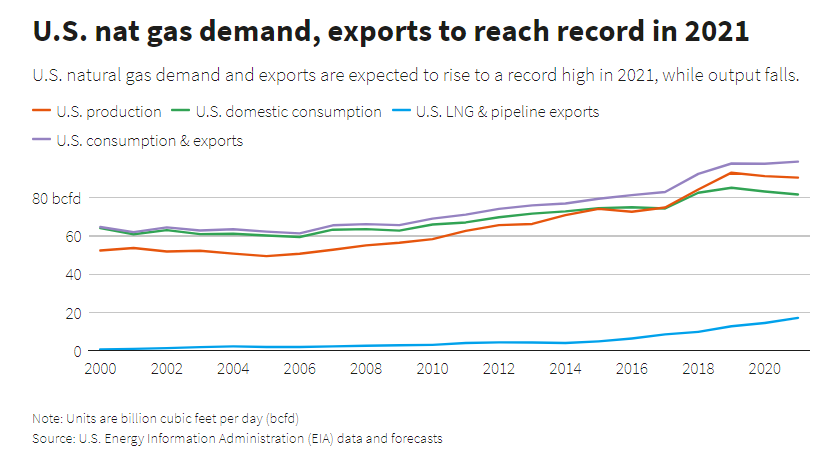
On top of falling U.S. supply, Canadian producers are looking to capitalize on increased demand as U.S. consumption and exports are forecast to hit record highs this year.

U.S. gas use, which includes a projected 19% increase in liquefied natural gas (LNG) and pipeline exports, is expected to increase by roughly 1% in 2021.

The imbalance is driving prices higher. Henry Hub futures, a proxy for price expectations, are at roughly $3 per million British thermal units (mm/BTU), representing a near-50% increase from 2020's average of $2.03, which was a 25-year-low.

Graphic: U.S. nat gas demand, exports to reach record in 2021, https://fingfx.thomsonreuters.com/gfx/ce/yzdpxwrojvx/Pasted%20image%201613076966715.png

SPRINGBOARD YEAR

To be sure, the recovery in Canada is in its early stages.

Recent mergers-and-acquisitions in shale, particularly among those who produce in Canada's premier Montney play in British Columbia, could also hold down spending.


On Wednesday ARC Resources Ltd said it will buy Seven Generations Energy in a deal that will create the biggest Montney producer.

ARC Chief Executive Terry Anderson said the combined company's immediate focus would be paying down debt but next year it will be looking at expanding production.

Longer-term, Canadian gas firms are expected to benefit from the phase-out of Canadian coal-fired power stations and the country's first LNG export terminal, expected to be completed in British Columbia by mid-decade.

Wood Mackenzie said it sees this year as the start of another era of gas growth, and forecast Canadian gas exports will rise to around 9 bcfd by 2030.

"2021 is the springboard year," said Wood Mackenzie analyst Dulles Wang.

(Reporting by Nia Williams in Calgary, Scott Disavino in New York; Editing by Marguerita Choy)
A tidal turbine built in Scotland is now producing power in Japan

Anmar Frangoul CNBC

Monday's news marks the latest example of how companies in Japan are turning to projects centered around tidal and wave energy.

The International Energy Agency describes marine technologies as holding "great potential" but adds that extra policy support is required.
© Provided by CNBC

A tidal turbine built and tested in Scotland has been installed in waters off a Japanese island chain, representing the latest example of how the East Asian country is investigating the potential of marine-based forms of energy production.

In a statement Monday, London-listed firm Simec Atlantis Energy said its pilot turbine had generated 10 megawatt hours in its first 10 days of operation.


The AR500 turbine was put together at a facility in Scotland before being shipped to Japan, where it was installed in waters off Naru Island, which is part of the larger Goto Island chain.

According to SAE, the overall project involves the leasing of tidal generation equipment as well as the provision of offshore construction services to Japanese company Kyuden Mirai Energy.

SAE's CEO, Graham Reid, described the installation as a "huge milestone for the deployment of clean, renewable energy from tidal stream and we hope it will be the first of many tidal turbines installed in Japan."

Monday's news marks the latest example of how companies in Japan, an island nation boasting thousands of miles of coastline, are turning to projects centered around tidal and wave energy.

In January, it was announced that shipping giant Mitsui O.S.K. Lines would partner with a company called Bombora Wave Power to scope for potential project sites in Japan and surrounding regions.

The collaboration between the Tokyo-headquartered MOL and Bombora will focus on finding possible locations for the latter's mWave system, as well as hybrid projects which combine mWave and wind energy.

In simple terms, the tech developed by Bombora — which has offices in both the U.K. and Australia — is based around the idea of using rubber membrane "cells" which are filled with air and fitted to a structure submerged underwater.

According to a video from the company outlining how its system works, when waves pass over the system, its "flexible rubber membrane design pumps air through a turbine to generate electricity."

The International Energy Agency describes marine technologies as holding "great potential" but adds that extra policy support is required for research, design and development in order to "enable the cost reductions that come with the commissioning of larger commercial plants."

For its part, Japan says it wants renewables to make up 22% to 24% its energy mix by 2030.

Last October, Prime Minister Yoshihide Suga said the country would target net zero greenhouse gas emissions by the year 2050. By 2030, Japan wants a 26% reduction in greenhouse gas emissions compared to 2013.

Work still needs to be done for the country to achieve its aims, however. In 2019, its Agency for Natural Resources and Energy said the country was "largely dependent on fossil fuels" like coal, oil and liquefied natural gas.


Alberta slaughterhouse to close temporarily amid growing COVID-19 outbreak that has claimed one life

Joel Dryden, Sarah Rieger 

© GoFundMe Darwin Doloque, 35, died of COVID-19 on Jan. 28 after contracting the virus in an outbreak linked to his work at the Olymel slaughterhouse in Red Deer, Alta. On Monday, the company announced it will temporarily close the plant, due to the rapidly growing…

Darwin Doloque's friends describe him as an eternal optimist, one who couldn't say no to anyone who needed help.

On Jan. 28, the 35-year-old permanent resident who immigrated to Canada from the Philippines was found dead at his home in Red Deer, Alta. The cause of death was attributed to a case of COVID-19 linked to his work at the city's Olymel meat-processing plant.

Late Monday — nearly three weeks after Doloque's death and in an abrupt change of position hours after telling CBC News it planned to remain open — Olymel said it would temporarily shut down the plant, due to the rapidly growing COVID-19 outbreak at the facility.

As of Monday, 326 employees at the plant had tested positive for COVID-19, nearly double the count of 168 on Feb. 6. Of those, 192 remain active.

CBC News spoke to six employees of Olymel for this story and agreed to withhold their names because they fear they could lose their jobs if they are identified.

During the interviews, workers said they were afraid to go to the plant, fearing for their own health and the health of their families. Several described negative effects on their mental wellbeing, as the outbreak continued to spread.
Operations to cease over next few days

The company said Monday that management now believes the plant can no longer continue normal operations in a safe and efficient manner.

Operations will cease over the next few days, Olymel said, and the company will continue to investigate how the outbreak grew so large.

Less than four hours earlier, company spokesperson Richard Vigneault had said neither Alberta Health Services (AHS), the provincial government, nor the company, itself, had yet come to the conclusion that the Red Deer plant should temporarily close. The company's statement Monday evening did not state the reason for the change, but Vigneault said an assessment of the situation that afternoon led the company to a new conclusion.

The rapid increase in cases had drawn a warning from AHS, which on Thursday sent a letter to the company cautioning the outbreak "has become a concern for public health." © CBC The Olymel pork-processing plant in Red Deer, Alta. A COVID-19 outbreak at the site has infected as many as 1 in 5 workers, Alberta Health Services says.

In the letter, which was obtained by CBC News, AHS said around one in five workers was believed to be infected and spreading the virus.

The plant has a workforce of close to 1,850 and about 60 per cent of the staff hold at least one other job outside the slaughterhouse.

A spokesperson for Alberta's labour minister said Sunday that occupational health and safety officials had inspected the facility 14 times, remotely and in-person, since the outbreak began in mid-November, deeming the plant safe to remain open.

AHS said it was not involved in the plant's decision to close.
Struggling to breathe

One worker, who has tested positive for COVID-19, struggled to gather the breath to share his story between bouts of coughing.

"We workers, we feel insecure. We feel unsafe inside the plant," he said over the weekend, before Monday's announcement. "We are hoping that they will close temporarily."

"We don't know what to do.… We are hoping the government will help us."

His illness started with a headache. Before he realized he was symptomatic, he had spread the infection to his entire family.

With everyone sick, he said he worries how they will make rent.

"We are all positive and now we don't have work," he said. "We have a big problem."

The union that represents employees at the plant said more than 90 per cent of approximately 600 workers it surveyed through a text-message poll said they wanted the plant to close temporarily, and that 80 per cent of respondents reported feeling unsafe at work.

© Radio-Canada A production line at a Quebec-based Olymel facility is shown in this file photo from October 2020. Workers at the Red Deer, Alta., Olymel facility interviewed by CBC News before the company announced Monday it would close the plant said they were afraid to go back to work, fearing for their health and the health of their families.

Tom Hesse, president of the United Food and Commercial Workers (UFCW) Local 401, said Sunday the union had been in contact with the provincial government and the company to discuss concerns the workplace had become dangerous, but both had been largely unresponsive.

"We've been very disappointed that, even at this stage, we haven't seen big corporations and the government of Alberta be responsive to what's become the terror of Albertans," Hesse said.

The union had called for a temporary shutdown of the facility on Feb. 5.


Vigneault said earlier on Monday that Olymel has fully co-operated with AHS "to support various actions on our site to control the outbreak."

Those actions included COVID-19 testing, regular information updates provided to employees, and maintaining a list of employees' close contacts, he said.

These are in addition to a variety of other measures "already in place since the beginning of the pandemic," Vigneault said.

The company said the union and its hog suppliers have been informed of the pending closure. 

Concerns over swab testing


Other workers said they felt the procedures surrounding testing were insufficient given the numbers of their co-workers who have tested positive for the virus.

When Doloque died, people "started to get paranoid," said one worker.

That employee said they asked the company nurse if they should continue to work while awaiting the results of their COVID-19 test. "Yes, because you guys need money," the worker said the nurse told them.

The company said it did not have information relating to that specific case, but would investigate.
© CBC A sign outside the Olymel pork plant in Red Deer thanks the company's essential employees. The union says it surveyed employees, and the majority were scared to report to work due to the growing COVID-19 outbreak.

Another worker also raised concerns about swab tests.


"They send the people back inside without the result, and they get the result and they end up tested positive. So it's already inside," said the worker, who has also tested positive for COVID-19.

"After that man passed away, there were a lot of people who were a close contact, and then of course they went to work and they didn't get tested," the employee said. "The next thing you know, they tested positive. It's all over the place."

Before Monday's announcement, Vigneault said Olymel's policy dictates employees showing or declaring symptoms are not allowed to work.

Close contacts who chose not to be tested would have to complete the 14-day isolation as a minimum, he said.

'We feel unsafe'


One worker said he feared he'd bring the virus home to his daughter, who is immunocompromised.

He said while Olymel has provided workers with face shields and encourages hand washing, there are areas of the workplace where those measures didn't feel like enough.

"Our cafeteria is very congested," he said. "When we get a break we take off our mask, right? So that we can eat."

In a recent email to staff, employees were warned they could face $1,200 fines for violating public health orders and expect discipline, even termination, should they not comply with company's COVID-19 policies.

Vigneault said the company's surveillance in terms of sanitary measures in place at the plant may reflect "the quality of information and honesty," of the employee.

"We have strong controls to know where a worker was during the work shift but our weakness is how an employee behaved in private," Vigneault said. "So we rely on the employee's honesty to help us."
Company was compliant with public health orders: AHS

AHS said its inspectors had been in daily contact with the company and visited the site on multiple occasions since the start of the outbreak to identify areas for improvement, should those arise.

The company remains compliant with public health orders, AHS said.

"Many measures were previously undertaken early on in the pandemic, and the site continues to take proactive steps to enhance their practices and mitigation measures," AHS said.

It said health workers provided a second round of on-site testing for COVID-19 between Feb. 3 and 5.

Other meat plants battle outbreaks


Meat plants have been home to many of the worst outbreaks of the pandemic.

There are currently eight outbreaks at meat processing or packing facilities in Alberta, including one at Cargill in High River, where 950 workers tested positive. A class-action lawsuit and police investigation are underway in that case.

Workers at Cargill told CBC News at the time they were instructed to return to work after testing positive for COVID-19 and while symptomatic.

Workers at both plants describe similar environments — a majority- immigrant population working a fast-paced, high-stress job in close quarters and feeling like they have little recourse.

"I find that we are here again a giant failure of public policy," said Sheila Block, with the Canadian Centre for Policy Alternatives.

"We've learned a lot about this disease over the last 11 months and it seems like the lessons that we've learned aren't applied equally … those people who have more access to power and privilege seem to get better protections than those who do not."

Block said the prevalence of outbreaks in low-wage, marginalized communities shows a need to look at instituting further supports both in and outside of the workplace — ensuring people have safe ways to travel to and from work, widespread access to workplace testing and income supports that allow them to stay home if sick.

Plant had been ramping up production


In the letter sent by AHS to the company, it largely focuses on staff responsibility — reminding workers to self-isolate, notify all employers of a positive test, or risk a fine.

The letter makes two requests of management: that employees be required to be tested if they have previously not been swabbed or have tested negative, and that management monitor breaks to ensure employees keep distance from one another.

Block said, in her view, it's immoral to lay blame at the feet of individual employees. She said it's the government's responsibility to set and enforce baseline rules to keep workers safe.

"These are the workers that allow those of us, who have the privilege to do so, to continue to work from home and be safe," she said. "We absolutely have to have government step up and value these workers' lives as much as they value the lives of people who can afford to protect themselves," she said.

Olymel is currently hiring, and the union had said that prior to Monday's late-day announcement, the plant had been ramping up production.
Councillor, Homeless advocate upset after police kick people out of Edmonton LRT station during cold snap

Phil Heidenreich 1 day ago

A member of a community-based organization that provides food and support to vulnerable Edmontonians is raising concerns after posting a video to social media showing homeless people being kicked out of an LRT station amid bitterly cold temperatures this weekend.

© CREDIT: Facebook/The Bear Clan Patrol Edmonton Beaver Hills House A member of a community-based organization that provides food and support to vulnerable Edmontonians is raising concerns after posting a video to social media showing homeless people being kicked out of an LRT station amid bitterly cold temperatures this weekend.

"When people are hungry and they need water and a hot meal...we oblige, because we're humans and that's why we're out there, to help other human beings -- especially in this cold snap," Judith Gale, who works with The Bear Clan Patrol Edmonton Beaver Hills House, told Global News on Monday.

"It just kills me that our brothers and sisters were put out on the street."

On Sunday night, Gale said she and other Bear Clan members helped feed about 25 people who were taking shelter from the cold inside the LRT network's Central Station.

She told Global News that after negative encounter with a police officer on one side of the station, she went to the other side. When police approached her and several homeless people there about leaving the premises, she began recording video.

In the video, a police officer tells some of the homeless people that they can't take their face coverings off inside even if they're eating and adds that they are loitering and need to find somewhere else to eat.

Gale is heard telling the officers that the homeless people they were feeding will face "extreme weather" outside and a police officer is heard telling her "there's lots of shelters though."

Gale said for their own reasons, some people do not feel comfortable going to shelters and believed the situation could have been handled differently.

"(The officer) didn't arrange for any transportation to that shelter," she said. "He had no humanity.

"For EPS (Edmonton Police Service) to do that, what are they saying?"

READ MORE: As bitter cold snap lifts next week, Edmonton to lift extreme weather response

Gale also questioned whether the police officer's concern about COVID-19 masks not being worn while people were eating was appropriate.

"We put masks over the necessity of life?" she asked. "How about if that person had been starving and needed nourishment immediately?


"How can they go outside in -33 and eat peacefully? You can't do that."


In an email to Global News, a spokesperson for the EPS said police are aware of the video and are making efforts to reach out to the Bear Clan Patrol to discuss what happened.

"Our officers strive to balance the role of enforcing public safety, bylaws (loitering) and COVID-19 protocols," police said.

"In this particular case, we should have better communicated our role in helping connect citizens to the City of Edmonton's services and partner agencies whose goals are to keep vulnerable citizens safe and warm."

Earlier this month, the City of Edmonton activated its extreme weather response plan as a brutal cold snap was about to sweep into Alberta's capital.

READ MORE: Edmonton activates extreme weather response with overnight transit to shelters

The response plan sees two Edmonton Transit Services bus loops operating overnight, travelling between emergency shelters, transit centres and other key locations. At the same time, some local organizations found ways to increase shelter capacity to try to accommodate more people during the deep freeze.

Ward 4 councillor Aaron Paquette told Global News his office has recently received a number of phone calls from citizens expressing concern about homeless Edmontonians.

"They're really concerned about folks who are kind of outside during this extreme cold weather, and they want to know what we're doing to help," he said.

Paquette said he believes the situation at the LRT station could have been handled better.


"If there's a concern about loitering, rather than just putting people out into the cold, perhaps the better solution is to provide them with the solutions that are already available," he said.

Paquette said he plans to speak to city councillors who sit on the police commission about what police officers' protocols are in such situations and if they are aware they can call 211 to get support helping homeless people in the cold.

"No one should be freezing to death on our streets... They shouldn't be losing limbs," he said, adding that in the past, he has advocated for using LRT stations to help vulnerable people warm up from the cold.

"Our shelters are not yet at capacity.. some are... (but) shelters are not a solution to homelessness.. they are a stop-gap to at least help people survive."

Paquette said some of the reasons that some homeless people are reluctant to go to shelters is because they fear they will get sick there, particularly during the ongoing COVID-19 pandemic. He also said that some homeless shelters make people that use them "engage or listen" to things that trigger past traumas.

Gale said she knows of Edmontonians who have essentially frozen to death, noting in some cases, they were found near buildings where some of the wealthiest people in the city work.

"These people that we serve, unfortunately, they don't have lovely jackets and hats and scarves," she said. "They can't sustain themselves all night walking around in that kind of weather so they have to come in.

"We don't need to have people freezing to death on the streets of Edmonton."

Paquette said the recent cold snap "definitely shows that there's work to be done."

"These sorts of situations shouldn't even be happening," he said. "When it comes to homelessness... we can solve it. We already know how.

"The real problem is we don't have the funding."

READ MORE: 80 supportive housing units to be built in 2 Edmonton neighbourhoods by end of 2021

Paquette noted that he believes the Alberta government needs to do more to help pay for long-term supportive housing to address the problem.

"The City of Edmonton, we don't have the money to do it ourselves -- otherwise we would," he said. "It costs less to fix these issues than we are spending by not fixing them.

READ MORE: Edmonton mayor asks province for $17M in annual funding for supportive housing services

Gale said she wants more people to recognize homeless people as part of their community.

"They're our brothers and sisters, they're our responsibility," she said. "And that's why we go out every night (to help)."


SNC-Lavalin gets first U.S. contract for hydroelectric engineering services


MONTREAL — SNC-Lavalin Group Inc. says it has inked its first hydroelectric engineering contract in the U.S., offering services for projects in Pennsylvania as the U.S. government moves to provide more support for clean energy efforts.
© Provided by The Canadian Press

The Montreal-based engineering company will work on three hydroelectric projects in the state, which is home to a large oil and gas industry, and would add powerhouses to sites owned by the U.S. Army Corps of Engineers.

"This contract, the first of its kind for us in the U.S., is in line with our strategy to grow and position our hydro capabilities and expertise in this important market," SNC-Lavalin chief executive Ian Edwards said in a statement. "It also supports our broader sustainability goals to be an industry leader in the fight against climate change."

Edwards added that the contract from hydropower energy company Rye Development to upgrade existing dams comes amid a broader push to address climate change. The project is designed to bring reliable and renewable energy to the Pittsburgh region, Rye Development chief executive Paul Jacob said.

SNC-Lavalin didn't specify the financial value of the contract, which includes technology, field investigation, environmental assessment and permitting.

SNC-Lavalin's expansion comes as U.S. President Joe Biden pledges to reverse the Trump Administration's policies on climate change, rolling out increased measures to hold polluters accountable.

On his first day in office, Biden signed an executive order encouraging the development of green technology by pausing new federal oil leases and investing in electric vehicles, among other measures.

"As countries and communities find new ways to tackle climate change, we welcome any new opportunity to share our world-class engineering and industry expertise to help our clients achieve net zero carbon as rapidly as possible," SNC-Lavalin spokesman Harold Fortin said.

Biden's campaign promises on combating climate change also include a $400 billion investment over 10 years into clean energy and innovation, as well as requirements for public companies to disclose climate-related financial risks and greenhouse gas emissions in their operations and supply chains.

Biden's proposals on clean energy have drawn criticism from Republican lawmakers, who said that cracking down on the industry would reduce employment. Biden has attempted to counteract the criticism by arguing that investments in clean energy could create new jobs.

SNC-Lavalin's role in the projects will involve 50 employees for a one-year period, Fortin said. SNC-Lavalin's partnership with Rye Development comes as Allegheny County, which includes Pittsburgh, enters into a 35-year agreement with Rye Development to purchase energy from the company.

"This announcement renews our commitment to the environment, our commitment to addressing climate change and is an investment in our future generations," Allegheny County executive Rich Fitzgerald said in a statement.

The U.S.'s new stance on energy policy has already affected Canada. One of Biden's first moves in office was to block the development of the Keystone XL pipeline, which was supposed to transport oil from Alberta to the U.S. The decision prompted outcry, particularly in Canada's Western provinces.

SNC-Lavalin recently announced an agreement to sell its oil and gas business to Kentech Group, a construction and engineering conglomerate. As part of the deal, Kentech would be responsible for historical claims and litigation related to that business, a point that analysts praised for its ability to offload risk from SNC.

This report by The Canadian Press was first published Feb. 15, 2021.

Companies in this story: (TSX:SNC)

Jon Victor, The Canadian Press
Cement giants turn to green hydrogen and carbon capture in efforts to curb emissions

Anmar Frangoul CNBC

Firms involved in energy intensive processes are looking to find ways to maintain productivity whilst reducing emissions.

Cement production is one industrial process ripe for major improvement when it comes to emissions and other metrics related to sustainability.

© Provided by CNBC The unit is housed inside a converted shipping container.

A subsidiary of multinational building materials firm HeidelbergCement is working with researchers from Swansea University to install and operate a green hydrogen demonstration unit at a site in the U.K.

The collaboration represents another example of how firms involved in energy intensive processes are trying to find ways to maintain productivity whilst simultaneously reducing emissions.

In a statement last week, Swansea University said the green hydrogen unit — which is housed inside a converted shipping container — had been installed at Hanson UK's Regen GGBS plant in the town of Port Talbot, south Wales.

The term GGBS refers to ground granulated blast furnace slag, which can be used instead of cement when producing concrete.


The effect of cement production on the environment is considerable. According to a 2018 report from U.K. think tank Chatham House, over 4 billion metric tons of cement are produced annually. This, the policy institute said, amounted to roughly 8% of global CO2 emissions.

While it may have a lower carbon footprint than Portland cement, Regen GGBS remains an energy intensive product, requiring substantial amounts of electricity and natural gas.

According to Swansea University, the idea behind the Port Talbot project is to "replace some of the natural gas used at the plant with green hydrogen, which is considered a clean source of energy as it only emits water when burned."

The unit at Hanson UK's site generates hydrogen using electrolysis, which splits water into oxygen and hydrogen.

If the electricity in the process comes from a renewable source — the project in Wales makes use of on-site wind and solar installations — then the end product is dubbed "green hydrogen."

The system was put together as part of the Reducing Industrial Carbon Emissions initiative, which is headed up by Swansea University's Energy Safety Research Institute.


In a statement, Charlie Dunnill, a senior lecturer based at the ESRI, described cement manufacture as "one of the most energy and carbon intensive industries and therefore a perfect place to start making impacts in carbon reduction."

Last week also saw the world's largest cement company, LafargeHolcim, announce it would take part in a collaboration to "explore the development" of carbon capture and storage solutions.

In a statement, the business said it would "study the feasibility of capturing carbon" from two facilities, one in Europe and the other in North America, using carbon sequestration tech from Schlumberger New Energy.

The United States Geological Survey describes carbon sequestration as "the process of capturing and storing atmospheric carbon dioxide." Breaking things down a bit further, carbon capture can take place naturally — through forests, for example — or via artificially engineered systems developed by humans.

Cement production is just one industrial process ripe for major improvement when it comes to emissions and other metrics related to sustainability.

Aluminum manufacture is another. BMW recently said it had started to source and use aluminum that has been produced using solar energy, for example.

Speaking to CNBC's "Street Signs Europe" last Friday, the CFO of aluminum producer Hydro commented on the market for more sustainable offerings.

"We are seeing demand for our specific products, Hydro REDUXA and Hydro CIRCAL, which has low CO2 content, or is recycled … really picking up again," Pal Kildemo said.

"And we're able to demand a premium on those compared to other, more 'normal' products."