Wednesday, February 17, 2021

In their own blood, Mexican women demand help for victims of violence
By Ana Isabel Martinez 

© Reuters/TOYA SARNO JORDAN Relatives of missing people protest for the lack of attention by authorities, in Mexico City

MEXICO CITY (Reuters) - Flora Marcelo wrote her appeal on a white wall outside the U.N. human rights office in Mexico City, using a finger dipped in her own blood: "Justice for the disappeared."

At least five women joined Monday's protest, some drawing their blood with the help of a catheter, to bring attention to the plight of children and other relatives who have gone missing or been killed amid the violence of Mexico's long drug war
.
© Reuters/TOYA SARNO JORDAN Relatives of missing people protest for the lack of attention by authorities, in Mexico City

Marcelo, 36, has spent weeks camped outside government offices along with dozens of other women in a bid to highlight their cases. This protest was a "desperate" measure, she said
.
© Reuters/TOYA SARNO JORDAN Relatives of missing people protest for the lack of attention by authorities, in Mexico City

"They don't listen to us, and I want justice for my daughter," Marcelo said as blood flowed from her arm through a slender plastic tube.

Mexico has registered nearly 80,000 missing people, most of them victims of gang-related violence since the start of a "war on drugs" in 2006. Officials say around half of those could be unidentified bodies in morgues that are under-funded and ill-equipped to deal with the avalanche of homicides.
© Reuters/TOYA SARNO JORDAN Relatives of missing people protest for the lack of attention by authorities, in Mexico City

Despite a new legal framework and the establishment of a national search commission, the number of missing keeps rising. Support groups of family members, mostly mothers, have formed to search in clandestine graves scattered across the country
.
© Reuters/TOYA SARNO JORDAN Relatives of missing people protest for the lack of attention by authorities, in Mexico City

Marcelo's 13-year-old disappeared in October from their home in Guerrero, one of Mexico's most violent states. Several days later, her body was found, dismembered. Marcelo discerned it was her daughter from the clothes discovered nearby.

Montserrat Ramirez, also from Guerrero, said her husband disappeared in April.

For Ana Maria Maldonado, more than 10 years have passed since her son went missing in Mexico City. She now wears a pin bearing his photo and the words, "Have you seen... ?"

(Reporting by Ana Isabel Martinez, additional reporting by Lizbeth Diaz and Toya Sarno Jordan, Writing by Daina Beth Solomon; Editing by Sonya Hepinstall)

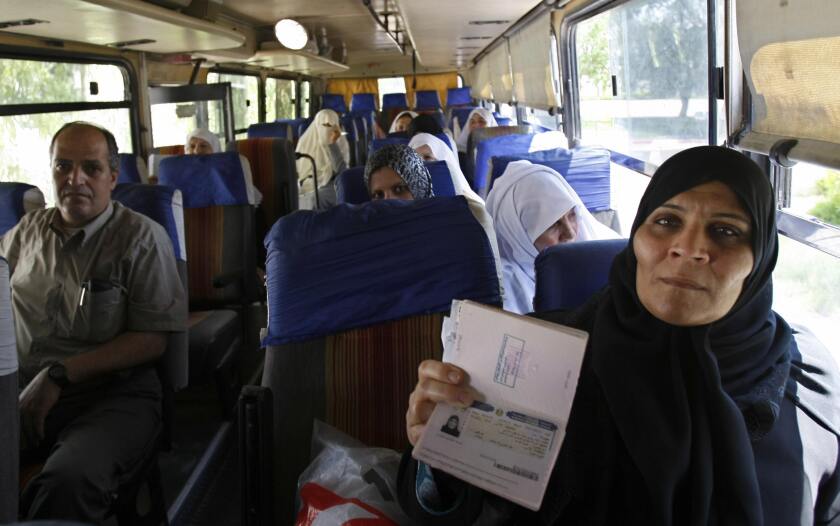
 

Hamas court says women need 

a male guardian’s approval to 

travel

A Palestinian woman shows her visa
A Palestinian woman shows her visa as she waits in a bus to cross to Egypt through the Rafah border in the southern Gaza Strip in 2009.
(Said Khatib / AFP /Getty Images)
 

A Hamas-run Islamic court in the Gaza Strip has ruled that women require the permission of a male guardian to travel, further restricting movement in and out of the territory that has been blockaded by Israel and Egypt since the militant group seized power.

The rollback in women’s rights could spark a backlash in Gaza at a time when the Palestinians plan to hold elections later this year. It could also solidify Hamas’ support among its conservative base at a time when it faces criticism over living conditions in the territory it has ruled since 2007.

The decision by the Sharia Judicial Council, issued Sunday, says an unmarried woman may not travel without the permission of her “guardian,” which would usually refer to her father or another older male relative. Permission would need to be registered at the court, but the man would not be required to accompany the woman on the trip.

The language of the ruling strongly implied that a married woman would not be able to travel without her husband’s approval.

The edict also said that a man could be prevented from traveling by his father or grandfather if it would cause “grave harm.” But the man would not need to seek prior permission, and the relative would have to file a lawsuit to prevent him from traveling.

The ruling resembles the so-called guardianship laws that long existed in ultra-conservative Saudi Arabia, where women were treated as minors requiring the permission of a husband, father or even a son to apply for a passport and travel abroad. The kingdom loosened those restrictions in 2019.

Hassan al-Jojo, head of the Supreme Judicial Council, told the Associated Press that the ruling was “balanced” and consistent with Islamic and civil laws. He dismissed what he called “artificial and unjustified noise” on social media about the edict.

He justified the measure by citing past instances in which girls had traveled without the knowledge of their parents and men had left their wives and children without a breadwinner.

Israel and Egypt have largely sealed Gaza’s borders since Hamas seized power from rival Palestinian forces in 2007. Israel says the restrictions are needed to isolate the militant group, which has fought three wars with Israel, and prevent it from acquiring arms.

The territory is home to some 2 million Palestinians. All Gazans must go through a lengthy permit process to travel abroad and largely rely on the Rafah crossing with Egypt, which only opens sporadically. The restrictions make it difficult for people to seek medical care or higher education outside the narrow coastal strip.

The ruling sparked criticism on social media, where many accused Hamas of rolling back women’s rights even as Saudi Arabia has eased its restrictions, including by allowing women to drive. The Palestinian People’s Party, a small left-wing group, called on Hamas to reverse the decision.

Zainab al-Ghunaimi, an activist who runs a Gaza-based group focused on women’s rights, said the ruling contravened the Palestinian Basic Law, which grants equal rights to adults, and meant that authorities were “going backward in protecting human rights.”

She noted that the same legal body allowed a woman to marry at age 16 and get travel documents on her own.

Hamas has not imposed the kind of harsh interpretation of Islamic law championed by other armed groups, such as the Islamic State group and the Taliban in Afghanistan. But it has taken some limited steps to enforce the territory’s conservative mores, including the imposition of an Islamic dress code on female lawyers and high school students.

US billionaires vie to make space the next business frontier
Jeff Bezos unveils Blue Origin’s space exploration moon lander in Washington. Photograph: Clodagh Kilcoyne/Reuters

Jasper Jolly
@jjpjolly
Sat 6 Feb 2021

Later this year Jeff Bezos, the first person to have led a business from nothing to a trillion-dollar valuation, will step down from his job as head of Amazon. But as you’d expect from a tech multibillionaire, his eyes are on a potentially bigger prize: outer space. Bezos will be dedicating more time to a space race between entrepreneur rivals that hopes to push the frontiers of society – and commerce – beyond planet Earth.

Having completed its 14th mission last month – successfully carrying a dummy, “Mannequin Skywalker”, into space – Bezos’s space company, Blue Origin, believes relatively cheap travel for humans is not far off. That would finally deliver a return on the $1bn (£730m) of Amazon stock Bezos has to sell annually to fund it. Blue Origin was one of four projects flagged by the Amazon boss as likely recipients of his attention now, alongside the Washington Post newspaper, his Day One charitable fund and the environmental Earth Fund.

“I’ve never had more energy, and this isn’t about retiring. I’m super passionate about the impact I think these organisations can have,” said Bezos, who is becoming executive chairman at Amazon.

But competition in the stratosphere will be as tough as in retail. Rival billionaire Elon Musk’s SpaceX is arguably ahead of Blue Origin. Despite an uncrewed test flight last week ending in a fiery crash, SpaceX is already able to reuse its Falcon 9 rockets. Musk (no stranger to making and sometimes breaking bold promises) aims to fly to Mars as soon as 2024.


01:44 'Gotta work on that landing': SpaceX rocket fails again – video

There had already been a private-sector revolution in the space industry, as US government enthusiasm for huge spending waned. Commercial companies now account for about 80% of the $424bn global space industry, according to Professor Loizos Heracleous of Warwick Business School, who has written extensively on the business of space

Most of the industry is focused on IT, but experts believe the billionaires’ efforts are about to usher in a new era, with the start of space tourism, manufacturing and more. Google co-founder Larry Page has backed Planetary Resources, a startup hoping to mine asteroids.

It will be overdue in the eyes of many. Sir Richard Branson predicted that Virgin Galactic, the space tourism company he founded, would first fly in space in 2009. Nonetheless, despite false starts and a fatal crash in 2014, analysts at UBS say Virgin Galactic will in 2021 offer “the only way for consumers to gain entry into the [roughly] 560-member astronaut club in the next five years”.

Cheaper technology – such as “cubesats” the size of a loaf of bread – mean more players can turn their eyes skywards. A global wave of investors looking for returns has loosed a wave of easy money, much of it through special purpose acquisition companies (Spacs) – “blank-cheque” vehicles that raise money on stock exchanges before boldly going to look for investments.
A Blue Origin rocket lifts off from its launchpad in Texas. Photograph: AP

Spacs have made some investors nervous about too-easy money, but they are delivering funding. Astra, a California-based rocket company founded by a former Nasa chief technology officer, last week announced it would use a merger with a Spac to list on the Nasdaq exchange, with a valuation of $2.1bn. Momentus, a company aiming for “last-mile” transportation in space, announced last October that it, too, would take the Spac route, for a billion-dollar valuation.

The total space industry could grow by $1tn in the next decade, according to Ron Epstein, aerospace analyst at Bank of America Merrill Lynch. He sees a turning point as technology improvements and capital combine, making space tourism and in-space manufacturing – of space stations, or even pharmaceuticals – increasingly viable. Deep-pocketed investors were playing a role similar to that of predecessors who had helped aerospace grow into a global industry, he said.

Space-faring is risky and unpredictable, but that is the price for pushing the frontiers of technology – and humanityProfessor Loizos Heracleous

Heracleous agreed: “Accidents for SpaceX and other commercial players show that space-faring is unpredictable and dangerous. But this is the price for solving challenges and pushing the frontiers of technology and, ultimately, humanity.”

However, it is still an inherently risky business. Alok Sharma, the then business secretary, last year had to override written warnings from his top civil servant that the UK government could lose everything when it invested £400m in OneWeb, a bankrupt but potentially promising satellite company.

Governments are still involved. A mission to land the first woman on the moon by 2024 appears to be one of Donald Trump’s few legacies. Joe Biden’s administration said last week that it would continue the programme.

SpaceX and Blue Origin are already working on moon-lander designs under contracts awarded last year by Nasa for almost $1bn, alongside Dynetics, a subsidiary of defence contractor Leidos. Those contracts covered only 10 months of work: Nasa is due to evaluate each company’s efforts this month, before a test mission with just one of them.

Taking people to the moon and beyond is a key part of both Musk’s and Bezos’s visions, which can verge on the apocalyptic. Bezos talked in 2019 of a trillion humans populating the solar system, far beyond the resources of Earth; Musk has made clear his belief that a Mars colony could save humanity. That view is heavily criticised by some environmentalists, who argue we should focus on respecting the bounds of the planet we already inhabit.

Yet the hope for the space industry is that, by lowering the cost of space access, this billionaire race may have as-yet-unknown benefits for the world, even as the existential threat from the climate crisis looms.

Jim Cantrell, who worked with Musk at SpaceX in its early days, sourcing rockets, said the company’s success had made it easier for other space projects to get off the ground. These include his latest company, Phantom Space, which aims to drive down launch costs by mass-producing small rockets.

Cantrell said cheaper access to space had started something like the “New World economy” that followed the discovery of America: “It’s just beyond imagination how big it is.”
Elon Musk says colonising Mars could be humanity’s saviour. 
Photograph: Getty Images


Space cadets

Jeff Bezos

Blue Origin will be one of Bezos’s priorities in life beyond Amazon, alongside the Washington Post newspaper and his charities.

Sir Richard Branson
Virgin Galactic could have paying passengers in space this year. An early focus on space tourism could eventually give way to supersonic travel using similar technology.

Elon Musk

Musk’s shareholding in Tesla meant he overtook Bezos as the world’s richest man this year. His schedule also includes Neuralink, a brain-to-computer interface, alongside SpaceX’s Mars ambitions.

Larry Page

The Google co-founder has backed Planetary Resources, an asteroid mining company, although analysts believe successful resource extraction could be decades away.

Marc Benioff

The Salesforce founder was a backer of Astra, a rocket startup that will raise as much as $500m through a merger with a special purpose acquisition company.

Mark Zuckerberg
The Facebook founder has expressed ambivalence about space tourism, but he did back Breakthrough Starshot, a project to send out small laser-powered “lightsail” spacecraft to collect imagery and scientific data.


Europe launches recruitment drive for female and disabled astronauts

European Space Agency aims to take on 26 people for missions to the Moon and eventually to Mars

‘When it comes to space travel, we are all disabled,’ said Italian astronaut Samantha Cristoforetti. 
Photograph: Ivan Sekretarev/AP

Reuters
Wed 17 Feb 2021

European space chiefs have launched their first recruitment drive for new astronauts in 11 years, with particular emphasis on encouraging women and people with disabilities to join missions to the Moon and, eventually, Mars.

The European Space Agency (ESA) said on Tuesday that it was looking to boost the diversity of its crews as it cavassed for up to 26 permanent and reserve astronauts.

But the ESA warned that it expected a “very high number” of applications to come in during the eight-week recruitment drive from 31 March, and said candidates would have to endure a tough selection process lasting until October 2022.

“Candidates need to be mentally prepared for this process,” Lucy van der Tas, ESA head of talent acquisition, said at a media conference.

Adapting technology that enabled humans to be in space could open the opportunity for people with disabilities, Italian astronaut Samantha Cristoforetti said.

“When it comes to space travel, we are all disabled,” Cristoforetti added.

Requirements for an astronaut job at ESA include a master’s degree in natural sciences, engineering, mathematics or computer science and three years of post-graduate experience.

“I think it’s a great opportunity ... It will be an opportunity to learn a lot about yourselves,” Cristoforetti said.

It comes as human space flight appeared set for a revival.

After years in which the only launch site for crewed flights to space was Baikonur in the steppes of Kazakhstan, cooperation with private companies such as SpaceX has raised prospects for more human missions.
Hackers target Myanmar government websites in coup protest

AFP 

Hackers attacked military-run government websites in Myanmar Thursday as a cyber war erupted after authorities shut down the internet for a fourth straight night.

© STR Thousands gathered across Myanmar to protest against the military coup

A group called Myanmar Hackers disrupted multiple government websites including the Central Bank, Myanmar Military's propaganda page, state-run broadcaster MRTV, the Port Authority, Food and Drug Administration.


The move comes a day after thousands of people rallied across the country to protest against a military coup that toppled Aung San Suu Kyi's civilian government from power earlier this month.

"We are fighting for justice in Myanmar," the hacking group said on its Facebook page.

"It is like mass protesting of people in front of government websites."

Cybersecurity expert Matt Warren from Australia's RMIT University said it was likely the aim of the hacking was to generate publicity.

"The sorts of attacks they would be undertaking are denial of service attacks or defacing websites which is called hacktivism," he told AFP.

"The impact will be potentially limited but what they are doing is raising awareness."

Another internet shutdown began in Myanmar at about 1:00 am on Thursday (1830 GMT Wednesday), according to NetBlocks, a Britain-based group that monitors internet outages around the world.

It said internet connectivity had dropped to just 21 percent of ordinary levels.

lpm/fox

Trump Plaza casino in Atlantic City demolished
Feb. 17, 2021 - 1:29 - The long-vacant Trump Plaza casino in Atlantic City, N.J., was reduced to a pile of rubble on Wednesday. Footage courtesy of WTXF

VIDEO

The Baltimore Sun to Be Purchased by Nonprofit

By Associated Press
February 16, 2021 


FILE - Flags wave near the Chicago Tribune Tower in Chicago, April 12, 2006. Newspaper publisher Tribune, which owns the Chicago Tribune, the Baltimore Sun and other newspapers, said Feb. 16, 2021, it has agreed to be sold to Alden Global Capital.


BALTIMORE - The Baltimore Sun announced Tuesday that the newspaper and its affiliated publications will be purchased by a nonprofit developed by businessman and philanthropist Stewart Bainum, a move that would place it back in local hands.

The newspaper reported that the sale was made possible by Alden Global Capital's $630 million deal to acquire full control of Tribune Publishing, which also publishes the Chicago Tribune, the New York Daily News and other major newspapers.

As part of the acquisition, the nonprofit Sunlight for All Institute would acquire The Baltimore Sun, The Capital Gazette in Annapolis, The Carroll County Times and several other local weeklies and magazines and affiliated online properties, according to The Sun.

Alden's deal from Tribune, announced a few hours after the stock market closed Tuesday, would create one of the largest newspaper operators in the U.S. It follows weeks of negotiations between a special committee of Tribune Publishing's board and Alden, a hedge fund known for cutting costs and eliminating newsroom jobs.


That deal isn't completed. In its announcement, Tribune Publishing said Alden signed a "non-binding term sheet" to sell The Sun to the nonprofit established by Bainum.

Bainum, 74, made his fortune in hotels and nursing homes. He is chairman of Choice Hotels International, the Rockville, Maryland-based hospitality franchisor for such names as Cambria Hotels, Quality Inn and Econo Lodge.

A lifelong Democrat and one-time politician, Bainum served in the Maryland General Assembly, first as a delegate from 1979 to 1982, then as a senator from 1983 to 1986.


Bainum became CEO of ManorCare in 1987. He and his wife, Sandy, joined The Giving Pledge, a campaign seeking commitments by the world's wealthiest people to contribute most of their wealth to philanthropic causes.

Others who have made the pledge include Facebook's Mark Zuckerberg and his wife, Priscilla Chan; Elon Musk; Michael Bloomberg; CNN founder Ted Turner; MacKenzie Scott; Texas oilman T. Boone Pickens and, notably, biotech billionaire Patrick Soon-Shiong, who acquired the Los Angeles Times and San Diego Tribune from Tribune Publishing for $500 million in 2018 and owns about 24% of Tribune Publishing.

A rural-urban divide: Data gives most detailed look yet at where CERB went


OTTAWA — Kelly Ernst recalls standing on sidewalks, waving to needy families in Calgary's northeast as they opened their doors to pick up food hampers.

© Provided by The Canadian Press

Ernst, vice-president for vulnerable populations at Calgary's Centre for Newcomers, said the memory speaks to how COVID-19 hurt the community, socially and economically.

Ernst said the Skyview Ranch neighbourhood is one of the most diverse in the country, with a high proportion of visible minorities and newcomers. Residents are often employed in precarious retail jobs or in warehouses, Ernst said. Others work at the city's airport or in the municipal transit system, both of which were also affected by the pandemic.

"Some of the first people to be laid off during the downturn were people in these precarious jobs," Ernst said, adding many were left looking for "some way to get through this whole thing."

Almost seven in every 10 residents over age 15 in Skyview Ranch, received the Canada Emergency Response Benefit in the initial month that the pandemic aid was available, one of the highest concentrations among over 1,600 neighbourhoods The Canadian Press analyzed.

Federal data, obtained through the Access to Information Act, provides the most detailed picture yet of where billions of dollars in emergency aid went last year.

The data is broken down by the first three characters of postal codes, known as "forward sortation areas," to determine the number of active recipients at any time anywhere in the country.

The Canadian Press used population counts from the 2016 census to calculate what percentage of the population over age 15 in each forward sortation area received the CERB in any four-week pay period.

Some forward sortation areas in the data from Employment and Social Development Canada were created after the 2016 census and weren't included in the analysis.

Over its lifespan between late March and October of last year, the CERB paid out nearly $82 billion to 8.9 million people whose incomes crashed because they saw their hours slashed or lost their jobs entirely.

Some three million people lost their jobs in March and April as non-essential businesses were ordered closed, and 2.5 million more worked less than half their usual hours.

The data from Employment and Social Development Canada show that 6.5 million people received the $500-a-week CERB during the first four weeks it was available, or more than one in five Canadians over age 15.

What emerges from that initial wave is a largely rural-urban split, with higher proportions of populations relying on the CERB in cities compared to rural parts of the country.

Neighbourhoods in Brampton, Ont., on Toronto's northwest edge, had the largest volume of CERB recipients with postal-code areas averaging over 15,160 recipients per four-week pay period.

CERB usage also appears higher in urban areas that had higher COVID-19 case counts, which was and remains the case in Calgary's northeast.

"As cities relied more on accommodations, tourism and food as drivers of economic growth, the more they would have been sideswiped by the pandemic, and larger centres have a higher concentration of jobs in these areas," said David Macdonald, senior economist at the Canadian Centre for Policy Alternatives, who has studied the CERB.

"More rural areas of the country and certain cities that have a higher reliance on, say, natural resources wouldn't have been hit as hard."

In Skyview Ranch, census data says 12 per cent lived below the poverty line in 2016, and about three in 10 owners and four in 10 renters faced a housing affordability crunch, meaning they spent 30 per cent or more of their incomes on shelter.

Many live in multi-generational households, which the local city councillor said caused additional concerns about students and working adults spreading the virus to grandparents.

"These are real worries and challenges that members of my community have been facing throughout a pandemic," said Coun. George Chahal.

"The CERB program and the additional support to small businesses was a huge relief for the fear with many folks in my ward."

The CERB program paid out $500 per week for people whose incomes had fallen to nothing as a result of the pandemic. The federal Liberals amended the program in April to set a monthly income threshold of $1,000.

At the outset, there were 6,520 residents of Skyview Ranch on the CERB, about 69.4 per cent of the population 15 and up.

Then things improved. Businesses reopened and workers were rehired. The decline in the program's use in Calgary's northeast mirrored a nationwide drop in recipients overall, even though there were local increases here and there.

In all, there were 4.4 million recipients in the CERB's second month, the biggest month-to-month change, 3.7 million in the third, and a steady decline to almost 2.3 million recipients by the time the CERB was replaced by a trio of new recovery benefits and a revamped and restarted employment-insurance system.

Over the lifetime of the CERB, the Ontario town of East Gwillimbury had the highest average number of residents accessing the program, at 24 per cent. The town with the lowest percentage was Winkler, Man., at 3.83 per cent.

In Skyview Ranch, the number of recipients in the last month of the CERB stood at 2,440, or about one-quarter of those over age 15.

There is still hardship in Skyview Ranch. The area has seen a spike in COVID-19 cases and incomes have dropped again as restrictions rolled in through December, part of a wider drop in the national labour market.

Chahal said there still is a need in the area for government aid like the federal recovery benefits.

"Maybe not for everybody," he said, "but there are going to be a lot of folks who are going to be in need of assistance in the upcoming months as we move from this stage of the pandemic (and) into economic recovery."

This report by The Canadian Press was first published Feb. 15, 2021.

—With files from Lucas Timmons and Meredith Omstead

Jordan Press, The Canadian Press

CANADA

Gun control advocates calling on national handgun ban, mandatory buyback


Duration: 02:57 

On Tuesday, the federal government announced a bill aimed at tackling gun violence in Canada, but as Erica Vella reports, gun control advocates say the bill falls short in areas surrounding the buyback program and handgun prohibition.

Global News 

Optional gun buyback programs more likely than compulsory ones to miss mark: expert

OTTAWA — The Trudeau government is expected to introduce gun-control legislation this week that gives owners the choice of keeping recently outlawed firearms under strict conditions instead of turning them in for compensation.  

© Provided by The Canadian Press

However a gun-control expert who has studied buyback initiatives says optional programs, as opposed to compulsory ones, have a greater chance of missing the mark of making communities safer.

"The empirical evidence, the studies, show that a voluntary buyback is the most likely to fail," said Philip Alpers, an adjunct associate professor at the University of Sydney's school of public health in Australia.

Alpers points to major gun buyback programs in Australia and New Zealand that not only prohibited certain guns but included stiff penalties for not turning them in.

"It was the penalty that made the difference with the success of both the Australian and New Zealand gun buybacks," he said in an interview. "If you make it voluntary, you're making it optional."

The Canadian government outlawed an array of firearms by cabinet order in May, saying they were designed for the battlefield, not hunting or sport-shooting. 

The ban covers some 1,500 models and variants of what the government considers assault-style weapons, meaning they can no longer be legally used, sold or imported.

The coming bill is believed to propose a program to buy back these firearms for a fair price, but allow owners to hang on to them if certain conditions are met.

Many gun-control advocates have been pressing the Liberals to make the buyback mandatory, warning that firearms that remain with owners could be misused or stolen.

When 35 people were gunned down at the Port Arthur Historic Site in Tasmania in 1996, Australia banned semi-automatic and pump-action rifles and shotguns, buying back some 650,000 from owners. The National Firearms Agreement also toughened licensing, registration and safe-storage provisions.

More than a dozen mass shootings occurred in Australia in the 25 years before the reforms, but after the buyback there were none until 2014.

"For Australia, the NFA seems to have been incredibly successful in terms of lives saved," said a 2011 assessment by Harvard University's Injury Control Research Center.

New Zealand implemented a buyback following the March 2019 shootings at two mosques that killed 51 people and injured many others.

Before the initiative, police estimated there were between 55,000 and 240,000 newly outlawed firearms in the country, based on a consulting firm's analysis.

More than 61,000 firearms were handed in or modified.

A gun group criticized the buyback, saying there were 170,000 prohibited firearms in New Zealand, but the group Gun Control NZ says it has seen no credible evidence to support this figure.

Group co-founder Philippa Yasbek says she is concerned the Canadian government has been misled by the discredited number.

The compromise solution of a voluntary buyback in Canada would antagonize the gun lobby without yielding the desired "good safety outcomes," Yasbek said in an interview.

"I definitely think they should be going for a mandatory buyback and following the Australia and New Zealand model."

Alpers said if the Trudeau Liberals cite the New Zealand or Australian programs as reasons to avoid a mandatory buyback, "the information they've been given, is inaccurate at best and malicious at worst."

"By and large, those who claim that the New Zealand and Australian gun buybacks are failures are those who claim that all gun control is a failure," he said.

"And so if the Liberal government listens to those people, they will be falling victim to misinformation."

Aside from fleshing out last spring's ban of many firearms, the long-promised Liberal bill would propose stricter storage provisions and target illegal gun smuggling.

The bill is also expected to:

— Enhance the ability of doctors, victims of domestic abuse and families to raise red flags on those with guns who pose risks to themselves or an identifiable group;

— Include new penalties for gun purchases by a licensed buyer on behalf of an unlicensed one; 

— Maintain current firearm magazine limits, which are generally five bullets for hunting rifles and shotguns and 10 for handguns, but crack down on the sale of magazines that can be modified to hold more cartridges.

This report by The Canadian Press was first published Feb. 15, 2021.

Jim Bronskill, The Canadian Press


Canada will not implement a national handgun ban, instead, they'll leave that up to individual communities

By Paula Newton, CNN

Wed February 17, 2021


Ottawa (CNN)The Canadian government proposed legislation Tuesday that would allow local communities to ban handguns, but stopped short of supporting a national handgun ban, which many gun control advocates had called for.

"These are the strongest measures to fight gun violence our country has ever seen," Prime Minister Justin Trudeau said in a news conference Tuesday in the capital, Ottawa.

Trudeau's Liberal government is making good on both a 2019 election promise for stricter gun control and an announcement last May, when Canada banned the sale of military-style assault weapons and promised more legislation would follow.

That pledge came after the deadliest mass shooting in Canada's history, in which a heavily armed gunman dressed as a police officer killed 22 people in a shooting spree that terrorized residents of rural Nova Scotia.

The legislation, which would still take months to become law, also introduces a voluntary buyback program for the estimated 150,000 to 200,000 legally-owned assault-style weapons in Canada. Owners of the now-prohibited firearms can still choose to keep them, although they could no longer use them as guns and they would be subject to strict licensing and storage laws.

Mayors seek solution for worsening gun violence

Trudeau acknowledged there would be political fallout from both sides of the gun control debate. The mayors of Canada's two largest cities, Toronto and Montreal, have advocated for a national handgun ban as gun violence worsens in those cities.

In a statement obtained by CNN, Toronto Mayor John Tory said city staff are reviewing the new set of proposed laws and that the city welcomes the federal government's efforts to curb gun violence. But Tory also restated his city's support for a national handgun ban.

"Toronto City Council has been clear that it supports a national handgun ban. The federal government has said the changes announced today would allow municipalities to ban handguns and include federal penalties for those who violate local bylaws. The City looks forward to receiving details from the Government of Canada on how such a ban would work and what its impact would be on gun violence," Tory said in the statement.

Federal government officials said cities cannot act alone and that provincial governments, several of which have indicated they do not support banning handguns, would have ultimate jurisdiction.
Law enforcement officials say random gun violence in Canadian cities continues to worsen, with deaths increasingly linked to gang violence.
A teenage girl was killed in a drive-by shooting earlier this month in Montreal, prompting the mayor to again call for a national handgun ban.
"Obviously there are political elements in this but the core of why we are doing this, the core of why Canadians want this done, is to keep our communities safe. In Canada people can use guns for hunting and for sport shooting, not for personal protection. And there is no need (for) military-style assault weapons anywhere in this country," said Trudeau.
In his news conference, Trudeau highlighted a key component of the new set of laws, the "red flag" and "yellow flag" provisions. He said they would help combat intimate-partner and gender-based violence by allowing people to apply to the courts to order the removal of a person's firearm or to suspend their gun license.

Neither side happy

Gun control advocates noted that while the proposed legislation is comprehensive, it does not go far enough.

"This is imperfect legislation but a very Canadian approach to addressing a complex issue," Dr. Philip Berger, senior adviser to Canadian Doctors for Protection from Guns, said in a statement. He added, "To make the further changes still necessary, the 80% of Canadians who support gun control need political parties other than the Liberals to step up and be accountable."

If passed, the new law would also forbid the altering of the cartridge magazine component of a firearm and would ban depictions of violence in firearms advertising. There would be tighter restrictions on imports of ammunition and a ban on the import, export, sales and transfers of all replica firearms.

PRO GUN TORIES
Canada's Conservative Party denounced the proposed legislation, saying it penalizes lawful gun owners and does not adequately address the issue of guns being smuggled into Canada from the United States.
"I think that Mr. Trudeau misleads people when he tries to suggest that buying things back from hunters and other Canadians who are law-abiding is somehow going to solve the problem of shooting and criminal gang activity in the big cities. It's ignoring the real problem and it's dividing Canadians," 
Conservative Party leader Erin O'Toole said in a news conference Tuesday.

In a detailed technical briefing, the government outlined that it would continue to combat gun smuggling and trafficking by stepping up enforcement and increasing penalties. The Trudeau government has also said it will reach out to US President Joe Biden's administration to find new ways to cooperate on gun smuggling issues along the border.

Saskatchewan RCMP charge leader of Canadian Nationalist Party with hate speech

REGINA — RCMP in Saskatchewan have charged the leader of the Canadian Nationalist Party with wilfully promoting hate against Jewish people.© Provided by The Canadian Press

Police say officers began investigating Travis Patron after a report in June 2019 from the Canadian Anti-Hate Network about an alleged anti-Semitic video posted on YouTube.

Police say the video, called "Beware the Parasitic Tribe," featured the party leader from Redvers, Sask., in the province's southeast.

A video under the same name posted on the party website contains a rant about Jews being "inside manipulators" who control the banks and media and need to be removed from the country.

The website says its mandate is to keep a "European-descended demographic majority" in Canada. It is registered as a political party by Elections Canada.

In the 2019 federal election, Patron appeared on the ballot for the party in the rural Saskatchewan riding of Souris-Moose Mountain and earned less than one per cent of the vote.

RCMP say their investigation into Patron was forwarded to the province's attorney general, as is required, who directed the charge.

Police say the 29-year-old was arrested Monday. He appeared by phone in Regina provincial court on Wednesday while in RCMP custody in Carlyle, Sask.

Before court ordered him to be released, Patron asked what jurisdiction the Queen had to police his speech.

A spokeswoman for Elections Canada said Patron's charge doesn't change the status of the party, but legislation does prohibit a candidate from running while behind bars.

The Centre for Israel and Jewish Affairs commended the RCMP for the arrest.

The Friends of Simon Wiesenthal Center for Holocaust Studies also applauded the arrest and the laying of the charge. The organization said last summer it filed a hate speech complaint with RCMP about an anti-Semitic flyer posted by Patron's party on social media.

Mounties say they are investigating four more reports received between last April and June of alleged anti-Semitic videos and hate speech by Patron.

The party's website says it was founded in 2017 when Patron was 25. He had studied at the University of Saskatchewan from 2010 to 2013.

This report by The Canadian Press was first published Feb. 17, 2021.