Friday, August 20, 2021

AUSTRALIA

Household power bills could jump if ageing power plants are paid to remain open, report warns


By business reporter Gareth Hutchens
Posted 8h ago
Is the National Electricity Market under threat from the influx of renewable energy providers?
(ABC News: Chris Gillette)
Share

Households on Australia's east coast could see their power bills jump by hundreds of dollars a year if they are forced to pay coal and gas plants to keep running, a new report warns.

Key points:

The Energy Security Board has recommended paying ageing power plants to remain open

A new report warns the cost will be borne by consumers

It estimates household power bills could face charges more than double the carbon price


The Institute for Energy Economics and Financial Analysis (IEEFA), and Green Energy Markets, have released a report warning households could face power bills of $182 to $430 more a year if a new proposal goes ahead.


They say those charges would far exceed the impact of the carbon price on power bills.


Their report criticises a proposal by the Energy Security Board (ESB) to introduce a "capacity payment" to the National Electricity Market.


The National Electricity Market (NEM) spans Australia's eastern and south-eastern coasts, connecting five states (and the Australian Capital Territory) with electricity via thousands of kilometres of transmission lines.
The National Electricity Market (NEM) connects every state and territory, except for Western Australia and the Northern Territory. This map shows some of the network's major transmission infrastructure.(

Source: Australian Energy Market Operator website)

The ESB says it is concerned about the speed with which renewable energy providers are entering the electricity network.

It has recommended paying ageing power plants to stay open — even if they're not providing power — in case they're needed during extreme demand peaks in coming years.

It said such payments would ensure the system had capacity to meet any demand, and avoid blackouts, without suffering from the sudden withdrawal of ageing coal plants as the network evolved towards lower emissions.

However, Johanna Bowyer, report co-author and IEEFA electricity analyst, says the ESB's proposal would see consumers paying extra money to bail out ageing power generators for little benefit.

“The ESB’s new proposal will require electricity consumers to pay primarily conventional generators such as coal and gas plants for what they could produce if the plant was operating at its full level of capacity, regardless of whether or not, or how often, the generator uses all of its capacity to produce electricity,” Ms Bowyer said.

“While it is true that several coal power plants are facing financial difficulties, our analysis finds that reliability is not at threat by the level of likely coal power plant exits over the next 10 years.

“Thanks in part to actions of the federal government, there is a flood of dispatchable capacity entering the NEM. This covers a range of controllable sources of power from hydro to batteries, bioenergy, gas and even some small coal power plant upgrades.”
Electricity has become a jigsaw


When the early closure of Victoria's second-biggest coal-fired power station was announced last week, something the energy minister said was less than complete.Read more


Report co-author, Tristan Edis of Green Energy Markets, says the grid is in a very different situation to when Hazelwood was shut down in 2017.

“From 2017 to 2027, almost 6,500 megawatts of dispatchable power project capacity will be added to the grid,” Mr Edis said.

“To put this into perspective, this is almost double the capacity that will be lost from the next three coal power stations due to close after 2027 — Yallourn, Callide B and Vales Point B.

“This means that all states across the NEM have enough power capacity for the next decade to meet the strict reliability standard of satisfying more than 99.998 per cent of demand.

“There are also thousands of megawatts of further battery projects in development which could be committed to construction if required," he said.
What are the current rules?

Under current rules, power plants are paid for the power they produce which is used by consumers.

Verrender: Truth on energy

Much of the debate about our future power generation has become mired in political point scoring and simplistic arguments designed to inflame and outrage, writes Ian Verrender.Read more


However, when renewable energy generators (such as wind and solar) provide large amounts of energy to the system, ageing power plants (such as coal and gas) can run at a loss, threatening their viability.

The ESB has therefore recommended introducing a "capacity payment" to the market, which would see energy retailers paying additional money to conventional power plants based on the size of the installed capacity of their generators, rather than the power they actually provide.

Federal Energy Minister Angus Taylor has accepted the logic of the ESB's recommendation.

The Energy Security Board was created after South Australia's state-wide blackout in 2016, following a recommendation by the Finkel Review into the security of the National Electricity Market.
Analysis of potential impact

However, to estimate the potential impact the plan could have on household power bills, IEEFA has looked at the "capacity market prices" faced by households in Western Australia's electricity market.

According to its analysis, if households on Australia's east coast faced similar prices, the cost of power bills would rise by between $2.9 billion to $6.9 billion every year.


"We found households in the NEM would see their electricity bills increase anywhere between $182 and $430 a year," Ms Bower said.

"By way of comparison, the cost increase by New South Wales, Victorian and Queensland consumers from the carbon price was between $112 to $150.

"Based on the Western Australian capacity payments experience, consumers could be facing a new charge which is potentially more than double that of the carbon price."

The 22-page report, Energy Security Board's Capacity Payment: Burden on Households, was released on Friday.
Contested space

The "capacity payment" proposal has been welcomed by some players in the energy space, and opposed by others.

Electricity prices predicted to fall

A new report by the Australian Energy Market Commission predicts all states in the National Electricity Market will have lower energy prices in 2023 but not the ACT.Read more


Major energy consumer representative groups such as the Energy Users Association of Australia and the Aluminium Council do not support the proposal.

But large generators say the plan is necessary to keep ageing power plants viable and the power supply stable as the network slowly transitions to renewable energy.

They say sudden withdrawals of ageing power plants could threaten network's ability to provide uninterrupted power through the day.

The ESB's recommendation is sitting with Mr Taylor, and state energy ministers are also considering it.

A spokesman for Mr Taylor questioned the reliability of the report's analysis, and said the government was focused on "ensuring outcomes for consumers."

"A mechanism that values capacity provides the investment signals needed to ensure we have the reliable generation we need to safeguard affordable, reliable power for Australians as more renewables enter our energy system," the spokesman said.


Energy reforms are adrift and consumers and the planet will pay

Today the federal, state and territory energy ministers will meet to discuss a range of proposed, clean energy-based redesigns of the National Electricity Market (NEM), prepared by the Energy Security Board (ESB).

While Barnaby Joyce may still want to see what’s on the climate action ‘menu’, we know already that the Prime Minister’s easiest path to emissions reduction would be to reform the energy market in a way that allows renewables to crowd-out coal.

Institutional investors and millions of households are already building and installing the new solar, wind and batteries that will power the grid of the future.

All the federal government has to do is accelerate the redesign of the electricity system so that it is secure and reliable when coal power stations inevitably retire or fail.

In May the coal-fired Callide C power station in Queensland exploded. This caused cascading failures at Callide B, Stanwell and Gladstone coal power stations.

A month later it was Victoria’s turn when the Yallourn power station flooded, leading the government to declare a state energy emergency.

The Australian Energy Regulator has reported an incredible 1,000 days of “baseload outages” in the second quarter of this financial year.

As the climate crisis worsens and our aging coal fleet falters, there is a clear and urgent need to build a future-proof electricity system that is able to operate securely without fossil fuels.

The Australian Energy Market Operator recently announced that the NEM will be able to operate safely on 100% renewable energy for brief periods by 2025.

The primary challenge of the clean energy transition is political, not technical. Federal energy and emissions minister Angus Taylor has consistently undermined clean energy reform of the NEM and promoted subsidies for gas and coal.

Taylor has twice tried to sack the Board and terminate its reform project. Progressive Liberal energy ministers in NSW and SA teamed up with Labor and Green ministers to keep the reform process going.

Last month the ESB finished the “Post-2025” project and the redesign recommendations were sent to ministers. Taylor seems to be using ‘cabinet-in-confidence’ to control information about the reform process, even though they are not cabinet documents.

The federal government tasked the ESB’s work to the Energy National Cabinet Reform Committee. The problem is that the Administrative Appeals Tribunal recently ruled that the National Cabinet is not a committee of the federal cabinet and therefore not subject to confidentiality. Yet minister Taylor is yet to release the reform recommendations the public.

Bizarrely, Taylor has been campaigning on his preferred ESB recommendation, while at the same time keeping the paper secret. Other ministers are respecting the supposed confidentiality of the process that he is undermining.

Australia Institute research has shown that the policy Taylor supports would create a new market to prop up failing coal power stations and would be bad for consumers. It has been widely condemned by environmentalists and renewables companies.

It makes no sense to supposedly safeguard the NEM by forcing consumers to pay in advance for baseload that is out of action at a rate of 1000 days per quarter.

Imagine if the federal government banked on its coal capacity market to get Australia through a long hot summer and the outage rate was even higher.

For two and half years, hundreds of energy experts from across the industry, stakeholder groups and the research sector have worked with the ESB on the NEM redesign. Millions of dollars worth of effort has been expended.

Now nobody knows when the reform recommendations will be made public or when ministers will make their final decisions.

This policy uncertainty is delaying investment, which pushes up the cost of energy. It is bad for the economy and makes it harder for the Prime Minister to commit to deeper emissions reductions.

The states are stepping up while the federal government fails to lead. States are committing to carbon emissions reduction targets while building out massive Renewable Energy Zones. But they need to do more.

In the immediate-term, the report the states and commonwealth commissioned from the ESB should be made public immediately. It is policy advice to government, not a cabinet document.

In the short-term, the states must agree to schedule the orderly retirement of their remaining coal generators.

In the medium-term, they should draw on constructive recommendations from the ESB to procure the security services and energy resources required to safely manage that phase-out.

It is regrettable, but just as the states have led in Australia’s response to the COVID-19 crisis, they must now step in once again and save the NEM reform process from the clumsy mishandling of the federal government.

Dan Cass is an energy policy and regulatory expert at the independent think-tank the Australia Institute. @danjcass


Lethbridge Biogas to supply renewable natural gas to FortisBC

An aerial view of the Lethbridge Biogas plant. (Supplied by Lethbridge Biogas)
Aug 19, 2021 | 7:53 AM

LETHBRIDGE, AB – A Lethbridge-based company, which is the largest agricultural-based biogas facility of its kind in Western Canada, is teaming with FortisBC to supply enough energy to meet the needs of roughly 3,800 homes in British Columbia.

FortisBC Energy Inc. is now receiving carbon-neutral Renewable Natural Gas (RNG) from Lethbridge Biogas LP., which offers reliable disposal options for agricultural organic waste in the Southern Alberta region. Following an expansion to its facility to add a biogas upgrading system, Lethbridge Biogas signed a deal to provide FortisBC with up to 350,000 gigajoules of RNG per year.

READ MORE: Lethbridge Biogas undergoing $7-million expansion

FortisBC noted that this is its third source of RNG from outside of British Columbia as the company continues to add new volumes of renewable gases and reduce greenhouse gas emissions.

Director of renewable gas and low carbon fuels with FortisBC, David Bennett said, “greenhouse gases don’t recognize provincial borders, so our efforts to combat them shouldn’t be limited by geographical borders either.”

“That’s why, while we continue to develop local sources of RNG, we’re also searching for opportunities to bring more RNG supply into our system from outside of the province. Not only are we continuing to increase the amount of RNG in our system, we’re now working with a fellow RNG forerunner in Lethbridge Biogas. It’s an exciting time for us.”

FortisBC explains that when bacteria breaks down organic waste from sources like landfills, agricultural waste and wastewater from treatment facilities, it produces a biogas mostly made of methane. FortisBC can capture that biogas and purify it to create RNG, a carbon neutral energy source, rather than releasing methane into the environment. As the RNG mixes into the existing natural gas infrastructure, it displaces equivalent volumes of conventional natural gas and lowers greenhouse gas emissions overall.

Lethbridge Biogas’ director of operations, Stefan Michalski said, “RNG has become a highly sought-after commodity to reduce the carbon footprint in the natural gas supply chain.”

He added that the company is extremely thrilled to be part of FortisBC’s RNG supply system.

“This is a significant milestone for us, as we finally see full recognition for the value our facility provides in the context of environmental sustainability and greenhouse gas reductions. This allows us to expand on future feedstock opportunities and to offer reliable disposal options for organic waste in the region for decades to come.”

Lethbridge Biogas’ site is the largest agricultural-based biogas facility in Western Canada.

More on FortisBC’s RNG work is available here. More information about Lethbridge Biogas can be found here.

NOT THE COOLING WE WANT

Massive volcanoes could cool Earth 

more in a warming world


A 1991 eruption from Mount Pinatubo sent global temperatures plummeting.

 
ARLAN NAEG/AFP VIA GETTY IMAGES

There are few forces on Earth more powerful than a large volcanic eruption. At their most potent, volcanoes inject millions of tons of Sun-blocking particles high into the atmosphere that can cool Earth for nearly 5 years, endangering crops and leading to “years without summer.” The most recent, the Philippines’s Mount Pinatubo eruption in 1991, caused a temporary 0.5°C drop in global temperatures.

Yet it’s become increasingly clear that even these monumental forces are being altered by human-driven climate change. Declining ice cover can trigger more frequent eruptions near the poles, in Iceland and elsewhere. And an increasingly layered ocean will allow more volcano-induced cooling to linger at Earth’s surface. Now, a new study suggests increased greenhouse gases will help the plumes from large eruptions reach higher, spread faster, and reflect more sunlight, causing more abrupt and extreme cooling.

Before humanity started in on its planet-altering course, volcanoes were one of the biggest climate players. Over the long term, they belched carbon dioxide from Earth’s interior, causing warming. But in the short term, their sulfur gases often react with water to form highly reflective particles called sulfates, triggering spells of global cooling. Dark smudges of ash littering ice cores—our best evidence of these early eruptions—are a dim reflection of the wild weather left in their wake

But the opposite is also true, it turns out: Climate can have a big impact on volcanoes. In the new study, Thomas Aubry, a geophysicist at the University of Cambridge, and colleagues combined computer simulations of idealized volcanic eruptions with a global climate model. They simulated the response to plumes released from midsize and large volcanoes both in historical conditions and by 2100, in a scenario when Earth is predicted to warm very rapidly.

The researchers found two countervailing trends. Normally just one or two midsize volcanic eruptions shoot through the troposphere each year, bypassing this cradle of Earth’s weather to reach the stratosphere, the calm, dry zone above. As reflective particles spread through the stratosphere, they cause a small spurt of global cooling. But when the troposphere warms, it expands in height, eventually putting the stratosphere out of reach for these eruptions.

“It's as if regulation basketball hoops around the world were suddenly raised a few inches, making it that much harder to score,” says Benjamin Black, a volcanologist at Rutgers University, New Brunswick, who is not affiliated with the study.


The story changes with Pinatubo-scale eruptions, however. In a world that warmed 6°C by 2100—an increase that matches only the most dire, and unlikely, projections of the latest Intergovernmental Panel on Climate Change report—the troposphere would grow 1.5 kilometers in height. But ultramassive eruptions would still be able to punch through to the stratosphere; what’s more, their gases would actually reach higher and travel faster than in the present climate, amplifying their cooling effect by 15%, the researchers report this month in Nature Communications. The reasons why come down to the bizarro world that is the stratosphere, Aubry says.

As greenhouse gases trap heat near Earth’s surface, the stratosphere is cooling, especially in its upper layers. That lets air mix more easily up and down in this layer of the atmosphere. By 2100, this mixing should help volcanic plumes travel about 1.5 kilometers higher than before, according to the team’s model. In addition, warming will accelerate the stratosphere’s primary wind pattern, causing the reflective volcanic particles to spread more quickly throughout the upper atmosphere to the poles, before they have time to coalesce into larger particles. And the smaller the particle, the more light it reflects.

The fact that midsize eruptions may no longer reach the stratosphere is “interesting and important,” says Michael Mills, an atmospheric chemist at the National Center for Atmospheric Research who was not involved with the study. And many of the trends identified in the new model—the cooling stratosphere, rising troposphere, and accelerating circulation—have already been seen in the real world. But it’s still uncertain whether the limited particle growth simulated by the new model reflects what would happen in the real world, Mills adds.

Indeed, the study raises more questions than it answers, Aubry says. “It’s more like opening a can of worms.” For one, it studies only tropical eruptions, not those closer to the poles, where the stratosphere is closer. And it is hard to say whether the increased cooling from large volcanoes or decreased cooling from smaller ones will win out as the bigger climate influence. “My gut feeling is that the large eruption effect will dominate,” he adds, simply given those eruptions’ sheer power as a climate lever.

The next step will be testing how these trends work under more realistic future warming levels—and in additional climate models. Researchers also hope to integrate other trends, including the increased eruptions expected to take place as glaciers melt off some polar volcanoes and the increasing stratification of the ocean, which allows more volcanic cooling to linger at the water’s surface, cooling the atmosphere. “My hope is we will never warm the climate enough to influence volcanoes,” Aubry says. “But it’s becoming a narrow, narrow pathway.”


China To Build Massive Green Hydrogen Project

China will build a large-scale green hydrogen production site in Inner Mongolia that will utilize a generation capacity of 1.85 GW of solar and 370 MW of wind to produce close to 67,000 tons of hydrogen annually.

This amount of hydrogen, if used in fuel cell cars, could eliminate the demand for about 28,000 tons of gasoline, BloombergNEF analyst Xiaoting Wang said, as quoted by Bloomberg.

Fuel cell cars are indeed on the Chinese authorities’ pollution-fighting agenda. Earlier this week, Argus reported Beijing’s authorities are already implementing plans to put 3,000 fuel cell vehicles on the streets of the city by the end of 2023, along with building 37 hydrogen fueling stations.

Carmakers are also ramping up production of fuel cell cars, the Argus report added. Between January and July, fuel cell vehicle output in China was 48.5 percent higher than a year earlier, at 664 cars. Sales of fuel cell cars in the seven-month period also rose substantially, by 47.7 percent, to 675 cars. Last year, China produced 1,000 fuel cell cars, with production severely affected by the pandemic.

State-owned oil major Sinopec also has big plans for hydrogen. Following ambitious targets to become carbon neutral by 2050, the company plans to build 1,000 hydrogen refueling stations by 2025, among other low-carbon projects such as EV charging stations and solar farms.

The Inner Mongolia site will produce some electricity for the grid, Bloomberg reports. Still, it will be only about a fifth of the total. The bulk would be used to produce green hydrogen. This scale would require massive electrolyzer capacity, BloombergNEF’s Wang said, more than is produced globally.

The project would need 465 MW of electrolysis capacity, the analyst noted. For context, global electrolyzer sales last year totaled 200 MW. Forecasts for this year see electrolyzer shipments doubling to 400 MW—still lower than what the Inner Mongolia project would need.

By Irina Slav for Oilprice.com


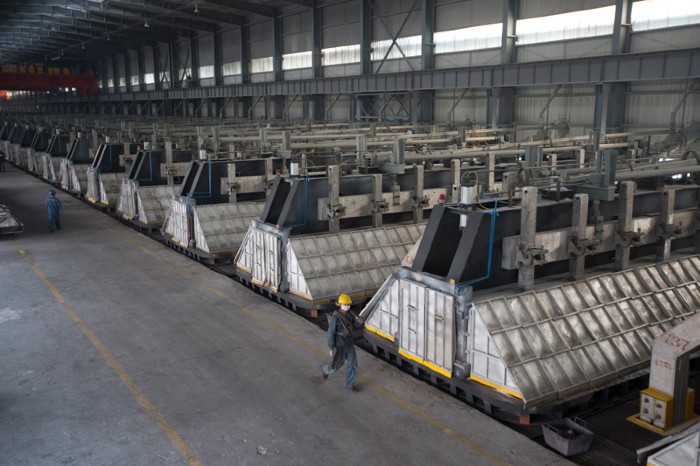
An aluminium smelter in Zouping, China. Two greenhouse gases whose atmospheric levels have soared in recent years have been traced to such smelters and to semiconductor factories in Japan and South Korea. Credit: Brent Lewin/Bloomberg/Getty

ATMOSPHERIC SCIENCE


What’s the mystery source of two potent greenhouse gases? The trail leads to Asia

Atmospheric levels of two powerful heat-trapping gases are rising quickly — and are higher than official emissions records suggest.

The powerful greenhouse gases tetrafluoromethane and hexafluoroethane have been building up in the atmosphere from unknown sources. Now, modelling suggests that China’s aluminium industry is a major culprit.

The gases are thousands of times more effective than carbon dioxide at warming the atmosphere. Official tallies of tetrafluoromethane and hexafluoroethane emissions from factories are too low to account for the levels in the air, which began to rise in 2015 after seven years of relative stability.

Seeking to pinpoint the sources of those emissions, Jooil Kim at the University of California, San Diego, and his colleagues analysed air samples collected roughly every 2 hours between November 2007 and December 2019 on South Korea’s Jeju Island. The scientists also modelled the weather patterns that transported air across the island during that period, to track the gases’ origins.

The results suggest that aluminium smelters in China account for a large proportion of these chemicals in the atmosphere. Semiconductor factories in South Korea and Japan are probably also to blame.


There’s a new federal holiday in September. What does it mean for you?

For the first time, Sept. 30 will mark the National Day for Truth and Reconciliation.

In June, Ottawa declared it a federal statutory holiday that is meant to give public servants an opportunity to recognize the legacy of residential schools.

The designated paid holiday for federal employees also addresses one of the 94 calls to action from the Truth and Reconciliation Commission: “We call upon the federal government, in collaboration with Aboriginal peoples, to establish, as a statutory holiday, a National Day for Truth and Reconciliation to honour survivors, their families, and communities, and ensure that public commemoration of the history and legacy of residential schools remains a vital component of the reconciliation process.”

READ MORE: Senate unanimously votes to create national holiday for truth and reconciliation

Saskatchewan has not declared it a provincial holiday. However, it does fall on the same day as provincially-proclaimed Orange Shirt Day — a day on which people honour residential school survivor Phyllis Webstad, who had her orange shirt taken away on the first day of school.

“We continue to proclaim Sept. 30 as Orange Shirt Day and recognize it as an important day of remembrance for those who have suffered harm and to honour those lives that were lost at residential schools,” said a Government of Saskatchewan spokesperson.

Employees still have to work that day, but all provincial government buildings will lower flags to half-mast.

Similarly, in Saskatchewan schools, staff and students will be in the classroom on Sept. 30.

As they do every year, school divisions in Regina and Saskatoon are planning Orange Shirt Day activities to reflect on the multigenerational impacts of residential schools.

READ MORE: SaskTel Centre, STC to host concert celebrating National Day of Truth and Reconciliation

“For Regina Public Schools, it is a day which specifically honours residential school survivor Phyllis (Jack) Webstad, and is an opportunity to build on learnings about residential schools, reconciliation, Indigenous ways of learning, land based education and treaties, including Treaty 4 on which the school division exists,” said Regina Public Schools spokesperson Terry Lazarou.

For staff and students at both the University of Regina (U of R) and University of Saskatchewan (USask), they will get the day off.

In alignment with the U of R’s commitment to Truth and Reconciliation, a university spokesperson said all campuses will be closed Sept. 30 to observe the National Day for Truth and Reconciliation. Classes will resume Oct. 1.

“Members of our University community are also encouraged to attend other events and ceremonies marking National Truth and Reconciliation Day, and to take the time to reflect on our individual roles and responsibilities in travelling the path towards reconciliation,” the U of R spokesperson said.

In a campus-wide email, USask provost and vice-president academic Dr. Airini confirmed the National Day for Truth and Reconciliation will be an official university holiday, which gives all faculty, staff and students the day off.

“We hope our campus community can use the time to learn, reflect and contemplate how we can do our part to eliminate structural and overt racism and other forms of discrimination on our campus, in our communities and across the country,” Dr. Airini said.

READ MORE: Saskatoon gift shop sells orange shirts to support residential school survivors

“The world needs a university where Indigenous concepts, methodologies, pedagogies, languages, and philosophies are respectfully woven into the tapestry of learning, research, scholarship, creativity, and community engagement.”

Planning for the statutory holiday closure and Orange Shirt Day programming is underway at both USask and the U of R.

In Saskatoon, city administration is currently reviewing the various collective agreements in place to determine the impact of the newly declared federal holiday, according to city manager Jeff Jorgenson.

“At this time, our focus is on recognizing the day with appropriate acknowledgement. The City of Saskatoon supports efforts to elevate the significance of September 30th and to reflect on the legacy and impacts of the Indian Residential School System,” Jorgenson said.

The City of Regina declined an interview at this time, but said it will have more information on its plans for the National Day of Truth and Reconciliation in the coming days.

Deere, UAW begin negotiations on pay, benefits for 10,100 workers, including in 7,200 in Iowa

Donnelle Eller
Des Moines Register


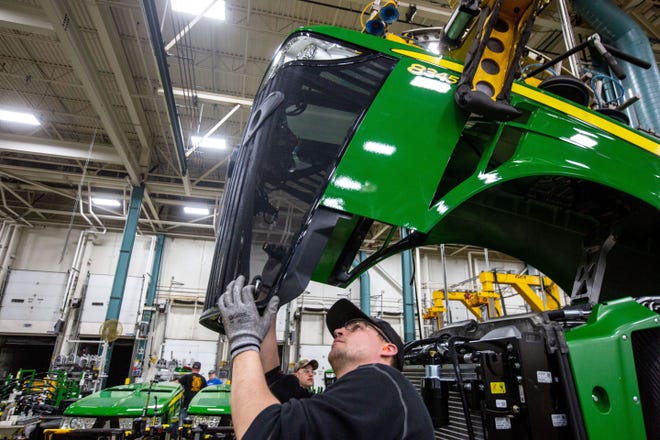
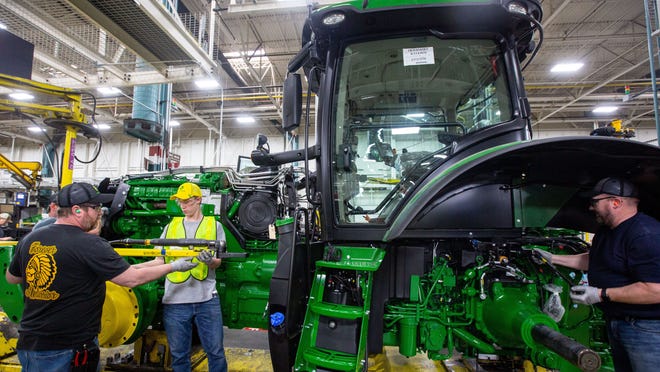
Deere & Co says it has begun negotiating a new labor contract with the UAW that will cover about 10,100 employees, including about 7,200 production workers in Iowa.

Based in Moline on the Illinois side of the Quad Cities, the manufacturer of tractors, combines and other farm and construction equipment said the existing six-year master contract ends Oct. 1. It sets pay and benefits for employees at Deere facilities in Illinois, Kansas and Iowa.

“We look forward to honoring the contributions of our employees through the bargaining process and reaching an agreement that demonstrates a vision for our shared success — and the success of all those who rely on us — well into the future,” Brad Morris, Deere's vice president for labor relations, said in a statement.


The contract negotiations come as Deere reports record earnings the first half of the year. Powered by high commodity prices and strong demand, Deere earned $1.2 billion in the first quarter and $1.79 billion in the second quarter. The previous record was $1.08 billion in the second quarter of 2013, the company said.

MORE: Everybody wants a John Deere tractor. But not everybody wants a John Deere job. Why?

It plans to release its third-quarter earnings Friday.

The Iowa facilities covered under the Deere contract include the Davenport, Des Moines, Dubuque, Ottumwa and Waterloo works.

Facilities under the contract in Illinois are the Harvester Works in East Moline, North American Parts Distribution Center in Milan, and the seeding group and cylinder division in Moline. In Kansas, there is one facility: Coffeyville Works.


Workers are represented by the International Union, United Automobile, Aerospace, and Agricultural Implement Workers of America.

Deere said it's worked with organized labor to "provide competitive compensation and rewarding careers allowing employees, their families and communities to prosper."


UAW and John Deere meet to negotiate on how to ram through a sellout contract

On Tuesday, the world’s largest agriculture machinery company, Deere & Company (John Deere), announced it had opened contract negotiations with the United Auto Workers (UAW). The current six-year contract, ratified in 2015, expires on October 1, 2021. The new contract covers some 10,100 workers from plants in Illinois, Iowa and Kansas.

During the 2015 contract negotiations the WSWS wrote, “The UAW is going to sell you out.” This proved correct in 2015, and the union is preparing an even worse betrayal now. In fact, the company and the union already have their contract, worked out behind closed doors. The only thing Deere and UAW are really “negotiating” is how to ram it through the workers.

John Deere assembly line (Flickr/Charles & Hudson)

The UAW and Deere are developing their strategy; John Deere workers need theirs. This requires the establishment of rank-and-file committees at every plant. Workers must take matters in their own hands and not wait for what they know is coming.

The 2015 contract demonstrates that the UAW has no business claiming that it “represents” workers at Deere. The agreement was rammed through without workers having a chance to even look at it. They were only given a self-serving, 17-page “highlights” document distributed the day workers were to vote—with just two hours to consider it!

The contract maintained the hated two-tier system and increased out-of-pocket costs for health care. It included a pathetic $3 wage increase over the six-year span of the contract. Exploiting the economic hardships caused by previous UAW-backed concessions, Deere and the UAW attempted to lure workers into voting “yes” with a $3,500 sign-on bonus.

The UAW’s announcement of the agreement’s ratification was met with outrage by workers, who repeatedly demanded a recount and revote while the union responded to their demands with silence. The WSWS received a document from workers that stated the contract was passed by a margin of only 180 votes.

The 2015 deal was the latest in a long series of concessionary contracts rammed through by the UAW at Deere, which were used as models for the entire auto industry. This included the 1994 and 1997 contracts, which introduced and expanded the hated two-tier wage and benefit system.

The 1997 contract agreement was also the first six-year contract, doubling the period between negotiations, which granted enormous leverage to Deere. These contracts and every one that followed contained minimal wage increases entirely eaten up by inflation.

In 2009, the UAW executives patted themselves on their backs after announcing they secured an agreement with Deere that would prohibit plant closings for the duration of the contract. But the agreement did nothing to stop layoffs. In 2015, under the 2009 contract, Deere laid off 910 employees at plants in Iowa and Illinois, almost matching the 1,000 workers they laid off in 2014. Since then, thousands more have been laid off.

Lessons of the Volvo strike

The UAW is not a workers organization but an instrument of corporate management. In recent years it has been engulfed in a corruption scandal that has exposed the fact that its top executives stole workers’ dues money and accepted bribes in exchange for pushing through pro-company contracts.

So far, 12 UAW officials, including two of the last four union presidents, have pleaded guilty to various charges stemming from the investigation, including former UAW Vice President Norwood Jewell, who oversaw the 2015 Deere contract.

John Deere workers should take their lead from the workers at Volvo Trucks in Dublin, Virginia, who in the course of their struggle formed a rank-and-file committee to fight for their interests against both management and the UAW.

In June and July of this year, the nearly 3,000 Volvo Trucks workers waged a five-week-long strike, which the UAW was forced to call after workers rejected by 90 percent two sellout contracts. After the workers voted down the third contract, the UAW had them vote on it again just days later, claiming that it ultimately passed by just 17 votes.

The UAW shut down the strike and declared the new contract valid. The new contract included higher out-of-pocket health care expenses, forced younger workers to work six years or more to reach top pay and continued forced overtime. Raises for the top paid workers average only 2 percent a year, well below the current rate of inflation of 5.4 percent.

At every instance, the UAW sought to end the strike. It isolated it and maintained a blackout of information on contract negotiations. But workers fought back against the UAW’s attempt to sabotage their struggle and formed the Volvo Workers Rank-and-File Committee (VWRFC). The VWRFC broke the UAW’s news blackout and isolation of the strike and garnered support from autoworkers in Detroit and other cities, Mack Trucks workers and Belgian Volvo workers.

Reflecting on the struggle at Volvo, the VWRFC stated, “A real movement of workers must come from the bottom, not from the bureaucracy. The building of a powerful rank-and-file movement—of the workers, by the workers and for the workers—is the task facing all workers everywhere.”

Organize a rank-and-file committee!

Many Volvo workers expressed the sentiment: We wish we had the rank-and-file committee earlier! That is the task now at Deere. Deere workers cannot sit back and wait for the inevitable betrayal. Now is the time to organize and mobilize to advance and fight for your own demands.

For the UAW, the contract “process” is as follows: Management says what it wants, the UAW agrees, and the workers must accept what they are given. This must end now!

rank-and-file committee should begin by formulating demands that meet workers’ real needs, including:

  • An end to the two-tier system, with all workers brought up to top pay and benefits
  • A 30 percent across-the-board pay increase to make up for the years of wage freezes and stagnation
  • An annual cost-of-living escalator clause to keep up with spiking inflation
  • Fully paid health care benefits for retirees, with no co-pays or premiums

Workers should demand now that all negotiations between the UAW and the company be open to workers’ representatives. No to backroom negotiations! And if any contract is reached, workers must have it in full, with two weeks to discuss and study it before any vote.

Deere workers face a powerful and experienced corporate conglomerate, which is determined to siphon as much of the wealth produced by the workers to the shareholders. But workers have powerful allies among the working class in the US and around the world whose numbers are far more numerous and collectively contain immense strength