Tuesday, December 07, 2021

Anti-mask, anti-vaccine conspiracy theorist among 3 arrested during demonstration at West Edmonton Mall

CBC/Radio-Canada 
© Getty Images The West Edmonton Mall's mask mandate is in accordance with the city's mask bylaw. There are few exceptions where people can be inside the mall without a mask.

An Ontario-based anti-mask and anti-vaccine conspiracy theorist, his wife and a third person were arrested Saturday, as a result of an anti-mask demonstration at the West Edmonton Mall, police say.

Chris Saccoccia — who goes by Chris Sky — organized a demonstration where people would shop for toys at the mall for a Christmas toy drive, without wearing masks, regardless of vaccination status.

All mall-goers have to wear a mask when inside, with very few exceptions, in accordance with the City of Edmonton mask bylaw.

The Edmonton Police Service knew of the planned anti-mask demonstration, according to an EPS news release issued Saturday.

Saccoccia was already wanted on several outstanding warrants, including uttering threats and public mischief, police say. But he and his wife, Jennifer Saccoccia, were arrested Saturday regarding an injunction banning them from the West Edmonton Mall.

A third person was also arrested for breaching the injunction, police say.

All three people will remain in custody until they speak to the charges in Court of Queens Bench Monday morning, police s
B.C. First Nations concerned with provincial logging process


(ANNews) - First Nations in B.C. are concerned with the government’s old-growth deferral process, believing that the province isn’t doing enough to protect forests.

In November, the government approached First Nations with 26,000 square kilometres of old-growth forests at risk of loss of permanent biodiversity. They then gave the First Nations 30 days to decide if they supported logging deferrals in those areas.

Many Indigenous people, including the Union of B.C. Indian Chiefs, believe that 30 days is not enough time to make such a decision, as Grand Chief Stewart Phillip said it was a “critically important discussion.”

“The issue of old growth is, in many ways, the metaphor for the absolute neglect of the forest lands in B.C. for the last 50 years,” said Phillip.

“The forest industry itself has traditionally been the piggy bank for the provincial government, no matter what political stripe, they may be."


Supporters of the First Nations believe that the government actions are not consistent with free, prior and informed consent, which is a major aspect of the UN Declaration on the Rights of Indigenous Peoples — legislation that passed in B.C. in 2019.

Elected chairperson of the Squamish Nation, Khelsilem, said that 97 per cent of all old-growth forrest have been logged in Squamish territory.

Asking for consent to defer, but not asking for consent to log, is a total about-face and a misalignment on (the province’s) values when they say they want to partner with First Nations and they want to respect Indigenous rights,” Khelsilem said.

Jacob Cardinal, Local Journalism Initiative Reporter, Alberta Native News

The First Nation opioid crisis In Canada

(ANNews) – In 2020, Canada’s chief medical health officer Dr. Theresa Tam released a report detailing the state of public health and the worsening opioid crisis amid the COVID-19 pandemic.

The report said the reason for the increase in opioid-related deaths was because of the amount of fentanyl in illegal drugs — with extreme concentrations of fentanyl being found in 14 per cent of opioid deaths.

Now a year later, the crisis has only gotten worse.

Ontario


In late November 2021, the Chiefs of Ontario, in collaboration with the Ontario Drug Policy Research Network, released two reports documenting the increase in opioid-related poisonings during the COVID-19 pandemic, as well as the need to address the opioid-crisis in regards to First Nations communities.

The amount of opioid-related deaths in the province has more than doubled during the first year of the COVID-19 pandemic.

The Chiefs of Ontario attributed the rise in opioid-related poisonings to the growing presence of fentanyl in the unregulated drug supply and the COVID-19 pandemic.

“The COVID-19 pandemic emerged amid an opioid crisis in our communities. The findings in these reports reinforce what First Nations leadership, families and communities have been demanding for decades,” said Ontario Regional Chief Glen Hare. “More needs to be done, and we must act now.”

“First Nations have been disproportionately affected by the overdose crisis. The use of opioids and other substances continues to surge during the COVID-19 pandemic, producing conditions that further increase overdoses and deaths,” said Regional Chief Hare.

The reports note that 116 First Nations people died due to opioid poisoning between March 2020 and March 2021, compared with 50 people in the previous year.

That’s a 132 percent increase, compared to a 68 percent increase of opioid-related deaths among the rest of the population in the province.

First Nations people were identified in the report using the Indian Registry System database, which includes people who are eligible for Indian Status under the Indian Act.

Neither the Ontario Ministry of Health or Indigenous Services Canada have provided a comment.

The Rest of Canada

However, opioid usage and poisonings have been felt nationally, especially in Western Canada, with the provinces of B.C. and Alberta seeing an increase in opioid-related deaths in the recent past.

Now Saskatchewan and the Yukon have begun seeing an increase as well.

The Saskatchewan coroner’s service recently released statistics outlining opioid-related deaths in the province. So far in 2021, there have been a total of 364 suspected and confirmed drug-related deaths.

In 2020 there were 330.

As for the Yukon, the territory reported alarming opioid death statistics in September, claiming that 14 overdose deaths have occurred since Jan. 1.

Yukon’s chief coroner Heather Jones said of the 14 deaths that occurred this year, six people were First Nations.

All of the 14 deaths “involved opioids in various formats of fentanyl and in combination with other illicit drugs and/or alcohol,” the report said.

“More and more Yukon families are being left with a devastating reality found in the wake of these lost lives.

“This is a pain that is now close to so many of us.”

, Local Journalism Initiative Reporter, Alberta Native News

Alberta government firm on recovery-oriented care as province on track for deadliest year for drug poisonings

Province announced 8,000 addiction treatment beds have

been funded annually since 2019 promise of 4,000

The newly funded treatment spaces include 2,184 spaces annually at Alpha House Society in Calgary. (Calgary Alpha House Society/Facebook)

Alberta Premier Jason Kenney and Associate Minister of Mental Health and Addictions Mike Ellis announced Saturday the Alberta government has doubled the number of addiction recovery beds that it promised in 2019 would be funded.

They also encouraged people to use an app, the Digital Overdose Response System, that they hope will help dispatch ambulances to people overdosing in their homes. It is already in use in Calgary, Edmonton and surrounding communities.

Alberta is on track for its deadliest year on record for fatal drug poisonings. As of August, more than 1,000 people had died from drug poisonings. Just less than 1,300 people died in 2020, which was the highest single-year total so far.

Ellis says there is no one answer to the crisis.

"We're exploring a lot of options, but right now we are completely focused on recovery," he said.

In 2019 the government announced funding for 4,000 new annual treatment spaces that those struggling with addiction can access without fees. Kenney said the government has doubled that goal, making 8,000 beds available each year instead.

He also announced Saturday an integrated software to connect different recovery facilities across the province that will be launched in 2022.

Focus remains on recovery-oriented care

Kenney said a lack of access to recovery services is "unacceptable."

"The bottom line is this: if a single-minded focus on so-called harm reduction, including so-called safe supply, really worked, then how do we explain the total disaster of the Downtown Eastside in Vancouver?"

Lori Sigurdson, NDP critic for addictions and mental health, said in a statement that though more addiction recovery beds are a good thing, there should be more emphasis put on harm reduction services, such as supervised consumption sites.

"The government's response to this crisis cannot be measured in beds opened or dollars spent, but must be measured by lives saved," said Sigurdson. "By that measure the UCP's failure is a tragic one."

She said Kenney has mischaracterized harm reduction services, stigmatizing people who need to access them.

JUNKIES ONLY HAVE THEMSELVES TO BLAME 

"We don't think facilitating deadly addictions is the safe or responsible approach," said Kenney Saturday about pushes for safe supply.

Trust needed for people to use app for overdoses: health policy expert

The majority of drug users are in their own homes in the suburbs, not at safe consumption sites, Ellis said.

He and Kenney encouraged people to use the Digital Overdose Response System app, which has a timer that is set before a person uses a drug. If a person doesn't respond within a certain time after the timer goes off, an ambulance is dispatched to their home.

Concerns about privacy or police showing up might stop some people from using the app, though, said Elaine Hyshka, an assistant professor at the University of Alberta's School of Public Health.

"What we've seen in other jurisdictions that have had these apps for much longer, like British Columbia, is that they're useful for some people but they're not really widespread — there isn't widespread uptake," Hyshka said.

"It's not a bad thing to have an app. I actually think it's really important to try new things we haven't done before to get on top of the situation, but we just have to do a lot of due diligence to ensure it works well for people."

Russia to send Japanese tycoon to ISS in return to space tourism


BAIKONUR, Kazakhstan, Dec 6, 2021 (BSS/AFP) - Russia on Wednesday will send
Japanese billionaire Yusaku Maezawa to the International Space Station in a
move marking Moscow's return to the now booming space tourism business after
a decade-long break.

One of Japan's richest men, Maezawa, 46, will blast off from the Baikonur
cosmodrome in Kazakhstan accompanied by his assistant Yozo Hirano.

On Sunday morning, their Soyuz spacecraft with a Japanese flag and an "MZ"
logo for Maezawa's name was moved onto the launch pad in unusually wet
weather for Baikonur, an AFP journalist saw.

The mission will end a decade-long pause in Russia's space tourism
programme that has not accepted tourists since Canada's Cirque du Soleil co-
founder Guy Laliberte in 2009.

However, in a historic first, the Russian space agency Roscosmos in October
sent actress Yulia Peresild and director Klim Shipenko to the ISS to film
scenes for the first movie in orbit in an effort to beat a rival Hollywood
project.

Maezawa's launch comes at a challenging time for Russia as its space
industry struggles to remain relevant and keep up with Western competitors in
the modern space race.

Last year, the US company SpaceX of billionaire Elon Musk ended Russia's
monopoly on manned flights to the ISS after it delivered astronauts to the
orbiting laboratory in its Crew Dragon capsule.

This, however, also freed up seats on Russia's Soyuz rockets that were
previously purchased by NASA allowing Moscow to accept fee-paying tourists
like Maezawa.

Their three-seat Soyuz spacecraft will be piloted by Alexander Misurkin, a
44-year-old Russian cosmonaut who has already been on two missions to the
ISS.

The pair will spend 12 days aboard the space station where they plan to
document their journey for Maezawa's YouTube channel with more than 750,000
subscribers.

The tycoon is the founder of Japan's largest online fashion mall and the
country's 30th richest man, according to Forbes.

"I am almost crying because of my impressions, this is so impressive,"
Maezawa said in late November after arriving at Baikonur for the final days
of preparation.

Maezawa and Hirano have spent the past few months training at Star City, a
town outside Moscow that has prepared generations of Soviet and Russian
cosmonauts.

- 'Hardest training ever' -

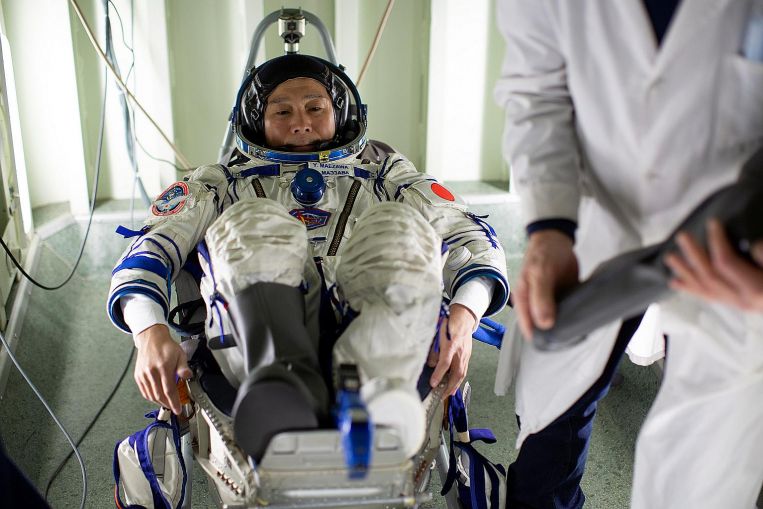
Maezawa said that training in the spinning chair "almost feels like
torture".

"It's the hardest training ever done," he tweeted in late November.

So far Russia has sent seven self-funded tourists to space in partnership
with the US-based company Space Adventures. Maezawa and Hirano will be the
first from Japan.

Maezawa's launch comes at the end of a year that became a milestone for
amateur space travel.

In September, SpaceX operated a historic flight taking the first all-
civilian crew on a three-day journey around the Earth's orbit in a mission
called Inspiration4.

Blue Origin, the company of Amazon founder Jeff Bezos, completed two
missions beyond the Earth's atmosphere. The passengers included 90-year-old
Star Trek star William Shatner and Bezos himself.

Soon after, billionaire Richard Branson travelled aboard his Virgin
Galactic spacecraft that also offered a few minutes of weightlessness before
coming back to Earth.

Those journeys mark the beginning of space opening up for non-professionals
with more launches announced for the future.

In 2023, SpaceX is planning to take eight amateur astronauts around the
moon in a spaceflight that is bankrolled by Maezawa, who will also be
onboard.

Russia has also said it will take more tourists to the ISS on future Soyuz
launches and also plans to offer one of them a spacewalk.

For Russia, retaining its title of a top space nation is a matter of
national pride stemming from its Soviet-era achievements amid rivalry with
the United States.

The Soviets coined a number of firsts in space: the first satellite, first
man in space, first woman in space, first spacewalk, to name just a few.

But in recent years Russia's space programme has suffered setbacks,
including corruption scandals and botched launches, and faced a cut in state
funding.

The industry remains reliant on Soviet-designed technology and while new
projects have been announced, such as a mission to Venus, their timeline and
feasibility remain unclear.

Yusaku Maezawa: Irreverent Billionaire Fascinated By Space

By Kyoko HASEGAWA, Sara HUSSEIN
12/05/21 

Japanese billionaire Yusaku Maezawa, who blasts off for the International Space Station this week, is an irreverent space enthusiast who has made headlines for splashing the cash on modern art.

The 46-year-old tycoon is the founder of Japan's largest online fashion mall and is the country's 30th-richest person, according to business magazine Forbes.

But he is far from the traditional image of a staid Japanese businessman, with more than 10 million people following his Twitter account, its handle a play on his first name: @yousuck2020.

And he's a big spender, particularly when it comes to his twin passions: modern art and space travel.

He hit the headlines in 2017 when he forked out a whopping $110.5 million for Jean-Michel Basquiat's 1982 painting "Untitled", a skull-like head in oil-stick, acrylic and spray paint on a giant canvas.

It was a record price, but Maezawa insists he is just an "ordinary collector" who buys pieces "simply because they are beautiful".

On December 8, Maezawa will become the first space tourist to travel to the ISS with Russia's space agency Roscosmos since Canadian Guy Laliberte, co-founder of Cirque du Soleil, in 2009.

He will be accompanied on the 12-day mission by his assistant Yozo Hirano, a film producer who will be documenting the journey for Maezawa's YouTube channel and its 754,000 subscribers.

How much Maezawa has spent on his upcoming space adventure is unclear, as the price tag has been kept a secret, though similar trips have cost millions of dollars.

But the cost is unlikely to make much of a dent in the $1.9 billion net worth Maezawa is estimated to have accumulated through his firm Zozo, previously known as Start Today, which operates the hugely popular ZOZOTOWN online fashion site.

Maezawa arrived in Kazakhstan for space training in November, and has said he is "not afraid or worried" about the voyage.


Japanese billionaire Yusaku Maezawa will blast off for the ISS as part of a 12-day mission P
hoto: POOL via AFP / SHAMIL ZHUMATOV

He has been soliciting ideas for things he should do in space and asking questions including: "Do you move forward when you fart in space? What happens when you play Pok?mon GO in space?"

In Japan, Maezawa's exploits are often fodder for gossip magazines, with a particular focus on his love life over his space exploits.

The ISS trip won't be Maezawa's last space odyssey, as the businessman has also booked out an entire SpaceX rocket for a trip around the Moon scheduled for 2023 at the earliest.

Maezawa originally said he planned to invite six to eight artists on the trip, asking them to create "masterpieces (that) will inspire the dreamer within all of us".

But in March, he announced he was broadening the search beyond artists, and claims to have received one million applications for eight spots on the rocket made by Elon Musk's firm.

Maezawa has made a habit of holding online competitions, creating a Twitter frenzy in 2020 when he said he would give away $9 million to 1,000 people as a "social experiment".

But he backed out of a separate competition seeking candidates to be his girlfriend... after attracting nearly 30,000 applicants.

As a young man, Maezawa had aspirations in the music world and was a drummer with a band named Switch Style, which made its debut in 2000.

But he came to feel the business world was more creative than music, and has said writing and performing eventually become a frustrating routine.

He began dabbling in business even before the band's debut, and has attributed Zozo's success to the fact he and his staff were "doing what we enjoy".

"Work hard, make people happy, earn money, buy big dreams, visit amazing places, meet people, experience great things, grow as a person, and work again," he wrote in May on his Twitter account, explaining his philosophy.

"The cycle repeats. The cycle of making dreams come true. We can even go to space."
Alberta firehall first in Canada to construct safe surrender box as alternative to baby abandonment


Hope's Cradle like Angel Cradles in Edmonton, Safe Haven Baby Boxes in U.S., but 1st attached to fire station

A plain grey metal door outside the fire station in Strathmore will soon be a safe place for parents to surrender their newborns, says Eric Alexander, shift captain of the Strathmore Fire Department. (Terri Trembath/CBC)

The community fire station in Strathmore, Alta., will soon be the first in Canada to offer a safe place for parents to surrender their newborn babies. 

Hope's Cradle is similar to intiatives like Angel Cradles at two Edmonton hospitals and Safe Haven Baby Boxes in the United States. But Hope's Cradle is the first in Canada to be attached to a fire station.

Shift captain Eric Alexander is happy to see the project close to being fully operational.

"We're really excited to be able to offer this service to our community and the surrounding communities as well," Alexander said. "It's pretty special to be the first one in Canada."

He hopes it catches on across the country.

Partnership with Gems for Gems

Alexander started working on Hope's Cradle after a baby was found dead in a Calgary dumpster on Christmas Eve in 2017.

As a new father, the story stuck in his mind. As a firefighter with a priority of saving lives, he wanted to ensure that doesn't happen again.

"I just couldn't imagine the pain of having to make that decision as a new parent," he said.

While Alexander was working on the project, a Calgary-based charity called Gems for Gems was working on a similar idea.

Four months ago, they partnered to come up with Hope's Cradle and split the $20,000 cost of construction.

"For this first one, we've partnered with Strathmore but we want to partner with several all across Alberta and all across Canada," said Jordan Guildford, CEO and founder of Gems for Gems, a charity that aims to end domestic abuse.

In the U.S., Guildford explained, Save Haven Baby Boxes are used more in rural locations, because people living in cities have the perception that anonymity is higher in rural areas. So they will drive to surrender their newborn.

Strathmore, a town 50 kilometres east of Calgary, fits the bill, she said.

Gems for Gems is working with partnerships with the Calgary fire department as well, she said.

How Hope's Cradle works

Right now, the spot is a simple, small, square metal door on the outside of the Strathmore fire station. But eventually the door will have a decal clearly marking it as Hope's Cradle, Alexander said.

The door can be opened once. Inside, there is an enclosed, heated bassinet waiting for the baby to be placed in. When the door closes, it locks, and a silent alarm goes off to alert fire department staff.

"We want to ensure that expectant mothers know that their anonymity will be protected and will not be released under any circumstances, as long as the child is surrendered without signs of neglect or abuse," Alexander said.

Unless the child is injured, leaving a baby in a safe place will not result in criminal charges. The goal of the program, he explained, is to provide a safe place for newborns to go to a caring home and get the support they need.

Hope's Cradle has no religious or political affiliation, Guildford said.


No Permit, No Problem: More States Allow Residents to Carry a Hidden Gun
1969
Matt Vasilogambros, Stateline.org
Mon, December 6, 2021

Dec. 6—Six more states no longer require residents to hold a permit to carry a concealed firearm.

Arkansas, Iowa, Montana, Tennessee, Texas and Utah this year enacted what gun rights advocates often refer to as "constitutional carry" measures. A legislative priority for groups such as the National Rifle Association, 21 states now have such measures in place. Many of these states still have restrictions on possessing firearms in certain government buildings.

More states may be added to that list before the end of this legislative season. The Ohio House last month passed a bill along party lines that would eliminate a requirement for gun owners to take an eight-hour class and undergo a background check to carry a concealed firearm in public. It is now before the state Senate, which also is controlled by Republicans. Wisconsin lawmakers also are debating a permitless carry bill.

Similar bills have passed in one legislative chamber in both Louisiana and South Carolina this year. Meanwhile, the U.S. Supreme Court is considering whether New York's gun permitting system violates the Second Amendment—a case that could gut firearm permit provisions nationwide.

Permitless carry laws eliminate what proponents say is an onerous and time-consuming step for people who want to arm themselves for self-protection. When Tennessee Gov. Bill Lee signed his state's permitless carry law earlier this year, the Republican tweeted that "it shouldn't be hard for law-abiding Tennesseans to exercise their" Second Amendment rights.

Gun safety advocates and law enforcement agencies argue that having more people with concealed firearms in public places endangers communities and police officers.

"This is a dangerous step for states," said Eugenio Weigend, director of the gun violence prevention program at the Center for American Progress, a liberal think tank. "This could easily raise some confrontations in some places, further escalating violence to reach lethal levels."

The debate over self-defense figured prominently in the recent trial of Kyle Rittenhouse, who was charged with homicide after he killed two people in the tumultuous aftermath of a police shooting in Kenosha, Wisconsin, in 2020. A jury acquitted Rittenhouse last month, finding that his use of deadly force in the chaotic streets was legally justifiable. Prosecutors called him a dangerous vigilante.

In Georgia, Travis McMichael argued he was acting in self-defense when he shot and killed Ahmaud Arbery, an unarmed Black man who was jogging in McMichael's neighborhood. McMichael was convicted of murder last month, along with his father and a neighbor. The three men pursued Arbery in a pickup truck.

Wisconsin's permitless carry bill, which received a public hearing in the state Senate in October, also would prohibit local governments from banning weapons on public transportation. It's unclear when the legislation will get a vote, but gun rights advocates are confident it will pass.

Eliminating the permit requirement would be a welcome change for gun owners uneasy about being on a government list, said Nik Clark, president of Wisconsin Carry, a Milwaukee-based gun rights organization. It also would allow people who want a gun for self-protection to acquire one without having to wait through the permitting process, which Clark said is important in cases of domestic abuse or in situations such as the civil unrest of 2020.

"We have a human right to self-defense," Clark said. "To say that you need permission from the government to do that is crazy. It's anti-American."

Gun rights advocates such as Clark have been pushing for a permitless carry law in Wisconsin for more than a decade. It never gained the support of key state legislative leaders or former Republican Gov. Scott Walker, who said in 2017 that licenses for concealed firearms were "appropriate."

But pressure continued from advocates. Bolstered by national momentum, this year's bill in Wisconsin has 31 cosponsors, all of whom are Republican. If the bill passes, Democratic Gov. Tony Evers would likely veto it, to the relief of gun safety advocates.

"This puts our citizens at higher risk," said Jeri Bonavia, executive director of the Wisconsin Anti-Violence Effort Educational Fund, a gun safety group.

1971


Bonavia and researchers at the Center for American Progress found in a September study that since Wisconsin enacted a law in 2011 allowing residents to carry concealed weapons with a permit, gun-related homicides and aggravated assaults have risen. Gun-related homicides and assaults were on the decline in Wisconsin before 2012, but began to shift upward during the implementation of the law, the researchers found.

The gun homicide rate in Wisconsin from 2012 to 2019 was a third higher than it was from 2004 to 2011. The annual average of aggravated assaults with firearms from 2012 to 2019 increased by more than half compared with 2004 to 2011. The increase in gun homicide rates after 2011 did not occur in neighboring states without a concealed carry law.

Last month, the Republican-led Pennsylvania legislature passed a similar permitless carry bill. However, Democratic Gov. Tom Wolf vetoed the legislation last week.

"Unfortunately, this bill would make gun violence worse and would put law enforcement officers at greater risk of harm," Wolf said in his veto message.

Until 2011, Vermont was the only state that did not require its residents to have a permit to carry concealed weapons. Since then, Republican-led states have steadily dropped permit requirements. In several states, the law applies to residents who are 21 and over, with some exceptions for members of the military who are 18 and over.

These new laws have coincided with measures allowing guns in houses of worship and on school grounds and public transportation.

While Democrats widely reject the permitless carry policy, polling suggests it also lacks widespread support in the GOP. Most of the pressure on lawmakers to pass these bills has come from gun rights lobbyists at the NRA and other groups, Bonavia said.

"These bills are not a result of public demand," she said. "There is not a groundswell of support that we need to carry these guns without any regulations."

Indeed, just over a third of Republicans support allowing people to carry concealed guns without a permit, according to an April survey by the Pew Research Center. (The center is a subsidiary of The Pew Charitable Trusts, which funds Stateline.)

Gun safety advocates have called on state lawmakers to restrict gun access, rather than expand it, citing a spike in gun violence and recent school shootings, including one at a Michigan high school last week that left four dead.

While most Americans generally support stricter laws around firearms, that support has waned since it reached its pinnacle in the aftermath of the school shooting in Parkland, Florida, in February 2018 and the nationwide, student-led protests that followed. According to Gallup polling, support for stricter gun laws declined from 67% in March 2018 to 52% this October.

Gun rights advocates such as Clark argue that the civil unrest that occurred in some places during the mostly peaceful anti-racism protests in summer 2020 demonstrated the importance of allowing Americans to carry concealed firearms without a permit.

"If people need protection quickly," he said, "they don't have time to take a class."

#ABOLISHSECONDAMENDMENT


Texas plumber who found cash in Lakewood wall 'upset' with Joel Osteen: 'Should have heard something'


Emma Colton
Mon, December 6, 2021

The Texas plumber who found cash in a wall in preacher Joel Osteen’s Lakewood Church said he’s "upset" that no one from the church has contacted him.

"I wanted to hear [Joel Osteen] say, ‘You know, Justin, what you did was right. We understand what you did and what you could have done,’" the man said after attending a service held by Osteen on Sunday, according to Click 2 Houston. The man has only been identified as Justin.

JOEL OSTEEN’S HOUSTON CHURCH HAD $600K INSIDE WALL FROM 2014 ROBBERY, PLUMBER CLAIMS

"I feel like, at this point, I should have heard something," he said. "I’m just a little upset."

The plumber found the cash in a wall of the church in about 500 envelopes. Houston police said the money is in connection to a 2014 robbery at the church, where $200,000 in cash and $400,000 in checks were stolen from a church safe.

"There was a loose toilet in the wall, and we removed the tile," the plumber said on 100.3 FM’s morning show. "We went to go remove the toilet, and I moved some insulation away and about 500 envelopes fell out of the wall."

The church also released a statement saying police were contacted after the discovery was made.

JOEL OSTEEN ENLISTS KANYE WEST, MARIAH CAREY AND TYLER PERRY FOR EASTER SUNDAY AMID CORONAVIRUS PANDEMIC

"Recently, while repair work was being done at Lakewood Church, an undisclosed amount of cash and checks were found," the church said. "Lakewood immediately notified the Houston Police Department and is assisting them with their investigation. Lakewood has no further comment at this time."

The discovery, however, has left some parishioners with more questions following the 2014 robbery.

"I was discouraged the first time," longtime parishioner Benito Rodriguez told Click 2 Houston, referring to the 2014 theft. "I was discouraged and now I am more discouraged because they found it. It doesn’t make any sense."


Wings and a prayer: Monarch surge brings hope for butterfly recovery


Francine Kiefer
Mon, December 6, 2021

Naturalist Danielle Bronson is ecstatic. The butterflies are back. Specifically, the Western monarch butterfly – more than 20,000 of them hanging in clusters from branches in elegant eucalyptus trees or fluttering around this conservation grove on the central California coast.

Last year, the count in the Pismo State Beach Monarch Butterfly Grove totaled only 200, in what is a top overwintering spot for monarchs west of the Rocky Mountains. The entire recorded population numbered less than 2,000 last year – down from millions in the 1980s. Experts feared this year might mark their end. Instead, the butterflies are experiencing a resurgence, though no one knows exactly why or if their upward trajectory will continue.

“I’m thrilled, because having 2,000 as the entire population, it was a blow to the face actually,” says Ms. Bronson. As a schoolgirl, she visited this grove, awed by hundreds of thousands of monarchs so plentiful they covered tree trunks. The sight inspired her to a career with the state park service, where she now works as a park interpreter and educator. “Last year was devastating, but this year I’m very hopeful.”

Ms. Bronson calls monarchs “the Hollywood species,” celebrities in their own right, flitting about in gorgeous orange-and-black gowns designed by Mother Nature. As stars of the pollinator world, they also serve as high-profile messengers about what is happening to this all-important group.

Both Western and Eastern monarchs – indistinguishable in genetic makeup but distinct populations because of their location on either side of the Rockies – have suffered severe declines since the early 1990s. The Eastern monarchs, which migrate to Mexico where they overwinter and mate, have seen their numbers drop by about 70%. The Western population, which migrates from northern states and parts of Canada to the California coast, is much worse off, plunging by 99%. The U.S. Fish and Wildlife Service is expected to add monarchs to the list of endangered species in 2024, says Sarina Jepsen, director of endangered species for the Xerces Society for Invertebrate Conservation.

The society organizes an annual Thanksgiving count of the Western monarch, at about 250 overwintering sites throughout California, Mexico’s Baja California, and a few places in Arizona. Volunteers arrive at first light to count the butterflies in their clusters. Any later, and they risk an overcount as the sun warms up these cold-blooded creatures and they begin to fly about.

These monarchs are a special generation that lives for six to eight months. After overwintering and mating, the females fly off and lay their eggs on milkweed, usually inland, on which the emerging caterpillars feast until they turn into a chrysalis and, finally, butterflies. Those adults typically live for only 30 days, with successive generations traveling on before the fall migration begins again.

This year, the butterflies arrived early. A preliminary tally of the Thanksgiving count finds more than 100,000 Western monarchs, a stunning 4,900% increase over last year. The final result will be announced in January. It’s encouraging, but “not a recovery,” cautions Ms. Jepsen, who cites a tendency of insect populations to bounce around.

“We’re really grateful it didn’t bounce to zero. What it means is we have a little bit of time to work toward recovery, but it doesn’t mean the population has recovered,” she says. As a reference point, a population under 30,000 is considered to have entered the “extinction vortex,” she says.

Many factors contribute to the decline of the monarchs. Overwintering habitat is lost to development. There’s less milkweed – the only food that monarch caterpillars eat – and fewer nectar-producing plants to nourish the butterflies. Pesticides, wildfires, and climate change all play a role, according to the Xerces Society. Because of the many reasons for decline, it’s not possible to pinpoint what’s behind this year’s resurgence. “We really can’t interpret it,” says Ms. Bronson.

But experts do know that restoring habitat and planting nectaring plants and milkweed can help. The massive infrastructure bill signed by President Joe Biden in November included $10 million to fund pollinating plants along roads and highways. The Monarch Act, sponsored by Oregon Sen. Jeff Merkley and California Rep. Jimmy Panetta would provide $125 million to save the Western monarch.

Individuals can play a role, says Ms. Bronson, though she explains that the messaging about milkweed is a bit complicated. It should be planted away from overwintering sites – if it’s too close, it will encourage the butterflies to come out of diapause and mate sooner than they should. And the plantings should be native milkweed. Tropical milkweed, often sold by big-box stores, can house a harmful parasite and should not be used, she advises.

The simplest way to help, she says, is to grow nectar-producing plants to give butterflies energy during their journey and while overwintering. “You really can’t go wrong on that one, because you’re not just helping monarchs, you’re helping all pollinators.” The Pismo Beach conservation site, just off of Highway 1, has a nearby garden with coyote bush and senecio, a flowering succulent, to feed the monarchs.

Visitor Suzi Goodwin got the message. A local, she often visits the grove at this time of year, especially if she has company. She is delighted with the noticeable increase in butterflies, and loves the grove for its peaceful feel and scent. She has put in plants friendly to butterflies and bees at her house in Santa Maria, about 20 miles from the grove. “We did our homework before we bought our plants,” says the retiree.

Of course Ms. Bronson hopes the monarch numbers will continue to go up. She wants her 2-year-old son to see what she saw as a little girl. “And not just my kid. I get utter joy when you have school groups coming out here, and the ‘oohs’ and the ‘ahs’ and the ‘wow.’ And the smile that you can see in their eyes. That also brings hope.”

Related stories

‘This isn’t just weeds’: Native gardens are repairing local ecosystems

Do not disturb: In India, traditions and science protect sacred forests

Riding with the wildlife rescuers: No creature too big, small, or wild

‘Creation care’: How churches aim to save a warming planet
Granderson: Where are men on the demolition of abortion rights?

LZ Granderson
Sun, December 5, 2021

Abortion rights advocates demonstrate in front of the Supreme Court on Wednesday, when the court heard oral arguments about a Mississippi abortion law and overruling the 1973 Roe vs. Wade decision. (Kent Nishimura / Los Angeles Times)

It’s been a while since I took a science class, but from what I can recall, humans do not reproduce asexually. I bring this up because we tend to talk about reproductive rights as if it’s a women's issue.

Sure, if the Supreme Court guts Roe vs. Wade next year, there will be a number of men who will not care. I could not imagine being a father or brother or son and thinking none of this has anything to do with me. But men, including many who called themselves “girldads,” a viral hashtag on social media after Kobe Bryant died, should care that a patriarchal government wants to force their daughter to give birth against her will.

And be not mistaken, at its core, that’s exactly what this debate is about.

Not the morality of abortion, or religion, or state’s rights. No, this is the latest incarnation of government-sanctioned misogyny that was evident in the writing of the Constitution; evident in the 1927 Supreme Court case Buck vs. Bell in which the justices voted 8-1 in favor of forced sterilization; evident in state laws that punished women for seeking contraception until Griswold vs. Connecticut ruled such laws unconstitutional in 1965.

The phrase “pro-life”?


That’s just good PR. We all know in a country where universal healthcare is considered political poison and mass shootings are no longer shocking that being “pro-life” was never really our thing.

During her recent book tour stop in Los Angeles, Nikole Hannah-Jones, creator of The 1619 Project, said “we have to stop letting the language hide the crime.” As an example she pointed at how the word “plantation” was just a way to rebrand the “slave labor camps” the nation’s wealth was built on.

The most recent example of this linguistic trick is watching elected officials use the word “rioters” to describe armed terrorists who overran Capitol police and sent members of Congress running for their lives. And so it is also true that the phrase “pro-life” distracts us from the fact that the same patriarchal government that once denied women the right to vote or own property wants to force them to give birth against their will. It is a scenario ripped from the pages of Margaret Atwood’s 1985 novel “The Handmaid’s Tale.”

The reversal of a woman’s right to control her body — undergirded by religious fervor — moves the conversation away from routine partisan politics to being Taliban-adjacent.

Political analysts are already calculating how this issue will reshape the 2022 midterm election, which is a bit too cynical for my taste. What’s at stake here is not a policy fight but rather the morality of the republic.

We are on the cusp of trading in American ideals (even if often unfulfilled) for a society that forces rape victims to give birth because of the laws of a government overrepresented by men.

If we do that, the democracy banner we fly — already fraying because Republican members of Congress are pretending that Jan. 6 was nothing more than some rowdy tourists on Capitol Hill — will be left in tatters.

Roe vs. Wade may have become shorthand for abortion, but that Supreme Court decision meant so much more than that. It meant we were becoming a nation that valued women’s lives and their right to participate fully in this society. It signaled progress toward what America could be. Demolishing Roe is a big step back toward what America claims it is not.

@LZGranderson
This story originally appeared in Los Angeles Times.
Inside Dr. Oz’s Shameless Flip-Flop on Abortion

Roger Sollenberger
Mon, December 6, 2021

Photo Illustration by Kelly Caminero/The Daily Beast/Getty

When the Supreme Court heard arguments last week for a case that could upend abortion rights nationwide, Mehmet Oz—the TV doctor and accused “quack” turned Republican candidate for Senate in Pennsylvania—suggested he was at peace that the Supreme Court could overturn Roe v. Wade.

But only two years earlier, Oz characterized efforts to overturn Roe as a misleading and possibly conspiratorial crusade. Not only was Oz supportive of abortion rights, he seemed puzzled that people would spend time fighting abortion rights—going so far as to say that, as a physician, he was “really worried” about the anti-abortion movement and that eliminating Roe would have negative effects on women’s health.

“It’s, as a doctor—just putting my doctor hat on—it’s a big-time concern,” Oz said in the 2019 interview, which aired on the Breakfast Club radio show. “Because I went to medical school in Philadelphia, and I saw women who had coat-hanger events. And I mean really traumatic events that happened when they were younger, before Roe v. Wade. And many of them were harmed for life.”

Oz conceded that abortion “is a hard issue for everybody,” and he said that, on “a personal level,” he disliked abortion and would not want anyone in his family to have one. But he took a common pro-choice position in 2019 that his belief should not be forced onto others. He would not want to “interfere with everyone else’s stuff,” he said, “because it’s hard enough to get into life as it is.”

Oz’s defense of abortion wasn’t just a passing question. He held forth for seven minutes in this 2019 interview about the practice and was highly critical of anti-abortion advocates who argue that life begins at conception. His tone throughout the entire segment on abortion was one of concern that legislators might be passing abortion restrictions, and he seemed to endorse viability—generally thought of as about 24 weeks—as a popular limit for abortion.

“Just being logical about it,” he said, “if you think that the moment of conception you’ve got a life, then why would you even wait six weeks? Right, then an in vitro fertilized egg is still a life.”

Oz also questioned why restricting abortion access was so important to some people.

“There’s so much we gotta do already to take care of each other. To start picking fights on this—I always wonder about it,” he said. “It happens periodically. There are these moral issues that almost on purpose are inflamed.”

And yet, despite his full-throated support for abortion access in 2019, Oz said last week during an interview on WGAL in Lancaster that he was “OK with the Supreme Court making the right decision” on Roe, “based on what they think the Constitution says.”

Earlier that day, the high court heard arguments regarding a challenge to Mississippi’s prohibitive abortion law, with conservative justices signaling they were prepared to scrap Roe entirely.

But in the discussion with the Breakfast Club—hosted by rapper and political pundit “Charlamagne tha God”—Oz devoted several minutes to explaining why the resurgent anti-abortion movement concerned him as a physician, and why Roe was valuable and should not be overturned.

Dr. Oz’s Sick Journey From Political Joke to Senate Candidate

When The Daily Beast called Dr. Oz for comment, he picked up his phone and immediately ended the call. He then did not reply to a text message asking about his remarks in the abortion discussion.

But asked in 2019 about prohibitive laws like the near-total ban Alabama Republican Gov. Kay Ivey had signed earlier that month—a so-called “heartbeat” bill which outlawed abortion in almost every instance starting six weeks after conception—Oz denounced the idea as dangerous, unfair to women, and premised on misleading information.

At one point in the conversation, Oz, who has been vocal about his own Christian faith, also questioned why anti-abortion advocates cared so much in the first place.

“Is this really the way they want to spend their time?” he wondered. “There’s so much we gotta fix in the world.”

While the physician and herbal weight-loss supplement salesman acknowledged that true believers “gotta be heard,” he said “that doesn’t mean that’s what the rule of the land is.”

“If people thought about it and logically work through it, most Americans sort of already agree on what the right answer is”—a position that appears directly at odds with the conservative majority on the Court.

Asked by tha God whether he thought prohibitive anti-abortion laws were “healthy,” Oz replied, “I’m really worried about it,” and invoked his professional experience.

Longtime New Jersey Resident Dr. Oz Announces He’s Running in Pennsylvania’s Senate Race

“I’ve taken care of a lot of women who had issues around childbirth. The problem with the [Alabama] law as it stands now—and I think the law was really only passed to generate a Supreme Court challenge—but most women don’t know they’re pregnant,” he said, taking specific aim at the bad-faith effort to overturn Roe. “It’s two weeks past your last period when you have to decide by,” Oz explained, referencing the six-week line.

Oz, who rose to fame in the 2000s as a regular guest on Oprah Winfrey’s daytime television show, claimed he had guests on his own show “all the time” who did not know they were pregnant even “when they’re delivering.”

“So you’re asking women to decide almost instantaneously if they’re pregnant or not,” Oz said. “And it’s also banned in cases of incest and rape. So I don’t quite get it as a doctor.”

He then went to lengths to dismantle the spurious six-week “heartbeat” talking point.

“There are electrical exchanges at six weeks, but the heart’s not beating,” Oz said.

“If you’re going to define life by a beating heart, then make it a beating heart, not little electrical exchanges in the cell that no one would hear or think about as a heart,” he continued. To do otherwise, he said, misleads the average person into “envisioning a little acorn heart beating in there, and that’s not what’s going on at six weeks.”

The Mississippi law currently before the court is not as extreme as Alabama’s 2019 bill, banning abortions after 15 weeks, not six. But hours ahead of Oz’s interview, the conservative justices signaled they were open to a broad ruling that would legalize six-week bans.

Chief Justice John Roberts was the lone conservative to raise the question of a narrow decision, saying, “The thing that is at issue before us today is 15 weeks.” But Roberts would need to pick off at least two other conservatives, and none appeared eager to join him.

One of those justices, Samuel Alito, mused that “the only real options we have” are to uphold or overturn Roe.

And while Oz now seems fine with a conservative majority overturning Roe, as he faces a GOP primary field of anti-abortion Republicans, Oz was explicitly concerned by that prospect in 2019, and suggested abortion bans could result in a “big sucking sound of businesses leaving” states.

Dr. Oz: World’s Best Snake Oil Salesman

When Breakfast Club co-host Angela Yee expressed concern that if Roe were overturned, abortions would continue, but “in a dangerous way and it could actually kill you,” Oz backed that up with his own medical experience.

The abortion discussion was only one part of a wide-ranging interview on the Breakfast Club. Dr. Oz and the hosts also covered why it’s unsanitary to wash chicken before cooking it (“you spray the salmonella all over the kitchen”), why Americans should consume less meat (“what’s destroying our economy in many ways is the way we eat so much meat”), the medical promise of hallucinogenic drugs (“I don’t have a problem that I think it would help”), environmentally friendly wet wipe alternatives (“I take toilet paper; I spit on it, to moisten it, or use the sink”) and how liberals and conservatives are different “partly for genetic reasons.”

“Liberals primarily view freedom and the right to do what’s important to them as their primary drivers. Conservatives tend to use other factors in addition. For example, you don’t want people pissing in your neighborhood—that’s much more important to conservatives,” Oz explained.

An acclaimed thoracic surgeon and director of integrated medicine at one of the top med schools in the country, Oz long ago morphed into a controversial public figure straddling the worlds of health, media, and politics. He leveraged Oprah’s imprimatur into a multimillion-dollar celebrity doctor brand, racking up accusations of “quackery” along the way—promoting false theories about genetically modified foods and hawking “sham” weight-loss supplements, for which he at one point answered to Congress.

Dr. Oz watches as Oprah Winfrey shaves off the moustache of television personality Dr. Phil in 2010.
Lucas Jackson/Reuters

As the coronavirus pandemic descended last spring, Oz—a regular on Fox News—caught the attention of then-President Donald Trump, who wanted to connect with Oz after watching him speak positively about the unproven COVID treatment hydroxychloroquine.

In an interview two months before the 2016 election, Oz briefly quizzed then-candidate Trump on women’s reproductive health, touching first on birth control and following up with a fleeting discussion about abortion.

“What is your stand on abortion today?” Oz asked.

“I am pro-life,” Trump replied.

Oz had no other follow-ups.