As It Happens·Q&A
Anne Rice used vampires to show people they belong, says son
The gothic fiction author, who wrote Interview With The Vampire, has died at the age of 80


Anne Rice used vampires, witches and werewolves to explore "great cosmic spiritual questions" about identity and belonging, says her son.
Rice — bestselling author of the novel Interview With The Vampire and its many sequels, known collectively as the Vampire Chronicles — died late Saturday from complications from a stroke. She was 80.
Her son, author Christopher Rice, spoke to As It Happens host Carol Off, about his mother's writing and the deeper meaning behind it. Here is part of their conversation.
She really defies categorization, doesn't she, as a writer? I mean, they say she's the vampire writer, the gothic stories writer. But you must be getting so many people responding to her work and her passing with their own views on what she contributed to their lives.
I like to say she was a one-woman army against mediocrity and convention.
The people who are reaching out to me, and the public outpourings of grief — all of which have made this easier for the family because most of it is so loving and respectful — [say] that she articulated this way of being different in the world.
My best friend, [writer] Eric Shaw Quinn, who was also a very close friend of hers, said she brought an answer to this question that was particularly resonant to queer people, of: How can I be in this world and not be a thing of God?
That was what she used the vampire for. But it's also what she used witches for. And then later it was what she used werewolves for. She used paranormal, supernatural gothic tales to pursue what she saw as these great cosmic spiritual questions.
And in the long arc of the Vampire Chronicles novels, we see the vampires coming to that understanding. And there is a moment in Prince Lestat, which was her return to the series, where she has the character, Louis, who begins Interview With The Vampire in total dread and alienation and despair over both the grief of having lost his brother and then the horror of being turned into a vampire creature that must take life to live. By the time he arrives at Prince Lestat, where he has a moment in the garden of this home where other vampires are gathered, where he realizes: I belong. If I was created, I belong.
I think that is why her work transcends for so many people.
Anne was about defiance. She was about defying the things that could hold us back and hold us down- Christopher Rice, author, son of Anne Rice
I was reading the obituary in the New York Times, and they go back to one of their own earliest reviews of your mother's work. They say [it's] ... "self-conscious soliloquizing out of Spider-Man comics wrapped in pompous language." … And yet, almost immediately, Interview With The Vampire and the Vampire Chronicles became bestsellers, right? They just defied the critics, didn't they, these works?
She always saw herself starkly at odds with whatever the literary trends of the moment were.
The accomplishment of Interview with the Vampire that I think we all see now, which was not seen in the moment by many critics, was that she had completely flipped the point of view. She had taken what was previously considered to be … the unknowable monster, and she went into their point of view and she showed us: What does the world look like through the eyes and the heart of the character we have dismissed in these terms?
There were so many people who identified with that shift, you know, not the least of which was her.

You wrote a beautiful piece on Facebook about your mother after she died. And so I just want to ask you: What was Anne Rice like as a mother?
Fierce. She was a fierce mother. She was a fierce advocate for me. But she was also a fierce advocate for what she saw as my artistic potential.
As a young child, I was in this almost Montessori-style school with no letter grades. We would sit in circles every morning and the students would share their feelings. It was so California through and through. But they brought her in once because she had allowed me to watch the movie Jaws as a young boy and I had become sort of both terrified and obsessed with its imagery the way young children do.
And I was drawing these photographs and the teacher showed her the pictures and they said: "Look at the fear in these photographs."
And she said: "Look at the talent."
There was not an attempt to lock me away in a bubble or to keep the world sanitized for me. I was treated like an adult. I was conversed with like an adult fairly early on. I think one of the kind of milestone moments for us was that I discovered by accident in that same school that [my parents] had had a child before me.
We were making family trees. It was a sort of school project and using construction paper and cutting out, you know, squares for different relatives. And this student in class … made a joke about what we did for a relative who had died. Did we use a dead apple? Did we draw one on our tree?
And the teacher scolded him and said, "We're not going to talk about it that way. Many people in this class have had relatives who died, including Chris, who had a sister."
I was stunned. And I remember I looked up at the teacher and I said — very prim and proper, as was my way back then — "I most certainly did not."
The teacher's face fell, and my father came to pick me up from school later that day, and she took him aside and told him what had happened. And from then on, they opened up this aspect of their lives to me that yes, they had had this other child, she had become gravely ill. The drawings on the walls that they had said were from a neighbour in an old neighbourhood were actually by her. And they didn't hold back. And they let me ask questions about who she was and who she had been and how she had died.

The celebration of her life will be open to the public. I expect there are going to be a lot of fans there. She has said in the past that when she would go to signings, there would be all kinds of people there with dead roses, wrapped in leather, handcuffs and lace and velvet. But do you expect just an extraordinary array of people who will want to celebrate her with you?
I certainly hope so, and I think we're going to build something that welcomes them and invites them because I think the thing that's important to remember about all of those wild theatrical book signings is that they were a lot of fun. You know, there was a sense that we weren't mocking death, but we were embracing the gothic in a way that was loving and about the splendour of it.
Anne was about defiance. She was about defying the things that could hold us back and hold us down. And we're going to build an event that celebrates that.
Written by Sheena Goodyear. Interview produced by Abby Plener. Q&A has been edited for length and clarity.
Anne Rice, New Orleans native and author
of gothic novels, dead at 80
BY THE ASSOCIATED PRESS
DEC 12, 2021 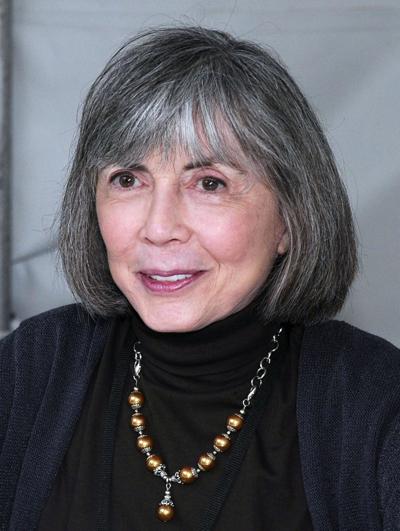
Author Anne Rice's archives will be housed at Tulane University in her hometown, New Orleans.PROVIDED PHOTO
Anne Rice, the gothic novelist widely known for her bestselling novel "Interview With the Vampire," died late Saturday at the age of 80.
Rice died due to complications from a stroke, her son Christopher Rice announced on her Facebook page and his Twitter page.
"In her final hours, I sat beside her hospital bed in awe of her accomplishments and her courage," Christopher Rice wrote in the statement.
Anne Rice was the author of the 1976 novel "Interview With the Vampire," which was later adapted, with a script by Rice, into the 1994 movie directed by Neil Jordan and starring Tom Cruise and Brad Pitt. It's also set to be adapted again in an upcoming TV series on AMC and AMC+ set to premiere next year.
Archive of fantasy writer, New Orleans native Anne Rice to be permanently housed at Tulane
"Interview With the Vampire," in which reporter Daniel Molloy interviews Louis de Pointe du Lac, was Rice's first novel but over the next five decades, she would write more than 30 books and sell more than 150 million copies worldwide. Thirteen of them were part of the "Vampire Chronicles" begun with her 1976 debut.
Born Howard Allen Frances O'Brien in 1941, she was raised in New Orleans, where many of her novels were set. Her father worked for the postal service but made sculptures and wrote fiction on the side. Her older sister, Alice Borchardt, also wrote fantasy and horror fiction. Rice's mother died when Rice was 15.
Raised in an Irish Catholic family, Rice wrote about her fluctuating spiritual journey, including the 2008 memoir "Called Out of Darkness: A Spiritual Confession." But in 2010, she announced that she was no longer Christian, saying "I refuse to be anti-gay. I refuse to be anti-feminist. I refuse to be anti-artificial birth control."
"I believed for a long time that the differences, the quarrels among Christians didn't matter a lot for the individual, that you live your life and stay out of it. But then I began to realize that it wasn't an easy thing to do," Rice told The Associated Press then. "I came to the conclusion that if I didn't make this declaration, I was going to lose my mind."
Rice was expected to be interred during a private ceremony at a family mausoleum in New Orleans on an undisclosed date, according to the statement. A public celebration of life was to take place next year.
THE UNDYING APPEAL OF ANNE RICE
RANDY POTTS
NIGHT CREATURES
12.14.2021
There was a summer in 2009 when a brand new boyfriend found a brand new habit smoking meth and I, to deal with something you can’t really deal with, buried my head in Anne Rice’s vampire books. It was hot that summer in Dallas and his place was small and stuffy; I’d lie on his bed naked, propped up on my elbows reading, fully engrossed in Rice’s novels until he’d eventually come back, always sweating too. Sweating but not from the heat or, at least, not just from that; he’d lean down and kiss me, grinning, with a mouth that looked like devils pouring out: lips flared; teeth, somehow, sharper; a grin meant to prove to me everything was normal.
I suppose there was, in truth, only one summer in 2009 but it felt like so many different summers that year. I was convinced for a time that my boyfriend would die, an addict, maybe in an alley somewhere, maybe with a tourniquet, tied up, a sleeve torn off? Fantasy. Vampire fantasy, specifically — The Vampire Lestat, then Interview With A Vampire, The Vampire Armand, Memnoch the Devil — weekly trips to the nearest Barnes and Noble to get my fix. Vampires are addicted, too, but in Anne Rice’s vampire world they’re not just addicted to blood. Power, knowledge, understanding — maybe even love — and youth, and moonlight, and shadows, and the smell of flowers rotting in New Orleans spilling out into the streets like blood.
Even if at one point Rice does pull a C.S. Lewis and try to quasi-scientifically explain the power of the blood — “there is power, power, wonder working power in the precious blood of the lamb”— Rice’s books are not sci-fi, they are fantasy. The easiest read of them is that Anne Rice’s vampire chronicles are just another Boomer trying to deal with aging. Trying to find a certain power in the chill settling on suddenly brittle, bloodless, always cold hands — vampires warming their hands on hot drinks is a big thing in those books — but, of course, it’s not that simple. I remember my boyfriend warming his hands on me, too, in the air conditioning, while he sweated. Blood pressure. Up, down. Up.
Lestat is everybody’s favorite vampire among Anne Rice adepts and for good reason; the best pages Rice ever wrote include the opening of Lestat’s story in The Vampire Lestat when a wiry, muscled, fantastically-blonde 20-year-old brat born to a house of nobles in decline, astride a horse in the wintry French wilds, battles wolves with two rusted guns, a mace, and two soon-to-be-dead dogs. And yet, my favorite character, by far, is Marius — bookish, Roman, dutiful Marius.
I loved Lestat the same way I loved my boyfriend: desperately. Stupidly. Worshipfully. Lestat was glinting metal and anger and a raw, quick bleed; you could dance with him but it wouldn’t last. In the end it was every man for himself: it was blood in his eyes and on his teeth and that one time when I literally carried him home from the bar and he collapsed on the floor next to the bed and was suddenly somehow too heavy to lift. I left him there all night and, in the morning, teeth bared, he asked me why I didn’t fuck him. Like that. Prone, on the floor, that night, ass up in the air. Drugs make you want funny things. Funny, scary, dark things.
Marius and Lestat are two sides of the same coin; the same character, really, a father/son duo at times, united by their worship of Those Who Must Be Kept. Lestat’s search for Marius across the ravages of time — etching words in stone in the empty forgotten wheat and farro fields of antiquity — is quite unlike anything I’ve ever read. It’s a search for Jesus, a will to know: why was Lestat, and all other vampires, forsaken? Eli Eli Lama Sabachthani — my god, why hast thou forsaken me — was the cry they heard from Jesus on the cross and it was Lestat’s cry, too.
And mine, that summer, already disowned by family and church and suddenly watching my boyfriend’s smile become sharper the way vampires do.
Eli eli; lama sabachthani.
What Rice’s vampire books are about, maybe, is people being against their will taken from their place within the human condition and thrust into: the void. Into a new body, a new being, one that only has a parasitic relationship with the past; many Christians and gays can relate. Gays, converts to a new faith, meth smokers — they’ve all been born again. All of us have, in one way or another, and that rebirth, even when it’s something we chose —can you choose alienation? — that rebirth is never easy. Rice’s vampire novels have all the sex and drama and beauty and queer romance you could want but they mostly have a champion (me, you) and a reality — being alone, cut off from your past, the rest of your life having to settle for savoring things that will always feel unfamiliar and often, especially for certain vampires, not just deadly but plain wrong.
How the fuck do you deal with that? As a born again anything you gain new powers but you are also saddled with strict, unbending restrictions; in Rice’s world many vampires, eventually, choose to go into the fire to escape the thrust-upon-them terribly-unfair beautifully-powerful condition of: being reborn. Being a vampire. Being both hunter and prey, sleeping only in fortresses or hidden redoubts beneath the earth. Coming out in the evening when the stars twinkle and the gay bars boom and the lighters’ soft firelight flickers on reflective black leather harnesses. Smoke, and mirrors, and cold bloodless hands wrapped around a mug of hot steaming… something.
I refused to let my boyfriend go until I had to let him go; he survived, and I did too; Rice’s books, with me til the day we parted ways. I learned, years later, that most people don’t actually die from meth; even so most people are, if they smoke it long enough, born again. It’s a hard life, that new life, just a baby all over again, defenseless, unable to work, unable to pay the bills, unable to even, eventually, kiss your boyfriend. Nothing but hot, pulsing blood on the mind, no longer the warm and tender body, the beloved reduced to the taste of salt and iron and your victim, wincing, swooning, the life rushing out— that vampire life. Sexy, cool, empty — and filled with fire.
Randy Potts is a public school teacher in Washington, D.C.
The world lost a literary giant this past weekend. Anne Rice, author of nearly 40 novels, including the transformative Vampire Chronicles series, passed away at age 80. Many, including myself, have elaborated upon how much Rice’s novels transformed vampire fiction. And gothic fiction overall. But personally, Anne Rice changed my life. Particularly as a queer person who barely saw himself represented in the kinds of fantastical fictional landscapes that I loved. I know I was hardly alone in this regard.

Rice’s first three vampire novels came out between 1976 and 1988. But it was in the early ‘90s that the books, now packaged as a trilogy, really took off with readers. (Similar to how the ‘50s published The Lord of the Rings became a ’60 counterculture phenomenon). Rice’s The Vampires Chronicles and Lives of the Mayfair Witches books drew queer Gen X readers like me en masse into her hyper-sensualized world. But really, anyone who felt like they didn’t belong in a world that celebrated the ordinary and mundane over the exotic and transgressive found kinship with Rice’s beautiful monsters too.
I first heard of Anne Rice’s world in hushed tones. I was perhaps eight years old—this was the early ‘80s. A paperback novel my aunt and older brother both read, Interview with the Vampire, captivated them. I was curious as to what they were talking about all the time, so they tried to explain the book to me in kid terms. They explained to me that it was about “a family of Draculas.” One a little girl, who lived forever and could never grow up. The novel had an image of the three leads on the back. And it was a hilariously bad photo. One that didn’t resemble their descriptions in the book at all. But I was fascinated with this grown-up book I couldn’t read. The memory of that novel’s cover imagery stuck with me.

Fast forward several years. By 1989, that lone vampire book had become a trilogy. The Vampire Chronicles, which comprised Interview, The Vampire Lestat, and the Queen of the Damned. Now a teenager, I was old enough to read and truly appreciate these books, and I utterly devoured them. I loved the tale of the vampiric family of the first novel—particularly the tragedy of the undead child Claudia. Anne Rice created a lush and sensuous world I had never experienced, and I finished that first book only wanting more.

But the two immediate follow-up novels expanded upon the universe and its history in ways that rendered that first novel almost quaint. The way Rice explored vampiric history, going back to the days of ancient Rome and ancient Egypt, enthralled me. She had taken this vampire legend exploited in pop culture for years, and created an entirely new mythology for it. Other vampire fiction has made their own vampire origin stories since then, but I’ve yet to see one that matches anything that Rice invented.
But the real way Rice’s books changed my life was the fact that my discovering them coincided with my own coming to terms with being gay. The late ‘80s and early ‘90s were not an era when mainstream genre fiction explored queer themes. Certainly not the kind of fiction that sold millions of copies. Even a 14-year-old me understood that these characters, despite not having sex the way humans do, were explicitly queer. The vampire Lestat loved his progeny Louis romantically, as much as he loved his human lover Nicolas before him. Yes, women also drew him in, like Akasha, a vampire queen. But his principal relationships were with other men. In fact, the family of Lestat, Louis, and their daughter Claudia were the first same-sex parents I ever encountered in any media.

And with that queer subtext explicit, it shaped how I viewed my sexuality at a vulnerable age. Interview with the Vampire in particular showed the main character of Louis as someone who hated what he was, and despised all of his own innate desires. No matter how much pleasure and companionship it gave him over the centuries. He was the perfect metaphor for the self-loathing homosexual, who begins and ends the narrative as someone who despises his very nature. So, not the role model I wanted.
His vampiric maker, Lestat, was the opposite. Yes, he was essentially the villain of that first book, and took despicably cruel actions at times. But he also believed that their outsider nature gave them a unique perspective on humanity that no one else had. It wasn’t a curse, as Louis saw it, but a gift. One with serious drawbacks, to be sure, what with the “having to kill” thing and all. But a gift nevertheless. Absorbing these books, I felt a lightbulb go off over my head. “What makes you different makes you special, not lesser.” It’s a lesson I internalized, and I have Anne Rice to thank for it.

I could have chosen to hate myself for what I was by nature, much like Louis did. A great deal of LGBTQ folks in my generation absolutely struggled with this. Or, I could relish in my otherness. I chose to view my circumstances as Lestat did his. In The Vampire Lestat, he said “I am very good at being what I am.” Well then, I would be too. As I met more and more Rice fans, I noticed how many of the most devoted were queer like me. Or, at the very least, didn’t fit into society the way everyone else did. Her Sleeping Beauty series of erotica put BDSM literature in the local chain bookstore. She did so decades before there were 50 shades of anything. And the BDSM community embraced her as well.
But like all things initially loved by queer and outsider audiences, mainstream consumers eventually wanted in on the phenomenon. I’ll always remember the moment when I was browsing in a bookstore circa 1991. I was all of 16 years old. I overheard a customer talking to a clerk, asking her all these questions about a nameless character in a book. And I quickly realized that she was asking about Louis, the narrator of Interview. As an impertinent kid, I butted into the conversation. “Louis clearly struggles with depression,” I said. She replied, “Has EVERYONE read all these books except me?”
For a time, it sure felt like everyone had.

By the time Rice’s fourth Vampire Chronicle, The Tale of the Body Thief, came out in 1992, Rice was like a nerdy rock star to her most devoted fans. I recall a book signing in a Barnes & Noble at a mall. My teenage friends and I got there early, hoping to be among the first to meet our literary idol. We didn’t account for the fans who camped out overnight. We were in line for the better part of eight hours. But we didn’t mind. We bonded in line with other fans. We talked about how which characters were our favorites, and how wonderfully queer it all was. And, of course, who we’d like to see play them in an eventual movie. And trust me, Tom Cruise was never on our radar. Even though Rice herself admitted that worked out.
Her characters seemed real to us, because they were real to her. She’d often elaborate about how she’d look at the world around her and wonder what Lestat or others would think of something she’d read or experienced. She used real-world locations in her novels, to the point where the entirety of her Witching Hour book took place in her own Garden District mansion in New Orleans. This trend goes back to the beginning. The house where Louis gives his confession in Interview with the Vampire is a real Victorian house in San Francisco, one which still stands. On the day after Rice passed, I had to go and make a pilgrimage to the place where it all began to pay my respects.

Another thing about Anne Rice that made her special was that she was one of us. And by that I mean she was a huge nerd too. In the ’90s, she had a publicly listed phone number fans could call to hear her talk and answer questions about her novels, or just hear her effusively recommend current films and books. (My phone bill, thanks to all those calls to New Orleans, was a hefty one). In the modern era, her Facebook page mainly featured her talking about all the same media we all love, from Game of Thrones to True Blood to Downton Abbey.

Anne Rice understood fiction had a transformative power, especially fantasy fiction. It’s part of the reason why she was so grateful for her readers. Because she loved fiction in the exact same way we did. She never thought our passion for stories of the fantastic was frivolous or a waste of time. She was honored that people loved her stories the way she loved those of Charles Dickens and others. Looking at it now, in her final years, her returning to her world of vampires, mummies, and pansexual erotica, felt like a beautiful farewell gift to us.
So I want to say now, to Anne Rice, wherever you are: as a boy you helped me see my queerness as a blessing, and I am forever grateful. As an adult professional who interviewed you more than once, you were thoughtful and generous with your time. Your work will live on in me, and millions of your readers who identified with your glamourous outsiders. You once said, “I picture heaven as a vast library, with unlimited volumes to read. And paintings and statues to examine galore. I picture it as a great doorway to learning… rather than one great dull answer to all our questions.” I hope you are wandering the halls of this library now, soaking in all that beautiful knowledge.