Wednesday, December 15, 2021

Dr Angela Needle of Cadent Gas talks about ‘Future heat for everyone and the role of hydrogen’

Sustainable Gas Institute Annual Lecture 2021
Dec 13, 2021

Imperial College London
 

Hydrogen Science Coalition Cuts Through the 'Hydrogen Hype'
(ACTUALLY THEY ARE THE H2 HYPE)
Scientists, academics, and engineers are working to bring an evidence-based viewpoint.

By Lloyd Alter
Published December 14, 2021
Fact checked by Haley Mast
Our hydrogen future: planes, trains, and automobiles.
Scharfsinn86 / Getty Images

Hydrogen plays many important roles in our lives. The biggest use is for fertilizer, but it is also used in petroleum refining, glassmaking, electronics manufacturing, and making methanol. We need a lot of it: production in 2018 was 60 million metric tons. Over 70% of hydrogen is classified as "grey" and made from natural gas, while 27% of it is made from coal and is classified as "brown."1 According to the International Energy Agency, all hydrogen production releases about 830 million metric tons of carbon dioxide (CO2) per year—9.3 kilograms of CO2 for every kilogram of hydrogen.2

Just decarbonizing the hydrogen we need and use now is going to be a huge and expensive undertaking, yet we are being promised that "blue" hydrogen (where the CO2 is captured and stored during production) or "green" hydrogen (made with renewable electricity) can solve all our problems, from home heating to cars to planes. It seems too good to be true, but that is what we read in the media or hear from our politicians.

That's why the Hydrogen Science Coalition is such an interesting and important resource. It describes itself as "a group of independent academics, scientists and engineers who are working to bring an evidence-based viewpoint to the heart of the hydrogen discussion... We use our collective expertise to translate the role that hydrogen can play in the energy transition for politicians, media and investors."

“Any decisions to invest public money in hydrogen need to be backed up with facts. Relying only on vested interests to guide the development of a hydrogen sector risks undermining where the evidence tells us hydrogen should play a role” said Tom Baxter, visiting professor at the University of Strathclyde and an ex-BP engineer, in a press release.

They have written a manifesto that is jargon-free and a big splash of cold water on so much of the hydrogen hype. The most important point is the first one, but there are several notable points.

"Zero emission hydrogen is an opportunity for governments to speed up the energy transition. However the only true zero emission hydrogen is that made from renewable electricity."

No blue hydrogen, please—it is a fig leaf to keep burning fossil fuels. They claim that carbon capture and storage (CCS) is always partial, and "its emissions can be as bad or even worse than simply burning fossil fuels." This will be the hardest pill to swallow: There is so much money behind blue hydrogen these days, even though it barely exists.

"Deploy green hydrogen for hard to decarbonise sectors, starting with where grey hydrogen is used today."

As noted above, we are using a lot of hydrogen now and will need more in the future for industrial processes like making steel. We should be putting our green hydrogen to work here first.

"Hydrogen shouldn't be used to delay deploying electrification alternatives available today, such as in heating and transport."

As the fun tweet shows, making green hydrogen isn't very efficient, compared to using electricity directly: "Heating buildings with boilers using green hydrogen takes about six times more electricity than using electric heat pumps."

"Given how valuable green hydrogen is, blending it into the existing gas grid does not make sense due to its limited impact on emissions savings."

This is what is being proposed by gas utilities in Europe and North America, but it makes no sense; you need so much more of it because of its lower energy content. We are using high-quality energy to get low-temperature results. As engineer Robert Bean says, it is like warming your hands with a blowtorch.

It is a straightforward manifesto that is easy to understand, as are most of the other backup documents such as "Hydrogen for aircraft – number-crunching the solution, or the hoax," which did a more convincing job munching the numbers on hydrogen fuel than I did last year.


Energy Cities

Adrian Hiel of Energy Cities, who developed the original Energy Ladder explaining where hydrogen was useful and where it wasn't, had a look at the coalition's documents and tells Treehugger:

"I am really impressed with what the H2 Science Coalition brings to the hydrogen debate. They don't pretend to have all the answers of where hydrogen will be used but explain really clearly where we should focus our efforts and which sectors (like heating and road transport) where the physics just aren't going to work. I hope politicians are paying attention to these experts rather than the boiler and car salespeople who are trying to protect profit margins at the expense of the energy transition."


The five founders of the Hydrogen Science Coalition—Bernard van Dijk, David Cebon, Jochen Bard, Tom Baxter, and Paul Martin—are all scientists and lecturers volunteering their time. They will have a challenge; look at who they are up against. In Europe, companies like Shell call hydrogen "sunshine in a bottle" and, of course, there is the boiler (gas furnaces for home heating) and car salespeople.


Companies behind H2 Report.

H2 Science Coalition

This is what they are up against. It's the list of companies behind the recent "Road Map to a US Hydrogen Economy" that described hydrogen as "an energy vector that can be transported and stored, and a fuel for the transportation sector, heating of buildings and providing heat and feedstock to industry." There's serious money out there peddling hydrogen.

Much of the hydrogen hype is about what Alex Steffen calls predatory delay: "the blocking or slowing of needed change, in order to make money off unsustainable, unjust systems in the meantime." As I noted earlier, it is not delay from the absence of action, but delay as a plan of action—a way of keeping things the way they are for the people who are benefiting now, at the expense of the next and future generations.

The Hydrogen Science Coalition offers an alternative. It says it will "provide briefings, access to data and work as a credible resource grounded in unbiased evidence." I hope that it is kept very, very busy.

Blue Hydrogen Study Finds It Isn't Climate-Friendly, Igniting Fierce Debate Over Emissions


What's driving France to push hard for hydrogen vehicles?


Hydrogen is considered a great alternative to petrol or diesel. (Bloomberg)

15 Dec 2021
THT Auto Desk

Hydrogen is considered as a pure clean fuel as the only byproduct from a hydrogen powered engine is water.

Not long ago, the debate in the automotive world was about choosing zero-emission mobility over internal combustion engine-powered mobility. Now, with zero-emission vehicles gaining popularity among the customers the debate has shifted dimensions. Now, it is about the form of zero-emission mobility - battery electric vehicles or any other form of green mobility.

(Also Read: Govt will push EV adoption but will not stop registration of ICEs: Nitin Gadkari)

While there are debates about the source of electricity not being carbon neutral and therefore the lithium-ion based battery electric vehicles are not at all completely zero-emission, hydrogen is considered as one of the great alternatives. Hydrogen is stored in a fuel tank in gaseous form and it goes through a process to separate electrons and ions to generate energy. The only byproduct from the hydrogen power plant is water, making it a truly clean mobility solution.

This is why several countries around the world are pushing hard for hydrogen-powered vehicles. European Union has been pushing hard for hydrogen adoption for green mobility solutions. Despite the battery-electric bikes and scooters taking off across Europe as emission regulations are tightening, the EU countries are focusing on hydrogen adoption. France is one country that is keen on hydrogen mobility.

In 2020, as part of the French government's post-pandemic recovery strategy, it announced plans to invest two billion euros into hydrogen sector development over the next two years and a total of seven billion euro by 2030. Not only the scooters of motorbikes, but France is also aiming for hydrogen energy penetration in other segments of the automobile industry as well.

Interestingly, India too is mulling the implementation of hydrogen mobility on large scale. The union minister of road transport and highways, Nitin Gadkari has been advocating for greener mobility solutions including lithium-ion battery-powered vehicles and other alternative fuel solutions as well. Hydrogen one of the key green fuel solutions he has been advocating for.


Why France May Be Pushing Hard For Hydrogen-Powered Scooters

The scooters could be the cherry on top of a hydrogen-powered industrial sea change.


Dec 13, 2021 
By: Janaki Jitchotvisut

As the signs of climate change continue to compound around the world, many have been working out strategies to curb carbon emissions. While electric vehicles have been a steadily rising presence in multiple markets, others have been pushing hard for hydrogen adoption. In particular, France is pushing hard in this direction—so let’s take a look at recent developments.

At current stages of development in 2021, electric vehicles produced by major OEMs are both more practical and more feasible than they’ve ever been. Cost parity, particularly in Europe, is making the choice between EV and combustion vehicles easier for car drivers, as well.

While those vehicle segments are certainly important, they’re hardly the only areas where carbon emissions are an issue. Motorbikes come with their own sets of challenges as regards clean, efficient, affordable forms of power. Likewise, heavy equipment—think construction vehicles, heavy trucks, and trains, as just three examples—isn’t currently an area where electrification is practical. 

That’s one of the areas where the E.U. is pushing for hydrogen adoption. For those unfamiliar with how hydrogen power works in vehicles, it’s currently stored in its gaseous form, and then goes through a process to separate electrons and ions to generate power. The only byproduct from hydrogen power is water, which makes it pretty easy to see why that would be attractive to someone looking for a cleaner form of energy.

There’s a catch, though. While it’s technically possible to generate so-called “green hydrogen,” it’s also currently the most expensive way to do so. In a perfect world, that green process solely using renewable energy (solar and wind power) to electrolyze water (separate the hydrogen and oxygen atoms) and harvest hydrogen would be a great answer.


However, there is more than one way to make hydrogen. Currently, all the other methods result in varying degrees of carbon emissions being created. They’re also all currently less expensive options to choose. That said, if your primary goal is eliminating carbon emissions, they simply don’t make the grade.

More Hydrogen:
 
French President Unveils Ambitious Green Transport Goals For 2030

Now, back to the divergent path of alternatively-fueled motorbikes in France. While electric motorbikes have been taking off across Europe as emissions regulations have gotten tighter, France has also been pushing forward with hydrogen-powered hybrids like the Mob-Ion TGT. In fact, in 2020, as part of the French government’s post-pandemic recovery, it announced plans to invest €2 billion (about $2.259 billion) into hydrogen sector development in the next two years alone—and a total of €7 billion (about $7.9 billion) by 2030.

Clearly, that isn’t only about scooters and motorbikes roaming the French countryside. Instead, France’s plans address a broader potential range for emissions reduction than just motor vehicles of any kind. Plans to explore hydrogen power for various industrial applications, like steel and concrete manufacturing, are also in the cards. Presumably, that’s why France is pushing hydrogen as a potential power source for two-wheelers as well—because it’s yet another area where its hydrogen push in bigger industrial sectors can potentially make an impact.

As with the EV debate regarding sticky topics like harmful extractive processes to mine the precious metals needed (not to mention effective and efficient recycling and reclamation at a battery’s and/or vehicle’s end-of-life), hydrogen power’s potential carbon neutrality comes with its own set of caveats. If France—and anyone else seeking to use hydrogen power on a large scale—can commit to green hydrogen production, it’ll be as big a boon to carbon emissions goals as intended. That’s an extremely big “if,” though—and it’s not at all clear whether that’s a challenge that can or will be met.


Sources: French GovernmentFrench Ministry for Ecological TransitionToulouse School of EconomicsFuel Cells and Hydrogen Joint Undertaking: Hydrogen Roadmap EuropeFinancial Times


Hydrogen fuel cell vehicles – how close is commercialization?
 December 13, 2021


As hydrogen continues to gain traction in the vehicle sector, ATTI looks at recent investments, strategies and partnership announcements

Numerous hydrogen fuel cell tie-ups were announced in 2021, aimed at commercializing the technology once and for all. Ekpo Fuel Cell Technologies managing director, Julien Etienne, believes that the dynamics of the market are there to allow for quick growth. ElringKlinger and Plastic Omnium formed the joint-venture company earlier this year. It brings together ElringKlinger’s expertise in fuel cell tech with Plastic Omnium’s investment capabilities in the hydrogen vehicle market.

Cellcentric managing director, Christian Mohrdieck, says there are two hurdles that need to be overcome on the journey to commercialization, namely vehicle cost and volume. He notes that it’s a chicken and egg scenario: a volume increase will only be possible as the cost to produce the vehicles comes down, and growth in volumes will help to reduce costs.

“There are two areas where we see high costs. One is the technology itself, but this [issue]has mainly been solved. Then there is the supplier market, but we are seeing strong competition among suppliers, which is good for cost price reduction,” he says.


Julien Etienne, MD, Ekpo Fuel Cell Technologies

Small successes
Hydrogen fuel cells have their advantages over other propulsion technologies, experts note. Hydrogen can be rapidly refueled. In low temperatures, fuel cells have a minimal loss of range, making the technology ideal for large, long-range vehicles or those operated in cold environments.

Etienne notes the rapid maturation in fuel cells and hydrogen-powered vehicles in the last two to three years from an OEM and supplier standpoint. This is partly thanks to the successful execution of real-world applications, which are producing imperative data to hone the technology, he says.

“Low-volume production of fuel cell vehicles by the likes of Toyota, Hyundai, Honda and Daimler has provided field experience to work on component maturity.”

Meanwhile, Cellcentric has had 50 hydrogen-powered buses running for a number of years in cities across Europe, and Mohrdieck envisages heavy-duty trucks being among the first commercial applications.


Christian Mohrdieck, MD, Cellcentric

Bundle of joy
Packaging remains one of the biggest development challenges. Cellcentric’s solutions are designed to fit into the same space as a combustion engine in the engine compartment to ensure they are compatible with any given vehicle application.

As Etienne at Ekpo Fuel Cell Technologies highlights, although a hydrogen fuel cell simply slots into the powertrain, fuel cell analysis differs from ICE testing in some respects. “We do not have an accelerated test like we have for a conventional internal combustion engine, for instance. There is a relative lack of maturity in the technology, or experience, that prevents us from doing this [accelerated testing].”

When it comes to virtual evaluation, it is simply a matter of time before enough good-quality data is gathered to enable the recreation of the fuel stack and powertrain in the computer.

Hydrogen fuel cell tie-ups 2021
General Motors signed an agreement to provide its fuel cell technology to truck maker Navistar. Navistar is in turn supplying hydrogen production firm OneH2 to provide trucking specialist J.B. Hunt Transport Services with a zero-emissions long-haul mobility system. Navistar plans to make its first production model fuel cell EV commercially available in 2024.
Groupe Renault and fuel cell system specialist Plug Power launched a 50/50 joint venture to manufacture hydrogen fuel cell systems for light commercial vehicles. The new company, based in France, will also produce technology for fuel cell passenger car applications.
Strategic partnerships between Stellantis, automotive supplier Faurecia and fuel cell specialist Symbio, which is Faurecia’s JV with Michelin, will focus on the development of the fuel cell stack and the hydrogen storage system for Stellantis’s planned line of light commercial vehicles.
AVL Powertrain and Ford began working on the design and development of a driveable demonstrator fuel cell EV. AVL is leading research into the integration of the fuel cell and hydrogen systems into the vehicle. The goal of the project is to accelerate UK-based FCEV expertise and know-how to support the automotive industry’s drive toward zero-emission propulsion.
Canadian companies Ballard Power Systems and Linamar Corporation announced that they are jointly developing fuel cell powertrains and components for Class 1 and 2 vehicles, including buses and commercial trucks, weighing up to five tons. The powertrains will initially be marketed in North America and Europe.


How to manage energy crises in an age of climate disruption

Capital markets seem finally to be internalising the message that high-carbon investments should carry a significant risk premium


AFP

By Jörg Haas and Lili Fuhr
Published: Mon 13 Dec 2021

A recent report by Goldman Sachs reached a surprising conclusion: Over the past eight years, financial markets have been increasing the cost of capital for big, long-term, high-carbon investments in sectors such as offshore oil and liquefied natural gas. But when it comes to renewable projects, the “hurdle rate” – the minimum rate of return required by investors – has been declining. The difference is significant, translating into an implied carbon price of about $80 per tonne of carbon dioxide for new oil developments and $40 per ton of CO2 for LNG projects.

Capital markets seem finally to be internalising the message that high-carbon investments should carry a significant risk premium. This insight has not emerged spontaneously. It is the result of many years of in-depth research, targeted analyses by groups like Carbon Tracker and the Institute for Energy Economics and Financial Analysis, pressure from investor alliances, hard-hitting NGO campaigns, and divestment decisions by foundations, churches, universities, and pension funds.

The shift in capital-market sentiment has been reinforced by political action. At last month’s United Nations Climate Change Conference (COP26) in Glasgow, nearly 40 countries and institutions pledged to end public finance for oil, gas, and coal projects overseas. In addition, Denmark and Costa Rica spearheaded a group of 12 countries and regions that launched the Beyond Oil and Gas Alliance.

These efforts, though still partial in their coverage and insufficient, are to be welcomed as a sign that financial flows are now starting to align with the goals of the 2015 Paris climate agreement, as mandated by article 2.1(c) of that treaty. But the implicit carbon price demanded by capital markets so far covers only the supply side: the oil, gas, and coal fields, refineries, and transport infrastructure that feed fossil fuels into the global economy.

Unfortunately, similar progress on the demand side for coal, oil, and gas has been lacking. Despite much talk of green recoveries from the COVID-19 shock, huge government stimulus programs have largely failed to discriminate between green and dirty economic activity, and have thus stabilized the global economy on the old growth path.

Moreover, these interventions have created significant consumer demand as the economy bounces back. Movement profiles point to renewed car use and air travel, while energy-intensive industries like cement, steel, plastics, and chemicals are again fueling demand for electricity, gas, and coal. Significantly, China’s economic stimulus has focused far too much on the highly carbon-intensive building sector, instead of undertaking the long overdue reorientation of the country’s growth model in line with its climate goals.

The current surge in fossil-fuel energy prices reflects a multitude of highly idiosyncratic factors. But today’s situation may well presage a future in which a misalignment of supply- and demand-side climate policies generates significant price swings.

Hydrocarbon lobbyists have been quick to exploit the recent uptick in fossil-fuel energy prices to advocate for renewed government financing and subsidies, as well as favourable regulatory treatment for their clients’ investments. In essence, they are calling for the public sector to step in to help fossil-fuel producers at a time when private capital is quite rightly shying away from climate risk and slowly withdrawing from the sector.

Efforts to ease the energy crunch can and must be aligned with solving the climate crisis. Each well-insulated house, wind park, and solar panel reduces the strain on gas supplies. Making cities attractive for cycling and walking, and upgrading public transport, is not only good for public health and safety; it is also an investment in weaning ourselves off the oil that is straining our purses and killing our planet.

Similarly, reducing demand for single-use plastic packaging will further decrease demand for the fossil-fuel feedstocks of petrochemicals. And innovations like flying taxis, supersonic air travel, and space travel that benefit only the super-rich and create new, wasteful energy demand could easily be restricted or even banned before they are widely adopted.

Instead of loosening supply-side carbon policies, as some short-sighted voices advocate, we must – even in periods of high energy prices – keep our eye on the main goal. That means focusing on the inevitable, well-managed decline of coal, oil, and gas and their substitution by sustainable clean energy. In the short term, the best remedies for high energy prices are demand-reducing measures, like the lower highway speed limits that some Western governments instituted following the 1970s oil-price shock.

In short, a just transition away from fossil fuels requires us to “cut with both arms of the scissors”. As the UN Environment Programme emphasised in two pre-COP26 reports, that means simultaneously closing the huge gaps in climate action on both the demand and the supply side.

Despite the much-needed progress towards pricing high-carbon investments appropriately, these gaps are still far too big. Only by closing them quickly and in parallel can we stave off catastrophic climate disruption, and avert the economic disaster that could result from massive energy-price swings and extensive stranded fossil-fuel assets.


Jörg Haas is Head of International Politics at the Heinrich Böll Foundation. 

Lili Fuhr, Head of the International Environmental Policy Division of the Heinrich Böll Foundation, is a steering committee member for the Fossil Fuel Non-Proliferation Treaty Initiative and a founding board member of the Climate Justice Fund.

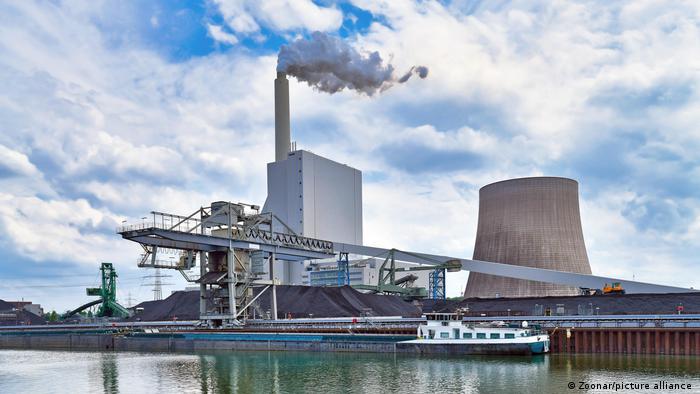
Coal and fossil fuel share of German electricity rises in 3Q

Conventional sources of energy accounted for more than half the total electricity generated in the third quarter of 2021. The share of electricity sourced from coal, to be phased out by 2038, rose sharply.


Electricity generation from conventional energy sources increased by 2.7% compared to the third quarter of 2020

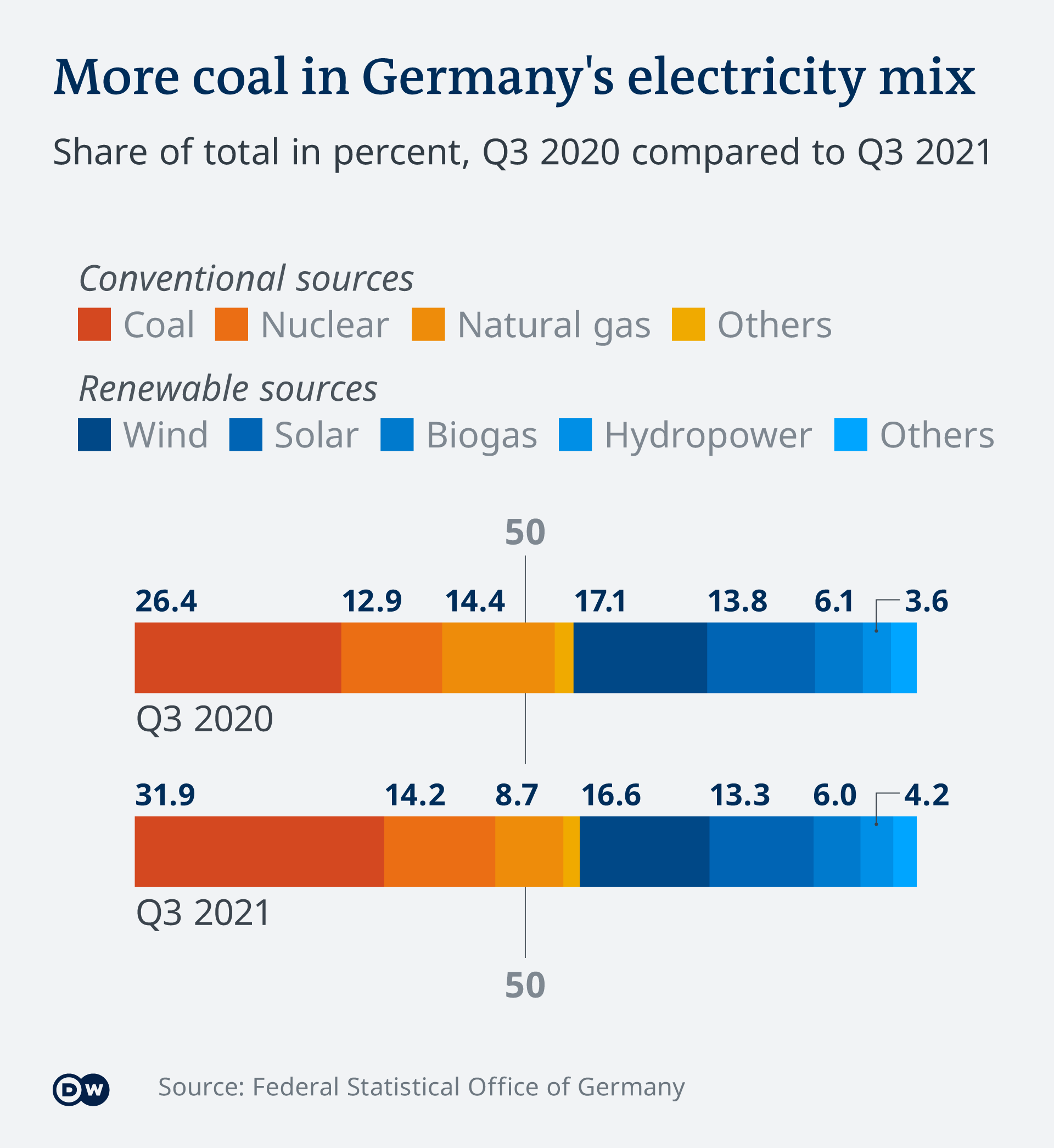
Conventional sources of energy accounted for more than half of Germany's electricity generated in the third quarter of 2021, according to data from the Federal Statistical Office.

The data from the German government's statistics agency, released on Tuesday, showed that conventional sources accounted for 56.9% of the total electricity generated between the months of July and September.

Coal accounted for 31.9% of that electricity mix in the third quarter of the year. This marked a sharp year-on-year and quarter-to-quarter increase: Coal accounted for 26.4% during the same period in 2020, and accounted for 27.1% of the electricity generated in the first half of 2021.


Germany's new government on December 13 approved a plan to tackle climate change, which includes a goal of generating 80% of its electricity from renewable sources by 2030. Assuming comparable overall electricity usage going forward, that will require renewable electricity generation to almost double in less than a decade.

Germany also plans to stop all coal mining by 2038; many of the country's nuclear plants have already shut down, with another flurry going offline at the end of this year and the last ones scheduled to shut down by the end of 2022.

Share of natural gas, renewable sources of energy declines

The share of natural gas was only 8.7% during the third quarter of 2021, which is over a third less electricity generated from natural gas than during the same period in 2020. This is largely because the price of natural gas increased in the second half of 2021, Destatis said.

The share of natural gas also represented the lowest quarterly value since the third quarter of 2018.

The share of renewable energy sources also fell slightly in the third quarter of 2021, at 0.8% less than in the third quarter of 2020.

On the other hand, the amount of electricity imported into Germany increased by 13.6% in the third quarter of this year, compared to the same period of 2020.

A large portion of electricity imported was from France, Germany's European neighbor, which in contrast continues to embrace nuclear power.

Germany on December 13 also approved an additional € 60 billion ($ 68 billion) in public spending to combat climate change, making use of sums that had been set aside to tackle the COVID-19 pandemic but have not been used for the cause.

rm/msh (Reuters, AP)
Shell acquires US solar and energy storage firm

Savion has currently more than 18GW of solar power and battery storage in the pipeline

Dimitris Mavrokefalidis
Wednesday 15 December 2021


Shutterstock

Royal Dutch Shell has announced the acquisition of the US developer of solar and energy storage projects Savion LLC from Macquarie’s Green Investment Group.

The move aims to boost the energy giant’s solar portfolio as Savion currently holds a capacity of more than 18GW of solar power and battery storage under development.

Wael Sawan, Integrated Gas and Renewables and Energy Solutions Director at Shell, said: “Savion’s significant asset pipeline, highly experienced team and proven success as a renewable energy project developer make it a compelling fit for Shell’s growing integrated power business.

“As one of the fastest-growing, lowest-cost renewable energy sources, solar power is a critical element of our renewables portfolio as we accelerate our drive to net zero.”

Last week, Shell announced its decision to withdraw from the controversial proposed Cambo oil field.

Earlier, unveiled plans to move its headquarters to the UK.
Amazon’s plastic waste soars by a third during pandemic, Oceana report finds

Online retailer disputes study saying it produced 270,000 tonnes of packaging last year, with 10,000 tonnes likely to end up in seas


Oceana estimates up to 10,700 tonnes of Amazon packaging, including air pillows, bubble wrap and plastic-lined envelopes, could to end up in the sea. Photograph: Amit Dave/Reuters

Seascape: the state of our oceans is supported by


Karen McVeigh
@karenmcveigh1
Wed 15 Dec 2021 06.00 GMT

Amazon’s plastic packaging waste soared by almost a third, to 270,000 tonnes, during the pandemic last year, according to a report from marine conservation group Oceana.

Oceana estimates up to 10,700 tonnes of this plastic, including air pillows, bubble wrap and plastic-lined paper envelopes, equivalent to a delivery van’s worth every 67 minutes, is likely to end up in the sea.

Amazon, the western world’s largest retailer, rejected Oceana’s figures and said it had overestimated the plastic waste by 300%. It also questioned the model used to estimate the percentage likely to enter the sea. It did not provide alternative figures.

The retailer saw a boom in sales of 38%, to $386bn (£290bn) in 2020, when much of the world was in lockdown and online sales increased.

Oceana’s report challenges the company’s recycling pledges, using interviews with local municipal waste officials, stores linked to by Amazon’s Second Chance recycling website and surveys of Amazon Prime customers. It concluded that the company’s recycling efforts “will not significantly reduce its enormous (and growing) plastic footprint”.

Matt Littlejohn, Oceana’s senior vice-president, said: “We are using the best data available to us. If Amazon was transparent, we would gladly use their data. Yes, they are using more non-plastic packaging, but they are also selling a ton more product.

“We understand people need Amazon. And so we’re hoping Amazon can fix this problem and become a leader in reducing plastic, which is really important for the oceans.”

A staff member packs items in an Amazon warehouse in Manchester, UK, 2019. The retailer saw a boom in global sales of 38% in 2020. Photograph: Anthony Devlin/Getty Images

Plastic film used by Amazon in its packaging has little or no value to the recycling market and is not generally accepted by municipal recycling schemes in the US, UK and Canada, the report said.

Oceana found that nearly 75% of Amazon Prime customers surveyed in 25 cities in the UK and US sent the plastic, knowingly or not, to landfill. Almost 40% put it in recycling bins, where the presence of plastic film would result in it going to the dump, and 35% disposed of the plastic in the bin. A little under 20% of 1,400 customers said they reused the plastic, while 5% said they placed the packaging in drop-off bins in stores on Amazon’s customer-driven recycling programme on the company’s Second Chance website.

Further, representatives at more than 40% of the stores that Amazon suggests as alternative recycling drop-offs for plastic film told secret shoppers that Amazon’s plastic film was not accepted.

Only 9% of all plastic waste has ever been recycled. Almost all goes to landfill, is burned, or enters and pollutes the environment, including waterways and oceans.

Rachel Johnson Greer, a former programme manager at Amazon, who worked for the company for eight years, said the company would only take action on plastics if governments or a majority of customers demanded it.

In May, more than a third of Amazon shareholders voted for a resolution calling on it to quantify its single-use plastic and provide recommendations on how to reduce its plastic footprint by the end of the year.

Oceana has highlighted the action taken by the retailer in India, where it has eliminated single-use plastic packaging by using paper alternatives, after India’s prime minister, Narendra Modi, and its central government pledged to ban single-use plastics by 2022. The ban was delayed, but a tribunal ruled that packaging was the responsibility of producers, importers and brand owners.

Amazon also announced it would move away from single-use plastic packaging in Germany.

“If the company can do this in India and Germany, they can move away from single-use plastic packaging on a worldwide basis,” Littlejohn said.

An Amazon spokesperson said: “Amazon shares Oceana’s ambition to protect the world’s oceans and respects their work but, for a second year, their calculations are seriously flawed. They have overestimated our plastics usage by more than 300%, and use outdated assumptions about the sources of plastic waste entering our oceans.”

“Amazon is making rapid progress in reducing or removing single-use plastics from packaging materials in the UK and around the world.”

Among its initiatives to reduce plastic waste, Amazon is looking to double fully recyclable cushioned plastic in North America, replace single-use pillows in Australia with fully recyclable paper ones, and expand its packaging-free initiative to 100 cities across India, it said.

 Odd alliance of investors and environmentalists keep oil stocks afloat

Oil stocks are booming right now, which isn’t startling amid the economic recovery. What is more surprising is that the oil-stock boom might plausibly continue for years beyond the pandemic recovery phase.

“I think we’re in a multi-year bull market for oil,” argues Eric Nuttall, a prominent energy investment manager and partner at Ninepoint Partners LP.

You might think efforts to decarbonize the world economy would make oil a sunset industry with poor long-term prospects. The transition to renewable energy will likely take decades, however.

That leaves plenty of time for oil-stock investments to pay off handsomely, says Nuttall, lead portfolio manager for the Ninepoint Energy Fund, Canada’s largest oil-and-gas-sector mutual fund by asset size.

Constrained supply

While the world continues to use oil, its supply is constrained in surprising ways. Due to an unusual combination of environmentalist and shareholder pressures, oil companies are showing uncharacteristic restraint when investing in production, despite high prices.

“I see an environment where sufficient investment is no longer permitted, whether by environmental pressures or pressures from shareholders who want companies to prioritize returns over spending,” Nuttall says.

While no one can forecast what’s going to happen with much certainty, if supply is constrained while demand stays strong for an extended period, then prices should stay relatively high while those conditions prevail. If that’s the case, oil company profits and stock prices will likely do well.

Even though prices for many Canadian oil stocks have already doubled this year, valuations are still “ludicrously inexpensive,” says Nuttall. In many cases, current valuations are a fraction of typical historical levels. By one measure of valuation — enterprise value to operating cash flow — Canadian oil stocks are currently trading at a ratio of 2.0 to 3.5 times, versus typical historical figures of 7.0 to 9.0 times, Nuttall says.

Oil prices collapsed early in the pandemic, then mounted a gradual but strong recovery. U.S. benchmark prices reached more than $80 (all figures U.S.) per barrel in late October, the highest level since 2014. They’ve since settled back, partly from reaction to news of the Omicron variant, but oil prices were hovering just under $70 per barrel for most of last week, a relatively high level sufficient for healthy profits.

As the oil price recovery took hold earlier this year, companies first focused on paying down debt and repairing the damage to their finances. With finances now in better shape, Canadian oil companies are switching their focus more to buying back stock and big dividend increases. Among prominent examples, Suncor Energy Inc. recently doubled its dividend, fully restoring a cut made early in the pandemic. “Investors are just now getting that first taste of those juicy dividends,” says Nuttall.

Surprising allies

Supporting oil industry prospects is an unusual alliance of value-oriented investors and environmentalists, which for different reasons are both applying pressure to constrain investment in oil production. Since oil is a depleting resource, oil companies need to keep investing massive amounts in exploration and development to just maintain existing production levels, let alone add to it.

Environmentalists are out to reduce carbon emissions from oil any way they can, whether by constraining supply or impacting demand, but transitioning from oil to low-emissions energy sources will be gradual and problematic. It will take a while before everyone is driving electrical vehicles, which will require not only a massive transformation of the vehicle industry, but also decarbonizing and expanding the world’s electrical generating capacity, now heavily dependent on carbon-intensive coal and natural gas.

So the world will still need oil for quite a few years. The International Energy Agency’s World Energy Outlook released in October projects that even if all climate pledges by every country in the world were met in full and on time, oil production in 2030 would still be modestly higher than the pre-pandemic peak of 2019. It’s only in the 2030s that the IEA sees oil production declining significantly below 2019 levels based even on those aggressive assumptions.

A less aggressive IEA projection based on policies that governments have actually put in place would result in significantly higher oil production in 2030 compared to 2019, followed by a subsequent levelling off.

Yet the increasing array of environmental regulations, emissions caps, and carbon taxes combine to discourage oil companies from investing in production. Environmentalists are also pressuring banks and institutional investors to shift financing activity away from the industry and in favour of renewable energy. That makes it harder for oil companies to find financing at reasonable cost.

At the same time, value-oriented investors have increased sway over oil company management.High prices in the last oil cycle caused massive investment in additional production, notably in U.S. shale. But the resulting surge in world production swamped demand, crashing prices in 2014, followed by almost seven mostly lean years. So investors, having been burned, now pressure management to curtail investments in production, despite the high prices.

Oil companies around the world including the big U.S. shale producers and “supermajors” like BP PLC and Royal Dutch Shell PLC have mostly embraced this new discipline. BP is going so far as to sell off a major portion of its fossil-fuel assets to finance a shift into renewable energy. In many cases, companies aren’t investing enough to sustain production at current levels. Royal Dutch Shell reportedly expects to decrease oil production by one to two per cent per year until 2030. That plan remains unaffected by the recent oil price surge. “From my perspective, (the price rise) means nothing,” a Shell executive told the Economist.

Where company management tries to buck the trend, it faces intense investor pressure. This year a hedge fund called Engine No. 1 led a revolt among ExxonMobil Corp. investors opposing the company’s expansionary policies. With the support of big institutional investors like BlackRock and Vanguard, they succeeded in replacing three directors on the board, undercutting the likelihood of Exxon Mobil proceeding with big new projects.

The coalition of oil-producing countries known as “OPEC Plus” (members of OPEC plus allies like Russia) represent a potential wild card for world supply, but their recent disciplined behaviour in support of higher prices suggests they are unlikely to swamp the market with additional oil for the foreseeable future. They cut oil supply drastically in the early stages of the pandemic to help halt the plunge in prices. Since then, they have gradually added back oil supply in a disciplined manner that still allowed for price rises.

New emissions commitments

The Canadian oil industry’s recent climate-change commitments will require it to spend large amounts of money on emissions cuts instead of returning the money to shareholders.

Canadian oilsands, a large part of national production, have been shunned by environment-focused investors even more than regular oil companies because of particularly high carbon emissions. However, in October, Canada’s five largest oilsands producers pledged to reach net-zero emissions from oil production by 2050, with interim milestones in 2030 and 2040. Plans include a carbon capture network that would gather sequestered carbon dioxide from 20 oilsands facilities and ship it by carbon pipeline to a storage facility at Cold Lake Alberta.

For environmentalists, this doesn’t come close to resolving the Canadian oil industry’s environmental issues, but it is a big step in the right direction. “It’s very positive that the companies have all made net-zero commitments,” says Chris Severson-Baker, Alberta regional director for the Pembina Institute, a clean energy think tank.

Still, the lengthy time to achieve net zero means it “doesn’t mean a lot in the short-term,” says Chris Severson-Baker, a director at the Pembina Institute, a clean-energy think tank. And looking at the plans in detail category-by-category, “it’s overly optimistic.” What’s more, oilsands production still generates higher emissions than conventional oil, while conventional oil producers are also working to reduce emissions starting from a lower emissions base, he says. “I don’t see much relief for the oilsands sector from external pressure.”

So while the world will likely need oil for a long time, it’s not clear Canadian producers will get to keep their current share of world production in the face of environmental pressure. To achieve that, the Canadian industry will likely need to keep ramping up efforts to clean up emissions — and if companies can continue to earn healthy profits, that just might provide them with the means to do that while also keeping shareholders satisfied with buybacks and dividends.

(Oil stocks are risky investments. Do your own due diligence, and/or consult a financial adviser, before investing in them.)

David Aston, a freelance contributing columnist for the Star, is a personal finance and investment journalist. He has a Chartered Financial Analyst designation and is a Chartered Professional Accountant. Reach him via email: davidastonstar@gmail.com

AFRICA

Alarm bells sound on future of oil industry --Funding sources fast drying up

Date: Dec - 14 - 2021 , 08:06
BY: Emmanuel Bruce

The decision by global financiers to move away from financing dirty hydrocarbons presents a challenge for oil and gas producing countries like Ghana, Manager for Gas Business at Ghana National Petroleum Corporation (GNPC), Mr Hamis Ussif, has said.

He said all over the world, investors continued to move away from financing oil and gas production and every now and then there were reports on a group of financiers or one major financier signalling a stop to financing hydrocarbons.

Speaking at the 7th edition of the Ghana Gas Forum, he said “at the last count, we had about 1500 global managers with trillions of dollars, saying they will not fund dirty fuel.”

He said the investment commitment for renewables had shot up to US$298 billion, while that of fossil fuel hovered around US$130 billion.

“Renewable energy is now gaining momentum, but already, funding commitments is now much bigger than fossil fuels. Global spend on hydrocarbons based power generation continues to reduce, whereas commitments and funding to renewables continues to increase.

“Tesla, a company set up only in 2003 has become one the biggest companies and as at October 26, its market capitalisation reached US$$1 trillion dollars, while we have the likes of Ford, Toyota struggling due to the onslaught of Tesla,” he pointed out.

He explained that the simple reason was that people were eager to move from vehicles fuelled with hydrocarbons to electric vehicles.

Read; Defined regulations needed to attract investments — Gas Stakeholders

Transitioning into energy companies

Mr Ussif said it was therefore necessary for oil and gas companies around the world to start transitioning into energy companies, something, he said the GNPC was already considering.

“When a company is faced with competitive challenges, the usual prescription is focus on your core where you have the resources and competence to withstand the competition. Unfortunately in this case, the core itself is the problem.”

“For a typical upstream oil and gas company, if you are going to focus on your core, that will be on exploration and production of hydrocarbons and that is where the problem is. So the paradigm is shifting,” he explained.

He said oil and gas companies must therefore adopt the notion of an integrated energy company.

“What we have realised is that, as the transition continues to gain momentum, we are going to have more and more consolidations within the sector. We are not going to see companies stick to their oil business because it is a dying business.”

“We are going to have refocusing of energies on gas because it is a transition fuel and has a bit more time to run than oil. It is cleaner and more efficient and works better on power plants,” he stated.

Read; Natural Gas must power Africa’s industrialisation agenda’

Pursuing opportunities

The Commercial Gas Manager therefore urged companies to pursue the agenda and the opportunities that were in natural gas.

For a national oil company like GNPC, he said one of its key mandates was to ensure energy security, by providing the energy security needs of the country.  

He said on the other hand, with the decarbonisation agenda, people expect GNPC to shun the hydrocarbon resources that would help it meet the energy needs of the country.

“And because of the de carbonisation agenda, you won’t get the usual sources of funding, which are mostly from the global capital market.

“So GNPC is trying to ensure that we maximise the resources that we have as quickly as we can, as we want to ultimately transition into an energy company. The segments of the business keeps shrinking: oil is going to be phased out, gas itself has some respite but over the long term, it would also be squeezed out,” he noted.

He concluded that any oil and gas company that wanted to survive had to look beyond its core business.

Opportunities still exist

The Managing Director of Tullow Ghana Ltd, Mr Wissam Al Monthirry, while also admitting that financing opportunities in the sector were shrinking, said that he was of the view that some financing opportunities still existed.

He said the oil and gas industry was at a substantial crisis point with relation to raising funds, mainly due to concerns about climate change, but also due to technical challenges in the industry and volatility of the commodity price.

He said Tullow was however confident and strongly believed that there was appetite to finance the growth of continents, particularly Africa through gas.

“We are firm believer as a large investor in Africa and in particular Ghana, that there will be appetite to support that growth in the country and continent,” he stated.

To buttress his point, he revealed that Tullow had been able to raise a US$1.8 billion dollars bond earlier this year, which was four times oversubscribed.

“This is not only a testament to investments in oil and gas but testament for Ghana because all of those investors know their primary investment target is Ghana.

“So we take some comfort and take that as a demonstration that there is still appetite, provided it’s done under the right context and gas is actually one of those transition fuels that creates a lot of excitement for investors,” he stated.

Commenting on how easy it would be to secure financing for exploration of just gas even in the absence of oil, he said that environment has not yet been created for such a focus.

“It is easier to raise money for oil and gas now but it won’t be easy to raise money just for gas production and this may be due to the commerciality of oil.

“The world needs gas but in general the world is over supplied with gas so investors are worried about the lack of commerciality of gas. If you produce a barrel of oil, it will be sold but gas is a little bit difficult,” he pointed out.

He said this was why agreements like the take or pay was sometimes necessary to give confidence to investors that gas could be commercialised.

“In spite of its known environment detriments, it is still easier to secure investments for oil than gas,” he noted

Humans Have Broken a Fundamental Law of the Ocean

Sea life seemed to follow a predictable pattern. Then industrial fishing came along.


MATT REYNOLDS


Damselfishes and Mediterranean bream fishes or Sarpa salpa, in the Roustaud reef near La Ciotat, southern France. August 18, 2019.Boris Horvat/AFP

This story was originally published by Wired and is reproduced here as part of the Climate Desk collaboration.

On November 19, 1969, the CSS Hudson slipped through the frigid waters of Halifax Harbour in Nova Scotia and out into the open ocean. The research vessel was embarking on what many of the marine scientists on board thought of as the last great, uncharted oceanic voyage: The first complete circumnavigation of the Americas. The ship was bound for Rio de Janeiro, where it would pick up more scientists before passing through Cape Horn—the southernmost point in the Americas—and then head north through the Pacific to traverse the ice-packed Northern Passage back to Halifax Harbour.

Along the way, the Hudson would make frequent stops so its scientists could collect samples and take measurements. One of those scientists, Ray Sheldon, had boarded the Hudson in Valparaíso, Chile. A marine ecologist at Canada’s Bedford Institute of Oceanography, Sheldon was fascinated by the microscopic plankton that seemed to be everywhere in the ocean: How far and wide did these tiny organisms spread? To find out, Sheldon and his colleagues hauled buckets of seawater up to the Hudson’s laboratory and used a plankton-counting machine to total up the size and number of creatures they found.

Life in the ocean, they discovered, followed a simple mathematical rule: The abundance of an organism is closely linked to its body size. To put it another way, the smaller the organism, the more of them you find in the ocean. Krill are a billion times smaller than tuna, for example, but they are also a billion times more abundant.The smaller the organism, the more of them you find in the ocean.
What was more surprising was how precisely this rule seemed to play out. When Sheldon and his colleagues organized their plankton samples by orders of magnitude, they found that each size bracket contained exactly the same mass of creatures. In a bucket of seawater, one third of the mass of plankton would be between 1 and 10 micrometers, another third would be between 10 and 100 micrometers, and the final third would be between 100 micrometers and 1 millimeter. Each time they would move up a size group, the number of individuals in that group dropped by a factor of 10. The total mass stayed the same, while the size of the populations changed.

Sheldon thought this rule might govern all life in the ocean, from the smallest bacterium to the largest whales. This hunch turned out to be true. The Sheldon spectrum, as it became known, has been observed in plankton, fish, and in freshwater ecosystems, too. (In fact, a Russian zoologist had observed the same pattern in soil three decades before Sheldon, but his discovery went mostly unnoticed). “It kind of suggests that no size is better than any other size,” says Eric Galbraith, a professor of earth and planetary sciences at McGill University in Montreal. “Everybody has the same size cells. And basically, for a cell, it doesn’t really matter what body size you’re in, you just kind of tend to do the same thing.”

But now humans seem to have broken this fundamental law of the ocean. In a November paper for the journal Science Advances, Galbraith and his colleagues show that the Sheldon spectrum no longer holds true for larger marine creatures. Thanks to industrial fishing, the total ocean biomass of larger fish and marine mammals is much lower than it should be if the Sheldon spectrum was still in effect. “There was this pattern that all life seems to have been following for reasons that we don’t understand,” says Galbraith. “We have changed that over the last 100 years or even less.”

To work out if the Sheldon spectrum still held true, Galbraith and his colleagues brought together data on plankton from satellite images and ocean samples, scientific models that predict the abundance of fish, and marine mammal population estimates from the International Union for Conservation of Nature. In total, the group estimated the global abundance of 12 major groups of marine organisms, from bacteria to mammals. They then compared the state of today’s oceans with an estimate of what they might have been like before 1850, by taking into account the fish and mammals that industrialized fishing and whaling have plucked out of the water. To simplify things, the researchers assumed that the levels of bacteria, plankton, and smaller fish in 1850 were similar to today’s levels.“The world that I grew up in is gone,” says Kristin Kaschner, a marine ecologist at the University of Freiburg in Germany.

When Galbraith and his colleagues looked at this pre-1850 estimate they could immediately see that the Sheldon spectrum largely held true. The researchers found that in the pre-1850 scenario, biomass was remarkably consistent across size brackets. When they totaled up all the organisms that weighed between 1 and 10 grams, it came to 1 billion metric tons. The same was true for all the organisms weighing between 10 and 100 grams, and between 100 grams and 1 kilogram, and so on. Only at the very extreme ends of the spectrum—the smallest bacteria and the biggest whales—did the measurements start to vary.

Comparing these pre-1850 estimates to the modern-day models told a very different story. The models suggest that the biomass of fish larger than 10 grams and all marine mammals has shrunk by more than 2 billion metric tons since 1800. The very largest size classes appear to have experienced a reduction in biomass of nearly 90 percent since 1800. Many of the big fish and mammals that used to populate the ocean simply aren’t there anymore.


“The world that I grew up in is gone,” says Kristin Kaschner, a marine ecologist at the University of Freiburg in Germany. Between 1890 and 2001, the population of all whale species declined from more than 2.5 million to under 880,000. While the population of some whale species has rebounded since the global whaling moratorium in 1986, many are still endangered. And while the majority of fish stocks are fished in a way that allows them to maintain or grow their populations, just over 34 percent of them are overexploited, which means we’re removing so many fish from a certain area that their populations cannot recover.

Some of the fish stocks being overexploited include Japanese anchovy, Alaska pollock, and South American pilchard. “I think we are moving towards a world where the default is not a natural ecosystem in which everything is as you had it before there was human exploitation and intervention,” says Kaschner.

Although the picture isn’t rosy at the moment, looking at the size spectrum of marine organisms could be a helpful indicator of ocean health, says Julia Blanchard, an ecologist at the University of Tasmania in Australia. Blanchard has studied coral reefs and found that when the Sheldon spectrum seems out of whack, it’s a sign that the reef ecosystem is no longer healthy. “If we’re looking at improving that, what we might do is ask what would be a level of fishing that would maintain the size spectrum,” she says.One problem is that fisheries often target “big, old, fat, fecund, female fish.”

One problem is that fisheries often target what scientists call BOFFFFs: big, old, fat, fecund, female fish. Their large bodies are prized by fishers, but BOFFFFs are a vital source of new baby fish. Take these away and the size spectrum quickly veers out of kilter. One way to manage this is to encourage the fishing industry to target medium-size fish, allowing mature ones to replenish depleted populations.

Of course, overfishing isn’t the only challenge that marine populations are facing. A worst-case scenario of 5 degrees Celsius of warming would be too hot for 50 percent of fish species, and even 1.5 degrees of warming would still be too much for 10 percent of fish, according to one study. Overfishing means these populations are starting from a much weaker point than they would otherwise be. Take too many fish out of the ocean and you reduce genetic diversity, weaken food webs, and allow ocean habitats to degrade, all of which makes an individual ecosystem more vulnerable to changes. “What’s important is that as you fish out a system and then it’s warmed, it’s much less resilient to that warming,” says Blanchard.

The good news is that fish species can bounce back. “They are extremely resilient,” says Ken Andersen, a marine ecologist at the Technical University of Denmark. In September, the International Union for the Conservation of Nature moved four tuna species further down its list of threatened species after their populations started to recover, thanks to stricter fishing quotas and crackdowns on illegal fishing. “It’s easier to stop overfishing than it is to stop climate change,” says Galbraith. “If we fish less, if we allow ecosystems to recover, we can maintain that.”