Tuesday, December 21, 2021


Cyber Pirates Could Hold The Renewable Revolution For Ransom


Editor OilPrice.com
Sun, December 19, 2021

A few years ago, researchers proved that wind turbines could be hacked and manipulated. Solar farms can also be taken hostage by hackers: one Dutch scientist found a way to hack the inverters of solar installations. With more wind parks and solar farms getting built amid the energy transition, these are turning into critical infrastructure that needs to be defended. But can it?

For starters, it needs noting that the cybersecurity management of wind and solar installations is a pretty complex task. Benny Czarny, founder and CEO of OPSWAT, a cybersecurity company with a special focus on critical infrastructure, explains that wind and solar installations are run by industrial control systems and operational security systems, with the latter often isolated from the former. In theory, he says, this is supposed to make the infrastructure more secure. In practice, it adds a layer of complexity to the management of the infrastructure and this, in turn, makes it more vulnerable to attacks.

“Cyber risks to renewable energy assets are extremely acute,” Fieldsfisher partner and cybersecurity specialist James Walsh told Oilprice. “Many of these generation facilities will be directly connected to a regional or national grid and most now rely on smart systems, allowing their owners and operators to manage them digitally – all of which creates cyber risk interfaces.”

The cybersecurity risk to critical energy infrastructure came to the fore earlier this year when hackers took over the Colonial Pipeline and forced it shut down, causing fuel shortages along the East Coast. This certainly drew attention to the protection of energy systems but not enough.

Wind and solar have historically accounted for a small portion of U.S. power generation capacity, so they have not been placed in the same priority for protection as conventional power plants, says David White, founder and president of Axio, a cyber risk management software development firm. Yet there are now states that generate almost a third of their power from renewable installations, he adds, so the time to act on better protecting them has come.

Somewhat unfortunately, part of the reason for the increased cyber vulnerability of wind and solar installations is good intentions. As the CTO of Awen Collective, Jules Farrow, explains, connectivity is not always a good thing.

“The efforts to gather and analyse operational data to improve the efficiency and resilience of OT systems is a worthy cause, but one which often results in undermining the only protection traditional OT [operational technology] systems had - a lack of connectivity to other systems and networks,” he told Oilprice.

Awareness of the problem is the beginning of this protection. Then comes the security of devices used in proximity to critical infrastructure systems and continual risk assessment in order to be able to detect vulnerabilities early on.

“The greater connectivity associated with renewable energy assets, versus oil and gas, which are disconnected energy commodities, increases system risks and could potentially pose threats to entire grid networks,” says Fieldfisher’s Walsh.

Possible specific measures include “adequate access controls, strong segmentation from the business network and the internet, strong protection of any third-party connectivity (like some modern fossil-fuel generation, many of these assets have persistent connectivity to third parties for control and monitoring), and monitoring,” according to Axio’s White.

Training a company’s employees to protect themselves against cyberattacks is also crucial in the risk mitigation of energy systems, according to Keatron Evans, principal security researcher at Infosec Institute. Yet risk mitigation is not always possible and companies need to focus on post-attack recovery, too.

Phil Bezanson, energy and cybersecurity expert and partner at law firm Bracewell, agrees. According to him, minimum standards in cybersecurity management should include “comprehensive data mapping, updating software security patches, training employees about user-error contribution to cyber incidents, and having a tested incident response plan.”

The thing to remember is that as wind and solar installations become more complex and more advanced, so do the techniques hackers use to infiltrate any system. This means that operators of wind and solar systems—as of any other critical energy infrastructure—need to advance their management practices as well.

“Newer wind and solar operations must be designed and built with cybersecurity in mind,” says Matt Donahue, compliance and risk analyst at Sentient Digital. “Updating and reinforcing security measures on older systems should be made a priority, since these will be most vulnerable to attack. This includes not only updating their systems, but the physical security of the grids and retraining of personnel.”

All cybersecurity experts agree on the need to focus on connectivity. Per Axio’s White, “Owners and operators of wind and solar farms need to understand the cyber risk exposure of those assets and implement appropriate measures to respond to those risks. In particular, we should take measures to protect any persistent connectivity to third parties to minimize the systemic exposures that could arise from the compromise of one of those third parties.”

The threat of cyberattacks is increasing and will continue to increase in the future. At the same time, wind and solar generation capacity will also increase. “We are at constant risk of a significant cyber attack on the U.S. energy sector,” says Lisa Sotto, head of global privacy and cybersecurity practice at Hunton Andrews Kurth.

The thing to keep in mind is that no energy system is immune to cyberattacks—in fact, energy systems being critical infrastructure are a magnet for hackers—and prepare accordingly before it is too late.

By Irina Slav for Oilprice.com
COLD WAR 2.0
Putin and Xi's evolving disinformation playbooks pose new threats


Jessica Brandt
Sun, December 19, 2021

The TechCrunch Global Affairs Project examines the increasingly intertwined relationship between the tech sector and global politics.

As the information domain becomes an increasingly active and consequential realm of state competition, two countries have gone all in. Both China and Russia have developed sophisticated information strategies to advance their geopolitical interests, and their playbooks are evolving. No longer primarily relying on proxy troll farms to generate large quantities of polarizing content, the Kremlin has turned to military intelligence assets to carry out more targeted information operations designed to circumvent platform-detection mechanisms. And motivated by concern that it might be blamed for a pandemic that has claimed the lives of more than five million people worldwide, Beijing has become considerably less risk-averse in its use of “wolf warrior” diplomats to push conspiracy theories online. To sustain its vision of a free and open internet, Washington must develop a strategy to push back.

Moscow’s information manipulation playbook is evolving

Russia, a declining power by many measures, seeks to compensate for its relative weakness through asymmetric means, by disrupting the institutions, alliances and domestic politics of its neighbors and geopolitical competitors in the near term. With little to lose and much to gain from public awareness of its activities, the Kremlin is not particularly sensitive to attribution or concerned about repercussions. And so, in order to keep the transatlantic community distracted, divided and unable to carry out a confident, coordinated foreign policy that could be detrimental to its interests, the Kremlin uses disinformation to stoke chaos and promote disorder.

To accomplish this, Moscow uses at least two techniques that represent a maturation of its playbook since its “sweeping and systematic” campaign to interfere in the 2016 U.S. presidential election. First, it regularly co-opts domestic voices and institutions within target societies in order to cast information operations as authentic advocacy, often by hiding trolls within a target population, renting the social media accounts of local citizens or recruiting real activists to stoke protests. It does so partly to evade increasingly sophisticated platform-detection mechanisms and partly to exacerbate the politicization of content moderation debates within the United States.

Second, the Kremlin‘s disinformers recognize that they do not need to perpetuate an operation at scale in order to create the impression that they or others have, and that the impression alone is enough to sow doubt about the legitimacy of election results and exacerbate partisan discord. Moscow can thus leverage widespread concern about the potential for manipulation, particularly in an election context, to achieve its goals by claiming that manipulation has happened — even in the absence of a successful operation.

Beijing is taking a page from Moscow’s playbook — and writing some of its own plays

China, meanwhile, is a rising power with little to gain and much to lose from public awareness of its interference activities. Unlike Russia, it prefers a stable international order, but one that is more conducive to its interests than the current U.S.-led framework. As a result, its activities in the information domain are primarily geared toward promoting China’s image as a responsible global superpower and stifling criticism that would tarnish its prestige, while denting the appeal of democracy by casting the United States and its partners as ineffective and hypocritical.

For Beijing, pursuing these interests has entailed a three-pronged strategy of piggybacking on the propaganda networks of other strongmen, manufacturing the appearance of popular support and co-opting conversations on its rights record. Lacking an influencer network of its own, China regularly relies on the constellation of alternative thinkers, many of them Western, that are a fixture of Russian propaganda. Highlighting the difficulty of generating support for pro-China positions on a platform Beijing has banned at home, China’s wolf warrior diplomats regularly engage with false personas on Twitter. And in order to push back on criticisms of its rights record, it attempts to co-opt discussions on the treatment of Uyghur Muslims in Xinjiang using hashtag campaigns and slick videos.

AND USING NORTH KOREAN CYBER HACKERS AS CUTOUTS

Autocrats align — but only sometimes

Despite important differences in their long-term goals, Moscow and Beijing share multiple immediate objectives: denting the global prestige of democracy, weakening multilateral institutions and undermining democratic alliances. As a result, the two countries deploy several of the same tactics.

Both use “whataboutism” to paint the United States as hypocritical, particularly on issues of race. Both use clickbait content to generate large followings on Twitter, recognizing that an audience is a strategic asset. Both regularly traffic in multiple, often conflicting, conspiracy theories to cast doubt on official accounts of political events, evade blame for their activities and create the impression that there is no such thing as objective reality. Both operate extensive propaganda apparatuses that spread their preferred narratives.

They also deploy many of the same narratives. Both countries have worked to diminish confidence in the safety record of certain Western COVID-19 vaccines and portray the United States and its allies as ineffective. That said, Russia is primarily focused on pushing divisive content that deepens polarization and diminishes trust in institutions and elites, all while pushing back on what it characterizes as anti-Russian bias in established media. China, for its part, is primarily interested in highlighting the benefits of its governance model, while painting critiques of its rights abuses as hypocritical. Kremlin state media almost never cover Russian domestic politics. Moscow’s goal is to drive audiences away from the political West, not pull them toward Russia. For China, the opposite is true.

Much has been made about the state of cooperation between Russia and China in various domains of their respective competitions with the United States. Evidence suggests there is very little formal coordination of their information activities beyond largely symbolic agreements to distribute one another’s content. That is not entirely a surprise. Beijing doesn't need to formally cooperate with Moscow in order to amplify Kremlin-promoted narratives or to emulate other successful elements of the Kremlin’s information strategy.

What’s to come

Both Russian and Chinese information strategies are evolving. Russia’s disinformation activities are becoming more targeted and harder to detect, while China is taking a more assertive, less subtle approach than before. For Russia, these changes appear to be driven by growing awareness of its activities since 2016, which simultaneously prompted the implementation of new platform policies and detection mechanisms and ushered in an era of partisan debates over election legitimacy that reverberate today. For China, changes to its information strategy seem to be primarily motivated by the COVID-19 pandemic, a global crisis of unique salience to its geopolitical standing that will continue to create opportunities for Beijing to test new approaches.

Recognizing these consequential changes to the way Russia and China approach the information domain, the United States needs a playbook of its own. A robust strategy would include harnessing truthful information to highlight the failures of repressive rule, deploying American cyber capabilities to prevent or impose costs on those who would conduct destabilizing disinformation campaigns and implementing legislation that would make platform transparency, particularly with trusted researchers, the norm. Finally, because it is good for democratic societies and creates challenges for their authoritarian competitors, the United States should more forcefully defend freedom of information worldwide.

In the consequential contest between democratic and authoritarian societies, autocrats have seized the initiative. This collection of measures represents a starting point for bold and responsible action to ensure that the United States regains it. To succeed, the U.S. and its democratic partners must act quickly.
'I'm back' says Lula, vowing a broad alliance ahead of Brazil election


Former Brazilian President Luiz Inacio Lula da Silva poses for a picture during an interview with Reuters in Sao Paulo


Mon, December 20, 2021
By Lisandra Paraguassu and Stephen Eisenhammer

SAO PAULO (Reuters) - Brazil's former President Luiz Inacio Lula da Silva, who is currently leading in the polls ahead of next year's election, said if reelected he would seek to build a broad range of alliances in a bid to unite a deeply polarized country.

In an interview on Friday, the 76-year-old former union leader promised to more fairly distribute wealth under a Workers Party government, and stressed the need to get rich Brazilians to pay more tax.


He also vowed to regain Brazil's international credibility, damaged by President Jair Bolsonaro. A South American trade deal with the European Union would be a priority, he said, as would strengthening ties with the United States and China.

"I don't want to fight: I want to join forces so we can build," he said at the Workers Party offices in downtown Sao Paulo.

It marks quite the reversal.

Just over two years ago he was in prison convicted of corruption, and until eight months ago he was banned from running for Brazil's top job.

With those convictions annulled by the Supreme Court, the former leftist leader is back in the running. While there is a long way to go until the October presidential elections - and Lula has yet to officially declare his candidacy - current polls show. Bolsonaro, widely criticized for his handling of the pandemic, is a distant second with 21%.

"A resurrection," Lula called it.

Lula governed Brazil from 2003 until 2010 and oversaw a period of dramatic economic growth - driven by a commodity boom - that helped lift millions out of poverty.

Under his government, deforestation in the Amazon rainforest fell and Brazil emerged as a global force. He left office with approval ratings of around 80%.

Polls suggest the memory of those years is selling well.

But today's reality, despite some parallels, is markedly different. Brazil's political spectrum is far more polarized, the pandemic has killed over 600,000 people and thrown many more into poverty.

As the world reopens, inflationary pressures have become a global problem, not just a Brazilian one - and harder to fix as a result. Environmentally, South America's largest country has become a pariah.

Lula said he would reestablish Brazil as a regional and global player.

"Together with the European Union, we (South America) could form an economic bloc, a bloc with similar political positions, with similar environmental views, to face up to the two giants... the United States and China," he said.

On the economy, he called for a council of 100 people, taken from all sections of society, to help form economic and social policy.

He said he would like to see the inheritance tax, which is around 4% in Brazil, brought closer to European levels of about 50%.

But, for Lula, more money in the hands of the poor helps to grow the consumer base, creating a bigger market for companies to sell their goods. He dismissed investor concerns of a future Lula government. "I will offer you a market," he said.

Although many Brazilians remember Lula's presidency fondly, the years that followed soured the Workers Party legacy.

Under his successor, Dilma Rousseff, the economy first slowed, then fell off a cliff. As the party's political star fell, Rousseff lost support in Congress and was impeached. Prosecutors uncovered a massive corruption scheme.

"If there was (graft in my government), we created the whole apparatus that investigated corruption," he said, referencing investment in police intelligence, the passing of transparency laws and the autonomy of public prosecutors.

Analysts had expected a resurgent Lula to stoke support for Bolsonaro. But that has not yet materialized.

Instead the pandemic, rising poverty and inflation have dented the president's popularity.

Lula has been careful not to help his rival too, presenting himself as peacemaker with little of the fiery rhetoric for which he became known as a union boss.

"The polarization is not between Lula and Bolsonaro: the polarization is between Bolsonaro and everyone else," he said.

As part of that strategy, sources close to Lula say he is considering ex-rival Geraldo Alckmin as a centrist running mate.

A four-term former governor of business powerhouse Sao Paulo, Alckmin is an unlikely partner but one brimming with market credibility.

Lula said no decision had been taken but was full of praise for the man who ran against him for the presidency in 2006. "Alckmin is a very important political figure," he said.

About his own future, Lula was more forthright. "I'm back in the game. I want to play, and I want to win."

(Reporting by Lisandra Paraguassu and Stephen Eisenhammer; editing by Diane Craft)
Dozens released after protest at India plant of Apple supplier Foxconn


Sun, December 19, 2021
By Sudarshan Varadhan

CHENNAI (Reuters) -Police in India have released dozens of those detained for blocking a key highway in a protest against food poisoning at a Foxconn unit, the country's second instance of unrest at an Apple Inc supplier factory in a year.

India is among the countries, such as Mexico and Vietnam, that are becoming increasingly important to contract manufacturers supplying American brands as they try to minimise the impact of the trade war between China and the United States.

The highway was blocked for hours in the southern city of Chennai in Tamil Nadu state, home to a plant where the Taiwan contract manufacturer, formally known as Hon Hai Precision Industry Co Ltd, began assembling the iPhone 12 this year.

It was not immediately clear if production was disrupted by the protests sparked by last week's food poisoning incident that led to 150 employees being admitted to hospital.

Foxconn declined to comment. Apple did not immediately respond to an email seeking comment.

A police official said plant workers and their relatives were among those who blocked the highway linking Chennai to India's technology hub of Bengaluru.

While the nearly 70 women detained over Saturday's protest were released the following day, some of the 22 men held were arrested, added the official, who sought anonymity as he was not authorised to speak to media on the issue.

Most of Foxconn's workers in India are women
.

In December last year, thousands of contract workers at a factory owned by Apple supplier Wistron Corp destroyed equipment and vehicles over the alleged non-payment of wages, causing damages estimated at $60 million.

(Reporting by Sudarshan Varadhan and Sayantani Ghosh; Editing by Michael Perry and Clarence Fernandez)
MUNCHKIN HOMES
One of California's most expensive areas has a new plan to fight homelessness

Cyrus Farivar
Mon, December 20, 2021

SAN JOSE, Calif. — On a recent fall day, stepping out of her house, Alexandria Urrea pushed a stroller holding her baby girl.

“Before here, we were living in our car,” Urrea said. “So that wasn’t going to work out at all. So if they didn’t call us, then we wouldn’t have anywhere [to go].”

She was referring to Santa Clara County, home to Silicon Valley, where an estimated 10,000 people are homeless, including Urrea and her daughter. They are among 62 people, including 40 children, living in prefabricated tiny homes on county-owned land.

A total of 25 homes are positioned on a site that once served as San Jose City Hall but had stood vacant for over 15 years. Amigos de Guadalupe, a local charitable organization that administers the program, invites families to stay up to 120 days or until they find permanent housing.

Casitas de Esperanza is part of a larger effort Santa Clara County announced in 2020 to “end homelessness” within five years. The county wants to expand Casitas and other homeless services and start a program similar to the state’s motel-conversion model.


Image: Pallet temporary home (Cyrus Farivar / NBC News)

County Supervisor Otto Lee said officials are willing to consider privately owned properties, such as those held by nonprofit groups and religious institutions, for Casitas de Esperanza's expansion.

“If they’re willing to put up the land, the rest of the items the county should be able to supplement and pay for,” he said.

Homelessness and its twin social ill, lack of affordable housing, are particularly acute in urban and suburban areas of the state, where about 161,000 people are unsheltered. In July, Gov. Gavin Newsom signed a $12 billion bill to address homelessness, with much of the money likely to be spent buying older hotels and motels and converting them into residential units.

Many major tech firms, including Apple and Google, own large amounts of commercial property in Silicon Valley and across the region. In September, just a few miles away from Casitas, Apple cleared a longstanding homeless encampment on undeveloped property it owns near the San Jose International Airport. The company is paying millions to temporarily house the displaced people in motels.


Image: Pallet temporary homes (Cyrus Farivar / NBC News)

Supervisor Cindy Chavez said during a news conference in November that many homeless people in the region grew up in the area and work full time but cannot afford a modest house or apartment.

“Even with the minimum wage, if you’re working a full-time job, and you’re making $15 an hour, but the house you’re living in is $2,400,” she said. “There is no way to bridge that gap. So one of the things that we’ve seen with homelessness in our community is that we have a lot of people who are working who are homeless.”

Santa Clara County is one of the most expensive areas in California, with the median home price doubling in less than a decade to $1.5 million, according to real estate website Zillow.

Four individuals or families from Casitas de Esperanza have transitioned to affordable housing since the site opened in February, according to Amigos de Guadalupe, and two more residents are in the process.

As for Urrea, she said her next goal is to work with her case manager to find a permanent place to live.

“We’re hoping to get housed,” she said.


Unfair and Unpaid: A Property Tax Money Machine Crushes Families


Jason Grotto and Caleb Melby
Mon, December 20, 2021

(Bloomberg) -- Trinity Smith lost her home in Detroit because of unfairly high property taxes—and in the process, she handed over thousands of dollars to a multibillion-dollar money machine that benefits real estate speculators, big banks and the county government that foreclosed on her.

Smith’s home was one of more than 100,000 that officials have auctioned off over the past decade in Wayne County, Michigan, which has transformed delinquent property taxes into investment opportunities. Since 2005, county officials have used the debts to back roughly $3.5 billion in bond sales—securities that pay high yields to investors and are funded by penalties, fines and foreclosure sales like Trinity Smith’s.

While issuing these so-called Delinquent Tax Anticipation Notes, or DTANs, the county has done well for itself, collecting hundreds of millions of dollars in revenue beyond the actual tax debts. Meanwhile, Smith, who lost her entire investment in the house as part of the 2013 foreclosure, is still grappling with the consequences.

“I haven’t been able to get myself back mentally,” she said in a recent interview, wiping away tears.

Wayne County is an extreme example of a nationwide phenomenon: Local officials use fines and foreclosures or tax lien sales as cudgels against people who haven’t paid their property taxes—even though flawed tax assessments have systematically inflated tax bills for the lowest priced homes. Some municipalities’ efforts to securitize or sell the debts have led to a broad, upward transfer of wealth that’s rooted in fundamentally unfair tax systems.

New York City, where a Bloomberg News investigation found profound systemic unfairness in property taxes, has recouped billions by rolling tax liens into trusts and selling bonds, a practice that generates millions in fees for finance professionals. New York’s attorney general has recommended overhauling the practice, citing a “disproportionate impact” on minority homeowners.

And in Texas, a financial firm cofounded by a billionaire has taken a private-sector approach to financializing property-tax debt, purchasing and bundling more than 35,000 municipal liens worth nearly $300 million into securities to sell on Wall Street.

Nationwide data show that much of the debt that’s being sold never should have existed in the first place. Across the U.S., local governments collect roughly $500 billion in residential property taxes each year by applying a set tax rate to the market value of every home, making it vitally important to assess each property’s value accurately. But in county after county, studies show that unfair valuations shift the tax burden from high-priced homes to low-priced ones.

Some local officials have acknowledged the problem, citing causes that include the challenge of ascertaining the condition—and thus, the value—of thousands of individual homes. But if the causes are complex, the effects are simple: Families who have been unfairly taxed get caught in a vicious cycle of debt, and many lose their best chance at building wealth.

See also: How Unfair Property Taxes Keep Black Families From Gaining Wealth

King Smith was 11 years old when the men came to put him and his mother, Trinity, out of their two-story home in Detroit’s Rosedale Park neighborhood. He recalls his friends looking on as the workers piled their possessions on the curb. His Playstation went missing. Later, he’d learn that animal control had taken his two dogs.

“That was the childhood I was supposed to have,” says King, now 16, “but it was taken away from me.” The Smiths moved from a street with wide lawns and a canopy of trees, eventually landing in a one-story house on a block that’s pocked with abandoned properties.

Trinity Smith had purchased their home in 2011 for $22,500, but Detroit officials valued it at $85,000 for tax purposes that year. She’d applied for a property-tax exemption under a local program for low-income families, she says, and she never received a bill or any other official notice from the city. Regardless, county records show, the house racked up more than $6,000 in unpaid taxes in just a few years’ time.

Her first clue about the tax debt came in 2013, when she got a call from a company offering to buy her home; the caller mentioned the past-due amount and told her she was in danger of losing her place to foreclosure. Smith rushed to the Wayne County Treasurer’s office, where she discovered that that her property sat on two separate tax parcels. While that’s not uncommon, it had caused a mix-up with her exemption paperwork, she says.

She filed for an extension and sought aid from a social-service agency. But by that time, the county had already foreclosed. The next year, the Smiths’ house became one of more than 23,000 homes that county officials auctioned off; it fetched a price of $39,000. Trinity and King Smith lost everything. Others gained.

First, Wayne County used their tax debt and thousands of others to back its 2014 issue of DTANs. The two- to three-year notes were attractive to underwriters and investors; in an era of historically low interest rates, they offered yields that were as much as six times higher than similarly rated debt, county records and market data show. Among the largest institutional holders of the bonds were Bank of New York Mellon, a handful of insurance companies and a rural electric cooperative association.

Since 2017, Wayne County has offered DTANs through private placements, and as of this year, it had sold roughly $617 million privately. County records show that roughly $500 million of those notes were purchased by JPMorgan Chase & Co. A spokeswoman for the bank declined to comment for this story.

Bondholders weren’t the only beneficiaries when the Smiths lost their home. It sold for $39,000 in October 2014, far more than Trinity Smith’s $6,358 tax debt—and Wayne County pocketed the difference for a five-fold return on the unpaid taxes.

For years, Wayne County and at least seven other counties in Michigan have routinely auctioned off foreclosed homes for amounts that exceeded the homes’ tax debts and kept the difference. Last year, the Michigan Supreme Court ruled that the practice constitutes an unconstitutional “taking” of private property. Thus far, none of the Michigan counties have agreed to reimburse people like Trinity Smith; five class action lawsuits have been certified.

“It was just shocking to me that governments were treating people like they don’t really own their property,” says Christina Martin, an attorney for the Pacific Legal Foundation, a libertarian public-interest law firm that led the team that secured the state Supreme Court ruling. “They have a right to seize property to get paid for what they are owed, but they don’t have the right to keep anything more than that.” The group has challenged similar practices across the country, Martin said, including in Nebraska, Massachusetts, New Jersey and Minnesota.

In Michigan, Martin said, “it quickly became apparent that this practice was being used by some treasurers as a way to boost their budgets.”

Since 2005, Wayne County’s delinquent tax program and its foreclosures have generated roughly $715 million in revenue beyond the taxes that were owed, audited financial reports show, and the county has transferred almost $600 million from the program into its general fund.

In a written response to questions, Wayne County Treasurer Eric Sabree said that the county operates the delinquent tax program “in accordance with Michigan law” and that transfers to the county’s general fund “are also mandated by state law.” He added, “We are continuously analyzing and evaluating any impact of the Michigan Supreme Court ruling” and “related litigation is ongoing.”

The investor who bought the Smiths’ home also got some advantages. After buying it for $39,000 in 2014 and letting Trinity and King Smith stay for a while, the investor flipped it in 2017 for $120,000, property records show. That year, city assessors valued it at just $47,000 for tax purposes—about 39% of its market value. When Trinity Smith bought it in 2011, assessors had valued the place at 377% of its market price.

Such “regressive” assessments—meaning those that burden people at the low end of the economic scale more than people at the high end—were responsible for at least 25% of Detroit’s foreclosures of the lowest-priced homes, according to a 2019 study. One of the study’s authors, Bernadette Atuahene, a law professor at the Illinois Institute of Technology's Chicago-Kent College of Law, co-founded a group that’s fighting to stop inflated property tax assessments; she has noted that the state constitution prohibits assessing homes at more than 50% of their market values. The group is seeking to suspend foreclosures until Detroit addresses the inaccuracies and to provide compensation to affected homeowners.

In a paper last year, Atuahene cited systemic flaws in the city’s assessments and the high volume of foreclosures in calling Detroit a “predatory city.” She suggested that other cities across the U.S. might also deserve the title.

“There are a lot of people making money at various levels,” Atuahene said. “The people profiting are doing what’s perfectly legal, but they are allowing a predatory system built off illegally high assessments.”

Foreclosures are far rarer in New York City, where property tax debts have backed more than $2 billion in bonds since 1996; the most recent batch was sold Dec. 17. Because the city operates a highly regressive property tax system that shifts hundreds of millions of dollars in taxes from higher- to lower-priced properties each year, many homeowners still wind up losing.

Kevin B. Rose discovered as much after his father died in 2012. Lyndon Rose left behind the family home in the Bronx, where unpaid property taxes began piling up. By the time Kevin Rose realized what was happening, he had a heap of foreclosure warnings to sort through and a tax debt that was approaching $10,000 at interest rates as high as 18%. (In 2019, officials cut the top interest rate to 7% for properties like the Roses’.) Feeling overwhelmed, he sold the house in April 2016 for $260,000.

That sale price was $80,000 less than the value that city officials had attached to the house two months earlier, city records show, resulting in an annual tax bill of about $3,900. Based on the actual sale price, that’s an effective tax rate of 1.5%—far higher than the median rate of 0.9% for the Bronx.

(The buyer got to work rehabbing the Roses’ former home a month later, city records show, and resold the property in 2017 for $442,568. That year, city officials set its value for tax purposes at $370,000.)

“It’s incredible, it’s unbelievable,” Kevin Rose says of the experience. “They know that people like my father, he may not have a support group, a lawyer who can look this stuff over. They take advantage of your ignorance, your lack of options.”

He didn’t know it, but a chunk of the tax bill went to investors as well. Each year, New York City officials collect about $30 billion in property taxes and set up a trust to handle a comparatively tiny $75 million worth of taxes that haven’t been paid, on average. Officials transfer liens—or official, binding claims they’ve filed against properties for unpaid bills—into each trust, which then issues bonds to investors. Liens on roughly 7,000 properties were eligible for the most recent sale, city data show.

Companies hired to recoup the debt earn 1% of the trust’s assets as a base fee. Bonuses climb as they collect more; their payments can reach $3 million for larger trusts. For several years, New York’s trusts have given this collection work to South Carolina-based MTAG Services and New Jersey-based Tower Capital Management. MTAG executives didn’t respond to requests for comment, and an executive at Tower said all inquiries should be directed to New York’s finance department.

In an email, a department spokesman said the system has advantages over traditional enforcement efforts, including a decreased chance of foreclosure.

“The tax lien sale has been an effective enforcement tool to maintain a high level of voluntary compliance with property taxes,” the spokesman said. “The program is designed to prompt property owners to pay delinquent taxes and charges. It is not a blunt instrument that charts a one-way path to foreclosure.”

Those who buy the trusts’ bonds—typically, institutional investors like insurers and banks—get remarkably safe bets and yields that surpass U.S. treasuries.

The bonds generally receive AAA scores, and for good reason: Tax liens get “super-priority” in the case of a defaults; lien holders get paid even before mortgage lenders. Moreover, the value of a New York tax lien, on average, is about 10% of the property’s value, which tends to give owners an incentive to pay instead of simply walking away.

New York’s commitment to tax lien trusts may be waning. Officials didn’t create one for 2020, citing the Covid-19 pandemic. In an October letter, New York Attorney General Letitia James had called on outgoing Mayor Bill de Blasio to forgo creating one this year too, describing the prospect as “alarming.” Critics say the trusts exacerbate displacement and gentrification, a societal cost that they consider too high.

De Blasio’s incoming successor, Eric Adams, has said he plans to end the trusts. Even Keith Sernick, who cofounded one of the companies that collects debt for them, says their time has probably passed.

“They’d be better off if they just did an open auction” to sell off tax liens without securitizing them, says Sernick, who now runs an economic development firm. “Because securitizations are very expensive. And the guys who do the securitization make tons of money.”

Meanwhile, a company in Texas has demonstrated that the private sector can accomplish pretty much the same process. In 2014, Propel Financial Services bundled $141 million of Texas tax debt into a trust that sold securities backed by it; and in 2017, after expanding its reach to seven more states, it launched another, with $137 million worth of notes.

Propel mostly built those trusts one lien at a time, by going directly to delinquent homeowners, often via direct mail or online marketing campaigns. In effect, the company pays off the homeowners’ back taxes, creating new loans that are still secured by the liens against their property.

For borrowers, the appeal can be hard to resist: They exchange thousands of dollars in public tax debt for comparatively manageable monthly payments. But the new debts can add up quickly. Initial fees can add $600 or more to the principal, and interest accrues at rates of 13.9% and higher, according to contracts reviewed by Bloomberg. If borrowers pay down their debts on schedule, they’ll typically have paid more than double the face value of their tax liens.

“This is one of my babies that I intend to grow into a very competitive financial services company,” Propel cofounder Red McCombs told the San Antonio Business Journal in March 2018. “In two to three years, it will be a $100 million business.” McCombs, a billionaire, built his wealth on car dealerships and Clear Channel Communications, the media company.

Propel executives didn’t respond to repeated requests for comment for this article.

Back in Detroit, prospects are looking up for some property tax debtors. The Gilbert Family Foundation has pledged $15 million to pay off the debts for 20,000 Detroit homeowners on fixed incomes. The foundation was established by billionaire Dan Gilbert, founder of Detroit-based Quicken Loans, now known as Rocket Mortgage, and his wife Jennifer. As of September, the property-tax program aided about 1,600 households.

A 2020 state law, pushed by local community groups, drastically reduced back taxes for those who receive poverty exemptions from the county. Trinity Smith would have qualified. But for her family, like tens of thousands of others, the aid came too late. Detroit officials have acknowledged overtaxing about 130,000 homeowners between 2010 and 2013. Recent research shows that the city’s system remains deeply regressive.

King Smith is now a junior in high school. A star wide receiver on his high school football team, he is working to keep his grades up and looking forward to college. A scholarship would come in handy; his mother, Trinity, says she spent much of his college fund in a futile attempt to hold on to their old home. She’s working part-time now as a contractor for Amazon, delivering packages at night. Sometimes the job takes her back to her old neighborhood.

“That’s when I feel like I didn’t do everything I could have to keep that house,” she says. “It was wealth. I thought I could pass it along to him someday. But then I realize this is big business. They wanted my house, and they took it.”

(Updates with additional background on law professor and advocacy group in 24th paragraph)
CTHULHU SAY NO
The world's first octopus farm - should it go ahead?

Claire Marshall - BBC environment & rural affairs correspondent
Mon, December 20, 2021,

Octopuses have the largest and most complex brains of any invertebrate

News that the world's first commercial octopus farm is closer to becoming reality has been met with dismay by scientists and conservationists. They argue such intelligent "sentient" creatures - considered able to feel pain and emotions - should never be commercially reared for food.

Playing with a Giant Pacific Octopus is part of Stacey Tonkin's job. When she lifts the lid on the tank to feed the creature known as DJ - short for Davy Jones - he often scoots out from his cave to see her and stick his arms on the glass. That's if he's in a good mood. Octopuses live to be about four - so, at one year old, she says that he's the equivalent of a teenager.

"He definitely exhibits what you'd expect a teenager to be like - some days he's really grumpy and sleeps all day. Then other days he's really playful and active and wants to charge around his tank and show off."


Stacey is one of a team of five aquarists at Bristol Aquarium, and she sees DJ reacting differently to each of them. She says he will happily stay still, and hold her hand with his tentacles.

The keepers feed the octopus with mussels and prawns and bits of fish and crab. Sometimes they put the food in a dog toy for him to tease out with his tentacles, so he can practise his hunting skills.

She says his colour changes with his moods. "When he's an orangey brown, it's more like an active or playful kind of feeling. Speckly is more curious and interested. So he'll be swimming around orange and brown, then he'll come over and sit beside you and go all speckly and just look at you, which is quite amazing.

Stacey says the octopus shows his intelligence through his eyes. "When you look at him, and he looks at you, you can sense there's something there."

The level of awareness that Stacey witnesses first-hand is to be recognised in UK law through an amendment to the Animal Welfare (Sentience) Bill.

The change has come after a team of experts sifted through more than 300 scientific studies and concluded that octopuses were "sentient beings" and there was "strong scientific evidence" that they could experience pleasure, excitement and joy - but also pain, distress and harm.

The authors said they were "convinced that high-welfare octopus farming was impossible" and the government "could consider a ban on imported farmed octopus" in future.

But octopus tentacles sizzle in pans, coil on plates and float in soups around the world - from Asia to the Mediterranean, and increasingly the USA. In South Korea, the creatures are sometimes eaten alive. The number of octopuses in the wild are decreasing and prices are going up. An estimated 350,000 tonnes are caught each year - more than 10 times the number caught in 1950.

Against that background, the race to discover the secret to breeding the octopus in captivity has been going on for decades. It's difficult - the larvae only eat live food and need a carefully controlled environment.

The Spanish multinational, Nueva Pescanova (NP) appears to have beaten companies in Mexico, Japan and Australia, to win the race. It has announced that it will start marketing farmed octopus next summer, to sell it in 2023.

The company built on research done by the Spanish Oceanographic Institute (Instituto Español de Oceanografía), looking at the breeding habits of the Common Octopus - Octopus vulgaris. NP's commercial farm will be based inland, close to the port of Las Palmas in the Canary Islands according to PortSEurope.

It's reported the farm will produce 3,000 tonnes of octopus per year. The company has been quoted as saying it will help to stop so many octopus being taken from the wild.


Octopuses drying on a line

Nueva Pescanova has refused to reveal any details of what conditions the octopuses will be kept in, despite numerous approaches by the BBC. The size of the tanks, the food they will eat and how they will be killed are all secret.

The plans have been denounced by an international group of researchers as "ethically and ecologically unjustified". The campaign group Compassion in World Farming (CIWF) has written to the governments of several countries - including Spain - urging them to ban it.

Dr Elena Lara, CIWF's research manager, is angry. "These animals are amazing animals. They are solitary, and very smart. So to put them in barren tanks with no cognitive stimulation, it's wrong for them."

She says anyone who has watched the 2021 Oscar-winning documentary - My Octopus Teacher - will appreciate that.


An octopus hiding in a shell

Octopuses have large, complex brains. Their intelligence has been proven in numerous scientific experiments. They've been observed using coconut and sea shells to hide and defend themselves and have shown they can learn set tasks quickly. They've also managed to escape from aquariums and steal from traps set by people fishing.

What's more, they have no skeletons to protect them and are highly territorial. So they could be easily damaged in captivity and - if there was more than one octopus in a tank - experts say they could start to eat each other.

If the octopus farm does open in Spain, it seems the creatures bred there would receive little protection under European law. Octopuses - and other invertebrate cephalopods - are considered as sentient beings, but EU law covering farm animal welfare is only applied to vertebrates - creatures that have backbones. Also, according to CIWF, there is currently no scientifically validated method for their humane slaughter.

Farming in the sea

Aquaculture is the term given to the rearing of aquatic animals for food

It is the fastest-growing food-producing sector in the world

The global aquaculture market is growing at around 5% a year and is projected to be worth almost $245bn (£184bn) by 2027

Some 580 aquatic species are farmed around the world

As the human population grows, global aquaculture could provide a vital source of food

Fish kept in captivity tend to be more aggressive and contract more diseases

The EU recently published guidelines acknowledging the "lack of good husbandry practises" and "research gaps" in aquaculture's impact on animal and public health

Humans and octopuses had a common ancestor 560 million years ago, and evolutionary biologist Dr Jakob Vinther, from the University of Bristol, also has concerns.

"We have an example of an organism that has evolved to have an intelligence that is extremely comparable to ours." Their problem-solving abilities, playfulness and curiosity are very similar to those of humans, says Dr Vinther - and yet they're otherworldly.

"This is potentially how it would look if we were ever going to meet an intelligent alien from a different planet."

Nueva Pescanova says on its website that it is "firmly committed to aquaculture [farming seafood] as a method to reduce pressure on fishing grounds and ensure sustainable, safe, healthy, and controlled resources, complementing fishing".

But CIWF's Dr Lara argues that NP's actions are purely commercial and the company's environmental argument is illogical. "It doesn't mean that fishermen will stop fishing [octopuses]."

She argues that farming octopuses could add to the growing pressure on wild fish stocks. Octopuses are carnivores and need to eat two-to-three times their own weight in food to live. Currently around one-third of the fish caught around the planet is turned into feed for other animals - and roughly half of that amount goes into aquaculture. So farmed octopus could be fed on fish products from stocks already overfished.

Dr Lara is concerned consumers who want to do the right thing may think eating farmed octopus is better than octopus caught in the wild. "It's not more ethical at all - the animal is going to be suffering its entire life," she says. And a 2019 report - led by associate professor of environmental studies at NYU, Jennifer Jacquet - argues that banning octopus farming wouldn't leave humans without enough to eat. It will mean "only that affluent consumers will pay more for increasingly scarce, wild octopus," it states.


Pulpo a la Gallega is a common Spanish dish

The whole debate is fraught with cultural complexities.

Factory farming on land has evolved differently around the world. Pigs, for example, have been shown to be intelligent - so what's the difference between a factory-farmed pig producing a bacon sandwich, and a factory-farmed octopus being put in the common Spanish dish Pulpo a la Gallega?

The conservationists argue the sentience of many farmed animals wasn't known when the intensive systems were set up, and the mistakes of the past shouldn't be repeated.

Because pigs have been domesticated for many years, we have enough knowledge about their needs and know how to improve their lives, says Dr Lara. "The problem with octopus is that they are completely wild, so we don't know exactly what they need, or how we can provide a better life for them."

Given all we know about the intelligence of octopuses, and the fact they are not essential for food security, should an intelligent, complex creature start to be mass-produced for food?

"They are extremely complex beings," says Dr Vinther. "I think as humans we need to respect that if we want to farm them or eat them."


Follow Claire on Twitter @BBCMarshall
WAGE SLAVERY 
Companies Embrace Older Workers As Younger Employees Quit or Become Less Reliable


Bruce Horovitz
Mon, December 20, 2021

aging worker on an assembly line

Bob Adams works at AIS’s Leominster, Mass., facility Credit - Rick Marchand

At 73, showing up to work five days a week in the shipping department of AIS Inc.—an office pod manufacturing company he’s been with for nearly two decades—was starting to be a grind for Bob Adams. He kept having to request Fridays off for doctor’s appointments to help keep his nagging diabetes, high blood pressure, and cholesterol issues in check.

So last month, Adams asked for all Fridays off—a permanent four day workweek.

At a time when employers nationwide are desperate to find and retain reliable workers, Adams not only got his wish, but his employer says he is welcome to ask for whatever work schedule fits his needs. “I’m 100% sure that if Bob said he could work only two days weekly, we’d do that because we know his value to the company,” says Steve Savage, chief operating officer at AIS.


At a growing number of companies, this is the power of reliable, older workers, a new dynamic that explains why 40% of AIS’s 750-person workforce is over age 50. It’s why AIS, Microsoft, Marriott, and Macy’s are among more than 1,000 employers nationwide that have signed the AARP Employer Pledge to promote equal opportunity for all workers, regardless of age. Thanks to new forces at play in the U.S. economy, experts say the future for some older workers—many of whom are more accustomed to getting pink slips or buyout offers—might be brightening.


“I don’t know that it’s comparable to anything we’ve seen before,” says Susan Weinstock, vice president for financial resilience programming at AARP. “We’re living longer and staying healthier and continuing to work is a great antidote to social isolation.”

Despite the stereotypes, most older workers are still eager to learn. Some two-thirds of workers over age 50 are interested in additional training, says Weinstock.

Increasingly, companies are realizing that hiring and retaining older workers makes financial sense. “Whatever business you are in, if you want to do it best, you need to have the best talent you can get. How foolish to turn your back on top talent just because they had a birthday or have grey in their hair,” says Ken Dychtwald, CEO of the consulting firm Age Wave and author of What Retirees Want: A Holistic View of Life’s Third Age.

It’s not as if there aren’t plenty of potential older workers out there, ready to give working longer—or working again—a whirl. Back when Dychtwald was a kid and his grandparents turned 60, it was commonly accepted that their lives were winding down, he says. But now, he says, we are living decades longer “so you’re looking at another 20, 25, or 30 years.”

The way Savage figures it, AIS gets an enormous return on its investment when it nurtures its older workforce. Unlike younger employees, who can sometimes have problems with attendance, his older workers—who he prefers to call “mature workers”—are far more reliable about showing up to work each day. That’s one reason AIS’s shipping department just hired two new workers in their 60s.

In March, Microsoft took a unique step toward creating an age-inclusive workplace when it hosted a free, virtual seminar called “Include,” and the company invited Dychtwald to discuss what employers can do to be more age-inclusive. Among the actions Dychtwald suggested: flexible work schedules, sabbaticals, and retraining for older workers.

Microsoft’s age-inclusive reforms include comprehensive health coverage without employee premiums, holding deductibles flat for over ten years; offering four paid weeks of annual family caregiver leave; and for employees who downshift from full-time to part-time, their benefits remain largely the same, says Kathleen Hogan, executive vice president and chief human resources officer at Microsoft.

Marriott, meanwhile, is focused on offering more flexible scheduling for its workers. Workers who stay 25 years or more enjoy complimentary hotel stays. For associates and their senior family members, Marriott offers help buying and selling homes. It also has a program that links employees with Sunrise Senior Living services and access to some preferred rates.

“We’ve seen firsthand how important it is to learn from each other and embrace multi-generational workplaces,” says Ty Breland, chief human resources officer at Marriott International.

Older workers are the heartbeat of Huntington Ingalls Industries, widely known as America’s largest military shipbuilder. Nearly a quarter of its 45,000-person workforce has been with the company at least 25 years. And more than 1,600 workers have been employed there for at least 40 years, says chief human resources officer, Bill Ermatinger.

To help retain older workers—as well as attract younger ones—Huntington Ingalls built family health centers on its sites in Virginia and Mississippi, which are staffed by doctors, dentists and vision specialists who offer virtually all health services except surgeries. Another incentive that older employees in particular like: the company provides “wealth advisors” at no charge. Employees can phone the advisors at any time for financial and retirement advice, says Ermatinger.

“Why do we place such a large emphasis on those who have been with us for a longer time?” asks Ermatinger. Well, he says, some ships can take five to eight years to build. “It’s critical to have longevity in your workforce,” he says.

Back at AIS, Adams says it’s a big relief to no longer have to ask constantly for time off for doctors appointments, which he now regularly schedules on Fridays. But he’s in no rush to cut back his workweek any further. “Working here makes me feel younger,” he says. “Why would I want to change that?”

Adams’ father was a mill worker who was forced into early retirement, and Adams says his job at AIS gives him a sense of purpose. It also helps keep him fully engaged with the younger generation because, he says, his two 30-something co-workers always have his back. If, for instance, an item that’s to be shipped arrives at his station and looks too heavy for him to lift, one of the younger co-workers typically rushes over to lift it for him.

There’s one more thing that working into his 70s accomplishes for Adams: it helps to pay for his hobbies. Adams has a passion for fly fishing, archery, and woodworking. And, yes, he likes to hit the casino now and then. “By working,” says Adams, “I can afford to buy all the toys I want.”


What's the record for how long it's ever rained without stopping?

Lynn McMurdie, Research Associate Professor of Atmospheric Sciences, University of Washington 

Joe Boomgard-Zagrodnik, Postdoctoral Research Associate in Crop and Soil Sciences, Washington State University

Mon, December 20, 2021

Some places rarely see the sun. Donat Photography / EyeEm


Curious Kids is a series for children of all ages. If you have a question you’d like an expert to answer, send it to curiouskidsus@theconversation.com.

What is the longest time it has ever rained for? – Wayne

The answer is – it depends. If you live in a dry place, like the Atacama Desert in South America, and it rains for an hour, that may be the precipitation record for that location. If you live in a wet place, like the Amazon rain forest, raining for 40 days in a row wouldn’t be a big deal.

As scientists who study the weather, we love rain data – and use it to learn how storm systems work. We’ve also learned what conditions produce rain records.

What happens inside clouds

Rain forms when moist air is lifted into the sky where it cools. As moist air chills, the water vapor molecules press together to form tiny microscopic droplets. Together they look like clouds. Air motion inside clouds can sometimes cause the droplets to bang into each other and become larger droplets. In the upper parts of clouds, the temperature is cold enough to make ice crystals, which eventually get heavy enough to fall – and melt into rain on their way to the ground.

Rain can come from many different types of storms. Thunderstorms, for example, have a short life span and can produce intense downpours. Other storms, such as winter storms, can linger for several days and produce gentle rain, steady rain or, if it’s cold enough, snow.

In most places, weather alternates between dry and wet periods. That’s because each period of stormy weather is followed by a period of dry air with plentiful sunshine and few clouds.

A person walks with an umbrella on a rain soaked trail.

An exception to this rule is where mountains are near oceans. In that case, as moist ocean air blows toward the land, it encounters the mountains and is forced to lift over them. Clouds can form there almost continuously, bringing rainfall that can last for weeks or longer.
Days and days of rain

Rainfall records exist only in places where people live and keep records. Many towns and cities don’t bother collecting rainfall data. And records don’t exist for the many uninhabited locations on Earth, like over the ocean or deep in rain forests. So rainfall data is incomplete.

In modern record keeping, rainfall is measured by the amount in a given time period, usually hourly or daily. A few drops of rain is called a “trace” of rain. Rainfall is “measurable” if it adds up to 0.01 inch (0.25 millimeters) or more.

In the U.S., the longest periods of daily rain have occurred in Hawaii, where easterly trade winds blow toward the mountains. An incredible 331 consecutive days of measurable rainfall were recorded at Manuawili Ranch, Maui, in 1939-40. If you include a trace of rain, the record is 881 consecutive days, or nearly three straight years, at Honomu Maki, Oahu, from 1913 to 1916. This dependable and continuous rainfall is the reason that region is a tropical rainforest.


An enormous tree trunk.

In the continental U.S., the longest daily rainfalls have occurred in winter near the coastal mountain ranges of the Pacific Northwest. In 1997-98, Otis, Oregon, received 79 straight days of measurable rainfall. The Pacific Northwest has temperate rainforests, where the continuously wet cold season nurtures huge trees, even though it is often relatively dry in the summer.

There are plenty of other rainy places in the world where moist air flows over mountains. The Meteorological Observatory in Cherrapunjee, India, recorded 86 consecutive days of measurable rainfall during the monsoon in 1995. Other rainy places include Southern New Zealand, Bioko Island in Equatorial Guinea and western Colombia in South America.

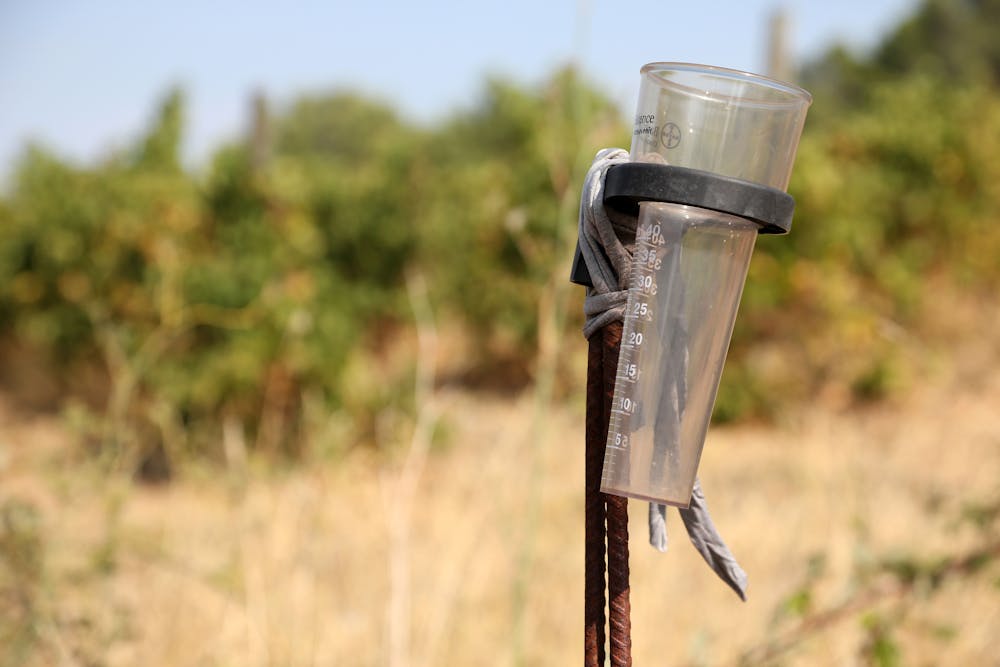
Closeup of a rain gauge.

If you want to know how much it rains where you live, the best way is to install a rain gauge and start recording your own daily rainfall measurements. A great resource is the CoCoRahs Network, a community of volunteers working to measure and map rain, hail and snow.

Collecting data about the location and intensity of all kinds of precipitation really helps scientists like us understand weather systems and improve our weather forecasting.

This article is republished from The Conversation, a nonprofit news site dedicated to sharing ideas from academic experts. It was written by: Lynn McMurdie, University of Washington and Joe Boomgard-Zagrodnik, Washington State University.

Read more:

What would it feel like to touch a cloud?

Why does some rain fall harder than other rain?

The authors do not work for, consult, own shares in or receive funding from any company or organization that would benefit from this article, and have disclosed no relevant affiliations beyond their academic appointment.

2021’s climate disasters revealed an east-west weather divide, with one side of the country too wet, the other dangerously dry

Shuang-Ye Wu, Associate Professor of Geology, University of Dayton
Tue, December 21, 2021

Wildfires that swept through Sequoia National Forest in California in September 2021 were so severe they killed ancient trees that had adapted to survive fires.
AP Photo/Noah Berger

Alongside a lingering global pandemic, the year 2021 was filled with climate disasters, some so intense they surprised even the scientists who study them.

Extreme rainstorms turned to raging flash floods that swept through mountain towns in Europe, killing over 200 people. Across Asia, excessive rainfall inundated wide areas and flooded subway stations in China. Heat waves shattered records in the Pacific Northwest, Europe and the Arctic. Wildfires swept through towns in California, Canada, Greece and Australia. And those were only a few of the extremes.

In the U.S. alone, damage from the biggest climate and weather disasters is expected to total well over US$100 billion in 2021.

Many of these extreme weather events have been linked to human-caused climate change, and they offer a glimpse of what to expect in a rapidly warming world.

In the U.S., something in particular stood out: a sharp national precipitation divide, with one side of the country too wet, the other too dry.

As a climate scientist, I study the impact of global warming on precipitation and the water cycle. Here’s what happened with precipitation in the U.S. in 2021 and why we’re likely to see similar scenarios in the future.

The east-west weather divide

The eastern U.S. weathered storm after storm in 2021. Record rainfall in Tennessee triggered deadly flash flooding in August. The remnants of Hurricane Ida merged with another front days after the hurricane hit Louisiana and became so intense they set rainfall records and flooded subway stations and basement apartments in New York and Pennsylvania, with devastating consequences.

Almost the entire West, meanwhile, was in some stage of drought, helping to fuel wildfires that swept through forests and towns.

This kind of east-west weather divide can be enhanced by La Niña, a periodical phenomenon fueled by Pacific Ocean temperatures that tends to leave the Southwest drier than normal and the North and much of the eastern half of the U.S. wetter.

But something else is going on: Global warming fuels both dryness and extreme rainfall.


Flash flooding swept away cars and damaged homes in Tennessee in August 2021.
AP Photo/John Amis

3 impacts of global warming on rainfall


Three things in particular happen to precipitation when the planet warms.

1) Global warming leads to more overall precipitation.


Higher temperature increases evaporation from Earth’s surface. It also increases the atmosphere’s capacity to hold moisture at a rate of about 7% per degree Celsius that the planet warms. With more moisture evaporating, global precipitation is expected to increase, but this increase is not uniform.

2) Global warming leads to more intense precipitation.

With higher temperature, more moisture is needed to reach the condensation level to form precipitation. As a result, light precipitation will be less common. But with more moisture in the atmosphere, when storm systems do develop, the increased humidity leads to heavier rainfall events.

In addition, storm systems are fueled by latent heat – the energy released into the atmosphere when water vapor condenses to liquid water. Increased moisture in the atmosphere also enhances latent heat in storm systems, increasing their intensity.

Research shows that both the frequency and intensity of heavy precipitation events has increased since the 1950s over most land areas.


The remnants of Hurricane Ida flooded subway stations in New York City in September 2021. 
David Dee Delgado/Getty Images

3) Global warming tends to make wet places wetter and dry places drier.

Precipitation is not distributed evenly over the planet because of the global atmosphere circulation pattern. This global circulation brings moisture to places where winds come together, such as the tropical regions where we find most of the world’s rainforests, and away from places where winds diverge, such as the midlatitudes where most world’s deserts are located.

Assuming no significant changes in global wind patterns, increases in evaporation and moisture will mean more moisture is transported from dry areas to wet areas and into the storm tracks at higher latitudes. Global warming could also potentially change the global circulation pattern, causing a shift in the world’s wet and dry regions.


A California farmer pulled out almond groves in June 2021 because of a lack of water to irrigate them. 
Robyn Beck/AFP via Getty Images

Mountains, moisture and the east-west divide

These dynamics are also affected by local conditions, such as the shape of the land, the types of plants on it and the presence of major water bodies.

The western U.S., with the exception of the West Coast, is dry in part because it lies in the rain shadow of mountains. The westerly wind from the Pacific Ocean is forced upward by the mountain ranges in the West. As it moves up, the air cools and precipitation forms on the windward side of the mountains. By the time the wind reaches the leeward side of the mountains, the moisture has already rained out. As the wind descends the mountains, the air warms up, further reducing the relative humidity.

Higher temperature in areas like these where the moisture supply is already limited means less humidity in the air, leading to less rain. Higher temperature and less precipitation would also reduce snow packs in the mountains and cause earlier melt in spring. All these changes are likely to increase aridity in the West.


The ‘bathtub ring’ around Lake Mead in July 2021 reflected record low water levels in this important Colorado River reservoir. The reservoir fell below 35% capacity and triggered water use restrictions.
Photo by David McNew/Getty Images

The eastern U.S., on the other hand, receives abundant moisture from the North Atlantic and the Gulf of Mexico carried by the easterly trade wind. With abundant moisture supply, increasing temperature means more moisture in the atmosphere, leading to more precipitation and stronger storms.

This is what years of precipitation records show and what is projected for future precipitation based on climate models. Both show a decrease in annual precipitation in the West, likely meaning more long periods of drought, and an increase in the East with global warming.

This article is republished from The Conversation, a nonprofit news site dedicated to sharing ideas from academic experts. It was written by: Shuang-Ye Wu, University of Dayton.

Read more:

California’s water supplies are in trouble as climate change worsens natural dry spells, especially in the Sierra Nevada

Avoiding water bankruptcy in the drought-troubled Southwest: What the US and Iran can learn from each other