Saturday, April 18, 2026

Feuding with Pope Leo, Trump Cancels $11 Million Contract for Catholic Charity Helping Homeless Migrant Children

“The administration chose to strip funding from a Catholic ministry that cares for traumatized children,” said one Catholic commentator. “The real reason is retaliation.”


Archbishop Thomas Wenski, Archdiocese of Miami, attends a press conference about the cancellation of an $11 million federal contract with Catholic Charities on April 16, 2026 in Miami, Florida.
(Photo by Joe Raedle/Getty Images)

Stephen Prager
Apr 17, 2026
COMMON DREAMS

In a move that the archbishop of Miami called “baffling,” President Donald Trump suddenly cut ties with a Catholic charity dedicated to helping unaccompanied migrant children in what many interpreted as a gesture of contempt amid his feud with Pope Leo XIV.

In an op-ed for the Miami Herald on Wednesday, Archbishop Thomas Wenski explained that Trump had abruptly cut off $11 million of funding and ended more than 60 years of government partnership with the Catholic Charities in the Archdiocese of Miami, which “has worked closely with the Office of Refugee Resettlement (ORR) to provide shelter and other services to thousands of unaccompanied minor children of all nationalities.”

Wenski said: “For more than 60 years, the Archdiocese of Miami’s services for unaccompanied minors have been recognized for their excellence and have served as a model for other agencies throughout the country. Our track record in serving this vulnerable population is unmatched. Yet, the Archdiocese of Miami’s Catholic Charities’ services for unaccompanied minors has been stripped of funding and will be forced to shut down within three months.”


Emily Hillard, the press secretary of the US Department of Health and Human Services (HHS), told the Herald that the relationship had been terminated because the number of unaccompanied minors entering the US is “significantly lower” under the Trump administration than under that of former President Joe Biden.

According to HHS, the number of unaccompanied children under the agency’s care is about 1,900, a significant decrease from the peak of the Biden administration, when it held about 22,000.

She said the Office of Refugee Resettlement was canceling the contract as part of a process of “closing and consolidating unused facilities as the Trump administration continues efforts to stop illegal entry and the smuggling and trafficking of unaccompanied alien children.”

“The real reason is retaliation.”

But while Wenski acknowledged that fewer unaccompanied minors are entering the US, he pointed out that the Miami charity’s facilities are hardly “unused.”

Wenski said its Children’s Village facility in Palmetto Bay can hold up to 81 minors, whom it helps to place in foster care, reunite with family members, and provide supportive services.

He said, “It is baffling that the US government would shut down a program that it would be hard-pressed to replicate at the level of competence and excellence that Catholic Charities has achieved if and when future waves of unaccompanied minors reach our shores.”


While the White House did not name Pope Leo as a factor in Trump’s sudden decision to gut the Catholic Charities funding, Christopher Hale, the author of the Pope-centric newsletter Letters from Leo, argues that “the timing tells you everything about the motive.”

Trump slashed the Catholic Charities funding just two days after lambasting Leo for being “WEAK on Crime and terrible for Foreign Policy” following the pontiff’s criticism of his war in Iran.

Leo responded that he has “no fear of the Trump administration” and will “continue to speak out loudly against war.” On Thursday, Leo added that “the world is being ravaged by a handful of tyrants” who spend billions of dollars to wage war and condemned “those who manipulate religion and the very name of God for their own military, economic, and political gain, dragging that which is sacred into darkness and filth.”

“They turn a blind eye to the fact that billions of dollars are spent on killing and devastation, yet the resources needed for healing, education, and restoration are nowhere to be found,” Leo said.

“This is the context in which the administration chose to strip funding from a Catholic ministry that cares for traumatized children,” Hale wrote. “The real reason is retaliation, and the pattern stretches back to the administration’s first days.”

He noted that in December, Trump also canceled funding for six years to the Catholic Charities of the Rio Grande Valley of Texas, which operates a migrant shelter in McAllen and has assisted more than 500,000 migrants since its founding in 2014.


The government’s contract with Catholic Charities in Miami dates back to 1960, when—as part of what was called Operation “Pedro Pan”—the organization sheltered more than 14,000 Cuban children whose parents had sent them alone to Florida by plane or by boat to flee the revolution led by Fidel Castro.

The Trump administration has acknowledged that a large new wave of migrants could be imminent as people flee the devastating consequences of its fuel blockade in Cuba, which military leaders have acknowledged could cause a “humanitarian crisis.” In recent days, reports have said Trump is mulling plans to attack Cuba militarily.

Last month, SOUTHCOM commander Gen. Francis Donovan said the US military was coordinating with the Department of Homeland Security to prepare to house any potential influx of refugees at the US military prison in Guantánamo Bay, a proposal that has been decried by dozens of human rights groups.

Catholic leaders in Miami told the Herald that blocking funds to the Catholic Charities and forcing the closure of the Children’s Village will needlessly traumatize dozens of children who have come there for refuge and have already endured enormous hardship, many having arrived in the US after fleeing poverty and violent conflict.

“You don’t cross several borders, you don’t walk across Mexico if you are 10 or 12 years old without being exposed and suffering trauma of one type or the other,” Wenski said.

Wenski and Catholic Charities CEO Pedro Routsis-Arroyo have asked the federal government to reconsider pulling the funding. Without it, they say many of the children will be forced to relocate to other shelter programs, which can create more trauma and instability.

“Who loses?” Routsis-Arroyo said. “The children lose.”
With 38,000+ Dead, Women and Girls Make Up Over Half of Those Killed in Israel’s US-Backed War on Gaza: UN

“Not a single combatant among them,” said one human rights activist. “Further confirmation that over 90% of the victims are innocent civilians.”


Palestinians mourn the loss of their loved ones killed in an Israeli attack on September 25, 2025.
(Photo by Abdalhkem Abu Riash/Anadolu via Getty Images)

Brad Reed
Apr 17, 2026
COMMON DREAMS


Israel’s years long assault on Gaza has killed more than 38,000 women and girls, according to a report released Friday by the United Nations.

In total, the UN found that at least 22,000 women and 16,000 girls have been killed in the conflict, an average of nearly 50 women and girls per day.

Sofia Calltorp, chief of humanitarian action at UN Women, said the report shows how Israel’s war on Gaza “has affected every aspect of life, with its most horrific toll seen in the scale of death.”

“Women and girls accounted for a proportion of deaths far higher than those observed in previous conflicts in Gaza,” Calltorp emphasized. “Those killed were mothers, they were daughters, sisters, and friends—deeply loved by those around them. They were individuals with lives and with dreams.”

More than 72,000 people in total have been killed since Israel launched its attack on Gaza in October 2023, after Hamas invaded Israeli territory and killed approximately 1,200 Israelis. Experts warn that the current known death toll is likely an undercount.

While Palestinian women and girls represent more than half of those who have been killed, according to the report, Israeli and US officials have persisted in claiming the US-backed assault has targeted Hamas fighters.

“Not a single combatant among them,” said Ramy Abdul, chairman of the Euro-Mediterranean Human Rights Monitor. “Further confirmation that over 90% of the victims are innocent civilians.”

Although a ceasefire has been in place since October 2025, the report notes that an estimated 730 Gaza residents have been killed over the last six months. Additionally, the report says the humanitarian situation in Gaza remains dire.

“Nearly one million women and girls have been displaced, repeatedly,” said Calltorp. “Access to water and food have been severely limited, with nearly 790,000 women and girls experiencing crisis-level or catastrophic levels of food insecurity. Extensive damage to infrastructure has made it almost impossible for women and girls in Gaza to access their basic needs, like healthcare.”

Calltorp demanded that the ceasefire deal “be fully implemented,” and that “respect for international law must be upheld” to ease the suffering in Gaza.

“Humanitarian assistance must reach those in need—at scale and without obstruction,” Calltorp said. “And women and girls must be placed at the center of response and recovery efforts.”

In addition to causing a humanitarian disaster in Gaza, Israel in recent weeks has also been waging an aerial bombing and ground invasion in Lebanon that has killed thousands of people and displaced more than 1 million. US President Donald Trump announced on Thursday that Israel and Lebanon came to a ceasefire agreement that is set to last for 10 days.

At the same time, Israeli settlers have been waging a campaign of increased violence against Palestinians living in the West Bank, and veteran Israeli war correspondent Ron Ben-Yishai on Thursday declared that the actions of the settlers look like “ethnic cleansing.”
TRUMP'S IMPOTENT

Israel Strikes Lebanon Less Than an Hour After Trump Says It’s ‘PROHIBITED’ From More Attacks

“This fragile truce must not be undermined,” said the secretary general of the Norwegian Refugee Council.


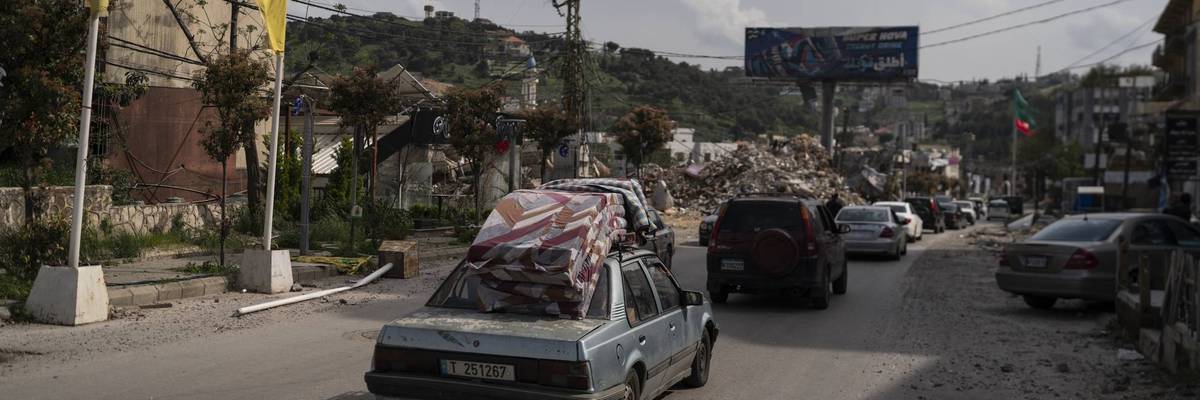
Residents return to check the aftermath of their businesses and houses on the first day of a ceasefire agreement on April 17, 2026, north of Saida in Nabatieh, Lebanon.
(Photo by Adri Salido/Getty Images)

Stephen Prager
Apr 17, 2026
COMMON DREAMS

Less than an hour after US President Donald Trump announced that Israel was “PROHIBITED” from attacking Lebanon under a 10-day ceasefire reached Friday, an Israeli drone strike reportedly killed at least one person in southern Lebanon.

Citing Lebanese media, The Times of Israel reported that an Israeli drone targeted a motorcycle between the southern towns of Khounine and Beit Yahoun. The Israel Defense Forces have not commented on the attack.

It was the latest in what the Lebanese Army said on Friday morning were “a number of violations” of the ceasefire within hours of it going into effect at midnight local time on Friday, as well as “intermittent shelling targeting a number of villages.”

Lebanon’s National News Agency reported that hours after the ceasefire went into effect, Israel struck an ambulance in the town of Khounine, near the Israeli border, which resulted in multiple casualties among the medical workers.

Israeli attacks on Lebanon since early March have killed nearly 2,300 people, according to Lebanese health officials and forced evacuation orders from Israel have resulted in the displacement of more than 1.2 million.

Trump said in a Friday social media post that under the framework reached Friday, “Israel will not be bombing Lebanon any longer. They are PROHIBITED from doing so by the U.S.A. Enough is enough!!!”

The US president has insisted that any agreement between Israel and Lebanon is separate from his ongoing two-week truce with Iran. Although Iran also announced on Friday that, following the Lebanon agreement, it stopped blocking travel through the Strait of Hormuz.

Iranian Foreign Minister Abbas Aragchi has specified that “the passage for all commercial vessels through the Strait of Hormuz is declared completely open for the remaining period of the ceasefire” between Israel and Lebanon.

Trump has claimed that the Iranian government “agreed to never close the Strait of Hormuz again,” and that the US will maintain its naval blockade of Iran.


Israel’s continued attacks on Lebanon have already put the peace deal between the US and Iran in jeopardy. After Iran briefly reopened the strait in response to the two-week ceasefire earlier this month, it began blocking travel again after Israel launched its most devastating attacks on Lebanon of the entire war, which killed hundreds of civilians.

Israel launched the attacks despite Lebanon having initially been announced as a party to the ceasefire, which Israeli Prime Minister Benjamin Netanyahu and then Trump quickly rejected.

After another agreement with Israel was reached on Friday, Lebanese President Joseph Aoun urged that the opportunity “must not be squandered because it may not come again.”

According to the US State Department, the agreement reached Friday still grants Israel the “right to take all necessary measures in self-defense, at any time, against planned, imminent, or ongoing attacks.” However, it is not clear at this time what imminent attack Friday’s strikes were intended to prevent.

Israel routinely violated its previous ceasefire with Lebanon that began in November 2024, with more than 10,000 air and land attacks over the first year, which the United Nations Interim Force in Lebanon (UNIFIL) said demonstrated a “total disregard of the ceasefire agreement.” It has done the same in Gaza, where hundreds of Palestinians have been killed since a ceasefire began in October 2025.

Netanyahu said on Friday that despite the ceasefire, Israel will continue its occupation of Southern Lebanon, where satellite images show the military has totally razed several towns and villages in what Israeli Defense Minister Israel Katz has described as a continuation of the “Gaza model,” which left most buildings in the strip totally destroyed.

Israel’s military spokesperson Avichay Adraee issued an “urgent message” to displaced Lebanese civilians following the ceasefire, urging them not to return to their homes south of the Litani River “until further notice.”

According to The Associated Press, thousands have begun heading home regardless to find their villages reduced to rubble.

“Across the country, roads are already congested with hopeful families trying to return to their homes. That alone shows how deeply people want this war to end,” said Jan Egeland, the Norwegian Refugee Council’s secretary general.

“This fragile truce must not be undermined. We cannot afford a repeat of the ineffective 2024 ceasefire, which saw countless violations. Worryingly, there are already reports of violations by the Israeli army, which also issued a warning against civilians returning to their homes south of the Litani river, home to hundreds of thousands of people,” Egeland said. “For this ceasefire to be meaningful for civilians, it must lead to a real and durable halt in hostilities.”
Donald Trump: The Forever War President

Everywhere, everywhere, everywhere is war.


A resident weeps while talking on the phone near a residential building that was hit in an airstrike  on March 30, 2026 in the west of Tehran, Iran.
(Photo by Majid Saeedi/Getty Images)

LONG READ


Steve Fraser
Apr 17, 2026
TomDispatch


War against Iran. Kidnapping the president of Venezuela. Threatening to take over Cuba and Greenland. Plans to plunder the planet of its land, labor, and vital resources to feed the insatiable appetite of American capitalism are indeed afoot and, in the age of Donald Trump, U.S. imperialism is back with a particular vengeance. Not, of course, that it ever went away. In fact, it’s been there from the beginning.

After all, the United States was launched as an act of settler colonialism, dispossessing the New World’s indigenous inhabitants. President James Monroe issued what became known as the “Monroe Doctrine” in 1823, proclaiming the country’s exclusive right to determine the fate of the rest of the western hemisphere. Meanwhile, the slave trade and slavery constituted an imperial rape of Africa by America’s planter and merchant elites.

And by the turn of the twentieth century, Washington had announced its “Open Door” policy, meaning it intended to compete for access to the world’s markets while joining the European race for colonies. It proceeded to do so by brutally taking over the Philippines in 1899, while the U.S. armed forces would make regular incursions into countries in Central America to protect the holdings of American corporations and banks. And the story that began there has never ended with bloody chapters written in Guatemala, Vietnam, most recently Iran, and all too many other places.

As the dispossession of indigenous populations and the enslavement of Africans suggest, the “homeland” (itself an imperial locution) has long been deeply implicated in the imperial project. Indeed, various forms of repressive military and police measures used abroad were first tested out against labor, Black, immigrant, and native insurgents. Rebellious immigrant workers in the nineteenth century were compared to “Indian savages” as local police and federal militia treated them with equal savagery. White supremacist ideology, nurtured at home, would then be exported to the global south to justify U.S. domination there. In fact, this country’s vaunted economic prosperity for so much of the last century was premised on its exploitative access to the resources of the global south, as well as its post-World War II hegemony over Western Europe.

Donald Trump turns out to be a purveyor of both imperialism (notwithstanding his promises to “stop wars” and refrain from “forever wars”) and its toxic outcome.

Today, Donald Trump’s government exercises a reign of terror over our immigrant brothers and sisters, millions of whom are here because their homelands were economically despoiled by this country’s business and financial powerhouses. Homegrown resistance to our imperial adventures abroad has always been met by government repression, the stripping away of democratic rights, and the creation of a surveillance state.

In the Beginning

The United States was always conceived as an imperial project, its DNA infected from the outset.

The earliest settlers were simultaneously colonial subjects of the British and other European empires, and themselves colonizers exercising their dominion over indigenous populations. Native Americans — agrarian communities, hunting and trading tribes, seafaring and fishing societies — were systematically stripped of their lands, resources, and ways of life (not to speak of their actual lives) by the newly arrived settler colonials.

Sometimes their undoing was left to the silent workings of the marketplace. From the sixteenth through the eighteenth centuries, the fur trade catered to the appetites of the world’s aristocracy — in Russia, China, and across Europe. Native American fur-trapping and trading societies entered into commercial relations with fur merchants like John Jacob Astor, the country’s first millionaire. But the terms of trade were always profoundly unequal and eventually undermined the viability of those fur-trapping communities.

Often enough, however, the colonizers resorted to far less “pacific” kinds of actions: military force, legal legerdemain, illegal land seizures, and even bio-warfare, as European-borne diseases nearly wiped out whole indigenous populations. The social murder of those peoples went on through the nineteenth century, from “the Trail of Tears” (the forced removal of the “five civilized tribes” from Georgia in 1830 on the orders of President Andrew Jackson) to the massacre of the Lakota Sioux at Wounded Knee in 1890.

Imagine the United States minus that historic erasure.

There’s no way, since the very geographic borders we take for granted would be utterly different. Much of this country’s most fertile land, crucial water resources, mineral-rich deposits, as well as the industries that grew up around them using buffalo hides for conveyer belts and horses to pull street-cars (not to speak of the oil wells that made certain Americans so rich drilling in territory that once had been part of the Comanche empire) would have remained outside the “homeland.” Where would America the Great have been then?

Less tangibly, but perhaps more essentially, without that emotional elixir, the sense of racial superiority that still poisons our collective bloodstream and helps justify our imperial brutality abroad, that sense of being perpetually at war with savages — President Trump only recently called Iran’s leaders “deranged scumbags,”— who knows what this country might have been.

Slavery and Manifest Destiny

Of course, slave labor disfigured the homeland for centuries, thanks initially to the transatlantic slave trade conducted by the imperial powers of Europe and eventually the United States. Shipowners, merchants, bankers, slave brokers, and planters, backed by the authority of the Constitution, grew extraordinarily wealthy by kidnapping and plundering African peoples.

Wealth accumulated in the slave trade or thanks to slavery found its way into industrial development, especially of the textile industries that powered the earliest stages of this country’s industrial revolution. We may fancy the notion that such a revolution was homegrown, a manifestation of a kind of native inventiveness, but factoring in the imperial assault on Africa makes the homeland’s vaunted industrial miracle seem less miraculous.

Territorial acquisition is often a hallmark of the imperial quest. And so it was in the case of this country’s expansion into the southwest and west, sometimes by purchasing land, but all too often by war. In fact, the seizure of a vast region that today stretches from Texas to California — sometimes referred to as the Mexican-American War (1846-1848) — was actually an invasion driven by the appetites of the slave owners of the American South for fresh lands to cultivate. Indeed, the most avaricious leaders of the Southern planter class wanted to take parts of Central America to extend the reach of the slave economy, as one imperial adventure whetted the appetite for another.

The phrase “Manifest Destiny,” the rubric deployed by American politicians to explain away their predatory behavior as something fated to be, remains part of an inbred American hubris. We, of course, make war and destroy only for the most idealistic motives: to save democracy, uplift the poor, hunt down demonic rulers, or bring the blessings of the American way of life to the benighted.

Exacerbated as well through the experience of conquest was a racialized ideology already deeply embedded in the country’s psyche. If, today, Donald Trump’s America is infected with an aversion to Latinos (not to mention African Americans), or immigrants of any non-White kind, look to the American imperial experience for its source. Earlier exercises in racism, including lynchings and church burnings in the Jim Crow South, became dress rehearsals for assaults on Muslims in our own moment of Trumpian paranoia.

Imperialism Without Colonies

Looked at from this vantage point, the American story turns out to be a serial exercise in imperial ambition. And yet, compared to its European competitors, the United States had precious few actual colonies.

True, after the Spanish-American War of 1898, it did run Cuba for a time, while establishing an unofficial protectorate over the Philippines (after waging a horrific counterinsurgency war there against a guerrilla independence movement). During that conflict U.S. forces mastered techniques — the establishment of concentration camps, for example — that they would deploy later against similar anti-colonial movements, particularly in Vietnam in the twentieth century.

Of course, the U.S. military also occupied various Central American nations — the Dominican Republic, Haiti, and Nicaragua, among other places — during the opening decades of the twentieth century, taking control of their government finances and so ensuring that they paid debts owed to American banks. That was the original version of what came to be known as “gunboat diplomacy” and is now being revisited. (Think of the recent capture of Venezuelan president Nicolás Maduro and his wife by the Trump administration.)

At the beginning of the previous century, Secretary of State John Hay developed a different approach to establishing American imperial hegemony, something less haphazard than those semi-colonial one-offs. In 1899, he announced an “Open Door” policy which, on the face of it, seemed eminently fair. The United States claimed that it sought equal access to markets, particularly China’s, that had previously been carved into exclusive zones by the great European powers.

Opening that door eventually led to American global economic dominance, not counting the part of the world controlled for about 75 years by the Soviet Union (in parts of which China is now dominant). U.S. economic preeminence after World War II, backstopped by the world’s most powerful military machine, proved irresistible, while functionally Europe became something like an American colonial possession under the auspices of the Marshall Plan and NATO. That door, in other words, was opened wider than Hays had ever imagined.

Mind you, his imperial perspective was trained not only on the outside world but on the homeland as well. By the turn of the twentieth century, this country’s business and political elites were worried that the domestic market for America’s huge industrial and agricultural output was fast approaching exhaustion. Periodic and severe depressions in the last quarter of the nineteenth century seemed like evidence of that.

What was needed, key Washington strategists came to believe, was an “open door” for U.S. commodities and capital investment globally. Such a policy would, they believed, not only ensure American prosperity but also dampen the chronic class warfare between the haves and have-nots that had raged in this country throughout the Gilded Age, threatening the viability of American capitalism.

From the close of the Civil War to the end of the nineteenth century, many people believed that the United States had entered a “second civil war,” as the titans of industry (sometimes backed by the country’s armed forces) faced off against the mass strikes of working people and farmers trying to survive the ravages of a capitalist economy. Ever since then, this country would have been inconceivable without its various versions of “open door” imperialism to buoy up the home front and pacify the natives — that is, us.

Acting the role of the hegemon, while lucrative, is also expensive. Public money still pours into sustaining and enlarging the warfare state to ward off all challenges to American supremacy. (The Pentagon only recently, for instance, asked for another $200 billion for its war in Iran.) It does so at the expense of social welfare programs, while starving investment in productive activities like the development of alternative forms of energy and new infrastructure, housing, and rapid transit that would improve life for everyone.

At times, as in the case of the Vietnam War, the warfare state has engendered full-blown domestic economic crises. Vietnam led to punishing years of hyper-inflation followed by years of economic stagnation. Moreover, such war expenditures nearly collapsed the world’s financial system in 1968.

Today, we may be beginning to experience something similar as the global economy teeters on the edge of collapse thanks to Trump’s war on Iran.

Democracy and Imperialism

From the beginning, however, there was resistance to the homeland’s imperialism. Native peoples waged war. Slaves revolted. Mexicans became anti-imperialists. Abolitionists took on the slavocracy. The Spanish-American War elicited opposition from middle-class folk and public figures like Mark Twain. During World War I, thousands of anti-war radicals had their organizations raided and their newspapers shut down by government decree, while some were imprisoned and some deported. Similarly, government repression sought to quell the anti-Vietnam War movement of the 1960s, culminating in the killing of four Kent State students in 1970.

Democracy and civil liberties, thought to make up the essence of the homeland’s civic religion, can’t survive the imperial drive. Today, violations of the most basic rights to free speech, privacy, a fair trial, and the right to vote are appalling and commonplace. Immigrants, often here because they couldn’t survive the ravages of American capitalism in their homelands, are treated like outlaws. The most basic constitutional requirement — the exclusive right of Congress to declare war — is ignored with impunity (and had been long before Trump took over). The imperial state, the surveillance state, and the authoritarian state are hollowing out what’s left of the democratic state.

Imperialism does massive and fatal damage abroad. The wars in Gaza and Iran are the latest bloodbaths for all to see. Less visible are the wages of imperialism at home. An equation might clarify the historical record: The Imperium = land, labor, resources, power, and wealth. The Homeland = cultural brutalization, dispossession, fear, misogyny, racism, repression, slavery, tyranny, and war.

Donald Trump turns out to be a purveyor of both imperialism (notwithstanding his promises to “stop wars” and refrain from “forever wars”) and its toxic outcome. Conjoined in his person is the perfect amalgam of America’s imperial history of aggressive aggrandizement and the ubermensch cruelty that history has instilled in the American psyche.


© 2023 TomDispatch.com


Steve Fraser

Steve Fraser is a historian, writer, and editor. His research and writing have pursued two main lines of inquiry: labor history and the history of American capitalism. He is the author of Class Matters: The Strange Career of an American Delusion. His previous books include The Age of Acquiescence and The Limousine Liberal. He is a co-founder and co-editor of the American Empire Project.
Full Bio >
Trump Is Stark-Raving Mad—Impeach Him Now

He’s been losing it for a while now, but in the last few months it’s become far worse.


President Donald Trump and first lady Melania Trump host a Women’s History Month Celebration at the White House on March 12, 2026 in Washington, DC.
(Photo by Heather Diehl/Getty Images)

Robert Reich
Apr 17, 2026
Inequality Media

It’s a catastrophe on the way to becoming a cataclysm.

Trump is rapidly going stark-raving mad. He’s a clear and present danger to the United States and the world.


Earlier this week he lashed out at The New York Times after its chief White House correspondent questioned his mental health and stability and pointed to his “erratic behavior and extreme comments.”

“HAVE THEY NO SHAME? HAVE THEY NO SENSE OF DECENCY?” Trump posted in CAPITAL LETTERS about the Times, inadvertently echoing the famous words of Joseph Welch when standing up to Joseph McCarthy during the Army-McCarthy hearings of 1954. Trump went on to take issue with the Times‘s coverage of his war in Iran rather than his mental state, as if to prove the Times‘s point.

He keeps saying he’s “won” the war with Iran, although he’s never said what “winning” means. At one moment his goal is to free Iran’s people. At another, it’s to end Iran’s capacity to produce a nuclear weapon. At another, to destroy Iran’s missiles. At another, to achieve “regime change.” At another, to open the Strait of Hormuz (which was open before Trump started his war). At another, he says he’ll know the U.S. military operation in Iran is over when he feels it “[in] my bones.”

We are all endangered. What happens if, in a demented rage, he hurls a nuclear bomb? Who is watching the “football” with the nuclear codes? Who’s ready to stop him to save the world?

He can’t even stay on the same subject for more than a few minutes. In the middle of a high-level Cabinet meeting about the war, he spends five minutes talking about his preference for Sharpie pens. He interrupts another Iran war update to praise the White House drapes.

He threatens that if Iran doesn’t reopen the strait, “a whole civilization will die tonight.” Then he says America doesn’t need the strait reopened. Then he says: “Open the Fuckin’ Strait, you crazy bastards, or you’ll be living in Hell - JUST WATCH! Praise be to Allah. President DONALD J. TRUMP.”

He calls the Pope “WEAK on Crime, and terrible for Foreign Policy” because the Pope wants peace. He posts an AI-generated picture of himself as Jesus, then says he was only depicting himself as a physician.

He won’t give up on his illegal and dangerous (for the economy) criminal investigation of Fed Chief Jerome Powell, claiming it’s not just about Powell’s renovations at the Fed but also a “probe on incompetence,” adding he’ll fire Powell if he doesn’t resign after his term as chair ends.

He claims that the United States “needs” Greenland. He confuses Greenland with Iceland. He says whales are being killed by windmills. He claims that he won all 50 states in 2020. That he defeated Barack Obama in 2016. He says the former chair of the Joint Chiefs of Staff should be executed. He goes on an eight-minute ramble about poisonous snakes in Peru. He boasts of ending a fictional war between Cambodia and Armenia.

After Robert Mueller’s death, he says, “Good, I’m glad he’s dead.” He blames the murders of Rob Reiner and his wife Michelle on “the anger [Rob Reiner] caused others through his massive, unyielding, and incurable affliction with a mind crippling disease known as TRUMP DERANGEMENT SYNDROME.” After Joe Biden is diagnosed with an aggressive form of Stage 4 prostate cancer, Trump says, “I’m surprised that the public wasn’t notified a long time ago because to get to Stage 9, that’s a long time” (there is no Stage 9 cancer).

He’s been losing it for a while now, but in the last few months it’s become far worse.

In 2017, 27 psychiatrists, psychologists, and other mental health professionals concluded in The Dangerous Case of Donald Trump that Trump’s mental condition posed a “clear and present danger” to the nation.

In 2021, members of Trump’s own Cabinet — horrified by the January 6, 2021, violence at the Capitol and Trump’s lack of urgency in stopping it — discussed whether to invoke the 25th Amendment to remove him from office due to mental incompetence.

During his 2024 campaign, he attacked Kamala Harris and then went into the stratosphere of his bonkers mind:
“She destroyed the city of San Francisco, it’s – and I own a big building there – it’s no – I shouldn’t talk about this, but that’s OK, I don’t give a damn because this is what I’m doing. I should say it’s the finest city in the world – sell and get the hell out of there, right? But I can’t do that. I don’t care, you know? I lost billions of dollars, billions of dollars. You know, somebody said, ‘What do you think you lost?’ I said, ‘Probably two, three billion. That’s OK, I don’t care.’ They say, ‘You think you’d do it again?’ And that’s the least of it. Nobody. They always say, I don’t know if you know. Lincoln was horribly treated. Uh, Jefferson was pretty horribly. Andrew Jackson, they say, was the worst of all, that he was treated worse than any other president. I said, ‘Do that study again, because I think there’s nobody close to Trump.’ I even got shot! And who the hell knows where that came from, right?”


It’s no longer possible to overlook his conspiracy-obsessed paranoia, his uncontrolled rage, his emotional volatility, his delusional claims, his vengeful rantings, his foul-mouthed posturing, his increasing detachment from reality.

Yet his Cabinet members and aides keep their heads down. Republican members of Congress pretend not to notice. His billionaire supporters dare not speak of his rapid decline. The media tries to “sanewash” his growing incoherence.

But some voices on the right — people who have long been supporters of Trump — have had enough.

Former Representative Marjorie Taylor Greene says Trump’s threat to destroy Iran’s civilization is “not tough rhetoric, it’s insanity.” Far-right podcaster Candace Owens calls him “a genocidal lunatic.” Conspiracy theorist Alex Jones says Trump “does babble and sounds like the brain’s not doing too hot.” A White House lawyer in Trump’s first term, Ty Cobb, says Trump is “clearly insane.” Former Trump White House press secretary Stephanie Grisham says “he’s clearly not well.

The public is catching on. Fully 61 percent of Americans think he’s become more erratic with age, while just 45 percent say he is “mentally sharp and able to deal with challenges” (down from 54 percent in 2023).

For the good of the nation and the world, it’s time we face the reality: The most powerful man in the world does not have the mental capacity to do the job. Donald Trump — who has a family history of dementia — is increasingly unhinged.

We are all endangered. What happens if, in a demented rage, he hurls a nuclear bomb? Who is watching the “football” with the nuclear codes? Who’s ready to stop him to save the world?

Don’t wait. Impeach him now.


© 2025 Robert Reich


Robert Reich
Robert Reich is professor emeritus of public policy at Berkeley and former US secretary of labor. His latest book is the No. 1 New York Times best-seller, "Coming Up Short."
Full Bio >
Khanna Asks Elon Musk If He’s OK With Billionaire Tax After Latest Claims About AI and Mass Layoffs

“Start with the modest $3000 check Bernie Sanders and I have proposed for families under $150,000.”


Rep. Ro Khanna (D-Calif.) speaks at a town hall event on February 20, 2026 in Stanford, California.
(Photo by Benjamin Fanjoy/Getty Images)

Brad Reed
Apr 17, 2026
COMMON DREAMS

Rep. Ro Khanna put the world’s richest man on the spot on Friday after Elon Musk acknowledged that artificial intelligence and robotics advancements in the future would lead to mass layoffs for human workers.

In a social media post, Musk, the tech billionaire and right-wing ally to President Donald Trump, acknowledged that AI would lead to disruption in the labor market, but claimed that a guaranteed universal income program could make up for it.


Thousands of Layoffs at California Hospitals Underscore Calls for Billionaire Tax


“Universal HIGH INCOME via checks issued by the federal government is the best way to deal with unemployment caused by AI,” Musk wrote. “AI/robotics will produce goods and services far in excess of the increase in the money supply, so there will not be inflation.”

Khanna, however, responded to Musk’s post by arguing that any universal income program should be at least partly funded by the billionaire tech CEOs who are becoming even richer thanks to AI.

“In that case, are you willing to pay a modest trillionaire and billionaire tax to pay for checks to working families?” Khanna asked. “We could start with the modest $3000 check Bernie Sanders and I have proposed for families under $150,000?”

Both Khanna and Sen. Bernie Sanders (I-Vt.) for months have been talking about the potential threats AI poses to working people, especially if it replaces human labor.

During a roundtable discussion with Sanders and author Naomi Klein on Tuesday, Khanna likened AI to the technological advances made during the Industrial Revolution, which saw historic gains in productivity, but also in inequality.

“If you look at the Industrial Revolution, for 60 years, worker wages fell... even as Britain became wealthy,” Khanna explained. “And so the question, in my view, for AI is, are we going to let a few billionaires, trillionaires, call the shots, or are we going to make sure that the technology is actually used in any way to enhance workers, to enhance total productivity?”

Sanders flagged Amazon founder Jeff Bezos seeking to raise $100 billion to automate US factories with AI-powered robots as a particularly dangerous threat to the livelihoods of blue-collar workers.

“It means there will no longer be manufacturing jobs in the United States or in warehouses,” Sanders said of Bezos’ plan. “He wants to get rid of the 600,000 Amazon workers and replace them with robots. Elon Musk is converting Tesla partially to a robotics company. He wants to produce a million robots a year… What do you think a robot is there for? It’s to replace a union worker.”

Sanders on Friday continued banging the drum about billionaires’ plans for AI, and he slammed members of the Democratic Party who are reportedly wary of criticizing the industry publicly for fear of its enormous campaign war chest that it’s planning to deploy during the upcoming midterm elections.

“With the AI industry planning to spend $300 million this election cycle,” Sanders wrote on social media, “Democrats are being pressured by consultants to avoid ‘antagonizing’ them. Unacceptable. Democrats must get super PACS out of their primaries. Citizens United must be overturned. We must have the courage to take on the AI Oligarchs.”
When Thought Becomes Record in the Age of AI

How a court footnote, retention orders, interagency data sharing, and the government’s own words reveal what happens when we pour private thought into a chatbot.


The Claude by Anthropic app logo appears on the screen of a smartphone in Reno
(Photo by Jaque Silva/NurPhoto via Getty Images)

LONG READ

John Marks
Apr 18, 2026
Common Dreams


Last month, a sentence went viral claiming that if you type into a chatbot, the FBI can get everything. The claim was too broad. The truth may be narrower, and worse.

Worse, because what is at stake is not some dramatic collapse of privacy. It is a daily practice so ordinary that most people do not even register it as exposure. Thought leaves a protected setting, enters a consumer platform, becomes a record, and then falls under rules the user did not write and will almost never see. Catastrophes announce themselves. Habits do not. Habits become infrastructure before the public notices what has changed.
RECOMMENDED...


Naomi Klein, Bernie Sanders, and Ro Khanna Roundtable Explores Future of AI


‘Caught Red-Handed’: UK Study Finds Rapidly Growing Number of AI Chatbots ‘Scheming’ to Disobey Users

This essay walks through six documents: a footnote, two preservation orders, an executive order on interagency sharing, a national security memorandum, and a budget request. Read one by one, each can be minimized. Read together, they describe an apparatus already in motion, and a desk already inside it.

A conversation is something you have. A record is something someone else keeps. The text box in front of you now performs both functions at once. It feels like conversation. It can become record.
I. The First Shift: When Thinking Starts Looking Like Disclosure

In United States v. Heppner, decided in the Southern District of New York on February 17, 2026, Judge Jed S. Rakoff wrote in a footnote: “But even if certain information that Heppner input into Claude was privileged, he waived the privilege by sharing that information with Claude and Anthropic, just as if he had shared it with any other third party.”

Read that again, slowly. Speed helps disguise the act.

What happens when the record no longer belongs to the person who created it?

The footnote does not say the attorney-client relationship dissolves because a chatbot exists. It says something narrower, and more unsettling. Whatever Heppner himself carried out of a protected setting and voluntarily shared with Claude could lose privilege the way material shared with any other third party can lose privilege. The room remains protected. What leaves the room may not.

That is old doctrine meeting a new habit. The danger lies in the habit’s ordinariness. A doctrine once applied to deliberate disclosure becomes harsher when the third party is a text box millions of people treat as an extension of private thought.

People use consumer chatbots to think through problems, including legal ones. They paste in memos, summaries, draft language, and questions they cannot yet frame in legal terms. Some of that material originated with counsel. Some did not. Not every exchange is privileged. That is not the point. The point is that the text box does not sort those categories for the user, and the user often does not sort them either. The platform feels intimate, immediate, and close enough to thought that the act often does not register as disclosure.

That is the shift. Most users do not believe they are sharing protected material with a third party. They believe they are working privately through a problem. The platform may not honor that distinction. The court may not honor it. The state may not honor it either.

The Heppner footnote may not survive appeal, but the pattern it marks does not depend on its survival. Carpenter v. United States points in a different direction on digital third-party records. A split among district courts is already visible. But appellate uncertainty is not protection in the meantime. Courts sort doctrine on one timetable. Institutions build systems on another. Retention practices, routing rules, and interagency structures can harden before doctrine settles.

The legal tracks must stay distinct. Privilege is not work product. Work product is not Fourth Amendment privacy. Privacy is not retention. Retention is not acquisition. Acquisition by warrant is not acquisition by administrative subpoena or interagency sharing. The sequence that follows does not require those categories to collapse. It requires only that, in practice, they begin to converge in ways that steadily weaken user control.

A ruling declaring that every chatbot exchange destroys privilege would trigger immediate alarm. A footnote this quiet does not. That is why the narrower reading is worse. It marks an ordinary act, repeated every day by people who think they are thinking privately when, in legal effect, they may be disclosing.

The public paraphrase overstated the law. The law understated the habit. Once that shift comes into view, the next question follows: What happens when the record no longer belongs to the person who created it?
II. The Record Leaves Your Hands

The Heppner footnote did not arrive alone. It arrived inside a pattern. The pattern matters more than the sentence.

Courts are sorting several adjacent questions the public keeps collapsing into one. One week before Heppner, in Warner v. Gilbarco, the Eastern District of Michigan rejected the claim that using ChatGPT to work through litigation material automatically destroyed work-product protection. Roughly six weeks later, Morgan v. V2X in the District of Colorado widened the split rather than closing it, recognizing Rule 26(b)(3) protection for AI-assisted material prepared by a pro se litigant while still imposing disclosure obligations and cautioning against uploading confidential information into mainstream AI systems.

Read together, these cases do not settle AI in the abstract. They suggest that courts are sorting channels, control, supervision, and institutional setting. Where the law sees counsel, protective orders, and defined litigation materials, it can still imagine a protected path. Where it sees voluntary disclosure into a consumer platform outside counsel’s direction, the protection thins. A law firm inside a controlled environment gets one reading. A person at a kitchen table with a monthly subscription gets another. Ordinary users behave as though the boundary were settled in their favor. It is not. Uncertainty does not reduce the risk. It enlarges it.

Then the preservation orders deepen the problem. Once material becomes platform record, the user no longer controls the baseline that governs how long it exists or when it can be reached.

People still imagine their chat history exists inside a promise. It does not.

On May 13, 2025, in New York Times v. OpenAI, Judge Ona Wang entered a preserve-and-segregate order covering a vast population of user logs. On January 5, 2026, Judge Sidney Stein affirmed production of a 20 million de-identified log sample. His reasoning matters as much as the scale. He wrote that users’ privacy interests in that material were weaker than in wiretapped phone calls because the users had voluntarily disclosed the contents to a platform that retained them in the ordinary course of business.

The point is not that one company lost a fight. The point is that deletion baselines can change outside the user’s control. They can change in litigation the user is not party to, in a courtroom the user has never heard of, without notice to the person whose records are being kept. The later announcement that the broad preservation obligation ended does not erase that point. It confirms it. The baseline moved once. It can move again.

Even if the Heppner footnote falls on appeal, the preservation and retention architecture does not fall with it. Privilege doctrine is one track. Retention defaults are another, governed by platform terms, contract law, litigation holds, and administrative process. The constitutional fight may proceed in one courtroom while the records keep being kept in another.

Retention exposure is not uniform across users. When OpenAI’s broad preservation obligation was in effect, it excluded Enterprise accounts, Edu accounts, and API customers who had contracted for Zero Data Retention. The organizations and professionals with resources to buy safer configurations could obtain them. Ordinary users on consumer accounts could not.

That stratification is a structural feature of the platform layer, not an accident of one lawsuit. Law firms can buy protected configurations. A person at a kitchen table with a monthly subscription cannot. Before the first subpoena arrives, before the first interagency route opens, before any category written into National Security Presidential Memorandum-7 (NSPM-7) is applied to anyone, the exposure is already stratified by who can afford which tier. That stratification will track the sorting that follows.

Retention is not government acquisition. It is the prior condition that makes acquisition possible. People still imagine their chat history exists inside a promise. It does not. It exists inside a current default, and defaults are fragile. A judge can change them. A litigation hold can change them. A production order can change them. The user often learns that only after the fact, if at all. Once a record can be kept, the next question is how it begins to move.
III. The State Has Already Built the Routes

On March 20, 2025, the White House issued an executive order with a title that sounds like office management: “Stopping Waste, Fraud, and Abuse by Eliminating Information Silos.” The word “silo” sounds bureaucratic and dull. That is part of its function. It makes a structural change sound merely administrative. The key word is “eliminating.”

Taken on its own, the order does not compel any single disclosure. Yet it plainly directs movement. It tells agency heads to ensure that designated officials receive full and prompt access to unclassified records, data, software, and IT systems. It authorizes sharing and consolidation within and across agencies. It calls for unfettered access to comprehensive data from state programs that receive federal funding, to the maximum extent consistent with law. The order treats the seams between agencies not as safeguards, but as obstacles. Boring language often carries the heaviest load because it is designed to pass without alarm. Usually, it does.

Administrative routing does not require a courtroom. It does not require a warrant. It requires an interagency agreement and a technical connection. Once that connection exists, records move under rules the user does not see, into hands the user did not anticipate, for purposes the user was never asked to weigh. Quietly at first. Then routinely. Then as a matter of course.

Once a state can create records, keep them, and move them with reduced friction, it no longer waits passively for events to arrive in fully formed cases.

That matters more when other forms of process reduce friction further. Washington Post reporting in February 2026 described the Department of Homeland Security’s use of administrative subpoenas at volumes that experts and former staff estimated in the thousands or tens of thousands. American Civil Liberties Union (ACLU) litigation, including Doe v. DHS, added specific challenged cases to that pattern. Administrative subpoenas are not new. What matters is their operational use: speed, breadth, and limited front-end judicial review.

A system that can demand material quickly behaves differently from one that must persuade a judge before the process begins. A system that does not require a judge at the front end is not meaningfully slowed when a judge at the back end issues a clarifying opinion three years later. By then, the records have moved, and the institutional lesson has been learned.

The warrants aimed at journalist Hannah Natanson reveal the same pattern from another angle. Their significance is not that journalists are uniquely vulnerable. It is that Natanson’s case was legible. She had a national byline. Her case could be read, tracked, and contested in public.

Most cases will not look like that. Most people caught in expanding process will be organizers, students, immigrants, and members of communities sorted first under every previous expansion of federal attention. They will not have a national employer or a legal defense fund. Their names will not trend. Their records will still move. The unreadable cases are the condition. The visible ones are the narrow window through which the rest of us glimpse it.

Names matter less than architecture. Replace any one official and the route still exists the next morning. The Information Silos order still stands. The subpoena posture still matters. The warrant machinery still works. Personnel matter. Architecture matters more.

Once a state can create records, keep them, and move them with reduced friction, it no longer waits passively for events to arrive in fully formed cases. It gains the practical ability to sort, correlate, and escalate before the public sees any full story. From there, the next question is unavoidable: What kinds of people has the state already told itself to look for?
IV. The Categories Are Already on the Page

The most revealing documents in this essay are not leaked. They are posted. The apparatus does not need secrecy for the first stages of this work. It can describe itself in public because the public rarely reads primary documents until the output becomes undeniable.

Start with NSPM-7, issued on September 25, 2025, under the title “Countering Domestic Terrorism and Organized Political Violence.” Read that title carefully. “Domestic terrorism” is one phrase. “Organized political violence” is another. The memorandum joins them into a single operational field. A category this wide gives agencies room to sort more conduct, posture, and association than the public usually imagines when it hears the word “terrorism.”

The FBI’s Fiscal Year 2027 Budget Request, submitted in March 2026, translates that field into administrative appetite. On page 13, the request states that violent conduct in the United States commonly relates to views associated with anti-Americanism, anti-capitalism, and anti-Christianity; support for the overthrow of the US government; extremism on migration, race, and gender; and hostility toward those who hold traditional American views on family, religion, and morality. That ideological enumeration is the budget’s own language. NSPM-7 supplies the broader “investigate, prosecute, and disrupt” frame within which it operates. The categories are framed in terms of political disposition and affiliation rather than completed acts.

Broad security language rarely falls evenly. It reaches certain communities first, long before the public agrees on what the category means or whom it is for.

Appetite alone does not move records. A vehicle does. The same request names it: the NSPM-7 Joint Mission Center, composed of personnel from 10 agencies, which the budget says will integrate intelligence, operational support, and financial analysis to proactively identify networks and prosecute domestic terrorist and related criminal actors.

That phrase matters. Proactive identification of networks is not the same as investigating a specific act after a complaint, a tip, or an arrest. The language moves upstream, away from completed acts and toward recurrent motivations, indicia, and network mapping. When the categories guiding that work are framed in ideological and cultural terms, network mapping does not remain confined to the individuals at any given node. It extends outward. That is how categories begin to function as engines. Broad markers, interagency routes, and a budget request for advance identification: That is the combination now on the page.

These documents do not prove that every citizen who holds one or more of these views is already under active federal investigation. They prove something serious enough. They show that the administration has formalized a broader operational category than most citizens realize, paired it with interagency movement of information, and requested funding for proactive identification under that category. The concern is not a proven dragnet. The concern is that the categories, routes, and funding streams are now broad enough to normalize sorting before a complete individualized case exists.

Kash Patel’s name appears on a cover page. Stephen Miller, Russell Vought, and Todd Blanche occupy familiar nodes of power. Those offices matter. But the signature is not the explanation. It is the citation. The explanation is the architecture written into policy, budget language, and routing authority. That architecture will outlast the current roster, and most of the litigation currently aimed at one footnote inside it. Once categories are written, routes are built, and funding is requested, somebody meets them first.
V. Broad Powers Never Land Evenly

In American practice, that somebody is rarely random. Broad security language rarely falls evenly. It reaches certain communities first, long before the public agrees on what the category means or whom it is for. That is not incidental to the history. That is the history.

The recent treatment of students and faculty involved in campus Palestine solidarity shows the first mechanism clearly: label before case. Visa revocations, detention, and removal proceedings have moved ahead of any settled public showing of unprotected conduct. The label comes first. The individualized case comes later, if it comes at all. That is what proactive identification looks like when policy language leaves the page and lands on a life.

The Stop Cop City prosecutions show the second mechanism: association widening exposure. Protest activity, bail funds, and mutual aid networks were drawn into racketeering and domestic terrorism frames that stretched beyond any single completed act. Once the state begins to map relation, exposure no longer stops where conduct stops. It moves through contact, support, and nearness itself.

The newest entry point into an old machinery does not arrive with sirens or boots at the door. It arrives as invitation. It arrives as convenience. It arrives as a blinking cursor.

Standing Rock shows the third mechanism: records and suspicion moving across institutions. Federal agencies, state police, and private contractors shared surveillance functions across the very seams liberal legal culture likes to treat as safeguards. The point is that, in practice, observations, records, and suspicions moved across a cooperative field. The Information Silos order does not invent that logic. It removes more of its friction.

The post September 11 surveillance of Muslim American communities shows the oldest mechanism: population sorting before any specific act. Whole communities were subjected to preemptive scrutiny because of religion, association, and presumed risk. That template did not disappear when the emergency rhetoric faded. It remained ready for new technologies, new authorizations, new words, and new enemies.

Taken together, these examples reveal recurring forms, not isolated abuses: label before case, association widening exposure, records moving across institutions, populations sorted in advance. None of this depends on a future court adopting the broadest possible reading of Heppner. The apparatus already knows how to work on bodies, files, and communities.

What is new is not the appetite to sort, but the route by which sorting begins. The newest entry point into an old machinery does not arrive with sirens or boots at the door. It arrives as invitation. It arrives as convenience. It arrives as a blinking cursor.
VI. The Text Box Is the Last Voluntary Step

That cursor sits in a text box. That is where the sequence begins, not in a courtroom, not in a budget request, not in a raid after the fact. It begins here, at the tips of your fingers.

Once the record leaves your hands, the rest unfolds elsewhere: in retention policies you did not write, in orders you will never see, in routes built to reduce friction, in agencies already widening the categories through which they read the public. What felt private a moment ago enters systems that are not private at all.

By this point, the sequence should be visible. Ordinary use turns thought into record. Record is kept under terms the user does not control. Kept records travel along routes designed to reduce friction. They enter a state that has already begun defining, in public, the kinds of subjects it intends to sort before complete individualized stories arrive. None of those steps depends on whether one district court footnote survives appellate review. Each proceeds under its own authority and on its own timetable.

Once thought becomes record, and record becomes retainable, movable, sortable, the problem is no longer private. It is structural.

That is why civic literacy now matters at a different level. It is one of the few ways a citizen can see the structure before its output reaches him in a form he can no longer mistake. By the time most people encounter the apparatus as event, surprise is no defense. The route already existed. The category already existed. The records already existed.

That is also why the answer cannot be private caution alone. No defensive posture at one desk can interrupt an architecture built at the level of routes, retention, and category. The venues where architecture is contested are collective: civil liberties litigation at organizations like the ACLU and the Electronic Frontier Foundation; investigative reporting willing to read the documents before the output reaches the front page; and legislative pressure aimed at retention, at sharing, and at the scope of process. That is where the sequence can still be slowed. That is where it can still be narrowed. That is where it can still be broken.

The point is no longer just to be cautious at the desk. The point is to understand what the desk now connects to. Once thought becomes record, and record becomes retainable, movable, sortable, the problem is no longer private. It is structural.

The text box may feel like a place to think. It is also becoming a place where thought changes hands.


Our work is licensed under Creative Commons (CC BY-NC-ND 3.0). Feel free to republish and share widely.


John Marks
John D. Marks, PhD, PE, is a US Army veteran and biomedical engineer who earned his doctorate at the University of Utah and later directed clinical research at a major medical device firm. His military service in the Corps of Engineers and his years living in postwar Europe gave him direct insight into how governments use bureaucracy, surveillance, and institutional power. He has authored numerous peer-reviewed scientific and clinical research publications and now writes from Pennsylvania on democratic erosion, authoritarian systems, and strategies of civic resistance.
Full Bio >
US Supreme Court Hands Big Oil Major Win in Battle Over Destruction of Louisiana Coast

Allies of fossil fuel companies are celebrating the development as a step toward “stopping the endless wave” of lawsuits against the climate-wrecking industry.


Climate justice campaigners march from the Shell Center to Trafalgar Square on November 12, 2022 in London, England.
(Photo by Mark Kerrison/In Pictures via Getty Images)

Jessica Corbett
Apr 17, 2026
COMMON DREAMS

US fossil fuel giants have long sought to shift litigation over industry harms from state to friendly federal courts, and the country’s top court unanimously handed polluters a big win on Friday, allowing such a move in a case centered on environmental damage in coastal Louisiana.

Cases can be removed from state court when they are against federal officers or persons “acting under” them, “for or relating to any act under color of such office.” Although the US Supreme Court has previously rejected multiple removals requested by Big Oil, the justices sided with the industry in Chevron USA v. Plaquemines Parish.

The company argued that its challenged production was sufficiently related to its contractual duties to refine crude oil into aviation gasoline, or avgas, for the US military during World War II. A federal district judge and the US Court of Appeals for the 5th Circuit rejected Chevron’s argument, but the high court bought it.

“Chevron has plausibly alleged a close relationship between its challenged conduct and the performance of its federal duties—not a tenuous, remote, or peripheral one,” Justice Clarence Thomas wrote for the majority. Justice Ketanji Brown Jackson penned a concurring opinion.

Justice Samuel Alito recused himself shortly before arguments. As with some other cases involving Big Oil, he bowed out due to his stock in ConocoPhillips, whose subsidiary Burlington Resources Oil and Gas Company is involved in the case at the district court level.

This fight before the high court stemmed from dozens of cases filed over a decade ago. As NOLA.com detailed Friday:
In 2013, a group of local parishes and the state filed 42 lawsuits against energy companies whose predecessors sought and produced crude during World War II. They argued that the oil and gas companies damaged wetlands and failed to get or comply with the proper permits.

After a three-week trial, a Plaquemines Parish jury sided with the state in one of those cases and awarded a $745 million verdict against Chevron and two other companies.

But the companies challenged the verdict, saying the lawsuit should have been heard in federal court, not state court.


Thanks to the Supreme Court, the Plaquemines Parish case may now be retried in a US district court. Company spokesperson Bill Turenne said in a statement that “Chevron looks forward to litigating these cases in federal court, where they belong.”

There are also potential implications for other legal battles involving the industry that is fueling the global climate emergency—as American Energy Institute CEO Jason Isaac, a former Republican state representative in Texas, celebrated in a Friday statement. He described the decision as “a critical step toward restoring sanity to our legal system and stopping the endless wave of politically motivated lawsuits designed to punish the very industry that powers our economy and national security.”

The Supreme Court’s decision notably came as the justices prepare to hear ExxonMobil and Suncor’s request to move a 2018 lawsuit filed by the city of Boulder, Colorado—seeking financial damages for the companies’ role in creating the climate crisis—from state to federal court. Alito has not yet recused himself from that case.

Fossil fuel companies largely have support from the Republican Party, which controls the White House and both chambers of Congress. President Donald Trump returned to power last year with help from the industry’s campaign cash, and his administration has supported the companies being challenged in Louisiana.

As The New York Times noted Friday, the local communities’ lawsuits “have gained support from Louisiana Republican leaders, including those who have otherwise endorsed President Trump’s ‘energy dominance’ agenda. Gov. Jeff Landry and Attorney General Liz Murrill, both Republicans, have supported the legal challenges.”

However, ahead of the November midterm elections, Republicans in Congress are working on shielding oil and gas companies from what they call “abusive state climate lawsuits.” As Common Dreams reported Friday, US Sen. Ted Cruz (R-Texas) and Congresswoman Harriet Hageman (R-Wyo.) introduced the Stop Climate Shakedowns Act this week.

“Big Oil companies have raked in massive profits at the pump while lying to the American people about the catastrophic harm of their products, and now they want to deny Americans their rightful day in court and stick taxpayers with the bill for the mess they made,” said Center for Climate Integrity president Richard Wiles. “If fossil fuel companies have done nothing wrong, why do they need immunity?”

There are related legislative efforts at the state level. As the Times detailed earlier this month, Utah recently “became the first state to enact a law that shields companies from climate-related claims.” Tennessee swiftly followed suit, and Republican lawmakers in states including Iowa, Louisiana, and Oklahoma are working on similar legislation.

Cassidy DiPaola, communications director for the Make Polluters Pay campaign, warned earlier this year that “a federal liability shield for fossil fuel companies would not lower energy prices or ease the cost of living. It would simply shift more of the financial burden onto working families and local governments while insulating one of the most profitable industries in history from accountability.”

“Congress should not close the courthouse doors to communities seeking redress,” said DiPaola. “Big Oil is not entitled to special immunity from the consequences of its conduct.”


This article has been updated to include updates on state legislation and Common Dreams’ reporting on a bill that would shield the fossil fuel industry from liability.