It’s possible that I shall make an ass of myself. But in that case one can always get out of it with a little dialectic. I have, of course, so worded my proposition as to be right either way (K.Marx, Letter to F.Engels on the Indian Mutiny)
Thursday, January 13, 2022
Analysis - Kazakhstan Crisis: Internal dispute or Western-plotted Color Revolution?
January 11, 2022 - 8:10 AMNews Code : 1217700Source : Al Waght NewsLink:
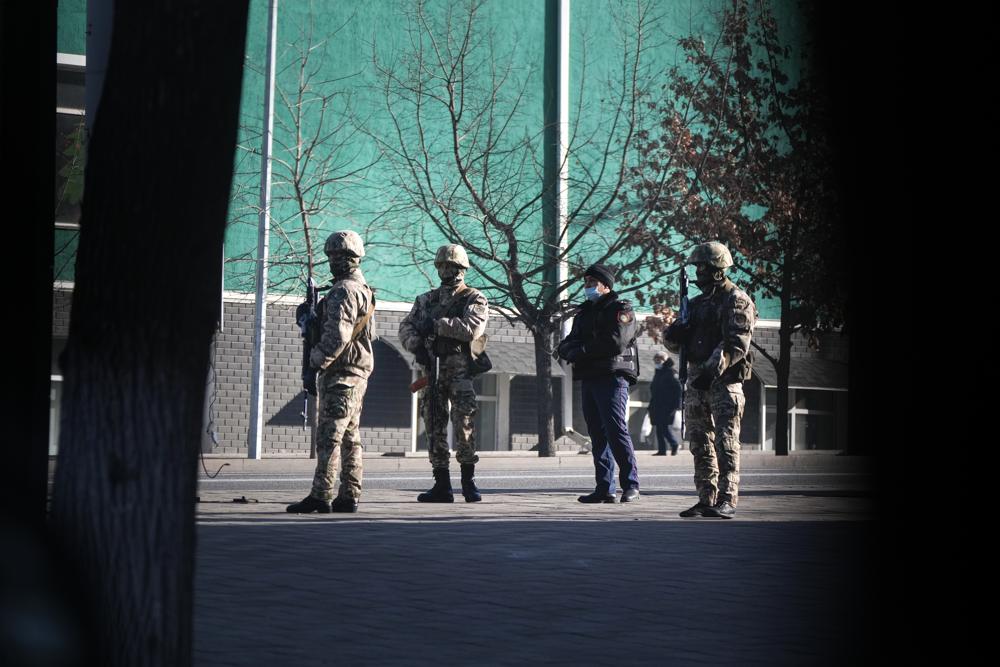
Situation is yet to be calm in Kazakhstan where unrest and clashes between the government forces and protestors, some of them armed, gripped the country since last week.
AhlulBayt News Agency (ABNA): Situation is yet to be calm in Kazakhstan where unrest and clashes between the government forces and protestors, some of them armed, gripped the country since last week.
Kazakhstan officials say more than 4,000 people have been detained in recent days. Protests in Kazakhstan were sparked by rising fuel prices, but as unrest spread, protesters raised other demands, including political freedoms.
Kazakhstan's President Kassym-Jomart Tokayev has ordered suppression of the protests and told security forces that they can fire on protesters without warning.
With the country calm and secure for years, the unfolding riots raise various speculations about the main reasons behind the fast-moving developments.
An internal dispute?
When the protests in Kazakhstan began last Wednesday, these developments were unexpected for many. Although the protests were rooted in discontentment about fuel price hike, since the beginning, some said they are a result of internal strife in Kazakhstan, adding the protests were exploited, if not planned, by incumbent President Tokayev and aimed at reducing pressure and influence of the former President Nursultan Nazarbayev. The speculations went broader especially after rumors of Nazarbayev fleeing the country were circulated. On Saturday, Nazarbayev's spokesman rejected the news, saying that the founder of modern Kazakhstan was in the capital. His Twitter post said that the ex-president is in the country, held some consultation meetings, and kept in touch with Tokayev. He also, the spokesman continued, "talked to leaders of friendly countries and called on the people to unite around support for the current president to weather the current conditions."
There has been denial of rumors of Nazarbayev's departure, but there is no doubt that Tokayev made the most of the current protests to reduce Nazarbayev's power. Although Nazarbayev has not been president since 2019, he has retained his influence and power in the former Soviet republic. It seems that Tokayev is seeking to distance Nazarbayev from power and that appears why he was dismissed from the presidency of the powerful National Security Council amid the demonstrations.
Nazarbayev ruled the country for about three decades with an iron fist and attracted hundreds of billions of dollars in foreign investment for energy and mining sectors. With extreme guile, he established balanced relationship with strong neighbors Russia and China. But he was intolerant of opposition and accused by West and rights organizations of human rights abuses and violation of democratic freedoms. A large part of the country's economy is estimated to be at his family's hands and after his dismissal from the National Security Council as his powerhouse things are unclear how would develop for him.
However, the continuing protests in Kazakhstan show that the issue goes far beyond the internal power dispute, although it provided an appropriate opportunity to settle political scores. On Saturday, National Security Committee declared arrest of Karim Masimov who was also sacked from his post during the protests as the committee's chief. Masimov it an ally of Nazarbayev and served as prime minister from 2007-2012 and from 2014-2016. His removal and arrest is seen as part of a purge campaign pushed by the current president.
Impasse of color revolution in Kazakhstan
The protests in Kazakhstan have provoked widespread international reactions, with Russia reacting so seriously that it has deployed troops under a peacekeeping mission within the framework of Collective Security Treaty Organization (CSTO), a Russian-led regional security bloc. About 2,500 troops with heavy equipment from several Central Asian countries are currently stationed in Kazakhstan under the command of Russian peacekeeping mission. Moscow said the deployment came at the behest of the Kazakh president. At the same time as Russian troops are being sent to Kazakhstan, a BBC correspondent reported that the central square of Almaty has become a "battlefield" and the sound of machine gun fire can be heard overnight in Kazakhstan's largest city.
Russia is very worried that instability and insecurity in Kazakhstan will be extended to Russia, and therefore will not accept unrest in Kazakhstan under any circumstances.
On the other hand, the deployment of Russian-led peacekeeping forces in Kazakhstan has been met with a US reaction, with a White House spokesman questioning the legality of the dispatch. So far, the US response to Kazakhstan's developments has been conservative, but at the same time many have said that Kazakhstan's unrest is rooted in the West's plotting against Russia. In other words, the US-led West is trying to divert Russia's focus from tensions in Ukraine to the situation in Kazakhstan by orchestrating protests. Some experts suggest that Kazakhstan protests bear hallmarks a color revolution, a series of Western-arranged government changes in neighbors of Russia since the 2000s.
But leaders of regional states, including Armenia, Turkey, Tajikistan, and Azerbaijan, in a reaction united with Kremlin's assured Kazakhstan president of support, signaling that they stand by Moscow in these developments.
With regional countries demonstrating alignment of stance with Russia in preservation of Kazakhstan government, Western-eyed color revolution does not seem to have a chance of success in the big and important Central Asian country.
UPDATED
Campaign Against Nazarbaev And Cronies Of Kazakhstan’s First President Has Begun – Analysis
(RFE/RL) — The dust is settling in Kazakhstan after a tumultuous start to the year in which initially peaceful protests were hijacked by violent groups who left carnage in Almaty and other parts of the country.
Amid the unrest, it also became apparent that there was a power struggle going on within the government between the current president, Qasym-Zhomart Toqaev, and loyalists of his still powerful predecessor, Nursultan Nazarbaev.
The turmoil now seems to be ending with members of the family of the country’s first president and his close associates seemingly facing a bleak future.
If there were any doubts about who emerged victorious, Toqaev put them to rest on January 11 at a session of parliament when he ordered the end to any state business with a massive waste and recycling company linked to Nazarbaev’s youngest daughter, Aliya.
“Entrepreneurs and society in general have a lot of questions about the activities of the company, which is called the Operator ROP,” Toqaev said.
Operator ROP is a recycling monopoly founded in 2015.
Kazakh Ecology, Geology, and Natural Resources Minister Serikkali Brekeshev told a meeting of the government on January 12 that the company has earned some 692 billion tenge (almost $1.6 billion) since 2016.
The company’s website features a large photo of President Nazarbaev with a strong recommendation for the heads of Kazakh regions to do business with Operator ROP.
Toqaev’s January 11 comments were the first clear indication that the vast wealth and holdings of members of the Nazarbaev family might be in jeopardy.
Toqaev had announced that he was taking Nazarbaev’s seat as secretary of Kazakhstan’s Security Council on January 5, a move many saw as an indication that the fortunes of the 81-year-old former president known as “Elbasy” — or Leader of the Nation — might have taken a turn for the worse.
Nazarbaev had used that powerful post to retain a great deal of his influence after he officially stepped down as president in March 2019 and handed over the presidency to Toqaev, his hand-picked successor.
Nazarbaev press spokesman Aidos Ukibay said on January 9 that the ex-president had voluntarily stepped down as Security Council secretary, though no one else in the Kazakh government repeated this claim.
Amid speculation as to Elbasy’s whereabouts – he has not been seen in public since December 28 — Ukibay said on January 8 that Nazarbaev was still in the capital, Nur-Sultan.
In his January 11 speech, Toqaev added that “Thanks to the first president, Elbasy, a group of very profitable companies emerged in the country, as well as a group of people whose wealth is significant even by international standards.”
Toqaev announced that a special social fund “for the people of Kazakhstan” would be created and would receive “significant and regular contributions” from businesses.
He said the government “will have to establish the group of companies with which it will have to agree with upon the size of their annual contributions to the foundation.”
Toqaev added: “I believe the time has come to pay that which is due to the people and help them.”
Toqaev did not mention any specific names, but he didn’t need to.
People like Kazakhmys chief Vladimir Kim or banker Bulat Utemuratov — well connected to the former president — are known to have made billions of dollars during Nazarbaev’s nearly 30-year reign.
And everyone in Kazakhstan knows that the members of Nazarbaev’s family have grown fantastically wealthy, something detailed in a December 2020 report by RFE/RL.
Nazabaev’s second-oldest daughter, Dinara, and her husband, Timur Kulibaev, are regularly ranked as being among the richest people in Kazakhstan with assets in excess of $1 billion.
Prior to the recent outbreak of violence, it seemed like most of the time when Kazakhstan was mentioned in Western media it was because of mansions, villas, and even castles members of the Nazarbaev family owned in Europe, the United States, or Dubai — or for the massive yachts and private jet planes they bought.
Where most of the members of the Nazarbaev family are today remains unclear at the moment.
An aide to Darigha Nazarbaeva, Nazarbaev’s eldest daughter and parliament member, said on January 12 that she had COVID and is still in Almaty, which is why she missed sessions of parliament.
Kyrgyzstan’s 24.kg website reportedon January 12 that Nazarbaev’s notorious brother, Bolat, crossed into Kyrgyzstan by car in the early morning of January 6 and later the same day boarded a flight from Bishkek to Dubai.
And the investigative outlet Bellingcat tracked “a Bombardier Challenger 604 private jet [that] flew from Almaty to Geneva” on January 4, two days after the protests started.
Bellingcat said “this aircraft’s past flight record shows trips to several European countries, Russia, the Maldives, and Dubai.”
Bellingcat also reportedthat “On 5 January, between 10 and 11 UTC…a Bombardier Global 6000 with no registration number and no other identifying details was spotted flying from Almaty…[and] we found that it landed at Farnborough Airport just outside London, a common destination for private jets coming to the U.K.”
And there were two Kazakh planes that briefly landed at Kyrgyzstan’s Manas airport on January 5, one arriving from Dubai and the other from North Macedonia. The planes stopped only briefly for maintenance and refueling before traveling onward.
The abundance of private jets flying in and out of Kazakhstan during the days of upheaval have many suggesting that close and extended members of the Nazarbaev family left the country.
Toqaev has not openly said Kazakh authorities are going after the Nazarbaevs and, considering Toqaev has been in the Kazakh government working for Elbasy since the first days of independence, he will need to tread carefully in attacking the family of the man he served for so long.
But Toqaev would have an abundance of public support for stripping Nazarbaev family members of their ill-gotten gains and Toqaev will need this support as he finally steps out of the shadow of his predecessor and forms his own government.
Bruce Pannier writes the Qishloq Ovozi blog and appears regularly on the Majlis podcast for RFE/RL.
Kazakhstan: Did 'anti-terrorist' operation hide battle between political clans? One week after the violent repression of protests in Kazakhstan, France 24 went on the ground to try to understand what sparked the situation.
A week after the crackdown on protests in Kazakhstan, residents of the former capital, Almaty, are still wondering what really happened. As Russian coalition forces began their withdrawal Thursday, FRANCE 24 went there to try to understand how peaceful demonstrations could have turned into war scenes.
10 days after the events, what really happened in Almaty remains unknown. Amnesty International has called on Kazakhstan to publish information on the number of victims among civilians; so far there has not even been an estimate of that figure.
At the public television station Almaty TV, visited by FRANCE 24, the damage was visible. “We asked the authorities," said Aygerim Agyltaeyeva, the news editor, "but we haven’t had an answer yet”.
After Kazakhstan unrest, relatives await detainees’ release 1 of 10
Police block the road to control the traffic in Almaty, Kazakhstan, Wednesday, Jan. 12, 2022. Kazakh authorities said Wednesday they detained 1,678 more people in the past 24 hours over their alleged participation in the violent unrest that rocked the former Soviet nation last week, the worst since Kazakhstan gained independence three decades ago. (AP Photo)
ALMATY, Kazakhstan (AP) — With about 12,000 people arrested after anti-government protests in Kazakhstan last week, friends and relatives of those held by police waited outside a jail Wednesday, hoping to learn their fate. Some even went to morgues to see if a loved one was among the scores killed in the unprecedented violence in the Central Asian nation.
Authorities have refused to allow relatives or lawyers to see those in custody, giving little information about them, according to human rights activists.
The demonstrations began Jan. 2 in the western part of Kazakhstan over a sharp rise in fuel prices and spread throughout the country, apparently reflecting wider discontent with the government, which declared a state of emergency for the whole country and asked a Russia-led military alliance to send in troops to help restore order.
Another 1,678 people were arrested in the past 24 hours in Almaty, the largest city that was hit hardest by the turmoil, and more than 300 criminal investigations have been opened. President Kassym-Jomart Tokayev blamed the unrest on foreign-backed “terrorists,” but did not provide any evidence, and had given shoot-to-kill orders to security forces to quell the unrest.
Outside a branch of the Internal Affairs department that housed a large detention center, a man who gave his name only as Renat said he has been waiting nearly a week to see or get any information about a close friend, Zhandos Nakipovich. He said Nakipovich, whom he described as being like “a brother” to him, was taken into custody on Jan. 4 during a peaceful protest.
“He was at first held at a precinct, then they told us he was in the Internal Affairs department,” Renat told The Associated Press. “Since Jan. 6, we’ve been here and we don’t know whether he’s alive or not.”
Military checkpoints prevented anyone from getting close to the building.
“Neither lawyers nor relatives — no one is allowed inside. Lawyers should be present during interrogation, but as you see, no one can pass,” said Galym Ageleuov, head of the Liberty human rights group, who was waiting at the barricade.
“The checkpoint blocks the access for lawyers and relatives to see what’s going on there. We don’t even have the list of detainees,” Ageleuov said.
More than a dozen men and women in dark winter clothes gathered outside one of Almaty’s morgues, with some of them waiting to collect the bodies of relatives killed in the unrest. Huddled together in small groups, they stood at the gate of the facility, chatting quietly with each other but refused to talk to a reporter.
Although the official death toll was announced as 164, Tokayev has said hundreds of civilians and security forces were killed and injured.
Life in Almaty has started returning to normal after days of unrest that saw cars and buses torched, government buildings stormed and set ablaze, the airport seized and the sound of gunfire ringing out. The unrest had largely ended by last weekend.
Public transportation has resumed and shopping malls reopened, and the only reminders of the violence were occasional military roadblocks and the charred exterior of city hall, which was set ablaze at the height of the rioting.
Authorities in the energy-rich country of 19 million sought to mollify the anger at the government by capping fuel prices for 180 days. The Cabinet resigned, and longtime former leader Nursultan Nazarbayev was ousted from his influential post of head of the National Security Council. Nazarbayev had stepped down as president in 2019 after nearly three decades in power, but retained influence in the security forces.
Tokayev requested help from the Collective Security Treaty Organization, or CSTO, a Russia-led military alliance of six ex-Soviet states. The bloc sent over 2,000 troops to Kazakhstan, and Tokayev said the troops will start withdrawing Thursday.
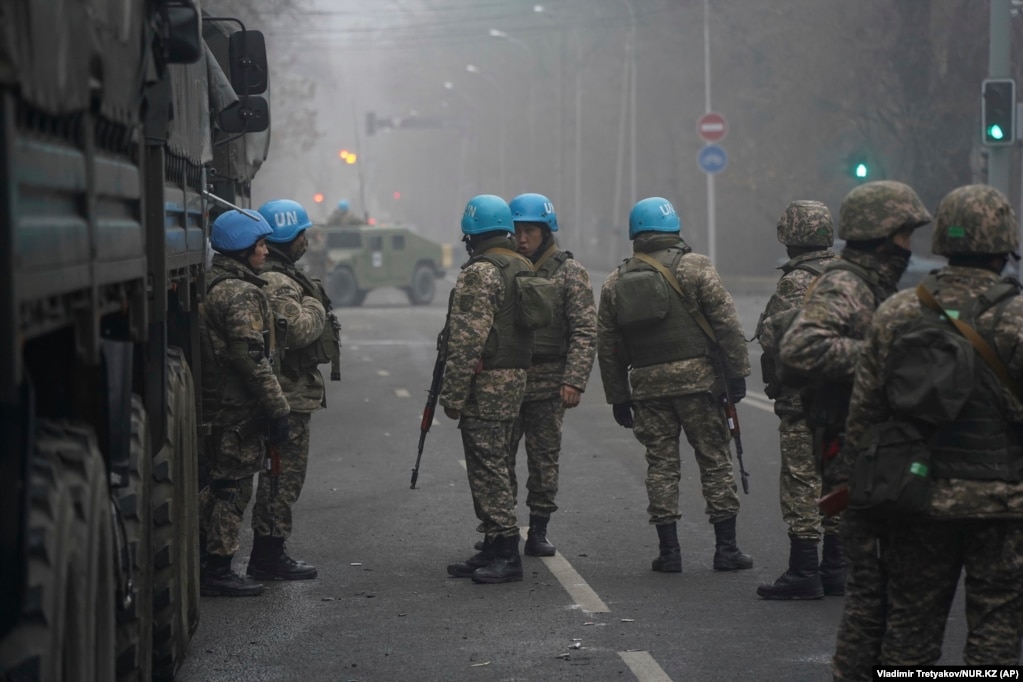
Surprising photos of soldiers in Almaty wearing UN peacekeeping helmets spark a response from the United Nations.
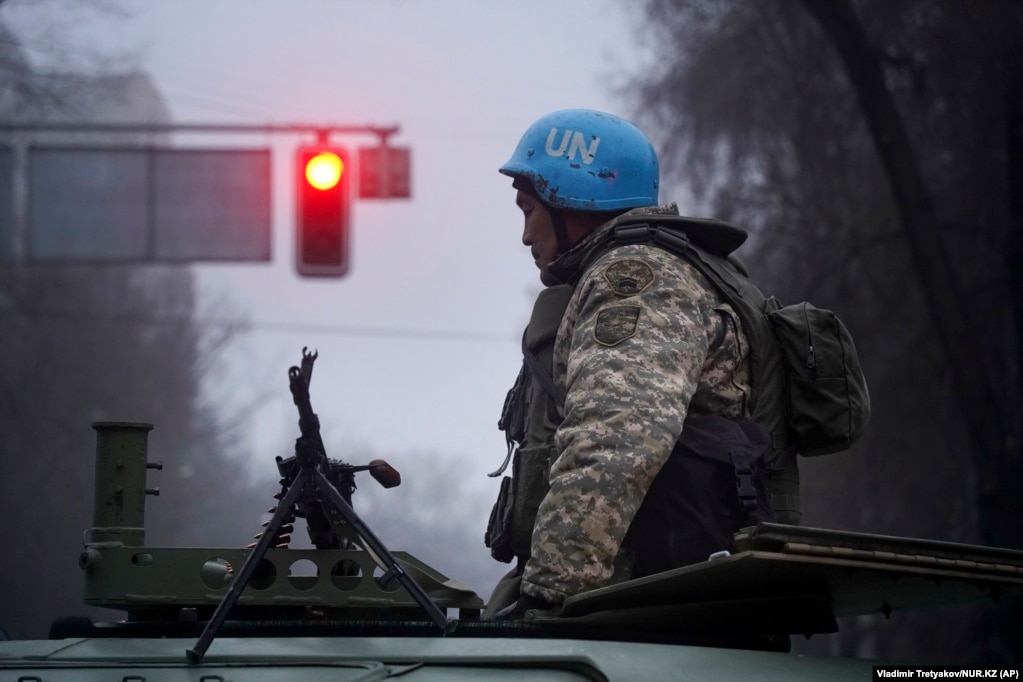
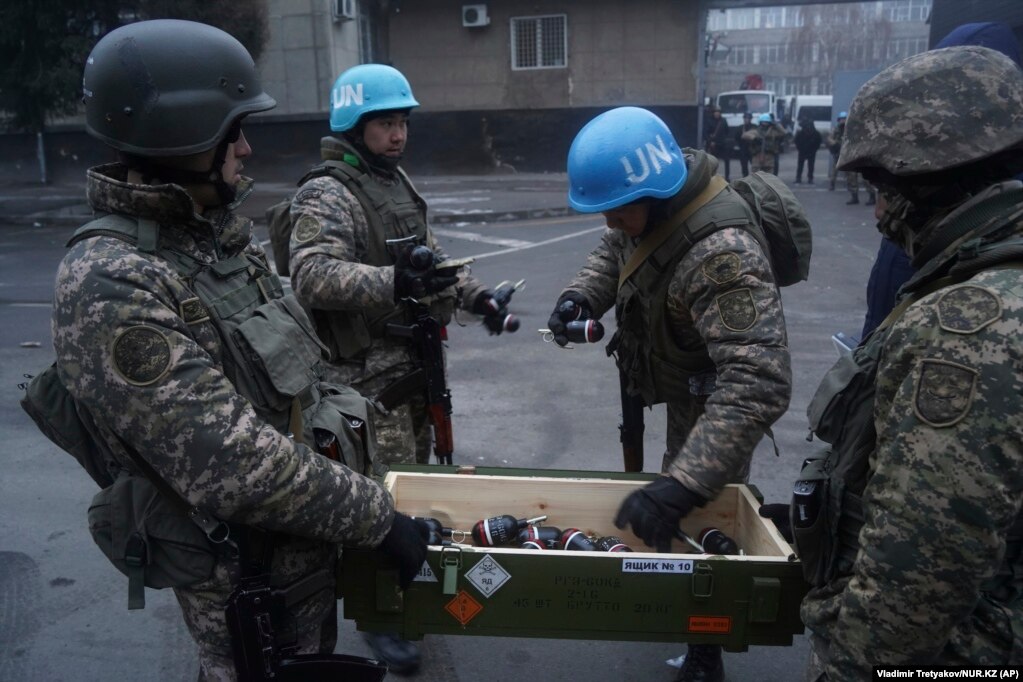
Images released by the Associated Press on January 8 show several soldiers in Kazakhstan's largest city, Almaty, wearing helmets with "UN" stenciled on them in the unmistakable colors of United Nations peacekeeping forces. The photos, made by photographer Vladimir Tretyakov and shared by independent journalist Jake Hanrahan, have added to questions over what exactly is happening in the restive Central Asian country.Since protests set off by gas prices broke out across Kazakhstan last week, Internet blackouts, unidentified gunmen, disputed official claims, and winter fog have made events on the ground increasingly murky.
Kazakh troops are seen wearing UN helmets in Almaty on January 6.
A UN peacekeeping spokesperson on January 10 confirmed to RFE/RL by e-mail that the armed men seen in the images shared by AP were not part of a UN peacekeeping mission, saying, "We have conveyed our concern to the Permanent Mission of Kazakhstan on this issue."
The spokesperson wrote that "United Nations troop and police contributing countries are to use the UN insignia only when they are performing their mandated tasks as UN peacekeepers, in the context of their deployment within a United Nations peacekeeping operation as mandated by the UN Security Council."
Kazakhstan's military does have a United Nations-backed unit of English-speaking peacekeepers known as KAZBAT who are authorized to wear blue UN helmets, but only while on parade or during a UN peacekeeping mission.
A Kazakh soldier stands near a belt-fed machine gun in Almaty on January 6. The images from Almaty in this story were released by AP on January 8.
A spokesman for Kazakhstan's Department of Defense in Almaty responded to a telephone query about the UN helmets on January 10.
First the man identified the blue-helmeted soldiers as being part of the UN-linked KAZBAT battalion, before saying they were not part of any UN mission and had a mission of "guarding strategic objects, airports, and governmental buildings."
He then said: "You may have seen online that KAZBAT has been to Libya. It's our peacekeeping corps," before adding: "you can also look up the Indian peacekeeping forces. Half of KAZBAT is now in Libya with [the Indian forces], the other half is here [in Kazakhstan]."
Kazakh forces joined an Indian battalion for a peacekeeping mission in Lebanon in 2018 and the two countries' peacekeeping forces are closely linked.
Kazakh soldiers wearing blue "UN" helmets pick out flash-bang grenades in Almaty on January 6. Arm badges on the servicemen are those of the Kazakh military.
Eric David,an expert in international humanitarian law and peacekeeping operations at the Free University Of Brussels, says the Almaty images appear to capture "a gross misuse by the authorities of the troops who wore these helmets."
David told RFE/RL that if those behind the use of the blue helmets are Kazakh officials, "they trigger the international responsibility of Kazakhstan for an internationally wrongful act."
Any unauthorized use of United Nations uniforms that results in death or serious injury constitutes a war crime in international conflicts.
But David says despite the presence of foreign troops in the country, the current violence in Kazakhstan will almost certainly be classed as an internal, rather than international conflict by the International Committee of the Red Cross. David believes therefore, that use of the blue helmets in Kazakhstan is "unlawful, but not a war crime."
The expert in international law says he doesn't have the "slightest idea" why the helmets may have been used in Almaty but that it's possible that a massive call-up from the military may have resulted in a shortage of hardware, or it could be a deliberate attempt "to give the impression that real UN troops are with the Kazakh government."
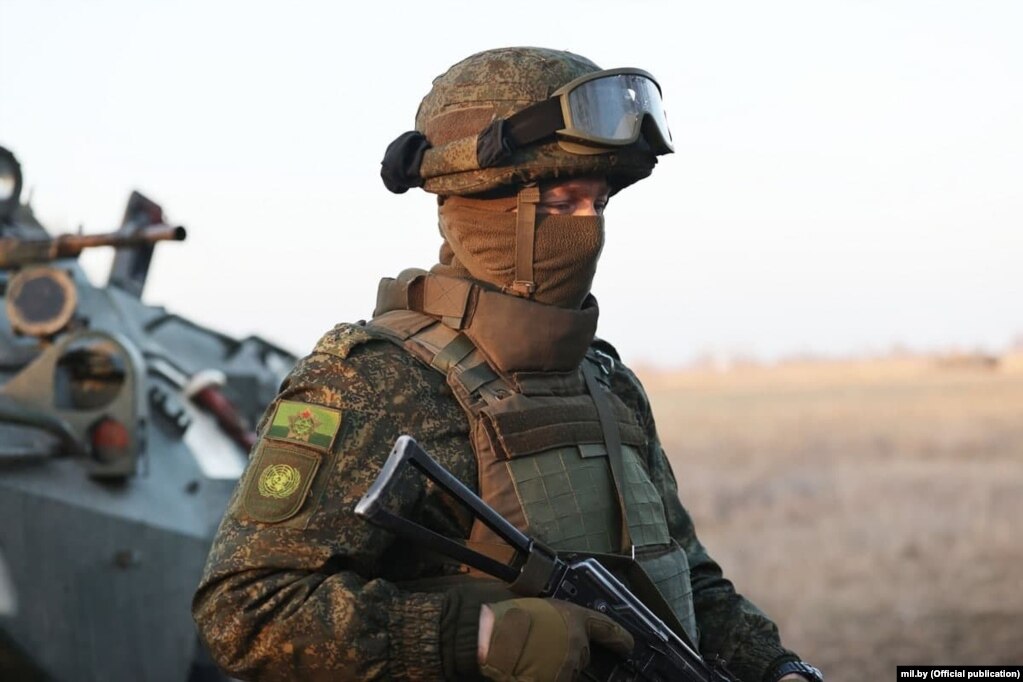
A Belarusian peacekeeping soldier near an armored vehicle in Kazakhstan. A badge on his right arm has sparked claims that Belarus is engaged in "trolling" the UN.
Adding to the questions over the blue helmets in Almaty, photos and video appeared on Belarusian state media on January 9 showing Belarusian troops sporting arm badges that some have claimed to be muted United Nations insignias.
Belarus and other countries of the Russian-led CSTO military alliance sent contingents to Kazakhstan after President Qasym-Zhomart Toqaev requested the bloc's assistance in quelling the unrest in his country.
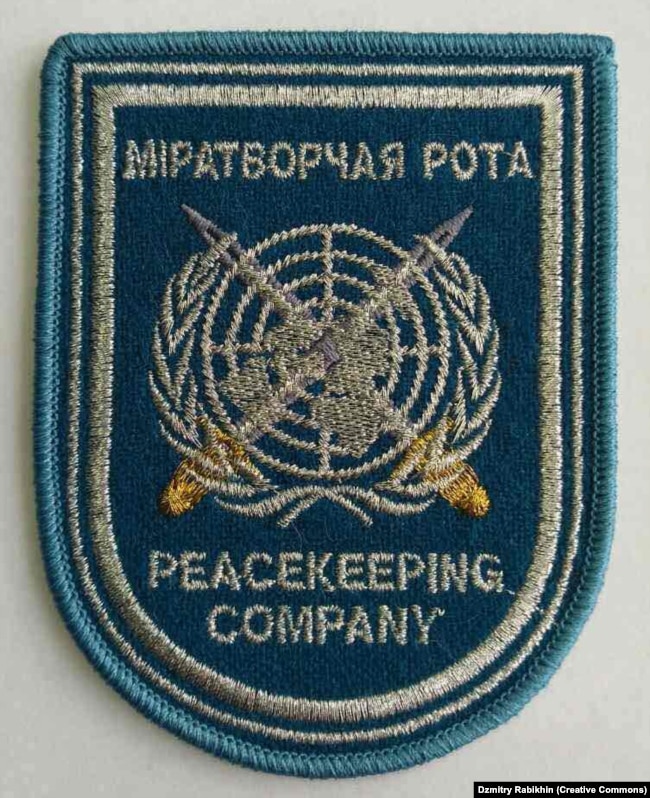
A badge of the peacekeeping company of Belarus
The insignia in fact belongs to Belarus's "Miratvorchaya Rota" and features the English translation "Peacekeeping Company" beneath an icon nearly identical to the United Nations' own design of the northern hemisphere flanked by wreaths representing peace. The Belarusian insignia has added crossed swords behind the hemisphere. The Belarusian peacekeeping unit has also served in Lebanon.
At the time of writing, a spokesperson for UN peacekeeping had not provided an answer to RFE/RL about what rules apply over the use of the United Nations' insignia in military uniforms.
What to Make of Kazakhstan’s Seemingly Sudden Unrest
As Moscow deploys troops at the behest of its Central Asian neighbor, where do Kazakhstan’s explosive protests go from here?
What started last week as a protest against fuel price increases has quickly turned into a nationwide movement that is taking aim at Kazakhstan’s elite political and economic leaders — in particularly, the semi-retired former President Nursultan Nazarbayev, whose continued role in political affairs has become a focal point of popular discontent. The demonstrations have become increasingly violent in recent days, as protesters clash with Kazakh police and Russian military personnel have been brought in at the request of Kazakhstan’s president. USIP’s Gavin Helf and Donald Jensen discuss where these explosive protests came from, Moscow’s increasing role in the crisis and where Kazakhstan goes from here.
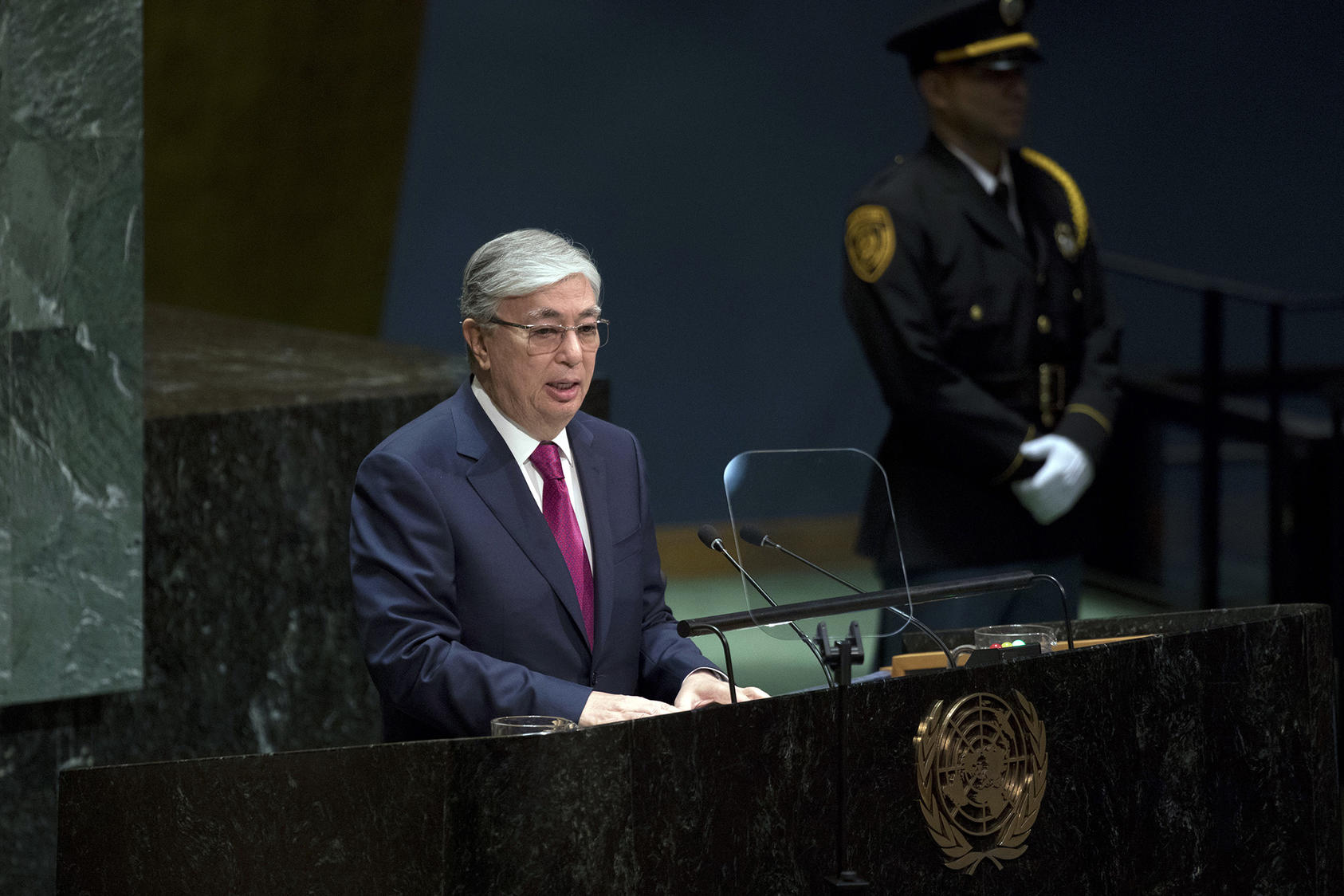
President Kassym-Jomart Tokayev of Kazakhstan, delivers remarks at the United Nations General Assembly at the United Nations headquarters in New York. September 24, 2019. (Dave Sanders/The New York Times)
Kazakhstan is the wealthiest Central Asian republic and — until now — has been the most stable. Is this all out of the blue or have warning signs been visible for a while?
Helf: In many ways, Kazakhstan is a poster child for the new “techno-authoritarianism” and a model of a successful petrostate. It has been careful about investing its oil wealth to create a robust, diverse economic future beyond petroleum and has done better at sharing the wealth throughout the society than many of its neighbors. It is now an upper middle-income economy that attracts foreign labor — unlike its neighbors, who are dependent on labor migrant remittances from Russia.
Problems in the past that have led to protests have been usually localized and/or narrowly focused —such as labor unrest in Western Kazakhstan, protests over land ownership (especially by Chinese companies), inter-ethnic conflicts and protests over consumer debt relief and inflation.
As in a lot of places, Kazakhstan’s good economy has been shaken by COVID and government has lost some of its shine over the last two years. Corruption, always endemic at some level, has become more offensively obvious during COVID. What has been surprising this time, though, is the sudden and wide geographic spread of the discontent and its initial lack of focus.
Kazakhstan saw local protests get out of hand ten years ago, but a brutal, heavy-handed crackdown was employed to quell them. In the interim, authorities have tried to learn from that experience and developed a more sophisticated game plan. So far, they’ve tried to address concerns over fuel price hikes by reversing — and then cutting — the prices, and then cutting prices on other commodities and making other economic concessions. When that didn’t work, they blamed the ministries and the prime minister, who the president then fired as a scapegoat. This, again, has not worked to quell the protests.
Who are the protesters then, and how has this developed?
Helf: It is very hard to get a clear picture right now, but the protests up until Wednesday were faceless, peaceful and seemed to be consistent with the kind of post-COVID economic revolt that the government thought it could buy off.
Then things took a very different turn. The protests suddenly became focused on the country’s semi-retired first president Nursultan Nazarbayev. After his official retirement in 2019, he has been publicly revered as “The Leader” and “Father of the Nation.” But as these protests developed, statues of him started to fall and reports of him preparing to seek medical treatment abroad and of his family members fleeing by private jet started to circulate. Right now, it’s not clear why this happened.
His hand-picked successor, President Kassym-Jomart Tokayev, also removed him from his chairmanship of the National Security Council and very quickly started to purge Nazarbayev’s loyalists in key positions. We still don’t know where Nazarbayev is, what role he is playing at this time or whether he is actively opposing Tokayev’s purge.
The situation on the ground changed on Wednesday night as well — turning violent. In Almaty, armed protesters seized the country’s major airport, as well as important government buildings, which they set ablaze.
What we may be seeing — in addition to a “people-power” revolt — is also a catastrophic failure of Nazarbayev’s managed transition to his successor, Tokayev, playing out in real time. Transition from one ruler and ruling family to another is a huge weak spot in authoritarian, oligarchical systems. It seldom goes well, as a fading leader tries to secure both his political legacy and the wellbeing of his family after his own passing.
January 4 also marked the 20th anniversary of the suppression of the Democratic Choice of Kazakhstan — a pro-reform, pro-Nazarbayev political movement that Nazarbayev turned against. One of their leaders, Mukhtar Ablyazov, has been very actively trying to promote regime change from abroad since his exile, and has popped up all over foreign media this week, seeming to speak for the protesters. He is likely to figure prominently in any hunt for a “foreign” hand in this drama, regardless of what he actually did over the last few days.
It’s also important to remember that in Kazakhstan, there really is no democratic opposition waiting in the wings. The government has either coopted or suppressed anyone even mildly critical of its policies over the last three decades. There are, however, plenty of grievances that nativists, Islamic extremists, xenophobes and others could try to exploit — along with plenty of political entrepreneurs with their own agendas who will try to take advantage of the situation and bend it to their own goals. Whatever comes next will likely be messier than what has come before.
President Tokayev has appealed to the Moscow-dominated Collective Security Treaty Organization (CSTO) for assistance. How has Russia responded to the request, and what is motivating Moscow’s decision-making in regard to Kazakhstan?
Jensen: On January 6, Kazakh President Tokayev claimed that unrest in his country was due to “an invasion of bandit formations trained from abroad” and requested the assistance of the Russian-led Collective Security Treaty Organization (CSTO). In response, the CSTO officially announced the start of a peacekeeping mission in Kazakhstan that would be tasked with the protection of state and military facilities and assistance to police forces. Russian airborne special forces have already begun arriving in the country, and reports indicate they will send a few companies but no more than 5,000 troops total.
Russia’s immediate goal in Kazakhstan is most likely the containment and suppression of political instability at its southern border. In addition, Russia has numerous interests in Kazakhstan, including military installations, the Cosmodrome at Baikonur and valuable business investments. The protection of these locations from violent disruption is probably of paramount importance to the Kremlin.
In the long term, it’s unlikely that Moscow sees the current unrest in Kazakhstan (and the CSTO response to that unrest) as an opportunity to crystalize or serve some broader strategic approach. The events in Kazakhstan also come at an inconvenient time for the Kremlin, with its attention focused on Ukraine, where Russia has massed forces near the Ukrainian border in an effort to gain concessions from Ukraine and its Western supporters either through saber rattling or a real invasion.
With that military deployment underway, it is highly unlikely the Kremlin would use the current situation in Kazakhstan as an opportunity to use military force in Central Asia or to assert a new foreign policy doctrine. Russian policy has not been consistent regarding defense of neighboring authoritarians, and in the case of Kazakhstan, it’s not even clear whether they would be intervening to stop a democratic revolution or to stop internecine elite fighting. It is far more probable that the Kremlin is responding to events with the minimal force necessary to protect Russia’s interests.
Yanks’ Balkovec living ‘American dream’ with manager role
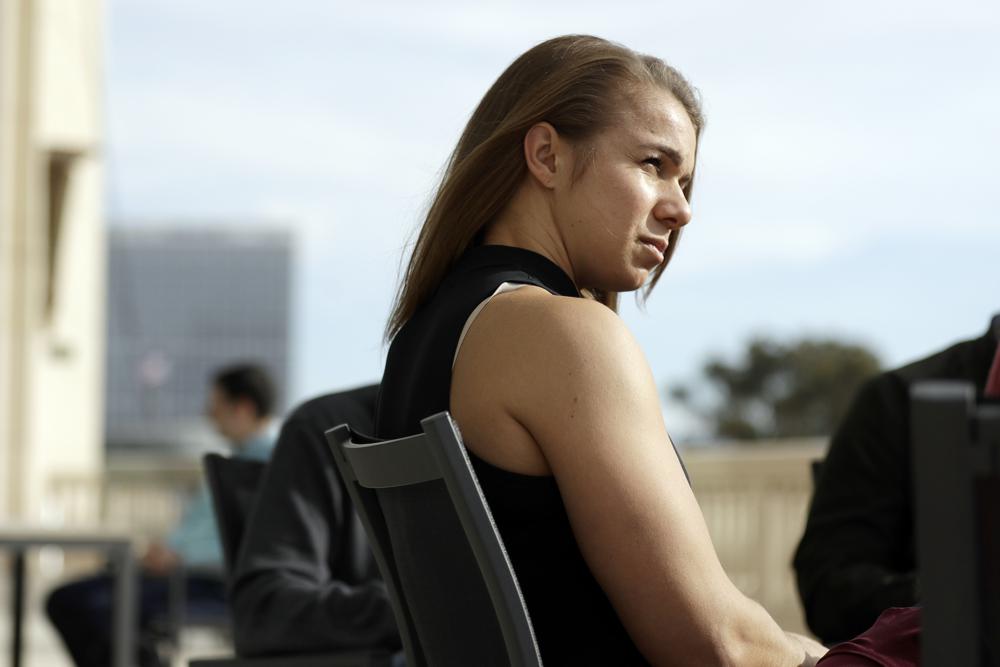
By JAKE SEINER New York Yankees minor league hitting coach Rachel Balkovec speaks to reporters during the Major League Baseball winter meetings on Dec. 10, 2019, in San Diego. Balkovec was introduced Wednesday, Jan. 12, 2022, as manager of the Tampa Tarpons, the New York Yankees’ Low A affiliate in the Florida State League. (AP Photo/Gregory Bull)
NEW YORK (AP) — Rachel Balkovec is aware of the negativity in her social media feeds and tries to leave it there. Her sisters see it, too, and can’t help but pass along certain disparaging reactions to her barrier-breaking journey.
“It’s hilarious to me,” Balkovec said. “Because it’s the American dream.”
In the clubhouse? She hasn’t seen any of that toxicity there.
Balkovec was introduced Wednesday as manager of the New York Yankees’ Low A affiliate in the Florida State League. In taking over the Tampa Tarpons, Balkovec will become the first female manager in the history of affiliated baseball, an appointment 10 years in the making for the former college softball player.
“If you know my story and you have a pulse, I think it’s pretty hard not to get behind what’s going on here,” she said.
Nearly a decade after changing her name on resumes to disguise her gender and break into baseball, the 34-year-old has smashed several barriers en route to this title. She was the first woman to serve as a full-time minor league strength and conditioning coach, then the first to be a full-time hitting coach in the minors.
This promotion — a year after former Yankees employee Kim Ng became the majors’ first female general manager with the Miami Marlins — is different. Balkovec will run the clubhouse in Tampa, charged with overseeing the development of future big leaguers for one of the most famous sports franchises in the world.
“The players that I’ve worked with, whether they like me, they don’t like me, they like what I’m saying, they don’t like what I’m saying, I do feel like they respect me,” she said.
It’s a trust she’s earned via an unusual route — one that didn’t exist 20 years ago, but not just because of her gender.
A former softball catcher at Creighton and New Mexico, Balkovec has a master’s degree in kinesiology from LSU and another in human movement sciences from Vrije University in the Netherlands. She’s worked in strength and conditioning with the St. Louis Cardinals and Houston Astros since first breaking into pro ball in 2012, and also spent time at Driveline Baseball, a data-driven center that has trained numerous major leaguers. She’s an expert in performance science, precisely the expert teams are coveting.
When the Yankees hired her as a minor league hitting coach in 2019, she was at the forefront among women breaking into uniformed jobs, but she was hardly the only coach without a traditional playing background.
Hitting 95 mph isn’t the same skill as teaching someone else to, and as teams have shifted their focus in the hiring process to reflect that, it’s created a pathway for women like Balkovec or Alyssa Nakken, part of the San Francisco Giants’ major league coaching staff since 2020.
“There wasn’t a ton of debate as to whether baseball was ready or the world was ready,” said vice president of baseball operations Kevin Reese, who made the decision to promote Balkovec. “We’re trying to find the best people and put them in the best position to have an impact here.”
Reese, introduced Wednesday under a new title after being promoted from senior director of player development, helped hire Balkovec in 2019 and has been overwhelmingly impressed with her expertise and ability to lead, including with young Latin American players. The Nebraska native taught herself Spanish after becoming Houston’s Latin American strength and conditioning coach in 2016, and some of her most notable work has been with New York’s Spanish-speaking players, including top prospect Jasson Dominguez.
General manager Brian Cashman has had a woman as an assistant general manager since hiring Ng in 1998. When she left in 2001, Jean Afterman was appointed to the role and has been there since. Balkovec has expressed interest in one day working in the front office and potentially becoming a GM herself.
“The sky’s the limit,” Cashman said. “She’s determined. She’s strong. She’s got perseverence.”
She’s needed it. After serving her temporary role with St. Louis in 2012, she began applying for baseball jobs with what she knew was a rock-solid resume. And yet, only one team responded.
Her point of contact with that club said his bosses wouldn’t let him hire a woman in a strength and conditioning role. Even worse, that person called around to other teams with vacancies, and they all told him the same.
“In that very moment, my level of naivete went from a 10 to a zero,” she said.
One of her sisters suggested changing her name to “Rae Balkovec” on her resume, and the tactic worked to at least get hiring managers on the phone. The Cardinals brought her back as a full-time strength and conditioning coordinator in 2014.
She’s seldom had issues with players related to her gender — “so little it’s hardly worth mentioning,” she said. Being the only woman in that trail-blazing role was lonely, though.
Now, she believes there will be 11 women with on-field jobs in affiliated ball next year, and she’s able to compare experiences with them. Tennis great Billie Jean King was among the many who congratulated her on the Tampa job, and she’s developed a network of support that’s reinforced her confidence that she’s ready for the role.
“On behalf of Major League Baseball, I congratulate Rachel on this historic milestone,” Commissioner Rob Manfred said. “As manager of the Tampa Tarpons, she will continue to demonstrate her expertise and leadership in the Yankees’ organization. We wish Rachel well in this new capacity and appreciate her mentorship to the growing network of women in baseball operations and player development roles.”
The job ahead of her, though, is the same as any other skipper — get the most out of the players in her clubhouse.
“My goal is really to know the names of the girlfriends, the dogs, the families of all the players,” she said. “My goal is to develop them as young men and young people who have an immense amount of pressure on them. My goal is to support the coaches that are on the staff.
“We’re going to be talking more nuts and bolts of pitching and hitting with them, and defense. It’s really just to be a supporter, and to facilitate an environment where they can be successful.”
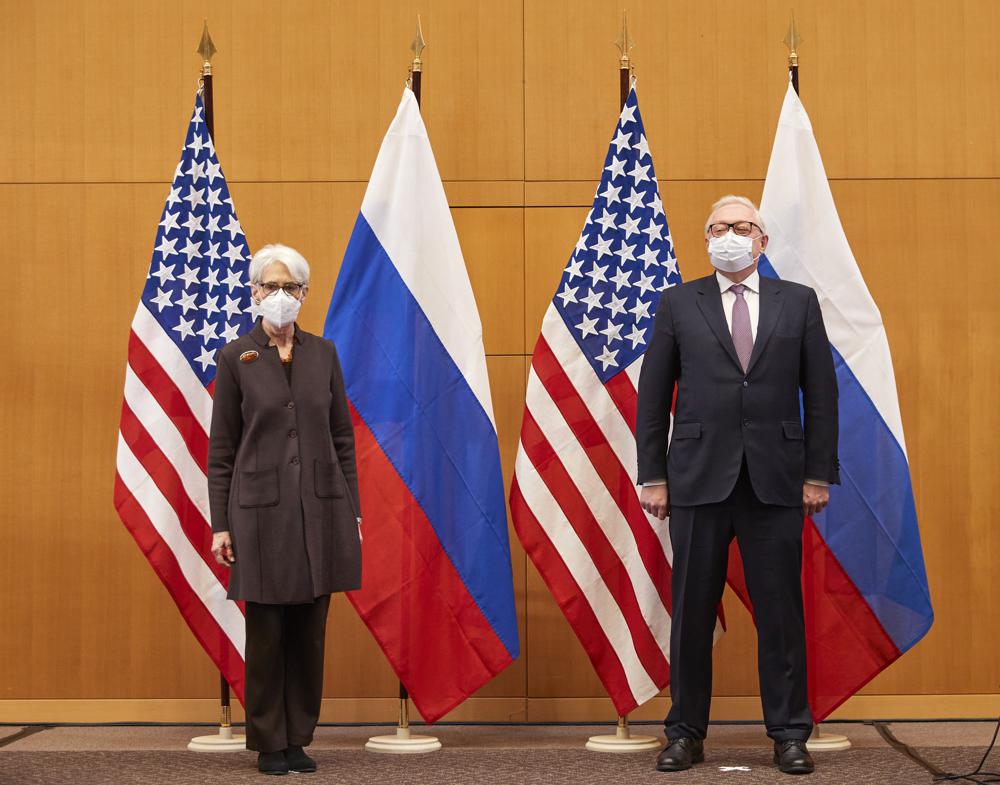
US Deputy Secretary of State Wendy Sherman, left, and Russian deputy foreign minister Sergei Ryabkov attend security talks at the United States Mission in Geneva, Switzerland, Monday, Jan. 10, 2022. (Denis Balibouse/Pool via AP)
MOSCOW (AP) — Russia raised the stakes Thursday in its dispute with the West over Ukraine and NATO’s expansion when a top diplomat refused to rule out a military deployment to Cuba and Venezuela if tensions with the United States escalate.
Deputy Foreign Minister Sergei Ryabkov said he could “neither confirm nor exclude” the possibility of Russia sending military assets to Latin America if the U.S. and its allies don’t curtail their military activities on Russia’s doorstep.
“It all depends on the action by our U.S. counterparts,” the minister said in an interview with Russian television network RTVI, citing Russian President Vladimir Putin’s warning that Moscow could take unspecified “military-technical measures” if the U.S. and its allies fail to heed its demands.
Ryabkov led a Russian delegation in talks with the U.S. on Monday. The negotiations in Geneva and a related NATO-Russia meeting in Brussels took place in response to a significant Russian troop buildup near Ukraine that the West fears might be a prelude to an invasion.
Russia, which annexed Ukraine’s Crimea Peninsula in 2014, has denied having plans to attack the neighboring country. The Kremlin reacted to the suggestion by accusing NATO of threatening its territory and demanding that the military alliance never embrace Ukraine or any other ex-Soviet nations as new members.
Washington and its allies firmly rejected the demand this week as a nonstarter, but the NATO and Russian delegations agreed to leave the door open to further talks on arms control and other issues intended to reduce the potential for hostilities.
A senior Biden administration official suggested Thursday that Ryabkov’s statement about Cuba and Venezuela had not changed Washington’s calculations.
“We are not going to respond to bluster. If Russia actually started moving in that direction, we would deal with it decisively,” said the official, speaking on condition of anonymity to discuss the ongoing negotiations.
Ryabkov last month compared the current tensions over Ukraine with the 1962 Cuban Missile Crisis — when the Soviet Union deployed missiles to Cuba and the U.S. imposed a naval blockade of the island.
That crisis ended after U.S. President John F. Kennedy and Soviet leader Nikita Khrushchev agreed that Moscow would withdraw its missiles in exchange for Washington’s pledge not to invade Cuba and the removal of U.S. missiles from Turkey.
Putin, in seeking to curtail the West’s military activity in Eastern Europe, has argued that NATO could use Ukrainian territory to deploy missiles capable of reaching Moscow in just five minutes. He warned that Russia could gain a similar capability by deploying warships armed with the latest Zircon hypersonic cruise missile in neutral waters.
Soon after his first election in 2000, Putin ordered the closure of a Soviet-built military surveillance facility in Cuba as he sought to improve ties with Washington. Moscow has intensified contacts with Cuba in recent years as tensions with the U.S. and its allies mounted.
In December 2018, Russia briefly dispatched a pair of its nuclear-capable Tu-160 bombers to Venezuela in a show of support for Venezuelan President Nicolas Maduro amid Western pressure.
Ryabkov said a refusal by the U.S. and its allies to consider the key Russian demand for guarantees against the alliance’s expansion to Ukraine and other ex-Soviet nations makes it hard to discuss the confidence-building steps that Washington says it’s ready to negotiate.
“The U.S. wants to conduct a dialogue on some elements of the security situation ... to ease the tensions and then continue the process of geopolitical and military development of the new territories, coming closer to Moscow,” he said. “We have nowhere to retreat.”
Ryabkov described U.S. and NATO military deployments and drills near Russia’s territory as extremely destabilizing. He said U.S. nuclear-capable strategic bombers flew just 15 kilometers (9 miles) from Russia’s border.
“We are constantly facing a provocative military pressure intended to test our strength,” he said, adding that he wondered how Americans would react “if our bombers fly within 15 kilometers off some U.S. bases on the East or the West Coast.”
The high-stakes diplomacy this week took place as an estimated 100,000 Russian troops with tanks and other heavy weapons are massed near Ukraine’s eastern border. Kremlin spokesman Dmitry Peskov on Thursday rebuffed the West’s calls for a troop pullback from areas near Ukraine.
“It’s hardly possible for NATO to dictate to us where we should move our armed forces on Russian territory,” he said.
Peskov said this week’s talks produced “some positive elements and nuances,” but he characterized them as unsuccessful overall.
“The talks were initiated to receive specific answers to concrete principal issues that were raised, and disagreements remained on those principal issues, which is bad,” Peskov said in a conference call with reporters.
He warned of a complete rupture in U.S.-Russia relations if proposed sanctions targeting Putin and other top civilian and military leaders are adopted. The measures, proposed by Senate Democrats, would also target leading leading Russian financial institutions if Moscow sends troops into Ukraine.
Russian Foreign Minister Sergey Lavrov likewise denounced the proposed sanctions as a reflection of U.S. “arrogance,” adding that Moscow expects a written response to its demands from the U.S. and NATO next week in order to mull further steps.
Tensions revolving around Ukraine and Russia’s demands on the West again appeared on the table at a Thursday meeting of the Organization for Security and Cooperation in Vienna.
Polish Foreign Minister Zbigniew Rau, who assumed the position of the OSCE’s chairman-in-office, noted in his opening speech that “the risk of war in the OSCE area is now greater than ever before in the last 30 years.”
The tensions over Ukraine also figured high on the agenda of a meeting of European Union foreign ministers in Brest, France. Danish Foreign Minister Jeppe Kofod said it’s important “for Putin to understand that the military threats, the game he’s playing, the way he’s trying to take us back to the darkest days of the Cold War, is totally unacceptable.”
The EU’s foreign policy chief, Josep Borrell, reiterated that “any further aggression against Ukraine will have massive consequences and severe costs for Russia.” Borrell said the 27-country bloc is providing 31 million euros ($35.5 million) in logistical assistance to the Ukrainian army and is preparing to send a mission to help the country counter cyberattacks.
Russia seized the Crimean Peninsula after the ouster of Ukraine’s Moscow-friendly leader and in 2014 also threw its weight behind a separatist insurgency in eastern Ukraine. More than 14,000 people have been killed in nearly eight years of fighting between the Russia-backed rebels and Ukrainian forces. .
___
Emily Schultheis reported from Vienna. Lorne Cook in Brussels and Colleen Long in Washington contributed to this report.
ANTI-ABORTION IS REALLY ANTI-BIRTH CONTROL
Abortion grows as priority issue for Democrats: AP-NORC poll
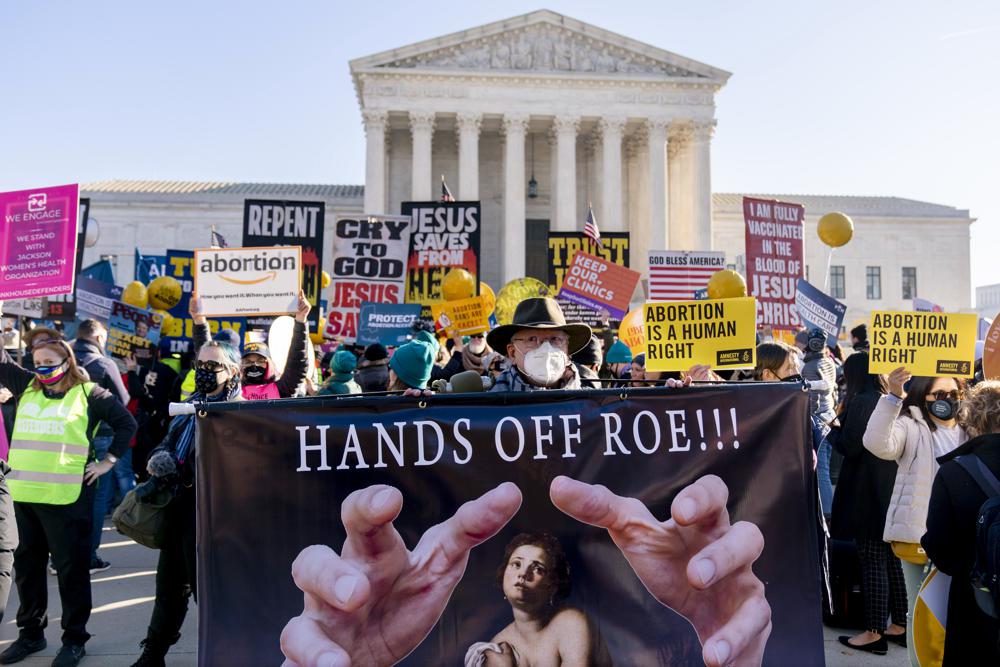
By HANNAH FINGERHUT Stephen Parlato of Boulder, Colo., holds a sign that reads "Hands Off Roe!!!" as abortion rights advocates and anti-abortion protesters demonstrate in front of the U.S. Supreme Court, on Dec. 1, 2021, in Washington. With Roe v. Wade facing its strongest threat in decades, a new poll finds Democrats increasingly view protecting abortion rights as a high priority for the government.
Thirteen percent of Democrats mentioned abortion or reproductive rights as one of the issues they want the federal government to address in 2022, according to a December poll from The Associated Press-NORC Center for Public Affairs Research. That’s up from less than 1% of Democrats who named it as a priority for 2021 and 3% who listed it in 2020.
Some other issues like the economy, COVID-19, health care and gun control ranked as higher priorities for Democrats in the poll, which allowed respondents to name up to five top issues. But the exponential rise in the percentage citing reproductive rights as a key concern suggests the issue is resonating with Democrats as the Supreme Court considers cases that could lead to dramatic restrictions on abortion access. “The public have lots of things that they want to see government addressing,” said Jennifer Benz, deputy director of The Associated Press-NORC Center for Public Affairs Research. “You ask this kind of question in a time of economic turmoil and in the time of a pandemic and all of these other things going on, we might not expect abortion to rise to the top.”
Calling the abortion polling numbers “stark,” Benz noted that conventional wisdom holds that abortion is a motivating issue for Republicans and not for Democrats. Research from the 1980s and 1990s, Benz said, “regularly found that opponents of abortion had greater strength of attitudes and considered the issue important to them personally more than pro-choice people.”
That may be changing. Sam Lau, senior director for advocacy media at the Planned Parenthood Action Fund, believes more Americans are recognizing this moment as a crisis for abortion access.
The court’s 1973 decision, reaffirmed in the 1992 ruling in Planned Parenthood v. Casey, allows states to regulate but not ban abortion up to the point of fetal viability, at roughly 24 weeks. If Roe and Casey are overturned in June, abortion would soon become illegal or severely restricted in roughly half the states, according to the Guttmacher Institute, a research organization that supports abortion rights.
That’s just months ahead of midterm elections that are expected to be challenging for Democrats.
Lau thinks people are starting to recognize they “simply cannot rely on the courts to protect our rights and our access to essential health care.”
“We are currently pushing for elected officials who are champions of sexual and reproductive health care to be bold and to go on offense and to pass proactive legislation to protect access to abortion,” Lau said. “I think voters are going to go to the polls and want to vote for candidates who they can trust to protect their health care and their reproductive freedom.”
Polling shows relatively few Americans want to see Roe overturned. In 2020, AP VoteCast, a survey of the electorate, showed 69% of voters in the presidential election said the Supreme Court should leave the Roe v. Wade decision as is; just 29% said the court should overturn the decision. In general, AP-NORC polling shows a majority of the public favors abortion being legal in most or all cases.
Still, Americans have nuanced attitudes on the issue, and many don’t think that abortion should be possible after the first trimester or that women should be able to obtain a legal abortion for any reason.
For 41-year-old Rachelle Dunn, who knew girls in high school and women in college and her adult life who have needed abortions, it’s “just health care.”
“It’s something that women I have known through my life have needed for different reasons,” said Dunn, of Tarentum, Pennsylvania. “The government needs to step in because all of these laws are being written and passed, but none of them are for medical reasons.”
She’s concerned about a domino effect from these Supreme Court cases, adding that she worries about how they will affect her two daughters’ futures, as well as her son’s.
“It just seems like, if it’s been affirmed, repeatedly, why are we still doing this?” Dunn said.
___
The AP-NORC poll of 1,089 adults was conducted Dec. 2-7 using a sample drawn from NORC’s probability-based AmeriSpeak Panel, which is designed to be representative of the U.S. population. The margin of sampling error for all respondents is plus or minus 4.1 percentage points.
TOXIC
Rubble brings opportunity, and risk, in war-scarred Gaza By FARES AKRAM 1 of 11
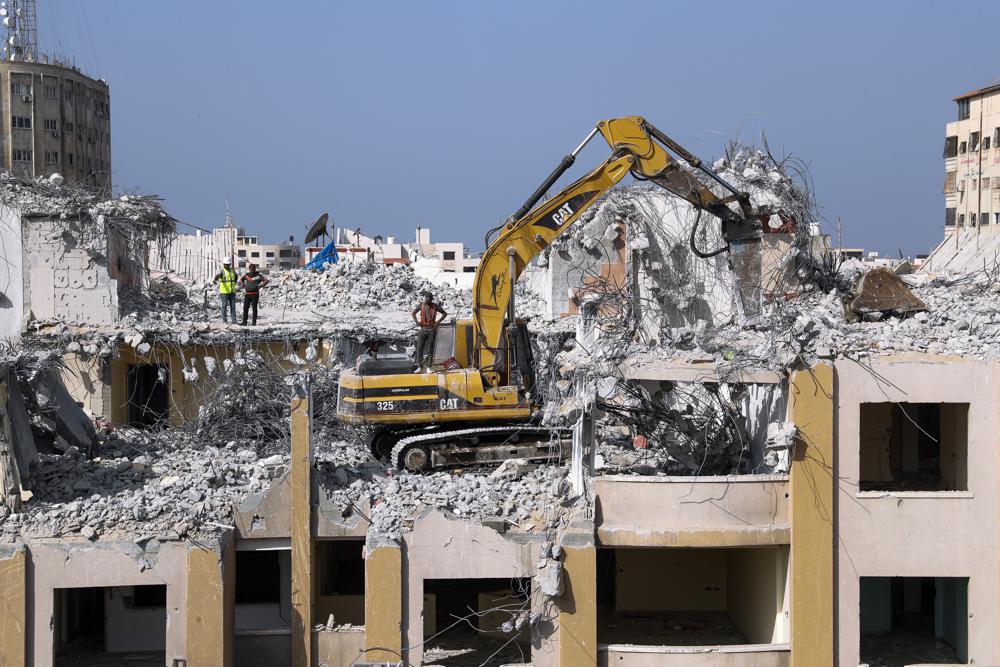
Palestinian workers use a backhoe to break and remove parts of the Al-Jawhara building, that was damaged in Israeli airstrikes during Israel's war with Gaza's Hamas rulers last May, in the central al-Rimal neighborhood of Gaza City, Nov. 16, 2021. The Gaza Strip has few jobs, little electricity and almost no natural resources. But after four bruising wars with Israel in just over a decade, it has lots of rubble. Local businesses are now finding ways to cash in on the chunks of smashed concrete, bricks and debris left behind by years of conflict. (AP Photo/Adel Hana)
GAZA CITY, Gaza Strip (AP) — The Gaza Strip has few jobs, little electricity and almost no natural resources. But after four bruising wars with Israel in just over a decade, it has lots of rubble.
Local businesses are now finding ways to cash in on the chunks of smashed concrete, bricks and debris left behind by years of conflict. In a territory suffering from a chronic shortage of construction materials, a bustling recycling industry has sprouted up, providing income to a lucky few but raising concerns that the refurbished rubble is substandard and unsafe.
“It’s a lucrative business,” said Naji Sarhan, deputy housing minister in the territory’s Hamas-led government. The challenge, he said, is regulating the use of recycled rubble in construction.
“We are trying to control and correct the misuse of these materials,” he said.
Israel and Gaza’s Hamas rulers have gone to war four times since the Islamic militant group, which opposes Israel’s existence, seized control of the territory in 2007. The most recent fighting was in May. Israeli airstrikes have damaged or leveled tens of thousands of buildings in the fighting.
The United Nations Development Program says it worked with the local private sector to remove some 2.5 million metric tons of rubble left behind from wars in 2009, 2012 and 2014. Gaza’s Housing Ministry says the 11-day war in May left an additional 270,000 tons.
The UNDP has worked on rubble recycling since Israel’s 2005 withdrawal from Gaza. It also has played a key role in the latest cleanup, removing about 110,000 tons, or more than one-third of the rubble. That includes the Al-Jawhara building, a high-rise in downtown Gaza City that was damaged so heavily by Israeli missiles that it was deemed beyond repair. Israel said the building housed Hamas military intelligence operations.
Over the past three months, excavators lifted atop the building systematically demolished it floor by floor. Just one floor remains and the construction crews are now removing the building’s foundations and pillars on the ground.
In a common scene outside every building destroyed by the war, workers separated twisted rebar iron from the debris, to be straightened out and re-used in things like boundary walls and ground slabs.
Israel and Egypt have maintained a crippling blockade on Gaza for the past 15 years, restricting the entry of badly needed construction materials. Israel says such restrictions are needed to prevent Hamas from diverting goods like concrete and steel for military use. Since 2014, it has allowed some imports under the supervision of the United Nations. But thousands of homes need to be repaired or rebuilt, and shortages are rampant.
The UNDP has put tight restrictions on its recycling effort. It says that renewed rubble is not safe enough for use in building homes and buildings. Instead, it allows it to be used only for road projects.
“We do not recommend any of the rubble to be used for any reconstruction as such, because it is not a good quality material for reconstruction,” said Yvonne Helle, a UNDP spokeswoman. She said the metal is separated and returned to the buildings’ owners because it “also has a value.”
On a recent day, trucks trickled into a lowland in central Gaza near the Israeli frontier, carrying large chunks from the Al-Jawhara tower. The site, adjacent to a mountain of garbage serving as Gaza’s main landfill, is overseen by the UNDP.
A wheel loader filled a bucket with debris that was tossed into a crushing machine. It produces large pieces of aggregate that the site supervisor said could be used as a base under the asphalt layer in street construction. Because of safety concerns, they are not allowed to crush the rubble into smaller aggregate that could be used in house construction.
The trucks then return to Gaza City where the UNDP is funding a road project, providing a much-needed source of work in a territory with nearly 50% unemployment.
The U.N. road projects have provided a partial solution for the rubble problem, but most of Gaza’s debris continues to make its way into the desperate private sector.
Sarhan, the Housing Ministry official, said it is forbidden to use recycled rubble in major construction. But he said enforcing that ban is extremely difficult and much of the material is creeping back into the local construction markets.
Ahmed Abu Asaker, an engineer from the Gaza Contractors’ Union, said many brick factories use the local aggregate, which he said is not a “great concern.” He said there have been a few isolated cases of it being mixed into concrete, which is far more dangerous.
There have not been any reports of building collapses. But Abu Asaker estimates that thousands of homes have been built with materials from recycled rubble since 2014.
Just north of the UNDP processing center, about 50 rubble crushers were hard at work at a private facility on a recent day, producing different kinds of aggregate.
The most popular items are the “sesame,” which is used for making cinder blocks, and the “lentil-like” grind sent to cement-mixing factories.
Around the crushers were mounds of small aggregate, with tiny pieces of shredded plastic, cloth and wood clearly mixed in.
Antar al-Katatni, who runs a nearby brick factory, says he makes bricks using the sesame aggregate. He acknowledged the material has impurities like sand, but there is an upside. “It makes more bricks,” he said.
He said engineers do not buy his blocks for internationally funded projects, because they are not allowed to do so, “but poor people do.”
A brick costs two shekels, or about 65 cents, when it’s made with higher quality Israeli-imported aggregate. The price for the ones he makes are slightly cheaper, at 1.7 or 1.8 shekels. When a typical project might require several thousand bricks, even the small price difference can add up for a poor family.
Sarhan said that given the blockade and Gaza’s numerous other problems, it is difficult to regulate the gray market industry.
“We cannot patrol or control every citizen,” he said. “That’s why you may find someone used recycled rubble here or there.”