Tuesday, February 15, 2022

Opinions
This is how western media lose credibility in Ukraine

 Julia Kazdobina dissects why a recent New York Times article about the alleged dangers of “armed nationalists in Ukraine” does a disservice to the credibility of western media in Ukraine.


By Julia Kazdobina, for Euromaidan Press
2022-02-15

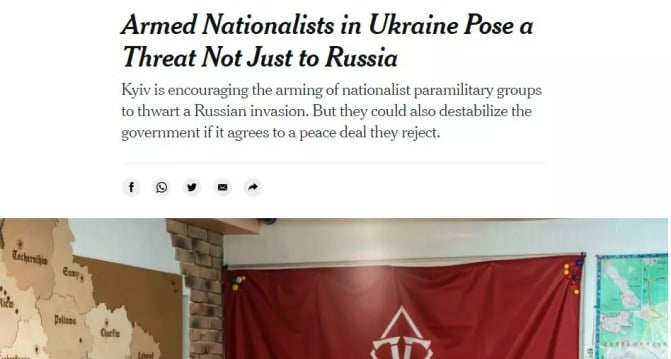
An article titled Armed Nationalists in Ukraine Pose a Threat Not Just to Russia by Moscow-based Andrew E. Kramer appeared in The New York Times on February 10.https://22b51b025223c4b5c1254f15b1f24f79.safeframe.googlesyndication.com/safeframe/1-0-38/html/container.html

A very poorly done piece of reporting, it contains factual inaccuracies, seems to deny Ukrainians the right to assembly and self-expression, as well as the right to self-defense.Screenshot from New York Times

The inaccuracies seem to be intentional since they help blow out of proportion the point the article would probably even fail to make if the reporter had done his job.

The article is centered on the Democratic Axe – a minor political party that has been around since 2018. Its main goal is to decrease the role of government. It ran about a dozen candidates in the 2019 parliamentary elections and in the 2020 local election. Democratic Ax is a bunch of computer geeks who oppose the government and periodically stage small peaceful protests. Their popularity rating is close to zero but they do participate in various civic bodies that exercise government oversight. And they are NOT even close to being a nationalist paramilitary group.
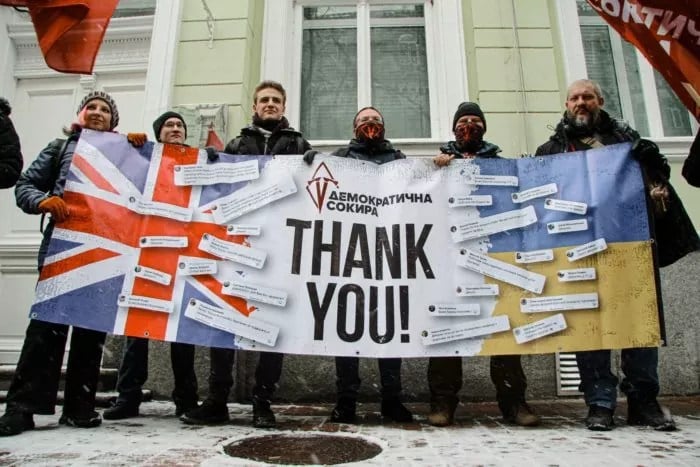
Democratic Axe activists deliver printed notes of Ukrainians addressed to the United Kingdom, thanking for deliveries of weapons. Photo: Democratic Axe’s Facebook page

There is no policy in Ukraine encouraging paramilitaries to arm, as the lead of the article would suggest. There is a policy aimed at forming and training territorial defense units to counter Russian aggression should a full-scale invasion take place. Although some paramilitaries may join and their groups could be strengthened as a result, arming them is NOT the government policy.

Also, before making this claim the author failed to check whether the government is taking any precautions against this development. Had he done that, maybe, there would have been no story?

Opposition to the settlement that Russia is trying to impose on Ukraine in the east (special status for the currently occupied territories) is NOT a fringe view. 56% of Ukrainians oppose it. And this is true for supporters of all political parties except one, including the ruling party.

Ukraine was forced to sign the Minsk deal following a military escalation caused by the Russian troops that crossed into the Ukrainian territory under the guise of pro-Russian separatists. Russia’s role in this hybrid conflict has been destructive from the start – sending its people and injecting propaganda into the situation which was already tense.

Now Russia is threatening even more military action to make Ukraine comply with Minsk’s unfavorable terms which moreover entrench the problem rather than provide a solution.

The Capitulation Resistance Movement, another organization mentioned in the article, does not call for violent action, although they too oppose the government and the aforementioned settlement. However, the right to peaceful assembly and freedom of expression are guaranteed in any democracy and in the Ukrainian Constitution. There is nothing wrong with protesting against a settlement that a majority of the population does not regard just. A peaceful protest is an exercise of democratic rights and not a threat to the government

. 
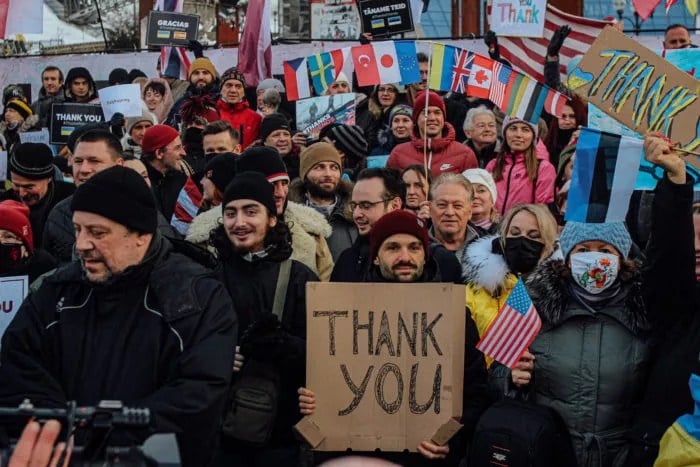
One of the recent rallies Democratic Axe co-organized with the Capitulation Resistance Movement, #ThanksFriends, took place on 30 January on Maidan Nezalezhnosti in Kyiv. Participants thanked countries that provided defensive arms to Ukraine.
 Photo: Democratic Axe’s FB page

The only time violence is mentioned in the article is closer to the end where Yuriy Hudymenko of the Democratic Axe said that he would use his Kalashnikov against the government only if government forces fire at peaceful protesters the way it happened back in 2014 at the end of the Revolution of Dignity. 

Is there anything wrong with this position? The government has no right to use firearms against a peaceful demonstration and people have the right to self-defense. So, again, is this a threat?

The title of the article is beyond any decency let alone journalistic standards. People in Ukraine are arming to fight Russia in case it invades and moves to seize more territory and kill more people. So, is this the reason they pose a threat to Russia? No other reason why they could be a threat is given in the article.

THE TITLE OF THE ARTICLE IS BEYOND ANY DECENCY LET ALONE JOURNALISTIC STANDARDS

Balanced reporting that stays true to facts is indispensable at the time of conflict. It’s needed even more when one of the parties to the conflict makes every effort to spread propaganda and to muddy the waters.

https://euromaidanpress.com/minsk-agreements-faq/embed/#?secret=BXIGQq8KDg

Unlike Russia, Ukraine does not have gas and oil revenues to get its word out nearly as loudly as Russia does, and so the propaganda pieces about violent nationalism and civil war concocted by the Russian government have found their way into the mainstream western discourse.

And the New York Times article simply perpetuates them without much respect to what is actually happening on the ground.

No wonder Ukrainians start treating the once-respected media outlet as a piece of cheap pro-Russian propaganda.

By Julia Kazdobina, for Euromaidan Press

Julia Kazdobina is Head of the Ukrainian Foundation for Security Studies, Julia specialized in government policies to counter foreign influence operations online and sanctions policy. She has served as a pro-bono advisor to the Information Policy Minister of Ukraine and holds a Master’s Degree in Political Science from the University of Rochester.
Over 330 women victims of femicide in Turkey in 2021 – report


Feb 14 2022 
http://ahval.co/en-136576

At least 339 women have been killed by men in Turkey last year, according to news website Bianet’s Male Violence Monitoring Report.

The data for 2021, in which Turkey withdrew from international Istanbul Convention on violence against women, marks the highest number of female deaths by men in Bianet’s annual monitoring reports, accounted for since 2010.

Men also killed at least 34 children and raped 96 women in the country last year, Bianet said on Monday.


Violence against women and femicide remain serious problems in Turkey, where citizens are putting increased pressure on the government to tackle the issues.

Compiling data from local and national newspapers, Bianet has recorded male violence against women in the country since 2010 on a regular basis.

According to the reports, at least 3,175 women have lost their due to violence inflicted by men between 2010 and 2021. 2021 marks a record number of female deaths by men. In 2020, 284 were killed, while in 2019, the deaths totalled 328.

Last year, at least 793 women were subjected to male violence, according to the report. At least 208 children were abused and 772 women were forced to be a sex worker, the report also showed.

As of July, Turkey formally withdrew from the Council of Europe Convention on Preventing and Combating Violence against Women and Domestic Violence, better known as the Istanbul Convention, after the President Recep Tayyip Erdoğan pulled the country out of the accord on March 19, via an executive order.

The move came after a months-long debate over whether Turkey should withdraw, with pro-government conservative and Islamist groups arguing against the convention, saying that it undermines Turkish family values and promoted homosexuality.

Erdoğan’s move led thousands to protests and the Council of State received legal appeals to suspend the withdrawal from groups including the main opposition Republican People’s Party (CHP), bar associations and women’s organisations. The court rejected those appeals.

Ankara’s withdrawal also triggered heavy criticism from the international community, including the United States and the European Union.
#FREEOCALAN


Kurdish journalist arrested in crackdown ahead of anniversary for Öcalan capture


Feb 15 2022
http://ahval.co/en-136647

Journalist Zeynep Durgut from pro-Kurdish Mezopotamya news agency was arrested in a home raid in Turkey’s southeastern Şırnak province on Monday, ahead of Tuesday’s anniversary of the capture of Abdullah Öcalan, the imprisoned leader of the outlawed Kurdistan Worker's Party (PKK).

Durgut was among scores who were arrested in police raids across the country on the same day, as a “preventive measure” before Tuesday’s anniversary, a date that usually marked by protests demanding Öcalan’s release, the agency reported on Tuesday.

The PKK leader is serving a life term and being kept in solitary confinement on the İmralı Prison island in northwestern Turkey since 1999, on charges of treason for leading the armed group, which has been fighting for Kurdish autonomous rights in southeast Turkey for almost four decades.

Öcalan was initially received a death sentence, which was subsequently commuted to life in prison when Turkey abolished the death penalty in 2004 as part of its efforts to join the European Union.


The reason for Durgut’s detention is not clear, due to the confidentiality decision brought against her file, Mezopotamya said.

"Why was a journalist detained as part of a preventive measure,” Serdar Altan, co-chair of the Tigris Euphrates Journalists Association (DFG) told the agency.


Detaining Durgut is aimed to prevent the news she will make and the reflection of the developments to the public, Altan said, urging the authorities for the journalist’s immediate release.

Mezopotamya often finds itself at odds with the official government narrative on the Kurdish conflict, and is frequently accused of news coverage that benefits the PKK, an act punishable by several years in prison under Turkey’s extensive anti-terror laws.

Making propaganda, “in a manner that would encourage a terrorist organisation to resort to violence” is punishable by up to five years in prison, which can be doubled if the crime is committed via the media, according to Turkey’s Anti-terror Act.
CLIMATE CHANGE IS INFLATIONARY

Global Vanilla Prices Could Climb After Cyclones, Late Blooming in Madagascar

Kamlesh Bhuckory, Bloomberg New(Bloomberg) -- Cyclones and late flowering may stoke vanilla prices with output in Madagascar, the biggest producer of the spice, expected to fall by more than 30% from a year ago, according to the main association of exporters.

Tropical storm Dumako is forecast by Meteo Madagascar to bring prolonged, heavy rains and winds after making landfall Tuesday in the Indian Ocean island’s northeast region where a fifth of its vanilla is grown. It comes just weeks after Madagascar was devastated by cyclone Batsirai and storm Ana that together claimed at least 150 lives.

The disruptions will slash foreign currency revenue from a key agricultural activity for the island nation, and halt the 2021 surge in exports. Madagascar accounts most of the world’s vanilla used to flavor ice cream to baked goods.

“Add to the fact that late flowering has already reduced output by 30% in 2022, we should expect a more drastic cut in production,” according to Georges Geeraerts, president of Madagascar’s association of vanilla exporters. Such a situation will “definitely” have an impact on prices, he said by phone, without giving an estimate.

The minimum sales price is currently set by the government at $250 a kilogram.

While Batsirai caused extensive damage to the country’s south east, which accounts for 10% of output, Dumako is in a region known for high quality vanilla as well as being the biggest producer.

Madagascar exported 1,675 tons of vanilla in 2020 worth $512 million, data from the World Bank show. The U.S. was the biggest buyer, taking almost 50% of the crop.

“The past weeks, we have noticed that buyers have increased orders, in anticipation of a probable scarcity and increase in prices,” Geeraerts said.

©2022 Bloomberg L.P.
What about Hamas?

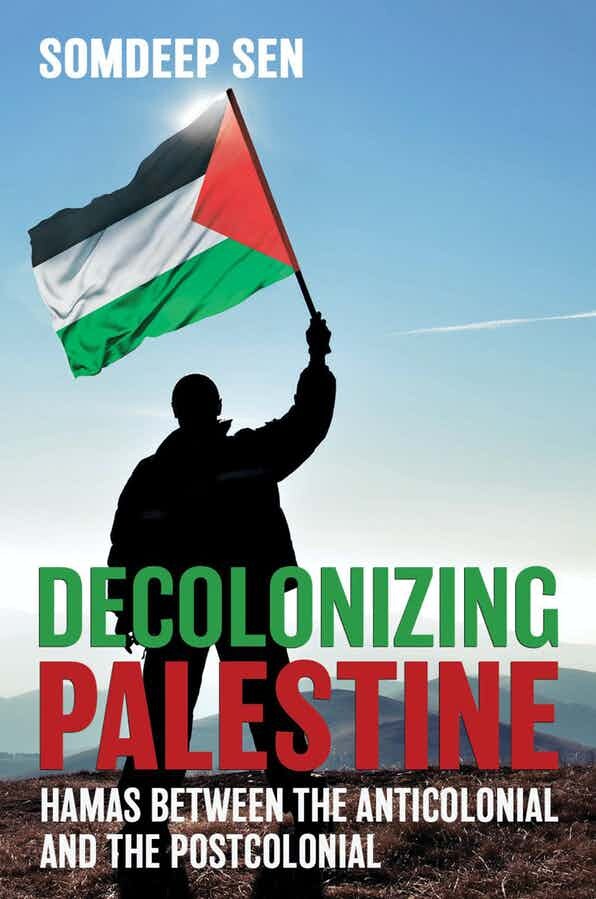
Decolonizing Palestine: Hamas between the Anticolonial and the Postcolonial 
by Somdeep Sen, Cornell University Press (2020)

Rod Such The Electronic Intifada

“But what about Hamas?”


This question ran rampant through social media exchanges last May as Israel pummeled Gaza with bombs that took down whole buildings while Hamas and other armed resistance groups fired unguided rockets into Israel, most of which were intercepted by Israel’s Iron Dome system.

The question was rarely asked in earnest but rather to deflect attention from the daily violence of a settler-colonial occupier intent on erasing the indigenous Palestinian presence, especially in occupied East Jerusalem during the period in question.

The rhetorical intent behind “doesn’t Israel have the right to defend itself” against an Islamic political organization is usually meant to tap into anti-Muslim bigotry while simultaneously seeking to recast the Palestinian victim as the victimizer. It’s a concerted effort to paint the situation as a symmetrical conflict to obscure the asymmetry of power.

For a long time now the response to this charade from Palestine solidarity activists in the US has featured its own kind of deflection. Most will correctly argue that oppressed people have the right to armed resistance. Indeed, this right is even codified in international law written in the aftermath of national liberation struggles in Africa and Asia, which ushered in the so-called postcolonial period.

Others will answer indirectly by noting that Israel originally encouraged the growth of Hamas in order to undermine the secular nationalists of the Palestine Liberation Organization. The existence of Hamas by implication is that it’s Israel’s own fault.

In both responses, however, the logic is that activists must avoid the trap of talking about the Islamic Resistance Movement, also known as Hamas.

But what if the question – what about Hamas – was answered directly? What accounts for the fact that Hamas retains steadfast popular support among many Palestinians after all these years? What explains the jubilant celebrations in Gaza extolling the ceasefire and the “Unity Intifada” when Hamas demonstrated the ability to respond to Israel’s provocations at al-Aqsa mosque?

And why have elections to the Palestinian Legislative Council been consistently postponed ever since Hamas won those elections in an upset victory in 2005? Apparently the PA and its bankrollers realize that Hamas would still make a good showing?

Resistance as self-defense

Decolonizing Palestine: Hamas Between the Anticolonial and the Postcolonial by Somdeep Sen offers some insights into these questions. The book apparently irked Israel apologists so much that some recently tried to force the University of Glasgow to vet a scheduled talk by Sen, who is a professor at Roskilde University in Denmark. Sen ultimately pulled out of the book talk.

In his book, Sen allows Hamas spokespersons to explain why they rejected the Oslo accords, revealing that the Hamas critique differs little from that offered by secular Palestinian intellectuals like Edward Said.

Hamas cofounder Sheikh Ahmed Yassin observed as early as 1999: “Nowhere in the world do resistance movements surrender their arms until they have regained their rights … But we gave up our arms at the beginning of the road and then sat waiting for handouts and rewards from the enemy.”

The reader learns that as early as 1997, Hamas leaders saw armed resistance as a kind of self-defense. “You can’t characterize what the Palestinians are doing against the occupation as violence,” Hamas leader Mousa Abu Marzook told a journalist. “In reality, it is a form of resistance. If there was no occupation, there would be no resistance.”

An examination of the origins of that resistance reveals that Israel has instigated all four of the major attacks on Gaza since 2008 while Hamas responded in self-defense. That Hamas’ resistance has resulted in numerous ceasefire agreements is a reflection of the self-defense nature of its armed struggle.

It also recalls the history of many anti-colonial struggles in which the goal of nonconventional warfare was never to achieve a decisive victory on the battlefield but simply to avoid complete defeat and gradually wear down the colonizer, as occurred in Algeria, the Portuguese-ruled African colonies, South Vietnam and apartheid South Africa, among others.

Has Hamas’ armed resistance changed since it defeated an attempted coup in Gaza in 2007, carried out by Fatah forces and supported by Israel and the US?

The author asks a Hamas-affiliated photojournalist about Hamas’ “dual role as resistance and government.”

Her response: “We need a mixture [of government and resistance], but the military wing is the most important part.” There can be no balance between the two, she asserts, “because of Israeli attacks. They have destroyed our infrastructure and prevent us from conducting proper governance.”

This qualification of “proper governance,” however, seems to escape the author, who insists on referencing “Hamas’ postcolonial governance.” Sen writes that this governance “evokes the image of an era after the withdrawal of the colonizer” (emphasis in original). According to Sen, it’s not just Hamas but also the Palestinian Authority, created under the Oslo accords, exhibiting “the pathologies of the postcolonial state.”

This assertion, in effect, echoes the mainstream media’s boilerplate description of Hamas as the political organization that “controls the Gaza Strip.” The description flips reality on its head.

Israel, after all, controls Gaza, using military force to rule its boundaries, coastal waters and airspace – what comes in and what goes out. Gaza lacks sovereignty in any meaningful sense of the term and is more correctly described as an open-air prison. If not for its resistance, Hamas would be nothing more than a trustee helping to run a prison while exercising no power over it whatsoever.
Postcolonial?

What’s more, the Oslo accords and the PA in no way reflect the advent of postcolonial governance. Both are more properly seen as a deliberate strategy of maintaining a settler-colonial regime by engaging the colonized themselves to act as security subcontractors to the occupation and farming out the costs of the occupation to the international community.

In 2003, Israeli Prime Minister Ariel Sharon openly described the settlement project as the implementation of his “Bantustan model,” the same strategy employed by the settler-colonialists in apartheid South Africa to retain their rule.

Sen is an ethnographer who conducted field work in Gaza, the West Bank, Egypt and Israel between 2013 and 2016 with the goal, he writes, of presenting “an ethnography of anticolonial violence and postcolonial statecraft in a settler colonial condition.”

Readers may be forgiven if they stumble over much of the academic jargon, while questioning whether the text might have benefited more from a study of settler-colonial histories and the resistance movements to them. Unfortunately, the book is also marred by a relatively incoherent thesis and a muddled narrative.

To return to the original question – but what about Hamas? – the answer may ultimately rest in what decolonization will look like, given that the vestiges of colonialism are likely to persist for a long time.

The liberation struggle may have only begun.

Rod Such is a former editor for World Book and Encarta encyclopedias. He lives in Portland, Oregon, where he is active in the Demilitarize Portland2Palestine campaign.
What makes Amnesty’s apartheid report different?


Maureen Clare Murphy The Electronic Intifada 3 February 2022
A Palestinian youth places a flag on Israel’s wall during a demonstration
in the West Bank village of Bilin in February 2014. 
Oren ZivActiveStills

What makes Amnesty International’s new report determining that Israel practices the crime of apartheid against Palestinians any different from those that came before it?

Certainly, Israel’s “hysterical” reaction – (in the words of one Haaretz headline) – to the Amnesty study is notably different from its relatively understated response to similar reports recently issued by B’Tselem, a human rights group in Israel, and the New York-based Human Rights Watch.

Palestinian human rights groups like Al-Haq, Adalah and Al Mezan have been advancing an apartheid framework for far longer and the reports from the above-mentioned Israeli and international groups build on their work.

Amnesty, Human Rights Watch and B’Tselem examined Israel’s system of control throughout historic Palestine that privileges Israeli Jews and marginalizes Palestinians and violates their rights by varying degrees, largely depending on where they live.

And in contrast to the analyses published by Palestinian groups, those three reports, welcomed as groundbreaking and paradigm-shifting, fall short of placing Israel’s system of apartheid in the context of settler-colonialism. (A keyword search of Amnesty’s report yields three results for the terms “colonialism” and “colonial” – found in the titles of works cited in the footnotes.)

Amnesty repeatedly stresses Israel’s “intent to maintain this system of oppression and domination” without making the explicit point that apartheid is a means towards the end of settler colonization: removing Palestinians from the land so that they may be replaced with foreign settlers.

The rights group does state that “since its establishment in 1948, Israel has pursued an explicit policy of establishing and maintaining a Jewish demographic hegemony and maximizing its control over land to benefit Jewish Israelis while minimizing the number of Palestinians and restricting their rights and obstructing their ability to challenge this dispossession.”

Credit where credit’s due: Amnesty blasts away Israel’s foundational mythology, acknowledging that it was racist from the beginning – a departure from the typical liberal attitude that Israel strayed from its ideals somewhere along the way.

Amnesty even points out that “many elements of Israel’s repressive military system in the OPT [West Bank and Gaza] originate in Israel’s 18-year-long military rule over Palestinian citizens of Israel,” beginning in 1948, “and that the dispossession of Palestinians in Israel continues today.”

Amnesty also acknowledges that “in 1948, Jewish individuals and institutions owned around 6.5 percent of Mandate Palestine, while Palestinians owned about 90 percent of the privately owned land there,” referring to all of historic Palestine prior to the establishment of the state of Israel.

“Within just over 70 years the situation has been reversed,” the group adds.

And that is Israel’s aim – the “system of oppression and domination” stressed by Amnesty is the means by which it has usurped Palestinian land for the benefit of foreign settlers.

After all, Zionist settlers didn’t come to Palestine from Europe for the purpose of dominating and oppressing Palestinians; they came with the intent of colonizing their land.

As the Jerusalem Legal Aid and Human Rights Center, a Palestinian group, states, “any recognition of Israel as an apartheid state should be situated within the context of its settler-colonial regime.”

Amnesty also refrains from examining and discussing Zionism, Israel’s racist state ideology around which its settler-colonialism project is organized.

As Adalah Justice Project, an advocacy group based in the US, asked Amnesty on Wednesday, “Is it possible to end apartheid without ending the Zionist settler colonial project


Groundwork for accountability

Despite these critical shortcomings, Amnesty’s study lays a solid groundwork for holding Israel accountable within the flawed framework of international law and makes forceful recommendations towards that end.

Amnesty joins Palestinian groups urging the International Criminal Court to “investigate the commission of the crime of apartheid” and for its prosecutor to “consider the applicability of the crime against humanity of apartheid within its current formal investigation” in the West Bank and Gaza Strip.

Given that the ICC doesn’t have territorial jurisdiction in Israel, Amnesty calls on the UN Security Council to either refer “the entire situation to the ICC” or establish “an international tribunal to try alleged perpetrators” of the crime against humanity of apartheid.

Amnesty adds that the Security Council “must also impose targeted sanctions, such as asset freezes, against Israeli officials most implicated … and a comprehensive arms embargo on Israel.”

Reiterating its “longstanding call” on states to suspend all forms of military assistance and weapons sales to Israel, Amnesty also calls on Palestinian authorities to “ensure that any type of dealings with Israel, primarily through security coordination, do not contribute to maintaining the system of apartheid against Palestinians” in the West Bank and Gaza.

Amnesty also states that Israel must recognize Palestinian refugees’ right of return and provide Palestinian victims “full reparations,” including “restitution for all properties acquired on a racial basis.”

These demands by Amnesty, which claims to be the world’s largest human rights organization, go much further than those made by Human Rights Watch and B’Tselem.

This goes some way toward explaining why Israel and its proxies and apologists attempted to pressure Amnesty to pull its report ahead of publication and, having failed to achieve that, are now resorting to the usual baseless accusations of anti-Semitism.

Yair Lapid, Israel’s foreign minister, attempted to discredit Amnesty’s report by saying it “echoes propaganda” and “the same lies shared by terrorist organizations,” referring to prominent Palestinian groups recently declared illegal by Israel.

“If Israel wasn’t a Jewish state, no one at Amnesty would dare make such a claim against it,” Lapid added.

In its report, Amnesty observes that “Palestinian organizations and human rights defenders who have been leading anti-apartheid advocacy and campaigning efforts have faced Israeli repression for years as punishment for their work.”

While Israel brands Palestinian human rights groups as “terrorist organizations,” it subjects “Israeli organizations denouncing apartheid to smears and delegitimization campaigns,” Amnesty adds.

Israel may find that such tactics when employed against the world’s largest human rights organization may not convince anyone beyond its choir.

Its attempt to “get ahead of the story,” reportedly spearheaded by Naftali Bennett, Israel’s prime minister, along with Lapid, by preemptively attacking the Amnesty report has only served to reinforce the association of Israel with apartheid.

It also ensured “that the report got a lot more exposure than it would otherwise receive,” as one Haaretz columnist observes.

Mainstreaming the apartheid framework


There is another key difference between the Amnesty report on apartheid and those that came before it.

Amnesty International is a campaigning organization with millions of members and supporters who, the group says, “strengthen our calls for justice.”

Amnesty has supplemented its report with a 90-minute online course titled “Deconstructing Israel’s apartheid against Palestinians.”

It also produced a 15-minute mini-documentary available on YouTube that breaks down the question of whether Israel practices apartheid for a mass audience:

So far Amnesty’s action items only include sending a polite letter to Naftali Bennett, Israel’s prime minister, opposing home demolitions and expulsions – hardly inspiring stuff.

Amnesty’s US chapter meanwhile has made bizarre disclaimers distancing itself from the Palestinian-led boycott, divestment and sanctions movement and even stated that the organization doesn’t take a stance on the occupation itself, instead focusing on Israel’s obligations, “as the occupying power, under international law.”

Meanwhile, its chapter in Germany has distanced itself from the report and stated that “the Germany section of Amnesty will not plan or carry out any activities in relation to this report” because of the legacy of the Holocaust and ongoing anti-Semitism in the country.

It is not the first time that Amnesty has limited its solidarity in ways that are enduringly shameful.

Both Amnesty International and Human Rights Watch are based in imperialist countries and were founded in the context of the Cold War, largely focusing on advocating for the rights of individuals in communist Eastern Europe.

Their narrow frameworks and founding ideologies have put them in opposition to anti-colonial liberation struggles and the violence those necessitate because, as Nelson Mandela put it, “it is the oppressor who defines the nature of the struggle, and the oppressed is often left no recourse but to use methods that mirror those of the oppressor.”

These fundamental contradictions mean that Western human rights groups will always take compromised, if not harmful, positions concerning Palestinian liberation, with Human Rights Watch recently suggesting a moral equivalence between the violence used by Israel against besieged Palestinians in Gaza and that of Palestinian resistance against it.

But Amnesty’s educational materials, including a lengthy Q & A, will help prepare grassroots campaigners to respond to Israel’s apologists who seek to deflect criticism of the state’s practices by attacking the messenger.

After all, as one astute observer put it on Twitter, that is the only arrow in the quiver of those committed to maintaining Israel’s apartheid rule and the situation of impunity.

Amnesty’s report is a strong indicator that an analysis beyond the 1967 occupation of the West Bank and Gaza is becoming mainstream.

Meanwhile, Israel and its proxies and abettors in the US Congress and State Department trot out tired talking points while ignoring the substance of Amnesty’s findings.

(By contrast, a few members of Congress belonging to the Democratic Party are publicly supportive of Amnesty’s findings, with Cori Bush calling for an end to “US taxpayer support for this violence.”)

But like UN and EU officials forever droning on about their commitment to the nonexistent peace process towards a two-state solution, those parroting these Israel lobby talking points so detached from reality appear increasingly ridiculous.
Israel fears UN report

While rejecting the term “apartheid” and attacking Amnesty, Israel and its proxies and supporters have their eyes on an even bigger threat to Israeli impunity.

According to an Israeli foreign ministry cable seen by the publication Axios, Israel has planned a campaign attempting to discredit a permanent UN commission of inquiry into Israel’s violations of Palestinian rights in all the territory under its control.

The UN Human Rights Council narrowly passed a resolution establishing that commission of inquiry last May following Israel’s 11-day attack on Gaza during which Palestinians rose up throughout their homeland.

Palestinian groups have long called on states “to address the root causes of Israel’s settler colonialism and apartheid imposed over the Palestinian people as a whole,” as Al-Haq said ahead of the vote.

The commission of inquiry undertaken by three independent human rights experts tapped by the Human Rights Council is expected to deliver its findings in June.

Axios reported last week that Israeli officials are “highly concerned that the commission’s report will refer to Israel as an ‘apartheid state.’”

The publication adds that “the Biden administration doesn’t support the inquiry and played a central role in cutting its funding by 25 percent in UN budget negotiations.”

A bipartisan grouping of 42 members of Congress has meanwhile called on the US secretary of state to “lead an effort to end the outrageous and unjust permanent commission of inquiry.”

But Israel apparently fears that this intervention may not be enough.

Haaretz reported this week that unnamed “senior Israeli officials” are concerned that the UN “may soon accept the narrative that Israel is an ‘apartheid state,’ issuing a serious blow to Israel’s status on the international stage.”

A UN consensus around Israeli apartheid “could lead to Israel’s exclusion from various international events, including sports competitions or cultural events,” the paper adds.

In other words, Israeli officials are afraid that the state will be treated as a global pariah as South Africa was before the fall of apartheid in that country.

The steering committee of the Palestinian-led boycott, divestment and sanctions movement – inspired by the global campaign that helped bring apartheid to an end in South Africa – argues that “investigation of Israeli apartheid by the UN and its members are necessary steps for achieving freedom, justice and equality for the Palestinian people.”

That committee urges formerly colonized states to reprise “the leading role they assumed in the UN for the eradication of apartheid in Southern Africa.”

Human Rights Watch has called for the appointment of a global UN envoy for the crimes of persecution and apartheid.

Amnesty states that the UN General Assembly “should reestablish the Special Committee against Apartheid, which was originally established in November 1962, to focus on all situations … where the serious human rights violation and crime against humanity of apartheid are being committed.”

These moves would have implications beyond the Palestinian cause within the UN system, where “bullying and political pressure have prevented the study and debate, let alone punishment, of Israeli apartheid,” according to the BDS movement steering committee.

Ultimately, Amnesty’s study may not be fundamentally different from those that came before.

But the context in which it appears – as international consensus coalesces around recognizing Israeli apartheid, an International Criminal Court investigation is underway and amid Israeli spyware blowback – suggests that a new chapter in the global struggle for Palestinian freedom may have begun.

Maureen Clare Murphy is senior editor of The Electronic Intifada


AOC Tells Joe Biden: Cancel More Student Loans to Have 'Any Chance' in 2022

BY DARRAGH ROCHE ON 2/15/22 AT 10:41 AM EST

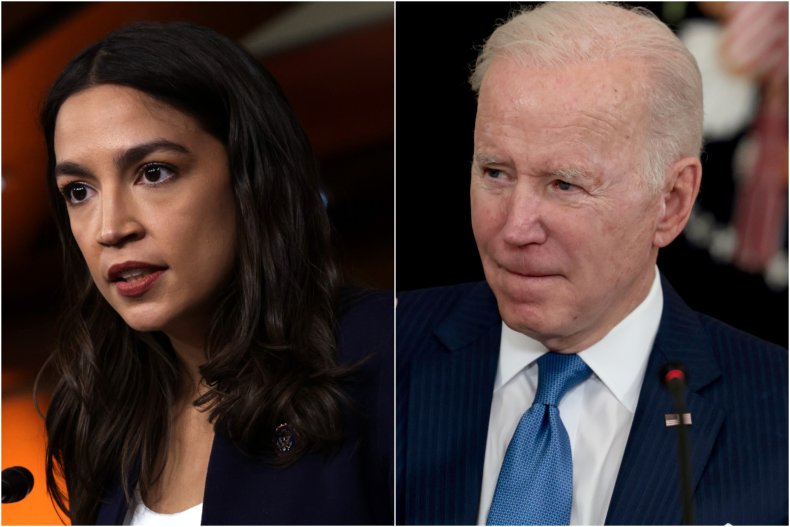
Representative Alexandria Ocasio-Cortez has warned that President Joe Biden should do more on student loan debt cancellation if the Democrats hope to have "any chance" in the 2022 midterm elections.

Ocasio-Cortez, a Democrat who represents New York's 14th congressional district, told The New Yorker in an interview published on Monday that the president's "hesitancy" on the issue was having a demoralizing effect on a key voting bloc.

Her comments come as the Democrats face crucial midterm elections in November with Republicans aiming to take back the House of Representatives and the Senate and then to potentially stymie Biden's agenda.

READ MORE Ocasio-Cortez Calls Working Atmosphere in Congress a 'Sh** Show'

Some Democrats, including Senate Majority Leader Chuck Schumer (D-NY) and Senator Elizabeth Warren (D-MA) have urged Biden to cancel up to $50,000 in student loan debt per borrower through executive action.

The president has expressed skepticism that he has the necessary power to do that, but Ocasio-Cortez reiterated that Biden should take action on the matter.

She suggested the Biden administration had "a reluctance to use executive power."

"The president has not been using his executive power to the extent that some would say is necessary," she said.

"One of the single most impactful things President Biden can do is pursue student-loan cancellation. It's entirely within his power," Ocasio-Cortez went on.

"This really isn't a conversation about providing relief to a small, niche group of people. It's very much a keystone action politically. I think it's a keystone action economically as well," she said.

Ocasio-Cortez suggested that Biden's apparent reluctance to act on canceling student debt through executive action could have an impact on the midterms.

"And I can't underscore how much the hesitancy of the Biden administration to pursue student-loan cancellation has demoralized a very critical voting block that the president, the House, and the Senate need in order to have any chance at preserving any of our majority," she said.

Millennials (those aged 25 to 40) and Generation Z (which includes children as well as adults aged 18 to 24) are a growing demographic group and many hold student loan debt. Polls have also shown these groups generally favor student debt cancellation.

Ocasio-Cortez, who is a member of the progressive "Squad," said she didn't believe there was "any guarantee" that Senators Joe Manchin (D-WV) and Kyrsten Sinema (D-AZ) would approve legislation "that will significantly and materially improve the lives of working people," admitting that was a "dismal assessment."

"The president has a responsibility to look at the tools that he has," she said.

Action on Student Debt


The Biden administration has touted the fact that it has discharged around $15 billion in student debt to more than 675,000 borrowers.

A spokesperson for the Department of Education told Newsweek on February 5: "While we continue to deliver immediate relief for borrowers struggling with debt we are also making permanent changes that reduce indebtedness and make college more affordable."

Nonetheless, Biden has been under pressure to do more. In April, he asked the Department of Education to prepare a memo on his ability to cancel up to $50,000 of student debt per borrower by executive action.

However, that memo has never been released in unredacted form, despite more than 80 lawmakers demanding its release in January, 2022.

Recent polls have shown Republicans leading Democrats ahead of the midterm elections, which may make Ocasio-Cortez's warning more concerning. If the GOP retakes control of either chamber of Congress, they could block President Biden's agenda for the two years leading into the 2024 presidential election.

Newsweek has asked the White House and Rep. Ocasio-Cortez's office for comment.

A judge just handed Trump a major loss in the DC attorney general's lawsuit over inauguration funds as the case heads to trial
President Donald Trump and first lady Melania Trump walk on the South Lawn of the White House in Washington, Saturday, Dec. 5, 2020, before boarding Marine One for a short trip to Andrews Air Force Base, Md. Trump is en route to Georgia for a rally for U.S. Senate candidates David Perdue and Kelly Loeffler. 
AP Photo/Patrick Semansky

A judge reinstated the Trump Organization as a defendant in a lawsuit over the potential misuse of inauguration funds.

The DC Attorney General alleges the organization wrongly took nonprofit funds from Trump's 2017 inauguration.

A judge ruled the AG brought enough evidence to keep the company as a defendant.

A Washington, DC judge reinstated the Trump Organization as a defendant in a lawsuit brought by the district's attorney general over whether former President Donald Trump misused funds for his 2017 inauguration — reversing an earlier decision and handing a major loss to Trump as the case heads to trial.


DC Attorney General Karl A. Racine filed the civil lawsuit in January 2020. He accused the Trump Organization, the Trump International Hotel in DC, and Trump's 2017 presidential inaugural committee, which is a tax-exempt nonprofit, of using tax-free funds to improperly pay the Trump Organization and members of the Trump family.

In November, DC Superior Court Judge José M. López cleaved the Trump Organization off the case, ruling that Racine's office didn't bring enough evidence to establish the company may have broken the law.

Racine filed a motion for reconsideration later that month. On December 31, the case was transferred to a different judge, Yvonne Williams, who ruled Wednesday night that the Trump Organization should remain in the case after all.

She pointed out in her ruling that Gentry Beach, a man who the attorney general's office says was acting on behalf of the Trump Organization, appeared to conflate the company and the inaugural committee when booking a block of hotel rooms.

"The contract involved a large block of rooms booked for people affiliated with the Trump Organization at the Loews Madison Hotel during the week of the 2017 Inauguration," Williams wrote. "Mr. Beach signed the contract on behalf of the Trump Organization and listed Lindsay Santoro, Mr. Donald Trump Jr.'s personal assistant, as the point of contact for the rooms."

Lawyers for the Trump Organization argued that the attorney general's office failed to collect any testimony from Beach. But Williams wrote that López erroneously ruled in their favor without first considering whether Racine should be able to issue a subpoena to depose Beach.

Racine celebrated the new ruling Wednesday night.


"Big news: The judge added the Trump Org in NY back into our lawsuit against the Presidential Inaugural Committee," he wrote on Twitter. "Our lawsuit is moving forward fully intact & full steam ahead. We sued the inaugural committee for misusing funds to enrich the Trump family. Now we're going to trial."

The case is now headed to trial. Stephanie Winston Wolkoff, former First Lady Melania Trump's former close friend, said Monday night that she would be "the lead witness" in the case.

Wolkoff joined the inauguration committee to help plan it before joining Melania Trump's office in the White House. She left in 2018 following reports that she misused inauguration funds herself, and later published a tell-all book in 2020 that burned bridges with the former first lady.

Williams wrote in her new ruling that she would hold a conference on Thursday to address discovery motions, at which point she may set a trial date.


Wife Of Noted Russian Rights Activist Dadin Faces Deportation To Her Native Ukraine

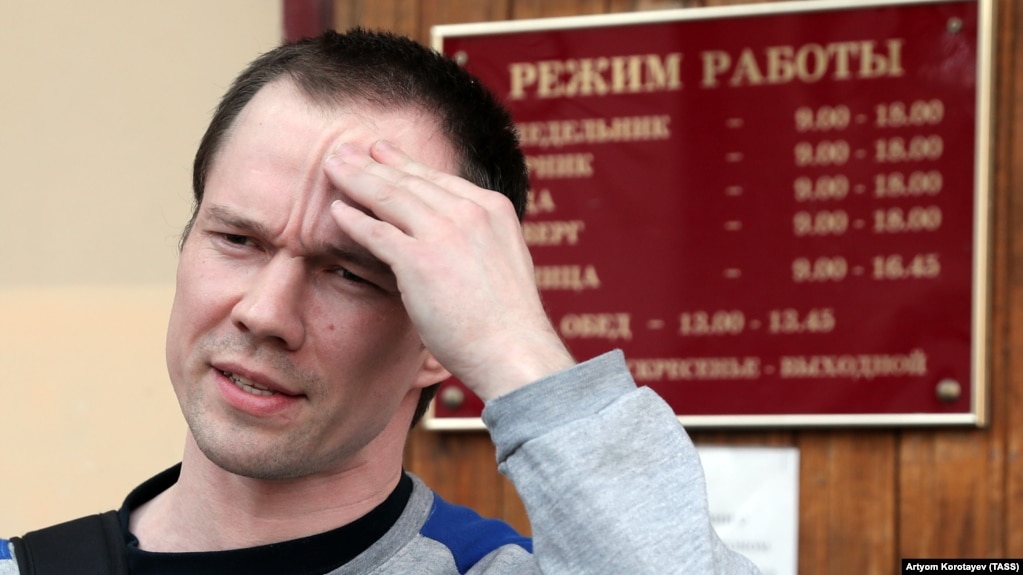
Russian opposition activist Ildar Dadin (file photo)

MOSCOW -- Russian authorities have cancelled the residence permit of Ukrainian citizen Oleksandra Sveshnikova, who is the wife of the well-known Russian rights activist Ildar Dadin.

Sveshnikova’s lawyer Nikolai Zboroshenko said on February 14 that the Interior Ministry's move will be appealed, adding that the Russian authorities’ main goal is to force Dadin and his wife from the country.

Dadin made headlines more than six years ago after he became the first Russian citizen to be convicted under a controversial law that criminalizes participating in more than one unsanctioned protest within a 180-day period.

He served more than a year in prison after he was convicted under the statute in December 2015.

The legislation then became known in the country as Dadin's law.

Russian human rights group recognized him as a political prisoner at the time.

Dadin has said that while serving his term he and other inmates were tortured and abused at a prison in Russia's northwestern region of Karelia.

Man charged after allegedly stealing dinosaur claw from Arizona gem show

By Caroline Kucera and Amanda Musa, CNN
Mon February 14, 2022

A dinosaur claw valued at $25,000 was stolen at a gem show in Tucson, Arizona, police said.

(CNN)A man is facing charges after allegedly stealing a dinosaur claw valued at $25,000 from a vendor at a gem show in Arizona, police said.

Christopher Thomas, 39, is accused of swiping the claw from the showroom of vendor Eric Miller, who was in Tucson selling fossils at the show on January 30, the Tucson Police Department said.

Thomas then tried to sell the claw to another vendor in the area on February 8, police said. The vendor recognized the claw and alerted Miller, police said, noting the vendors have a "tight-knit community."

Thomas was detained and charged with trafficking in stolen property, Tucson police said. CNN reached out to Thomas for comment.

The dinosaur claw was returned to Miller.

"This highlights the importance of vendors/neighbors communicating & working together," Tucson police said in an email to CNN.