Tuesday, September 20, 2022

FTC seeks more data on Amazon's $1.7-billion deal for vacuum maker iRobot

(Reuters) - The U.S. Federal Trade Commission (FTC) has asked Amazon.com Inc and iRobot Corp for more information on the e-commerce giant's $1.7-billion buyout of the Roomba vacuum maker.

In a filing on Tuesday, iRobot said the FTC had on Sept. 19 requested more details on the deal that was announced last month and would expand Amazon's stable of smart home devices.

A group of about 20 pro-privacy and worker organizations have urged U.S. antitrust enforcers to stop the deal, citing concerns about privacy and Amazon's already powerful position in the smart home devices market.

The FTC probe began earlier this month and covers both head-to-head competition and whether the deal would illegally boost the e-commerce company's market share in the connected device market as well as the overall retail market, according to a report from Politico.

(Reporting by Tiyashi Datta in Bengaluru; Editing by Vinay Dwivedi)

Hertz to order up to 175K GM electric vehicles over 5 years

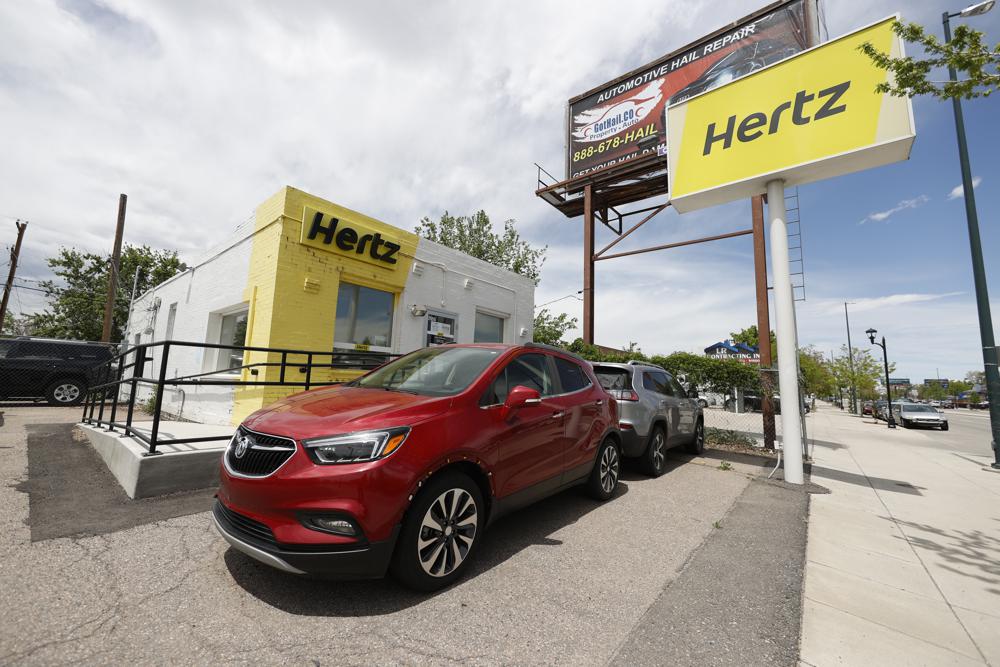
This May 23, 2020, photo shows rental vehicles parked outside a closed Hertz car rental office in south Denver. Rental car company Hertz plans to order up to 175,000 Chevrolet, Buick, GMC, Cadillac and BrightDrop electric vehicles from General Motors over the next five years. The deal includes electric vehicle deliveries through 2027 and will span a variety of vehicles such as SUVs, pickups and luxury automobiles. (AP Photo/David Zalubowski, file)

Hertz plans to order up to 175,000 electric vehicles from General Motors over the next five years.

The agreement announced Tuesday includes electric vehicle deliveries through 2027 and will include SUVs, pickups and luxury automobiles from Chevrolet, Buick, GMC, Cadillac and BrightDrop. The companies expect deliveries of the Chevrolet Bolt EV and Bolt EUV will start in the first quarter of next year.

“We are thrilled to partner with GM on this initiative, which will dramatically expand our EV offering to Hertz customers, including leisure and business travelers, rideshare drivers and corporates,” Hertz CEO Stephen Scherr said in a prepared statement.

Hertz’s current goal is for one-quarter of its fleet to be electric by the end of 2024.

GM Chair and CEO Mary Barra believes the partnership will help create new electric vehicle customers.

“With the vehicle choice, technology and driving range we’re delivering, I’m confident that each rental experience will further increase purchase consideration for our products and drive growth for our company,” she said.

GM said last year that it plans to go fully electric by 2035
Amazon to Bring Low Carbon Electrofuels to its Trucking Fleet

Tue, September 20, 2022

Agreement with Infinium will help Amazon reduce carbon emissions for roughly 5 million miles of travel per year

SEATTLE, September 20, 2022--(BUSINESS WIRE)--Amazon (NASDAQ: AMZN) has signed an agreement with renewable fuels technology company Infinium to begin powering Amazon’s transportation fleet with ultra-low carbon electrofuels beginning in 2023. Infinium is expected to initially supply enough electrofuels, which are a fossil-based fuel alternative created with carbon waste and renewable power, to begin powering Amazon trucks in lieu of diesel fuel for approximately 5 million miles of travel per year.

The agreement is another step forward in Amazon’s commitment to transition its transportation network away from fossil fuels and deliver packages to customers in more sustainable ways. Amazon plans to initially use the electrofuels in trucks in its middle mile fleet in Southern California, where the trucks are expected to help serve millions of customers. Amazon’s middle mile fleet is responsible for moving customer orders from its vendors and fulfillment centers to its network of sortation and delivery stations.

According to the United Nations, the transportation sector currently accounts for approximately 25% of all carbon emissions globally, and Infinium is working to change that by developing ultra-low carbon fuels that can easily be used to power cargo trucks, airplanes, and marine freight without engine modifications.

To start, Infinium plans to build one of the world’s first electrofuels-production facilities in Texas. The facility will use renewable-power-generated green hydrogen and approximately 18,000 tons of recycled carbon waste per year—which would otherwise be released into the atmosphere—to create the electrofuels.

Amazon previously invested in Infinium through The Climate Pledge Fund, Amazon’s $2 billion venture investment program that specifically invests in companies building technologies, products, and services that can help Amazon and others accelerate the path toward net-zero carbon future. Amazon has announced investments in a total of 18 companies through The Climate Pledge Fund to date.

"Infinium’s electrofuels can help Amazon reduce carbon emissions across our transportation fleet, which is important to both us and our customers, and will help us move closer to our goal of net-zero carbon by 2040," said Kara Hurst, vice president of Worldwide Sustainability at Amazon. "We’ve supported Infinium’s technology through our Climate Pledge Fund, and it’s exciting to see our investment turning into usable fuel that will help us, and others across the industry, decarbonize transportation in the long run."

"Our agreement with Amazon to provide Infinium electrofuels for use in the company’s transportation network is a significant moment for all of us," said Infinium CEO Robert Schuetzle. "We’ve been developing this technology for the better part of a decade, and we expect our electrofuels to reduce greenhouse gas (GHG) emissions by approximately 95 percent over traditional fossil fuels. We’re thrilled to have the first fleet of Amazon trucks powered by electrofuels starting next year, which will mark the beginning of a major shift for the entire transportation sector."

Amazon is committed to reaching net-zero carbon by 2040 as part of its commitment to The Climate Pledge, and will continue to take real business action to decarbonize its operations. Infinium is an example of how Amazon invested in new climate innovation, and the company will soon leverage its technology to help it reduce carbon emissions.

In addition to partnering with Infinium, Amazon has taken other significant steps toward net-zero carbon:

Amazon signed an agreement with Plug Power to supply 10,950 tons per year of green hydrogen for its transportation and building operations starting in 2025. Amazon will start to use green hydrogen to replace grey hydrogen, diesel, and other fossil fuels as it works to decarbonize its operations, and this green hydrogen supply contract will provide enough annual power for 30,000 forklifts or 800 heavy-duty trucks used in long-haul transportation.


Through The Climate Pledge Fund, Amazon invested in Electric Hydrogen and Sunfire, two of the most promising developers of electrolyzers, a key technology that makes emissions-free green hydrogen for use in heavy duty transportation.


Amazon has also ordered 100,000 electric delivery vehicles from Rivian, marking the largest order ever of electric delivery vehicles. Amazon’s custom electric delivery vehicles from Rivian started to hit the road this summer in the U.S., with thousands expected to be making deliveries in more than 100 major U.S. cities by the end of this year.

Learn more about Amazon’s sustainability efforts.

About Amazon

Amazon is guided by four principles: customer obsession rather than competitor focus, passion for invention, commitment to operational excellence, and long-term thinking. Amazon strives to be Earth’s Most Customer-Centric Company, Earth’s Best Employer, and Earth’s Safest Place to Work. Customer reviews, 1-Click shopping, personalized recommendations, Prime, Fulfillment by Amazon, AWS, Kindle Direct Publishing, Kindle, Career Choice, Fire tablets, Fire TV, Amazon Echo, Alexa, Just Walk Out technology, Amazon Studios, and The Climate Pledge are some of the things pioneered by Amazon. For more information, visit amazon.com/about and follow @AmazonNews.

View source version on businesswire.com: https://www.businesswire.com/news/home/20220920005359/en/

Amazon will start testing ultra-low carbon electrofuels for deliveries in 2023


Steve Dent
·Contributing Reporter
Tue, September 20, 2022 


PATRICK T. FALLON via Getty Images


Amazon is partnering with Infinium to test the use of so-called electrofuels (e-fuels) in its middle-mile diesel fleet, it announced. The company invested in Infinium last year as part of its goal to reach net-zero carbon by 2040. "We’ve been developing this technology for the better part of a decade, and we expect our electrofuels to reduce greenhouse gas (GHG) emissions by approximately 95 percent over traditional fossil fuel," said Infinium CEO Robert Schuetzle in a statement.

As part of this, Infinium plans to build one of the first-ever electrofuel production facilities in Texas, using renewable-generated hydrogen and around 18,000 tons of recycled carbon waste per year.


A quarter of greenhouse gas emissions are created by the transportation industry, Amazon notes. Infinium's e-fuels supposedly help combat that by combining green hydrogen (from electrolysis) with captured CO2 that would otherwise be emitted by industrial plants. The CO2 and hydrogen are combined into "syngas," which is then converted to liquid fuels via catalysts. The resulting "drop-in" fuel can be used directly in existing, unmodified diesel vans.


Infinium Amazon electrofuels for delivery vans

The vans still emit carbon emissions, but those would have been produced anyway by the industrial plants, so it's supposedly a net-zero operation. The electrofuels are about twice as expensive as traditional fuels, Infinium has explained.

There are clearly some issues that come to mind — the first being that the renewable power used to create hydrogen would be put to much better use in battery-electric vehicles. And neither Amazon nor Infinium explained where they got the 95 percent reduction figure, so I'd take that with a large grain of salt. Finally, despite the 2040 net-zero pledge, Amazon's emissions increased dramatically last year — and that's likely a drastic undercount.

Still, it could serve as an intermediate step. Infinium has previously noted that Amazon will "need liquid fuels for a long time" for ground, marine and air travel. Amazon is also taking other measures, like using green hydrogen (rather than grey hydrogen derived from fossil fuels or other fossil fuels) to power 30,000 forklifts and 800 heavy-duty trucks. It's also investing in companies that develop more efficient hydrogen electrolyzers and has ordered 100,000 electric delivery vehicles from Rivian.

How Amazon Became the Largest Buyer of Renewable Energy in the World

Andrew Blum
TIME
Thu, September 15, 2022

Solar panels line the 526 acre plot at Hawtree Creek in North Carolina, recently acquired by Amazon. Credit - Will Warasila for TIME


When Richard and Carson Harkrader first heard that 696 acres of North Carolina farmland had come up for sale, in 2016, one feature of the rolling landscape particularly caught their attention: the power lines that sliced across it as though someone had dog-eared its map. Hard up against the Virginia border, it was a pretty spot—pretty enough that a home builder would eventually take a quarter of the acres for a lakefront subdivision. But for the Harkraders, father-and-daughter operators of Carolina Solar Energy, an independent developer of solar-energy projects, the prettiest thing of all were those heavy-duty transmission lines that arced to the northwest, lacing into the PJM Interconnection, the giant electric grid that dominates the mid-Atlantic.

“It was kind of a gold rush,” the elder Harkrader says one morning this summer, standing amid the hundreds of thousands of glistening black panels, now known as Hawtree Creek Solar Farm, that follow the curve of the hills and tower over our heads. By midmorning the panels are sending 34 megawatts out to the grid, about the same as 10,000 backyard generators buzzing at once. By noon, it’s 65 megawatts—the maximum the grid will take. “I still think it’s magic,” Harkrader says. “Take sunlight and … boom!” Except the only noise is the occasional creaking of their steel frames, as small motors tilt the panels to follow the arc of the sun across the Carolina sky.

About 200 miles north, in Virginia, are the eager buyers of that electric gold: the mega-technology companies, like Amazon, Microsoft, and Google, that operate giant data centers essential to our daily lives, whether we’re ordering on Prime or backing up family photos. Under pressure from customers, employees, and shareholders—and, arguably, out of their own eagerness to reduce emissions—they have been increasingly determined to run these data centers on renewable energy. Once the Harkraders had secured the new solar farm’s preliminary permits and permissions—making a plan to accommodate local deer and joining the crowded “interconnection queue” to plug into the grid—they leased the land to Engie, a French energy giant that builds and operates more than 4,500 megawatts of solar power around the world. And then, before the panels had even arrived on site for installation, Engie in turn struck a deal to sell all the site’s power to a single company: Amazon.

That financial and legal arrangement, known as a PPA (power purchase agreement), has been a crucial force in the U.S.’s transition to clean energy. Of the approximately 235 gigawatts of wind and solar capacity now installed on the nation’s grid, nearly one quarter (more than 52 gigawatts) has been contracted by corporations, mostly over the past decade. That vigorous—and notably voluntary—corporate action has boosted a web of wind and solar manufacturers, developers, and operators. It has made renewables cost-competitive and helped grid operators learn to manage systems with more variability.

As the modern mortgage made the suburbs, the PPA has made the renewables industry. It bridges the economic needs of renewable–energy developers with the climate goals of corporate executives and shareholders. Solar panels and wind turbines are expensive to build but cheap to operate, given that their fuel—sunlight and fresh air—are free. By guaranteeing the electricity will be sold long before it’s been generated, a PPA gives banks confidence to front the money for construction—especially when there’s a giant corporation guaranteeing the deal. In the way that power grids work, all that electricity isn’t wired directly to these companies’ facilities, but adds more juice to each region as a whole. But the way that PPAs work means the companies can legitimately argue that these giant renewable projects wouldn’t have happened without them. PPAs stitch together developers like the Harkraders, energy operators like Engie, electric grids like PJM, and—above all—the large companies hungry for power from renewable sources.


Amazon delivery trucks line up to enter the Amazon DAX3 delivery station on Jan. 12, 2022 in Chatsworth, California.
ROGER KISBY—REDUX

They also set up the biggest corporate power purchase of all: Amazon has leveraged that ecosystem to go on the largest ever solar and wind shopping spree, buying 15.7 gigawatts globally over the past three years, nearly equal to the prodigious energy demands of the $1.4-trillion company. Like an early shopper on Black Friday, Amazon’s fervor has been felt across the industry—while also giving a glimpse of the incredible growth still to come, with the arrival of $369 billion in federal funds provided by the Inflation Reduction Act (IRA). Understanding this key driver of the past decade of solar and wind development helps us see what is likely to happen next: an unprecedented boom in renewable energy that could form a significant wedge in the broader effort to reduce carbon emissions and limit the warming of the atmosphere.

“If it was a market that only waited till something was built—and then you went out and tried to sell the -electricity—these projects wouldn’t get done,” says Harkrader. “People like Amazon, or Microsoft, Walmart, Target—on and on—are standing up and making this market possible. And it’s exploding.”

These days, Amazon is the hungriest of all. The behemoth was not the first to buy renewable power for its operations, but it is now buying the most. The plans it has announced, globally, amount to the equivalent of around 250 more Hawtree Creeks, and more or less equal to all the solar generation built in the U.S. last year. The buying spree is part of Amazon’s broader effort to reach “net-zero carbon” by 2040—meaning it will eliminate or offset the carbon emissions from all its operations, including trucks, planes, and manufacturing. That won’t be easy. An estimated two-thirds of American households are Amazon Prime members; it is almost impossible to use the internet without accessing an Amazon data center. Since it announced its climate goal in 2019, Amazon’s emissions have grown 40%—as its sales have grown more than 50%. “The path to achieving some of our goals will be long and complex,” acknowledges Kara Hurst, who leads Amazon’s sustainability efforts. But clean electricity is Amazon’s climate bright spot. With today’s technology—and a fat checkbook—the company has nearly eliminated its use of dirty energy, prioritizing the hard realities of glass and steel over tree planting or tricky accounting, building at a scale that rivals that of many countries. Amazon has catapulted itself to the front ranks of corporate buyers, contracting last year for more than double its nearest competitor, Microsoft.

Read More: The Future Is Being Written By Climate Devastation and Green Investment

For the past decade, in the absence of major climate legislation and in the face of a complex patchwork of regulations that limited the ability of utility companies to build renewable power, PPAs have done the job. But the IRA—the most substantial piece of climate-focused legislation the U.S. has seen—takes that progress and adds billions of dollars in federal incentives. “It supercharges both the role and the potential for customers to drive even more of this,” says Brynn Baker, senior director at the Clean Energy Buyers Association. The latest predictions are gargantuan. Solar developers expect to install more than 215 gigawatts of capacity over the next five years—40% more than was expected before the IRA, according to a report from the Solar Energy Industries Association and Wood Mackenzie.

But electricity is only one segment of carbon emissions, meaning that alone will not be enough to meet the climate goals set by the Paris Agreement. The hope is that the paths established by renewable energy can be applied to harder-to-decarbonize segments, like electric vehicles and manufacturing. Amazon, for example, has announced plans for 100,000 electric delivery vehicles by 2030. “I think we could see even faster progress on transportation than we’ve seen with clean energy on the grid,” says Bill Weihl, executive director of Climate Voice and a former director of sustainability at Facebook. In corporate renewable power purchasing, we can see the narrow path that will need to be expanded into a highway over the next decade.

For the Harkraders, Hawtree Creek required years of close attention to bring to fruition: attending county planning meetings, mapping wetlands, and exploring an old cemetery that, in the end, couldn’t be moved (the solar panels wrap around it). But for Charlie Daitch, who spearheads Amazon’s renewable-power purchasing, Hawtree was one row on a very tall spreadsheet. “I have a pretty good map in my head of the portfolio—where are we distributed, maybe not each individual project,” Daitch says from the passenger seat of a rented SUV, barreling across North Carolina, on his first visit to the site. “It’s gotten bigger than that.”


Amazon delivery electric vans (EV), built by Rivian Automotive, at charging stations parked outside the Amazon Logistics warehouse in Chicago, Illinois on Thursday, July 21, 2022. Amazon Inc. is starting delivery of packages to US customers using the first of as many as 100,000 electric vans built by Rivian Automotive Inc., which aims to hand over thousands of the vehicles this year.
JAMIE KELTER DAVIS—BLOOMBERG/GETTY IMAGESMore

When Amazon announced the “Climate Pledge” in 2019, it set its own target for reaching net-zero carbon emissions by 2040, 10 years ahead of the Paris Agreement. Included in that was an earlier goal: to use 100% renewable energy by 2030. For a company like Amazon, which has a sprawling -infrastructure for moving goods around the world, eliminating emissions is a challenge that stretches across the business. Sustainable aviation fuel and heavy-duty electric trucks are still years, if not decades, away from broad adoption. But wind and solar power are ready now. “Renewables is a place we identified where we could go fast to decarbonize our electricity stack,” adds Daitch, a mechanical engineer by training.

Compared with its competitors, Amazon came late to that realization. Walmart announced the first-ever “utility scale” PPA in 2008, with a 153-megawatt wind farm in Texas. At the time, it was a controversial move. “Those early companies that made these commitments did not do so because customers were asking for it,” says Miranda Ballentine, who led Walmart’s sustainability efforts at the time and is now CEO of the Clean Energy Buyers Association. The corporate winds shifted in 2010. That March, Greenpeace called out the technology companies for their energy use. Their report was perfectly timed, coming just days before the first iPad was released—a device that self-evidently depended on the internet behind it. The tech companies went on the defensive. “There is no such thing as a coal-powered data center,” insisted Facebook in a statement. “Every data center plugs into the grid offered by their utility or power provider.” Dirty energy, in other words, wasn’t their problem—it was the grid’s problem.

That half-shrug emoji of an argument didn’t last long. The next year, in a joint statement with Greenpeace, Facebook announced a new “preference” for “clean and renewable” energy. Over the next several years, the other tech giants lined up to follow suit. Putting solar panels on the roof or wind turbines in the parking lot was never going to be enough; data centers require too much energy for that, often hundreds of megawatts each. Power purchase agreements give large corporations a way to use renewable energy without having to wait for utilities. “Large off-site power purchase agreements remain the tool that allows you to move more quickly,” says Erin Decker, a consultant at Schneider Electric, one of the leading clean-energy advisers. Big Tech firms are happy to make long-term deals—especially if they can send out a press release. According to the logic of corporate climate action, if a solar farm is built in the desert, it needs to make a sound.

“When we think about our renewable-energy strategy, we’re like, ‘Well, how can we tell the most credible story to our customers about what we’re doing?’” says Amazon’s Nat Sahlstrom. “We don’t want to be greenwashing. We don’t want to be chasing investments that aren’t really having an impact.”

Most of Amazon’s competitors have already completed the deals that lock them into a decade or more of renewable power. Facebook, now known as Meta, long ago “unfriended coal” and has 7.5 gigawatts of renewables under contract. Google reached 100% renewable electricity in 2017, with over 7 gigawatts procured; its next effort is ensuring its data centers run “24/7” carbon-free, meaning all of its energy all the time comes from renewable sources, rather than, for example, buying excess solar during the day to make up for coal power it needs at night. Apple announced that it had sourced 100% renewable energy for its operations in 2018, with 87% of that in the form of PPAs; the next, far more challenging step is helping its suppliers and manufacturers do the same—a goal it has set for 2030. And Microsoft has nearly 8 gigawatts, 5.8 of which it bought in 2021.

Outside of tech, large companies have more catching up to do. “It’s not just Big Tech companies,” says Tyler Espinoza at 3Degrees, a climate-action consultancy. “You have a broad swath of massive corporations that are willing to put their money behind it.” In 2021, Pfizer announced a 15-year contract for 310 megawatts of electricity from a Texas wind farm, enough to power 100% of its North American operations—a gigantic leap from the mere 6% of its global usage previously met by renewables. In August, Ford announced an agreement with a Michigan-based utility for 650 megawatts of solar.

But small and medium-sized businesses struggle with the level of complexity, and commitment, that PPAs require. “The power purchase agreement is a wonderful tool for large, fairly sophisticated, high–creditworthy companies to be able to procure clean energy,” says Ballentine, of the Clean Energy Buyers Association. “It is not as easy of a tool for smaller companies.” As long as there are still large corporations eager to sweep up the available inventory of projects, that hasn’t been a great concern. In the first half of 2022, corporations contracted for 9.8 gigawatts of renewable power in the U.S.—a third of which was Amazon’s.

But across the board, the challenge is coming to terms with how significant the impact of this renewable-energy purchasing can be on the broader effort to counter climate change. Ballentine, who was in the trenches for Walmart’s early actions, sees a single-mindedness in these corporate actions. “The big ‘why’ is very simple,” she says. “It’s about solving the climate crisis. There is no other reason that a company would set a voluntary zero-carbon energy procurement goal or renewable-energy goal.”

Even on a global scale, Amazon’s efforts stand out. The company’s initial Climate Pledge called for 100% renewable energy by 2030. But early in the pandemic, that pace shifted, when Daitch and his colleagues realized they could move much faster than they already were. Yet other aspects of Amazon’s business—like all those trucks and planes—were not going to decarbonize anytime soon.


Solar panels on the 526 acre plot at Hawtree Creek in North Carolina.Will Warasila for TIME

At the time Amazon had about 1 gigawatt of renewable energy procured. Daitch, who got his start at a traditional energy utility in the Pacific Northwest, working on distribution planning, increased the intensity of his team’s search. Their criteria varied. Wind might work better in Kansas, while solar was preferable in Ohio. Some regions relied heavily on coal power, heightening the impact of any new renewables. But others had crowded—or dysfunctional—processes for connecting new projects to the grid. Generally, Hawtree Creek is emblematic of how the process often works: a local developer who really knows the geography of the state, its electric-transmission network, and the local politics of its counties might respond to Amazon’s solicitation. But once things are under way, they hand the project off to a large energy operator, like Engie.

At the end of 2021, Amazon announced a blockbuster purchase: 18 new projects around the world, bringing its total to 12 gigawatts and making Amazon the largest corporate buyer of renewable energy in the world. In April, it added 3.5 more gigawatts. Amazon’s projects dot the map. In Kansas, two wind farms, both finished in 2021, produce more than 500 megawatts of power. In Halifax County, Virginia, 65 miles west of Hawtree Creek, are four more similarly sized solar farms, totaling 261 megawatts of additional energy. In Ohio, more than 2,000 megawatts have been completed or are coming soon—and on, across 134 utility-scale projects in 15 countries. “There’s a flywheel,” says Daitch. “Our commitment, and signal to the market that we are moving at scale, then gets developers ramped up developing more projects. It gets solar manufacturers investing in more plants and production. So there’s that feedback loop.”

The past year has tested that presumption as the renewables industry struggled with rising prices and constrained supplies. Making matters worse, in April 2022 solar development ground to nearly a complete halt when the Commerce Department announced an investigation into Chinese companies violating tariffs—raising the threat of retroactive import taxes on even the modules that were already in the U.S. Then in June, the situation reversed, when the Biden Administration invoked the Defense Production Act to increase solar production. By the time industry analysts finished calculating the impact of the investment introduced by the IRA, a sense of giddiness settled in among climate activists. According to analysts at Wood Mackenzie, total investment in renewable energy will reach $1.2 trillion by 2035. In a look at the manufacturing of solar polysilicon, the key component in new panels, Bloomberg-NEF found that by 2025 global capacity will be enough to manufacture 940 gigawatts of panels annually—almost as much as the total 971 gigawatts of solar currently installed around the world.

For both corporations and individuals, all this comes back to the broadest goal of reducing emissions sufficiently to counter the effects of climate change. According to an analysis by the International Energy Agency, that means—at least—reaching global net-zero emissions by 2050, on a path that is “narrow but still achievable.” For the past decade, that has looked, frankly, improbable—at least at the pace corporations were going. With the IRA, the U.S. now has a chance.

Blum is the author of Tubes and The Weather Machine

Samsung climate inertia is by-product of Seoul's

Robyn Mak Reuters
PUBLISHEDSEP 19, 2022 

HONG KONG (Reuters Breakingviews) - Seoul's foot-dragging on climate change is holding back Korea Inc. Last week the country's top conglomerate, Samsung Electronics, unveiled an underwhelming net-zero carbon emissions target. Blame South Korea's power-market monopoly and regressive renewables policies.

The world's largest chip and mobile-phone maker lags on decarbonisation. Apple, both a rival and a customer, intends to achieve carbon neutrality for its supply chain and products by 2030; Japan's Sony and TSMC in Taiwan recently committed to the same goal by 2040 and 2050 respectively. The $274 billion South Korean group is only targeting emissions from its own operations - and by 2050, a decade later than Intel's similar pledge.

It's not entirely Samsung's fault. Its semiconductor and components business accounted for 90% of the company’s 17.4 million tonnes of greenhouse gases emitted last year. Most of that is probably from electricity for factories in South Korea, where renewable power is scarce. Solar and wind generated just 26.9 terawatt hours of electricity in 2021, a paltry 4.7% of the total and roughly equivalent to Samsung’s needs.

One culprit is government-backed Korea Electric Power Corporation, or Kepco, which dominates power generation, transmission and distribution. Despite years of shareholder pressure, the $9 billion utility remains addicted to fossil fuels, which made up over 70% of its total capacity as of June. Some of its power-generating units are even slashing renewable investments, the Korea Times reports, as first-half losses at Kepco balloon to a whopping $7.7 billion.

The government this year started allowing firms to buy from renewable-energy producers via direct power purchase agreements. Cutting out Kepco is a good step, but companies still must pay the utility incidental and network costs; these can total as much as 45% of current electricity prices, according to environmental group Solutions for Our Climate. Red tape around securing renewable project approvals has also pushed up prices.

As the country's top exporter, Samsung should be in strong position to lobby for change. The company warned that if it does not meet its corporate customers' demands of using 100% renewable energy, some 25.8 trillion won ($18.5 billion), or a fifth of business-to-business sales, based on 2020 results, are at risk. Yet President Yoon Suk-yeol's administration plans to lower its renewable-energy target for 2030, favouring nuclear power instead. Samsung's corporate heft will be put to test.

South Korea's Samsung Electronics on Sept. 15 announced a new environmental strategy that includes a commitment to achieve net-zero carbon emissions in its own operations by 2050. As part of the initiative, it will invest over 7 trillion won ($5 billion) by 2030 in technology that it hopes, for example, will filter out greenhouse gases and capture carbon dioxide generated during chip production.

The company has also joined RE100, a group of global corporations including Apple, Intel and TSMC that are committed to using 100% renewable energy across their own operations.

Separately, South Korea's government wants to lower its renewable energy target for 2030, according to a draft electricity demand and supply plan from the Ministry of Trade, Industry and Energy on Aug. 30. Renewable energy will account for 21.5% of generation capacity by 2030, down from the previous target of 30.2%.


(Editing by Antony Currie and Katrina Hamlin)
Mars is littered with 15,694 pounds of human trash from 50 years of robotic exploration

Cagri Kilic, Postdoctoral Research Fellow in Robotics, West Virginia University
 - 11h ago
THE CONVERSATION

People have been exploring the surface of Mars for over 50 years. According to the United Nations Office for Outer Space Affairs, nations have sent 18 human-made objects to Mars over 14 separate missions. Many of these missions are still ongoing, but over the decades of Martian exploration, humankind has left behind many pieces of debris on the planet’s surface.


Rovers on Mars frequently come across debris – like this heat shield and spring – from their own or other missions.© NASA/JPL-Caltech

I am a postdoctoral research fellow who studies ways to track Mars and Moon rovers. In mid-August 2022, NASA confirmed that the Mars rover Perseverance had spotted a piece of trash jettisoned during its landing, this time a tangled mess of netting. And this is not the first time scientists have found trash on Mars. That’s because there is a lot there.


All spacecraft that land on Mars eject equipment – like this protective shell – on their way to the Martian surface.© NASA/JPL-Caltech
Where does the debris come from?

Debris on Mars comes from three main sources: discarded hardware, inactive spacecraft and crashed spacecraft.

Every mission to the Martian surface requires a module that protects the spacecraft. This module includes a heat shield for when the craft passes through the planet’s atmosphere and a parachute and landing hardware so that it can land softly.

The craft discards pieces of the module as it descends, and these pieces can land in different locations on the planet’s surface – there may be a lower heat shield in one place and a parachute in another. When this debris crashes to the ground, it can break into smaller pieces, as happened during the Perseverance rover landing in 2021. These small pieces can then get blown around because of Martian winds.


The Perseverance rover came across this piece of netting on July 12, 2022, more than a year after landing on Mars.© NASA/JPL-Caltech

A lot of small, windblown trash has been found over the years – like the netting material found recently. Earlier in the year, on June 13, 2022, Perseverance rover spotted a large, shiny thermal blanket wedged in some rocks 1.25 miles (2 km) from where the rover landed. Both Curiosity in 2012 and Opportunity in 2005 also came across debris from their landing vehicles.


Related video: NASA’s Mars rover, Perseverance collects 'amazing diversity of samples' to be tested on Earth

The European Space Agency’s Schiaparelli lander crashed onto the surface of Mars in 2016, as seen in these photos of the crash site captured by NASA’s Mars Reconnaissance Orbiter.© NASA/JPL-Caltech/Univ. of Arizona

Dead and crashed spacecraft


The nine inactive spacecraft on the surface of Mars make up the next type of debris. These craft are the Mars 3 lander, Mars 6 lander, Viking 1 lander, Viking 2 lander, the Sojourner rover, the formerly lost Beagle 2 lander, the Phoenix lander, the Spirit rover and the most recently deceased spacecraft, the Opportunity rover. Mostly intact, these might be better considered historical relics than trash.

Wear and tear take their toll on everything on the Martian surface. Some parts of Curiosity’s aluminum wheels have broken off and are presumably scattered along the rover’s track. Some of the litter is purposeful, with Perseverance having dropped a drill bit onto the surface in July 2021, allowing it to swap in a new, pristine bit so that it could keep collecting samples.


The wheels of the Curiosity rover have taken damage over the years, leaving behind small bits of aluminum.© NASA/JPL-Caltech

Crashed spacecraft and their pieces are another significant source of trash. At least two spacecraft have crashed, and an additional four have lost contact before or just after landing. Safely descending to the planet’s surface is the hardest part of any Mars landing mission – and it doesn’t always end well.

When you add up the mass of all spacecraft that have ever been sent to Mars, you get about 22,000 pounds (9979 kilograms). Subtract the weight of the currently operational craft on the surface – 6,306 pounds (2,860 kilograms) – and you are left with 15,694 pounds (7,119 kilograms) of human debris on Mars.

Why does trash matter?

Today, the main concern scientists have about trash on Mars is the risk it poses to current and future missions. The Perseverance teams are documenting all debris they find and checking to see if any of it could contaminate the samples the rover is collecting. NASA engineers have also considered whether Perseverance could get tangled in debris from the landing but have concluded the risk is low.

The real reason debris on Mars is important is because of its place in history. The spacecraft and their pieces are the early milestones for human planetary exploration.

This article is republished from The Conversation, a nonprofit news site dedicated to sharing ideas from academic experts.

Read more:
Perseverance’s first major successes on Mars – an update from mission scientists
China to Latin America: All your fish belong to us

Ben Kritz - Yesterday 


AS if communist China was not already doing enough to degrade the rest of the world's quality of life for its own gain, recent news from South and Central America further reinforces the impression that its rapaciousness knows no bounds. China's Southeast Asian neighbors, particularly the Philippines, are already familiar with the Red Menace's greediness when it comes to marine resources, but on the other side of the world, a massive, well-organized, industrial-scale effort to carry out illegal fishing on both sides of Latin America is threatening to wipe out fish stocks for a dozen countries.


An Argentine navy patrol intercepts a Chinese ship on its way to fish in Argentina’s exclusive economic zone. ARGENTINE NAVY PHOTO© Provided by The Manila Times

In a news report by Inter-Press Service (IPS) last month, 631 Chinese-flagged fishing vessels were reported to have entered Peruvian and Ecuadorian waters so far this year. Over the past two years, Chinese fishing in the territorial waters or the exclusive economic zones (EEZ) of the South American countries bordering the Eastern Pacific has skyrocketed. This year's number of vessels already exceeds the 584 logged in all of 2021, which was in turn a sharp increase from the 350 ships in 2020.

The typical season for the Chinese fleet begins in April or May, when they arrive in the Eastern Pacific off Central America and northern South America. The fleet then gradually works its way southward, eventually passing through the Strait of Magellan into the South Atlantic to fish the waters off Argentina, Uruguay and Brazil.

Most alarmingly, Ecuadorian authorities have accused the Chinese of fishing with impunity in the Galapagos Islands, the world's most biodiverse region, and which is surrounded by a 193,000-square kilometer marine protected area. Under Ecuadorian regulations, only "artisanal" fishing by a limited number of local fishermen is permitted in the Galapagos as part of the country's resource management program for the marine protected area.

Farther south, fishermen in Peru have sounded the alarm about Chinese overfishing of giant squid, which is the country's second-biggest marine resource after anchovies. Squid fishing ordinarily provides about $800 million in revenue and thousands of jobs for Peruvians, but the industry is on the verge of being wiped out by the unwelcome competition from the Chinese. Moreover, the Chinese presence has completely derailed Peru's carefully managed program to impose harvest limits to ensure sustainability of the squid population.

Other fish being harvested by the Chinese in massive quantities include several species of tuna, hake, prawns, shortfin squid and sharks. Shark fishing is uniformly banned throughout Central and South America, but huge demand for it in China — particularly in Hong Kong, apparently — induces the Chinese ships to ignore the bans, hiding the illegal catch by transferring it between ships to evade the different countries' naval or coast guard patrols.

For some Latin American fishermen, the money to be made from sharks and other illegal species along with the loss of their regular harvest to the Chinese has enticed them to engage in illegal fishing as well, aggravating the problem. Authorities in Mexico, Chile and Brazil have reported intercepting and arresting dozens of fishermen from their own countries for illegal fishing.

The United Nations Food and Agriculture Organization (FAO) has also sounded the alarm, but noted that unchecked Chinese fishing is not limited to Latin American waters. In a statement, FAO regional fisheries officer Alicia Mosteiro Cabanelas said that "illegal, unreported and unregulated fishing is a global problem that compromises the conservation and sustainable use of fishery resources. Overfishing always has a direct impact on the sustainability of resources, generating a decrease in income for the fishing sector and in the availability of fishery products for local communities and consumers in general. Latin America is no exception. It also harms fishers' livelihoods and related activities, and aggravates malnutrition, poverty and food insecurity."

China has the world's largest fishing fleet, estimated at 17,000 vessels harvesting about 15 million tons of marine products per year. Not all of that is illegally caught, of course, but the amount that is — either protected or regulated species, or harvested in other countries' territorial waters — is estimated to be at least 20 percent, or about 3 million tons per year.

For its part, China avows that it does not approve of illegal fishing, and has on paper, at least, formally banned its fleet from operating in prohibited waters and warned ship captains that it will withdraw licenses from those who violate the rules. Chinese President Xi Jinping reportedly gave assurances to that effect to his Ecuadorian counterpart Guillermo Lasso when the latter visited Beijing in February of this year. So far, however, that seems to have been typical Chinese government lip service; the fleet continues to operate with impunity across the globe, and no cases of any Chinese ship owner or captain being penalized by his own government are known.

Not surprisingly, the Chinese effort to depopulate the world's oceans has become another front in the new cold war of China versus almost everyone else. At a summit of the Quadrilateral Security Dialogue (QSD) bloc in Tokyo in May, Australian Prime Minister Anthony Albanese, US President Joe Biden, Prime Minister Narendra Modi of India and Japanese Prime Minister Fumio Kishida agreed on "new surveillance mechanisms" for the Chinese fishing fleet. In addition, the US government has decided to dust off the Monroe Doctrine, and is currently working on security agreements with countries such as Colombia, Costa Rica, Ecuador, Mexico and Panama to improve monitoring and law enforcement efforts against the Chinese fleet.

ben.kritz@manilatimes.net

Twitter: @benkritz
'Our world is in peril,' UN secretary-general warns general assembly

CBC/Radio-Canada - 9h ago

The world's problems seized the spotlight Tuesday as the UN General Assembly opened on Tuesday with dire assessments of a planet beset by escalating crises and conflicts that an aging international order seems increasingly ill-equipped to tackle.

After two years when many leaders weighed in by video because of the coronavirus pandemic, now presidents, premiers, monarchs and foreign ministers gathered almost entirely in person for diplomacy's premier global event.

But the tone was far from celebratory. Instead, it was the blare of a tense and worried world.

"We are gridlocked in colossal global dysfunction," Secretary-General António Guterres said, adding that "our world is in peril — and paralyzed."

He and others pointed to conflicts ranging from Russia's six-month-old war in Ukraine to the decades-long dispute between Israel and the Palestinians. Speakers worried about a changing climate, spiking fuel prices, food shortages, economic inequality, migration, disinformation, discrimination, hate speech, public health and more.


After two years of holding the session virtually or in a hybrid format, 157 world leaders and their representatives are expected to attend the UN General Assembly in person
.© Anna Moneymaker/Getty Images

Guterres started out by sounding a note of hope, however. He showed a video of the first UN-chartered ship carrying grain from Ukraine — part of the deal between Ukraine and Russia that the United Nations and Turkey helped broker — to the Horn of Africa, where millions of people are on the edge of famine. It is, he said, an example of promise and hope "in a world teeming with turmoil."

Russia's war top of mind

Russia's invasion of Ukraine topped the agenda for many speakers. The conflict has become the largest conflict in Europe since World War II and has opened fissures among major powers in a way not seen since the Cold War.

Meanwhile, the loss of important grain and fertilizer exports from Ukraine and Russia has triggered a food crisis, especially in developing countries, and inflation in many nations.

As Jordan's King Abdullah II noted, well-off countries that are having unfamiliar experiences of scarcity "are discovering a truth that people in developing countries have known for a long time: For countries to thrive, affordable food must get to every family's table."

In an impassioned speech to the assembly, French President Emmanuel Macron said no country can stand on the sidelines in the face of Russia's aggression. He accused those who remain silent of being "in a way complicit with a new cause of imperialism" that is trampling on the current world order and is making peace impossible.

Brazil President Jair Bolsonaro, traditionally the first speaker, called for an immediate ceasefire in Ukraine, protection of civilians and "the maintenance of all channels of dialogue between the parties." He opposed what he called "one-sided or unilateral" Western sanctions, saying they have harmed economic recovery and have threatened human rights of vulnerable populations.


Brazilian President Jair Bolsonaro called for a ceasefire in Ukraine during his speech on Tuesday.© Mary Altaffer/The Associated Press

Neither Ukraine nor Russia has yet had its turn to speak. The assembly has agreed to allow Ukrainian President Volodymyr Zelenskyy to speak by video, over objections from Russia and a few of its allies.

Zelenskyy's speech is expected Wednesday, as is an in-person address from U.S. President Joe Biden. Russian Foreign Minister Sergey Lavrov is due to take the rostrum Saturday.
Nearly 150 leaders to speak

Nearly 150 heads of state and government are on the latest speakers' list, a high number reflecting that the United Nations remains the only place not just to deliver their views but to meet privately to discuss the challenges on the global agenda — and hopefully make some progress.

Prime Minister Justin Trudeau's two-day visit began Tuesday with a bilateral meeting with Chandrikapersad Santokhi, the president of Suriname, this year's chair of Caricom, a political and economic coalition of 15 member-states throughout the Caribbean.

The rest of Trudeau's UN agenda is laden with meetings on subjects close to his heart: climate change, gender equality and sustainable development, among others.

Later Tuesday he was scheduled to take part in a roundtable with former U.S. secretary of state Hillary Clinton on the virtues of inclusive job growth.

The death of Queen Elizabeth and her funeral in London on Monday, which many world leaders attended, created last-minute headaches for the high-level meeting. Diplomats and UN staff have scrambled to deal with changes in travel plans, the timing of events and the logistically intricate speaking schedule for world leaders.


Prime Minister Justin Trudeau takes part in a meeting at the United Nations in New York on Tuesday.© Sean Kilpatrick/The Canadian Press
Factbox-Latest on the worldwide spread of the coronavirus


Mon, September 19, 2022

(Reuters) - The coronavirus pandemic remains a global emergency but the end could be in sight if countries use the tools at their disposal, a spokesperson for the World Health Organisation said.

DEATHS AND INFECTIONS

* Eikon users, click on COVID-19: MacroVitals for a case tracker and summary of news. https://amers2.apps.cp.thomsonreuters.com/cms/?navid=1775942723

ASIA-PACIFIC

* Hong Kong will soon make an announcement on its controversial COVID-19 hotel quarantine policy for all arrivals, as it wants to keep the city connected with the rest of the world and allow an "orderly opening-up".

* China's government issued draft rules aimed at making it easier for some foreigners to enter the country for visits to tourism sites along the Chinese border.

* Shanghai announced eight infrastructure projects with total investment of 1.8 trillion yuan ($256.67 billion), after the city was hit hard by COVID-19 lockdowns in April and May.

AMERICAS

* U.S. President Joe Biden said in an interview aired on Sunday that "the pandemic is over," even though the country continues to grapple with coronavirus infections that kill hundreds of Americans daily.

EUROPE

* Dutch King Willem-Alexander held his annual budget day address on Tuesday, appearing in front of a full audience in The Hague for the first time since before the pandemic.

VACCINES, TREATMENTS

* Global vaccine alliance GAVI has set up financial instruments that will allow the group to immediately access pledged donor funding if it needs to buy vaccines for future pandemics, its chief executive told Reuters.

* Two COVID-19 antibody therapies are no longer recommended by the World Health Organization (WHO), on the basis that Omicron and the variant's latest offshoots have likely rendered them obsolete.

ECONOMIC IMPACT

* Asian tourists are only expected to resume international travel at pre-pandemic levels gradually, by 2024, the new chief executive of online travel agency Agoda said late on Monday.

* Japanese land prices rose in the 12 months to July 1 for the first time since before the pandemic, thanks to an easing of COVID-19 curbs, an annual land ministry survey showed.

* China's exports to North Korea grew at a slower pace in August than July, as shipments of masks and other COVID-related items plunged, customs data showed.

($1 = 7.0130 Chinese yuan renminbi)

(Compiled by Olivier Sorgho; Editing by)

Energy crisis key to Italy’s election — but not conservation

By COLLEEN BARRY
today

1 of 15
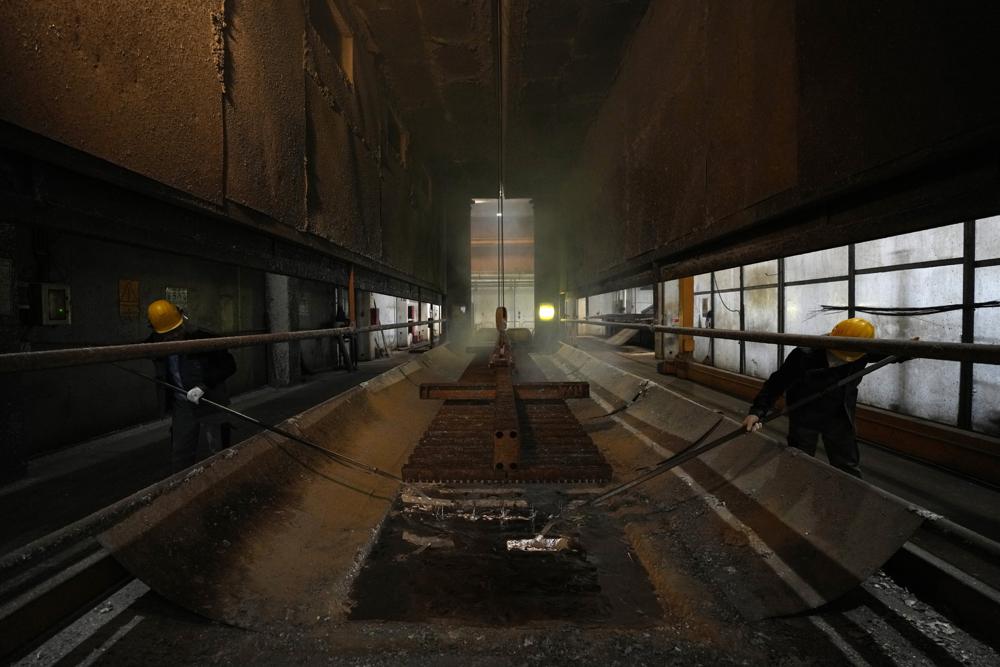
Men work in a galvanizing plant in Cambiano, northern Italy, Friday, Sept. 16, 2022. Zinc baths at Giambarini Group's galvanizing plants in northern Italy must remain super-heated around the clock, seven days a week, an energy-intensive process that has grown exponentially more costly as gas prices spike. The energy crisis facing Italian industry and households is a top voter concern going into Sunday's parliamentary elections as fears grow that astronomically high bills will shutter some businesses and force household rationing by winter. Never in an Italian election campaign has energy been such a central talking point. (AP Photo/Antonio Calanni)


MILAN (AP) — Giambarini Group’s plants in northern Italy must keep zinc baths that rustproof steel and iron parts super-heated around the clock, seven days a week, an energy-intensive process that has grown exponentially more costly as natural gas prices spike.

Methane to create molten zinc that forms a protective coating over high-rise support beams and wrought-iron fences used to take up just 3% of operating costs, but now it’s as much as 30%. The family-run company has passed some of the extra cost to customers, but business is uncertain as rising prices for raw materials freezes the construction industry that Giambarini supplies.

“We don’t know the future. We don’t know if it will get worse or better, since clients don’t know if they will have work,” said CEO Alberto Giambarini, the third generation in his family to run the business. He has orders for the coming 10 days, instead of through Christmas, like in the past. “We are living day to day.”

The energy crisis facing Italian industry and households — like those across Europe — is a top voter concern going into Sunday’s parliamentary elections as fears grow that astronomically high bills will shutter some businesses, at least temporarily, and force household rationing by winter. Prices started going up a year ago and have only been exacerbated as Russia has cut back natural gas used to generate electricity, heat and cool homes, and run factories as Europe supports war-torn Ukraine.

Already in July and August, industrial energy use dropped by double digits mostly because of scaled-back production — which experts say could affect economic growth and employment in the coming months.

At the same time, three-quarters of Italian households expect even more pain this fall with higher bills, according to the SWG polling institute. Already, 80% report important sacrifices to pay energy costs, such as delaying vacations, major purchases and eating out.

Never in an Italian election campaign has energy been such a central talking point. Candidates have sparred over whether debt-laden Italy, which has already spent more than 60 billion euros to help families, businesses and local governments, should incur yet more debt to finance new relief. They’re also facing off on whether Italy should consider investing in new nuclear technologies.

But no party is discussing mandatory conservation measures, like many of Italy’s European neighbors.

“It is remarkable to see how much all these people are commenting on energy. Before the current situation, no one would mention the issue. But at the same time, they are neglecting if not ignoring completely the climate side of this,” said Matteo Di Castelnuovo, an energy economist at Milan’s Bocconi University. “No one is going to talk about rationing or reducing consumption.”

Most major parties, including Giorgia Meloni’s far-right Brothers of Italy and Enrico Letta’s center-left Democratic Party, are largely following strategies pursued by the outgoing government of Premier Mario Draghi. They both advocate a European Union cap on natural gas prices, despite a failure to gain EU consensus in months of discussion, along with varying formulas to help families and offer tax breaks to businesses.

Pollsters and energy experts say these similarities have made it difficult for voters to be moved by energy policy.

Broadly, the campaign has focused on continued natural gas investments.

For the Democratic Party, plants that regasify liquid natural gas are positioned as a bridge to other technologies as it sets a target to add 85 gigawatts of renewable energy by 2030 in a country that for years has averaged just 1 gigawatt a year. The center-right coalition that Meloni’s party is leading wants to expand pipeline deliveries to Italy, which fits a longer-term strategy of making Italy a gas hub for Europe but does not address the EU goal of emission reductions by 2030.

The right-wing coalition and small centrist parties also advocate a return to nuclear power, which Italians have rejected in two referendums decades apart. In addition to societal resistance, the technology would take at least two decades to implement, too late to help Italy’s commitment with the Group of 7 wealthy economies to fully decarbonize by 2035, said Matteo Leonardi, executive director of the environmental think tank ECCO.

The political debate is largely focusing on lowering gas prices but not diversifying or discouraging households from consuming resources that would better support industry, Leonardi said.

“The response to this crisis, as they are saying in the rest of Europe, are renewables and efficiency,” Leonardi said. “You cannot face a war without arms. You cannot give the message that the state will take care of it, consume what you want.”

Italy’s famed textile industry, which gives French and Italian fashion houses their luxury edge, also is suffering. The small and medium operators that form the backbone of the system risk closure without a swift, systemic response from both Europe and Italy, said Sergio Tamborini, head of the SMI Italian Fashion System association.

“The bills that arrived in June and July were explosive,” Tamborini said.

Italy’s textile industry — along with leather and accessories accounting for revenue of 100 billion euros a year — is a luxury niche that Tamborini worries will be weakened by cheaper markets if costs aren’t reduced.

Dying and printing textiles is especially energy intensive, Tamborini said, and for some, “it is a problem of survival.”

“We should have had help already in September. We cannot wait for the next government to be active, because it could be Christmas or even after,” he said, given the fractured nature of Italian politics.

Meanwhile, Giambarini said his business has no immediate plans for short-term layoffs of 250 workers, but the outgoing government has been discussing new layoff programs to give businesses a way to avoid crippling energy costs.

Shutting down even temporarily would be devastating, taking months to relaunch, said Giambarini, adding he was still deciding which party to back.

“We are waiting for the election and hope we will get a government that will indicate a better road out of this period of crisis,” Giambarini said.

EXPLAINER: Bused, flown migrants can live in US -- for now

By ELLIOT SPAGAT
today

1 of 3
Carlos Munoz reaches out to hug Larkin Stallings of Vineyard Haven, Mass., as the immigrants prepare to leave St. Andrews in Edgartown, Mass., Friday, Sept. 16, 2022. Florida Gov. Ron DeSantis took the playbook of a fellow Republican, Texas Gov. Greg Abbott, to a new level by catching officials flat-footed in Martha's Vineyard, Mass., with two planeloads of Venezuelan migrants. On Friday, the migrants were being moved voluntarily to a military base on nearby Cape Cod, Mass. 
(Ron Schloerb/Cape Cod Times via AP)


Republican governors have been sending more migrants released at the U.S. border with Mexico to Democratic strongholds, raising questions about their legal status, how they are lured on board buses and planes and the cost to taxpayers.

Florida’s Ron DeSantis flew about 50 Venezuelans last week to the small, upscale island of Martha’s Vineyard in Massachusetts. During the weekend, Texas’ Greg Abbott bused more migrants to Vice President Kamala Harris’ Washington home.

U.S. authorities are grappling with unusually large numbers of migrants crossing the border from Mexico amid rapidly changing demographics. The administration said Monday that people from Venezuela, Cuba and Nicaragua accounted for more than one of three migrants stopped at the border in August. Authorities stopped migrants 2.15 million times from October through August, the first time above 2 million during the government’s fiscal year.

Since April, Texas has bused about 8,000 migrants to Washington, 2,200 to New York and 300 to Chicago. Arizona bused more than 1,800 to Washington since May, while the city of El Paso, Texas, bused more than 1,100 to New York since Aug. 23.

Here are some questions and answers:

ARE MIGRANTS LEGALLY IN THE UNITED STATES?

Yes, temporarily. Tens of thousands of migrants who cross the border illegally from Mexico are released in the United States each month with notices to appear in immigration court to pursue asylum or on humanitarian parole with requirements to report regularly to immigration authorities. Migrants may seek asylum if they enter the country illegally under U.S. and international law, and U.S. authorities have broad authority to grant parole based on individual circumstances.

Migrants must keep a current address with authorities, who schedule appointments in a city with the nearest court or immigration office. They must apply separately for permission to work.

Last year, it took an average of nearly four years for asylum cases to be decided in immigration court, according to the Biden administration, leaving migrants in a legal purgatory that shields them from deportation. The backlog in immigration courts has mushroomed to more than 1.9 million cases, according to Syracuse University’s Transactional Records Access Clearinghouse.

To avoid massive overcrowding in detention facilities, the administration began releasing many migrants on humanitarian parole. The Border Patrol paroled nearly 250,000 migrants from August through June, including 40,151 in June, the latest figures released. In the previous seven months, it paroled only 11 migrants.

ARE THESE MIGRANTS KIDNAPPED?

Kidnapping is a high legal threshold, but migrants flown to Martha’s Vineyard say they were taken there on false pretenses. Migrants sign waivers that the transportation is free and voluntary.

DeSantis used a state program in which migrants deemed “unauthorized aliens” can be moved “from Florida,” though the governor has acknowledged the flights originated in Texas.

They stopped first in Florida, before going to Martha’s Vineyard, but DeSantis has not emphasized that. Instead, he maintains that the two flights were a legitimate use of funds because the migrants otherwise would have aimed to go to Florida, though he offered no evidence of that and did not say how migrants might have been vetted.

Migrants who boarded the flights told The Associated Press that a woman who approached them at a San Antonio shelter promised jobs and three months of housing in Washington, New York, Philadelphia and Boston.

On Monday, Javier Salazar, the sheriff of Bexar County, which includes San Antonio, opened an investigation into the flights, but the elected Democrat didn’t say what laws may have been broken. Other Democrats have urged the U.S. Justice Department to investigate, including California Gov. Gavin Newsom and U.S. Rep. Joaquin Castro, whose district includes San Antonio.

DOESN’T THE BIDEN ADMINISTRATION BUS AND FLY MIGRANTS AROUND THE COUNTRY?

Yes, but under different circumstances. Like earlier administrations, it transports migrants between detention facilities, often on their way to being removed from the country.

U.S. Immigration and Customs Enforcement had more than 4,800 domestic flights in the last year, including 434 in August, according to Witness to the Border, a group that criticizes U.S. enforcement. The top five destinations from March to August were: Alexandria, Louisiana; Laredo, Texas; Phoenix; and Harlingen and El Paso in Texas. ICE also buses many migrants.

The Department of Health and Human Services transports unaccompanied children to “sponsors,” who are often family, or child-only detention facilities.

DID ANYONE ASK FOR THIS?

Republican-led states say they are sending migrants to “sanctuary” cities that welcome immigrants. While the definition of a sanctuary city is slippery, a sudden influx of migrants can test attitudes and limits of generosity.

Chicago’s “Welcoming City Ordinance” prohibits asking people about their immigration status, denying services based on immigration status and disclosing information to federal immigration authorities.
New York limits cooperation with U.S. immigration authorities, partly by prohibiting police officers from participating in joint enforcement or by letting immigration agents work in city jails.

In Martha’s Vineyard, the six towns that make up the island south of Boston haven’t issued any “sanctuary” declarations.

The Center for Immigration Studies, which advocates for restrictions, keeps an extensive list of “sanctuary” jurisdictions, which, by its definition, limit cooperation with federal immigration authorities. They include Boston and seven other Massachusetts cities. None of the towns in Martha’s Vineyard are on the list.

WHO’S PAYING AND HOW MUCH?

Texas has committed billions of dollars to Abbott’s “Operation Lone Star,” an unprecedented move into border security that includes the bus trips, prosecuting border crossers for trespassing and massive presence of state troopers and National Guard.

The Florida Legislature allocated $12 million for its program for the current budget year.

The city of El Paso, which last week contracted a private bus company at a cost of up to $2 million, plans to seek reimbursement from the federal government.

___

Associated Press reporters Don Babwin in Chicago, Anthony Izaguirre in Tallahassee, Florida, and Sophia Tulp and Philip Marcelo in New York contributed to this report.