Monday, September 26, 2022

Bank surtaxes to generate $5.27B, far less than feds expect: Budget watchdog


The federal government is poised to reap almost a billion fewer dollars from its bank surtaxes than it estimated, according to the Parliamentary Budget Officer.
 
The budget watchdog stated Thursday it expects the government will generate about $5.27 billion from the proposed increase in tax rates on profits over $100 million – to 16.5 per cent from 15 per cent – and the so-called Canada Recovery Benefit, which imposes a one-time 15 per cent tax on earnings over $1 billion for a two-year period.
 
The combined proceeds fall about $800 million short of the government’s estimate for $6.1 billion in revenue from the measures over the next five years.
 
The two additional targeted taxes were initially unveiled in the Liberal Party of Canada’s platform for the 2021 federal election (when Liberal Leader Justin Trudeau said the “extraordinarily large profits” made during the pandemic should in part flow back to taxpayers) before scaled-back versions were announced in this year’s budget.
 
The proposed surtaxes were quickly met with opposition from the industry, which argued they would unfairly punish banks that worked with government to swiftly roll out pandemic support measures.
 
The Canadian Bankers Association previously said the banks are already among the largest taxpayers in the country, estimating the Big Six generated $12.7 billion of tax revenue in the 2019 fiscal year, and highlighting that they also provide important dividend income for ordinary Canadians.
 
Brian Porter, chief executive of The Bank of Nova Scotia, was poised to be less nuanced in his response to the taxes. In prepared remarks for his bank’s annual general meeting in April, Porter called them “a knee-jerk reaction.” However, he didn’t ultimately deliver his speech due to a COVID-19 diagnosis.
 
Draft legislation to enshrine the surtax and Canada Recovery Dividend was released in August and is open for public comment until Sept. 30.


Banks, Insurers Face $3.9 Billion Hit From Trudeau’s New Taxes

(Bloomberg) -- Two new taxes on banks and insurers that Prime Minister Justin Trudeau proposed during last year’s Canadian election campaign will cost firms about C$5.27 billion ($3.92 billion) over five years, less than previously projected, according to a government analysis.

The Canada Recovery Dividend -- a one-time, 15% tax on domestically-generated profits over C$1 billion in the past two years -- is expected to raise C$3.02 billion in government revenue, the Parliamentary Budget Officer said Thursday. 

The other tax hike -- a 1.5-percentage-point increase to the corporate rate paid on banks and life insurers’ income over C$100 million -- will raise C$2.25 billion through 2027, the agency said.

The figures released Thursday are lower than the C$6.1 billion the government estimated in its April budget.

Trudeau pledged to impose the new taxes on the campaign trail last year, targeting the “extraordinarily large profits” banks had reaped during the pandemic in a bid to win over left-leaning voters. The new levies faced opposition from bank executives, who said it was unfair to single out their industry and highlighted the benefits banks provide to retirees through dividend payments.

Analysts also said that the taxes may backfire by encouraging the banks to pass along the costs to consumers through higher fees.

©2022 Bloomberg L.P.


Canadian banks' climate commitments lag expectations of UN-led coalition: Greenpeace

Canada's biggest banks could be pushed out of a UN-backed, net-zero emissions coalition if they don't boost their climate commitments, a report released Wednesday by Greenpeace Canada says.

The report focuses on updated standards released in June that lay out more clearly the expectation of members of the Race to Zero coalition.

Greenpeace Canada senior energy strategist Keith Stewart said the banks aren't currently meeting the new, stricter standards.

"This is really significant that the UN is basically ... saying we're not going to let our name be used to advance claims that are more PR than reality," Steward said.

Last year RBC, TD, CIBC, BMO and Scotiabank all joined the Glasgow Financial Alliance for Net Zero, led by former Bank of Canada governor Mark Carney. The alliance, which is anchored by the Race to Zero rules and criteria, commits the banks to reaching net-zero financed emissions by 2050 and to set interim reduction targets to be achieved by 2030

When the banks joined there was little guidance around those interim targets, though the alliance urged members to be aggressive when setting them as the next few years are crucial in determining how bad climate change will get.

The June update from Race to Zero however, calls for interim targets to be a "fair share" of the 50 per cent reduction of global emissions needed by 2030.

The update also emphasized the need for targets to cover all emission types, both direct and indirect, and the need for corporations to restrict the development and financing of new fossil fuel projects.

In releasing the refined criteria, the group said it was making explicit what had previously been implicit in the guidelines to "clearly show those actors who are truly moving ahead versus those who are trying to find loopholes."

Stewart said Canadian banks are falling behind those standards both on the interim targets, and their overall funding for the fossil fuel industry.

"The implication in the Race to Zero criteria ... is no new fossil fuels, and cut your finance fossil fuels in half by 2030, which is a much bigger step than anything most global banks are really doing right now, and certainly the Canadian banks who are increasing their funding of fossil fuels," Steward said.

Four of Canada's biggest banks released their 2030 targets earlier this year, which range from 24 per cent to 35 per cent reductions in financed emissions, while RBC says it expects to release targets this fall.

The bank targets also go against the guidance to have absolute reduction targets. Other than one part of the BMO target, Canadian bank goals are intensity based rather than absolute, meaning that while the emissions per barrel of oil produced may be going down, the number of financed barrels can still go up.

Banks have framed their continued funding of fossil fuel companies as being necessary for the transition, as stated in the Canadian Bankers Association's response to the Greenpeace report.

"Banks will continue to work with their clients in the oil and gas industry to help them transition to a more sustainable future ... by funding pathways to sustainability, banks are helping Canada progressively reduce its emissions while also helping meet energy demands in a volatile global context."

Individually, banks also emphasize their role in helping companies transition, with RBC saying "the biggest impact RBC can make is helping our clients' transition," CIBC saying "we are accelerating our efforts as we work with our clients through this transition," and BMO stating its climate ambition is to be its clients' lead partner in the transition.

Stewart, however, said that most Canadian bank funding to fossil fuel companies, which between 2016 and 2021 totalled $911 billion, is being done without any required links to a transition to a net-zero world.

"They're giving blanket lines of credit to these companies. And so as long as the company has on their books fossil fuel expansion programs, that's what they're funding."

He said scrutiny of this funding will increase as groups like the Glasgow alliance warn transition funding requires vigorous scrutiny to avoid the "greenwashing of business-as-usual financing activity."

The rules around membership criteria, and what it would take to kick someone out of these international climate coalitions, are still evolving. Pressure, however, is increasing, especially as the deadly and destructive effects of climate change increase.

Along with extreme droughts in Europe, China, the Horn of Africa and the U.S. Southwest, this week saw extreme rainfall in Pakistan that has killed over 1,000 people, about a third of them children.

United Nations secretary-general António Guterres said the flooding was a climate catastrophe and action needs to be taken to prevent worse to come.

"Let’s stop sleepwalking towards the destruction of our planet by climate change," he said in a statement.

"It is outrageous that climate action is being put on the back burner as global emissions of greenhouse gases are still rising, putting all of us – everywhere – in growing danger."

Government emissions targets for fertilizer use unrealistic, industry report argues

Now Showing

We can surpass the government’s emissions target, but we need support: Ontario farmer Stuart Oke 7:55

A new industry-led report suggests Canada's farmers can likely only achieve half of the federal government's targeted 30 per cent reduction in fertilizer emissions by 2030.

The report, commissioned by Fertilizer Canada and the Canola Council of Canada, examines what effect a 30 per cent reduction in greenhouse gas emissions from the use of nitrogen-based fertilizers on Canadian farms would have on crop yields and farm financial viability.

The report concludes that it may be possible to achieve a 14 per cent reduction in emissions from fertilizer by 2030, but that reaching 30 per cent is not "realistically achievable without imposing significant costs on Canada’s crop producers and potentially damaging the financial health of Canada’s crop production sector."  

“I believe what (this report) is saying is the 30 per cent reduction target is not achievable without putting production and exports in jeopardy, and we’ve been saying that all along," said Tom Steve, general manager of the Alberta Wheat and Barley Commissions.

"It was an arbitrary target that was set somewhere in the government, with no path as to how it was going to be achieved."

Ottawa first established its 30 per cent target for fertilizer emissions reduction in late 2020, as part of the federal government's overall climate change plan, and recently wrapped up a months-long consultation process on it. 

According to the government, between 2005 and 2019, fertilizer use on Canadian farms increased by 71 per cent. Over the same period, fertilizer-related emissions of nitrous oxide (a greenhouse gas 365 times more potent, from a global warming perspective, than carbon dioxide) in Canada increased by 54 per cent. In 2019 alone, according to the government, the application of nitrogen-based fertilizer resulted in 12.75 million tonnes of greenhouse gas emissions — the equivalent to that produced by 3.9 million passenger vehicles.

The government has said its 30 per cent target is a goal, not a mandatory enforceable target. It has also said it believes the target is achievable, since many of the required technologies and practices to reduce emissions from fertilizer use already exist.

Still, farmers have warned the goal is too ambitious, especially at a time when Canada's agriculture industry is being asked to produce more to help address global food security fears.

"It's really taken our eye off the ball of what is needed in our industry, which is to become more efficient and productive and competitive," Steve said. "Most farmers already do whatever they can to reduce their use of fertilizer — it's their most expensive input."

Karen Proud, president and chief executive of Fertilizer Canada, said there are already a number of industry-accepted best practices in place when it comes to fertilizer management. These include using the right fertilizer for the soil, as well as applying it at the right time of year and in the right amounts.

By helping more farmers become aware of these practices and encouraging them to adopt them, Proud said, the industry could potentially achieve a 14 per cent reduction in emissions by 2030. While that's an aggressive target, she said, it would strike a balance between the needs of the environment and the need for continued increased food production going forward.

Proud said that going beyond a 14 per cent reduction by 2030 would be economically unviable, since many of the changes required — such as working with a certified crop advisor, or doing soil testing — are costly for the farmer.

"We need to be able to allow farmers to increase their productivity to offset the costs of implementing these best practices," she said. "The only way to do that is you allow them to increase yields, or the math doesn't work. You can't ask farmers to invest in practices at a loss."

In February of this year, the federal government announced funding of up to $182.7 million for 12 recipient organizations to deliver the On-Farm Climate Action Fund across Canada. Through the fund, Canadian farmers will be eligible to receive direct support for environmental best practices, including nitrogen fertilizer management, soil sampling and analysis, and equipment modifications for fertilizer application in fields.

Canada has set the goal of achieving net-zero greenhouse gas emissions by 2050. According to the federal government, the agriculture sector has generated approximately 10 per cent of Canada's total greenhouse gas emissions annually since 1990.

RBC says Canada's economic engine may soon face energy shortages

Canada’s biggest commercial bank says the country will struggle to meet soaring electricity demand in coming years unless governments make tough decisions.

Energy consumption is expected to surge 50 per cent in the next decade but the country’s ability to meet that demand is constrained by its commitment to a net zero grid by 2035, Royal Bank of Canada said in a report Tuesday. Ontario, the most populous province and the country’s economic engine, could face power shortages as early as 2026, the bank warned.

Major infrastructure upgrades are needed to deliver energy between provinces, and to store power to ensure a reliable supply, RBC said, and it’s far from clear where that electricity will come from.

Meanwhile, Canada faces global competition for critical minerals and other materials as countries rush to decarbonize in the wake of a broader energy crisis triggered by Russia’s invasion of Ukraine.

“Canada shouldn’t just keep up -- it needs to accelerate the expansion of its electricity system or risk falling behind in a renewed Net Zero grid race,” economist Colin Guldimann said in the report.

RBC lays out the pros and cons of various options for meeting demand, including trade-offs between cheap versus reliable clean energy. “To stay in the race, Canada needs to expedite its big push on electricity: between provinces, through decades, and across the country,” the bank said.

Its other conclusions and recommendations include the following:

Shorter Term 

  • Existing natural gas plants will likely need to keep operating in provinces facing major energy shortages until at least 2035
  • More focus on conservation is needed
  • New renewable solar and wind assets should be built to “plug the gaps”
  • After 2030 provinces need to decide if they are willing to “gamble” on expensive carbon capture solutions to build new gas plants or retire gas plants by the mid-2030s

Longer Term 

  • Solar and wind power are now the cheapest sources of new electricity though solutions are needed to provide reliable power in times of darkness or calm weather
  • Some of the best solar and wind sites are in the Prairies, where phasing out coal power is most challenging
  • Hydro is Canada’s “trump card.” The country should invest in hydro and nuclear development as a way of adding baseload power to the national grid
  • Longer-term, using fewer batteries and more hydro and nuclear power to displace generation may be more affordable, adding CUS$4 billion (US$3 billion) to costs versus CUS$7 billion for an all-renewables storage solution
  • Current subsidies favor wind, solar and carbon capture; subsidies to encourage hydro and nuclear investment also should be considered
  • Major projects should be coordinated across provinces to cut costs

Five-out-of-six major Canadian airports fell below North American satisfaction average

Most major Canadian airports missed the bar on customer satisfaction, with the Vancouver International Airport as the only location to place above the North American average, according to a survey and report released J.D. Power on Wednesday.

On a 1,000-point scale for large airports in North America, Vancouver International Airport scored 794, with the average overall customer satisfaction coming in at 784.

In terms of mega airports in North America, Toronto Pearson International Airport received 755, which was below the average rating  of 769.

“The combination of pent-up demand for air travel, the nationwide labor shortage and steadily rising prices on everything from jet fuel to a bottle of water have created a scenario in which airports are extremely crowded and passengers are increasingly frustrated—and it is likely to continue through 2023,” said Michael Taylor, travel intelligence lead at J.D. Power.

“In some ways, this is a return to normal as larger crowds at airports tend to make travelers more frazzled, but in cases where parking lots are over capacity, gates are standing room only and restaurants and bars are not even open to offer some reprieve, it is clear that increased capacity in airports can’t come soon enough.”

Crowded terminals are one of travellers’ main complaints, with more than half (58 per cent) describing the airport as severely or moderately crowded.

Travellers are also less satisfied with food and beverage prices at airport terminals, with almost one-out-of-four individuals (24 per cent) saying they didn’t buy anything because it was too expensive.

Here’s the full results on where major Canadian airports ranked with traveller satisfaction:

Mega Airports:

  • Segment average for mega airports was 769
  • Toronto Pearson International Airport, the only Canadian one in this group, received 755

Large airports

  • Segment average for large airports in North America was 784
  • Vancouver International Airport posted 794 points
  • Calgary International Airport scored 780 points
  • Montréal-Pierre Elliott Trudeau International Airport received 766 points

Medium airports

  • Segment average for medium airports in North America was 807
  • Ottawa/Macdonald–Cartier International Airport received 806 points
  • Edmonton International Airport posted 799 points

Environment commitments not met by Canada's energy companies: Report

Sep 23, 2022

Most of Canada's oilsands producers have made little progress on their goal to decarbonize the sector despite historically high profits and low capital expenditures, a new report said.

A report from the Pembina Institute said little has been done by members of the Pathways Alliance, an industry group that accounts for 95 per cent of the country's oilsands producers, to meet its commitment to net-zero greenhouse gas emissions by 2050.

Last year, Canada's six largest oilsands producers and two existing oilsands organizations, pledged to meet Canada’s climate imperatives under the Pathways Alliance.

The pledge includes targets for the oil sands sector to achieve a 22-million-ton annual reduction by 2030 and a goal of reaching net-zero emission by 2050, said Pathways Alliance president Kendall Diling in a statement.

Pathways Alliance "recognizes it has a major role to play in helping Canada meet its climate goals," said Diling.

"Expectations by the Pembina Institute that Pathways Alliance companies make final investment decisions on these multi billion-dollar projects before governments have finalized regulatory frameworks to support them are unrealistic."

Several initiatives have been put in place or are underway by the Government of Alberta, said director of Pembina Institute's oil and gas program Jan Gorski, including the incoming Investment Tax Credit, finalization of green fuel regulations, the carbon pricing system and the cap on oilsands emissions.

"There's actually a lot more on the table now than when Pathways was announced," said Gorski.

To date, Pathways Alliance has integrated Canada’s Oil Sands Innovation Alliance and the Oil Sands Community Alliance into their organization to further efforts to reduce the environmental impact of oilsands, said Diling.

However, the report's authors want to see more detailed plans on carbon capture projects and what investment in such projects will contribute toward emissions reduction.

The report also notes that Canada's oil and gas sector is estimated to earn a profit of $152 billion in 2022. However, the boom in profit has not been invested in decarbonization efforts nor a significant expansion of jobs in the sector.

"There's an opportunity to create jobs through these decarbonization projects," said Gorski.

Instead of environmental initiatives, the report said that Pathway Alliance's companies are investing in share repurchases and dividend payments.

Pathways Alliance members include Suncor, Cenovus, Conoco Phillips, Canadian Natural Resources, Imperial Oil and MEG Energy.

Union leaders accuse Bank of Canada of trying to curb wage demands

A group of unions representing more than 3 million employees said it’s “deeply concerned” that the Bank of Canada is encouraging companies to push down wages amid historic inflation that’s hurting workers.

The Canadian Labour Congress, in a toughly worded statement issued Friday, accused the central bank of breaching its agreement with Prime Minister Justin Trudeau’s government. Language on achieving “maximum sustainable employment” was added to the bank’s inflation-targeting mandate when it was renewed at the end of last year. 

“By continuing to press for lower wages, the Bank risks overstepping their role of communicating policy and instead takes on the role of business consultant,” Bea Bruske, the labor group’s president, said in the statement. “A strong labor market and Canada’s low unemployment rate needs to be prioritized and preserved.” 

Her comments come a week after meeting with Governor Tiff Macklem and his deputies. 

The central bank chief raised the ire of the labor movement in July by telling businesses that they shouldn’t plan on inflation staying high. “Don’t build that into wage contracts,” Macklem said at a Canadian Federation of Independent Business event. 

With the consumer price index at a four-decade high, the bank flagged the risk of a wage-price spiral that would prompt inflation expectations, wages and prices to ratchet upward at its July policy decision. Such a scenario would result in interest rates having to climb higher than they otherwise would.

The Bank of Canada is in the midst of an aggressive series of rate hikes to bring price pressures to heel and ensure expectations don’t become entrenched. Macklem and his officials have already increased the policy rate by 3 percentage points since March, and are expected to continue hiking through the rest of this year. Markets are fully pricing in another 50 basis-point increase at the bank’s next decision on Oct. 26.

Bruske also raised concerns about the bank’s rapid monetary tightening that could push the economy into a recession and cause “devastating impacts” on workers and their families. 

“The prudent thing to do right now would be to slow down interventions designed to slam the brakes on Canada’s economy. The Bank should hold off on further interest rate hikes until we can see the result of the sharp policy actions already undertaken,” she said.

“We must ensure that the medicine is not worse than the disease.”

ITS NOT WAGES THAT CAUSE INFLATION IT IS RENT INCREASES/PRICE GOUGING


They're in a state of fear': CEOs are worried about quiet quitting

CEOs are worried about quiet quitting.

As news of the trend flooded the internet, human resources companies, consultants, law firms and even artificial intelligence startups have jumped in to offer advice on how to prevent and combat it. By all accounts there is demand: Leaders at large and well-known companies in finance, tech and health care are very concerned, said Ben Granger, chief workplace psychologist at survey firm Qualtrics.

“It’s pretty rare that a lot of leaders in major organizations would bring this up to us within as short of a time as this has been talked about in the media,” he said. “I don't see that a lot.”

But executives don’t know what to do about it. Human resource professionals say leaders are concerned about whether they can rely on their employees if there’s a recession — or if they can afford to fire and replace quiet quitters in a tight labor market, Granger said. Leaders are worried they won’t be able to spot it spreading under their noses. 

“A lot of leaders and clients I work with, some for the first time in 30 years, they’re in a state of fear as an employer.” said Erica Dhawan, workplace consultant and author of a book about remote and hybrid work. “They feel they have to keep people that aren’t performing.”

Especially scary for leaders is the “invisible” nature of the trend, according to Granger. In a remote or hybrid environment, the classic signs that an employee is checked out, like tardiness and absenteeism, can be harder to spot. While their first reaction is often to blame quiet quitting on laziness, Granger said many come to realize that it’s actually a management problem. There’s even an artificial intelligence startup claims to offer a solution, analyzing emails and Slack messages to detect engagement, burnout and turnover risk among employees.

However, chief human resource officers tend to be less freaked out about all the talk of quiet quitting than others in the C-suite, according to Caroline Walsh, vice president in the human resources practice at consulting firm Gartner. Since they’ve spent years focusing on and talking about burnout, the phenomenon comes as less of a surprise.

They could be underestimating the issue. More than half of HR professionals from a range of industries surveyed in late August were concerned about quiet quitting, according to a Society for Human Resource Management poll of over 1,200. Yet only about a third think it’s happening in their own organization, a perception that doesn't align with Gallup’s recent estimate that a full 50 per cent of the US workforce can be considered quiet quitters. 

While it’s hard to say how much more quiet quitting is happening since the trend went viral, Granger said the fact more people are talking about it is itself significant because it’s more likely to catch on and spread.

“Now you’ve got a big problem,” he said. “If you get into a situation where organizations start to see this tip, and now there’s massive amounts of quiet quitting happening, that is almost certainly going to lead to some massive downstream effects on the business.”

UK
Hydrogen could ‘nearly double’ cost of heating a home compared with gas

Using hydrogen would add about 70% to home energy bills, according to a report by a renewable energy charity

Ministers are poised to allow hydrogen to be blended with fossil fuel gas in the UK’s gas networks, as a way of reducing carbon emissions from home heating. 
Photograph: Joe Giddens/PA

Fiona Harvey 
THE GUARDIAN
Environment correspondent
Mon 26 Sep 2022

Ministers’ plans to pin the UK’s energy hopes on hydrogen could nearly double the cost of heating a home by the end of the decade compared with natural gas, research has shown.

Using hydrogen for home heating could prove much a more expensive option than natural gas, according to the leading energy analysts Cornwall Insight. Between now and 2050, when the UK is legally bound to reach net zero greenhouse gas emissions, using hydrogen would add about 70% to home energy bills compared with using gas, according to the report, commissioned by renewable energy charity MCS Foundation.

Jitendra Patel, senior consultant at Cornwall Insight, said: “While hydrogen does have a part to play in the decarbonisation pathway, through for example use in the industrial sectors and in the use of surplus electricity, current and forecast costs all show it is simply uneconomical to use 100% hydrogen fuel for heating our homes.”

Ministers are poised to allow hydrogen to be blended with fossil fuel gas in the UK’s gas networks, as a way of reducing carbon emissions from home heating. They are also considering a potential large-scale rollout of hydrogen to supply gas boilers in homes from 2026.

In the mini-budget unveiled by the chancellor, Kwasi Kwarteng, on Friday, there was a promise to boost five hydrogen infrastructure projects.

Hydrogen supporters argue that the gas could be used with little need to upgrade the UK’s existing network of gas pipes and gas boilers, which make up the vast majority of home heating systems in most parts of the country.

But serious concerns have been raised over the use of hydrogen, with some experts warning that it faces technical difficulties that could prove insurmountable.

Michael Liebreich, chair of Liebreich Associates and founder of the analyst firm Bloomberg New Energy Finance, has hit out at “boiler-slingers” – the UK’s existing network of gas companies, plumbing firms and engineers – who see hydrogen as a route to maintain as much of the status quo as possible, rather than moving to heat pumps and other proven low-carbon technology.

Liebreich tweeted: “Heating with hydrogen from renewable energy is six times less efficient than using the same electricity in a heat pump. I don’t know a single serious energy analyst not affiliated with the gas industry who thinks hydrogen heating will be a thing.”

There are also doubts over the low-carbon nature of some forms of hydrogen, as there are both “green” ways of producing hydrogen from renewable energy, and “blue” methods to produce the gas from fossil fuels. The latter does not represent a saving of greenhouse gas emissions unless the resulting carbon dioxide is captured and stored.

Those voicing concern have been largely drowned out, however, by intensive lobbying from fossil fuel companies, which see hydrogen as an alternative income source, a way to turn their existing resources and infrastructure to supposedly low-carbon ends.

There are at least 120 paid lobbyists for hydrogen operating in parliament at present, according to separate estimates from MCS Charitable Foundation. Big energy companies including Shell and BP, as well as a host of smaller companies and start-ups, are promoting hydrogen as a green fuel.

Hydrogen lobbyists are also out in force at the ongoing Labour party conference, and are to sponsor events at the Conservative party conference beginning this weekend.

Cornwall Insight, whose widely followed modelling forecast the big hikes in the energy price cap this year, found that blending hydrogen with gas would result in much smaller price increases for home heating, of about 5% in the short term and by 2050. However, that would still involve the use of natural gas long after the UK is supposed to have moved away from fossil fuels.

The five hydrogen infrastructure projects included in the government’s growth plan are: HyNet hydrogen pipeline; INOVYN hydrogen storage; East Coast Cluster hydrogen pipeline; Aldbrough hydrogen storage; and hydrogen electrolyser capacity deployment.
Movement to defund fossil fuels is coming for the private equity industry

BY IRINA IVANOVA
SEPTEMBER 19, 2022/ MONEYWATCH

As Wall Street banks and investors face mounting pressure to disinvest in fossil fuels, the massive private equity industry is taking their place, according to climate activists. The eight largest buyout firms have put nearly as much money into coal, oil and gas as the big banks, according to a recent analysis from the Private Equity Stakeholder Project and Americans for Financial Reform Education Fund (AFREF).

The firms, which include Apollo Global Management, Blackstone Group, Brookfield Asset Management, Carlyle Group, KKR and Warbug Pincus, collectively oversee $216 billion worth of fossil-fuel assets — on par with how much money big banks put into fossil fuels last year, the nonprofit groups found. Looking at the 10 largest private equity funds, it found that 80% of their energy investments were in fossil fuels.

"The billions of dollars private equity firms have deployed to drill, frack, transport, store, refine fossil fuels and generate energy, stand in stark contrast to what climate scientists and international policymakers have called upon to align our trajectory to the 1.5 degrees Celsius warming scenario," states the report, which was cosigned by major climate groups including Greenpeace, Natural Resources Defense Project, Sierra Club and the Sunrise Project.

"Pollution financiers of last resort"

As banks, utilities and other public companies offload polluting assets, private equity firms are "emerging as pollution financiers of last resort," Oscar Valdés Viera, research manager at AFREF, told CBS MoneyWatch.

"These polluting assets are shifting from the public markets, where there is greater amount of regulatory and public scrutiny, into the shadows of our financial industry, where private equity usually operates," said Riddhi Mehta-Neugebauer, research director at the Private Equity Stakeholder Project.

For instance, New Jersey-based utility PSEG, which has a goal of reaching net-zero emissions by 2030, recently sold 13 fossil-fuel power plants to ArcLight Capital Partners, a private equity firm.

Brookfield Asset Management recently bought oil pipelines in Canada and liquefied natural gas facilities in Louisiana. Warburg Pincus, through Citizen Energy, purchased oil and gas wells in Oklahoma. KKR, through subsidiaries, is invested in oil and gas production in Texas, Utah and Canada.

The Blackstone Group — one of the world's largest private equity funds — is also one of the worst polluters, according to the report. It notes that Blackstone-backed power plants produced 18.1 million metric tons of carbon dioxide emissions in 2020, the same as 4 million gasoline-burning cars.

Warburg Pincus and KKR disputed their portrayal in the report, which they said incorrectly attributed assets they don't own. In a statement, Brookfield said, "We are proud to be one of the world's largest renewable energy operators and manager of the world's largest climate impact fund," and noted that it plans to achieve net-zero emissions in its portfolio by 2050.

Blackstone did not respond to a request for comment from CBS MoneyWatch.

Net zero — eventually

While some PE firms have promised to eliminate carbon, environmentalists say they could be moving much more quickly.

Carlyle Group, which earlier this year pledged to have net-zero emissions by 2050, still maintains $24 billion in carbon-based energy through NGP Group, in which it holds a stake, according to the report, which noted that 60% of Carlyle's profit in the first half of this year came from NGP.

A Carlyle executive said the company doesn't control NGP's activities, and disagreed with the environmentalists' timeline on how quickly it's possible to retire fossil-fuel plants.

"Carlyle's approach to invest in, not divest from, the energy transition is a different one, grounded in seeking real emissions reductions within portfolio companies over the long term," the company said in a statement. "In order to work toward meaningful progress on climate change, we will continue to partner with companies across the energy spectrum to collect better data and strive for clear progress reducing greenhouse gas emissions."

The executive cited several examples of Carlyle's environmental push, noting the company has shut down coal plants under its ownership and pushed oil-and-gas companies Cepsa and Varo Energy to shift to renewables.

Carlyle announced in February that it would reach a net-zero portfolio by 2050. However, in the past year — with rising energy prices and now Russia's war in Ukraine — the fund is focused on energy security as much as sustainability, the executive said. That means keeping natural-gas plants online longer than initially planned.

More broadly, private equity firms say their investment in thousands of companies around the U.S., including many small and midsize employers, helps sustain struggling businesses and preserve jobs.
Will they listen?

Over the past decade, activists have has considerable success pressuring major banks and money managers to yank funding from fossil fuels, to the point where Republican states are trying to outlaw the practice.


But private equity firms — which raise and manage investment funds on behalf of large investors, including public pension plans — are more resistant to public criticism. Also called buyout firms, they have largely shrugged off accusations of squeezing community hospitals and nursing homes, gutting local newspapers, and destroying popular retailers like Toys R' Us, with the PE industry continuing to thrive

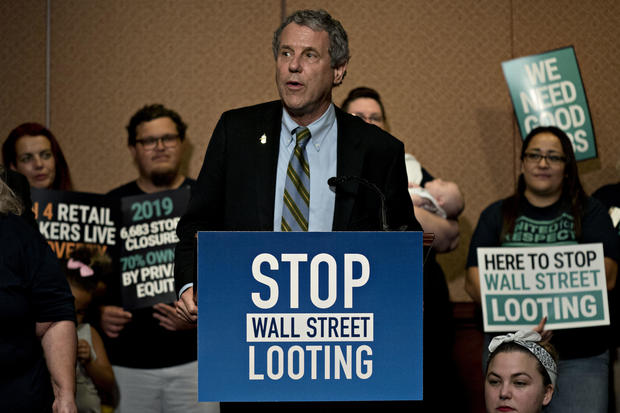
.Lawmakers in Washington, D.C. introduced the "Stop Wall Street Looting Act" in 2019. It would make private-equity firms responsible for debts and retirement pension obligations of companies they purchase, while making their profits contingent on the success of the entities they control.
ANDREW HARRER/BLOOMBERG VIA GETTY IMAGES

"The banks are accountable to their shareholders and to the public — companies are accountable in the same way, but private equity firms are only accountable to their limited partners," said Eileen Appelbaum, co-director of the Center for Economic and Policy Research, referring to the investors in a buyout fund.

Typically, limited partners sign on with a private equity fund manager without knowing what that person plans to buy. Once those investments are made, they don't have any say in how they're managed or when they're sold.

"In private equity, you're investing in what we call a blind pool — you're committing to this fund, but you don't know what you're buying because the private equity firm doesn't know what they're going to buy yet," said Hilary Wiek, lead analyst for fund strategies and performance at PitchBook. "They need to raise their fund first, and then they go out and find investments."


Wiek noted that some PE investors are coming around to the idea of decarbonization, and investors today are much more concerned about their portfolios' climate impact than just a few years ago.

But with deadly heat waves, wildfires and floods this year killing people by the thousands, defunding fossil fuels can't come soon enough, critics say. Many entities currently funding fossil fuels have promised to stop by 2050, a generation in the future. But a typical private-equity fund owns a company for just three to five years before selling it.

"Private equity firms have a very short timeframe," said Mehta-Neugebauer of the PESP. "If they're just holding on to these companies for three to five years, then perhaps even by the end of this decade they could achieve fossil-free portfolios."