Tuesday, December 05, 2023

 HIVES

Unravelling the mechanism of urticaria from eruption shapes


Innovation for developing new treatments based on eruption morphology in mathematical dermatology


Peer-Reviewed Publication

INSTITUTE FOR THE ADVANCED STUDY OF HUMAN BIOLOGY (ASHBI)

Unravelling the mechanism of urticaria from eruption shapes 

IMAGE: 

A RESEARCH GROUP LED BY PROFESSOR SUNGRIM SEIRIN-LEE AT KYOTO UNIVERSITY INSTITUTE FOR THE ADVANCED STUDY OF HUMAN BIOLOGY (WPI-ASHBI) LEVERAGED HIERARCHICAL MATHEMATICAL MODELING TO ANALYZE THE SHAPES OF SKIN ERUPTIONS AND LINK THESE MORPHOLOGICAL FEATURES TO THE IN VIVO PATHOLOGICAL DYNAMICS OF CHRONIC SPONTANEOUS URTICARIA CSU.

view more 

CREDIT: KANON TANAKA (HTTPS://WWW.KANONTANAKA-ILLUSTRATION-WEBDESIGN-SCIENCE.COM/INDEX.HTML)


The skin is the largest organ in the human body and plays an important role in maintaining homeostasis as well as protecting the body from the outside environment. Skin diseases can be life-threatening or heavily impair patients’ quality of life. Urticaria (also called “hives”) is common, affecting at least one in five people in their lifetime, and can persist for years or even decades. Many skin diseases are unique to humans, and their pathogenesis often remains unclear due to the lack of an appropriate experimental animal model and limited clinical data. One such human-specific disease is chronic spontaneous urticaria (CSU), which is characterized by the appearance of skin eruptions called wheals, which have a range of sizes and shapes and are accompanied by itching.


Despite CSU having a clear and visible appearance on the skin surface, the mechanism underlying the various shapes of wheals in vivo remains largely obscured. Recently, a number of pathophysiological characteristics of urticaria have been investigated, including autoimmune responses, cellular infiltrates, and activation of the coagulation pathway by the complement system. It is therefore of great importance to integrate these elements into their dynamics in vivo in order to develop more effective patient-specific treatments.


To address this, a research group led by Professor Sungrim Seirin-Lee at Kyoto University Institute for the Advanced Study of Human Biology (WPI-ASHBi) leveraged hierarchical mathematical modeling to analyze the shapes of skin eruptions and link these morphological features to the in vivo pathological dynamics of CSU. By incorporating both the intravascular and extravascular dynamics using in vitro experimental data, they classified the skin eruption patterns into five potential types. Using these patterns, the researchers developed the Criteria for Classification of Eruption Geometry (EGe criteria) according to their relations with tissue factor and histamine dynamics of mast cells, which act on blood vessels and induce wheal formation. The researchers then demonstrated the validity of their mathematical model to classify CSU according to these criteria in 105 patients, and found the reliability to be as high as 87.6% when analyzed by dermatologists.


“This study was the first to use mathematical models to clarify the pathophysiology of skin eruptions according to their morphology, and can help to pave the way for alternative treatment methods. For example, patients might take photos of their skin eruptions to provide data for a definitive diagnosis of underlying causes, or the effectiveness of treatment can be monitored over time. In addition, this study shows the promise of mathematical models in the understanding the mechanisms of human-specific diseases, where animal models are not available,” Seirin-Lee said.


Through these efforts, the authors hope to pioneer mathematical dermatology as a new multidisciplinary research field for practical use, integrating mathematical science and clinical dermatology for elucidating the pathophysiology of skin diseases and developing new strategies for managing intractable skin diseases.


Paper Information

Sungrim Seirin-Lee, Daiki Matsubara, Yuhki Yanase, Takuma Kunieda, Shunsuke Takahagi, and Michihiro Hide (2023) Mathematical-structure based Morphological Classification of Skin Eruptions and Linking to the Pathophysiological State of Chronic Spontaneous Urticaria, Communications Medicine


Small publishers increasingly important for translated literature

Reports and Proceedings

UPPSALA UNIVERSITY

Jana Rüegg, Doctor at the Department of Literature, Uppsala University, Sweden, 

IMAGE: 

JANA RÜEGG, DOCTOR AT THE DEPARTMENT OF LITERATURE, UPPSALA UNIVERSITY, SWEDEN

view more 

CREDIT: UTE RÜEGG


Over the period 1970–2016, small publishing houses became increasingly important for the publication of literature in translation in Sweden. More than ever, Nobel laureates are being published by relatively small independent publishers. A specialisation in translations often stems from a publisher’s personal interest in a language or geographical area. These conclusions are drawn in a doctoral thesis submitted at Uppsala University.

“It’s remarkable how quickly the small publishers became major actors for translated literature in the Swedish book market. Between 1978 and 1997, ten future recipients of the Nobel Prize in Literature were introduced in Swedish translation by a small publishing house founded after 1975. This is an important factor to consider, since publishing these authors before they are awarded the Nobel Prize entails a greater financial risk for a publisher than after the prize, when publication can be associated with prestige and guaranteed attention,” says Jana Rüegg, Doctor in literature, Uppsala University.

Many new publishing houses were founded after the introduction of state subsidies for literature in 1975 and several of them rapidly became important specifically for translations. Another wave of newly established small publishers has entered the market since the beginning of the 21st century. They have taken on a vital role in the publication of translations in Sweden, particularly from major languages such as French, German and Spanish.

In the years around 2010, several large publishers experienced financial crises, which led them to let go of translated authors whom other publishers were then able to take over, as the thesis shows. The small publishers have also influenced the selection of authors translated into Swedish.

“Over the period 1970–2000, numerous editions of works primarily by male writers were published, translated from the major languages French, German and Spanish. This was partly because of the very extensive publication of classics, which are a type of literature associated in this context with male authors such as Jules Verne, Franz Kafka or Marcel Proust,” says Rüegg.

Her research shows that small publishers founded in the 21st century have played an enormously important role in the publication of translations of works by female writers from French, German and Spanish. After 2005, the gap has narrowed and around 40 per cent of published translations from those three languages have female authors.

The thesis consists of two parts.

The first part, Nobelbanor (Nobel Trajectories), studies translated Nobel laureates in literature between 1970 and 2016 on the Swedish book market and whether they were published before or after the Nobel Prize. The study is based on a dataset of all editions of these authors in Swedish translation up to 2017.

To a large extent, the 45 Nobel Prize laureates were available in Swedish translation before the prize. The fact that 49 per cent of them were published in paperback editions before being awarded the prize shows that the publishers saw a potential demand for large editions of these authors. On average, 20 years passes between the first Swedish translation and the Nobel Prize, which means that in many cases, the Nobel Prize reawakens an interest in an author who has been forgotten by the Swedish book market since their first introduction.

Over time there is a clear migration from larger to smaller publishers in the publication of translated Nobel laureates.

The second part of the thesis, Förmedla och förlägga (Transmit and Publish), focuses on translations from French, German and Spanish published by Swedish publishers between 1970 and 2016. The study is based on a dataset of all fiction editions for adults translated from the three languages in Sweden from 1970 to 2016.

Over time, the number of translations from French and German has decreased and towards the end of the period studied, these translations were increasingly published by small niche publishers rather than large publishing houses. Translations from Spanish follow a different pattern, because it was not until the 1980s that Swedish publishers seriously began publishing translations from that language, including big names such as Gabriel García Márquez and Isabel Allende.

Large publishers continue to publish translations from Spanish to a greater extent, even towards the end of the period studied. According to Rüegg, the historical status of the languages on the Swedish book market clearly plays a role in determining what is translated and published.

“In French and German, there is a long tradition of publication in Sweden and here we find translations from a wide range of genres, from classics and Nobel laureates to popular fiction. Translations from Spanish do not have such a long tradition of publication in the Swedish book market, which has led to very few Spanish-language classics being translated and published and also to relatively limited publication of popular Spanish-language literature in translation during this period,” Rüegg concludes.


Tiny electromagnets made of ultra-thin carbon


When terahertz pulses strike graphene discs


Peer-Reviewed Publication

HELMHOLTZ-ZENTRUM DRESDEN-ROSSENDORF

HZDR's FELBE free-electron lasers 

IMAGE: 

DR. STEPHAN WINNERL (RIGHT) TALKS TO FELBE PHYSICIST DR. JOHN MICHAEL KLOPF ABOUT EXPERIMENTS AT THE HZDR'S FELBE FREE-ELECTRON LASERS.

view more 

CREDIT: HZDR/OLIVER KILLIG


Graphene, that is extremely thin carbon, is considered a true miracle material. An international research team has now added another facet to its diverse properties with experiments at the Helmholtz-Zentrum Dresden-Rossendorf (HZDR): The experts, led by the University of Duisburg-Essen (UDE), fired short terahertz pulses at micrometer-sized discs of graphene, which briefly turned these minuscule objects into surprisingly strong magnets. This discovery may prove useful for developing future magnetic switches and storage devices. The working group presents its study in the scientific online journal Nature Communications (DOI: 10.1038/s41467-023-43412-x).

Graphene consists of an ultra-thin sheet of just one layer of carbon atoms. But the material, which was only discovered as recently as 2004, displays remarkable properties. Among them is its ability to conduct electricity extremely well, and that is precisely what international researchers from Germany, Poland, India, and the USA took advantage of.

They applied thousands of tiny, micrometer-sized graphene discs onto a small chip using established semiconductor techniques. This chip was then exposed to a particular type of radiation situated between the microwave and infrared range: short terahertz pulses.

To achieve the best possible conditions, the working group, led by the UDE, used a particular light source for the experiment: The FELBE free-electron laser at the HZDR can generate extremely intense terahertz pulses. The astonishing result: "The tiny graphene disks briefly turned into electromagnets," reports HZDR physicist Dr. Stephan Winnerl.

"We were able to generate magnetic fields in the range of 0.5 Tesla, which is roughly ten thousand times the Earth's magnetic field." These were short magnetic pulses, only about ten picoseconds or one-hundredth of a billionth of a second long.

Radiation pulses stir electrons

The prerequisite for success: The researchers had to polarize the terahertz flashes in a specific way. Specialized optics changed the direction of oscillation of the radiation so that it moved, figuratively speaking, helically through space.

When these circularly polarized flashes hit the micrometer-sized graphene discs, the decisive effect occurred: Stimulated by the radiation, the free electrons in the discs began to circle – just like water in a bucket stirred with a wooden spoon. And because, according to the basic laws of physics, a circulating current always generates a magnetic field, the graphene disks mutated into tiny electromagnets.

"The idea is actually quite simple," says Martin Mittendorff, professor at the University of Duisburg-Essen. "In hindsight, we are surprised nobody had done it before." Equally astonishing is the efficiency of the process: Compared to experiments irradiating nanoparticles of gold with light, the experiment at the HZDR was a million times more efficient – an impressive increase. The new phenomenon could initially be used for scientific experiments in which material samples are exposed to short but strong magnetic pulses to investigate certain material properties in more detail.

The advantage: "With our method, the magnetic field does not reverse polarity, as is the case with many other methods," explains Winnerl. "It, therefore, remains unipolar." In other words, during the ten picoseconds that the magnetic pulse from the graphene disks lasts, the north pole remains a north pole and the south pole a south pole – a potential advantage for certain series of experiments.

The dream of magnetic electronics

In the long run, those minuscule magnets might even be useful for certain future technologies: As ultra-short radiation flashes generate them, the graphene discs could carry out extremely fast and precise magnetic switching operations. This would be interesting for magnetic storage technology, for example, but also for so-called spintronics – a form of magnetic electronics.

Here, instead of electrical charges flowing in a processor, weak magnetic fields in the form of electron spins are passed on like tiny batons. This may, so it is hoped, significantly speed up the switching processes once again. Graphene disks could conceivably be used as switchable electromagnets to control future spintronic chips.

However, experts would have to invent very small, highly miniaturized terahertz sources for this purpose – certainly still a long way to go. "You cannot use a full-blown free-electron laser for this, like the one we used in our experiment," comments Stephan Winnerl. "Nevertheless, radiation sources fitting on a laboratory table should be sufficient for future scientific experiments." Such significantly more compact terahertz sources can already be found in some research facilities.

Publication:

J.W. Han, P. Sai, D-B. But, E. Uykur, S. Winnerl, G. Kumar, M.L. Chin, R.L. Myers-Ward, M.T. Dejarld, K.M. Daniels, T.E. Murphy, W. Knap, M. Mittendorff: Strong transient magnetic fields induced by THz-driven plasmons in graphene disks, Nature Communications, 2023, (DOI: 10.1038/s41467-023-43412-x)

The Helmholtz-Zentrum Dresden-Rossendorf (HZDR) performs – as an independent German research center – research in the fields of energy, health, and matter. We focus on answering the following questions:

•             How can energy and resources be utilized in an efficient, safe, and sustainable way?

•             How can malignant tumors be more precisely visualized, characterized, and more effectively treated?

•             How do matter and materials behave under the influence of strong fields and in smallest dimensions?

To help answer these research questions, HZDR operates large-scale facilities, which are also used by visiting researchers: the Ion Beam Center, the Dresden High Magnetic Field Laboratory and the ELBE Center for High-Power Radiation Sources.

HZDR is a member of the Helmholtz Association and has six sites (Dresden, Freiberg, Görlitz, Grenoble, Leipzig, Schenefeld near Hamburg) with almost 1,500 members of staff, of whom about 670 are scientists, including 220 Ph.D. candidates.

The electrons from the ELBE accelerator generate laser light in one of the two blue-metallic magnetic structures, the so-called undulators.

CREDIT

HZDR/Christoph Reichelt

When a circularly polarized light pulse (red) hits a micrometre-sized graphene disc (grey), a magnetic field is created for a fraction of an instant (black lines).

CREDIT

Lucchesi, Uta (HZDR)


Rice engineers tackle hard-to-map class of materials


Technique could help tap 2D van der Waals ferroelectrics for use in next-generation electronics


Peer-Reviewed Publication

RICE UNIVERSITY

researchers 

IMAGE: 

YIMO HAN (LEFT) AND CHUQIAO SHI

view more 

CREDIT: PHOTO BY GUSTAVO RASKOSKY/RICE UNIVERSITY


HOUSTON – (Dec. 4th, 2023) – The properties that make materials like semiconductors so sought after result from the way their atoms are connected, and insight into these atomic configurations can help scientists design new materials or use existing materials in new, unforeseen ways.

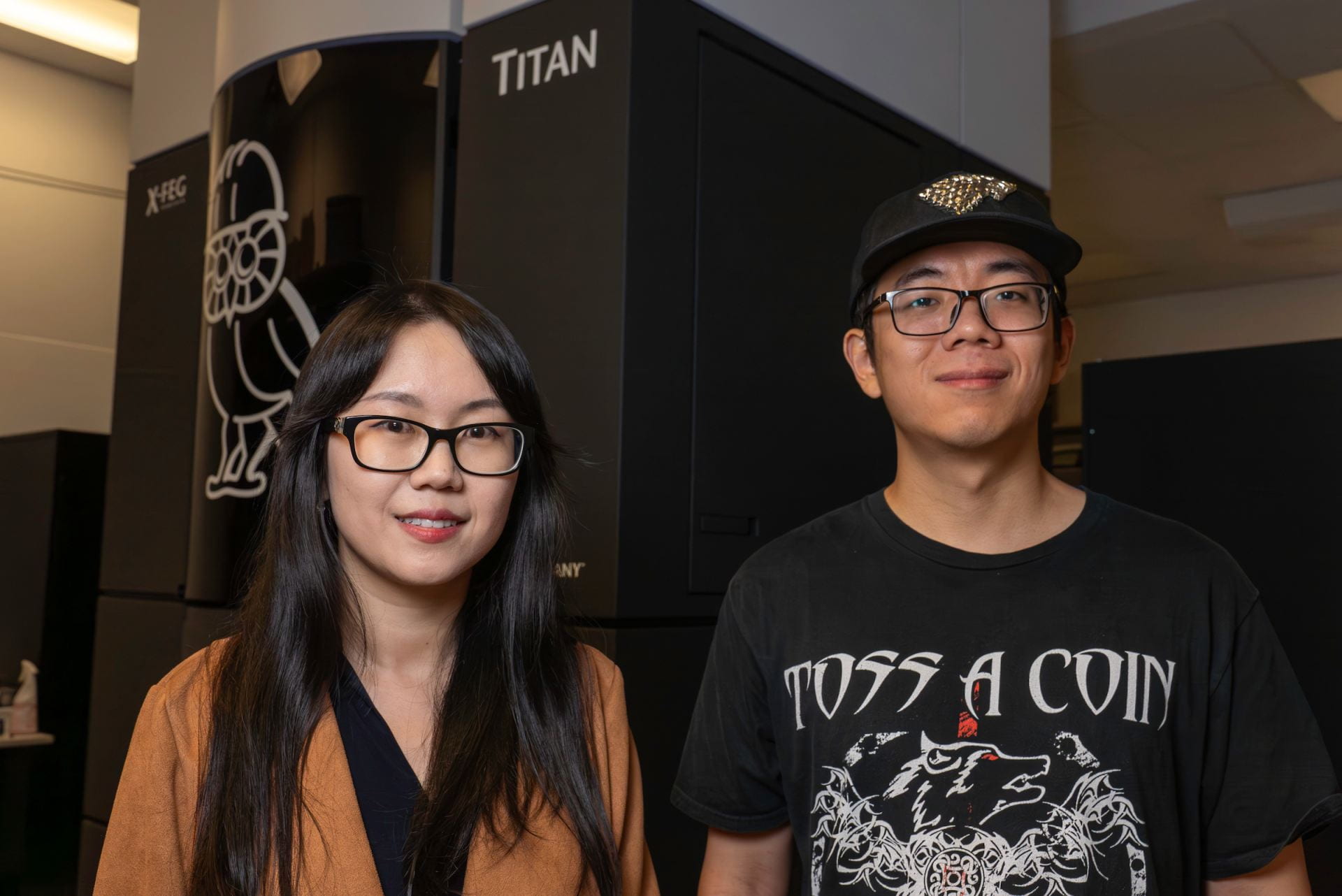
Rice University materials scientist Yimo Han and collaborators mapped out the structural features of a 2D ferroelectric material made of tin and selenium atoms, showing how domains ⎯ areas of the material in which molecules are identically oriented ⎯ impact the behavior of the material.

“Ferroelectric materials are widely used in applications such as memories and sensors, and they will likely be increasingly useful for building next-generation nanoelectronics and in-memory computing,” said Chuqiao Shi, a Rice graduate student in the Han lab and lead author on a study published in Nature Communications. “That’s because 2D ferroelectric materials have remarkable properties and are characterized by their atomic thinness and enhanced integration capabilities.”

In ferroelectric materials, molecules are polarized, and they also segregate and align based on polarization. Moreover, 2D ferroelectrics change shape in response to electrical stimuli ⎯ a phenomenon known as flexoelectricity. In the tin-selenium crystal that is the focus of this research, molecules self-organize into patches or domains, and the flexoelectric effect causes these to move, giving rise to structural shifts in the material that impact its properties and behavior.

“It’s really important that we understand the intricate relationship between atomic structure and electric polarization, which is a critical feature in ferroelectric materials,” said Han, an assistant professor of materials science and nanoengineering. “This domain-dependent structure can be very useful for engineers to figure out how to best use the material and rely on its properties to design applications.”

Unlike conventional ferroelectrics in which atoms are bound by a rigid lattice, in the tin-selenite crystal studied by Han and Shi, the forces that bind the atoms together are weaker, giving the atomic lattice a more supple and pliant quality.

“The material belongs to a special class of 2D materials known as van der Waals ferroelectrics, whose properties could serve to design next-generation, ultra-thin data storage devices and sensors,” Shi said. “Van der Waals forces are weaker than chemical bonds ⎯ they’re the same kind of forces that allow geckos to defy gravity and climb walls.

“The soft in-plane lattices of this 2D material coupled with relatively weaker interlayer van der Waals forces give rise to a unique structural landscape. These distinctive structural features generate effects exclusive to 2D ferroelectrics that are absent in their bulk counterparts.”

The greater degree of flexibility or freedom of the atomic lattice in 2D van der Waals ferroelectrics makes it more difficult to map out the relationship between polarization and material structure.

“In our study, we developed a new technique that allows us to look at both in-plane strain and out-of-plane stacking order simultaneously, which is something conventional investigations of this material were unable to do previously,” Han said. “Our findings are set to revolutionize domain engineering in 2D van der Waals ferroelectrics and position them as fundamental building blocks in the development of advanced devices for the future,” Han said.

The research was supported by the National Science Foundation (2239545, 1231319, 2132105, 1753054, 2039380, 1719875), the Welch Foundation (C-2065), the Department of Energy (DE-SC0020042, DE-SC0023353) and Texas A&M High Performance Research Computing.

-30-

This release can be found online at news.rice.edu.

Follow Rice News and Media Relations via Twitter @RiceUNews.

Peer-reviewed paper:

“Domain-dependent strain and stacking in two-dimensional van der Waals ferroelectrics” | Nature Communications | DOI: 10.1038/s41467-023-42947-3

Authors: Chuqiao Shi, Nannan Mao, Kena Zhang, Tianyi Zhang, Ming-Hui Chiu, Kenna Ashen, Bo Wang, Xiuyu Tang, Galio Guo, Shiming Lei, Longqing Chen, Ye Cao, Xiaofeng Qian, Jing Kong and Yimo Han

https://www.nature.com/articles/s41467-023-42947-3

Image downloads:

https://news-network.rice.edu/news/files/2023/11/231107_Yimo-Han-Chuqiao-Shi_Gustavo-3.jpg
CAPTION: Yimo Han (left) and Chuqiao Shi (Photo by Gustavo Raskosky/Rice University)

https://news-network.rice.edu/news/files/2023/11/figure.jpg
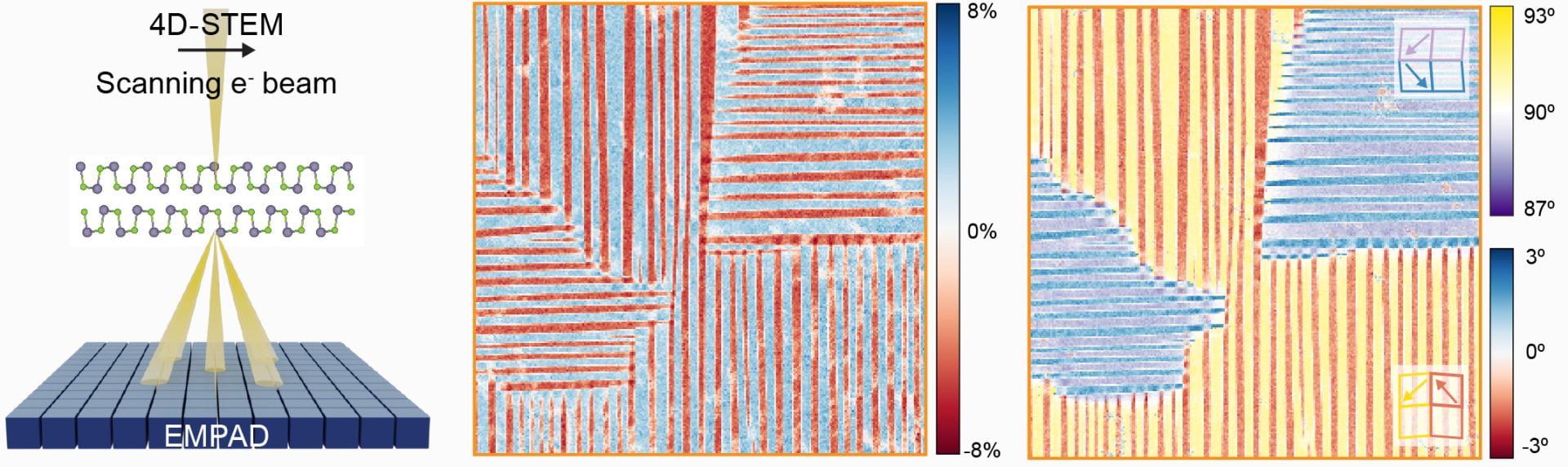
CAPTION: Rice researchers used four-dimensional scanning transmission electron microscopy to analyze the structure of the material (first panel from left); their analysis yielded a ferroelastic strain map of a flake of the material (second and third panels). Insets on the third panel represent polarization directions in different stripe domains. (Image courtesy of Han lab/Rice University)

 
Rice researchers used four-dimensional scanning transmission electron microscopy to analyze the structure of the material (first panel from left); their analysis yielded a ferroelastic strain map of a flake of the material (second and third panels). Insets on the third panel represent polarization directions in different stripe domains.

CREDIT

Image courtesy of Han lab/Rice University


Related stories:

Interdisciplinary Rice team tackles the future of semiconductors:
https://news.rice.edu/news/2023/interdisciplinary-rice-team-tackles-future-semiconductors

Gold buckyballs, oft-used nanoparticle ‘seeds’ are one and the same:
https://news.rice.edu/news/2023/gold-buckyballs-oft-used-nanoparticle-seeds-are-one-and-same

Yimo Han wins NSF CAREER Award:
https://msne.rice.edu/news/yimo-han-wins-nsf-career-award

Links:

Han lab: https://hanlab.blogs.rice.edu/
Department of Materials Science and Nanoengineering: msne.rice.edu
George R. Brown School of Engineering: https://engineering.rice.edu/

About Rice:

Located on a 300-acre forested campus in Houston, Rice University is consistently ranked among the nation’s top 20 universities by U.S. News & World Report. Rice has highly respected schools of architecture, business, continuing studies, engineering, humanities, music, natural sciences and social sciences and is home to the Baker Institute for Public Policy. With 4,574 undergraduates and 3,982 graduate students, Rice’s undergraduate student-to-faculty ratio is just under 6-to-1. Its residential college system builds close-knit communities and lifelong friendships, just one reason why Rice is ranked No. 1 for lots of race/class interaction, No. 2 for best-run colleges and No. 12 for quality of life by the Princeton Review. Rice is also rated as a best value among private universities by Kiplinger’s Personal Finance.
 

If you do not wish to receive news releases from Rice University, reply to this email and write “unsubscribe” in the subject line. Office of News and Media Relations – MS 300, Rice University, 6100 Main St., Houston, TX 77005.


Study shows advanced footwear technology positively impacts elite sprint performances


SO WILL THIS END THE PROSECUTION OF PERFORMANCE ENHANCING DRUGS


Peer-Reviewed Publication

PEERJ

Sprinter 

IMAGE: 

IMAGE: Nicolas Hoizey

view more 

CREDIT: NICOLAS HOIZEY


A scientific study published in PeerJ Life & Environment sheds light on the potential game-changing impact of advanced footwear technology (AFT) on elite sprint performances in track and field. The research, titled "The Potential Impact of Advanced Footwear Technology on the Recent Evolution of Elite Sprint Performances," reveals the significant strides made in sprint performance and suggests that AFT has played a pivotal role in these improvements. 


Elite track and field sprint performances have long been viewed as reaching a plateau as the boundaries of human physiology are tested. To further enhance sprinting capabilities, researchers have turned their attention to technological interventions, specifically the application of advanced footwear technology in sprint spikes. The study aimed to determine whether the use of AFT has led to notable improvements in sprint performances and the extent of these enhancements. 


The research, authored by Dr. Joel Mason of Friedrich Schiller University Jena and colleagues, analyzed performance data from the years 2016-2019 and 2021-2022, focusing on the top 100 athletes in each sprint event as listed by World Athletics. Key findings from the study include: 


1. No significant year-to-year differences in sprint performances were observed in any event before the introduction of AFT (2016-2019). 

2. Following the release of AFT (in 2021 and 2022), there were significant improvements in eight out of ten sprint events, with enhancements ranging from 0.40% (men's 100m) to 1.52% (women's 400m hurdles). 

3. The use of AFT was associated with performance improvements in six out of ten events, including men's and women's 100m, women's 200m, men's 110m hurdles, women's 100m hurdles, and women's 400m hurdles. 


The study also noted that improvements were more pronounced in women's sprint events compared to men's sprint events, indicating that AFT may have a greater impact on female athletes. 


In conclusion, this research offers compelling evidence that the recent evolution of elite sprint performances can be partially attributed to advances in footwear technology. These improvements are influenced by factors such as the specific sprint event, athlete gender, and potentially the level of the athlete offering athletes an exciting opportunity to further enhance their performances, and providing a challenge for World Athletics to preserve the integrity of the sport while still embracing developments in technology.

For media inquiries or additional information about this research, please contact euan@peerj.com


£1.5m funding to create ‘Digital Twin’ model to reduce methane emissions


Dr Robert Parker from the University of Leicester and the National Centre for Earth Observation receives one of 75 new Future Leaders Fellowships from UK Research and Innovation


Grant and Award Announcement

UNIVERSITY OF LEICESTER


A ‘twin’ of the world’s wetlands is to be created by Leicester scientists from satellite data, mathematical models and artificial intelligence to help monitor and reduce methane emissions.

Dr Robert Parker from the University of Leicester and the National Centre for Earth Observation will lead the project as one of 75 new Future Leaders Fellows announced today (4 December) by UK Research and Innovation (UKRI).

It comes as climate experts from Leicester attend the COP28 climate conference in Dubai this week, showcasing the vital role of space technology and data in tackling climate change, as well as research on measuring methane emissions from space.

UKRI’s flagship Future Leaders Fellowships allow universities and businesses to develop their most talented early career researchers and innovators and to attract new people to their organisations, including from overseas. 75 of the most promising research leaders will benefit from £101 million to tackle major global issues and to commercialise their innovations in the UK.

Dr Parker has been awarded £1.5m for his project ‘The First Environmental Digital Twin Dedicated to Understanding Tropical Wetland Methane Emissions for Improved Predictions of Climate Change’.

Methane is a major greenhouse gas and a significant target for mitigation of global warming. Many countries recently committed to the Global Methane Pledge, aiming to reduce methane emissions by 30% by 2030. However, recent unexplained and significant increases in atmospheric methane highlight an increasingly urgent need to understand how tropical wetlands are responding to climate change and how potential methane-climate feedbacks are driving such increases.

The Digital Twin, a virtual model using real-world data, will bring together our best capabilities for observing and predicting wetland emissions and make these results useful to researchers, policymakers or anyone who needs to ask questions about how the Earth responds to such changes. It will enable new types of analysis, generation of new data, new climate modelling capabilities, and improved decision support.

Dr Robert Parker from the University of Leicester School of Physics and Astronomy, and the National Centre for Earth Observation, said: “As we try to achieve Net Zero targets and meet commitments to the Methane Pledge to reduce methane emissions, it is vital that we understand the background of underlying natural emissions upon which human-made emissions are added. Climate feedbacks which accelerate natural emissions could undermine any benefit from reducing human-generated emissions and significantly change advice given to policymakers.

“I’m delighted to have this opportunity to demonstrate how we can bring together our amazing wealth of satellite data, modelling capabilities and machine learning techniques to tackle some of the most urgent environmental issues. Understanding and reducing methane emissions is a major global challenge but there’s a massive benefit if we can achieve it and limit future warming.”

UKRI Chief Executive, Professor Dame Ottoline Leyser, said: “UKRI’s Future Leaders Fellowships provide researchers and innovators with long-term support and training, giving them the freedom to explore adventurous new ideas, and to build dynamic careers that break down the boundaries between sectors and disciplines. 

“The fellows announced today illustrate how this scheme empowers talented researchers and innovators to build the diverse and connected research and innovation system we need to shorten the distance between discovery and prosperity across the UK.”

COP28, the year’s biggest climate conference, will be attended by three climate experts from the University of Leicester whose research is making significant contribution to the agenda through their work at Space Park Leicester and the National Centre for Earth Observation (NCEO).

Professor Heiko Balzter and Dr Cristina Ruiz Villena from NCEO, and Dr Harjinder Sembhi from Space Park Leicester are supporting the UK Space Agency’s collaborative action group, Space4Climate, who will be representing UK climate and space expertise from academia and industry. Dr Sembhi will also talk about how Earth Observing satellites can help address global challenges and will be showcasing some recent research on measuring methane emissions from space. Dr Cristina Ruiz Villena is one of 10 Early-Career Researchers awarded a UK Universities Climate Network (UUCN) scholarship to attend COP28.