Thursday, February 01, 2024

RENT IS INFLATION

Rent prices rose in 2023 as Canada saw lowest vacancy rate since 1988: CMHC


PROPERTY IS THEFT

Rent prices in Canada soared last year as supply struggled to keep up with demand, leading to the lowest national vacancy rate on record since the Canada Mortgage and Housing Corp. began tracking that data in 1988.

The federal housing agency said in a report Wednesday the vacancy rate for purpose-built rental apartments sat at 1.5 per cent during the first two weeks of October 2023, when it conducted its annual survey.

That was down from 1.9 per cent a year earlier, which at the time had been the lowest national vacancy rate in over two decades.

The average rent for a two-bedroom purpose-built apartment, which the CMHC uses as its representative sample, grew eight per cent to $1,359 in 2023. That growth figure was up from the 5.6 per cent average rent increase recorded in 2022 and above the 1990-2022 average of 2.8 per cent.

The data "did not surprise us at all," said CMHC deputy chief economist Kevin Hughes. Although rental supply rose in most Canadian cities last year, it was not enough to keep pace with increased demand pressures caused by population and employment growth.

"Demand from the demographic changes is definitely substantial," said Hughes.

"You have newly arrived immigrants, obviously, but you have also young Canadians that are seeking their first home and you also have older households who are needing to downsize."

He said with affordability challenges plaguing the home ownership market, especially amid last year's high inflation and interest rate environment, more Canadians are looking to rental options.

The agency reported the average rent for a two-bedroom rental condo was $2,049, up from $1,929 in 2022 as the secondary rental market also tightened, with the vacancy rate for such units falling from 1.6 per cent to 0.9 per cent annually.

"We have a chronic lack of supply in Canada and the statistics really are not, let's say, encouraging in terms of new additional supply or substantially increased supply," said Hughes.

"As we go through this current year, we would probably expect that there will be delays in some projects because of financing. There's also, in many markets, labour shortages for construction."

The report "confirms the extreme imbalance between supply and demand for homes that characterizes Canada's housing sector," said a note by National Bank of Canada economists Stéfane Marion and Daren King.

The pair predicted that imbalance is "likely to persist for the foreseeable future" as the Bank of Canada forecasts population growth of about 800,000 in both 2024 and 2025, "with only a limited increase in housing starts."

Hughes said Alberta's two largest cities stood out most from the CMHC's annual survey. Calgary and Edmonton both saw their lowest vacancy rates in a decade, at 1.4 per cent and 2.4 per cent, respectively, along with the sharpest rise in rents among major cities in 2023.

Calgary's vacancy rate was down from 2.7 per cent in 2022 while Edmonton saw a drop from 4.3 per cent. Hughes said population increases over the past year accelerated demand for rentals in those regions while supply did not increase substantially.

"Those were markets that were, let's say, more balanced last year," he said.

"The population (increase) stemmed from the international source with immigrants, but also domestically as well — so people moving into Alberta from other provinces or even to Calgary and Edmonton from within Alberta."

Canada's largest city, Toronto, recorded a 1.4 per cent vacancy rate, down from 1.6 per cent in 2022, while Montreal was at 1.5 per cent, down from two per cent.

Vancouver, at 0.9 per cent, had the lowest vacancy rate among major Canadian markets, but was on par with 2022 levels. Ottawa was also flat at 2.1 per cent.

"Very tight markets usually entail heavier increases in rent, which we've seen," Hughes said.

"Yes, the rental market is more affordable than the ownership market, for sure, but even that market is becoming quite daunting for many."

This report by The Canadian Press was first published Jan. 31, 2024.


Gildan investor pulls meeting request but boardoom scrap rages on

A top shareholder of Gildan Activewear Inc. withdrew its request for a special shareholder meeting, but will still press ahead with its campaign to replace most of the board of the Canadian clothing manufacturer. 

Los Angeles-based Browning West LP, which holds a five per cent stake in Gildan, said it will simply try to get its proposed slate of eight new board members elected at Gildan’s May 28 annual meeting. The investment firm is seeking to oust current directors and reinstate longtime Chief Executive Officer Glenn Chamandy, who was fired in December, prompting a corporate governance row.

Browning West, which is supported by several large shareholders in backing Chamandy, tried to force the special meeting to get a relatively quick vote on a new board. 

But Gildan, the Montreal-based company that owns the American Apparel brand, launched a legal challenge Monday in a Quebec court, arguing that Browning West broke U.S. regulations when it bought more shares last month.

Now, Gildan investors will wait nearly four months before making a decision on who they want in charge.  


“The board responded to our January 9th requisition by spending three weeks disregarding the feedback of numerous longstanding shareholders, leaking misinformation about Glenn Chamandy, and waging a low-road smear campaign and incessant legal harassment of shareholders,” Browning West Co-Founders Usman Nabi and Peter Lee said in a statement Wednesday.

Gildan called Browning West’s efforts a “spectacular failure” and indicated the board and management will keep fighting. 

“The company is continuing to investigate the scope of Browning West’s misconduct, including the implications of their illegally purchased shares on their capability to nominate and their capability to vote,” Simon Beauchemin, a Gildan representative, said in an emailed statement. 


Restaurateurs optimistic for 2024, looking to embrace AI: survey

Canadian restaurateurs are increasingly optimistic about the future of their business and are looking to embrace artificial intelligence in day-to-day tasks, according to the results of a new survey.

Financial services firm Square’s annual “Future of Commerce” report, released Wednesday, found 80 per cent of Canadian restauranteurs are feeling more optimistic about their business than they were a year ago, and 100 per cent are looking to expand their menu offerings in 2024.

Ming-Tai Huh, head of restaurants at Square, has first-hand experience the growing sense of optimism and experimentation as a partner of Boston-based Cambridge Street Hospitality Group.

“Restaurants moving out of COVID and the pandemic really have to find new ways to engage with their guests and that involves probably selling them different products,” he said during a media availability ahead of the report’s release.

“Something that we see is some caution about inflation as it may impact consumer spending, consumer dining trends. With that said, we still see optimism towards the future.”


AI uses for restaurants

With costs climbing and restaurants often short-staffed, many Canadian restaurants are looking at AI to fill the gaps.

The survey found 100 per cent of responding Canadian restauranteurs believe AI can help with their staffing challenges, including the use of food prep robots, voice ordering technology and predictive ordering.  

Huh doesn’t expect the restaurant experience will change drastically as establishments incorporate AI.

“For the average restaurant and the average small business, we're going to see incorporation of AI and automation at a small level … in helping restaurants effectively be more efficient and automated in some ways where you can take repetitive tasks and ultimately make them better,” he said.

“I really like to see that because there's so many things that these restaurants have to do on a daily basis and some things you just can't get to and now all of a sudden those things can happen very quickly.”

Customers also appear open to AI use in restaurants, as 60 per cent of surveyed consumers said they are supportive of AI-based tools and 76 per cent would prefer to place an order on a screen instead of a person.

Ara Kharazian, research and data lead at Square, said that even though restaurants tend to be a personal experience, consumers aren’t too worried about losing some human interaction.

“We found in our survey that consumers are generally open to a creative and effective use of AI and technology if it's going to improve the restaurant experience,” he said during the media event.

“These consumers are also the same people who saw how hard it was to go to a restaurant and enjoy the experience in a period of significant labour shortages.”

Huh envisioned a scenario where AI could improve the customer experience, especially when visiting a new restaurant.

“I like wine and when I go to a new restaurant, I'm maybe a wine nerd and I kind of know a lot, but not everybody has that skill and that that training,” he said.

“It'd be wonderful for a restaurant to be able to provide you with this recommendation based on your taste or needs.”

Methodology:

The Square Future of Commerce Retail and Restaurant Surveys were conducted by Wakefield Research among 2,000 retail owners & managers and 2,000 restaurant owners and managers, with quotas set within each survey for 500 respondents per market in the U.S., Canada, U.K. and Australia, between 27 October and 8 November 2023, using an email invitation and an online survey.

Results of any sample are subject to sampling variation. The magnitude of the variation is measurable and is affected by the number of interviews and the level of the percentages expressing the results. For the interviews conducted in this particular study, the chances are 95 in 100 that a survey result does not vary, plus or minus, by more than 2.2 percentage points for the Retail and Restaurant Surveys and by more than 1.6 percentage points for the Consumers Survey from the result than would be obtained if interviews had been conducted with all persons in the universe represented by the sample.

'Muscling': Alberta government won't stock B.C. wines that sell direct to consumers

 B.C., Manitoba, Saskatchewan and Nova Scotia allow consumers to order out-of-province wine directly from producers.


An interprovincial wine war is fermenting after Alberta's liquor wholesaler told vintners in British Columbia that it won't stock their products in retail stores unless they stop shipping it directly to consumers.

"They are really making a threat," said Al Hudec, a lawyer hired by winemakers to push back against the Alberta move.

"The B.C. wineries are not breaking any laws in Alberta. This is just muscling the wineries."

Last week, Alberta Gaming, Liquor and Cannabis, which regulates the sale of liquor in the province by controlling wholesale and distribution, sent a letter to wineries in B.C. It said the agency had been investigating the practice of consumers in Alberta ordering wine directly from B.C. wineries instead of buying it in Alberta stores.

"Our investigation found tangible evidence of (your winery's) involvement in (direct-to-consumer) shipping of wines across provincial borders in Alberta," said one of the letters, shared with The Canadian Press.

"To maintain the integrity of Alberta's liquor model and to protect the interests of Alberta retailers and liquor agents, AGLC will not accept any inbound shipments from (your winery) from this date forward. We will resume acceptance of inbound shipments if, by way of written notice, (your winery) agrees to immediately cease (direct-to-consumer) shipping operations to Alberta."

That's corked, said Hudec. He said Alberta is trying to impose its regulations on another province.

"Provinces only have jurisdiction over people in the province and activities in the province. Any enforcement action has always been brought against individual consumers, not the wineries."

What's more, he said the Alberta letter isn't fair.

"(It) alludes vaguely to some breach of the law but they don't give you the particulars. They don't give you a chance to respond, they don't give you a chance for a hearing.

"Then they impose this penalty they don't have any authority under the legislation to impose. It's totally offensive to administrative fairness."

Hudec said the Alberta move could be vulnerable to a judicial review.

B.C.’s Ministry of Public Safety and Solicitor General, in a statement Wednesday, said it was "actively engaging with the government of Alberta to address the issue and navigate shared concerns related to interprovincial direct-to-consumer wine sales for the benefit of the industry and consumers."

John Skinner of Painted Rock winery in Penticton, B.C., said Alberta's move couldn't come at a worse time. Freak cold weather has devastated grapevines throughout the province for a second year in a row.

"The industry is on its heels," he said. "We'd like a little consideration from our provincial friends."

He estimated about 10 per cent of his sales are directly to consumers in Alberta.

"(The move) doesn't represent the Alberta people," he said. "We have a lot of Albertan wine club members."

Wines of British Columbia has written its own letter back to Alberta.

"The letters raise serious concerns for both the individual recipients and for Alberta-British Columbia trade relationships generally," says the Jan. 24 document.

"The AGLC has no authority, within the legislation that it administers, to impose this interprovincial trade restriction."

Karin Campbell, spokeswoman for the Alberta commission, said in an email the agency is trying to protect Albertans.

"Suppliers from other provinces that offer direct-to-consumer shipping are in contravention of provincial legislation, are bypassing Alberta’s private liquor retailers and liquor agencies and are impacting the dollars that go to the general revenue fund," she wrote. "With no oversight, AGLC cannot ensure that these products are being sold only to adults over the age of 18."

Dale Nally, the United Conservative cabinet minister responsible for the agency, did not respond to a request for comment.

B.C., Manitoba, Saskatchewan and Nova Scotia allow consumers to order out-of-province wine directly from producers.

In Manitoba, a 2018 study commissioned by Wines of British Columbia found allowing direct-to-consumer didn't affect retail sales. It found overall wine sales in the province grew faster than the national average after direct sales were allowed.

It estimates direct-to-consumer counts for less than three per cent of wine sales, with most of that involving high-end bottles that aren't even available through government channels.

Direct sales are a long-standing issue for Canadian producers of alcoholic beverages. A 2018 Supreme Court decision found provinces had the right to restrict purchases that didn't go through provincial licensing agencies.

Hudec said that's part of the reason Canadians consume a lower proportion of their own wines than any other wine-producing country.

This report by The Canadian Press was first published Jan. 31, 2024.


Canadian economy gains speed as manufacturing, trade rebound

Passengers at Montreal airport

The Canadian economy bounced back sharply in the final quarter of 2023, driven by higher goods production and shipments and stronger U.S. demand. 

Preliminary estimates say gross domestic product grew 0.3 per cent in December, Statistics Canada reported Wednesday in Ottawa. That followed a 0.2 per cent expansion in the previous month, exceeding forecasts for 0.1 per cent in a Bloomberg survey of economists.

Overall, the industry-based numbers point to growth of 1.2 per cent on an annualized basis in the final three months last year, reversing a third-quarter contraction. The figures suggest Canada’s economy was being pulled along by robust consumer spending in the U.S. to close out 2023, and was expanding at a faster rate than the Bank of Canada’s projections. The central bank’s forecast was for flat fourth-quarter growth. 

Although the data will likely be revised on Feb. 29 when the income and expenditure-based figures for the fourth quarter are published, they show an economy that has managed to avoid a prolonged contraction so far. 

The release of the data temporarily caused bond yields to rise, though they quickly resumed their downward trend, with the two-year Canada benchmark trading around 3.96 per cent as of 10:03 a.m. in Ottawa. The loonie strengthened.

The show of economic strength may buy the Bank of Canada some time to put off interest rate cuts until it’s confident about the downward momentum in inflation. But the growth is also partly due to population increases. On a per-capita basis, the Canadian economy has been shrinking. 

“With the solid end to 2023, this clearly points to upside risk for our 2024 call of just 0.5 per cent GDP growth,” Doug Porter, chief economist at Bank of Montreal, said in a report to investors. “Given the recent large upward revisions to US growth, it’s far from shocking that Canada’s pace could also get a lift, with 1 per cent growth entirely within reach this year. Of course, as we so often like to point out, that’s still very modest when stacked up against rollicking population growth.” 

Last week, the central bank held its policy rate at five per cent for a fourth straight meeting. Governor Tiff Macklem said discussion of monetary policy is now shifting to how long it needs to stay at the current level — policymakers don’t expect to increase borrowing costs again if the economy evolves in line with their forecasts. 

The central bank sees growth accelerating around mid-2024, with household spending picking up while exports and business investments get a boost from foreign demand. It’s forecasting 0.8 per cent GDP growth this year and 2.4 per cent in 2025.

“I think this will give the Bank of Canada pause, but I don’t think it dramatically impacts their pace,” Dennis Mitchell, chief executive officer of Starlight Capital, said on BNN Bloomberg Television. “We have waves of mortgage refinancing that are going to put significant downward pressure on consumer spending and household disposable income.”

Wednesday’s figures suggest that when the final numbers come in, they’ll show the Canadian economy grew 1.5 per cent last year.


Film industry restarts

In November, the majority of the growth came from the goods-producing industries, which saw 0.6 per cent gains, the highest growth rate since January 2023. Service industries edged up 0.1 per cent.

The manufacturing sector jumped 0.9 per cent, wholesale trade rose 0.7 per cent and mining, quarrying and oil and gas extraction grew 0.3 per cent.

While transportation and warehousing expanded 0.8 per cent in November, the sector was one of the main drags to December output, along with construction and educational services, according to Statistics Canada’s advance estimate.

The education sector also declined 0.3 per cent in November due to strikes by workers in Quebec. 

Information and cultural services increased 0.5 per cent, led by the publishing and motion picture industries. The latter saw the largest monthly increase since September 2022, benefiting from the end of the Hollywood actors’ strike. The labour dispute was resolved in early November, allowing film and television companies to ramp up productions again.

This is the first key economic data release since the Bank of Canada’s first rate decision of the year. Policymakers next set rates on March 6, after releases of January jobs and inflation data, as well as another GDP print. Economists widely expect the bank to hold rates steady again. 

Quebec minimum wage rises by 50 cents to $15.75 an hour starting May 1

Quebec's minimum wage will increase by 50 cents to $15.75 an hour beginning May 1.

The Labour Department says it is hiking the minimum wage by a little more than three per cent because of the economic uncertainty in the retail and restaurant sectors.

The department says the hike will affect just over 200,000 workers, including more than 111,000 women.

Labour Minister Jean Boulet says the government doesn't want to raise the minimum wage too quickly because doing so could have a negative effect on employers, notably in restaurant and retail.

The government says the raise will keep the minimum wage to about half the average hourly pay for workers in Quebec, which is the province's goal.

Boulet says the increase of three per cent is higher than the estimated inflation for the province's 2024-25 fiscal year, which is 2.3 per cent.

This report by The Canadian Press was first published Jan. 31, 2024.

 

Enbridge to cut 650 jobs due to 'increasingly challenging' business conditions

Pipeline giant Enbridge Inc. is cutting its workforce by 650 positions due to what it calls "increasingly challenging business conditions."

Enbridge spokeswoman Gina Sutherland confirmed the cuts in an email Tuesday, adding the Calgary-based company aims to complete the job reductions by March 1. 

"Persistent headwinds – including higher interest rates, economic uncertainty and the ripple effects of geopolitical developments – all contribute to increasingly challenging business conditions across many industries," Sutherland said.

The company currently has approximately 12,000 employees, primarily in the U.S. and Canada, according to its website.

Enbridge will attempt to minimize the human impact of the cuts by looking first at reducing vacancies, contract positions and redeploying people where possible, Sutherland added. 

She did not provide specifics on which business units or regions would be most affected.

Enbridge, which is set to release its fourth-quarter and full-year 2023 financial results on Feb. 9, has made a number of significant business moves in recent months.

In September, the company announced it will purchase three U.S.-based utility companies — the East Ohio Gas Company, Questar Gas Company and its related Wexpro companies, and the Public Service Company of North Carolina — from Virginia-based Dominion Energy Inc. in a US$14 billion cash-and-debt deal.

The deal, expected to close sometime this year, will double the scale of Enbridge's gas utility business, making it the largest by volume in North America with a combined rate base of over $27 billion and about 7,000 employees delivering over nine billion cubic feet per day of gas to approximately seven million customers.

The company also announced in December the sale of its stakes in the Alliance pipeline and Aux Sable gas processing facility to Pembina Pipeline Corp. for $3.1 billion. It said it would use part of the proceeds to help finance the previously announced U.S. utilities purchase.

Enbridge is not the only Canadian energy company to announce significant layoffs in recent months. Suncor Energy Inc. announced last June its plan to cut 1,500 positions before the end of 2023 in an effort to reduce costs and improve the company's financial performance.

This report by The Canadian Press was first published Jan. 30, 2024.

Ontario minister confirms Pickering refurbishment plans

31 January 2024


The provincial government is supporting Ontario Power Generation (OPG) to go ahead with the refurbishment of units 5-8 at the Pickering nuclear power plant. OPG will now begin the initiation phase of the project.

Todd Smith announces the refurbishment plans at Pickering (Image: X/Todd Smith)

Announcing the government's support for the plan, Ontario Minister of Energy Todd Smith said refurbishing the four Candu units would enable the plant to produce "at least" another 30 years of safe, reliable and clean electricity while creating thousands of new jobs. "With global business looking to expand in jurisdictions with reliable, affordable and clean electricity, a refurbished Pickering Nuclear Generating Station would help Ontario compete for and land more game-changing investments," he said.

The government is supporting OPG's CAD2 billion (USD1.5 billion) budget for the initiation phase of the project, which will include engineering and design work as well as securing long-lead components to ensure materials are available when needed and to help keep costs down. OPG and its business partners will also identify potential Indigenous engagement opportunities in contracting, employment and other economic benefits related to the project, the government said.

OPG's current licence for the Pickering nuclear generating station expires in August 2028 but does not allow commercial operations for any of the units beyond 31 December 2024. The provincial government has previously supported OPG to extend the operating period beyond that date: the company earlier this year applied to the Canadian Nuclear Safety Commission to extend operation of units 5-8 until the end of 2026.

OPG is more than half-way through a CAD12.8 billion project to refurbish the four units at its Darlington plant, which is scheduled to be completed by the end of 2026. The "thousands" of lessons learned from that, and from Bruce Power's ongoing major project to refurbish six Candu units at its plant, are a "major advantage" to help ensure the project's success, OPG President and CEO Ken Hartwick said.

"Our experience refurbishing Darlington, a highly complex project that remains on time and on budget, will be invaluable as we begin the work necessary so Pickering can continue to help meet the growing electricity demands of this thriving province for another three-plus decades," he said.

OPG's preliminary schedule anticipates completing the refurbishment of the Pickering units by the mid-2030s. Preliminary analysis by the Conference Board of Canada says the project is expected to increase the province's GDP by CAD19.4 billion during the 11-year refurbishment project, create about 11,000 jobs per year during that time, and create and sustain more than 6000 jobs per year during operation after refurbishment.

"We are thrilled that Pickering, a workhorse of the Canadian energy system, will be refurbished and given the opportunity to provide us with another 30 years of affordable, sustainable, clean energy," John Gorman, president and CEO of the Canadian Nuclear Association, said. "This project ensures that we are maintaining and growing the skills and expertise that we have invested in over the past decade with the refurbishment and major component replacement projects at Darlington and Bruce."

The government said it will follow a multi-phase approvals process to ensure the Pickering refurbishment "only proceeds if it is in the best interests of Ontario and its ratepayers". The refurbishment will also require regulatory approval.

The Ontario government is also supporting pre-development work for potential new large-scale nuclear development at Bruce Power and three additional small modular reactors at Darlington as part of its plan to taking to meet electricity demand and reduce emissions by supporting the electrification of the province's economy as set out in Powering Ontario's Growth which it published last year.

Historic performance


Pickering is home to six currently operating Candu units supplying around 14% of Ontario's electricity. The plant produced 21.5 TWh of electricity in 2023 - its second-highest output as a six-unit station. The plant also produces around 20% of the world's supply of the medical radioisotope cobalt-60, used to irradiate and sterilise single-use medical devices.

The four units that are to be refurbished, sometimes referred to as Pickering B, began operations in the mid-1980s. The other currently operating reactors - units 1 and 4 - are part of the four-unit Pickering A plant which began operations in the early 1970s and was laid up in 1997. Units 1 and 4 underwent refurbishment before returning to service in the 2003 (unit 4) and 2005 (unit 1), but remain scheduled for closure by the end of 2024. Units 2 and 3 did not return to service after being laid up.

SaskPower-GEH agreement to advance SMR development

31 January 2024


Canadian Utility SaskPower and GE Hitachi Nuclear Energy (GEH) have signed an agreement to advance small modular reactor (SMR) development in Saskatchewan. In June 2022, SaskPower selected GEH's BWRX-300 as the technology to be used in its SMR development work.

(Image: GEH)

The new agreement will enable SaskPower and GEH to collaborate on project planning and facilitate the sharing of expertise related to the design, fuel sourcing and fabrication for the BWRX-300 SMR. It will also support workforce and supply chain planning needed for a Saskatchewan-based SMR deployment.

SaskPower said the agreement will streamline its planning and licensing work to inform its decision in 2029 whether to proceed with nuclear power in Saskatchewan.

"Gaining detailed technical specifications, requirements and designs to the BWRX-300 is necessary for our planning work and license applications," said SaskPower President and CEO Rupen Pandya. "Leveraging experience and expertise from our colleagues in the nuclear industry is an important part of our planning work."

"This agreement is another important step in our efforts to support Saskatchewan's workers, businesses and clean energy goals," said GEH Canada Country Leader Lisa McBride. "The BWRX-300 reimagines what is possible when it comes to generating reliable, carbon-free energy."

SaskPower selected GEH's (GEH) BWRX-300 in June 2022 for potential deployment in the province in the mid-2030s after an assessment process in which it looked at several SMR technologies.

The BWRX-300 is a 300 MWe water-cooled, natural circulation SMR with passive safety systems that leverages the design and licensing basis of GEH's US Nuclear Regulatory Commission-certified ESBWR boiling water reactor design and its existing, licensed GNF2 fuel design, a unique combination that GEH says positions it to deliver an "innovative, carbon-free baseload power generation source" this decade.

Ontario Power Generation has already selected the BWRX-300 for its Darlington New Nuclear Project in Ontario, where Canada's first commercial, grid-scale, SMR could be completed as early as 2028.

SaskPower will not make a decision on whether to build an SMR until 2029, but in the meantime will continue with project development, licensing and regulatory work. In September 2022, the company said it had identified two areas in the province of Saskatchewan - Estevan and Elbow - for further study to determine the feasibility of hosting an SMR.

Researched and written by World Nuclear News


IAEA mission reaffirms safety of Fukushima water release

30 January 2024


Japan's discharge of treated water into the sea at the damaged Fukushima Daiichi nuclear power plant is consistent with international safety standards, the International Atomic Energy Agency (IAEA) Task Force monitoring the release has concluded in its first full report since the water discharge began last year.

Task Force members viewing the dilution/discharge facility during a visit to Fukushima Daiichi in October last year (Image: Tepco)
At the site, contaminated water - in part used to cool melted nuclear fuel - is treated by the Advanced Liquid Processing System (ALPS), which removes most of the radioactive contamination, with the exception of tritium. This treated water is currently stored in about 1000 tanks on site.

Japan announced in April 2021 it planned to discharge treated water stored at the site into the sea over a period of about 30 years, and asked the IAEA to review its plans against IAEA safety standards. An IAEA Task Force was established to implement the assistance to Japan, which included advice from a group of internationally recognised experts from Member States, including members from the region, under the authority of the IAEA Secretariat.

Japan started to discharge the water on 24 August 2023 and has so far completed the release of three batches, a total of 23,400 cubic metres of water.

The latest report covers the IAEA review mission conducted from 24-27 October last year to follow up on the findings from the IAEA's Comprehensive Report on the Safety Review, published in July 2023. That report - issued before the discharge began - found Japan's plan for handling the treated water to be consistent with international safety standards and that the discharge as planned would have a negligible radiological impact to people and the environment.

During the latest mission, the Task Force reviewed the facilities and equipment installed at the Fukushima Daiichi plant to discharge the ALPS-treated water. It also met with Tokyo Electric Power Company (Tepco), the operator of the plant, Japan's Ministry of Economy, Trade and Industry and the Nuclear Regulation Authority.

Based on their assessments, the Task Force said the mission "did not identify anything that is inconsistent with the requirements in the relevant international safety standards" and therefore "reaffirmed the conclusions from the Agency's comprehensive safety report issued on 4 July last year".

The team also concluded: a robust regulatory infrastructure is in place in Japan to provide operational safety oversight of the discharge of ALPS-treated water; the equipment and facilities at Fukushima Daiichi are installed and operated in a manner that is consistent with Japan's plan for the release of the water and the relevant international safety standards; and optimisation of protection - that is the process to determine the level of protection and safety for individuals - needs to be considered as part of the overall decommissioning of the Fukushima Daiichi site. However, the Task Force fully recognised that the discharges are in the early stages and that further time and operational experience are required before progress can be made on this issue.

The next review mission to Fukushima Daiichi is anticipated to take place in the Spring of 2024.

Separately, the IAEA also issued two reports prepared as part of its safety review of the water discharge detailing the latest findings of its ongoing corroboration of the measurement data underpinning Japan's plan for the discharge of the ALPS treated water.

The first report describes an interlaboratory comparison (ILC) that assessed Tepco's capabilities for accurate and precise measurements of the radionuclides present in the treated water stored on site. Water samples were taken in October 2022 from two tanks at Fukushima Daiichi. In the second report, the IAEA details an ILC of radionuclides analyses in samples of seawater, sediment, fish and seaweed taken in November 2022 from offshore locations and a fish market close to the site.


Slovenia aiming for referendum on new nuclear this year


31 January 2024


Prime Minister Robert Golob has said that a cross-party summit has agreed on the need for both renewables and nuclear energy as part of the "path to a carbon-free future".

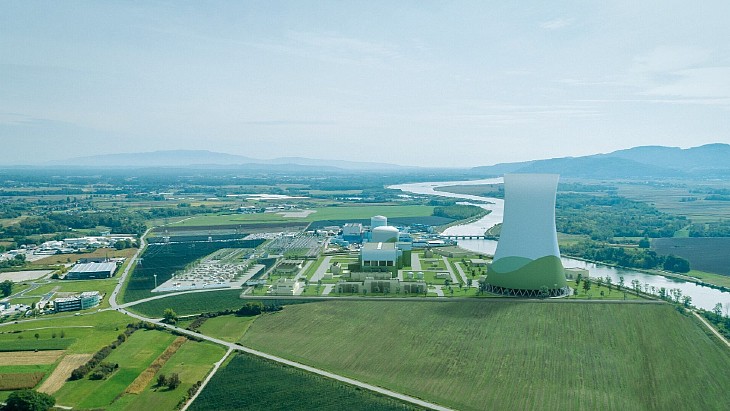
How JEK2 could look, alongside the existing Krško plant (Image: GEN/JEK2)

Those attending the meeting included Slovenia's President Nataša Pirc Musar, the President of the National Assembly Urško Klakočar Zupančič, the President of the National Council Marko Lotrič and the presidents of parliamentary parties in the country.

A referendum has already been pledged on the proposed new nuclear capacity at the Krško plant and Golob said all the parties agreed on holding a vote. "So far, we are leaning towards holding the referendum in the second half of the year, there is no final date yet. We will continue to discuss this issue," he said, adding that the referendum would "decide whether we want nuclear energy to remain part of Slovenia's future" as well as the construction of the second block at Krško.

He said those attending had agreed to work together on the wording of the referendum question. "In my opinion, there is a sincere willingness of all five parliamentary parties to find a question on which we will agree," he said.

Holding the referendum sooner rather than later was important for ensuring the speed of the development, with the aim of a final investment decision in 2027 or 2028 and the new capacity online in the 2030s. Those attending had also agreed to consider ways of expediting the legislative process relating to the new unit, the prime minister's office said.

Slovenia has plans to build a new nuclear power plant - the JEK2 project - with up to 2400 MW capacity next to its existing nuclear power plant, Krško, a 696 MWe pressurised water reactor which generates about one-third of the country's electricity and which is co-owned by neighbouring Croatia.

A working group of Slovenian government ministers and industry officials was established in September with the aim of speeding up the implementation of the project and preparing "all the necessary bases for citizens to make high-quality and informed decisions" about it in a referendum which the government says is needed for the project to happen. Earlier this month the country's main opposition party proposed an early consultative referendum on the project and the prospect of small modular reactors elsewhere in the country.

In October, GEN Energy CEO Dejan Paravan said there were three technology providers being considered for the project - Westinghouse, EDF and Korea Hydro & Nuclear Power - who all had strengths and "the decision will not be easy".

Researched and written by World Nuclear News